What Else Did Heaven Reveal to Marie-Julie Jahenny?
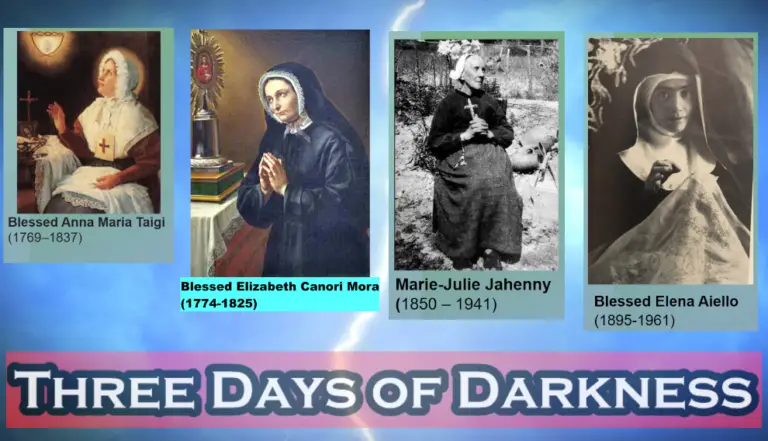
The Three Days of Darkness have made Marie-Julie Jahenny famous, but they fill only a few pages of the nearly six hundred in We Are Warned. The rest of the compilation, edited and translated by E. A. Bucchianeri (2011), records decades of ecstasies at La Fraudais in Brittany, and much of it has nothing to do with darkness at all.
Those pages hold a portrait of a coming king and a holy Pope, a stark warning about the liturgy, visions of St. Michael standing over France, devotions that Our Lord asked to be spread, practical remedies for diseases not yet known, and repeated promises that Brittany would be a place of refuge. Read together, they show a mystic whose mission was not only to warn but to equip the faithful with prayer, devotion and hope.
This article gathers those other revelations, theme by theme, with the page references so that readers can find each passage in the book for themselves.
Who Are the Great Monarch and the Angelic Pontiff?
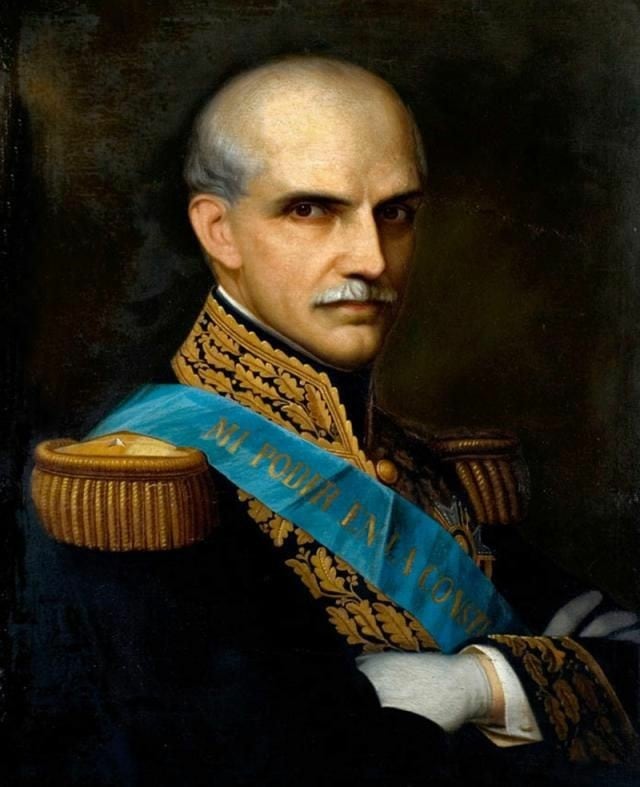
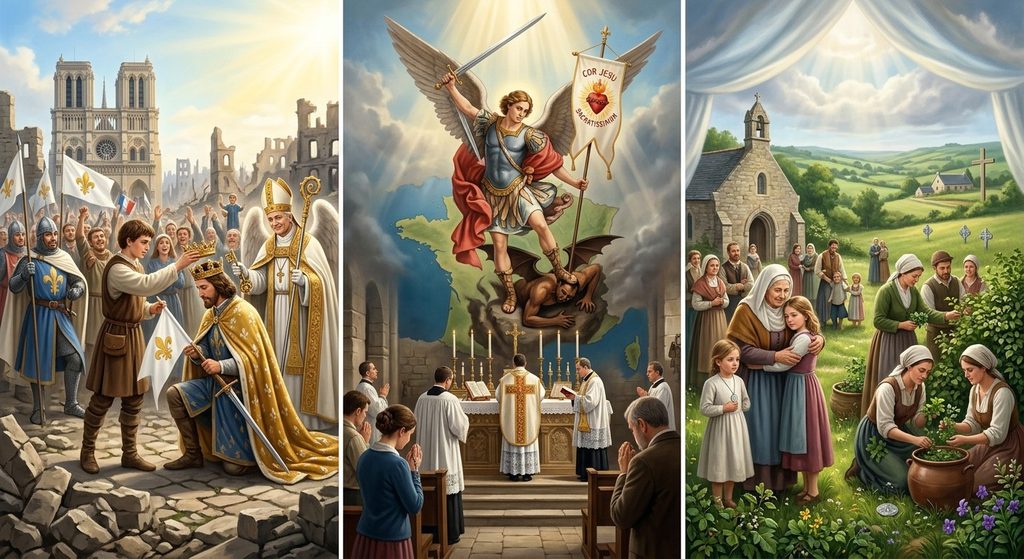
No theme returns more often in Marie-Julie’s ecstasies than the promise of a Catholic king. On 6 December 1877 he was described as “the miracle king,” “the Saviour of France,” one “chosen from his birth to give back to France the Lily and the white flag” (Bucchianeri, 2011, p. 80). In 1881 Our Lord and Our Lady gave him further titles: “the Man of God,” “the Chosen of the Eternal,” and “the Prince and salvation of his people” (Bucchianeri, 2011, p. 279).
The king is opposed from the start. In an ecstasy of 26 December 1877, Lucifer declared, “It is necessary to crush the Lily,” to which Marie-Julie replied that Satan did not love the King, but she did (Bucchianeri, 2011, p. 81). In time he would be named “Henri de La Croix,” Henry of the Cross, and crowned on the ruins of Paris by a young pastor from the diocese of Aix (Bucchianeri, 2011, pp. 309, 318).
Beside the king stands a Pope. As early as 25 August 1874, Marie-Julie was told that “the Holy Father will have false friends in the days of his triumph. This triumph will be held immediately after that of France” (Bucchianeri, 2011, p. 28). The restoration she foresaw was therefore twofold, of throne and of altar, with the triumph of the Church following close upon the triumph of France.
What Did Marie-Julie Foresee About the Mass?
Among the most discussed passages in the book is a warning about the liturgy. In an ecstasy the compilation dates to 27 November 1901 (other sources give 1902), Our Lord spoke of men “under the influence of the enemy of souls” preparing “a Mass that contains words odious in My sight.” These texts, He said, would be given out “as the book of the second celebration” in a time when “they will put to the test the Faith of My eternal priesthood.” He added: “Many of My holy priests will refuse this book sealed with the words of the abyss. Unfortunately, (they) will be the exception, it will be used” (Bucchianeri, 2011, p. 353).
A related passage, placed in the compilation under 21 July 1881, warns that “the holy sacrifices of the altars will have taken an infernal form,” that sanctuaries will be abandoned, and that “there will be a relentless hellish (attack) against the devotion to the Sacred Heart” (Bucchianeri, 2011, pp. 284–285). The editor notes that the source material has run several of these messages together, so their exact dates cannot be fixed (Bucchianeri, 2011, p. 285).
Bucchianeri, drawing on the Marquis de la Franquerie’s The Breton Stigmatist, reads these passages as a prophecy of the vernacular Mass introduced under Pope Paul VI (Bucchianeri, 2011, p. 353). That is an interpretation, and it should be weighed against the Church’s own judgement. Pope Benedict XVI taught that the Missal of Paul VI is the ordinary expression of the Roman Rite’s lex orandi, and the 1962 Missal its extraordinary expression, so that they are “two usages of the one Roman rite” (Benedict XVI, 2007, art. 1). Whatever one concludes, the prophecy’s lasting call is to reverence for the Holy Sacrifice and fidelity to the priesthood.
Why Does St. Michael Stand Over France?
Many of Marie-Julie’s visions are dramas played out between Heaven and France. In one, given on 26 December 1877, France stands before Our Lord stripped of her “white crown.” Christ offers her the Lily, the emblem of the monarchy, saying, “Guilty France, accept this Lily, I give it to you.” France confesses that the one who caused her downfall “made me believe the Lily would be my ruin, he threw me into darkness. Lord, I cannot come out of it without Thee” (Bucchianeri, 2011, p. 81).
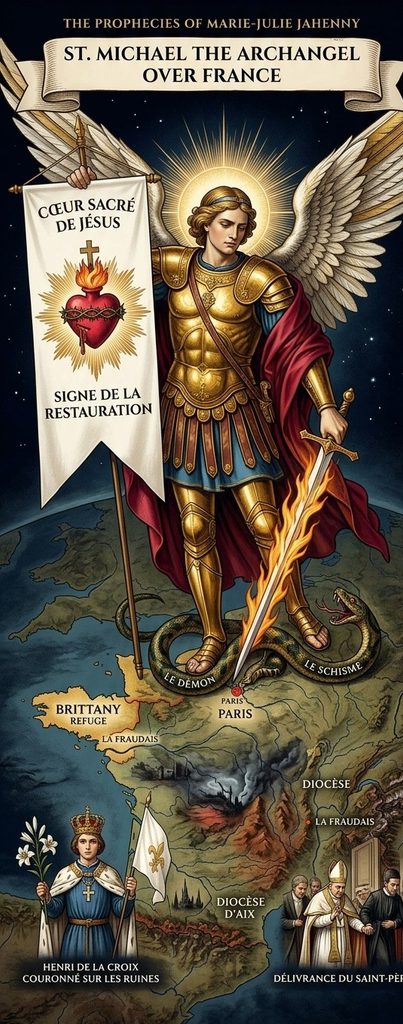
In the same vision, Our Lord commands St. Michael and the good angels “to dig a tomb for France so that she will go under the earth to rise up later, glorious and triumphant,” and St. Michael reproaches the Freemasons for having seduced her (Bucchianeri, 2011, p. 81). On 29 September 1878, the feast of St. Michael, the Archangel showed Marie-Julie the banner of the Sacred Heart and declared, “This is how we march on the borders of France, bearing the banner and the sword. I hold under my feet all the enemies of God” (Bucchianeri, 2011, p. 154).
The message is one of hope through humiliation. France must first go down into the tomb, but she will rise again, and the Archangel who defends her marches under the banner of the Sacred Heart.
Which Devotions Did Heaven Ask to Be Spread?
For every warning in the book there is a devotion, and several were given to Marie-Julie with explicit promises.
The first is devotion to the Wound of Our Lord’s Shoulder, the wound made by the weight of the Cross. Marie-Julie, who bore this stigma herself, taught that “the cross is inseparable from the Christian’s life” and that “we are the children of Calvary” (Bucchianeri, 2011, pp. 439–440). Our Lord attached promises to it: “I will bless all the souls who propagate this devotion: I grant them abundant graces” (29 March 1878), and “I will dispel the darkness that will come to their heart” (28 December 1877) (Bucchianeri, 2011, p. 443).
The second is reparation to the Blessed Sacrament. Our Lord dictated a prayer to be said at the foot of the tabernacle on Thursday mornings at nine o’clock and on Friday afternoons, together with the Litanies of the Passion, whose refrain answers each of Christ’s sufferings with the words “It is Love.” To those who say it, He promised that “at their death, I will almost immediately attract them in the eternal sojourn” (Bucchianeri, 2011, p. 456).
The third is the Cross itself, prayed in times of calamity: “I salute You, I adore You, I embrace You, O Cross of my adorable Saviour! Protect us, guard us, save us!” During great storms, the faithful are to say: “O Crux, ave, Spes unica! Et Verbum caro factum est. O Jesus, vanquisher of death, save us!” (Bucchianeri, 2011, p. 419). Our Lord also promised that “the devotion to the Holy Wounds will be a lightning rod for the Christians who will have kept it” (Bucchianeri, 2011, p. 576).
Finally, on 26 August 1880 Our Lady asked parents to give their children a simple white medal bearing the words “O you, Holy Virgin, who crushed the head of the serpent, guard our Faith and the innocence of our children,” to guard purity “when corruption will spread everywhere.” She wished to be invoked as Our Lady of Bonne Garde, of Good Protection (Bucchianeri, 2011, pp. 575–576).
What Remedies Were Given for Unknown Diseases?
One of the most unusual features of We Are Warned is its practical medicine. On 5 August 1880 Marie-Julie was told of “serious diseases that human art cannot alleviate,” a malady that “will attack the heart first, then the mind, and at the same time, the tongue,” with a fever so strong that the affected parts turn an unbearable red (Bucchianeri, 2011, p. 578).
The remedy given was the common hawthorn of the hedgerows. “You must pick the leaves, not the wood. Even dry, they will retain their effectiveness. Put them in boiling water and leave them there for 14 minutes, covering the container so that the steam remains.” At the first attack, the infusion was to be taken three times a day (Bucchianeri, 2011, p. 579). Other plants were named for other ills: ground ivy (rendered “St. John’s wort” in the translation) for crises, chest pain and violent headaches, and “the humble violet” for unknown fevers, “the perfume and virtue of humility” having its own effect (Bucchianeri, 2011, p. 578).
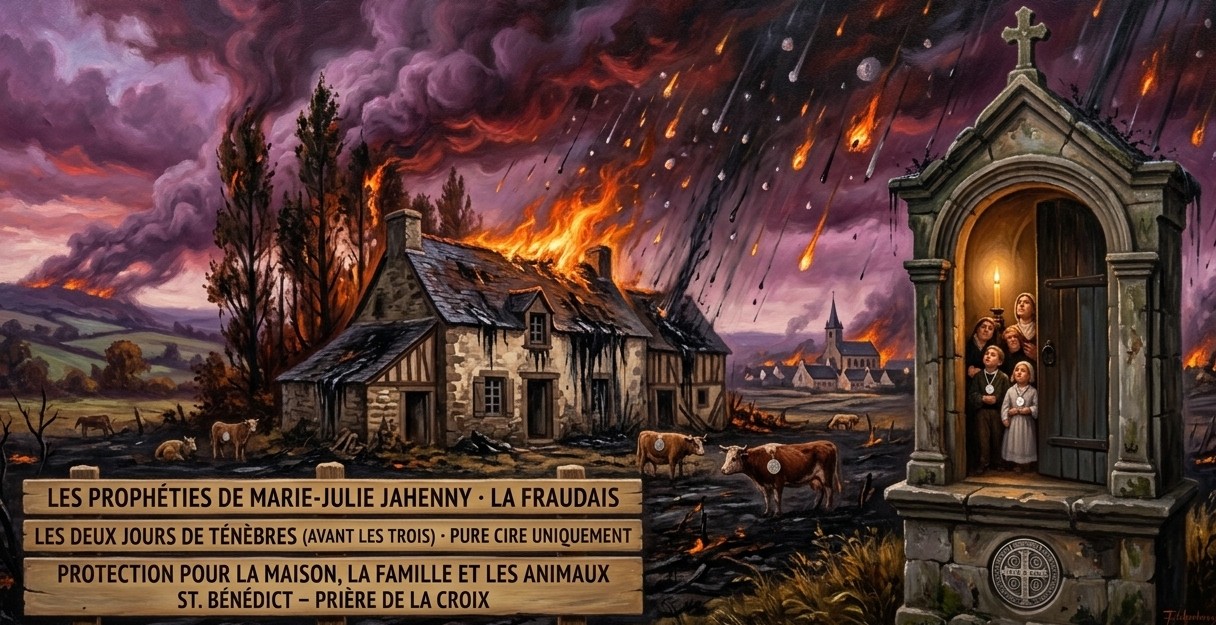
The remedies are never merely natural. For unknown maladies, Our Lord asked that a medal of His Divine Heart and an image of the Cross be placed in a glass of water, so that a single drop of this “twice blessed, twice purified” water in one’s food would turn aside “the blights of My Justice” (Bucchianeri, 2011, p. 576). In time of war, the faithful were to touch their foreheads with the Miraculous Medal so that their minds would “remain calm”; for farms, St. Benedict medals were to be planted in the fields in the form of a cross (Bucchianeri, 2011, pp. 574–575).
The editor rightly advises readers to consult a doctor before taking any herbal preparation (Bucchianeri, 2011, p. 579). The deeper lesson is that Heaven’s care reaches even the body, through the ordinary plants of the countryside and the sacramentals of the Church.
Why Is Brittany Called a Land of Refuge?
Again and again, Marie-Julie’s homeland is singled out for protection. On 29 July 1874 St. Anne, patroness of Brittany, promised: “It is I who will protect you from the dangers in Brittany … No, Brittany will not perish. I always protected it. I will still protect it. But pray and come to my blessed sanctuary!” (Bucchianeri, 2011, p. 28). On 19 March 1878 St. Joseph, who once fled with the Holy Family into Egypt, told the faithful that “Brittany will be (your) Egypt” (Bucchianeri, 2011, p. 90).
Our Lady pleaded for the region too. On 30 November 1880 she held up a crown to Heaven and prayed, “My Son, of all my people who are threatened, keep Brittany protected” (Bucchianeri, 2011, p. 273). In an undated ecstasy she went further: “France, you are divided. If my children ask me where they will have shelter, I would say make your asylum in Brittany.” When Marie-Julie objected that it would not be large enough, Our Lady replied, “I will make a tent and my mantle will be the covering” (Bucchianeri, 2011, p. 435).
The protection is not unconditional. Brittany “will be protected by the Virgin Mary, but depending on the extent of the Faith,” and the north of the region would suffer more than the south (Bucchianeri, 2011, p. 434). Refuge, in these revelations, is less a matter of geography than of fidelity: Our Lady’s mantle covers those who keep the Faith.
How Should Catholics Read These Revelations?
The same cautions apply here as to the Three Days of Darkness. Marie-Julie’s bishop, Monseigneur Fournier of Nantes, judged that “what she manifests is supernatural” (Bucchianeri, 2011, p. 9), but her words remain private revelation. The Church teaches that such revelations “do not belong … to the deposit of faith,” and that their role is “to help live more fully by it in a certain period of history” (Catechism of the Catholic Church, 1997, para. 67).
It also matters who is speaking on any given page. We Are Warned interleaves the texts of the ecstasies with the editor’s notes and with commentary drawn from earlier works, and the dating of some passages is uncertain (Bucchianeri, 2011, p. 285). Readers do well to distinguish what Marie-Julie reported from what others have concluded about it, especially on contested questions such as the liturgy.
Read with that care, the other revelations of We Are Warned share a single direction. They point away from fear and towards the Cross, the Sacred Heart, the Blessed Sacrament and the protection of Our Lady. As Our Lady said to Marie-Julie on 15 April 1900, “It is the Faith, it is confidence, the most beautiful prayer that obtains the most and more” (Bucchianeri, 2011, p. 577).
References
Benedict XVI. (2007). Summorum Pontificum [Apostolic letter motu proprio]. Libreria Editrice Vaticana.
Bucchianeri, E. A. (Ed. & Trans.). (2011). We are warned: The prophecies of Marie-Julie Jahenny. Scribd.
Catechism of the Catholic Church (2nd ed.). (1997). Libreria Editrice Vaticana.