How Do Catholics Put On the Armor of God?
We put on the armor of God by letting Christ himself clothe us. He does this through Baptism and Confirmation, the Eucharist and Confession, the Scriptures, the virtues and constant prayer, and through the blessed sacramentals the Church places in our hands. Each piece St. Paul names then becomes a daily Catholic habit rather than a pious metaphor.
What Is the Short Answer?
St. Paul’s “armor of God” (Ephesians 6:10–20) is not a self-help program but a share in Christ’s own victory. The Church teaches that Satan is real but a mere creature whose power is limited, and that the decisive battle was won on the Cross.
Each piece of armor corresponds to concrete Catholic practice:
- truth (honesty, formation, examination of conscience),
- justice or righteousness (Confession and the virtues),
- the Gospel of peace (Confirmation and witness),
- faith (the Creed, the Rosary, the St. Michael prayer),
- salvation (hope guarded by Baptism and the Eucharist)
- the Word (lectio divina and the liturgy) and
- prayer (the Liturgy of the Hours and the parish community).
Because the enemy is spirit but works through the material world, the Church also arms us with blessed matter.
- The Brown Scapular.
- The Miraculous Medal.
- The Medal of St. Benedict.
All belong naturally in Catholic homes and schools. Modern threats such as digital distraction, relativism, pornography, anxiety, polarization and consumerism are best met with a simple, realistic rule of life, lived in hope and under Mary’s mantle.
What Did St. Paul Actually Write?
Near the end of his Letter to the Ephesians, St. Paul gathers up everything he has taught about grace, the Church and Christian living and turns it into a call to arms. In the Douay-Rheims Bible (DRB), the classic English Catholic translation from the Latin Vulgate in Bishop Richard Challoner’s revision, the passage reads:
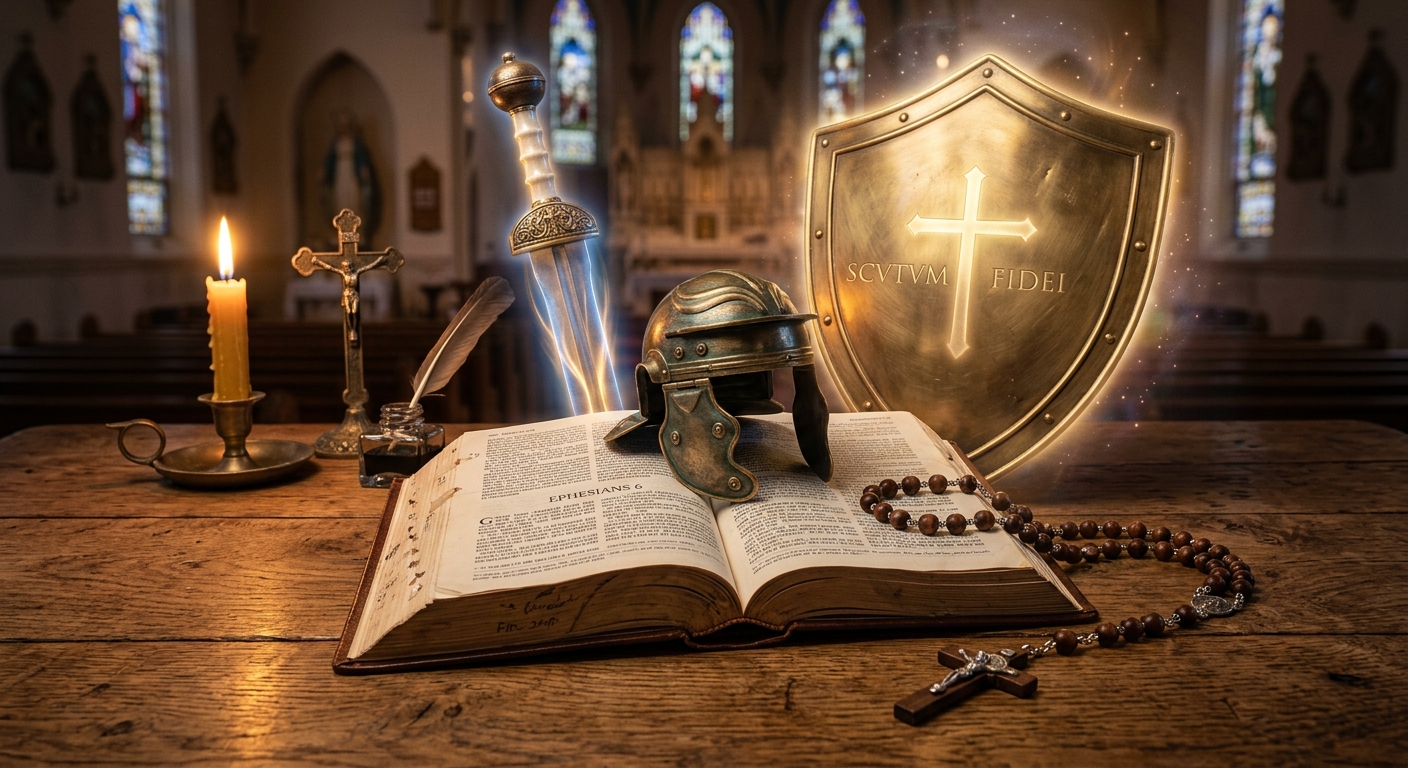
Finally, brethren, be strengthened in the Lord, and in the might of his power. Put you on the armour of God, that you may be able to stand against the deceits of the devil. For our wrestling is not against flesh and blood; but against principalities and powers, against the rulers of the world of this darkness, against the spirits of wickedness in the high places. Therefore take unto you the armour of God, that you may be able to resist in the evil day, and to stand in all things perfect. Stand therefore, having your loins girt about with truth, and having on the breastplate of justice, and your feet shod with the preparation of the gospel of peace: in all things taking the shield of faith, wherewith you may be able to extinguish all the fiery darts of the most wicked one. And take unto you the helmet of salvation, and the sword of the Spirit (which is the word of God). By all prayer and supplication praying at all times in the spirit; and in the same watching with all instance and supplication for all the saints: and for me, that speech may be given me, that I may open my mouth with confidence, to make known the mystery of the gospel, for which I am an ambassador in a chain, so that therein I may be bold to speak according as I ought. (Ephesians 6:10–20, DRB)
The Douay-Rheims keeps the older spelling “armour”, and where many modern translations say “righteousness” it says “justice”; elsewhere this article uses American spelling. This passage is the premise of everything that follows. Notice its first command. Before St Paul says “put you on”, he says “be strengthened in the Lord”. The armor is God’s, not ours. We do not manufacture it; we receive it and wear it.
Why Did St Paul Reach for a Soldier’s Armor?
St Paul calls himself “an ambassador in a chain” (Ephesians 6:20, DRB). Tradition places the letter in his Roman imprisonment of the early 60s, when, according to the Acts of the Apostles, he was allowed to live by himself “with a soldier that kept him” (Acts 28:16, DRB). The Church receives the letter as inspired Scripture in the Pauline tradition, and its imagery fits a man who spent his days within arm’s length of Roman military kit. The girded tunic, the bronze breastplate, the hobnailed sandals that let a legionary hold his footing, the great door-shaped shield that could be soaked to extinguish burning arrows, the helmet and the short sword were the everyday furniture of his confinement.
Yet the deeper source is the Old Testament. St Paul takes images from Isaiah and the Book of Wisdom that describe the battle dress of God himself and turns them into the equipment of every Christian, whose fight is directed not against other people but against the spiritual powers of evil. Isaiah pictures the Messiah with justice as “the girdle of his loins” (Isaiah 11:5, DRB) and shows God himself, who “put on justice as a breastplate, and a helmet of salvation upon his head” (Isaiah 59:17, DRB). Wisdom describes the Lord who “will put on justice as a breastplate, and will take true judgment instead of a helmet” and who “will take equity for an invincible shield” (Wisdom 5:19–20, DRB). And Isaiah sings of “the feet of him that bringeth good tidings, and that preacheth peace” (Isaiah 52:7, DRB). In the Douay-Rheims the same word, justice, runs from Isaiah’s breastplate to Paul’s, so the borrowing is unmistakable.
The point is breathtaking. The armor St Paul offers is the armor God wears. To put it on is, as St Paul says elsewhere, to “put ye on the Lord Jesus Christ” (Romans 13:14, DRB). St. John Chrysostom, preaching on this text, noticed that St Paul uses Isaiah’s very words to show “that these are things which we must have, not for a short time only, but continually, inasmuch as there is continual need of warfare” (John Chrysostom, ca. 400/1889, Homily 24).
Who Is the Enemy, and Is He Real?
St Paul insists that “our wrestling is not against flesh and blood”. The Douay-Rheims keeps his image of a wrestling match: this is close, hand-to-hand combat. It is also the first thing modern Catholics need to hear. The colleague who undermines us, the relative who mocks our faith, the commentator we cannot stand: none of these is the enemy. They are people for whom Christ died. The real adversary is invisible, personal and intelligent.
The Catechism of the Catholic Church is unambiguous. “Behind the disobedient choice of our first parents lurks a seductive voice, opposed to God” (Catholic Church, 2000, para. 391). In the Lord’s Prayer, “evil is not an abstraction, but refers to a person, Satan, the Evil One, the angel who opposes God” (Catholic Church, 2000, para. 2851). He is “a murderer from the beginning, . . . a liar and the father of lies” (Catholic Church, 2000, para. 2852). Through original sin “the devil has acquired a certain domination over man, even though man remains free” (Catholic Church, 2000, para. 407), and so “this dramatic situation of ‘the whole world [which] is in the power of the evil one’ makes man’s life a battle” (Catholic Church, 2000, para. 409).
Pope Francis made the same point with characteristic directness. The Christian battle “is also a constant struggle against the devil, the prince of evil” (Francis, 2018, para. 159), and “we should not think of the devil as a myth, a representation, a symbol, a figure of speech or an idea. This mistake would lead us to let down our guard, to grow careless and to end up more vulnerable” (Francis, 2018, para. 161). Pope Leo XIV, in a 2025 message to the International Association of Exorcists, called the exorcist’s ministry “delicate” yet “most necessary”, so that “the Lord may grant victory over Satan” (Vatican News, 2025).
The tradition also names two allies of the devil that live much closer to home. The first is the world, in the biblical sense of human life organized as if God did not exist. The second is the flesh, which in Catholic teaching means concupiscence, the disordered inclination that remains even after Baptism. The Catechism explains that Baptism erases original sin, “but the consequences for nature, weakened and inclined to evil, persist in man and summon him to spiritual battle” (Catholic Church, 2000, para. 405). Pope Francis wisely warns that the battle cannot be “reduced to the struggle against our human weaknesses and proclivities (be they laziness, lust, envy, jealousy or any others)”, nor merely against “a worldly mentality”, though it includes both (Francis, 2018, para. 159).
None of this should frighten us. Satan’s power “is, nonetheless, not infinite. He is only a creature, powerful from the fact that he is pure spirit, but still a creature. He cannot prevent the building up of God’s reign” (Catholic Church, 2000, para. 395). “Victory over the ‘prince of this world’ was won once for all at the Hour when Jesus freely gave himself up to death to give us his life” (Catholic Church, 2000, para. 2853). We do not fight for victory; we fight from it.
How Do We Fasten the Belt of Truth?
St Paul tells us to stand with our “loins girt about with truth”. The belt came first because everything else hung from it. A soldier with a loose tunic would trip. St John Chrysostom saw the belt as freedom of movement: the soldier “ought to be lightly accoutered, in order that there should be no impediment whatever to his running” (John Chrysostom, ca. 400/1889, Homily 24). In the previous homily he made the application plain: “all our duties let us pursue with truth, let us not lie one to another. . . . If we gird ourselves with truth, then shall no one overcome us” (John Chrysostom, ca. 400/1889, Homily 23).
Our age makes this piece of armor particularly urgent. On the eve of his election as pope, Cardinal Joseph Ratzinger warned that “we are building a dictatorship of relativism that does not recognize anything as definitive and whose ultimate goal consists solely of one’s own ego and desires” (Ratzinger, 2005). In a culture that treats truth as a matter of preference, and where misinformation, outrage and half-truths spread at the speed of a share button, the belt of truth means three things for ordinary Catholics.
It means knowing the faith: reading the Catechism a little at a time, perhaps a paragraph a day, so that we can tell the difference between what the Church teaches and what is merely said about her. It means telling the truth: no padded invoices at work, no flattering lies on a résumé, no anonymous cruelty online, no reposting of claims we have not checked. And it means telling the truth to ourselves, which is the purpose of the daily examination of conscience.
Pope Francis asks “all Christians not to omit, in dialogue with the Lord, a sincere daily ‘examination of conscience'” (Francis, 2018, para. 169). St. Ignatius of Loyola taught that the enemy “behaves as a chief bent on conquering”, who studies a fortress and “attacks it on the weakest side”. So the evil one “looks in turn at all our virtues, theological, cardinal and moral; and where he finds us weakest . . . there he attacks us” (Ignatius of Loyola, 1548/n.d., para. 327). Honest self-knowledge is the belt that keeps us from tripping where we are weakest.
What Is the Breastplate of Justice?
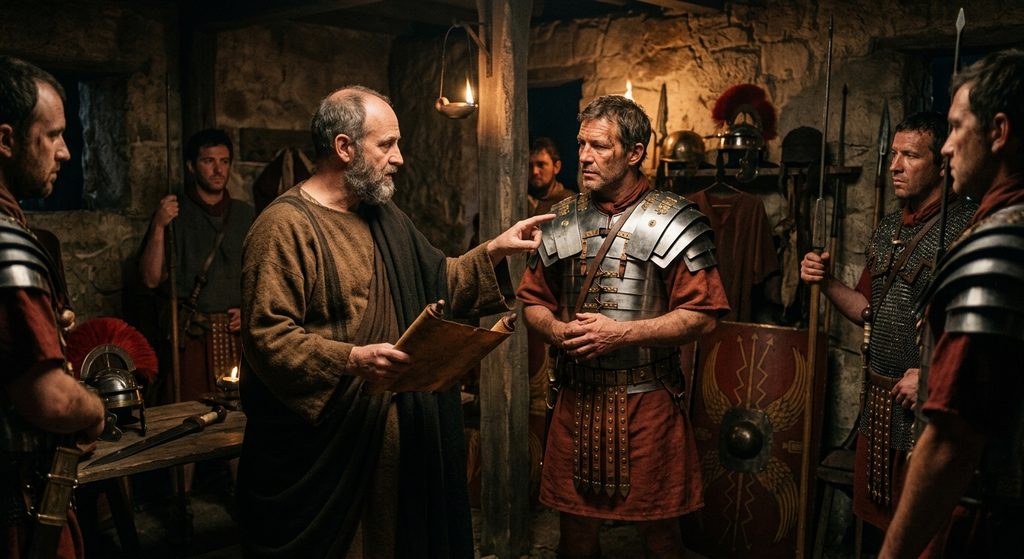
The breastplate guarded the heart and lungs. The Douay-Rheims calls it “the breastplate of justice”, where many modern versions say “righteousness”; both name the same reality of a life set right with God. For Chrysostom, it means “a life of universal virtue. Such a life no one shall ever be able to overthrow; it is true, many wound him, but no one cuts through him, no, not the devil himself” (John Chrysostom, ca. 400/1889, Homily 24).
Catholics should hear this in two registers. First, justice is a gift: we are justified by grace in Baptism, clothed in the white garment of Christ. Second, it is a way of life, built up through the virtues: the theological virtues of faith, hope and charity, and the cardinal virtues of prudence, justice, fortitude and temperance. The Catechism is honest that “there is no holiness without renunciation and spiritual battle. Spiritual progress entails the ascesis and mortification that gradually lead to living in the peace and joy of the Beatitudes” (Catholic Church, 2000, para. 2015).
When the breastplate is dented, the Church gives us the forge of Confession. The Catechism recommends even the regular confession of venial sins because it “helps us form our conscience, fight against evil tendencies, let ourselves be healed by Christ and progress in the life of the Spirit” (Catholic Church, 2000, para. 1458). Here the battle against pornography and addiction belongs. The Catechism calls pornography a grave offense that “does grave injury to the dignity of its participants” (Catholic Church, 2000, para. 2354), and many young Catholics fight it in secret.
St Ignatius observed that the enemy wants his suggestions “received and kept in secret”, and that when we reveal them to a good confessor or spiritual guide he is defeated (Ignatius of Loyola, 1548/n.d., para. 326). Frequent Confession, an accountability partner, filters on devices and a regular confessor are not signs of weakness; they are the breastplate being refitted.
Fasting and almsgiving strengthen this armor too. The Church names “fasting, prayer, and almsgiving” as the classic expressions of interior penance (Catholic Church, 2000, para. 1434). A small Friday sacrifice or a regular gift to the poor trains the will to say “no” to itself and “yes” to others, and that is the very muscle needed when temptation comes. It also frees us from consumerism, the quiet lie that we are what we buy.
What Shoes Does the Gospel of Peace Require?
A Roman soldier’s sandals let him stand firm and march far. St Paul says our feet are “shod with the preparation of the gospel of peace”. St John Chrysostom drew out a striking paradox: “this war which we have against them, puts an end to another war, that, namely, which is between us and God; if we are at war with the devil, we are at peace with God. Fear not therefore, beloved; it is a ‘gospel,’ that is, a word of good news; already is the victory won” (John Chrysostom, ca. 400/1889, Homily 24).
This piece of armor is especially linked to Confirmation. By this sacrament, the Catechism teaches, the baptized “are enriched with a special strength of the Holy Spirit. Hence they are, as true witnesses of Christ, more strictly obliged to spread and defend the faith by word and deed” (Catholic Church, 2000, para. 1285). Confirmation gives “a special strength of the Holy Spirit to . . . confess the name of Christ boldly, and never to be ashamed of the Cross” (Catholic Church, 2000, para. 1303).
In a polarized culture, readiness for the Gospel of peace means refusing to let the enemy turn neighbors into enemies. It means arguing without hatred online, choosing not to post the comment written in anger, and being a peacemaker at the family dinner table where politics or religion flare. Peace is not timidity. Paul asks for prayers that he may open his mouth “with confidence” (Ephesians 6:19, DRB). The Catholic who quietly explains why she goes to Mass, who says grace in a café, or who invites a colleague to a parish event is wearing these shoes.
How Does the Shield of Faith Extinguish the Fiery Darts?
The Roman shield, the scutum, covered almost the whole body, and soldiers locked them together in formation. St Paul says faith is the shield “wherewith you may be able to extinguish all the fiery darts of the most wicked one”. St John Chrysostom interpreted those darts as “both temptations, and vile desires; and ‘fiery,’ he says, for such is the character of these desires. Yet if faith can command the evil spirits, much more can it also the passions of the soul” (John Chrysostom, ca. 400/1889, Homily 24).
Today’s fiery darts include the sudden thought that God has abandoned us, the cynical headline designed to make faith seem ridiculous, the doubt that ambushes us late at night, and the endless stream of content that leaves no space for God at all. The shield of faith is raised by acts of faith: praying the Creed slowly, making a simple act of trust when doubt strikes, and returning to the truths we know when feelings fail.
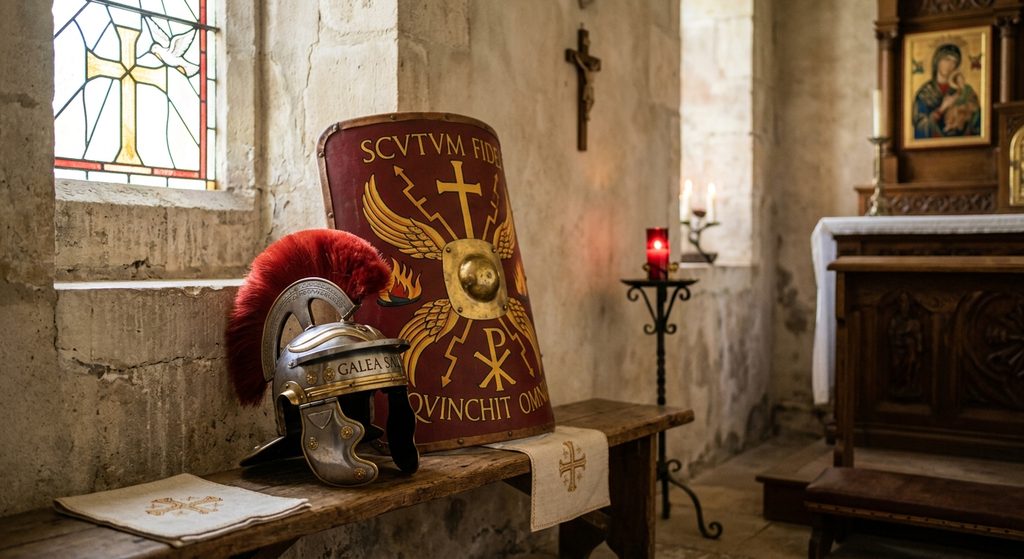
The Church’s devotions are part of this shield. The Rosary has long been prized as a spiritual weapon. Words widely attributed to St. Padre Pio call it “the weapon for these times”, and whatever the precise source, the Church’s experience bears them out: twenty minutes with the mysteries of Christ through Mary’s eyes is a fortress against the noise.
The prayer to St. Michael the Archangel belongs here too. Pope Leo XIII ordered the Leonine Prayers after Low Mass by decree of January 6, 1884, and added the St. Michael prayer to them in 1886. Their obligatory recitation ended with the Instruction Inter oecumenici of September 26, 1964, effective March 7, 1965 (Aleteia, 2018). Pope St. John Paul II urged the faithful in 1994: “Although this prayer is no longer recited at the end of Mass, I ask everyone not to forget it and to recite it to obtain help in the battle against the forces of darkness and against the spirit of this world” (John Paul II, 1994).
Remember, too, that Roman shields worked best together. Faith is never a solo effort. The parish, the Catholic friendship, the family Rosary and the prayer group are the locked shields of the Church Militant.
Why Does a Spiritual Battle Need Material Weapons?
If our wrestling is “not against flesh and blood”, why would a piece of brown wool or a small oval of metal make any difference? The answer lies at the heart of Catholic faith. The enemy is spirit, but he works through the material world: through images on a screen, substances in a bloodstream, money, bodies, homes and schoolyards. God answers him the same way. The Son of God took flesh. Christ heals with mud and spittle, feeds us with bread and wine made his Body and Blood, and washes us with water.
The Church continues this pattern through sacramentals. The Catechism describes them as “sacred signs which bear a resemblance to the sacraments”, which “signify effects, particularly of a spiritual nature, which are obtained through the intercession of the Church” (Catholic Church, 2000, para. 1667). They “do not confer the grace of the Holy Spirit in the way that the sacraments do, but by the Church’s prayer, they prepare us to receive grace and dispose us to cooperate with it” (Catholic Church, 2000, para. 1670). Quoting the Second Vatican Council, the Catechism adds that “there is scarcely any proper use of material things which cannot be thus directed toward the sanctification of men and the praise of God” (Catholic Church, 2000, para. 1670).
The Church also guards against misuse. “To attribute the efficacy of prayers or of sacramental signs to their mere external performance, apart from the interior dispositions that they demand, is to fall into superstition” (Catholic Church, 2000, para. 2111). A scapular or medal is not a lucky charm. It is a uniform, and a uniform means nothing unless the soldier is loyal. Worn with faith, these sacramentals become visible reminders of the invisible armor St Paul describes.
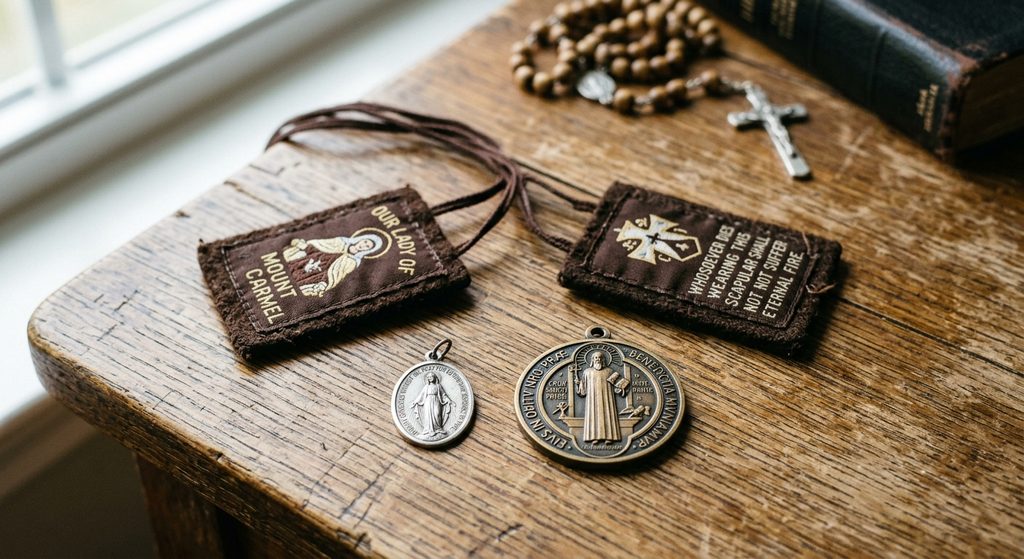
Holy water, a blessed crucifix in every room and the sign of the cross are the most familiar of these. Three others have a special place in Catholic homes and schools: the Brown Scapular of Our Lady of Mount Carmel, the Miraculous Medal and the Medal of St. Benedict.
What Is the Brown Scapular, and Why Wear It?
The Brown Scapular began as part of a religious habit. The Church’s Directory on Popular Piety and the Liturgy explains that it is “a reduced form of the religious habit” of the Carmelite Order. It calls the scapular “an external sign of the filial relationship established between the Blessed Virgin Mary, Mother and Queen of Mount Carmel, and the faithful who entrust themselves totally to her protection” (Congregation for Divine Worship and the Discipline of the Sacraments [CDWDS], 2001, para. 205). Carmelite tradition links it to a vision of Our Lady granted to St. Simon Stock in the thirteenth century, with the promise of her protection for those who wear it faithfully.
The scapular fits St Paul’s image of armor closely, because it is literally a garment. The rite of enrollment describes it as “a reminder that in Baptism we have been clothed in Christ” (CDWDS, 2001, para. 205). It is a small, daily way of renewing what St Paul means when he says, “put ye on the Lord Jesus Christ”. Pope St. John Paul II taught that “the most genuine form of devotion to the Blessed Virgin, expressed by the humble sign of the Scapular, is consecration to her Immaculate Heart” (John Paul II, 2001, para. 4). He added a personal testimony: “I too have worn the Scapular of Carmel over my heart for a long time!” (John Paul II, 2001, para. 6).
There is a further link to Fatima. Sr. Lúcia recorded that during the final apparition on October 13, 1917, the day of the Miracle of the Sun, Our Lady appeared as Our Lady of Mount Carmel (Lúcia, 1976/2007). The scapular works as a breastplate over the heart. It reminds the wearer whose they are, and so whose standards they live by. It is also a quiet act of trust: the wearer has placed themselves under a Mother’s protection in the battle.
What Is the Miraculous Medal?
In 1830, a young Daughter of Charity, St. Catherine Labouré, received apparitions of Our Lady in the chapel of the Rue du Bac in Paris. She was shown a medal to be struck. It depicts Mary standing on a globe and crushing the serpent, with rays of grace streaming from her hands. Around her runs the prayer “O Mary, conceived without sin, pray for us who have recourse to thee.” The first medals were distributed in 1832 during a cholera epidemic. So many graces were reported that ordinary people called it the “Miraculous Medal” before the Church ever did (Dirvin, 1958).
Its image is spiritual warfare in miniature. In the Douay-Rheims, God says to the serpent of the woman, “she shall crush thy head” (Genesis 3:15, DRB), and the medal shows exactly that first promise of redemption fulfilled. It also echoes the woman of Revelation 12, whom the dragon “pursued” but over whom he “had no hold” (Catholic Church, 2000, para. 2853). The medal belongs to the shield of faith: it confesses the Immaculate Conception and the victory of grace over sin. Its prayer is a short arrow of petition that can be prayed anywhere.
Many conversions have been associated with it, most famously that of Alphonse Ratisbonne in Rome in 1842. St. Maximilian Kolbe made the medal a hallmark of his Militia Immaculatae and handed out thousands, convinced that Mary leads souls to her Son.
What Do the Letters on the St. Benedict Medal Mean?
The Medal of St. Benedict is perhaps the most explicitly combative of all Catholic sacramentals. Its roots lie in St. Gregory the Great’s life of Benedict. St Gregory the Great tells how a cup of poisoned wine shattered when St Benedict made the sign of the cross over it, and how St Benedict repeatedly resisted the devil’s assaults (Gregory the Great, ca. 593/1949, bk. 2, chs. 3, 8). The medal’s present form spread from Bavaria in the seventeenth century, and Pope Benedict XIV approved it in 1742 (Guéranger, 1880).
The front shows St. Benedict holding a cross and his Rule. The back carries a cross and a series of Latin initials, which make good catechetical material:
C.S.P.B.: Crux Sancti Patris Benedicti, “The Cross of our Holy Father Benedict.”
C.S.S.M.L. (down the cross): Crux Sacra Sit Mihi Lux, “May the holy cross be my light.”
N.D.S.M.D. (across the cross): Non Draco Sit Mihi Dux, “Let not the dragon be my guide.”
V.R.S.N.S.M.V.: Vade Retro Satana, Nunquam Suade Mihi Vana, “Begone, Satan, never tempt me with vain things.”
S.M.Q.L.I.V.B.: Sunt Mala Quae Libas, Ipse Venena Bibas, “What you offer me is evil; drink the poison yourself.”
PAX: “Peace.”
The whole drama of Ephesians 6 is here. The cross is the sword, and Christ’s light is the belt of truth. The temptation to “vain things” is named and refused, and the final word is the Gospel of peace. The medal is a renunciation of Satan that you can hold in your hand, echoing the baptismal promises every Catholic family renews at Easter.
How Can Families Wear This Armor at Home?
The domestic church is the first battlefield, and it is where these sacramentals belong most naturally. A family might be enrolled in the Brown Scapular together by a priest, after the preparation the Church asks for (CDWDS, 2001, para. 205). Each member can then kiss the scapular on waking as a silent morning offering.
A Miraculous Medal can sit on each child’s school bag, rosary or bedroom wall, with the family learning its prayer as an aspiration for moments of fear or temptation. Medals and cords should never be placed on babies or very young children, for safety reasons. A blessed St. Benedict Medal can hang above the front door, sit in the car and be placed in a new home when the family moves in, alongside an invitation to the parish priest to bless the house.
These sacramentals also give parents a natural way to teach. Explaining the letters on the St. Benedict Medal opens a conversation about temptation, online pressure and the habit of saying “Begone” to what is false. Telling the story of St. Catherine Labouré teaches children that God still acts in history. Explaining the scapular teaches them that they belong to a Mother who will not abandon them.
Parents who worry about a child or relative who has drifted from the faith can pray daily through the Miraculous Medal. They might offer one with love and honesty, never forcing it, and respecting that person’s freedom. Families should have their sacramentals blessed by a priest. Many priests, especially Benedictines, still use the traditional blessing for the St. Benedict Medal, which contains a prayer of exorcism, and a priest who is asked is almost always glad to help.
How Can Catholic Schools Make These Part of School Life?
A Catholic school is a sacred space as well as an educational one. Its classrooms, playgrounds and online platforms are among the places where the spiritual battle is fought for young hearts. The three sacramentals can be woven into school life naturally, with due respect for the many students and families in our schools who are not Catholic. Each should be offered and explained, never imposed.
Enrollment in the Brown Scapular. Schools can work with the parish to offer enrollment to students in sacramental preparation years, for example after First Holy Communion or before Confirmation. Families should be invited and prepared beforehand, since the Church asks that the rite “should not be improvised” (CDWDS, 2001, para. 205). The feast of Our Lady of Mount Carmel on July 16 often falls during a school vacation, so schools can mark it in the first week back.
Celebrating the Miraculous Medal. Its feast on November 27 falls near the beginning of Advent. That makes it a fitting time for a Marian assembly, the story of St. Catherine Labouré, and the blessing and distribution of medals, especially to graduating students as a sign that Mary goes with them into the next stage of life.
Blessing the school with the St. Benedict Medal. At the start of each school year, the principal and chaplain can bless classrooms, staff rooms and grounds, placing a blessed medal near each doorway or in each classroom’s prayer corner alongside the crucifix. The medal’s Latin acrostic makes an excellent religious education lesson for upper elementary and high school students. It links Church history, Latin, Scripture and the moral life, and gives young people a vocabulary for rejecting temptation, including temptation that comes through their phones. St. Benedict’s feast on July 11 can be marked together with Mount Carmel.
Staff and parent formation. Teachers can only pass on what they understand. A short staff formation session, and a parent information night or newsletter article, should explain the Catechism’s teaching on sacramentals. Their power comes from Christ and the Church’s prayer, not from the object, and they never substitute for the sacraments, prayer or moral effort (Catholic Church, 2000, paras. 1670, 2111). Sacramentals also complement, and never replace, the school’s pastoral care and well-being services. A student wearing a Miraculous Medal still needs a counselor when they are struggling, and the medal can be a sign that God walks with them through that help.
In all this, the school simply shows what St Paul taught. The battle is spiritual, but it is fought in real places, with real bodies and real things. The Church has always armed her children with blessed water, blessed oil, blessed wool and blessed medals, because grace does not despise matter. Grace redeems it.
Why Must We Guard Our Minds With the Helmet of Salvation?
The helmet protects the head, and in another letter St Paul bids us take “for a helmet the hope of salvation” (1 Thessalonians 5:8, DRB). This is the armor for our anxious age. Many people today, young people especially, live with a low hum of dread, comparison and despair, much of it amplified by screens that never sleep. Gallup reported in December 2025 that “twenty-nine percent of U.S. adults describe their mental health as excellent, down 14 points from 2019”. Over the past six years only 23% of Gen Z and 28% of millennial adults rated their mental health as excellent, against at least 34% of older generations (Jones, 2025).
The helmet of salvation is the settled knowledge that we belong to Christ. Baptism marks us with an indelible seal, and the Eucharist is the pledge of glory to come. The Catechism teaches that “by the same charity that it enkindles in us, the Eucharist preserves us from future mortal sins” (Catholic Church, 2000, para. 1395). Regular Mass, Sunday at least and weekday when possible, and time before the Blessed Sacrament in adoration reset the mind on what is eternal.
Guarding the mind also requires practical custody of the eyes and ears. St. Francis de Sales described Lorenzo Scupoli’s classic The Spiritual Combat in one letter as a book “which I’ve carried around in my pocket for the last eighteen years”. His letter of January 24, 1608, to Jane de Chantal says fifteen, a “discrepancy of dates” noted by Eunan McDonnell (n.d.). Scupoli names four weapons: “distrust of one’s self, confidence in God, proper use of the faculties of body and mind, and the duty of prayer” (Scupoli, 1589/1945, ch. 1).
Proper use of our faculties today surely means deciding what enters our minds: turning off notifications, keeping phones out of bedrooms, choosing a “digital Sabbath” on Sundays, and filling the imagination with what is true and beautiful. St. Francis de Sales offers great consolation to anxious souls. Temptation itself is not sin, for “in temptation we do not act, we only suffer, and inasmuch as we take no delight in it, we can be liable to no blame” (Francis de Sales, 1609/n.d., pt. 4, ch. 3). The helmet of hope keeps the scrupulous and the fearful from surrendering ground the enemy has not won.
How Do We Wield the Sword of the Spirit?
The sword is the only offensive weapon in Paul’s list, and it is “the word of God”. Christ himself used it in the desert, answering each temptation with Scripture: “Not in bread alone doth man live, but in every word that proceedeth from the mouth of God” (Matthew 4:4, DRB). St John Chrysostom said that by this sword “all things are severed, by this all things are cleft asunder, by this we cut off even the serpent’s head” (John Chrysostom, ca. 400/1889, Homily 24).
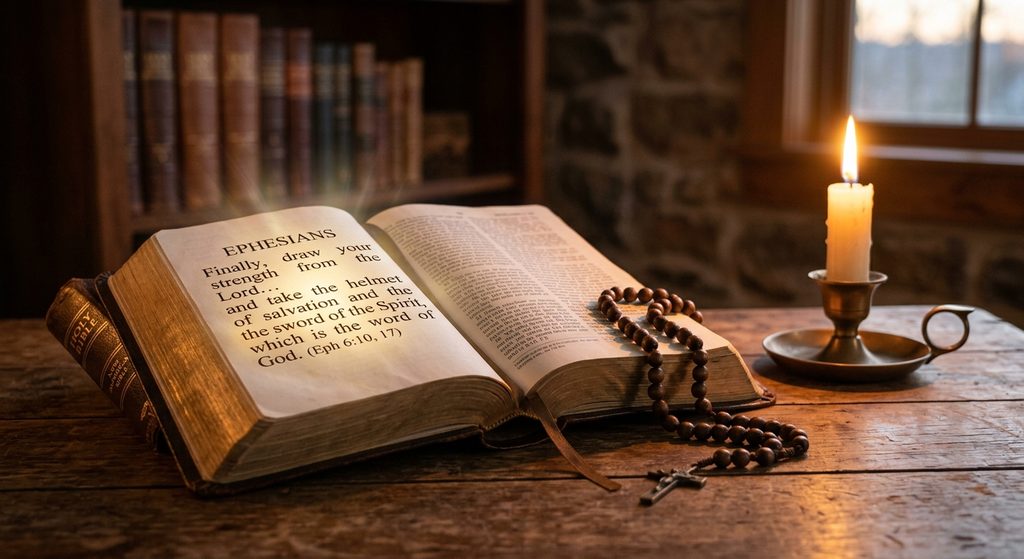
The Second Vatican Council urged all the faithful to frequent reading of the Scriptures, quoting St. Jerome: “ignorance of the Scriptures is ignorance of Christ” (Second Vatican Council, 1965, para. 25). The same passage reminds us that “prayer should accompany the reading of Sacred Scripture, so that God and man may talk together; for ‘we speak to Him when we pray; we hear Him when we read the divine saying'”, words of St. Ambrose (Second Vatican Council, 1965, para. 25).
The practical form of this is lectio divina: read a short passage, perhaps the day’s Gospel; reflect on a word or phrase; respond in prayer; and rest in God’s presence. Memorizing a few verses gives us a sword ready to hand: “The Lord ruleth me: and I shall want nothing” (Psalm 22:1, DRB; Psalm 23 in Hebrew numbering) for fear, “Blessed are the clean of heart” (Matthew 5:8, DRB) for temptation, “Come to me, all you that labour, and are burdened” (Matthew 11:28, DRB) for exhaustion. Families can read the Sunday Gospel together at dinner. Young people can use a reputable Catholic app for the daily readings instead of reaching first for social media in the morning.
Why Does St Paul End With Prayer?
Prayer is not a seventh piece of armor so much as the breath that keeps the soldier alive inside it. St John Chrysostom put it memorably: St Paul “has armed them with all security. What then is necessary after that? To call upon the King, that He may stretch forth His hand” (John Chrysostom, ca. 400/1889, Homily 24). The Catechism agrees that “the ‘spiritual battle’ of the Christian’s new life is inseparable from the battle of prayer” (Catholic Church, 2000, para. 2725).
Prayer at all times need not be complicated. St. Thérèse of Lisieux, a Doctor of the Church, described it this way: “For me, prayer is a surge of the heart; it is a simple look turned toward heaven, it is a cry of recognition and of love, embracing both trial and joy” (Catholic Church, 2000, para. 2558). The Church’s own rhythm of prayer, the Liturgy of the Hours, sanctifies morning and evening for laypeople as much as for clergy. Its Night Prayer on Tuesdays even uses St. Peter’s warning that “your adversary the devil, as a roaring lion, goeth about seeking whom he may devour” (1 Peter 5:8, DRB).
Notice, too, that St Paul asks the Ephesians to pray “for all the saints: and for me”. Intercession for others, for our priests, for the persecuted and for the whole Church is itself part of the battle. St. Augustine reminded his flock that Christ was tempted so that we might share his triumph: if in him we are tempted, in him we also overcome the devil (Augustine, ca. 415/n.d., Psalm 61).
What Might a Daily Rule of Life Look Like?
A rule of life is simply a realistic plan that turns good intentions into habits. Here is one that a busy parent, student or worker can actually keep, offered as a starting point rather than a burden.
On waking, before reaching for the phone, make the sign of the cross, kiss your scapular and make a brief morning offering, giving the day to God through the Immaculate Heart of Mary. Then “put on” the armor deliberately, perhaps praying through Ephesians 6:14–17 in your own words. Ask for truth in your speech, purity of heart, peace in your relationships, unshakable faith, hope in your thoughts and a love for God’s word. Finish with the St. Michael prayer. It takes less than five minutes.
During the day, read the Gospel of the day, even on the train or in a lunch break, and carry one phrase with you. Pray at least a decade of the Rosary, perhaps in the car or on a walk. Make one small sacrifice, whether skipping a snack, holding back a sharp remark or giving to someone in need. When temptation strikes, respond quickly with a short prayer, the name of Jesus, the sign of the cross, or the Miraculous Medal’s own prayer: “O Mary, conceived without sin, pray for us who have recourse to thee.” At work, let honesty, diligence and fairness be your quiet witness.
In the evening, keep phones out of the bedroom. Pray Night Prayer from the Liturgy of the Hours or a simple family prayer. Make a brief examination of conscience in the spirit Pope Francis recommends: give thanks, ask for light, review the day honestly, ask for forgiveness and resolve to begin again tomorrow. End with a Hail Mary and entrust yourself to your guardian angel.
Through the week and month, attend Sunday Mass without fail and add a weekday Mass or a visit to the Blessed Sacrament when you can. Go to Confession regularly, ideally monthly and with the same priest. Keep Friday as a day of penance. Find one companion in the faith, whether a friend, spouse, small group or spiritual director, with whom you can be honest. No soldier fights alone.
Why Can We Fight Without Fear?
The final word of Ephesians 6 is not anxiety but courage. St Paul, chained to a soldier, asks only that he “may be bold to speak according as I ought” (Ephesians 6:20, DRB). Pope Francis reminds us that this battle “is sweet, for it allows us to rejoice each time the Lord triumphs in our lives” (Francis, 2018, para. 158).
The Church places at the center of this struggle not a weapon but a woman. The Catechism, reflecting on the dragon of Revelation 12, says that Satan “pursued the woman” but “had no hold on her: the new Eve, ‘full of grace’ of the Holy Spirit, is preserved from sin and the corruption of death” (Catholic Church, 2000, para. 2853). From the first promise in Eden that the woman “shall crush thy head” (Genesis 3:15, DRB) to Mary standing firm at the foot of the Cross, she is the model of the Christian who stands “in all things perfect” (Ephesians 6:13, DRB). It is no accident that she clothes her children in her scapular and stamps her medal with the serpent beneath her feet.
Mary shows us the secret of the armor: it is worn best by the humble, who know their weakness and trust completely in God. Her “be it done to me according to thy word” (Luke 1:38, DRB) is the belt of truth, the breastplate of justice, the shoes of the Gospel, the shield of faith, the helmet of hope and the sword of the Word, all at once. So we pray, with the whole Church, to be delivered “from all evils, present, past, and future, of which he is the author or instigator” (Catholic Church, 2000, para. 2854), knowing that the outcome is already settled.
Be strengthened in the Lord. Put on the armor. Stand firm. The victory is his, and he means to share it with you.
Which Sources Are Cited?
Aleteia. (2018). [Article on the history of the Prayer to St. Michael and the Leonine Prayers]. Aleteia.
Augustine of Hippo. (n.d.). Expositions on the Psalms (Psalm 61) [Enarrationes in Psalmos]. (Original work written ca. 415). Excerpt in The Liturgy of the Hours, Office of Readings, First Sunday of Lent.
Catholic Church. (2000). Catechism of the Catholic Church (2nd ed.). Libreria Editrice Vaticana. https://www.vatican.va/archive/ENG0015/_INDEX.HTM. Also available via Magisterium AI: https://www.magisterium.com/docs/0583c069-d4bf-42dd-97de-c19f0b80150f/ref
Congregation for Divine Worship and the Discipline of the Sacraments. (2001). Directory on popular piety and the liturgy: Principles and guidelines. Libreria Editrice Vaticana. https://www.magisterium.com/docs/4fba701f-fda0-47a5-a2de-2e210d81f770/ref/205
Dirvin, J. I. (1958). Saint Catherine Labouré of the Miraculous Medal. Farrar, Straus and Cudahy.
Douay-Rheims Bible. (1899). The Holy Bible, translated from the Latin Vulgate (R. Challoner, Rev.). John Murphy Company. (Original work published 1582–1610). https://www.drbo.org/
Francis. (2018). Gaudete et exsultate [Apostolic exhortation on the call to holiness in today’s world]. Libreria Editrice Vaticana. https://www.vatican.va/content/francesco/en/apost_exhortations/documents/papa-francesco_esortazione-ap_20180319_gaudete-et-exsultate.html
Francis de Sales. (n.d.). Introduction to the devout life. (Original work published 1609). https://www.catholicity.com/devoutlife/4-03.html
Gregory the Great. (1949). Life and miracles of St. Benedict: Book two of the Dialogues (O. J. Zimmerman & B. R. Avery, Trans.). Liturgical Press. (Original work written ca. 593)
Guéranger, P. (1880). The medal or cross of St. Benedict: Its origin, meaning, and privileges. Burns and Oates.
Ignatius of Loyola. (n.d.). The spiritual exercises (Rules for the discernment of spirits, paras. 313–327). (Original work published 1548). https://scepterpublishers.org/blogs/scepter-blog-corner/14-rules-for-the-discernment-of-spirits-by-st-ignatius-of-loyola
John Chrysostom. (1889). Homilies on Ephesians (G. Alexander, Trans.). In P. Schaff (Ed.), Nicene and Post-Nicene Fathers, First Series (Vol. 13). Christian Literature Publishing. (Original work written ca. 400). Homily 23: https://www.newadvent.org/fathers/230123.htm; Homily 24: https://www.newadvent.org/fathers/230124.htm
John Paul II. (1994, April 24). Regina Caeli [Address]. Libreria Editrice Vaticana. Quoted in Vatican News, St. Michael, Archangel. https://www.vaticannews.va/en/saints/09/29/st–michael–archangel.html
John Paul II. (2001, March 25). Message to the Carmelite Order. Libreria Editrice Vaticana. https://www.magisterium.com/docs/95ba7963-a27e-40ff-9af4-1633bcd52718/ref/4
Jones, J. M. (2025, December 18). U.S. mental health ratings continue to worsen. Gallup.
Lúcia, Sr. (2007). Fatima in Lucia’s own words (L. Kondor, Ed.; Dominican Nuns of Perpetual Rosary, Trans.; 16th ed.). Secretariado dos Pastorinhos. (Original work published 1976)
McDonnell, E. (n.d.). [Essay on St. Francis de Sales and The Spiritual Combat]. In Studies in Salesian spirituality. DeSales University.
Ratzinger, J. (2005, April 18). Homily at the Mass “Pro eligendo Romano Pontifice”. Libreria Editrice Vaticana. https://www.vatican.va/gpII/documents/homily-pro-eligendo-pontifice_20050418_en.html
Scupoli, L. (1945). The spiritual combat (W. Lester & R. P. Mohan, Trans.). Newman Press. (Original work published 1589). http://www.quies.org/Spiritual-Combat_Scupoli.pdf
Second Vatican Council. (1965). Dei verbum [Dogmatic constitution on divine revelation]. Libreria Editrice Vaticana. https://www.vatican.va/archive/hist_councils/ii_vatican_council/documents/vat-ii_const_19651118_dei-verbum_en.html
Vatican News. (2025, September 23). Pope Leo XIV to exorcists: Your ministry is necessary and delicate. https://www.vaticannews.va/en/pope/news/2025-09/pope-leo-xiv-exorcists-message-rome-meeting.html