The Types of Scapulars: Their Origins, History, and Spiritual Purpose
“For as many of you as have been baptized into Christ have put on Christ.” — Galatians 3:27
What Is a Scapular?
A scapular begins as a piece of practical monastic clothing before it becomes a sign of consecration. The word itself derives from the Latin scapula, meaning shoulder, and the earliest scapulars were simply the long apron-like panels that fell over the front and back of a monk’s habit, worn while he labored. Over the centuries, religious orders came to see this humble garment as something more: a visible expression of the wearer’s total belonging to a particular order and its patroness, the Blessed Virgin Mary.
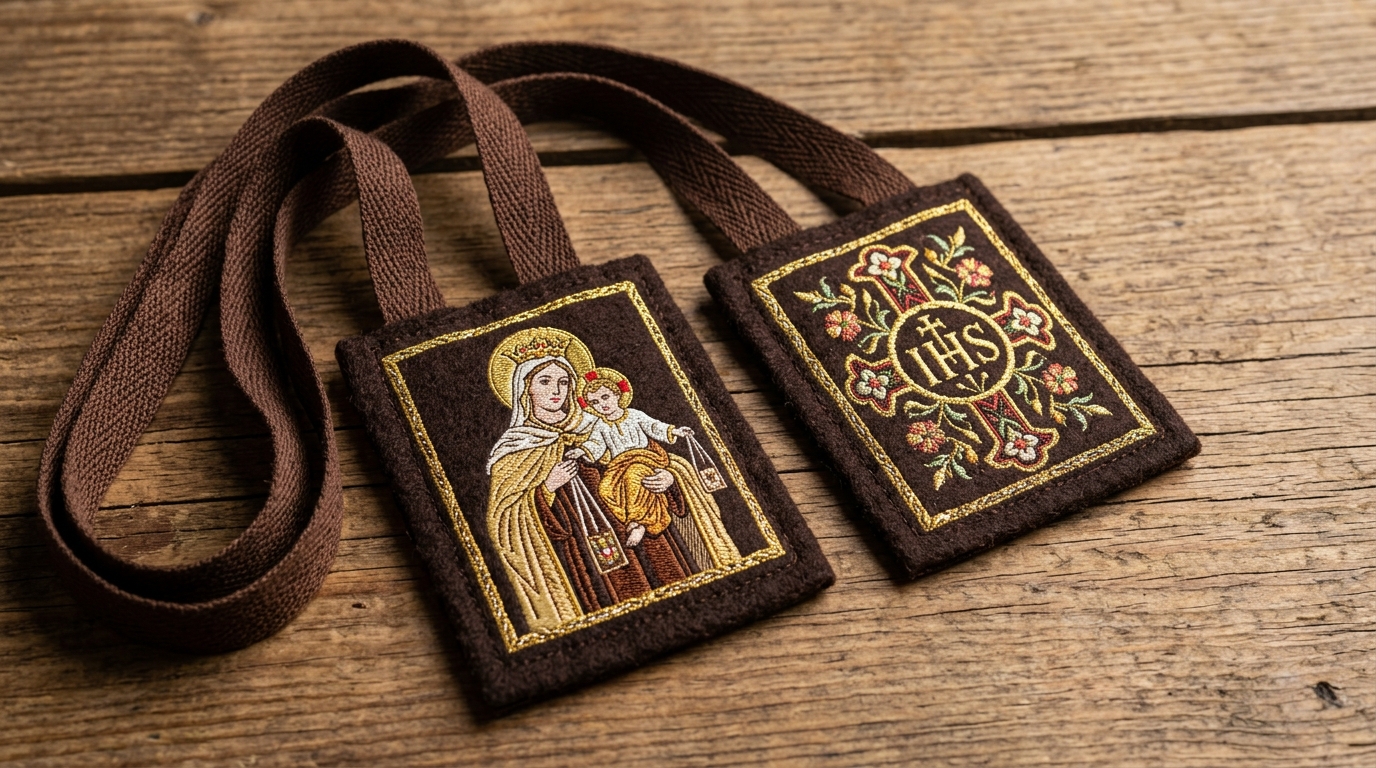
The devotional scapular that most Catholics know today is a much smaller descendant of that monastic garment: two small squares of cloth joined by cords or ribbons, worn over the shoulders so that one square rests on the chest and the other on the back. It is classified by the Church as a sacramental — not a sacrament, but a sacred sign instituted by the Church that disposes the soul to receive grace and prepares it to cooperate more fruitfully with God’s work (Catechism of the Catholic Church [CCC], 1994, § 1670).
Roughly eighteen scapulars have received some form of Church approval across the centuries, each tied to a particular religious family, a particular apparition, or a particular mystery of the Faith. The six pictured in the accompanying infographic — brown, blue, black, red, white, and green — are among the best known and most widely worn.
How Did the Scapular Tradition Begin?
The monastic scapular is traceable to the early medieval period, and by tradition it was already part of the Benedictine habit by the seventh century, worn as a kind of working apron that gradually took on symbolic weight as the “yoke of Christ.” To lay aside the scapular was, for a monk, tantamount to laying aside obedience itself; some Carmelite constitutions of the later Middle Ages even prescribed penalties for a friar who said Mass without it.
As the mendicant orders — the Carmelites, the Servites, the Trinitarians, and others — grew in the thirteenth century, laypeople who wished to share in their spiritual life without leaving the world began asking to be admitted to a kind of spiritual affiliation with these communities. The orders responded by clothing these lay associates, or tertiaries, in a small version of their own habit: the devotional scapular. Wearing it signified that the lay faithful shared, in a real if limited way, in the prayers, penances, and merits of the whole religious family to which the scapular belonged.
Each of the major colored scapulars therefore has its own distinct birth story, usually traced to a vision granted to a founder or a member of a religious community. What follows is the history behind each of the six scapulars most commonly encountered today.
What Is the Brown Scapular of Our Lady of Mount Carmel?
The Brown Scapular is, by a wide margin, the most recognized scapular in the Catholic world, and it belongs to the Carmelite family. The Carmelites trace their own roots to a community of hermits who settled near the Fountain of Elijah on Mount Carmel in the Holy Land in the twelfth century; by the following century, driven from the East, they had reestablished themselves in Europe as mendicant friars devoted to the Mother of God.
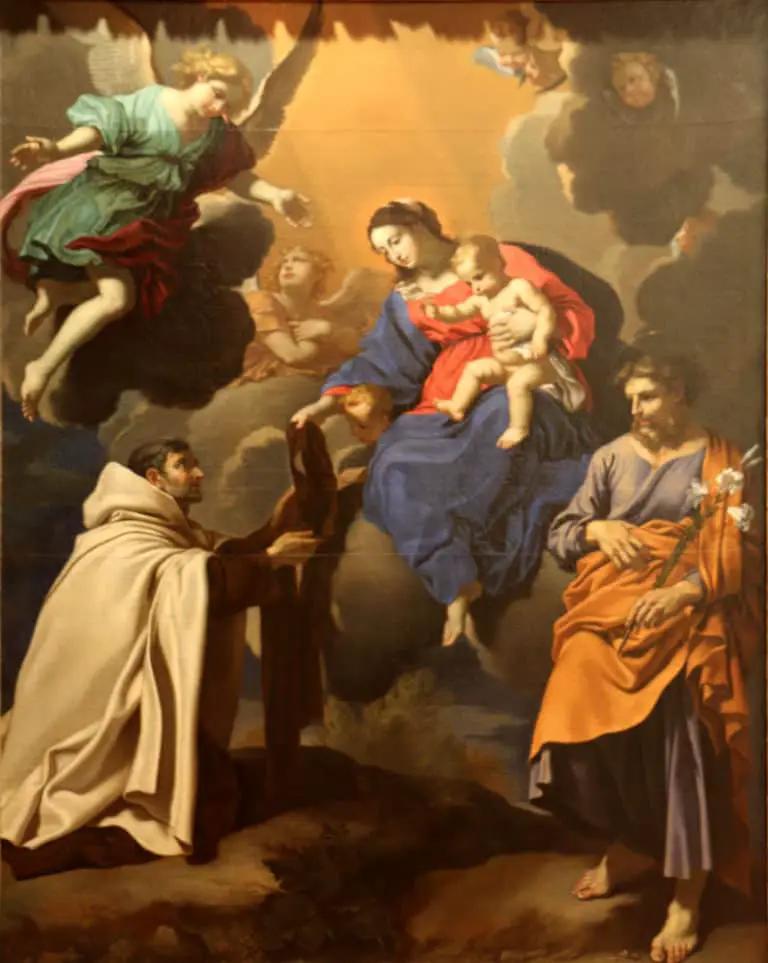
According to a tradition first recorded more than a century after the fact, the Carmelite prior general St. Simon Stock was praying in England on July 16, 1251, at a time when the fledgling order faced suppression and hostility. Our Lady appeared to him holding the Christ Child in one arm and a brown scapular in the other, and gave him the garment with words traditionally rendered, “Receive, my beloved son, this habit of thy order: this shall be to thee and to all Carmelites a privilege, that whosoever dies clothed in this shall never suffer eternal fire.” This promise became known as the Sabbatine Privilege.
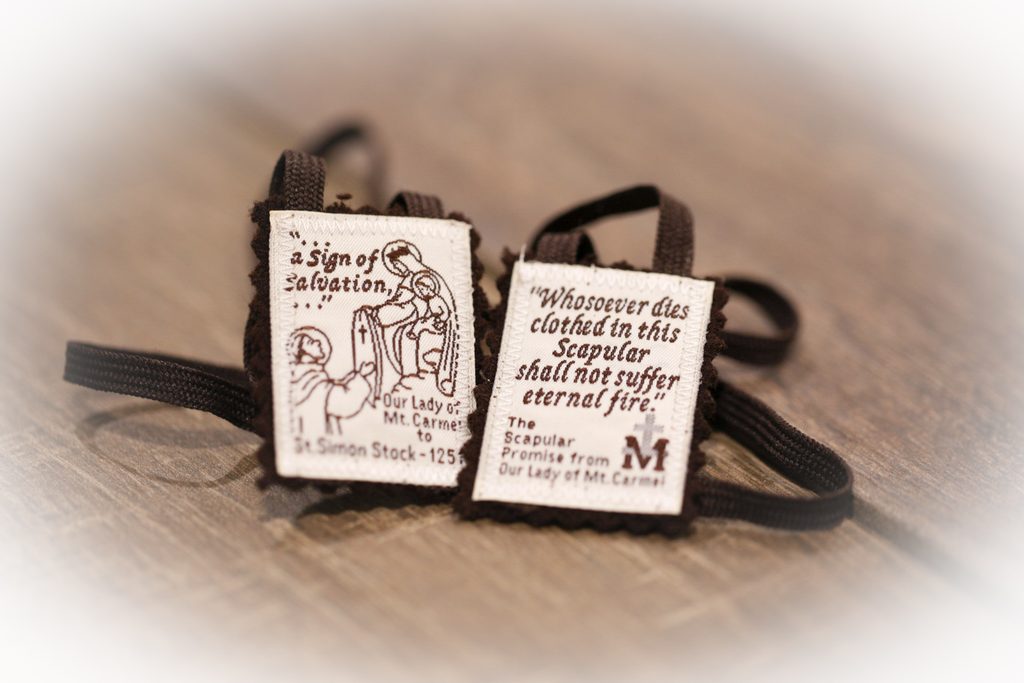
Confraternities of the Brown Scapular spread across Europe in the following centuries, receiving successive papal indulgences, and the Church still keeps the Feast of Our Lady of Mount Carmel every July 16 in commemoration of Mary’s gift to St. Simon Stock. To be properly enrolled, the wearer must be invested by a priest — or a layperson delegated with this faculty — in a brief, one-time ceremony that places the person under Our Lady’s protection and unites them spiritually to the Carmelite family. Since the mid-twentieth century, the Church has not required that this enrollment be entered into a formal parish register, though many parishes still hold public investiture ceremonies on the July feast.
Those enrolled commit themselves to wearing the scapular continuously, to a daily habit of Marian prayer such as the Rosary, and to living in a manner befitting members of Our Lady’s own household — obligations understood as fitting rather than strictly binding under sin.
What Is the Blue Scapular of the Immaculate Conception?
The Blue Scapular honors the Immaculate Conception of the Blessed Virgin and carries two distinct historical threads. In Spain, the Cistercian nun St. Beatriz da Silva founded the Order of the Immaculate Conception (the Conceptionists) in 1484, whose sisters wore a blue-accented habit in Mary’s honor. A century later in Naples, the mystic Venerable Ursula Benincasa received a vision of Our Lady clothed in white with a blue mantle after receiving Holy Communion on the Feast of the Presentation in 1617, and went on to found the Theatine contemplative nuns known for propagating the blue scapular among the laity.
Pope Clement X formally approved the blessing and investing of the Blue Scapular in January 1671, and Clement XI enriched it with further indulgences in 1710. The Theatine Fathers later granted the Congregation of Marian Fathers of the Immaculate Conception — whose Fr. Joseph Wyszyński first sought permission to invest the faithful with the Blue Scapular in 1733 — the enduring privilege of propagating this devotion, a work the Marian Fathers continue today.
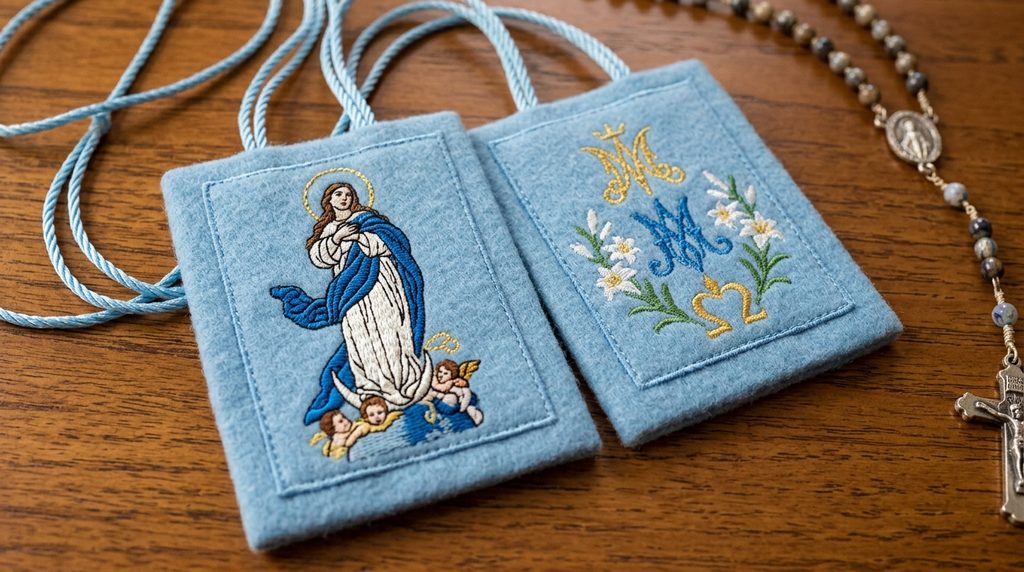
Admission to the associated confraternity is granted through a priest’s blessing and investiture, together with enrollment in the confraternity register and the presentation of a small chaplet of the Immaculate Conception. The scapular itself must be made of blue wool, bearing an image of the Immaculate Conception on one panel and the Virgin’s name on the other, and it is meant to be worn constantly by those who wish to retain its indulgences.
What Is the Black Scapular of the Seven Sorrows of Mary?
This scapular belongs to the Servite family — formally the Order of Servants of Mary — founded in the thirteenth century by seven Florentine laymen who abandoned worldly life after a series of Marian visions and dedicated themselves to meditating on Our Lady’s sorrows. Pope Alexander IV gave the young order formal approval in 1255, and lay men and women soon banded together in a confraternity of the Seven Sorrows, adopting a black scapular, the color of the Servite habit itself, usually stamped with an image of the Mother of Sorrows.
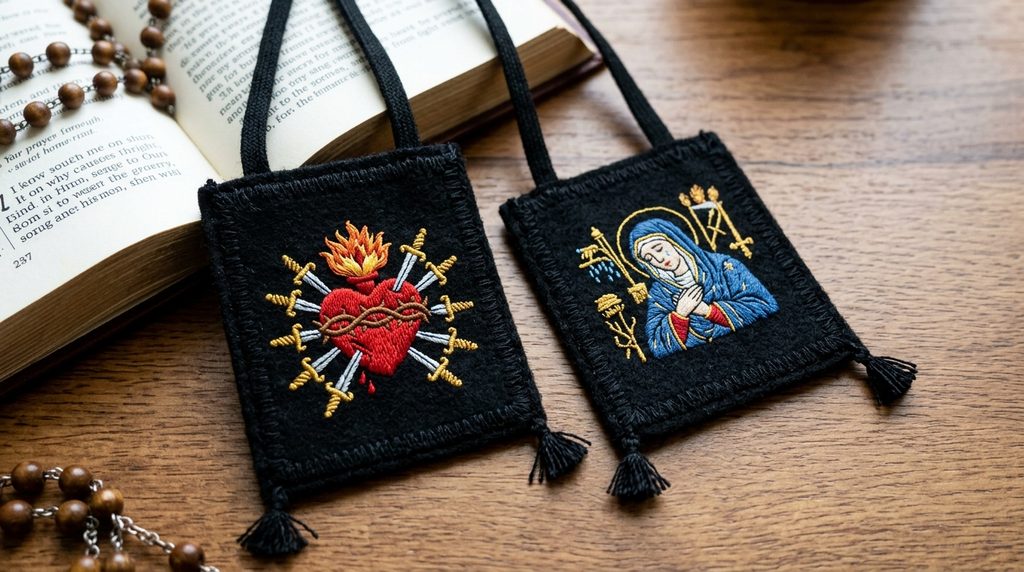
Pope Paul V granted indulgences to the confraternity and its scapular in 1611, and the Congregation of Indulgences confirmed a further summary of these graces in 1888. Enrollment is open to any baptized person of any age, and it is conferred by a priest who has received the necessary faculty from the Servite general. Members commit to wearing the black scapular continuously, to roughly fifteen minutes of daily prayer for the Church and the Servite Order — often the Chaplet of the Seven Sorrows — and to some concrete act of mercy toward those who suffer in body, mind, or spirit.
What Is the Red Scapular of the Passion?
The Red Scapular of the Passion of Our Lord and the Sacred Hearts of Jesus and Mary is the youngest of the six scapulars pictured here, and its origin is tied to a specific, well-documented series of visions. Sister Apolline Andriveau, a Daughter of Charity of St. Vincent de Paul stationed at Troyes, France, reported that between July 26 and September 14, 1846, Our Lord appeared to her repeatedly, dressed in a red tunic and holding out a red scapular.
One side of the scapular she was shown depicted Christ crucified, surrounded by the instruments of the Passion, with the words “Holy Passion of Our Lord Jesus Christ, save us.” The reverse bore the Sacred Hearts of Jesus and Mary beneath a small cross, inscribed “Sacred Hearts of Jesus and Mary, protect us.” Sister Apolline reported that Our Lord promised all who wore the scapular with faith an increase of faith, hope, and charity every Friday, the day the Church especially commemorates the Passion.
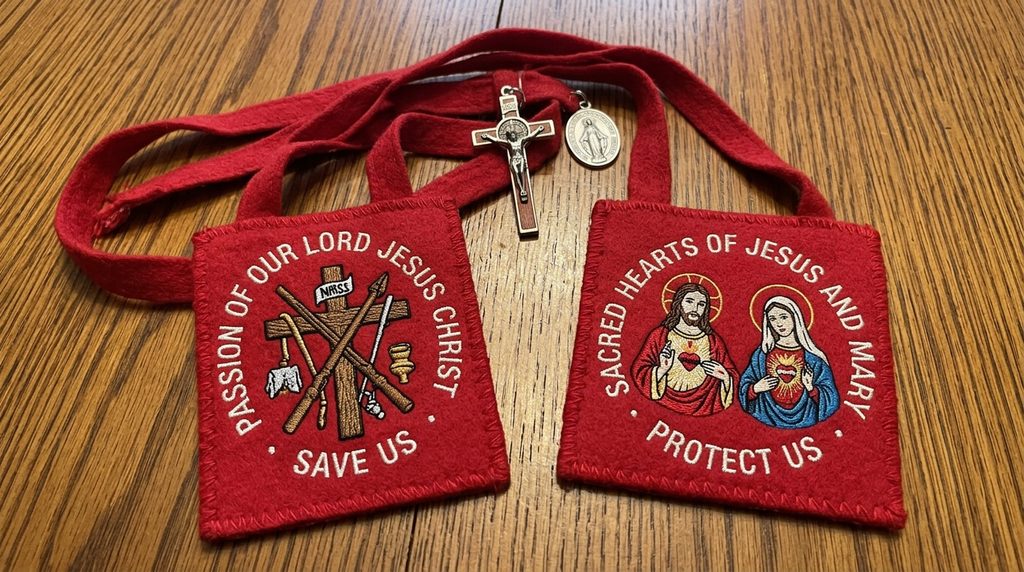
After the visions were relayed to her religious superiors, Pope Pius IX authorized the scapular’s use, blessing, and distribution by rescript on June 25, 1847. The Red Scapular has long been entrusted to the Vincentian family — the Congregation of the Mission and the Daughters of Charity — whose priests may bless and invest the faithful with it; it forms the uppermost fold of the well-known Fivefold Scapular, which combines five devotions into a single sacramental.
What Is the White Scapular of the Trinity and Our Lady of Ransom?
White is shared by more than one scapular devotion, and the infographic groups two of them together: the Scapular of the Most Holy Trinity and the scapular of Our Lady of Ransom.
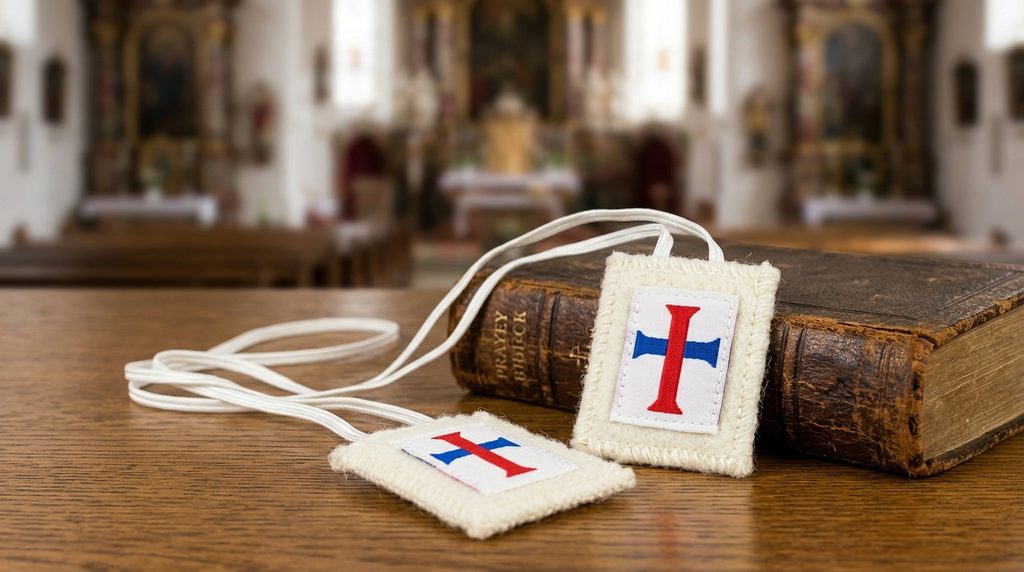
The Trinitarian scapular belongs to the Order of the Most Holy Trinity, founded around 1193 by St. John of Matha after a vision of Christ flanked by a Christian and a Moorish captive, and formally approved by Pope Innocent III in 1198. The Trinitarians, alongside their better-known charism of ransoming Christians held captive in North Africa, wore a white habit marked with a red-and-blue cross in honor of the Trinity, and eventually extended a matching white scapular to lay tertiaries and to members of the Confraternity of the Holy Trinity. Investiture in the confraternity is a sign of consecration to the Trinity and of spiritual fraternity with the order’s mission of redemption.
A related but distinct white scapular belongs to the Mercedarians — the Order of Our Lady of Mercy, founded by St. Peter Nolasco in the thirteenth century for the same work of ransoming captives. Its confraternity scapular bears an image of Our Lady of Ransom and received its own indulgences from the Congregation of Indulgences in 1868. Both white scapulars are less widely promoted today than the brown, but they remain valid, Church-approved devotions tied to orders whose founding mission — the liberation of captives — gives the color white a particular resonance of mercy and freedom.
What Is the Green Scapular of the Immaculate Heart of Mary?
The Green Scapular stands apart from every other scapular on this list, both in its origin and in how it is used. It was revealed in Paris to Sister Justine Bisqueyburu, a Daughter of Charity of the same community that had received the Miraculous Medal through St. Catherine Labouré only a decade earlier. In a series of visions beginning in 1840, Our Lady appeared holding her flaming Immaculate Heart in one hand and a green scapular in the other, asking that the image be spread as an instrument of conversion.
Unlike the other devotions described here, the Green Scapular is not tied to a religious habit or order, and it consists of a single piece of cloth rather than two joined panels. One side shows Our Lady holding her Heart; the other shows her Heart pierced and encircled by the words, “Immaculate Heart of Mary, pray for us now and at the hour of our death.” When Sister Justine’s confessor sought clarity from Our Lady on how the devotion should be practiced, Our Lady responded, in an apparition of September 8, 1846, that because the scapular was not the habit of a confraternity, no special formula was needed to bless or enroll someone in its use — a priest’s simple blessing suffices.
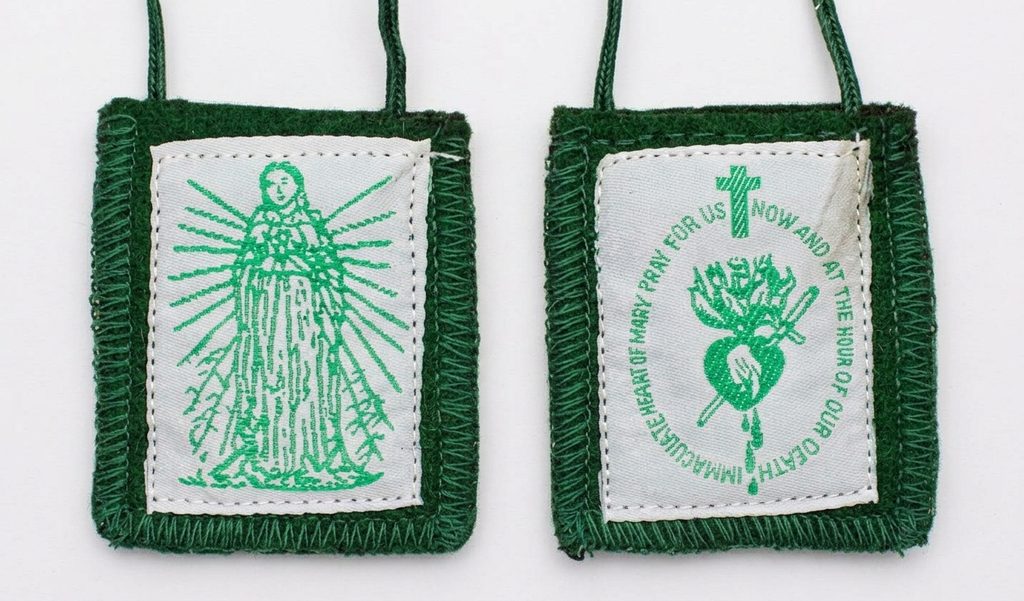
The Green Scapular’s most distinctive feature is that it may be given to anyone, including the non-practicing or the non-Catholic, and may even be placed discreetly among a person’s belongings if they are unwilling to wear it themselves. Its single condition is that someone — the wearer or an intercessor on their behalf — pray its inscribed words daily for the grace of conversion or healing. Pope Pius IX recommended the devotion twice, in 1863 and 1870, and it remains one of the Church’s most consoling sacramentals for those praying for the conversion of a loved one.
What Do All Scapulars Have in Common?
Despite their different colors, founders, and centuries, every approved scapular shares a common shape and a common purpose. Each is a sacramental of the Church, meaning it draws its efficacy not from the cloth itself but from the Church’s own intercessory blessing and from the faith and disposition of the one who wears it. Each is a sign of consecration and belonging — a pledge, in miniature, of union with a particular religious family and its patroness. Each fosters prayer and holiness of life rather than replacing them, and each points beyond itself to a mystery of the Faith: Mary’s motherhood, the Trinity, the Passion, or the Seven Sorrows.
Most significantly, every scapular is a sign of a covenant kept on both sides. The wearer promises fidelity to prayer and to the devotion in question; Our Lord and Our Lady, in turn, promise their protection and intercession. None of the promises attached to any scapular are meant to substitute for the ordinary means of salvation — the sacraments, a life of grace, and final perseverance.
Are Scapulars “Good Luck” Charms?
No. The Church is emphatic that a scapular is not a talisman, an amulet, or a magical guarantee of salvation regardless of how one lives. The Catechism warns that it is superstitious to attribute the efficacy of a sacred sign to its “mere external performance,” apart from the interior dispositions it demands of the one who uses it (CCC, 1994, § 2111).
The famous promise attached to the Brown Scapular — that whoever dies clothed in it will not suffer eternal fire — has always been understood by the Church’s theologians as conditioned on genuine fidelity to the devotion and to a Christian life, not as an automatic exemption purchased by wearing cloth. The scapular is not a good luck charm, and merely having it on one’s person at the moment of judgment is not sufficient in itself. The Church’s caution here echoes the First Commandment: sacramentals are meant to draw the soul more deeply into worship of the true God, never to substitute for it (CCC, 1994, § 2138).
How Does One Enroll in a Scapular?
With the single exception of the Green Scapular, every devotion described above requires a formal, one-time investiture by a priest — or, for the Brown Scapular, occasionally a delegated layperson — who has received the faculty to bless and enroll the faithful in the corresponding confraternity. This is typically a brief ceremony: the priest blesses the scapular, places it over the person’s shoulders, and prays over them, formally uniting them to the spiritual life and merits of the religious order to which the scapular belongs.
- Brown Scapular: enrolled by any priest, often on or near the July 16 Feast of Our Lady of Mount Carmel; no written registration is required today.
- Blue Scapular: enrolled through the Marian Fathers or another priest with the Theatine faculty, with the person’s name entered in the confraternity register.
- Black Scapular: enrolled by a priest holding the faculty from the Servite general; open to any baptized person willing to keep its obligations.
- Red Scapular: blessed and conferred by a Vincentian priest or any priest with the faculty granted since 1847.
- White Scapular: enrolled through the Trinitarian or Mercedarian orders, depending on which white scapular devotion is sought.
- Green Scapular: requires no enrollment ceremony at all — a priest’s simple blessing is sufficient, and it may even be given to someone who is unaware they are wearing it.
Once enrolled, a scapular may be replaced as needed without a new investiture, provided the wearer remains faithful to the devotion’s obligations. Most Catholic religious goods retailers today sell scapulars pre-approved for these devotions, and many include the appropriate enrollment prayer for a priest’s use.
What Does the Scapular Devotion Teach Us?
Scapulars remind the Catholic that the Christian life is never lived alone. Each small piece of cloth binds the wearer to a family far larger than themselves — to a religious order’s centuries of prayer and penance, to Our Lady’s own maternal care, and to the whole Church, militant on earth and triumphant in heaven. Through the guidance of the Church and the intercession of Mary and the saints, the faithful who take up a scapular are invited to grow daily in holiness, to follow Christ more nearly, and to trust more completely in God’s grace.
A small sign, a great purpose, a closer walk with God. Whether or not a Catholic chooses to wear a scapular, its witness endures as one more thread in the long tapestry of the Church’s sacramentals — ordinary matter set apart for an extraordinary purpose.
“Clothe yourselves with Christ, who is your all.” — Memory Verse, Galatians 3:27
References
Catechism of the Catholic Church. (1994). §§ 1670, 2111, 2138. Libreria Editrice Vaticana.
Catholic Answers. (2025, September 18). The Brown Scapular: Our Lady of Mt. Carmel’s sacramental gift to sacramentals. catholic.com
Catholic Company. (2025a, July 17). Our Lady of Mt. Carmel’s Brown Scapular: What you need to know. catholiccompany.com
Catholic Company. (2025b, September 3). What is the Green Scapular? History and spiritual meaning. catholiccompany.com
Catholic Culture. (n.d.). Different kinds of scapulars. catholicculture.org
Catholic Heritage Association of Ireland. (2011, October 29). White Scapular of Our Lady of Ransom of Prisoners. catholicheritage.blogspot.com
Catholic Tradition. (n.d.). The Blue Scapular. catholictradition.org
Catholicity.com. (n.d.). FAQs: The Brown Scapular. catholicity.com
EpicPew. (2017, November 24). Do you know about these different types of scapulars? epicpew.com
FAMVIN NewsEN. (2025a, January 27). Sister Justine Bisqueyburu and the Green Scapular: History, meaning, and graces. famvin.org
FAMVIN NewsEN. (2025b, July 24). July 26: The first apparition of Jesus to Sister Apolline Andriveau, DC, and the gift of the Red Scapular. famvin.org
Fenelon, M. S. (2020, July 16). Our Lady of Mount Carmel’s promise to St. Simon Stock about the Brown Scapular. margefenelon.com
Human Life International. (2025, March 24). What is the Catholic scapular? hli.org
Marians of the Immaculate Conception. (2025a, February 14). Let Our Lady’s Blue Scapular protect you. padrimariani.org
Marians of the Immaculate Conception. (2025b, October 28). The Confraternity of the Immaculate Conception of the Most Blessed Virgin Mary. marian.org
MaryPages. (n.d.a). White Scapular of the Most Blessed Trinity. marypages.com
New Advent. (n.d.). Catholic Encyclopedia: Scapular. newadvent.org
phat catholic apologetics. (2011, May). Is the scapular just another Catholic superstition? phatcatholic.blogspot.com
Rosary and scapular. (n.d.). In Wikipedia. Retrieved August 25, 2026.
Scapulars.com. (2022, October 5). The promises of the Brown Scapular. scapulars.com
Spiritual Matters. (2013, February 11). The Blue Scapular of the Immaculate Conception. spiritual-matters777.blogspot.com
The Catholic Gentleman. (2023, June 27). Spiritual weapons: The Red Scapular. catholicgentleman.com
The Scapular Confraternity. (n.d.). Frequently asked questions. carmelscapular.com
uCatholic. (2024, August 1). Mary promises special protection at the hour of your death if you wear this scapular. ucatholic.com
Wikipedia. (n.d.a). Scapular of the Most Blessed Trinity. Retrieved August 25, 2026.
Women of Grace. (2024, August 8). The Green Scapular is Church approved. womenofgrace.com