Chronicle of Marian Apparitions, Part 3: Shepherdesses and Sinners
Chronicle of Marian Apparitions, Part 3
Shepherdesses and Sinners: Our Lady of Querrien to Our Lady of Zion (1652–1842)
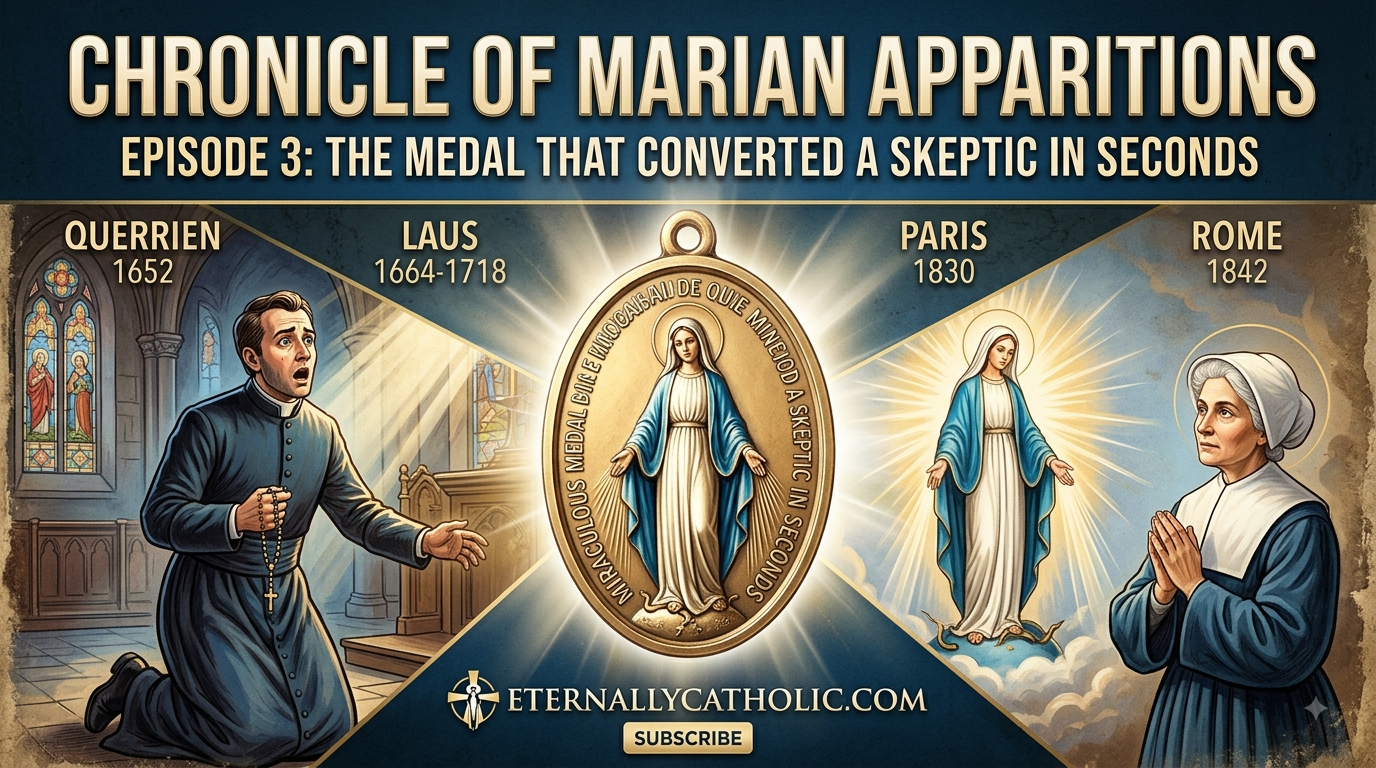
The apparitions gathered in this third installment span nearly two centuries and move from the pastures of rural France to the streets of Paris and a quiet church in Rome. Three of the four center on the humble figure of a shepherdess entrusted with a heavenly message; the fourth recounts one of the most striking individual conversions in modern Church history. Together they illustrate Mary’s preference for unlikely messengers and her recurring call to conversion, penance, and confidence in her intercession.
What Happened at Our Lady of Querrien in France (1652)?
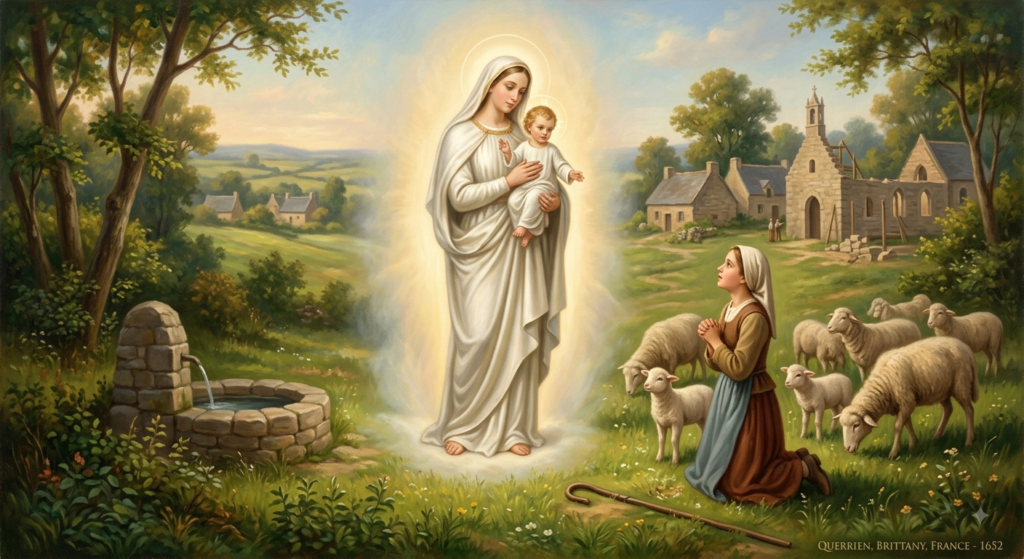
La Prénessaye, Côtes-d’Armor, Brittany, France — 15 August–September, 1652 — Witness: Jeanne Courtel
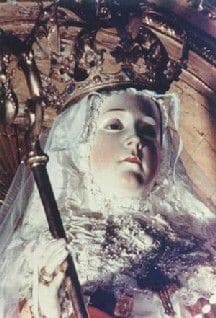
On 15 August 1652, a twelve-year-old shepherdess named Jeanne Courtel, deaf and mute since birth, was tending her father’s flock in a field known as the Fontenelles when she felt what she described as a gust of wind and turned to see a beautiful lady in white satin holding the Christ Child. Jeanne was instantly and miraculously able to hear and speak (Catholic Travel Guide, 2024). Mary asked that a chapel be built in the village and, in a tender exchange recorded in local testimony, asked the girl for one of her lambs; Jeanne answered that the sheep belonged to her father, not to her, so Mary offered to watch the flock while she sought permission. Mary appeared to Jeanne fifteen times over the following weeks and directed her to a spot near a spring where an ancient statue of the Virgin, hidden since the sixth century, was found perfectly preserved. The bishop of Saint-Brieuc, Denis de La Barde, formally recognized the apparitions that September and authorized construction of a chapel, completed in 1656.
What Was Our Lady’s Message at Querrien?
“I choose this place to be honored. Build for me a chapel in the middle of this village and many people will come.”
Querrien’s apparition, still known locally as Notre-Dame de Toute-Aide, Our Lady of All Help, emphasizes Mary’s motherly care extended even before it is asked: she healed Jeanne’s lifelong affliction unprompted, then invited the child into a simple, trusting dialogue. The title reflects the shrine’s enduring reputation as a place where Mary helps in every kind of need.
What Happened at Our Lady of Laus in France (1664–1718)?
Saint-Étienne-le-Laus, Hautes-Alpes, France — May 1664 to 1718 — Witness: Benoîte Rencurel
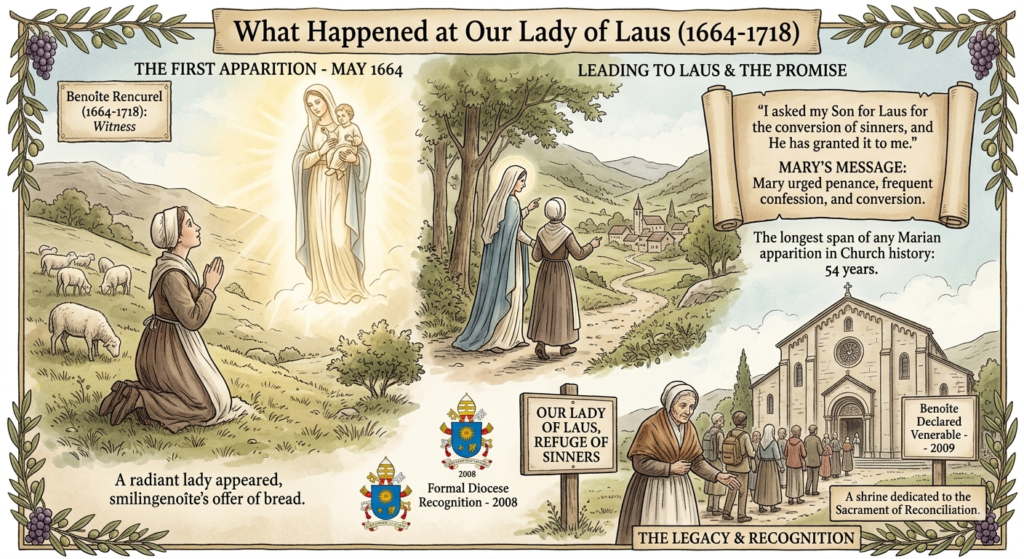
In May 1664, a seventeen-year-old shepherdess named Benoîte Rencurel, orphaned young and never taught to read or write, was tending a neighbor’s flock and praying the rosary when a radiant lady appeared to her holding a child. Benoîte, in her simplicity, offered the visitor bread and asked to hold the infant; the lady only smiled (Catholic Culture, n.d.). After a month’s absence that left Benoîte disconsolate, Mary reappeared and led her to the hamlet of Laus, where she declared she wished a church built in honor of her Son, promising that many sinners would there be converted (Michael Journal, n.d.). The apparitions continued for fifty-four years, the longest span of any Marian apparition in Church history, ending only with Benoîte’s death in 1718. The Diocese of Gap and Embrun formally recognized the supernatural character of the apparitions in 2008, and Benoîte Rencurel was declared Venerable by Pope Benedict XVI in 2009.
What Was Our Lady’s Message at Laus?
“I asked my Son for Laus for the conversion of sinners, and He has granted it to me.”
The Laus apparitions, uniquely, center almost entirely on the Sacrament of Reconciliation: Mary presented herself and the shrine as a refuge of sinners, urging penance, frequent confession, and devotion to the Eucharist. For over five decades Benoîte served as an intermediary who encouraged pilgrims toward the confessional, and Laus retains its title as a place of grace for the conversion of hardened sinners.
What Happened at the Miraculous Medal in Paris, France (1830)?
Rue du Bac, Paris, France — 18 July and 27 November, 1830 — Witness: Saint Catherine Labouré
On the night of 18 July 1830, a young novice of the Daughters of Charity, Catherine Labouré, was awakened by a child who led her to the convent chapel on the Rue du Bac in Paris, where the Virgin Mary appeared and spoke with her at length, foretelling difficult days ahead for France. On 27 November of the same year, Mary appeared again, standing on a globe with rays of light streaming from her hands, framed within an oval bearing the words “O Mary, conceived without sin, pray for us who have recourse to thee.” On the reverse, Catherine saw a letter M surmounted by a cross, beneath which were two hearts, one crowned with thorns and the other pierced by a sword, encircled by twelve stars (Marie de Nazareth, n.d.). Mary instructed Catherine to have a medal struck according to this design, promising great graces for all who wore it with confidence. Catherine’s confessor had medals produced in 1832; devotion spread with extraordinary speed, and the design became known worldwide simply as the Miraculous Medal.
Read our complete article here.
What Was Our Lady’s Message at the Rue du Bac?
“All who wear it will receive great graces.”
The medal’s message is theological as much as devotional: it visually proclaims Mary’s Immaculate Conception fourteen years before the doctrine’s formal definition by Pope Pius IX in 1854, and it presents her as mediatrix of grace, her hands radiating light toward a world in need. The medal became, and remains, one of the most widely distributed sacramentals in the Catholic Church, credited with numerous conversions, most famously that of Alphonse Ratisbonne twelve years later.
What Happened at Our Lady of Zion in Rome, Italy (1842)?
Church of Sant’Andrea delle Fratte, Rome, Italy — 20 January, 1842 — Witness: Alphonse Ratisbonne
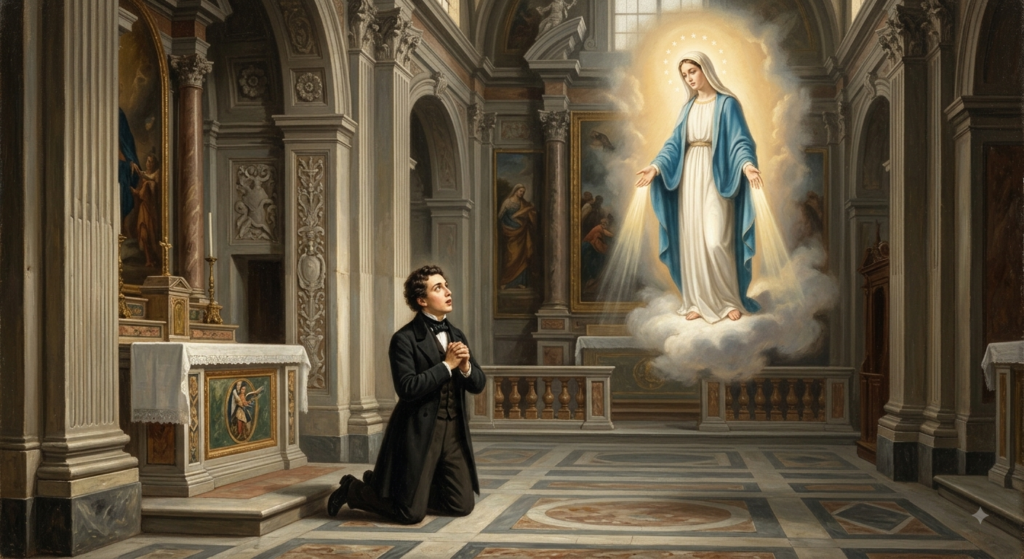
Alphonse Ratisbonne, a young Jewish banker from Strasbourg openly hostile to the Catholic faith, was persuaded during a visit to Rome to wear a Miraculous Medal and recite the Memorare daily, half in jest, as a challenge from a Catholic acquaintance, Baron Théodore de Bussières. On 20 January 1842, while waiting inside the church of Sant’Andrea delle Fratte, Ratisbonne reported that the building seemed to vanish around him and the Virgin Mary appeared before him exactly as she is depicted on the Miraculous Medal (Voice of the Family, 2025). He fell to his knees and, by his own account, understood everything without a single word being spoken. He asked for baptism at once and was received into the Church eleven days later. A canonical investigation by the Vatican in February 1842 concluded the conversion was miraculous (Little Treasures of Faith, 2023). Ratisbonne became a Jesuit and later a priest, and with his brother Théodore founded the Congregation of Our Lady of Sion, dedicated to prayer and outreach among the Jewish people.
What Was Our Lady’s Message at Zion?
Though Mary spoke no words to Ratisbonne, witnesses and his own testimony describe the encounter as instantaneously and totally transformative, a silent but complete communication of divine mercy. The event, commemorated today as Our Lady of the Miracle, reinforced devotion to the Miraculous Medal across Europe and helped prepare the ground for the 1854 definition of the Immaculate Conception, proclaimed just twelve years later.
References
Catholic Culture. (n.d.). Our Lady of Laus now on a par with Lourdes. https://www.catholicculture.org/culture/library/view.cfm?recnum=8296
Catholic Travel Guide. (2024, January 23). Querrien, La Prénessaye France: Apparition of Our Lady of Eternal Aid. https://thecatholictravelguide.com/destinations/france/querrien-la-prenessaye-france-apparition-of-our-lady-of-eternal-aid/
Little Treasures of Faith. (2023, April 24). The apparition of Our Lady of Zion. https://littletreasuresoffaith.wordpress.com/2022/01/21/the-apparition-of-our-lady-of-zion/
Marie de Nazareth. (n.d.). Our Lady appeared to Alphonse Ratisbonne. https://www.mariedenazareth.com/en/marian-encyclopedia/great-marian-witnesses/modern-times/other-witnesses-of-the-modern-period/alphonse-ratisbonne-1820-1884/our-lady-appeared-to-alphonse-ratisbonne
Michael Journal. (n.d.). Benoîte Rencurel and the apparitions of Our Lady of Laus, Refuge of Sinners. https://www.michaeljournal.org/articles/roman-catholic-church/item/benoite-rencurel-and-the-apparitions-of-our-lady-of-laus-refuge-of-sinners
Voice of the Family. (2025, January 22). The miraculous conversion of Alphonse Ratisbonne. https://voiceofthefamily.com/the-miraculous-conversion-of-alphonse-ratisbonne/
Wikipedia. (n.d.). Marian apparitions of Querrien. In Wikipedia. Retrieved August 8, 2026, from https://en.wikipedia.org/wiki/Marian_apparitions_of_Querrien
Wikipedia. (n.d.). Our Lady of Laus. In Wikipedia. Retrieved August 8, 2026, from https://en.wikipedia.org/wiki/Our_Lady_of_Laus