Chronicle of Marian Apparitions, Part 4: Weeping and Wonders
Chronicle of Marian Apparitions, Part 4
Weeping and Wonders: Our Lady of La Salette to Our Lady of Good Help (1846–1859)
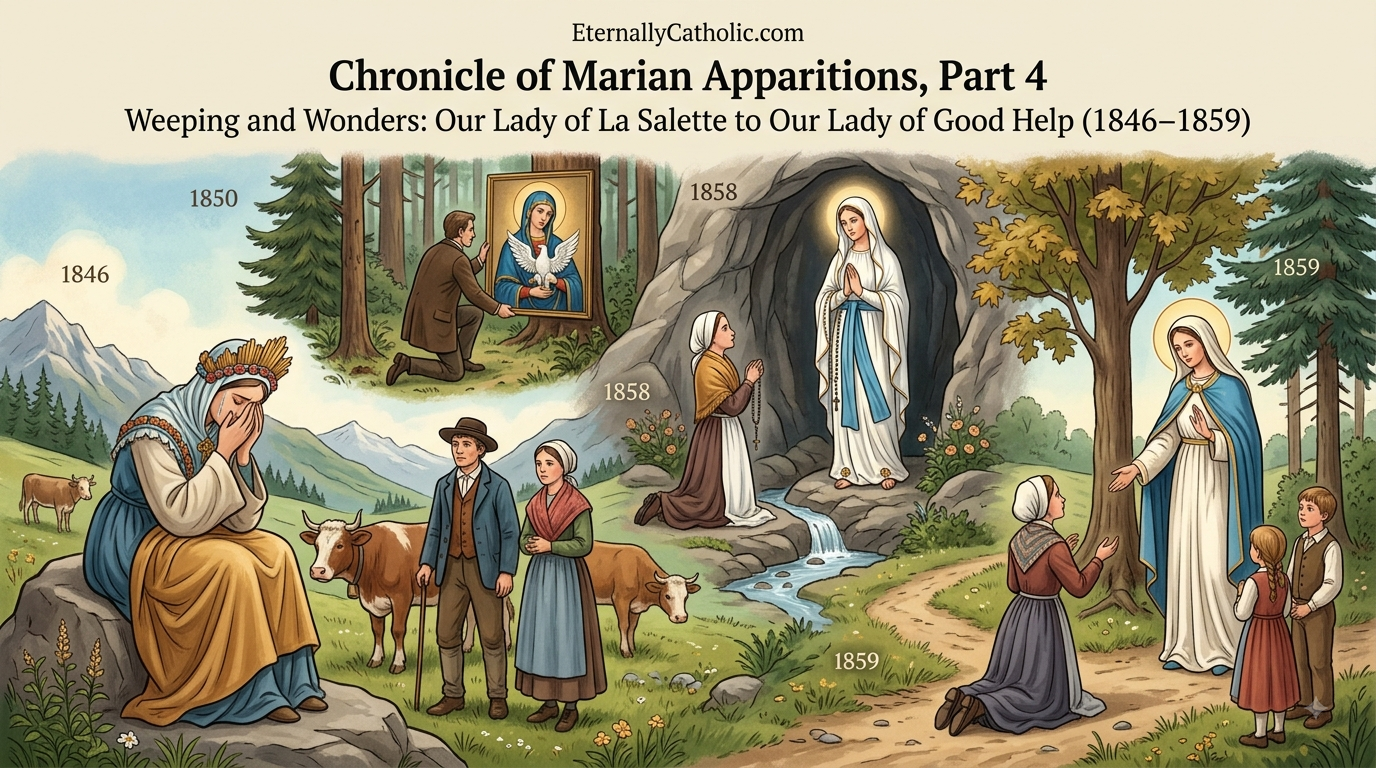
The mid-nineteenth century produced some of the best-documented and most consequential Marian apparitions in the history of the Church, culminating in the world-famous events at Lourdes. This fourth installment follows Our Lady from a remote Alpine pasture in France, where she wept over the sins of a nation, to a Polish forest bearing a message of national consolation, to the grotto that would become the most visited Marian shrine on earth, and finally across the Atlantic to a Belgian immigrant in the young American state of Wisconsin.
What Happened at Our Lady of La Salette in France (1846)?
La Salette, near Grenoble, France — 19 September, 1846 — Witnesses: Maximin Giraud and Mélanie Calvat
On 19 September 1846, two young shepherd children, eleven-year-old Maximin Giraud and fourteen-year-old Mélanie Calvat, were tending cattle high in the French Alps near the village of La Salette when they came upon a weeping woman seated on a rock, her head in her hands. She rose, addressed them in French, and, when they seemed not to understand, repeated her message in their local dialect. Speaking of widespread neglect of Sunday worship, profanity, and failure to observe the Lenten fast, she warned that continued indifference would bring famine and hardship, a warning many later connected to the devastating potato blight and grain failures that struck Europe in the following years. She also entrusted each child with a private message, or “secret,” not to be revealed to anyone else at that time. Bishop Philibert de Bruillard of Grenoble approved the apparition as worthy of belief in 1851 after a lengthy investigation, and a basilica was later built on the mountain.
What Was Our Lady’s Message at La Salette?
“If my people will not submit, I shall be forced to let fall the arm of my Son.”
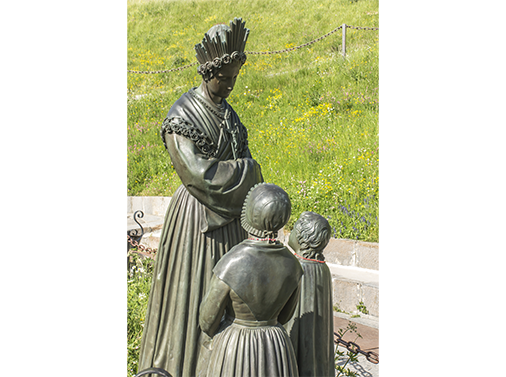
La Salette’s public message is one of urgent warning: Mary appeared as the Reconciler of Sinners, grieved by the neglect of prayer and the sanctification of Sunday, and pleaded for conversion to avert temporal chastisement. Unlike most other approved apparitions, La Salette combined this call to penance with two sealed personal secrets, later published separately by Maximin and Mélanie, that added a prophetic dimension to the event and made it one of the more debated apparitions of the era.
Read our full article here.
What Happened at Our Lady of Lichen in Poland (1813 and 1850)?
Grąblin Forest, near Licheń, Poland — 1813 and three apparitions in 1850
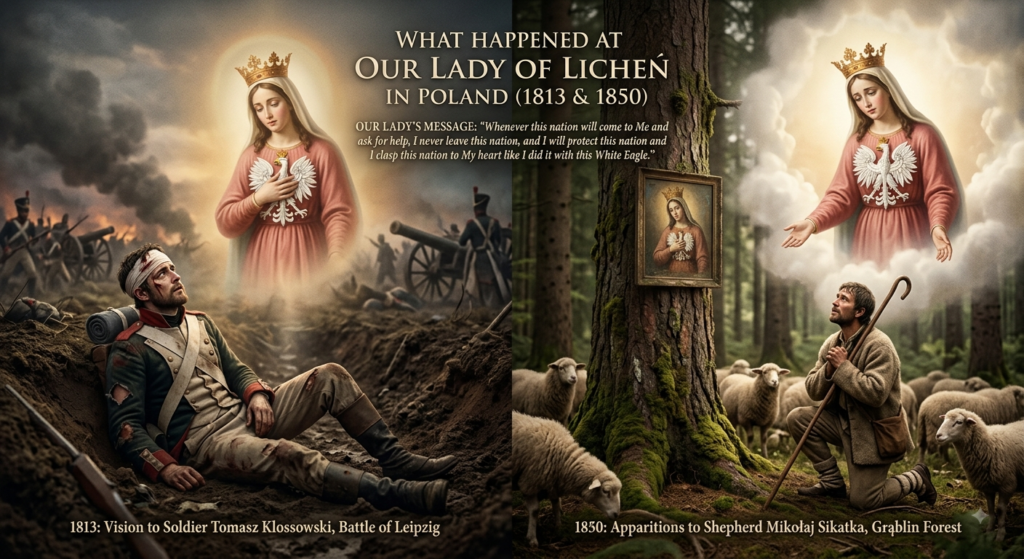
The story of Our Lady of Lichen begins with a Polish soldier, Tomasz Klossowski, gravely wounded during the Battle of Leipzig in 1813. Facing death far from home, he invoked the Virgin Mary and reported that she appeared to him wearing a crown and a rose-colored dress, clasping a white eagle, the symbol of Poland, to her breast; she promised his recovery and asked that he find and promote an image of her likeness (Marians of the Immaculate Conception, 2024). After years of searching, Klossowski located a matching painting in 1836 and eventually hung it on a pine tree in the Grąblin Forest. There, in 1850, the image’s presence drew a shepherd, Mikołaj Sikatka, who reported three apparitions of the same sorrowful lady with the white eagle. She warned of coming hardship, including war and a cholera epidemic, both of which followed within two years, and promised protection to those who sought her intercession before the image. The Basilica of Our Lady of Licheń, completed in 2004, is today the largest church in Poland.
What Was Our Lady’s Message at Lichen?
“Whenever this nation will come to Me and ask for help, I never leave this nation, and I will protect this nation and I clasp this nation to My heart like I did it with this White Eagle.”
Lichen’s message pairs a call to conversion, penance, and prayer with a national promise of protection for Poland in times of trial, a theme that resonated powerfully through the partitions, world wars, and Communist rule that followed. When cholera struck in 1852 as foretold, crowds who prayed before the image reported deliverance from the epidemic, cementing the shrine’s reputation for consolation in national suffering.
What Happened at Our Lady of Lourdes in France (1858)?
Massabielle Grotto, Lourdes, France — 11 February to 16 July, 1858 — Witness: Saint Bernadette Soubirous
Between 11 February and 16 July 1858, a poor, uneducated fourteen-year-old girl named Bernadette Soubirous experienced eighteen apparitions of a young lady, dressed in white with a blue sash and a rosary, in a grotto by the Gave river at Massabielle on the outskirts of Lourdes in southern France. The lady asked Bernadette to pray for sinners, to do penance, and to have a chapel built and processions held at the site. During one apparition Bernadette was directed to dig in the ground, uncovering a spring whose waters have since become associated with thousands of reported healings, a small number of which the Church has formally recognized as inexplicable by natural means. Not until the sixteenth apparition, on 25 March 1858, did the lady reveal her identity, telling Bernadette in the local Occitan dialect, “I am the Immaculate Conception,” a title that startled local clergy since the dogma of Mary’s sinless conception had been solemnly defined by Pope Pius IX only four years earlier, in 1854. The Church approved the apparitions in 1862, and Lourdes is today the most visited Marian shrine in the world.
Read the article on Our Lady of Lourdes here.

What Was Our Lady’s Message at Lourdes?
“I do not promise to make you happy in this world, but in the next.”
Lourdes’ message centers on prayer, penance for sinners, and confidence in Mary’s identity as the Immaculate Conception, confirming the recently defined dogma through the testimony of an illiterate peasant girl who could not have known its theological significance. The shrine’s healing spring and the millions of pilgrims who visit annually, many of them sick or disabled, have made Lourdes a global symbol of hope amid suffering, and Bernadette herself was canonized in 1933.
What Happened at Our Lady of Good Help in Wisconsin, United States (1859)?
Near Robinsonville (now Champion), Wisconsin, United States — 9 October, 1859 — Witness: Adele Brise
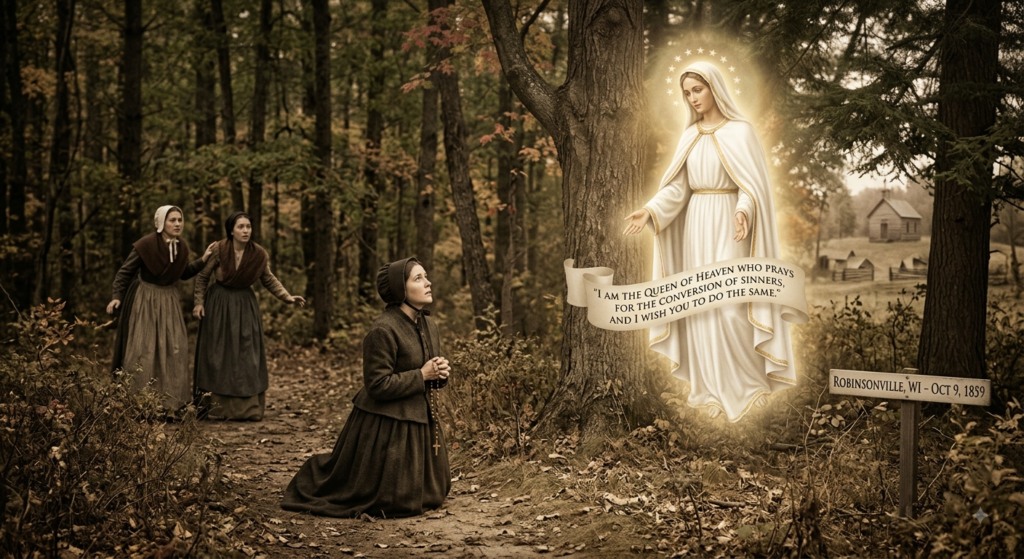
In early October 1859, a twenty-eight-year-old Belgian immigrant named Adele Brise was walking through the Wisconsin woods to a grist mill when she saw a woman clothed in dazzling white standing silently between a maple and a hemlock tree. A few days later, on 9 October, walking eleven miles to Sunday Mass with her sister and a neighbor, Adele saw the same figure again and, prompted by a priest’s counsel, asked, “In God’s name, who are you, and what do you want of me?” The lady answered that she was the Queen of Heaven, who prayed for the conversion of sinners, and asked Adele to do the same, gathering children to teach them the catechism (Championshrine.org, 2026). Adele devoted the rest of her life to this mission, founding a school and a small community of laywomen dedicated to Catholic education throughout the region. The shrine and its chapel were famously spared in the catastrophic Peshtigo fire of 1871, which burned the surrounding countryside. In 2010, Bishop David Ricken of Green Bay formally declared the events worthy of belief, making it the first Marian apparition approved by the Catholic Church in the United States.
What Was Our Lady’s Message at Good Help?
“I am the Queen of Heaven who prays for the conversion of sinners, and I wish you to do the same.”
Our Lady’s message to Adele Brise was a personal missionary commission: make a general confession, receive Communion for sinners, and above all teach children the truths of the faith, a task made urgent by the scarcity of priests and catechists among Catholic immigrant settlers on the American frontier. The apparition remains a distinctly American witness to Mary’s concern for Christian education and the instruction of the young.
References
Championshrine.org. (2026, April 13). The story of Adele Brice and Mary’s apparition in Champion, WI. https://championshrine.org/our-story/
Marians of the Immaculate Conception. (2024, July 1). The beautiful Sorrowful Mother of Poland. https://marian.org/articles/beautiful-sorrowful-mother-poland
Wikipedia. (n.d.-a). Our Lady of La Salette. In Wikipedia. Retrieved August 8, 2026, from https://en.wikipedia.org/wiki/Our_Lady_of_La_Salette
Wikipedia. (n.d.-b). Our Lady of Lourdes. In Wikipedia. Retrieved August 8, 2026, from https://en.wikipedia.org/wiki/Our_Lady_of_Lourdes
Wikipedia. (n.d.-c). Our Lady of Sorrows, Queen of Poland. In Wikipedia. Retrieved August 8, 2026, from https://en.wikipedia.org/wiki/Our_Lady_of_Sorrows,_Queen_of_Poland
Wikipedia. (n.d.-d). National Shrine of Our Lady of Champion. In Wikipedia. Retrieved August 8, 2026, from https://en.wikipedia.org/wiki/National_Shrine_of_Our_Lady_of_Champion