Chronicle of Marian Apparitions, Part 2: The Age of Evangelization
Chronicle of Marian Apparitions, Part 2
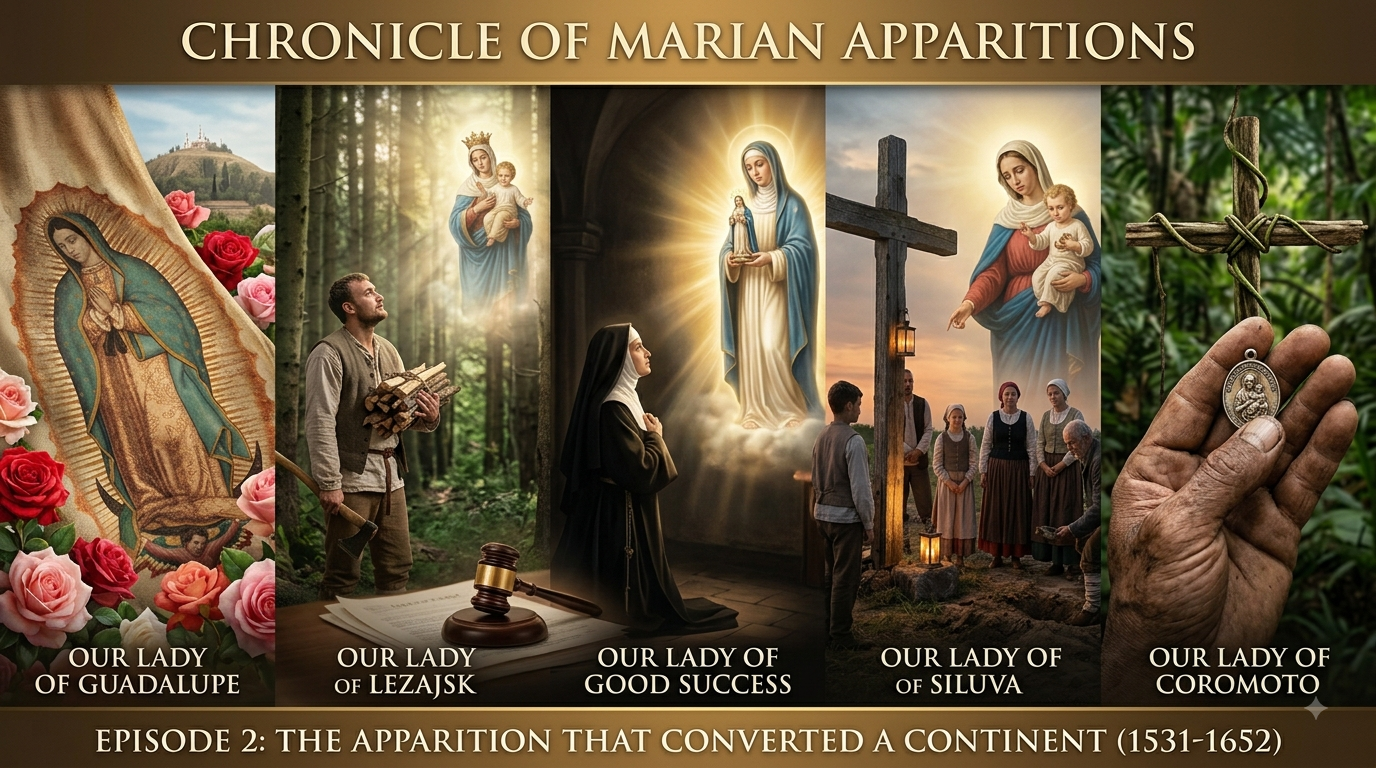
The Age of Evangelization: Our Lady of Guadalupe to Our Lady of Coromoto (1531–1652)
As the Catholic faith spread from Europe into the Americas and reawakened in lands touched by the Protestant Reformation, the Virgin Mary appeared repeatedly at the frontiers of the faith. This second installment traces five apparitions spanning barely more than a century, from the towering event at Guadalupe that reshaped the evangelization of an entire continent to quieter visitations in the forests of Poland and Lithuania and the waters of Venezuela. In every case, Mary’s appearance served the same end: to draw a resistant or wavering people back toward her Son.
What Happened at Our Lady of Guadalupe in Mexico (1531)?
Tepeyac Hill, near Mexico City, Mexico — 9–12 December, 1531 — Witness: Saint Juan Diego
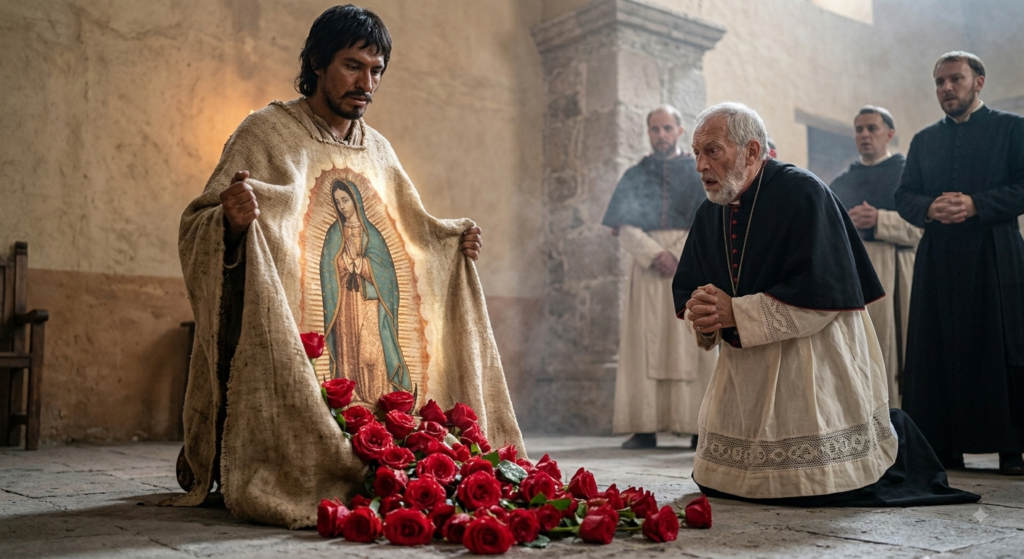
In December 1531, a decade after the Spanish conquest of the Aztec empire, the Virgin Mary appeared four times to Juan Diego, a poor, recently baptized indigenous convert, on the hill of Tepeyac outside Mexico City. Speaking to him in Nahuatl, she identified herself as the ever-virgin Mother of the true God and asked that a church be built on the site so that she might show her love and compassion to all who sought her help (Wikipedia, n.d.). When the local bishop demanded a sign, Mary directed Juan Diego to gather Castilian roses, out of season, from the barren hilltop and carry them in his cloak, or tilma. When he opened the cloak before the bishop, the roses fell away to reveal an image of Mary imprinted on the fabric, an image still venerated today at the Basilica of Our Lady of Guadalupe (read our full article by clicking https://eternallycatholic.com/what-is-the-story-miracle-and-message-of-guadalupe/), the most-visited Marian shrine in the world. Within a few years, millions of indigenous peoples across Mexico had entered the Catholic faith.
What Was Our Lady’s Message at Guadalupe?
“Am I not here, I who am your Mother?”
Guadalupe’s message is one of maternal nearness across every barrier of culture and language: Mary presented herself in indigenous dress, addressed Juan Diego with tenderness, and asked only for a place where mothers could bring their sorrows to her. The event is widely credited with reconciling the indigenous and Spanish populations of colonial Mexico and remains a foundational devotion for the whole of Latin America, with Guadalupe honored as Patroness of the Americas.
What Happened at Our Lady of Lezajsk in Poland (1578)?
Lezajsk, Poland — 1578 — Witness: Thomas Michalek
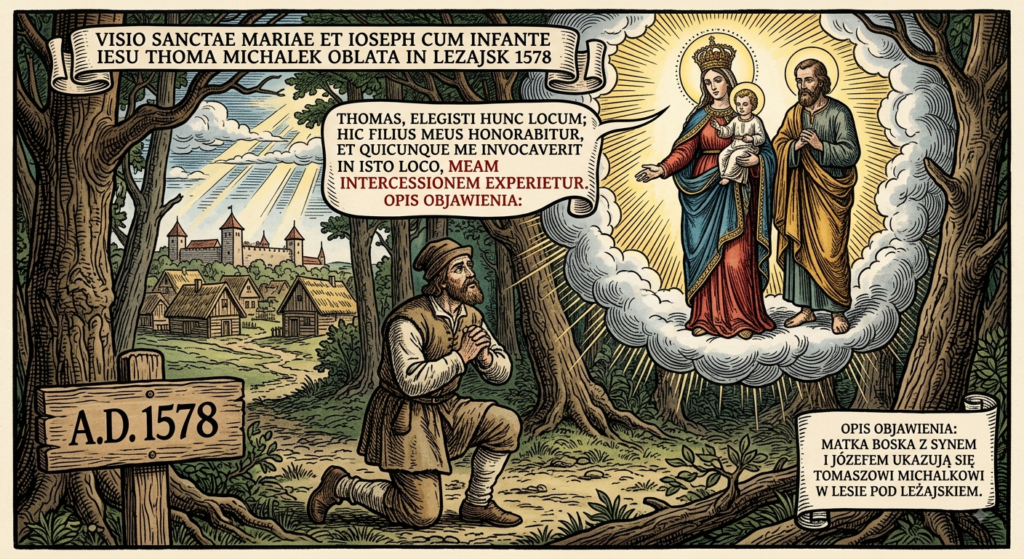
In 1578, a pious woodcutter named Thomas Michalek was gathering firewood near the town of Lezajsk in southeastern Poland when he was startled by a brilliant light in the forest. Within it he saw the Virgin Mary with the Christ Child and Saint Joseph, who told him she had chosen the spot for a church where all who invoked her would receive her intercession (Mother-Mary.org, n.d.). Michalek, humble and fearful of ridicule, said nothing at first; Mary appeared to him twice more, the final time reproaching his silence. When he finally reported the vision, local authorities and even his own parish priest refused to believe him, and he was taken to court. It was only after the death of the unbelieving priest that a small chapel was finally raised on the site. Bishop Henry Firlej later confirmed the apparition following a canonical investigation, and in 1752 Pope Benedict XIV personally crowned the miraculous image, which remains enshrined in the Basilica of Saint Mary of Lezajsk (Boundinlove.com, 2026).
What Was Our Lady’s Message at Lezajsk?
“Thomas, I have chosen this place; on it my Son shall be honored, and everyone who shall invoke me here shall experience my intercession.”
Mary’s words at Lezajsk stress her constant readiness to intercede for those who turn to her at the chosen shrine, while the long delay before Michalek’s testimony was accepted illustrates a recurring theme across many approved apparitions: heaven’s patience with human hesitation and institutional caution before a devotion is finally embraced.
What Happened at Our Lady of Good Success in Quito, Ecuador (1594–1634)?
Convent of the Immaculate Conception, Quito, Ecuador — 1594–1634 — Witness: Mother Mariana de Jesus Torres
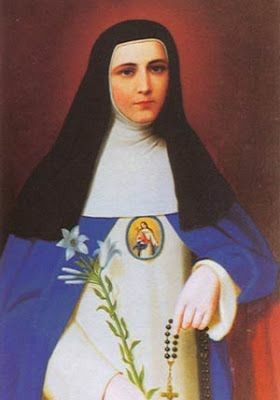
Over four decades beginning in 1594, the Virgin Mary appeared repeatedly to Mother Mariana de Jesus Torres, a Spanish-born Conceptionist nun and abbess in Quito, asking to be venerated under the title Our Lady of Good Success, meaning not worldly success but the ultimate, good outcome of God’s providence for the Church (FOCUS.org, 2026). In 1611, Our Lady requested a statue depicting her with the Christ Child, a crozier, and keys, symbolizing her spiritual authority over the convent; tradition holds the statue was miraculously completed by an angelic craftsman. The local bishop approved the early apparitions in 1611 during Mother Mariana’s lifetime, and her body, examined when her tomb was opened in 1906, was reportedly found incorrupt (Catholic World Report, 2017). The apparitions became widely known for their detailed prophecies concerning trials that would beset the Church and family life in the nineteenth and twentieth centuries.
What Was Our Lady’s Message at Good Success?
Our Lady’s messages to Mother Mariana centered on the erosion of faith, threats to the priesthood, marriage, and religious life, and the corrosive influence of secret societies working against the Church, paired always with a call to prayer, penance, and confident hope that these trials would ultimately serve a good and providential outcome (Apostolate of Our Lady of Good Success, n.d.). The devotion is closely associated with the reign of Ecuadorian president Gabriel García Moreno, who consecrated the nation to the Sacred Heart in 1873, a fulfillment devotees link to the seventeenth-century prophecies.
Our full article is found https://eternallycatholic.com/what-are-the-apparitions-of-our-lady-of-good-success/.
What Happened at Our Lady of Siluva in Lithuania (1608)?
Siluva, Lithuania — Summer, 1608
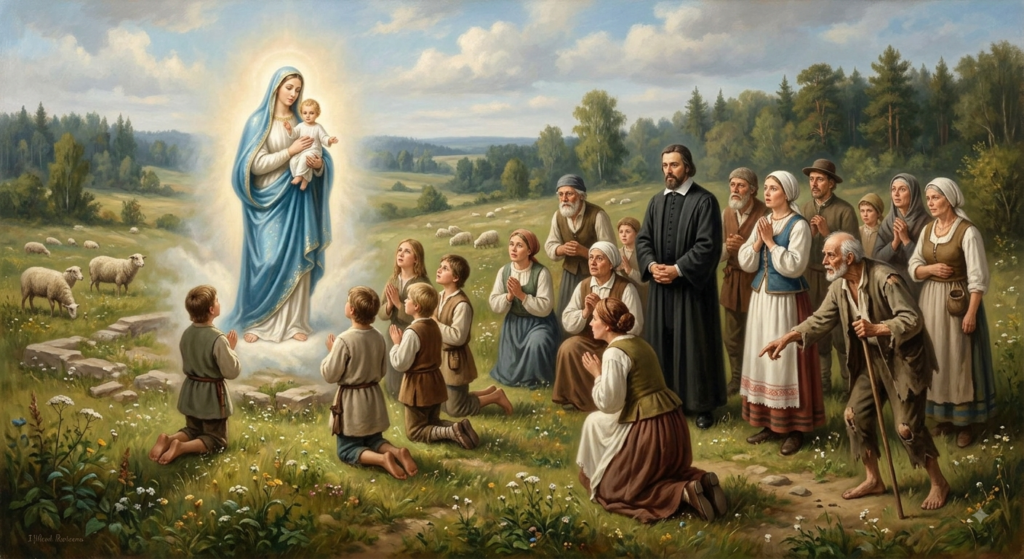
By the early seventeenth century, Calvinism had displaced the Catholic faith in the Lithuanian village of Siluva for two generations; before losing control of the parish church, its priest had secretly buried the deed to the church property and a treasured icon of Mary. In the summer of 1608, a group of shepherd children tending sheep on the site of the vanished church reported seeing a beautiful woman weeping while holding an infant. When the children returned the next day with villagers, including the local Calvinist minister, the group again saw the weeping figure (National Shrine of the Immaculate Conception, 2025). Asked the cause of her sorrow, she answered that her Son was no longer honored in that place as he once had been. An elderly, nearly blind man who had helped bury the church’s documents decades earlier recalled the exact spot; when it was excavated, the recovered deed allowed the Catholic Church to legally reclaim the property in 1622. Pope Pius VI formally authenticated the apparition in 1775.
What Was Our Lady’s Message at Siluva?
“Formerly in this place, my Son was honored and adored, but now, all that the people do is seed and cultivate the land.”
Siluva’s message is a lament over lost faith and a summons to restore true worship where it has been abandoned. Occurring in what is described as a completely un-Catholic setting, the apparition became a rallying point for Lithuanian Catholic identity through centuries of Protestant, and later Soviet, suppression, a significance renewed when Pope John Paul II visited the shrine in 1993.
What Happened at Our Lady of Coromoto in Venezuela (1651–1652)?
Guanare, Portuguesa, Venezuela — 1651 and 8 September, 1652 — Witness: Chief Coromoto
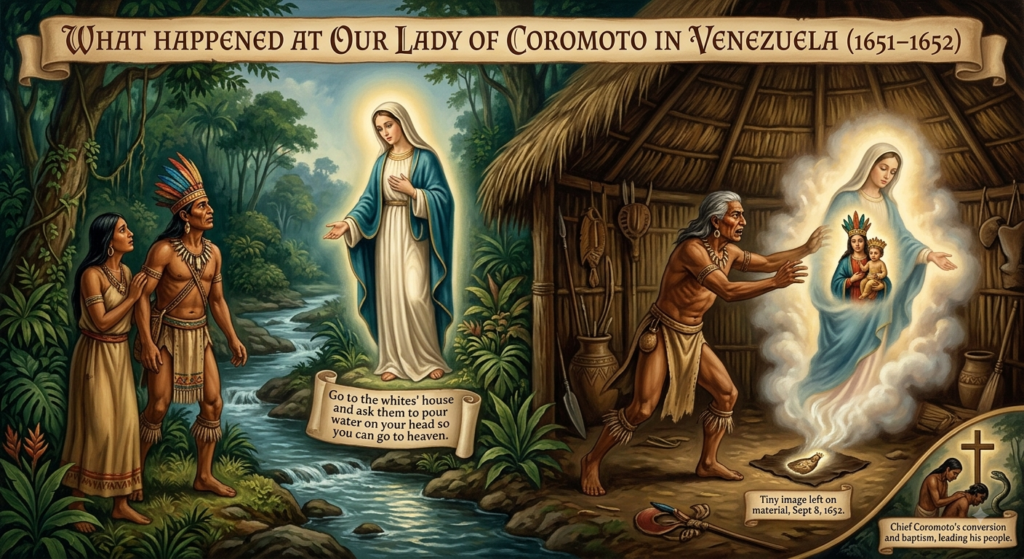
Near the town of Guanare in western Venezuela, the indigenous Cospes people had largely resisted Spanish missionary efforts. Tradition holds that the Virgin Mary appeared to the tribal chief Coromoto and his wife beside a stream around 1651, speaking to them in their own language and urging them to seek baptism from the Spanish so that they might enter heaven (Omnes, 2025). The chief resisted. When Mary appeared to him a second time inside his own hut, on 8 September 1652, he reached out to seize her; she vanished from his grasp, leaving behind a tiny image of herself and the Christ Child, only a few centimeters across, imprinted on a small piece of material (Grokipedia, 2026). Fleeing in fear, Coromoto was later bitten by a venomous snake; near death, he finally asked for baptism, received it, and became an evangelist among his own people before he died. The relic is venerated today at the Basilica of Our Lady of Coromoto, and Pope Pius XII declared her Patroness of Venezuela in 1944.
What Was Our Lady’s Message at Coromoto?
“Go to the whites’ house and ask them to pour water on your head so you can go to heaven.”
Coromoto’s message is a direct call to conversion and the sacrament of baptism, delivered with striking cultural sensitivity as Mary addressed an indigenous leader in his own tongue and appeared in a form his people would recognize. Scholarly examination of the miniature relic in 2009 found details, including an indigenous feather crown historically mistaken for a throne, consistent with its reputed origin as an image not made by human hands (SQPN, 2026).
References
Apostolate of Our Lady of Good Success. (n.d.). History. https://www.ourladyofgoodsuccess.com/pages/history
Boundinlove.com. (2026, February 27). More Marian apparitions. https://boundinlove.com/2026/02/27/more-marian-apparitions/
Catholic World Report. (2017, June 7). The 400-year-old Marian apparition that is particularly relevant today. https://www.catholicworldreport.com/2017/06/07/the-400-year-old-marian-apparition-that-is-particularly-relevant-today/
FOCUS.org. (2026, February 19). Meet Our Lady: Our Lady of Good Success. https://focus.org/posts/meet-our-lady-our-lady-of-good-success/
Grokipedia. (2026, January 14). Our Lady of Coromoto. https://grokipedia.com/page/Our_Lady_of_Coromoto
Mother-Mary.org. (n.d.). Lezajsk, Poland, 1578: Our Lady of Lezajsk. https://www.mother-mary.org/lezajsk-poland-1578
National Shrine of the Immaculate Conception. (2025, August 26). Virtually tour the Our Lady of Siluva chapel. https://www.nationalshrine.org/blog/virtually-tour-the-our-lady-of-siluva-chapel/
Omnes. (2025, September 11). Our Lady of Coromoto, patron saint of Venezuela. https://www.omnesmag.com/en/focus/our-lady-of-coromoto-patron-saint-of-venezuela/
SQPN. (2026, May 18). Our Lady of Coromoto: Patroness of Venezuela. https://sqpn.com/2026/05/our-lady-of-coromoto-patroness-of-venezuela/
Wikipedia. (n.d.). Our Lady of Guadalupe. In Wikipedia. Retrieved August 8, 2026, from https://en.wikipedia.org/wiki/Our_Lady_of_Guadalupe