Was the True Third Secret of Fátima Ever Actually Revealed? The Witnesses the Vatican’s 2000 Statement Cannot Explain
TL;DR
On June 26, 2000, the Vatican published what it called the Third Secret of Fátima: a wordless vision of a “Bishop dressed in White” being martyred. Taken on its own, this text cannot account for the decades of consistent, high-ranking testimony that preceded it. From the 1940s onward, a remarkable chain of witnesses — Cardinal Ottaviani, Bishop Venâncio, Fr. Schweigl, Fr. Alonso, Bishop do Amaral, Cardinal Oddi, Cardinal Ciappi, Alice von Hildebrand’s source Msgr. Boehm, Fr. Malachi Martin, and later Fr. Ingo Dollinger — independently described a secret containing actual words of Our Lady warning of apostasy and a crisis of faith spreading within the Church itself. None of that language appears anywhere in the 2000 text. The physical description of the document itself does not match what was released: witnesses who held or saw the original spoke of a single small sheet of roughly 25 lines, while the Vatican produced four manuscript pages of some 62 lines. Antonio Socci’s and Christopher Ferrara’s later research, built on Archbishop Capovilla’s testimony about a separate envelope kept in the papal apartment, adds documentary weight to the same conclusion. Taken together, the evidence supports the conclusion that what the world received in 2000 was, at most, part of the Secret — not the whole of it.
What did the Vatican actually publish in June 2000?
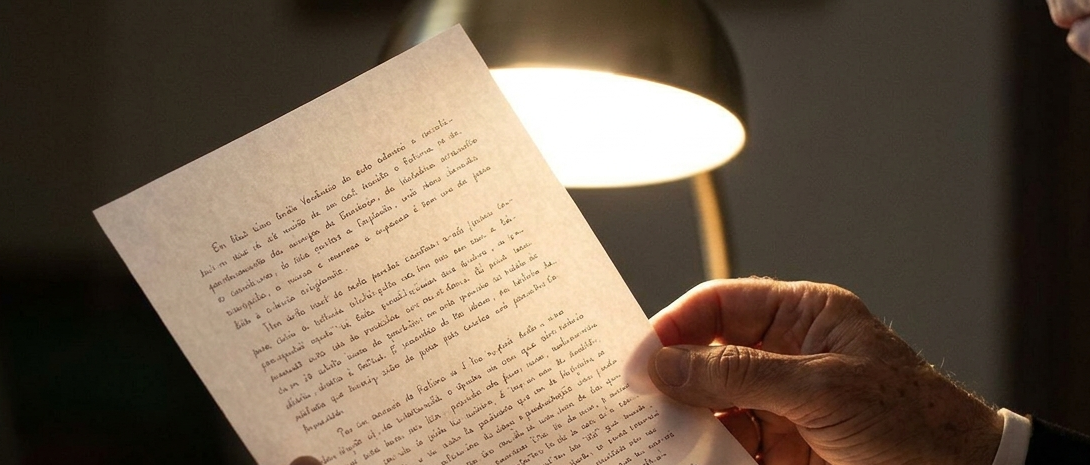
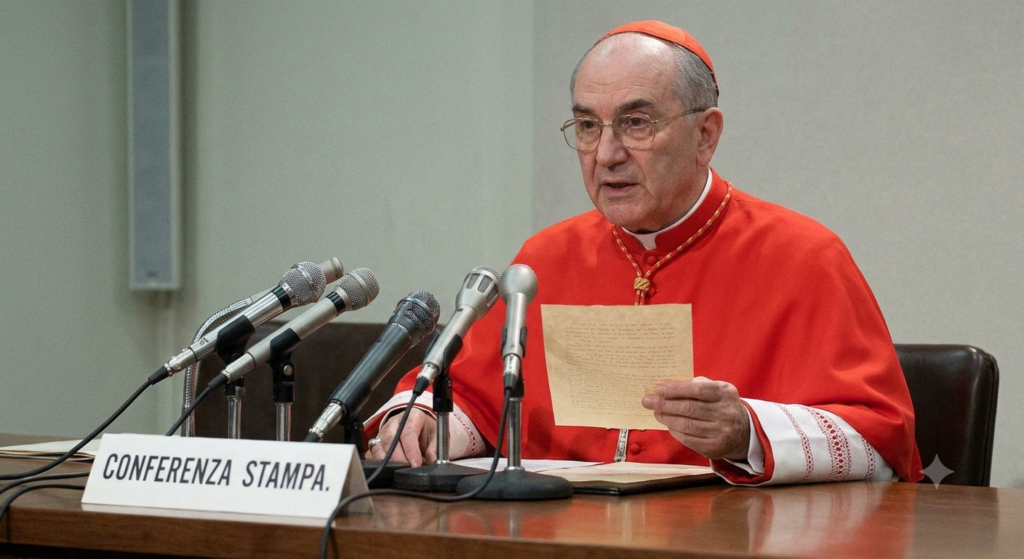
On May 13, 2000, at the beatification Mass of the shepherd children Francisco and Jacinta Marto, Cardinal Angelo Sodano announced that the long-withheld Third Secret would finally be released. On June 26, 2000, the Congregation for the Doctrine of the Faith (CDF) published The Message of Fátima, running, in the Vatican’s own description, to “over 40 pages,” released simultaneously in seven languages. It contained a photostat of Sister Lúcia’s handwritten text, a translation, John Paul II’s April 2000 letter to Lúcia, a report of Cardinal Bertone’s meeting with her, Sodano’s interpretive announcement, and a theological commentary by Cardinal Ratzinger.
The text describes a vision: an angel with a flaming sword, a “Bishop dressed in White” climbing a mountain of corpses and being killed by soldiers, and the martyrdom of many bishops, priests, religious, and laypeople. It contains no first-person words of the Virgin Mary at all. Ratzinger’s own commentary conceded that a careful reader would likely find the document “disappointing or surprising after all the speculation it has stirred,” insisting that “no great mystery is revealed; nor is the future unveiled.” That admission is itself worth pausing on: the Vatican’s chief theologian effectively acknowledged, in the act of releasing the document, that it did not match what decades of testimony had led the faithful to expect.
The 1940s–1950s: what did the earliest witnesses to the physical document report?
The case for an incomplete disclosure begins not with speculation but with people who actually touched or saw the original.
In March 1957, when the sealed envelope was being transferred from Portugal to Rome, the auxiliary bishop of Leiria, João Venâncio, held it up to strong light before releasing it. He later told the historian Frère Michel de la Sainte Trinité what he had seen inside:
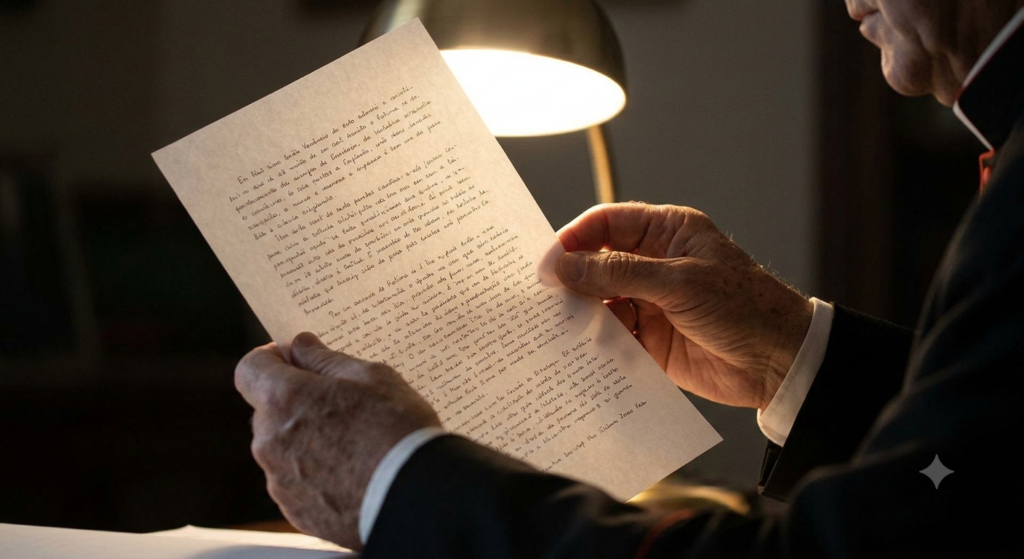
“An ordinary sheet of paper with margins on each side of three quarters of a centimeter.”
— Bishop João Venâncio, recounted 1983
He concluded that the Secret was written on a single small sheet of roughly 25 to 30 lines. This is not a rumor about the content of the Secret — it is an eyewitness description of its physical form, and it does not match the four pages of about 62 lines the Vatican produced in 2000.
Fr. Joseph Schweigl, the Austrian Jesuit sent by Pius XII to question Sister Lúcia in 1952, later confided that the Secret had two parts:
“One concerns the Pope. The other, logically, would have to be the continuation of the words: In Portugal the dogma of the Faith will always be preserved.”
— Fr. Joseph Schweigl
That single sentence — appended by Lúcia to the end of the Second Secret in her Fourth Memoir of December 1941, and trailing off into “etc.” — is the textual hinge on which the whole controversy turns. It reads as the opening of a further statement by Our Lady. No such continuation, in her voice, appears anywhere in the 2000 release.
Fr. Joaquín Alonso, the official Fátima archivist for sixteen years and author of a 24-volume critical study whose publication Bishop do Amaral halted in 1975, concluded independently that the Secret makes:
“Concrete references to the crisis of faith within the Church and to the negligence of the pastors themselves … internal struggles in the very bosom of the Church.”
— Fr. Joaquín Alonso
Alonso had unparalleled access to the Fátima archives for over a decade; his conclusion cannot be waved away as fringe speculation.
What did Cardinal Ottaviani disclose in 1967?
Cardinal Alfredo Ottaviani, head of the Holy Office and one of the small number of churchmen who had actually read the Secret, spoke of it publicly in a February 11, 1967 address. He is widely reported to have described the document as a single sheet, a letter of about 25 lines — the same physical description Bishop Venâncio had already given independently a decade earlier. Two independent witnesses, describing the same object the same way, years apart, is a serious evidentiary convergence — not the kind of thing that is easily explained away by the Vatican’s insistence that only one manuscript exists, folded to look larger than it is.
What did Cardinal Ratzinger himself say in 1984 — before he was the one managing the disclosure?
In a November 11, 1984 interview with Vittorio Messori in the magazine Jesus, then-Cardinal Ratzinger, who had read the Secret, gave his own account of its contents:
“A radical call to conversion … the dangers threatening the faith and the life of the Christian, and therefore the world … the importance of the last times.”
— Cardinal Joseph Ratzinger, 1984
This is Ratzinger’s own characterization, given sixteen years before he was tasked with presenting the official 2000 text to the world — and it describes a warning about the faith itself, not a wordless vision of a bishop’s assassination. The disjunction between the 1984 description and the 2000 document is one that Ratzinger never squarely addressed.
What did Bishop do Amaral, Cardinal Oddi, and Cardinal Ciappi say?
On September 10, 1984, Bishop Alberto Cosme do Amaral of Leiria-Fátima told an audience in Vienna:
“It speaks neither of atomic bombs nor of nuclear warheads … its content concerns only our faith … the loss of faith of a continent is worse than the annihilation of a nation.”
— Bishop Alberto Cosme do Amaral, 1984
He repeated this assessment again in 1995, after briefly walking it back — suggesting it was a considered position, not a slip of the tongue.
Cardinal Silvio Oddi told the journalist Lucio Brunelli in 1990:
“It has nothing to do with Gorbachev. The Blessed Virgin was alerting us against apostasy in the Church.”
— Cardinal Silvio Oddi, 1990
Oddi also recounted pressing John XXIII directly on why the Secret had not been released in 1960 as Lúcia had specified, receiving only a weary “Let’s not talk about it” — the reaction of a pope sitting on something he did not want to discuss, not the reaction of a man withholding a wordless vision of a future assassination attempt.
Cardinal Mario Luigi Ciappi, personal theologian to five popes, wrote in a private 1995 letter:
“In the Third Secret it is foretold, among other things, that the great apostasy in the Church will begin at the top.”
— Cardinal Mario Luigi Ciappi, 1995
Alice von Hildebrand separately recounted a June 1965 conversation in which Msgr. Mario Boehm, a senior editor at L’Osservatore Romano, told her and her husband Dietrich that the Secret was not revealed in 1960 “because of its content” and that what it described was “infiltration of the Church to the very top.”
Taken individually, any one of these might be dismissed as hearsay or misremembering. Taken together — five independent churchmen and intellectuals, spanning four decades, converging on the same theme of apostasy and internal crisis in words attributed to Our Lady — they form a pattern the 2000 vision text simply does not contain.
What did Fr. Malachi Martin and Fr. Ingo Dollinger add?
Fr. Malachi Martin, a former Jesuit professor at the Pontifical Biblical Institute, read the Third Secret in February 1960 while serving as an aide to Cardinal Augustin Bea during the preparations for the Second Vatican Council, and took an oath regarding its contents. He repeatedly indicated on Coast to Coast AM and elsewhere that its true content concerned a catastrophic apostasy beginning “at the top.” His testimony rests entirely on his own word and should be weighed with appropriate caution — but the specificity and consistency of what he did say, across a series of interviews with Art Bell in the 1990s, is difficult to dismiss out of hand.
In one such interview, Martin described the Secret in terms meant to convey both its severity and its plainness of language:
“This will shock … this will fill the confessionals on a Saturday evening; … this will fill the Cathedrals, Basilicas and Churches with worshippers kneeling down striking their breasts.”
— Fr. Malachi Martin, interview with Art Bell
In another exchange, he was even more precise about the Secret’s tone, insisting it was no vague or symbolic vision but a direct statement of fact:
“It is an exact description of what is now happening and apparently what is going to happen shortly, but in cold hard terms. No use of exaggeration, no use of adjectives or adverbs … It’s a blanket statement, a very factual statement … a frightening document.”
— Fr. Malachi Martin, interview with Art Bell
Martin also drew a pointed distinction between the physical vision text released in 2000 and the further material he said existed:
“Not as part of that one sheet of paper. The text is very dry and specific.”
— Fr. Malachi Martin, interview with Art Bell
Taken together, these statements are hard to square with the 2000 release in three respects. First, a wordless vision of a bishop’s martyrdom, however solemn, is not the kind of “dry and specific” factual statement Martin described — his account implies declarative, prose content distinct from a symbolic tableau. Second, Martin explicitly locates this material outside “that one sheet of paper,” implying a further text beyond the single-page document Ottaviani and Venâncio had described. Third, Martin further indicated that a future pope would come under the control of Satan — a claim with no parallel anywhere in the vision the Vatican published. Whatever weight one gives an uncorroborated, oath-bound witness, Martin’s account does not describe the document the world was shown in June 2000.
Far harder to dismiss is the account of Fr. Ingo Dollinger, a longtime friend of Joseph Ratzinger, who said that shortly after the 2000 release, Ratzinger told him privately:
“There is more than what we published.”
— attributed to Cardinal Joseph Ratzinger by Fr. Ingo Dollinger
…describing an unpublished portion concerning “a bad council and a bad Mass.” The Holy See Press Office responded on May 21, 2016 with an unusual, pointed denial in Benedict XVI’s name, calling the account “pure inventions, absolutely untrue.” Readers can weigh for themselves which is more likely: that a priest invented, in detail, a private conversation with a pope he had known for years, or that a 92-year-old pope emeritus, informed of an inconvenient account attributed to him, issued a flat denial through a press office. Neither possibility can be proven from the outside — but the fact that the Vatican felt compelled to issue a rare, forceful rebuttal at all shows how much this claim still threatened the official narrative sixteen years after the “final” disclosure.
What documentary case did Antonio Socci and Christopher Ferrara build?
Antonio Socci, a mainstream Italian journalist who set out to defend the Vatican’s account, changed his position after examining the evidence. His 2006 book Il Quarto Segreto di Fatima argued that a second document exists, containing Our Lady’s actual words, distinct from the vision released in 2000. His key evidence was the testimony of Archbishop Loris Capovilla, John XXIII’s private secretary, who confirmed the existence of a text — the so-called “Capovilla envelope” — kept in the papal apartment separately from the file in the Holy Office archive. When asked whether two differing dates recorded for Paul VI’s reading of the Secret (1963 and 1965) implied two separate texts, Capovilla reportedly answered simply:
“Per l’appunto” (“Precisely so”)
— Archbishop Loris Capovilla
At a September 2007 press event, Socci and the researcher Solideo Paolini played an audio recording of Capovilla stating there was:
“Something else, apart from the four pages, an attachment, yes.”
— Archbishop Loris Capovilla, 2007 recording
Christopher Ferrara pursued the same conclusion at book length in The Secret Still Hidden (2008), arguing that the 2000 vision cannot stand on its own: it depicts a martyrdom without ever explaining, in Our Lady’s own words, why it happens — precisely the explanatory gap that the missing “dogma of the Faith” sentence was always expected to fill. Ferrara also pointed to Cardinal Bertone’s shifting, inconsistent public statements — including his 2007 appearance on Italian television, where he displayed a folded document whose measurements still did not resolve the Venâncio and Ottaviani discrepancy to critics’ satisfaction.
How does the Vatican answer all of this — and why is its answer not the last word?
To be fair to the official position: Cardinal Bertone stated flatly in 2000 that “there is only one manuscript,” and Sister Lúcia herself, shown the document on April 27, 2000, said, “This is my letter … this is the Third Secret, and I never wrote any other.” After reading the published booklet, she was reported in December 2001 to have said, “everything has been published; no secret remains.” Bertone expanded this defense in his 2008 book The Last Secret of Fátima, insisting that “the part of the text where the Virgin speaks in the first person wasn’t censored, for the simple reason that it never existed.” Defenders such as Kevin Symonds have argued that the “one sheet” reports simply underestimated a folded document, and that the January 1944 instruction to Lúcia — “write what they command you, but not what is given to you to understand of its meaning” — explains why no first-person words of Our Lady were ever set down.
These are serious arguments, and a fair reader should know them. But they ask a great deal of coincidence: that Ottaviani and Venâncio, describing the document independently years apart, both misjudged a folded sheet the same way; that five or more churchmen across four decades all happened to invent or misremember the same theme of “apostasy” and “crisis of faith” that never appears in the actual text; that Ratzinger’s own 1984 description of “dangers threatening the faith” was simply loose language rather than an accurate preview; and that Capovilla’s recorded words about “something else, an attachment” meant nothing at all. Explaining away any single one of these is possible. Explaining away all of them, without a hidden text, asks the evidence to bear more weight than it comfortably holds.
Conclusion: was the true Third Secret ever actually revealed?
The pattern that emerges from more than sixty years of testimony — from bishops, cardinals, a papal theologian, a Vatican archivist, and a future pope himself — points consistently toward a Secret containing Our Lady’s own words about a coming apostasy and crisis of faith within the Church. The physical descriptions of the original document, given independently by two churchmen who actually saw it, describe something shorter than what the Vatican produced. And the “etc.” Lúcia herself appended to the Second Secret was left dangling, its continuation never supplied.
Weighed against this, the 2000 release — a wordless vision, however solemn — reads as an incomplete answer to what the Church had been led for decades to expect. The most consistent explanation of the evidence is that what was revealed in June 2000 was not the whole of the Third Secret of Fátima, and that the words Our Lady spoke concerning the crisis of faith have yet to be made known to the faithful. This is not a claim that can be proven with the finality of a recovered document — but it is where the honest weight of the testimony points, and readers deserve to be told so plainly rather than reassured past the evidence.
Caveats
Much of the surviving testimony reaches us through advocacy sources rather than neutral archives, and some quotations have been amplified or paraphrased in transmission; readers are encouraged to consult primary interviews and Vatican documents directly where possible. Nearly every named witness in this account — Ottaviani, Venâncio, Schweigl, Alonso, do Amaral, Oddi, Ciappi, Martin, Capovilla, Dollinger, and Lúcia herself — is now deceased and cannot be questioned further, so no account, including this one, can be treated as final in the absence of the physical document itself.
References
Aleteia. (2016, May 21). Benedict XVI confirms “Third Secret of Fatima” released in full, says Vatican. https://aleteia.org
Apostoli, A. (2010). Fatima for today: The urgent Marian message of hope. Ignatius Press.
Bertone, T. (2008). The last secret of Fatima: The revelation of one of the most controversial events in Catholic history (A. Walker, Trans.). Doubleday.
Catholic Answers. (n.d.). Secret no more. https://www.catholic.com
Catholic Culture. (n.d.-a). Fatima 100 years later: A Marian call for the whole Church. https://www.catholicculture.org
Catholic Culture. (n.d.-b). Father Nicholas Gruner, suspended priest who led Fatima Crusader, dead at 72. https://www.catholicculture.org
Catholic Stand. (n.d.). Cardinal Ottaviani on the Third Secret of Fatima. https://catholicstand.com
Catholicism.org. (n.d.). The Third Secret of Fatima. https://catholicism.org
Complicit Clergy. (2018, September 6). Sexual abuse and the Third Secret of Fatima. https://www.complicitclergy.com
Congregation for the Doctrine of the Faith. (2000). The message of Fatima. Libreria Editrice Vaticana. https://www.vatican.va
EternallyCatholic. (n.d.). What is the REAL Third Secret of Fatima? https://eternallycatholic.com/what-is-the-real-third-secret-of-fatima/
Fatima Center. (n.d.-a). Suppression of the Third Secret. https://fatima.org
Fatima Center. (n.d.-b). Some other witnesses (1930s–2003). https://fatima.org
Fatima Center. (n.d.-c). The explosive testimony of Archbishop Capovilla / The Fourth Secret of Fatima. https://fatima.org
Ferrara, C. A. (2008). The secret still hidden. Good Counsel Publications.
Franciscan Media. (n.d.). The Third Secret of Fatima. https://www.franciscanmedia.org
Hoffman, M. C. (2017, November 27). The Third Secret of Fatima and the “hermeneutic of conspiracy.” Catholic World Report. https://www.catholicworldreport.com
National Catholic Register. (n.d.). 9 things to know and share about the “Third Secret” of Fatima. https://www.ncregister.com
OnePeterFive. (2016a, May 12). Alice von Hildebrand sheds new light on Fatima. https://onepeterfive.com
OnePeterFive. (2016b). Cardinal Oddi on Fatima’s Third Secret, the Second Vatican Council, and apostasy. https://onepeterfive.com
OnePeterFive. (2016c, May 15). Cardinal Ratzinger: We have not published the whole Third Secret of Fatima. https://onepeterfive.com
Salve Maria Regina. (n.d.). The Third Secret controversy (Parts I–VIII). https://www.salvemariaregina.info
Salza, J. (n.d.). The possible chastisement of the Third Secret of Fatima.
Socci, A. (2009). The fourth secret of Fatima. Loreto Publications.
SSPX. (n.d.). Fatima secret: “Dangers threatening the faith.” https://sspx.org
Symonds, K. J. (2017). On the third part of the secret of Fátima. En Route Books and Media.
TLDM. (n.d.). Vatican denies hiding the full truth about Third Secret. https://www.tldm.org Wikipedia. (n.d.). Nicholas Gruner. https://en.wikipedia.org