The Assumption of Mary: What the Dogma Declares and What a Mystic Saw
What Did Pope Pius XII Actually Define in 1950?
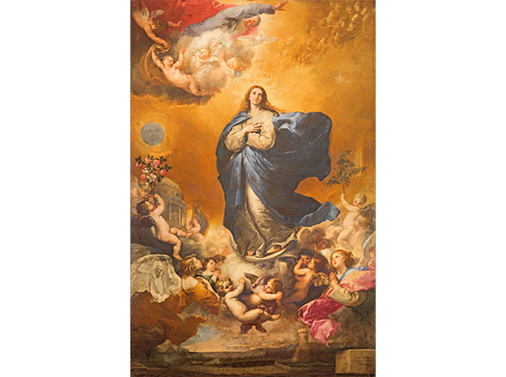
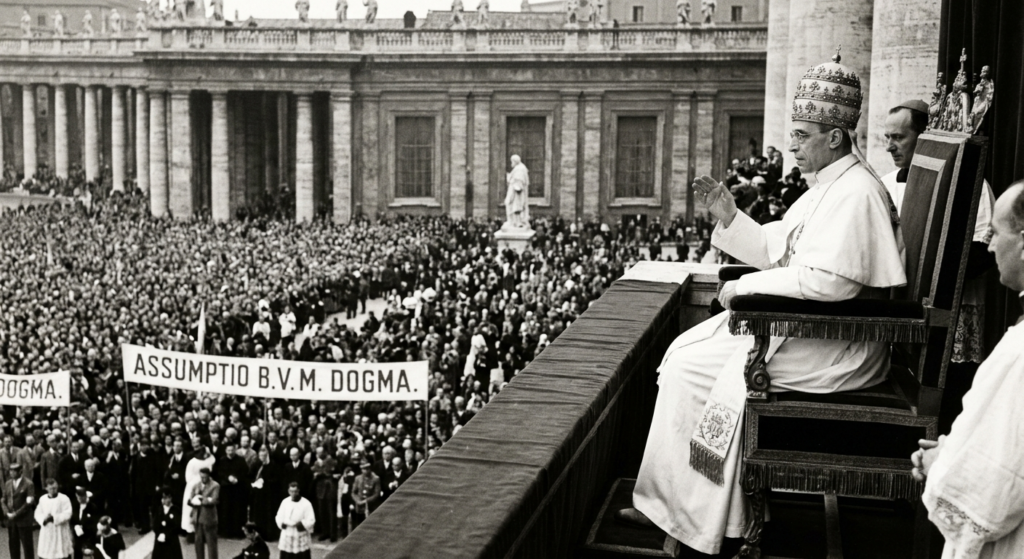
On November 1, 1950 — the feast of All Saints, in the middle of the Holy Year — Pope Pius XII closed a question that had occupied theologians and the faithful for centuries. In his apostolic constitution Munificentissimus Deus, he declared, ex cathedra, that the Immaculate Mother of God, ever a Virgin, having completed the course of her earthly life, was assumed body and soul into heavenly glory (Pius XII, 1950). This was no sudden invention. Pius XII had spent four years gathering the mind of the whole episcopate; of the 1,234 bishops he consulted, roughly ninety-nine percent affirmed that the belief was ready for solemn definition (Pius XII, 1950).
What is notable, and often overlooked, is what the definition does not say. It leaves open the question of whether Mary actually died before being taken into glory, or whether she was assumed without passing through death. The Church chose deliberately not to settle that point.
It is exactly here that a mystic writing three centuries earlier becomes so interesting to read alongside the dogma — because she does settle it, in vivid and specific detail.
Who Was Venerable Mary of Ágreda?
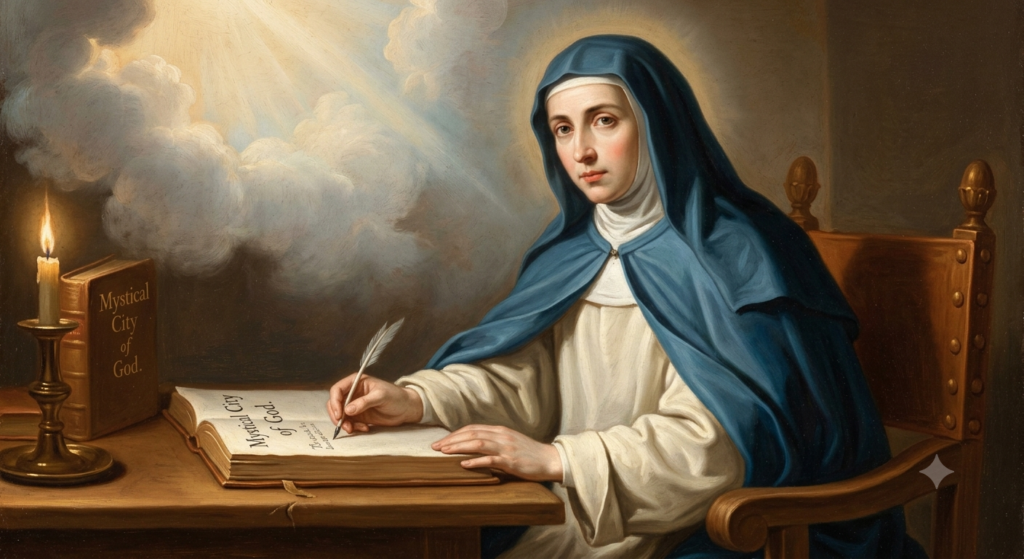
Venerable Mary of Jesus of Ágreda was a seventeenth-century Spanish Conceptionist abbess who claimed to have received an extraordinary series of visions concerning the life of the Blessed Virgin, which she set down at the command of her confessors in a work titled Mystical City of God. The final volume, The Coronation, closes with an extended account of Our Lady’s death, burial, resurrection, and assumption into heaven (Agreda, 1971). The work carries no claim to the authority of dogma or Scripture; it is a private revelation, the kind of writing the Church permits the faithful to read with devotion and prudence, never with an obligation of belief. Read in that spirit, alongside the defined dogma rather than in place of it, it offers a strikingly detailed devotional meditation on the very mystery Pius XII would later define.
What Does the Mystical City of God Say Happened at Mary’s Death?
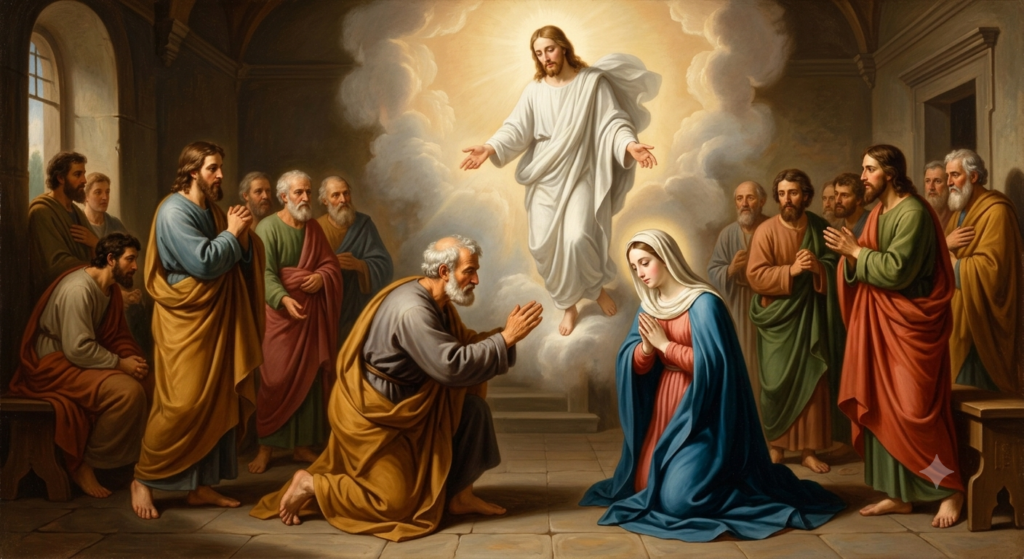
According to Ágreda’s account, three days before her passing, the Apostles were miraculously gathered to the Cenacle in Jerusalem — Peter carried there by an angel from Rome, the others drawn by interior inspiration (Agreda, 1971, para. 732). Each begged Our Lady’s blessing; she in turn knelt before Peter as the vicar of Christ and asked his blessing in return, and later did the same before John, thanking him for the years in which he had sheltered her as his own mother (Agreda, 1971, paras. 733, 737–738).
The most striking scene comes at the hour of her death. Ágreda describes Christ himself descending in glory to the Cenacle and offering his Mother a choice: she could pass into beatific glory without dying at all, since sin — and therefore death, its wage — had no claim on her, or she could freely choose death out of love, in order to be conformed to her Son in every particular of his Passion (Agreda, 1971, paras. 739–740). Mary, Ágreda writes, chose death freely, asking to enter eternal life by the common path of the other children of Adam (Agreda, 1971, para. 740). She died, in this account, not from any sickness or weakness but consumed by the sheer force of her love once the miraculous restraint that had tempered it throughout her life was withdrawn (Agreda, 1971, para. 741).
Why Did Mary Choose to Die at All?
This is the theological heart of Ágreda’s narrative, and she returns to it directly in the instruction she attributes to Mary. Since Mary had no share in original sin, death held no claim over her; had she wished, she could have been taken directly into glory. But because her divine Son had submitted to death though he too was sinless, she judged it fitting to imitate him fully rather than claim an exemption he himself had not claimed (Agreda, 1971, paras. 744–745). In return for that free act of love, Ágreda records, Mary was given a special privilege for all her devout children: whoever invokes her at the hour of death, in memory of her own Transition, is promised her particular protection and intercession in that hour (Agreda, 1971, para. 745).
How Does Ágreda Describe the Resurrection and Assumption of Mary’s Body?
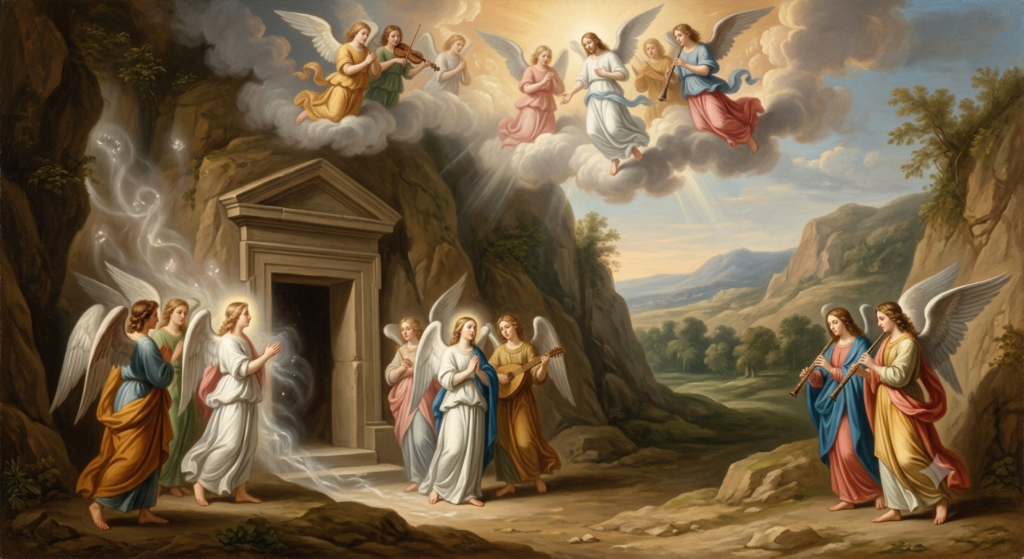
Ágreda’s account does not stop at death. The Apostles buried the sacred body — which neither the two maidens sent to prepare it, nor even Peter and John, were permitted to touch directly, so great was the light surrounding it — in a new sepulchre in the valley of Josaphat, accompanied by choirs of angels, a wonderful fragrance, and the healing of many who were sick (Agreda, 1971, paras. 748–754). For three days the angelic music continued at the tomb, watched over by the thousand angels of her guard (Agreda, 1971, para. 755).
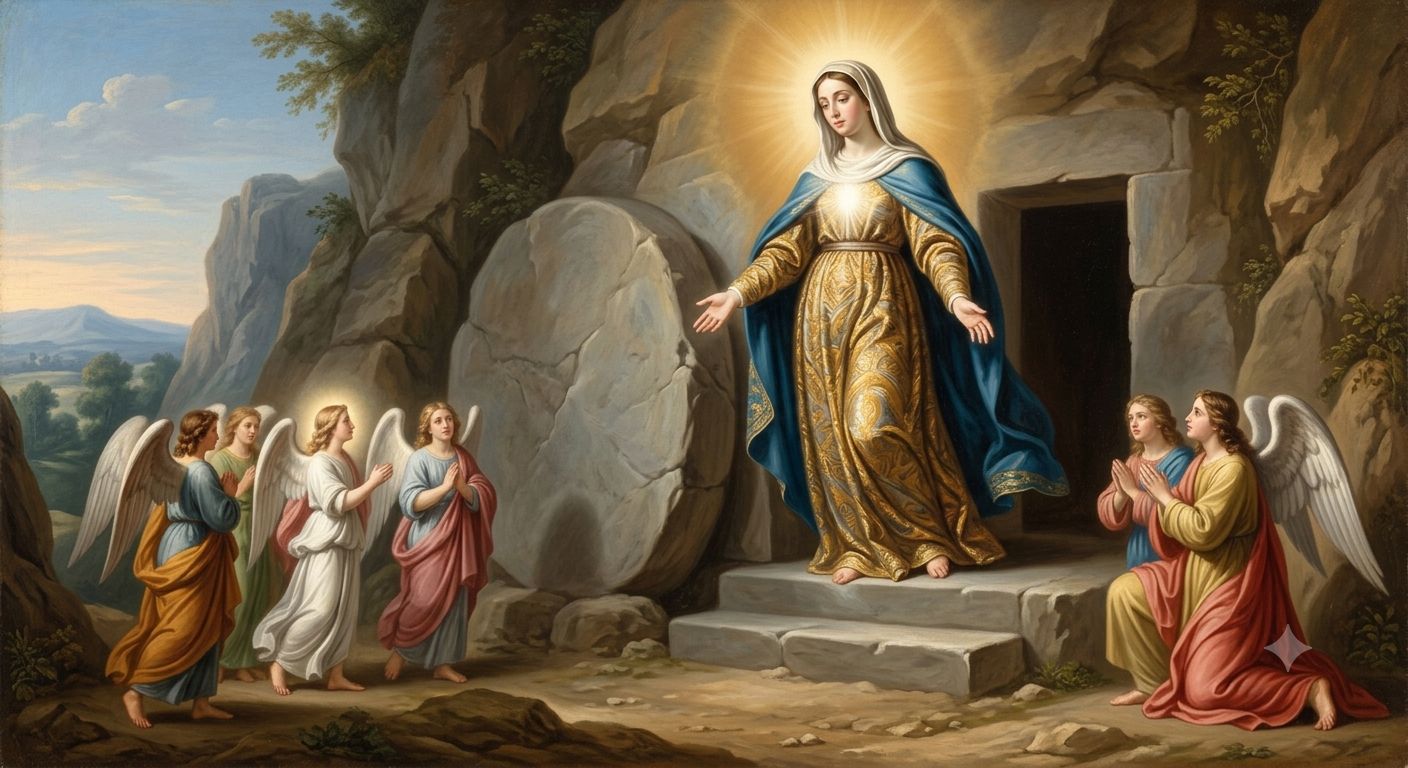
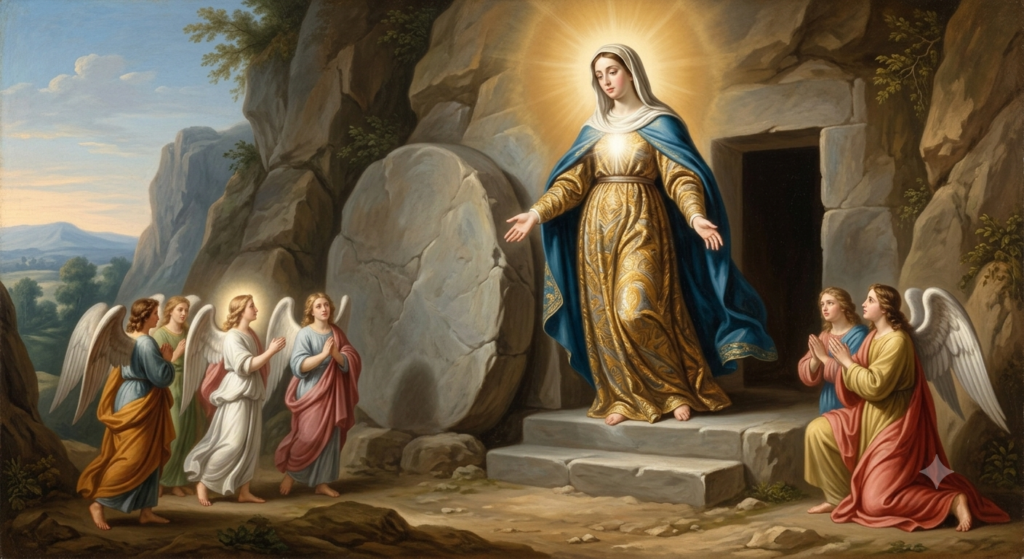
On the third day, Ágreda writes, Christ returned, bringing his Mother’s soul with him, and declared before the assembled saints that since his own flesh had been drawn from hers, and she had shared in the work of the Redemption, she must be raised as he himself had risen, so that she might be made like him in all things (Agreda, 1971, para. 766). Her soul reentered her body, which rose from the tomb without disturbing its stone or wrappings, arrayed, in Ágreda’s words drawn from the psalmist:
“Clothed in the gold of variety” (Agreda, 1971, para. 768; cf. Psalm 44:10, Douay-Rheims).
What Coronation Awaited Her in Heaven?
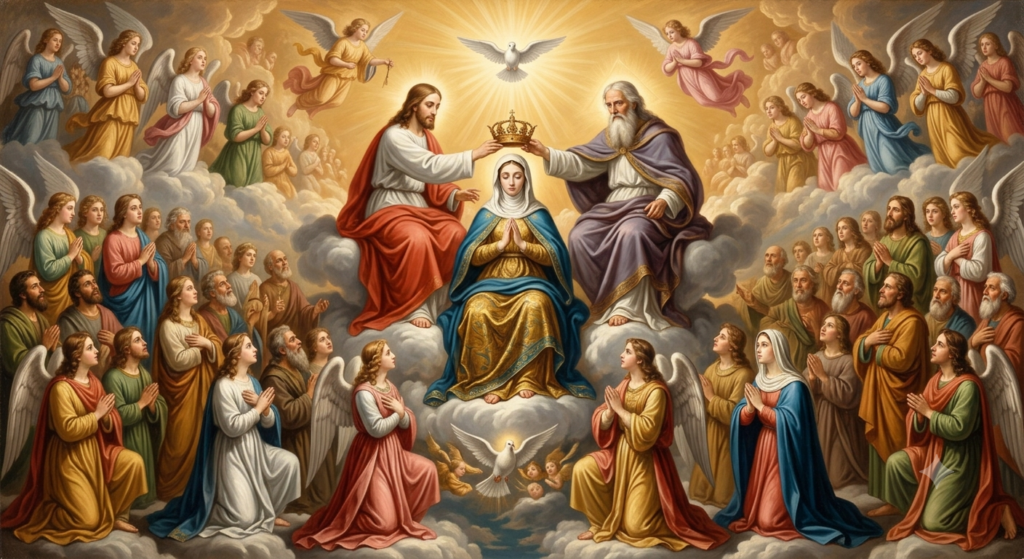
The final chapter describes Mary ascending body and soul to the throne of the Trinity, where, uniquely among all creatures, she is seated with the three Divine Persons rather than merely before them, and is given a place from which she will one day judge the world alongside her Son rather than be judged with the rest of humanity (Agreda, 1971, paras. 762–763). Ágreda records the Eternal Father addressing her, the Incarnate Word rewarding her as his Mother, and the Holy Spirit welcoming his Spouse into the joy that corresponds to a love that was never divided (Agreda, 1971, para. 769).
How Does This Private Revelation Relate to the Defined Dogma?
Munificentissimus Deus deliberately left the manner of Mary’s passing an open question, permitting the faithful to hold either that she underwent death or that she did not (Pius XII, 1950). Ágreda’s visions do not have the authority to close that question either — private revelation, however edifying, never rises to the level of a public dogma binding on the whole Church. What her account does offer is a coherent, prayerful answer to a question the Magisterium chose to leave unresolved, rooted in a theology of loving conformity to Christ: if he who had no debt of death nonetheless died, it was fitting that she who also had no debt of death should die as well, out of the same love that bound her to him at Calvary.
Read this way, the Mystical City of God does not compete with the dogma; it clothes it. The dogma tells the faithful what the Church holds as revealed truth — that Mary was assumed body and soul into heavenly glory. Ágreda’s visions offer one mystic’s detailed, devotional picture of how that truth might have unfolded, offered always in submission to the judgment of the Church.
What Does This Mean for the Faithful Today?
Whatever one makes of the particulars of a seventeenth-century mystic’s visions, the dogma itself stands as settled Catholic teaching: Mary’s Assumption is the pledge of what awaits every soul faithful to Christ — that the body, and not the soul alone, is destined for glory. Ágreda’s account adds a devotional richness to that truth, particularly in its emphasis on Mary’s free and loving choice to die in imitation of her Son, and in the promise she is said to have received: that all who invoke her at the hour of death will find in her a Mother and an advocate. Whether or not one accepts every detail of the vision, that is a hope worth carrying into every Marian feast, and especially into the Solemnity of the Assumption each August 15.
References
Agreda, M. de Jesús de. (1971). Mystical City of God: The divine history and life of the Virgin Mother of God (Vol. 4, The Coronation) (Fiscar Marison, Trans.). Ave Maria Institute. (Original work published 1670)
Pius XII. (1950). Munificentissimus Deus [Apostolic constitution defining the dogma of the Assumption of the Blessed Virgin Mary]. Vatican. https://www.vatican.va/content/pius-xii/en/apost_constitutions/documents/hf_p-xii_apc_19501101_munificentissimus-deus.html