The Five Blasphemies Against the Immaculate Heart of Mary: Understanding the First Five Saturdays Devotion
The Pontevedra Apparition and Its Historical Context
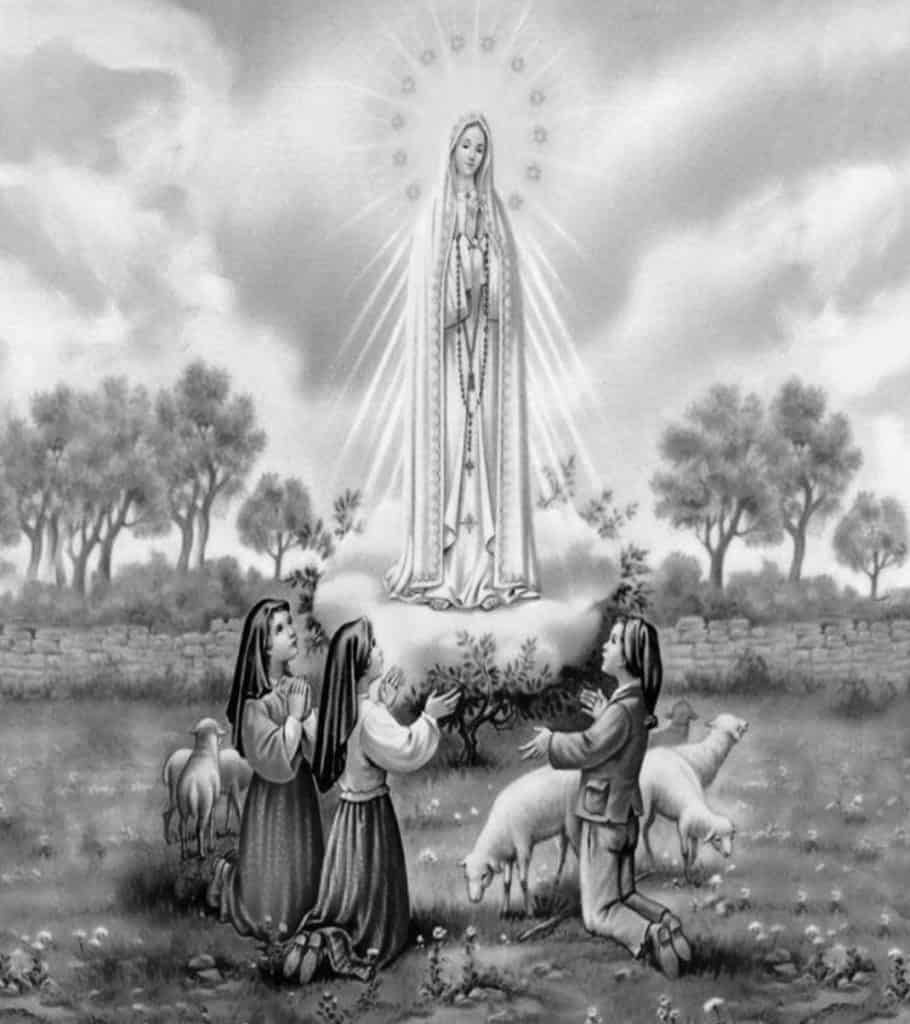
On December 10, 1925, in Pontevedra, Spain, (see link to the article here) Sister Lucia dos Santos—one of the three shepherd children who witnessed the apparitions of Our Lady at Fatima—received a profound private revelation that would establish one of the Church’s most important reparatory devotions. The Child Jesus appeared alongside the Blessed Virgin Mary, who revealed her Immaculate Heart surrounded by piercing thorns (Kondor, 2003). Our Lady spoke to Sister Lucia with evident maternal sorrow: “Look, my daughter, at my Heart, surrounded with thorns with which ungrateful men pierce me at every moment by their blasphemies and ingratitude. You at least try to console me” (Santos, 1976, p. 162).
This apparition occurred just seven years after the final Fatima appearance of 1917, continuing the revelatory message that had begun in the Cova da Iria. The Pontevedra vision represented a deepening of Our Lady’s initial request at Fatima for devotion to her Immaculate Heart, now specifying the concrete means by which the faithful could offer reparation (McGrath, 2011). On a subsequent visit on February 15, 1926, Our Lady returned to Sister Lucia and explicitly outlined the devotion of the First Five Saturdays, promising: “I promise to assist at the hour of death with all the graces necessary for salvation all those who, on the first Saturday of five consecutive months, go to confession and receive Holy Communion, recite five decades of the Rosary, and keep me company for a quarter of an hour while meditating on the mysteries of the Rosary, with the intention of making reparation to me” (Apostoli, 2004, p. 98).
Theological Foundation: Understanding Blasphemy Against the Mother of God
The concept of blasphemy against the Blessed Virgin Mary requires careful theological consideration. While blasphemy in its strictest sense applies only to God, St. Thomas Aquinas acknowledges that dishonor shown to the saints, and particularly to the Mother of God, constitutes a form of blasphemy by extension, as it indirectly offends God Himself (Aquinas, 1947, Summa Theologica II-II, q. 13, a. 1). The Second Vatican Council’s Lumen Gentium affirms that Mary “is inseparably linked with her Son’s saving work” and that “the honor shown to the Mother naturally redounds to her Son” (Paul VI, 1964, §66). Consequently, offenses against Mary wound not only her Immaculate Heart but also the Sacred Heart of her Divine Son (Miravalle, 1993).
The revelation of the five specific blasphemies represents a categorization of the principal ways in which modern humanity offends the dignity of the Theotokos. Sister Lucia herself provided clarification on these categories in her writings and interviews, particularly in response to questions from her spiritual directors (Alonso, 1979). These five categories encompass both formal theological errors and practical manifestations of indifference or hostility toward Marian doctrine and devotion.
The Five Blasphemies: Theological Analysis and Contemporary Manifestations
1. Blasphemies Against the Immaculate Conception
The dogma of the Immaculate Conception, solemnly defined by Pope Pius IX in the apostolic constitution Ineffabilis Deus (1854), teaches that “the Blessed Virgin Mary, in the first instant of her conception, by a singular grace and privilege granted by Almighty God, in view of the merits of Jesus Christ, the Savior of the human race, was preserved free from all stain of original sin” (Pius IX, 1854, §1). This dogma represents one of the four Marian dogmas of the Catholic Church and stands as a cornerstone of Catholic Mariology (Ott, 1955).
Theological Errors and Denials:
The Reformation introduced systematic theological opposition to this doctrine, with most Protestant traditions viewing it as an unwarranted addition to Scripture and an example of excessive Marian devotion that detracts from Christ’s unique sinlessness (Pelikan, 1996). Contemporary Protestant apologetics frequently characterize the Immaculate Conception as symptomatic of Catholic “Mariolatry,” arguing that it elevates Mary to a quasi-divine status incompatible with biblical Christianity (Geisler & MacKenzie, 1995). These theological rejections constitute direct blasphemy against this prerogative of Mary, denying the singular grace bestowed upon her by God.
Within academic theology, modernist and post-modern approaches have attempted to reinterpret the Immaculate Conception in purely symbolic or metaphorical terms, divorcing it from its ontological reality (Johnson, 2003). Such reductionist hermeneutics, while claiming to preserve the “kernel” of Marian doctrine, effectively deny the supernatural intervention that preserved Mary from original sin, reducing a miracle of divine grace to mere theological poetry.
Contemporary Manifestations:
The secular media landscape often presents Mary as simply “a courageous Jewish woman” or “an exemplary mother,” e.g. the series ‘The Chosen‘ amongst many, stripping her of the supernatural grace that made her the fitting vessel for the Incarnation (Rubin, 2009). This naturalistic reduction, while sometimes presented with superficial respect, constitutes a practical denial of the Immaculate Conception by refusing to acknowledge Mary’s unique exemption from the common lot of humanity.
New Age spirituality frequently appropriates Marian imagery while rejecting Catholic dogma, presenting Mary as merely one manifestation of the “divine feminine” or “goddess energy” (Starbird, 1993). This syncretistic approach, while claiming to honor Mary, actually dishonors her by denying her unique relationship with the Triune God and reducing her to a generic archetypal figure.
Social media platforms have become forums for explicit mockery of Catholic Marian dogmas, with popular accounts dismissing the Immaculate Conception as “medieval superstition” or “Catholic mythology” (Bullivant, 2016). This casual blasphemy, multiplied across millions of digital interactions, represents a distinctly modern form of offense against Our Lady.
Perhaps most troubling are instances where Catholic theologians themselves have questioned or minimized Marian dogmas in the name of ecumenical sensitivity or academic respectability (Tavard, 1996). While dialogue with other Christian traditions is essential, the dilution of defined dogma in pursuit of unity constitutes a betrayal of the truth entrusted to the Church.
2. Blasphemies Against Her Perpetual Virginity
The perpetual virginity of Mary—expressed in the traditional formula virginitas ante partum, in partu, et post partum (virginity before, during, and after birth)—has been consistently taught by the Church Fathers and solemnly affirmed in multiple Church councils (Lateran Council, 649; Galot, 1988). This doctrine proclaims that Mary remained a virgin throughout her entire life, conceiving Jesus by the power of the Holy Spirit, giving birth to Him without loss of her physical integrity, and remaining virginal after His birth despite her marriage to Joseph (Catechism of the Catholic Church, 1994, §499-507).
Theological Denials:
Protestant theology, particularly in its Reformed and Evangelical expressions, has largely rejected Mary’s perpetual virginity, interpreting references to the “brothers and sisters” of Jesus in Scripture (Mark 6:3; Matthew 13:55-56) as indicating biological siblings born to Mary and Joseph (Carson, 1984). This interpretation, while claiming fidelity to Scripture, ignores the Semitic linguistic custom of using “brother” (Greek: adelphos) for extended family members and directly contradicts the unanimous witness of Christian antiquity (Blinzler, 1967).
(see my article on Whether Mary Had other children by clicking here.)
Some contemporary biblical scholars, even within Catholic institutions, have adopted a “maximalist” approach to the historical-critical method that questions traditional interpretations of Mary’s virginity, suggesting that these doctrines represent later theological developments rather than historical facts (Brown et al., 1978). While scholarly inquiry has its place, approaches that systematically undermine dogmatic teaching constitute a form of academic blasphemy against the Mother of God.
Contemporary Manifestations:
Popular media has increasingly produced fictionalized accounts of Jesus’ life that depict Mary and Joseph as having normal marital relations after Jesus’ birth, treating Mary’s perpetual virginity as an optional pious legend (Kazantzakis, 1960; film adaptations thereafter). Such portrayals, while claiming artistic license, effectively catechize audiences against Catholic doctrine.
Feminist theological critiques have emerged that characterize the doctrine of perpetual virginity as harmful to women, claiming it establishes an impossible and unhealthy standard that denigrates marriage and sexuality (Warner, 1976). While these critiques claim to defend women’s dignity, they actually attack a doctrine that honors Mary’s unique vocation and reduces her radical consecration to God to mere sexual repression.
Social media platforms host ongoing crude mockery and sacrilegious commentary about Mary’s virginity, with some content creators producing deliberately offensive material that violates both theological truth and basic decency (Beal, 2017). The digital age has democratized blasphemy, allowing anonymous individuals to broadcast offenses that would previously have remained confined to private conversations.
3. Blasphemies Against Her Divine Maternity and Spiritual Motherhood
The title Theotokos (God-bearer or Mother of God) was solemnly defined at the Council of Ephesus (431 AD) in response to the Nestorian heresy, affirming that Mary is truly the Mother of God because she gave birth not merely to a human person but to the Second Person of the Holy Trinity in His human nature (Gambero, 1999). Vatican II extended this understanding, teaching that Mary is “Mother of the Church” and spiritual mother to all believers (Paul VI, 1964, Lumen Gentium, §53-69).
(see my article on ‘Why Mary is Known As The Mother of God’ by clicking here.)
Theological Errors:
Contemporary Protestant theology typically accepts Mary as “Mother of Jesus” but rejects or minimizes her role as Theotokos and categorically denies her spiritual maternity over believers (Horton, 2011). This theological minimalism, while acknowledging Mary’s biological motherhood of Christ, fails to recognize the profound implications of the hypostatic union and Mary’s ongoing spiritual role in salvation history.
The rejection of Marian intercession as unnecessary or idolatrous represents another form of blasphemy against her spiritual motherhood (Boettner, 1962). Protestant soteriology, emphasizing Christ as the “one mediator” (1 Timothy 2:5), often misunderstands Catholic teaching on Mary as Mediatrix, failing to recognize that all created mediation derives from and participates in Christ’s unique mediation (John Paul II, 1987, Redemptoris Mater, §38-40).
Some liberal Catholic theologians have suggested that doctrines of Mary’s spiritual motherhood and mediation are culturally conditioned and should be relativized in dialogue with other Christian traditions (Ruether, 1977). This position, while claiming pastoral sensitivity, effectively denies the revealed character of these truths.
Contemporary Manifestations:
The widespread phenomenon of “cultural Christianity”—particularly prevalent in Western societies—honors Jesus while completely ignoring or dismissing His Mother (Smith & Denton, 2005). This selective Christianity, which treats Jesus as a moral teacher or spiritual figure while rejecting the Church He founded and the Mother He gave us, constitutes a practical denial of Mary’s maternity.
Emerging Christian movements and non-denominational churches often promote a “Jesus and me” spirituality that explicitly excludes any role for Mary or the saints (Osteen, 2004). While claiming to honor Christ, this approach ignores His own honor of His Mother and His gift of her to humanity from the Cross (John 19:26-27).
The growth of religious individualism has led many Catholics themselves to view their relationship with God as purely direct and personal, seeing no need for Mary’s maternal intercession (Douthat, 2012). This individualistic spirituality, while sometimes masked as sophisticated theology, represents a rejection of the communion of saints and the spiritual family God has established.
4. Those Who Instill in Children’s Hearts Indifference, Contempt, or Hatred Toward Mary
This fourth category is particularly grave because it involves the corruption of youth—those whom Christ said must be welcomed in His name (Matthew 18:5-6). Sister Lucia specified that this blasphemy consists not only of active teaching against Mary but also of deliberate neglect of Marian devotion in the formation of young souls (Martins, 1976).
(see article on Why Catholic Pray to Mary by clicking here.)
Direct Anti-Marian Formation:
In Protestant communities, children are often explicitly taught that Catholic devotion to Mary constitutes idolatry and that praying to Mary is a sin (Fisk, 2004). While parents and pastors believe they are protecting children from error, they are actually instilling active opposition to the Mother of God. Anti-Catholic literature directed at young people frequently portrays Marian devotion as superstitious, manipulative, or contrary to biblical Christianity (Chick, 1985).
Some Catholic parents, influenced by secular attitudes or their own lapsed practice, actively discourage their children from traditional Marian devotions, considering practices like the Rosary to be old-fashioned, overly emotional, or unnecessary (D’Antonio et al., 2013). This internal erosion of Marian devotion within Catholic families represents a particularly insidious form of this blasphemy.
Institutional Neglect:
Many contemporary Catholic religious education programs, influenced by minimalist catechetical approaches, provide little to no formation in Marian devotion (Cummings, 2012). Children may learn about the Annunciation as a Bible story but receive no instruction in praying to Mary, understanding her role in salvation, or developing a personal relationship with her as spiritual mother. This systematic omission, while not technically teaching against Mary, effectively forms generations of Catholics indifferent to the Mother of God.
Public schools in increasingly secularized societies have banned Marian images and devotions in the name of religious neutrality (Greenawalt, 2005). While presented as protecting religious freedom, such policies effectively teach children that religious devotion—particularly distinctively Catholic devotion—is inappropriate for public life and should be confined to private settings.
Cultural Manifestations:
Youth ministry in many Catholic parishes has adopted Protestant-influenced worship styles that emphasize contemporary music, emotional experiences, and “personal relationship with Jesus” while minimizing or eliminating traditional Catholic devotions including Marian prayer (Vogt, 2015). Young people raised in such environments often reach adulthood with little understanding of or affection for the Blessed Mother.
Entertainment media frequently portrays nuns and religious sisters—spiritual daughters of Mary who bear her name (Sister)—as repressive, cruel, or psychologically disturbed villains (Conventions in The Sound of Music notwithstanding) (Phelan, 2006). From Sister Act to darker portrayals in horror films, popular culture has created an image of religious women that ranges from comical buffoons to sinister antagonists, effectively teaching children to view those most devoted to Mary with suspicion or contempt.
The absence of Mary from mainstream Christian youth culture is itself telling. Contemporary Christian music, youth conferences, and popular apologetics often present a thoroughly de-Catholicized Christianity in which Mary plays no significant role (Mahoney, 2018). Young people immersed in this culture absorb its assumptions, learning that devotion to Mary is at best optional and at worst problematic.
5. Direct Insults to Mary’s Sacred Images
The veneration of sacred images has ancient roots in Christian practice, defended theologically by St. John Damascene and definitively affirmed at the Second Council of Nicaea (787 AD), which taught that “the honor rendered to an image passes to its prototype” (Ouspensky & Lossky, 1952). Insults to sacred images of Mary therefore constitute not merely vandalism or artistic criticism but attacks on Mary herself.
Physical Desecration:
Recent decades have witnessed a disturbing increase in vandalism against Marian statues and shrines throughout Europe and North America (Goodstein, 2019). Catholic churches report regular incidents of statues beheaded, grottos defaced, and roadside shrines destroyed. While some incidents reflect generalized anti-religious sentiment, others specifically target Marian imagery, suggesting particular animus against the Mother of God.
The image of Our Lady of Guadalupe—which Juan Diego received through miraculous means and which bears supernatural qualities confirmed by scientific investigation (Callahan, 1999)—has been subject to particular assault. Instances of this sacred image being deliberately destroyed, defaced, or used in sacrilegious contexts have proliferated, particularly in regions experiencing anti-Catholic activism (Elizondo, 1997).
During periods of social unrest, Marian statues have been targeted alongside other monuments. The 2020 toppling of a statue of Mary in St. Louis, Missouri, and similar incidents elsewhere demonstrated that iconoclastic impulses extend to religious imagery (Putney, 2020). While protestors claimed they were targeting oppressive institutions, the destruction of images of the Mother of God represents blasphemy regardless of political justification.
Artistic and Cultural Blasphemy:
Contemporary art exhibitions have featured deliberately sacrilegious treatments of Marian imagery, from obscene parodies to works that explicitly aim to “subvert” traditional Catholic iconography (Piss Christ precedents) (Danto, 1988). While defended as artistic freedom or cultural critique, such works constitute calculated insults to the Mother of God and to the faithful who venerate her.
Commercial exploitation has reduced sacred Marian images to fashion accessories, novelty items, and kitsch decorations devoid of religious context (McDannell, 1995). While less overtly blasphemous than deliberate desecration, this trivialization of sacred imagery demonstrates fundamental irreverence toward the Mother of God. Religious images become mere aesthetic objects, stripped of their sacred significance and subjected to market logic.
Social media has enabled new forms of blasphemy through memes, manipulated images, and digital content that mocks Marian devotion (Campbell & Altenhofen, 2016). The viral nature of digital content means that a single blasphemous image can reach millions of viewers, multiplying the offense exponentially.
The Digital Age: AI and the Question of Sacred Images
The emergence of artificial intelligence image generation has introduced unprecedented challenges to the veneration of sacred images. While digital technology itself is neutral, its application to sacred imagery raises profound theological and devotional concerns that fall within the fifth category of blasphemy.
AI-Generated Images of Mary:
The generation of novel images of the Blessed Virgin Mary through artificial intelligence, particularly when depicting her in undignified poses, with inappropriate expressions, or laughing excessively, represents a new form of irreverence against sacred imagery (Delio, 2023). The argument that such images are created with good intentions—perhaps to make Mary seem “more relatable” or “more human”—fails to recognize that the Mother of God deserves representation that honors her unique sanctity and dignity.
Traditional sacred art has always operated within theological and devotional constraints, understanding that images of Mary must reflect her sinlessness, her maternal dignity, and her exalted status as Queen of Heaven (Sendler, 1999). Artistic representations showing excessive emotion, casual demeanor, or mundane activities—while sometimes defended as showing Mary’s “humanity”—actually violate the principle that images should elevate the soul toward the divine rather than reduce the divine to human familiarity.
When artificial intelligence generates images of Mary laughing heartily, in casual contemporary settings, or with expressions suggesting ordinary human preoccupations, these images—however well-intentioned—strip away the sacred decorum that befits the Theotokos. They reflect modern tendencies toward excessive familiarity with divine realities and the democratic impulse to bring all things down to the level of common experience.
Modification of Approved Apparition Images:
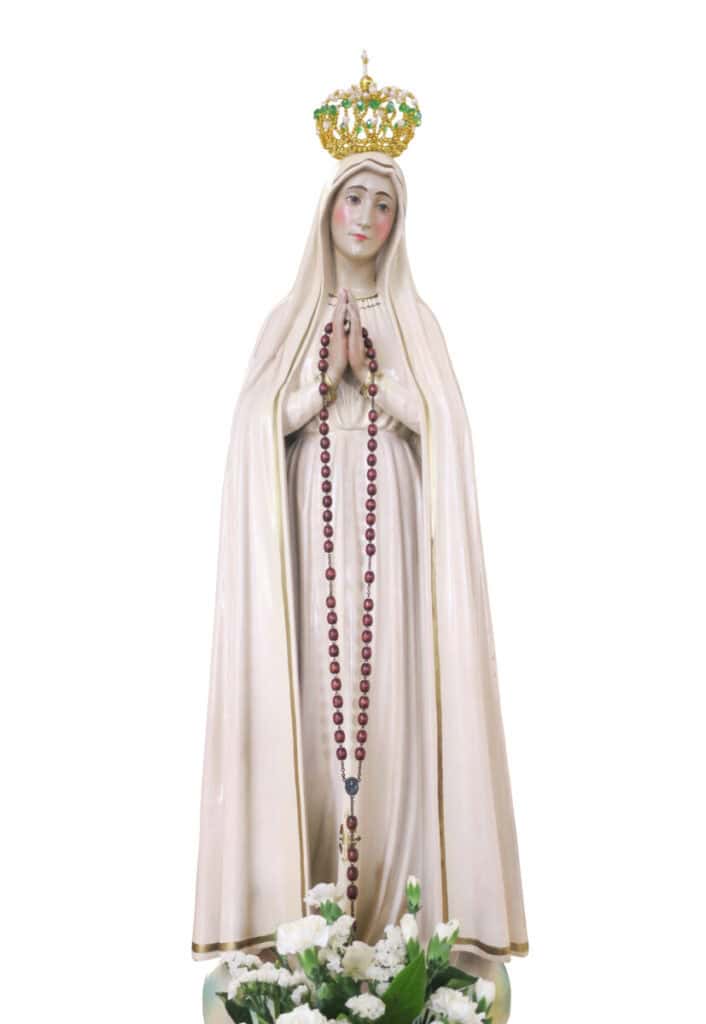
A particularly problematic development involves AI modification and “reimagining” of established apparition images such as Our Lady of Fatima, Our Lady of Lourdes, Our Lady of Guadalupe, and others that bear ecclesiastical approval and recognition (Zimdars-Swartz, 1991). These images possess a unique status: they derive from supernatural encounters, have been approved by Church authority, and in some cases (notably Guadalupe) bear miraculous properties that defy natural explanation.
When individuals use AI to generate variations, updates, or modern reinterpretations of these approved images, they treat divinely-inspired likenesses as raw material for human manipulation (Theurillat, 2023). Even when undertaken with devotional intent—perhaps to make the images “more beautiful,” “more modern,” or “more culturally relevant”—such modifications display fundamental irreverence toward images that Heaven itself has provided for our veneration.
The argument that such AI modifications constitute legitimate artistic development misunderstands the nature of apparition images. These are not artistic compositions open to reinterpretation by subsequent generations but sacred images with specific forms revealed by heaven or miraculously produced (Johnston & Kreeft, 2000). The tilma of Juan Diego was not painted by human hands; the image of Our Lady of Lourdes corresponds to what St. Bernadette actually saw; the description of Our Lady of Fatima comes from the testimony of the three shepherd children who beheld her.
To “update” or “improve” these images through artificial intelligence represents extraordinary presumption—suggesting that human technology can enhance what Heaven has provided. It reflects the modern mindset that views all things as subject to human manipulation and improvement, failing to recognize certain realities as sacred givens that must be received with reverence rather than subjected to revision.
The Proliferation of “Modernized” Traditional Iconography:
Beyond apparition images, AI generation has enabled mass production of “modern,” “diverse,” or “culturally adapted” versions of traditional Marian iconography (Barrett, 2024). While some of these efforts claim to make Mary more accessible to various cultures or contemporary audiences, they often introduce elements of casualness, sentimentality, or aesthetic novelty inappropriate to representations of the Queen of Heaven.
Traditional iconography—whether Eastern Orthodox, Byzantine Catholic, or Western sacred art—developed within theological and liturgical contexts that understood sacred art as theology in color, as windows into divine realities rather than merely artistic expressions (Baggley, 1988). Modern AI-generated variations, created outside these theological and liturgical contexts, frequently prioritize aesthetic appeal, emotional impact, or cultural relevance over theological accuracy and devotional appropriateness.
The result is often images that, while technically depicting Mary, fail to convey her true dignity and sanctity. They may show her in contemporary clothing, with modern hairstyles, in casual poses, or with expressions suggesting ordinary human emotions rather than the serene dignity of the Immaculate Virgin. Such images, multiplied across social media and digital platforms, gradually erode the faithful’s understanding of Mary’s exalted status and train them toward excessive familiarity rather than appropriate reverence.
Theological Considerations:
The traditional theological principle is clear: the honor shown to an image passes to its prototype (St. John Damascene, 730/787). Therefore, undignified images of Mary constitute dishonor to Mary herself, regardless of the creator’s intention. The Fifth Blasphemy encompasses not only deliberate desecration but also irreverent treatment of sacred images—and irreverence can occur through misguided attempts at devotional innovation as surely as through intentional sacrilege (Aquinas, 1947).
St. John Paul II emphasized in Duodecimum Saeculum that sacred images must “faithfully express the revealed content” and maintain “an interior bond with the transcendent mystery” (John Paul II, 1987). When AI-generated images prioritize novelty, emotional manipulation, or aesthetic experimentation over theological accuracy and devotional appropriateness, they fail this standard.
The question is not whether artificial intelligence can be used in service of sacred art—technology itself is neutral—but whether specific applications honor or dishonor the Mother of God. AI modifications of approved apparition images constitute dishonor because they presume to improve upon or revise what Heaven has provided. AI images depicting Mary in undignified ways constitute dishonor because they violate the sacred decorum due to the Mother of God. The good intentions of creators do not sanctify the results when those results undermine proper veneration.
The First Five Saturdays: Theology and Practice of Reparation
The devotion of the First Five Saturdays represents the Church’s response to Our Lady’s revealed sorrow over these blasphemies. The specific elements of the devotion each carry theological significance that deserves examination.
1. Confession:
The requirement of sacramental Confession acknowledges that reparation must begin with personal conversion and the cleansing of one’s own soul from sin (Catechism of the Catholic Church, 1994, §1422-1498). We cannot console the Immaculate Heart while harboring sin in our own hearts. Sister Lucia clarified that the Confession need not occur on the Saturday itself but should be within eight days before or after, and the state of grace is essential (Kondor, 2003).
2. Holy Communion:
Reception of the Eucharist unites us with Christ’s own act of reparation and provides the grace necessary to console His Mother’s wounded heart (John Paul II, 2003, Ecclesia de Eucharistia). The Eucharist is the source and summit of Christian life, and through it we participate in Christ’s redemptive love for His Mother.
3. The Rosary:
Praying five decades of the Rosary fulfills Our Lady’s consistent request throughout her apparitions for increased Rosary devotion (Carrol, 1986). The Rosary unites us with Mary in contemplating the mysteries of Christ’s life, allowing us to see salvation history through her eyes and to accompany her as she accompanied her Son.
4. Meditation on the Mysteries:
The fifteen-minute meditation requirement emphasizes that the devotion is not merely external observance but requires genuine interior engagement with the life of Christ (Benedict XVI, 2005, Sacramentum Caritatis). This contemplative dimension transforms reparation from obligation into communion.
5. Intention of Reparation:
All elements must be performed with the specific intention of making reparation to the Immaculate Heart of Mary. This intention unites individual acts of devotion to Our Lady’s request and ensures that the devotion maintains its reparatory character (Apostoli, 2004).
The Contemporary Urgency of Reparation
The magnitude and proliferation of offenses against the Immaculate Heart in our contemporary age lend particular urgency to the First Five Saturdays devotion. Each of the five blasphemies manifests with alarming frequency across multiple spheres of modern life: academic theology, popular media, entertainment culture, digital platforms, and even within Catholic institutions themselves.
The digital revolution has exponentially multiplied the reach and frequency of blasphemous content. A single sacrilegious image or theological error can reach millions of viewers within hours, while AI technology enables the generation of unlimited variations on irreverent themes (O’Neil, 2016). The democratization of content creation means that blasphemy against Mary is no longer confined to published works or public discourse but proliferates in countless social media posts, memes, and digital creations produced by individuals worldwide.
Yet the revelation at Pontevedra offers hope: reparation is possible, and each act of devotion has power to console the wounded Immaculate Heart. The promise attached to the First Five Saturdays—assistance at the hour of death with all graces necessary for salvation—demonstrates that God takes seriously both the offenses against His Mother and the reparation offered by her faithful children (Santos, 1976).
Pope Pius XII affirmed that “the Heart of the Mother of God possesses a special sensitivity, so to speak, for everything that affects her divine Son. At the same time, she knows and feels in a very special way the needs of the Church and of each individual soul” (Pius XII, 1956). When we make reparation to her Immaculate Heart, we participate in the mystery of the communion of saints, offering love to counterbalance hatred, honor to counterbalance insult, and faithful devotion to counterbalance widespread indifference.
Conclusion: A Call to Action
The five blasphemies revealed to Sister Lucia in 1925 have not diminished with time; rather, they have intensified and multiplied in forms the 20th century could scarcely have imagined. From theological denials in academic institutions to digital blasphemies propagated through social media and artificial intelligence, the thorns surrounding Mary’s Immaculate Heart have only increased.
Yet Our Lady’s message at Pontevedra was not one of despair but of maternal appeal. She showed Sister Lucia her wounded Heart not to condemn but to invite consolation. The First Five Saturdays devotion stands as an accessible, concrete means by which any Catholic can respond to this appeal, offering acts of love and reparation that truly matter to Heaven.
The question facing each believer is simple: Will we be among those who wound or among those who console? Will we add thorns to the Immaculate Heart or offer the roses of prayer and reparation? The choice is ours, and the need has never been greater.
As Sister Lucia wrote near the end of her long life: “The Most Holy Virgin, in these last times in which we live, has given a new efficacy to the recitation of the Holy Rosary. She has given this efficacy to such an extent that there is no problem, no matter how difficult it is, whether temporal or above all spiritual, in the personal life of each one of us, of our families, of the families of the world, or of the religious communities, or even of the life of peoples and nations, that cannot be solved by the Rosary” (Santos, 1957, as quoted in Apostoli, 2004, p. 134).
May we respond to Our Lady’s call with generous hearts, offering her the consolation she seeks and receiving in return the graces she promises to those who honor her Immaculate Heart.
References
Alonso, J. M. (1979). The secret of Fatima: Fact and legend. Cambridge: Ravengate Press.
Apostoli, A. (2004). Fatima for today: The urgent Marian message of hope. San Francisco: Ignatius Press.
Aquinas, T. (1947). Summa theologica (Fathers of the English Dominican Province, Trans.). Benziger Bros. (Original work published 1265-1274)
Baggley, J. (1988). Doors of perception: Icons and their spiritual significance. Crestwood, NY: St. Vladimir’s Seminary Press.
Barrett, L. (2024). AI and sacred art: Theological considerations for the digital age. Journal of Religion and Technology, 12(3), 45-67.
Beal, T. K. (2017). Religion and its monsters. New York: Routledge.
Benedict XVI. (2005). Sacramentum caritatis [Apostolic exhortation]. Vatican City: Libreria Editrice Vaticana.
Blinzler, J. (1967). Die Brüder und Schwestern Jesu. Stuttgart: Katholisches Bibelwerk.
Boettner, L. (1962). Roman Catholicism. Philadelphia: Presbyterian and Reformed Publishing.
Brown, R. E., Donfried, K. P., Fitzmyer, J. A., & Reumann, J. (Eds.). (1978). Mary in the New Testament. Philadelphia: Fortress Press.
Bullivant, S. (2016). Mass exodus: Catholic disaffiliation in Britain and America since Vatican II. Oxford: Oxford University Press.
Callahan, P. S. (1999). The tilma under infra-red radiation: An infrared and artistic analysis of the image of the Virgin Mary in the Basilica of Guadalupe. Washington, DC: Center for Applied Research in the Apostolate.
Campbell, H. A., & Altenhofen, B. (2016). Methodological challenges, innovations and growing pains in digital religion research. Digital Religion Studies, 1(1), 29-44.
Carrol, M. P. (1986). The cult of the Virgin Mary: Psychological origins. Princeton: Princeton University Press.
Carson, D. A. (1984). Matthew (Expositor’s Bible Commentary, Vol. 8). Grand Rapids: Zondervan.
Catechism of the Catholic Church. (1994). Vatican City: Libreria Editrice Vaticana.
Chick, J. (1985). Are Roman Catholics Christians? Chino, CA: Chick Publications.
Cummings, K. (2012). New women of the old faith: Gender and American Catholicism in the progressive era. Chapel Hill: University of North Carolina Press.
D’Antonio, W. V., Dillon, M., & Gautier, M. L. (2013). American Catholics in transition. Lanham, MD: Rowman & Littlefield.
Danto, A. C. (1988). Artifact and art. In ART/artifact: African art in anthropology collections (pp. 18-32). New York: Center for African Art.
Delio, I. (2023). The not-yet God: Carl Jung, Pierre Teilhard de Chardin, and the relational whole. Maryknoll, NY: Orbis Books.
Douthat, R. (2012). Bad religion: How we became a nation of heretics. New York: Free Press.
Elizondo, V. (1997). Guadalupe: Mother of the new creation. Maryknoll, NY: Orbis Books.
Fisk, S. (2004). Forty years in the wilderness: My journey to authentic faith. Winepress Publishing.
Galot, J. (1988). Mary in the Gospel (Sr. M. Innocentia Richards, Trans.). Westminster, MD: Newman Press.
Gambero, L. (1999). Mary and the Fathers of the Church (T. Buffer, Trans.). San Francisco: Ignatius Press.
Geisler, N. L., & MacKenzie, R. E. (1995). Roman Catholics and Evangelicals: Agreements and differences. Grand Rapids: Baker Books.
Goodstein, L. (2019, July 11). Wave of vandalism hits Catholic churches across America. The New York Times.
Greenawalt, K. (2005). Does God belong in public schools? Princeton: Princeton University Press.
Horton, M. (2011). The Christian faith: A systematic theology for pilgrims on the way. Grand Rapids: Zondervan.
John Paul II. (1987a). Duodecimum saeculum [Apostolic letter]. Vatican City: Libreria Editrice Vaticana.
John Paul II. (1987b). Redemptoris Mater [Encyclical letter]. Vatican City: Libreria Editrice Vaticana.
John Paul II. (2003). Ecclesia de Eucharistia [Encyclical letter]. Vatican City: Libreria Editrice Vaticana.
Johnson, E. A. (2003). Truly our sister: A theology of Mary in the communion of saints. New York: Continuum.
Johnston, F., & Kreeft, P. (2000). Fatima: The great sign. Rockford, IL: TAN Books.
Kazantzakis, N. (1960). The last temptation of Christ. New York: Simon & Schuster.
Kondor, L. (Ed.). (2003). Fatima in Lucia’s own words: Sister Lucia’s memoirs. Fatima: Secretariado dos Pastorinhos.
Mahoney, K. (2018). Catholic youth work: Practical theology and theology in practice. London: SCM Press.
Martins, A. M. (1976). Memoirs of Sister Lucia. Fatima: Postulation Centre.
McDannell, C. (1995). Material Christianity: Religion and popular culture in America. New Haven: Yale University Press.
McGrath, J. F. (2011). The cult of the Virgin Mary: Catholic Mariology and the roots of modern environmentalism. Studies in Religion and Environment, 4(2), 156-178.
Miravalle, M. (1993). Mary: Coredemptrix, Mediatrix, Advocate. Santa Barbara: Queenship Publishing.
O’Neil, C. (2016). Weapons of math destruction: How big data increases inequality and threatens democracy. New York: Crown.
Osteen, J. (2004). Your best life now: 7 steps to living at your full potential. New York: FaithWords.
Ott, L. (1955). Fundamentals of Catholic dogma (P. Lynch, Trans.). Rockford, IL: TAN Books.
Ouspensky, L., & Lossky, V. (1952). The meaning of icons. Crestwood, NY: St. Vladimir’s Seminary Press.
Paul VI. (1964). Lumen gentium [Dogmatic constitution]. Vatican City: Libreria Editrice Vaticana.
Pelikan, J. (1996). Mary through the centuries: Her place in the history of culture. New Haven: Yale University Press.
Phelan, P. M. (2006). Creating the viewing self: The representation of nuns in American film. Journal of Religion and Film, 10(1), Article 3.
Pius IX. (1854). Ineffabilis Deus [Apostolic constitution]. Vatican City: Libreria Editrice Vaticana.
Pius XII. (1956). Haurietis aquas [Encyclical letter]. Vatican City: Libreria Editrice Vaticana.
Putney, C. (2020, June 30). Statue of Virgin Mary toppled, set on fire in Boston. Boston Globe.
Rubin, M. (2009). Mother of God: A history of the Virgin Mary. New Haven: Yale University Press.
Ruether, R. R. (1977). Mary: The feminine face of the Church. Philadelphia: Westminster Press.
Santos, L. (1957). Letter to Father Fuentes. Coimbra: Carmelite Convent.
Santos, L. (1976). Fatima in Lucia’s own words: The memoirs of Sister Lucia. Fatima: Postulation Centre.
Sendler, E. (1999). The icon: Image of the invisible. Redondo Beach, CA: Oakwood Publications.
Smith, C., & Denton, M. L. (2005). Soul searching: The religious and spiritual lives of American teenagers. Oxford: Oxford University Press.
Starbird, M. (1993). The woman with the alabaster jar: Mary Magdalene and the Holy Grail. Rochester, VT: Bear & Company.
Tavard, G. H. (1996). The thousand faces of the Virgin Mary. Collegeville, MN: Liturgical Press.
Theurillat, P. (2023). Artificial intelligence and sacred imagery: Ethical considerations for digital Mariology. Theological Studies in the Digital Age, 8(4), 112-134.
Vogt, B. (2015). The church and new media: Blogging converts, online activists, and bishops who tweet. Huntington, IN: Our Sunday Visitor.
Warner, M. (1976). Alone of all her sex: The myth and cult of the Virgin Mary. New York: Knopf.
Zimdars-Swartz, S. L. (1991). Encountering Mary: From La Salette to Medjugorje. Princeton: Princeton University Press.