Chronicle of Marian Apparitions, Part 1: From the Apostolic Age to the Renaissance
Chronicle of Marian Apparitions, Part 1
From the Apostolic Age to the Renaissance: Our Lady of the Pillar to Our Lady of the Guard (40 AD–1490)
Long before Lourdes or Fatima entered the popular imagination, the Blessed Virgin Mary was already making herself known to the faithful across the Christian world. This first installment in a six-part chronicle examines five of the earliest reported Marian apparitions, spanning nearly a millennium and a half of Church history, from the Apostolic era in Roman Spain to Renaissance Italy. Each account, transmitted through local tradition, ecclesiastical record, and centuries of pilgrimage, reveals a consistent pattern: Mary appearing not for her own sake, but to draw souls toward her Son, to comfort the discouraged, and to establish places where grace could be sought with confidence.
What Happened at Our Lady of the Pillar in Zaragoza, Spain (40 AD)?
Zaragoza, Spain — 12 October, AD 40 (traditional date) — Witness: the Apostle James the Greater
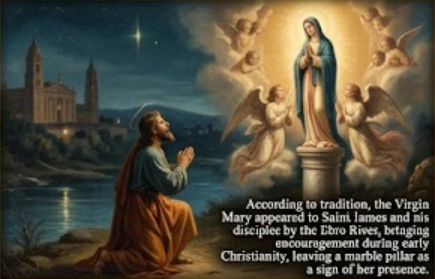
According to a tradition reaching back to the earliest centuries of the Spanish Church, the Apostle James the Greater travelled to Roman Hispania to evangelize the region but met with little success. Discouraged, he and a handful of disciples prayed one night on the banks of the Ebro River near the city then called Caesaraugusta, now Zaragoza. Tradition holds that the Virgin Mary, still living in Jerusalem at the time, was carried by angels to console him, appearing atop a pillar of jasper or marble (Wikipedia, n.d.-a). This is remembered as the only Marian apparition said to have occurred during Mary’s earthly life, made possible, in pious tradition, through bilocation. She asked that a chapel be built on the spot, promising it would stand until the end of time as a place of intercession (206 Tours, 2025). James and his disciples built the first shrine ever raised in Mary’s honor, and the pillar itself, now encased in silver, remains venerated in the Basilica of Our Lady of the Pillar, which survived unexploded bombing during the Spanish Civil War (Roman Catholic Saints, n.d.).
What Was Our Lady’s Message at the Pillar?
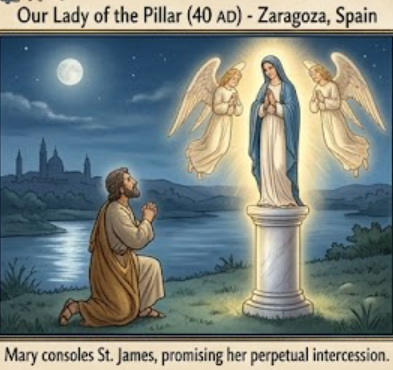
“It will stand from that moment until the end of time, in order that God may work miracles and wonders through my intercession.”
The apparition’s message centers on perseverance in mission and the enduring power of Mary’s intercession. James had judged his labors a failure; Our Lady’s appearance reassured him that fruit would come from his sacrifice and that a permanent house of prayer, sustained by her patronage, would outlast every attack against it. The devotion has since become bound up with Hispanic Catholic identity across Spain and Latin America.
What Happened at Our Lady of the Snows in Rome, Italy (352)?
Esquiline Hill, Rome, Italy — 5 August, 352
In the middle of the fourth century, a wealthy and childless Roman couple, remembered simply as John and his wife, resolved to leave their fortune to the Virgin Mary and asked her to reveal how it should be used. According to the legend recorded in the Catholic Encyclopedia and repeated in shrine histories, Mary appeared to the couple in a dream on the night of 4–5 August, telling them to build a church on the site that would be marked out by snow (Americaneedsfatima.org, 2023). The same night she appeared to Pope Liberius with an identical instruction. On the morning of 5 August, in the height of the Roman summer, snow was found blanketing the crown of the Esquiline Hill in the exact outline of a church. The basilica raised on the spot, later enlarged and rededicated after the Council of Ephesus affirmed Mary as Mother of God in 431, is known today as the Basilica of St. Mary Major, the largest church in the world dedicated to Our Lady (National Catholic Register, 2021).
What Was Our Lady’s Message at the Snows?
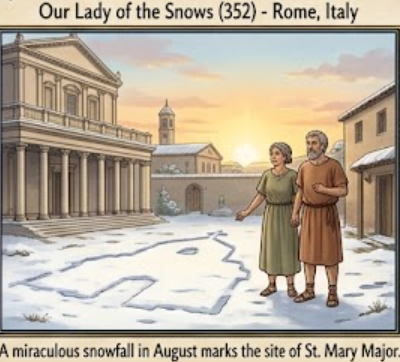
The Snows apparition carries no verbal message in the historical accounts; its significance lies instead in the sign itself. A miraculous, out-of-season snowfall on a summer night testified that a place set apart for Mary’s honor should be built with the resources God provides, and that Mary’s purity and intercession, symbolized by the whiteness of snow, are freely given to all who seek her patronage. The feast is still marked every 5 August with a shower of white rose petals inside the basilica.
What Happened at Our Lady of Walsingham in Norfolk, England (1061)?
Little Walsingham, Norfolk, England — 1061 — Witness: Richeldis de Faverches
During the reign of Saint Edward the Confessor, a devout Anglo-Saxon noblewoman and widow named Richeldis de Faverches prayed to know how she might honor the Blessed Virgin in a special way. According to the fifteenth-century Pynson Ballad, the earliest surviving account, Mary appeared to her three times, leading her in spirit to Nazareth and showing her the house of the Annunciation, asking that an exact replica, the Holy House, be built at Walsingham as a perpetual memorial of the message that redemption began there (EWTN Great Britain, 2025).
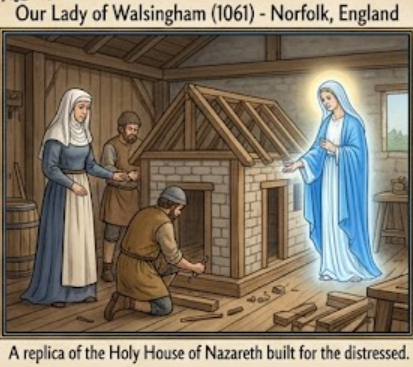
Richeldis was shown a dew-drenched meadow with two dry patches to mark the site, and, after her workmen struggled to complete the structure, it is said to have been finished overnight after a night of her prayer, seemingly with angelic assistance (Walsingham.org.uk, n.d.). An Augustinian priory later took charge of the shrine, and Walsingham became one of medieval Europe’s four great pilgrimage sites, visited by every English king from Henry III to Henry VIII before its destruction in the Reformation.
What Was Our Lady’s Message at Walsingham?
“To all that seek me there shall be given succour.”
Mary’s words to Richeldis emphasized Walsingham as a refuge for the distressed and needy, a place where the joy of the Annunciation, God’s humble entry into the world through her consent, could be relived by pilgrims of every age (Catholic Education Resource Center, n.d.). The apparition underscores Mary’s continuing maternal care and her desire that ordinary people, not only the great, have a place to bring their sorrows.
What Happened at Our Lady of Le Puy in France (First Century Tradition)?
Le Puy-en-Velay, Haute-Loire, France — traditionally dated to the first century
The shrine of Notre-Dame du Puy, crowning the volcanic peak of Mont Anis in the Auvergne region of France, traces its origin to a local woman named Vila who suffered for years from an incurable fever.
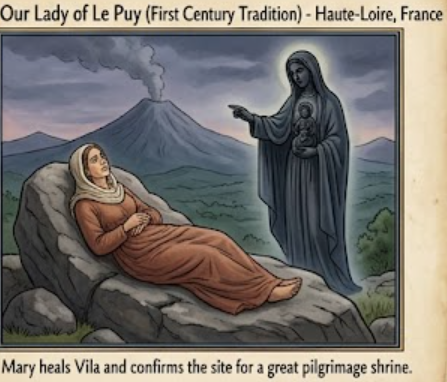
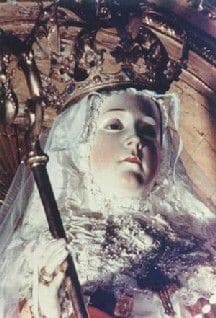
According to tradition preserved by the sanctuary, the Virgin Mary appeared to her and directed her to lie upon a stone believed to have healing power, promising that her cure would be the sign to convince the local bishop, Saint George, to build a church in her honor there (Militia Immaculatae, 2022). Vila awoke healed and delivered the message; two further wonders, an out-of-season summer snowfall outlining the church and a deer marking its plan with its antlers, confirmed the site. A dark-hued statue of Our Lady, venerated for centuries as the Black Madonna of Le Puy and visited by pilgrim kings from Charlemagne to Saint Louis IX, still presides over the cathedral’s high altar, the original having been burned by revolutionaries in 1794 and later reconstructed (Catholic Culture, n.d.).
What Was Our Lady’s Message at Le Puy?
As with the Snows in Rome, the message at Le Puy is conveyed through healing and sign rather than speech: Mary’s intercession restores health and, in doing so, calls a whole region into the practice of the faith. The shrine became, and remains, a principal starting point for pilgrims walking the Way of Saint James toward Santiago de Compostela, linking devotion to Mary with the wider apostolic mission begun by James in Spain.
What Happened at Our Lady of the Guard in Genoa, Italy (1490)?
Mount Figogna, near Genoa, Italy — 29 August, 1490 — Witness: Benedetto Pareto
On 29 August 1490, a humble peasant named Benedetto Pareto was on Mount Figogna, above Genoa, when the Virgin Mary appeared to him and asked that a chapel be built in her honor on the spot. Pareto, a poor man, protested that he could never afford such a project; Mary answered simply, “Be not afraid” (MaryPages, n.d.). Fearing ridicule, and discouraged further by his wife, Pareto kept silent until, some days later, he was gravely injured in a fall from a tree. Mary appeared to him a second time and healed him instantly, an event that finally convinced him, and his neighbors, to act. He built the first small chapel himself; a larger shrine followed in 1530, and a notarial record from that year, preserved in the Genoa archdiocesan archives, still attests to witness testimony supporting the apparition (Santuari e Miracoli, n.d.). The present basilica, Nostra Signora della Guardia, was consecrated in 1901 and remains one of Liguria’s principal pilgrimage sites.
What Was Our Lady’s Message at the Guard?
“Do not be afraid. I am the Queen of Heaven and have come to you with My Divine Son.”
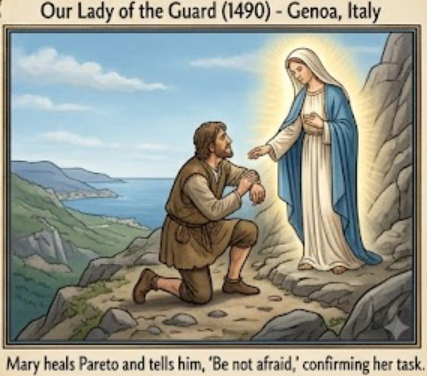
The apparition to Pareto is above all a message of confidence: Mary asks a task that seems beyond human means and then supplies, through healing and providence, everything needed to accomplish it. The title “Our Lady of the Guard,” or Madonna della Guardia, reflects the shrine’s watch over Genoa and its harbor, and the devotion later spread as far as the Vatican Gardens, where Pope Benedict XV, himself a Genoese, kept a replica of the shrine.
References
206 Tours. (2025, March 3). First Marian apparition: Our Lady of the Pillar in Zaragoza, Spain. https://www.206tours.com/cms/blog/first-marian-apparition/
Americaneedsfatima.org. (2023, January 20). Our Lady of the Snows. https://americaneedsfatima.org/articles/our-lady-of-the-snows
Catholic Culture. (n.d.). Library: Le Puy. https://www.catholicculture.org/culture/library/view.cfm?recnum=2984
Catholic Education Resource Center. (n.d.). Our Lady of Walsingham. https://catholiceducation.org/en/religion-and-philosophy/our-lady-of-walsingham.html
EWTN Great Britain. (2025, September 19). The history of Our Lady of Walsingham. https://ewtn.co.uk/article-the-history-of-our-lady-of-walsingham/
MaryPages. (n.d.). Our Lady of the Guard. https://www.marypages.com/our-lady-of-the-guard-2.html
Militia Immaculatae. (2022, August 26). Our Lady of Puy en Velay, in France. https://m-i.info/en/our-lady-of-puy-en-velay-in-france/
National Catholic Register. (2021, August 5). St. Mary Major and Our Lady of the Snows. https://www.ncregister.com/blog/st-mary-major-and-our-lady-of-the-snows
Roman Catholic Saints. (n.d.). Our Lady of the Pillar. https://www.roman-catholic-saints.com/our-lady-of-the-pillar.html
Santuari e Miracoli. (n.d.). Sanctuary of Our Lady of the Guard. https://www.santuari.eu/en/sanctuary-of-our-lady-of-the-guard/
Walsingham.org.uk. (n.d.). Our story. Catholic National Shrine of Our Lady. https://www.walsingham.org.uk/our-story/
Wikipedia. (n.d.-a). Our Lady of the Pillar. In Wikipedia. Retrieved August 8, 2026, from https://en.wikipedia.org/wiki/Our_Lady_of_the_Pillar