Sacred Monograms of the Faith: IHS, INRI, the Chi-Rho, and the Ichthys
Why Do Sacred Symbols Matter in the Life of the Church?
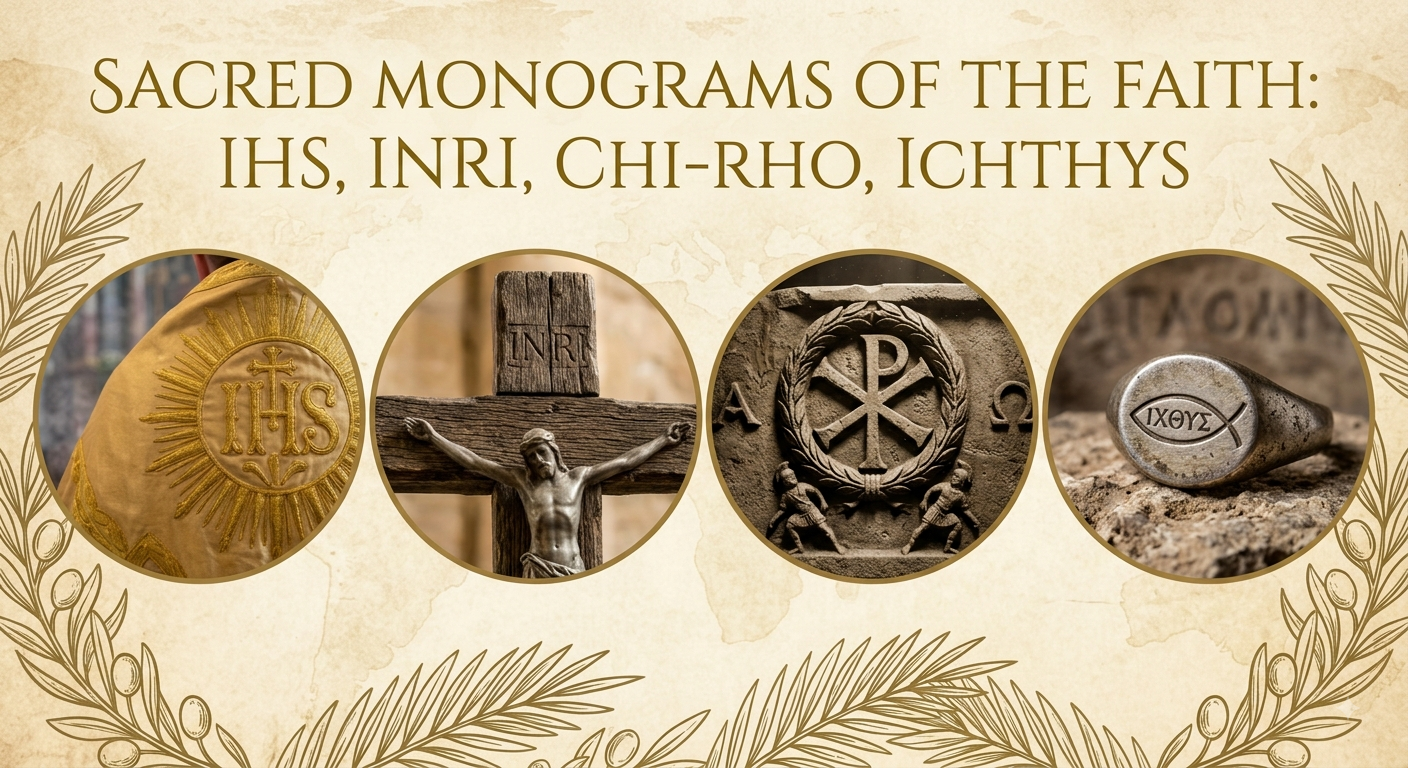
Long before catechisms were printed or cathedrals raised their spires, the faith of the Church was carried in symbols. Scratched into the soft tufa of the Roman catacombs, embroidered upon vestments, hammered onto the shields of soldiers, and carved above the heads of the dying, a handful of letters and images served as a compressed creed—a profession of faith small enough to fit on a signet ring yet vast enough to contain the whole mystery of Christ. Four of these sacred ciphers have endured with particular power:
- IHS, the monogram of the Holy Name;
- INRI, the title of the Cross;
- the Chi-Rho (☧), the monogram of Christ’s victory; and
- the Ichthys (ΙΧΘΥΣ), the fish that secretly proclaimed the divinity of the Saviour.
To understand them is to enter the imagination of the early Church and to recover devotions that have nourished saints for two thousand years.
What Is the IHS Monogram and Why Is the Holy Name of Jesus So Significant?
What Are the Origins and Meaning of IHS?
The monogram IHS is a Christogram drawn from the first three letters of the name of Jesus in Greek: ΙΗΣΟΥΣ (Iēsous)—iota (Ι), eta (Η), and sigma (Σ). Because the eta resembles a Latin “H” and the sigma was often written either as “S” or in its lunate form “C,” the West received the abbreviation as IHS or IHC. The Catholic Encyclopedia notes that from the third century the names of the Saviour were shortened in Christian inscriptions as nomina sacra (sacred names), with IH and later IHS standing for Jesus (Thurston, 1910).
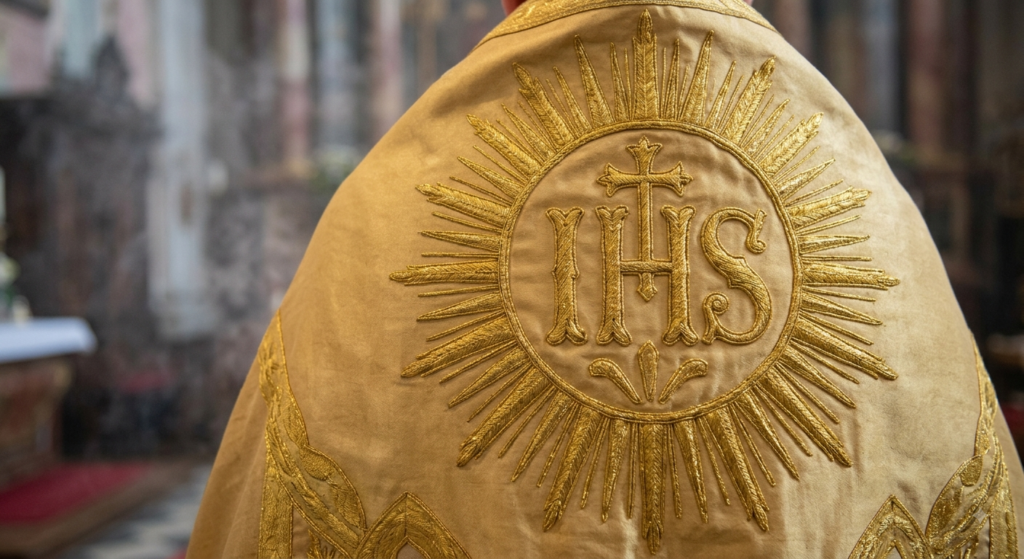
In the Latin West a pious secondary reading arose: Iesus Hominum Salvator—”Jesus, Saviour of mankind.” Other devout interpretations include In Hoc Signo (“In this sign”) and the Greek Iēsous Hēmeteros Sōtēr (“Jesus our Saviour”). These are best understood as devotional glosses; the monogram’s true and original meaning is simply the abbreviated Holy Name itself (Jone, 1962).
What Does Sacred Scripture and the Catechism Teach About the Holy Name?
The reverence for the Name flows directly from Scripture. The angel commanded that the child be called Jesus, “for he will save his people from their sins” (Matthew 1:21); the name itself means “God saves.” St. Peter proclaimed that “there is no other name under heaven given among men by which we must be saved” (Acts 4:12), and St. Paul taught that God “bestowed on him the name which is above every name, that at the name of Jesus every knee should bow” (Philippians 2:9–10). The Catechism of the Catholic Church gathers this teaching succinctly: “The name ‘Jesus’ signifies that the very name of God is present in the person of his Son… It is the divine name that alone brings salvation” (Catechism of the Catholic Church [CCC], 1997, no. 432); and further, “the name of Jesus is at the heart of Christian prayer” (CCC, 1997, no. 435).
Which Saints Were Champions of the Holy Name Devotion?
Devotion to the Holy Name blossomed in the Middle Ages. St. Bernard of Clairvaux (1090–1153), the “Doctor Mellifluus,” gave it unforgettable expression in his sermons on the Song of Songs:
“The name of Jesus is light, and food, and medicine… Jesus is honey on the lips, melody in the ear, joy in the heart” (Bernard of Clairvaux, as cited in Holyname.ie, n.d.).
But the monogram’s greatest herald was the Franciscan St. Bernardine of Siena (1380–1444), who at the close of his open-air sermons would raise a wooden tablet—gold IHS upon a blue ground—bearing a sun of twelve serpentine rays. Through this emblem St. Bernardine sought to displace the violent factional insignia that scarred the Italian cities, asking the crowds to prostrate themselves and adore the Redeemer of mankind (Thurston & Attwater, 1956).
Summoned to Rome on suspicion of heresy in 1426–1427, St. Bernardine was not only acquitted by Pope Martin V but encouraged to continue the practice; the pope himself joined a Roman procession in the Name’s honour (Thurston & Attwater, 1956). His tablet is venerated today at the Basilica of Santa Maria in Aracoeli in Rome. In 1541, St. Ignatius of Loyola adopted IHS as the seal of the Society of Jesus, surmounting the H with a cross and placing three nails of the Passion beneath, the whole encircled by a radiant sun (O’Malley, 1993).
How Is IHS Used in Liturgy and Art Today?
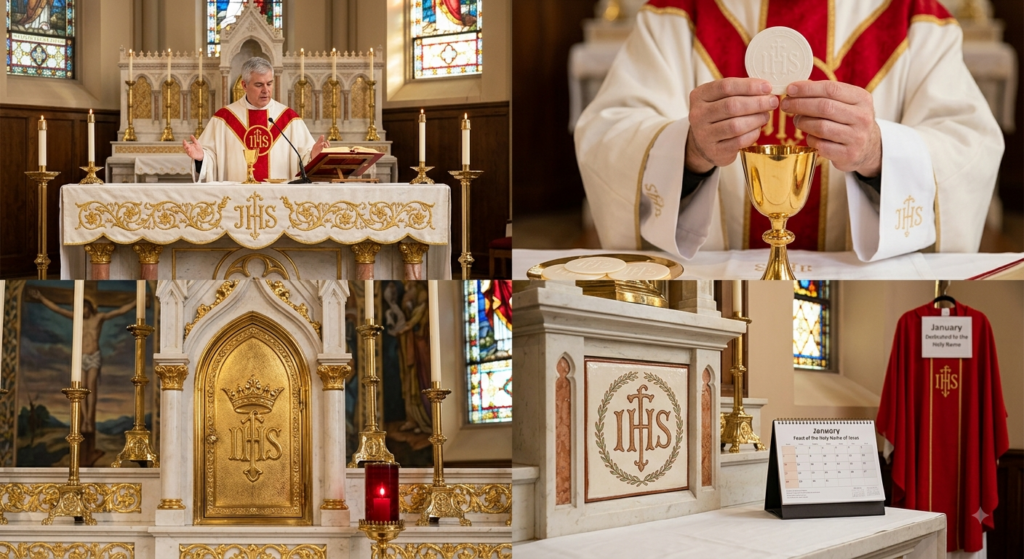
The monogram adorns altars, tabernacles, vestments, chalices, and altar linens throughout the Catholic world. The round altar-bread of the Latin Church has long been stamped with IHS or with the image of the Crucified, and Eucharistic hosts are still impressed with the monogram (Catholicus, 2023). The Feast of the Holy Name of Jesus is celebrated in January, the month traditionally dedicated to the Holy Name.
What Does INRI Mean and How Does It Proclaim the Kingship of Christ?
What Was the Gospel Inscription Above the Cross?
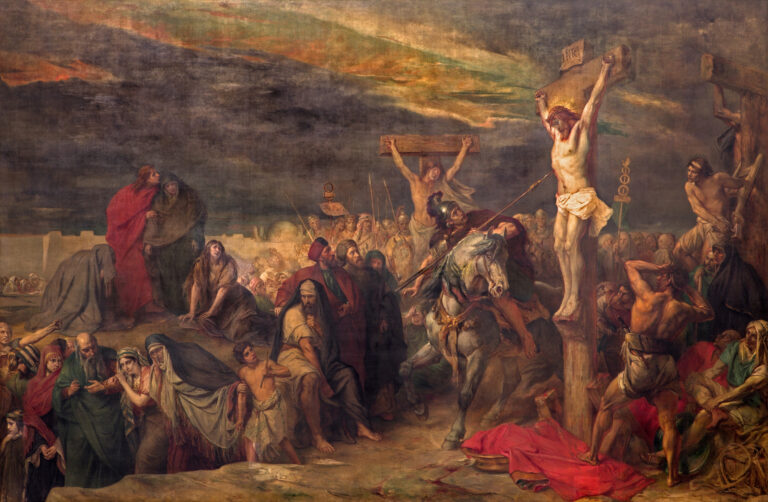
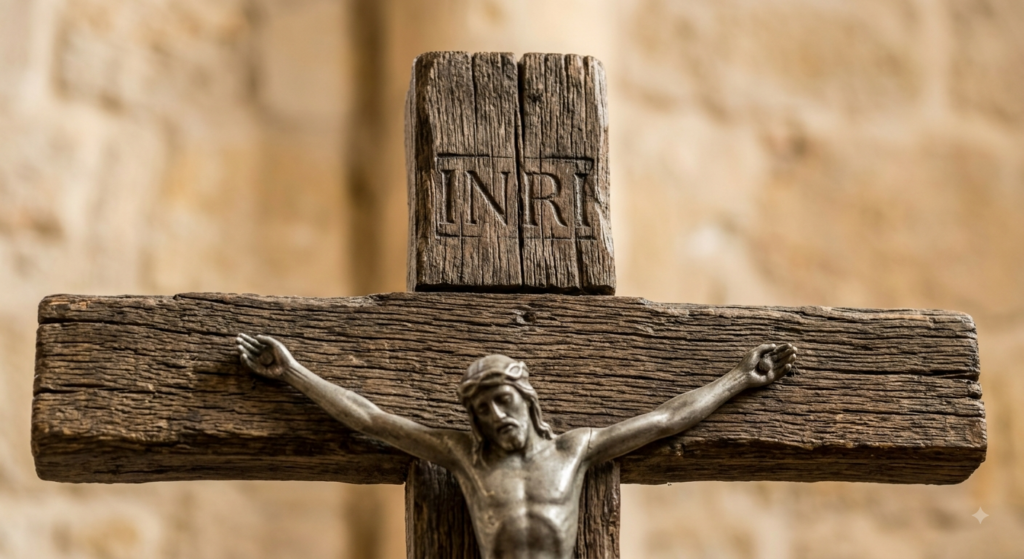
Above the head of the crucified Christ, Pontius Pilate ordered a titulus—a placard stating the charge against the condemned. St. John records: “Pilate also wrote a title and put it on the cross; it read, ‘Jesus of Nazareth, the King of the Jews.’… and it was written in Hebrew, in Latin, and in Greek” (John 19:19–20).
The Latin, Iesus Nazarenus Rex Iudaeorum, yields the abbreviation INRI. The inscription appears, with slight variation, in all four Gospels (Matthew 27:37; Mark 15:26; Luke 23:38; John 19:19)—a rare point of agreement among the evangelists on a precise detail. When the chief priests protested, Pilate answered, “What I have written, I have written” (John 19:21–22). What Pilate intended as mockery, Providence made into a triple proclamation, in the three great languages of the ancient world, of Christ’s true kingship.
What Is the Theological Meaning of INRI for the Kingship of Christ?
INRI proclaims a kingship revealed paradoxically in apparent defeat. Before Pilate, Jesus declared, “My kingdom is not of this world” (John 18:36)—a kingship grounded not in force but in truth and self-giving love. In St. John’s theology the Cross is itself the throne: Christ is “lifted up” and enthroned, crowned with thorns, the title proclaiming His royalty above Him.
This truth received its fullest modern expression in Pope Pius XI’s 1925 encyclical Quas Primas, which established the Feast of Christ the King. Against the rising secularism of the age, Pius XI taught the Social Kingship of Christ: that not only individuals but societies and states owe allegiance to Christ, who reigns by right both as Creator and as Redeemer. As the encyclical warned, “It would be a grave error… to say that Christ has no authority whatever in civil affairs” (Pius XI, 1925, no. 17). INRI, then, is no mere historical footnote but a standing declaration that Christ is King—of hearts, of families, and of nations.
What Is the Chi-Rho and How Did It Become a Symbol of Christian Victory?
What Are the Origins of the Chi-Rho Monogram?
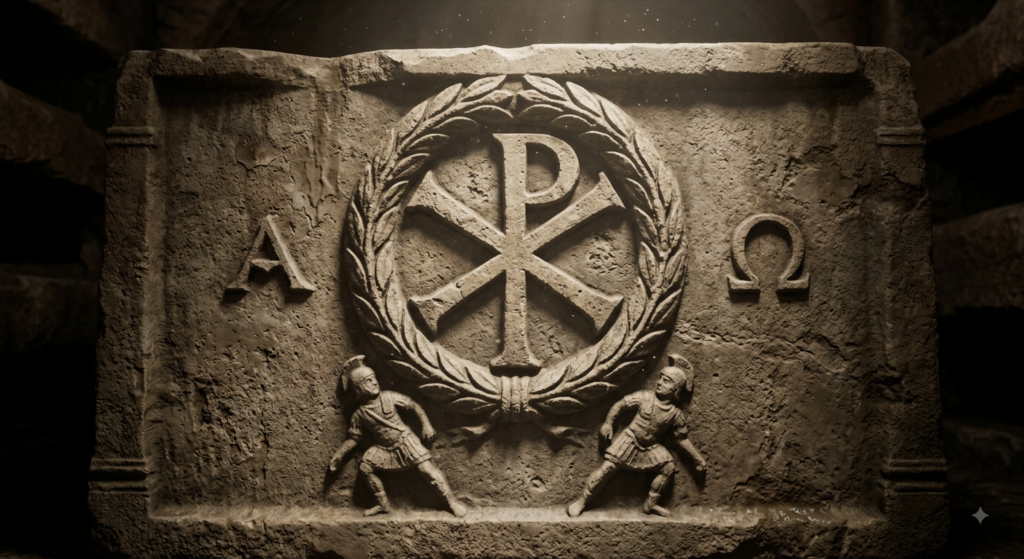
The Chi-Rho (☧) is formed by superimposing the first two letters of the Greek ΧΡΙΣΤΟΣ (Christos, “Christ”)—chi (Χ) and rho (Ρ). One of the most ancient Christograms, it served early Christians as a sign of identity and was used in catacomb art. It frequently appears flanked by the Greek letters Alpha (Α) and Omega (Ω), recalling the words of the Risen Christ: “I am the Alpha and the Omega, the first and the last” (Revelation 22:13).
What Happened at the Battle of the Milvian Bridge?
The Chi-Rho rose to world-historical prominence through Emperor Constantine the Great. On the eve of the Battle of the Milvian Bridge (28 October 312), Lactantius records that Constantine was commanded in a dream to mark his soldiers’ shields with “the heavenly sign of God” (Lactantius, De Mortibus Persecutorum, as cited in Cruse, 1998). Eusebius of Caesarea, in his Life of Constantine, gives the more famous account: Constantine and his army saw a cross of light in the sky with the Greek words Ἐν Τούτῳ Νίκα, rendered in Latin as In Hoc Signo Vinces—”In this sign you shall conquer” (Eusebius of Caesarea, Life of Constantine, as cited in Cameron & Hall, 1999). Constantine triumphed over Maxentius, who drowned in the Tiber, and the victory opened the path to the legalization of Christianity. The emperor adopted the Chi-Rho on his military standard, the labarum.
How Did the Chi-Rho Come to Symbolise the Resurrection?
In Christian art the Chi-Rho became a sign of triumph over death. On a fourth-century sarcophagus from the Catacomb of Domitilla, the monogram is encircled by a victor’s wreath above Roman soldiers—an early visual proclamation that Christ’s Resurrection has conquered death (Jesuswalk.com, n.d.). After Constantine the symbol spread to coins, sarcophagi, frescoes, lamps, and rings, and crossed the empire as far as Roman Britain, where it survives in a mosaic at the Lullingstone villa. It remains today the enduring symbol of Christ’s victory over death and the grave.
What Is the Ichthys and How Did a Fish Become a Creed?
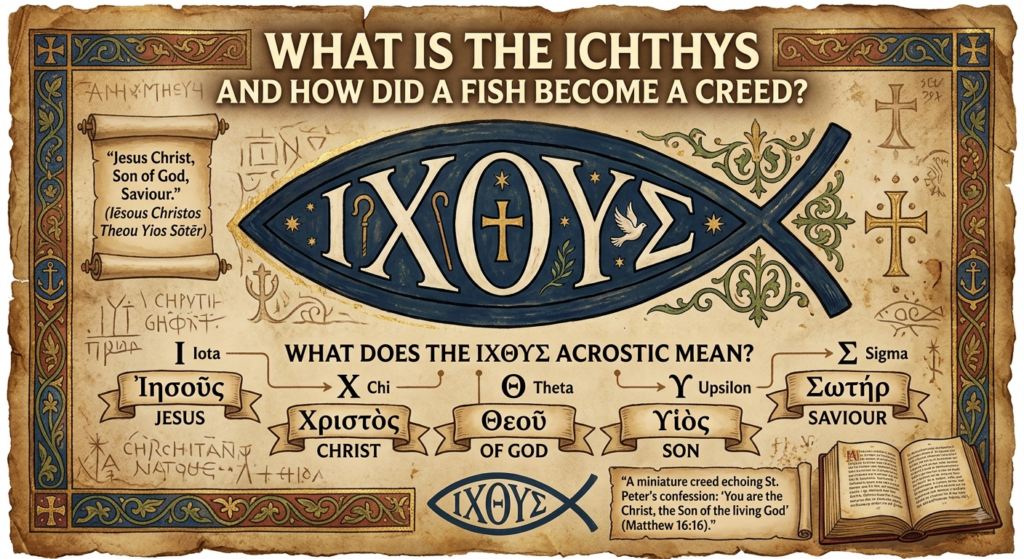
What Does the ΙΧΘΥΣ Acrostic Mean?
The Greek word for fish, ΙΧΘΥΣ (ichthys), became one of the earliest and most beloved Christian symbols through a providential acrostic. Its five letters are the initials of the confession Ἰησοῦς Χριστὸς Θεοῦ Υἱὸς Σωτήρ (Iēsous Christos Theou Yios Sōtēr)—”Jesus Christ, Son of God, Saviour.” In five words the fish proclaims the divinity, sonship, and saving mission of Christ—a miniature creed echoing St. Peter’s confession, “You are the Christ, the Son of the living God” (Matthew 16:16).
How Did the Church Fathers Explain the Fish Symbol?
The most celebrated patristic witness is St. Augustine of Hippo, who in The City of God (Book 18, Chapter 23) unfolds the acrostic in the context of a Sibylline prophecy. “If you join the initial letters of these five Greek words… they will make the word ichthys, that is, ‘fish,’ in which word Christ is mystically understood, because He was able to live, that is, to exist, without sin in the abyss of this mortality as in the depth of waters” (Augustine of Hippo, The City of God, XVIII.23, as cited in Dods, 1871/2009). The image is theologically exquisite: as the fish lives unharmed in the deep, so Christ entered the abyss of our fallen mortality without contracting its sin.
The earliest literary reference to the symbolic fish is given by Clement of Alexandria (c. 150–215), who in his Paedagogus (III, xi) counseled Christians to engrave their signet rings with a fish or a dove (Clement of Alexandria, as cited in Roberts & Donaldson, 1885/1994). Tertullian (c. 200) drew out its baptismal sense: “We little fishes, after the image of our Ichthys, Jesus Christ, are born in the water” (Tertullian, De Baptismo, I, as cited in Roberts & Donaldson, 1885/1994). The fish also carried a Eucharistic meaning, attested in the second-century epitaph of Abercius, bishop of Hieropolis in Phrygia, who described being fed on his journeys with “the Fish from the spring, the great, the pure,” together with bread and wine (Quasten, 1950).
Was the Ichthys Really Used as a Secret Sign of Faith?
Popular tradition holds that under Roman persecution Christians used the fish as a covert sign of recognition, one believer tracing an arc in the dust and the other completing the figure. Modern scholarship treats this particular story with caution—the earliest sources connect the fish primarily to baptism, the Eucharist, and the Gospel scenes of the loaves and fishes and the call of the apostles (“I will make you fishers of men,” Matthew 4:19), rather than explicitly to persecution (Jesuswalk.com, n.d.). What is certain is the fish’s enduring power as catechesis: it compresses the heart of the Creed into a single word and image, which is why it remains a living emblem of Christian identity today.
How Do These Four Symbols Sum Up the Heart of the Catholic Faith?
These four ciphers are not decoration but distilled doctrine. IHS adores the Holy Name in which alone is salvation; INRI proclaims the King who reigns from the Cross; the Chi-Rho announces the Risen Christ’s victory over death; and the Ichthys confesses, in a single word, that Jesus Christ is the Son of God and Saviour. Carved by persecuted believers, raised by missionary saints, and borne into battle by emperors, they have catechized the faithful across twenty centuries precisely because they are at once simple and inexhaustible.
In an age of noise and forgetting, the Church’s sacred symbols still do what they have always done: they fix the eye, instruct the mind, and lift the heart to Christ—teaching us with St. Bernardine to make the Name of Jesus shine, and with the early Christians to remain, like little fishes, ever alive in the living water of our Saviour.
References
Augustine of Hippo. (2009). The city of God (M. Dods, Trans.). Hendrickson Publishers. (Original work published 426 AD)
Bella, F., & Azzi, C. (2002). 14C dating of the “Titulus Crucis.” Radiocarbon, 44(3), 685–689. https://doi.org/10.1017/S0033822200032148
Cameron, A., & Hall, S. G. (Trans. & Eds.). (1999). Eusebius: Life of Constantine. Clarendon Press.
Catechism of the Catholic Church. (1997). Libreria Editrice Vaticana.
Catholicus. (2023). Hosts and particles: The silent miracle of the altar. https://catholicus.eu/en/hosts-and-particles-the-silent-miracle-of-the-altar/
Clement of Alexandria. (1994). Paedagogus. In A. Roberts & J. Donaldson (Eds.), Ante-Nicene Fathers (Vol. 2). Hendrickson Publishers. (Original work published c. 200 AD)
Foss, C. (1990). Roman historical coins. Seaby.
Holyname.ie. (n.d.). St Bernard of Clairvaux and the Holy Name of Jesus. https://www.holyname.ie/st-bernard-of-clairvaux/
Jesuswalk.com. (n.d.). Early Christian symbols in the catacombs. https://www.jesuswalk.com/christian-symbols/early-christian-symbols.htm
Jone, H. (1962). Moral theology (U. Adelman, Trans.). Newman Press.
O’Malley, J. W. (1993). The first Jesuits. Harvard University Press.
Pius XI. (1925). Quas primas [Encyclical on the feast of Our Lord Jesus Christ, King]. Libreria Editrice Vaticana. https://www.vatican.va/content/pius-xi/en/encyclicals/documents/hf_p-xi_enc_11121925_quas-primas.html
Quasten, J. (1950). Patrology: Vol. 1. The beginnings of patristic literature. Newman Press.
Roberts, A., & Donaldson, J. (Eds.). (1994). Ante-Nicene Fathers (Vols. 1–10). Hendrickson Publishers. (Original works published 1885)
Sacred Destinations. (n.d.). Santa Croce in Gerusalemme, Rome. http://www.sacred-destinations.com/italy/rome-santa-croce-in-gerusalemme
Tertullian. (1994). De baptismo. In A. Roberts & J. Donaldson (Eds.), Ante-Nicene Fathers (Vol. 3). Hendrickson Publishers. (Original work published c. 200 AD)
Thurston, H. (1910). IHS. In The Catholic Encyclopedia (Vol. 7). Robert Appleton Company.
Thurston, H., & Attwater, D. (1956). Butler’s lives of the saints (Vol. 2). P. J. Kenedy & Sons.