The Tetragrammaton: Understanding the Sacred Name of God in Scripture and Catholic Tradition
Among the many names by which God has revealed Himself in Sacred Scripture, none is more sacred, more mysterious, or more theologically significant than the Tetragrammaton — the four Hebrew consonants יהוה, transliterated YHWH. This name, given to Moses at the burning bush, expresses the very being of God and stands at the center of the Old Testament’s revelation of the divine identity. Understanding its history sheds light not only on Jewish reverence for the divine name but also on the Catholic Church’s own liturgical tradition and her teaching on the nature of God.
What Is the Tetragrammaton?
The word “Tetragrammaton” comes from the Greek tetra (“four”) and gramma (“letter”), and refers to the four-letter Hebrew name of God: yod, he, vav, he (YHWH). In ancient Hebrew, texts were written using only consonants; vowel markings were added centuries later by Jewish scribes. Because these vowel points were never applied with certainty to the divine name, its original pronunciation is no longer known with absolute confidence. The Tetragrammaton appears to derive from the Hebrew verb hayah, “to be” or “to exist,” pointing to God as the one whose very name declares His eternal, self-sufficient existence.
How Did God Reveal His Name to Moses?
The revelation of the divine name takes place at the burning bush. When Moses asks God what he should tell the Israelites when they ask for God’s name, God answers, “I AM WHO I AM,” and instructs Moses to tell the people, “I AM has sent me to you” (Exodus 3:13–14). Immediately afterward, God identifies Himself by the name YHWH and declares that this is His name forever, the name by which He is to be remembered throughout all generations (Exodus 3:15). This connection between the divine name and the verb “to be” reveals that God has no beginning and no end, and that His existence depends on nothing outside Himself.

How Often Does the Divine Name Appear in Scripture?
The Tetragrammaton is, by a wide margin, the most frequently used designation for God in the Hebrew Old Testament. According to the Masoretic Text as printed in Kittel’s Biblia Hebraica and the Biblia Hebraica Stuttgartensia, the divine name occurs 6,828 times (Würthwein & Fischer, 2014). This far exceeds the frequency of any other title used for God in the Old Testament, underscoring how central the personal, covenantal name of God is to the biblical witness — even though later Jewish and Christian practice would move away from speaking it aloud.
Why Did the Jewish People Stop Pronouncing the Name?
Out of reverence for the commandment not to take the name of the Lord in vain (Exodus 20:7), a custom developed — solidified especially after the Babylonian Exile — of never pronouncing YHWH aloud in ordinary speech or reading. When the sacred text was read and the Tetragrammaton appeared, readers substituted Adonai (“Lord”) or HaShem (“the Name”). By the time of Christ, this had become the settled practice among the Jewish people, and it remained so among the priesthood, with the sole exception of the high priest, who alone pronounced the name on the Day of Atonement within the Holy of Holies (Congregation for Divine Worship and the Discipline of the Sacraments, 2008).

How Did the Septuagint Render the Divine Name?
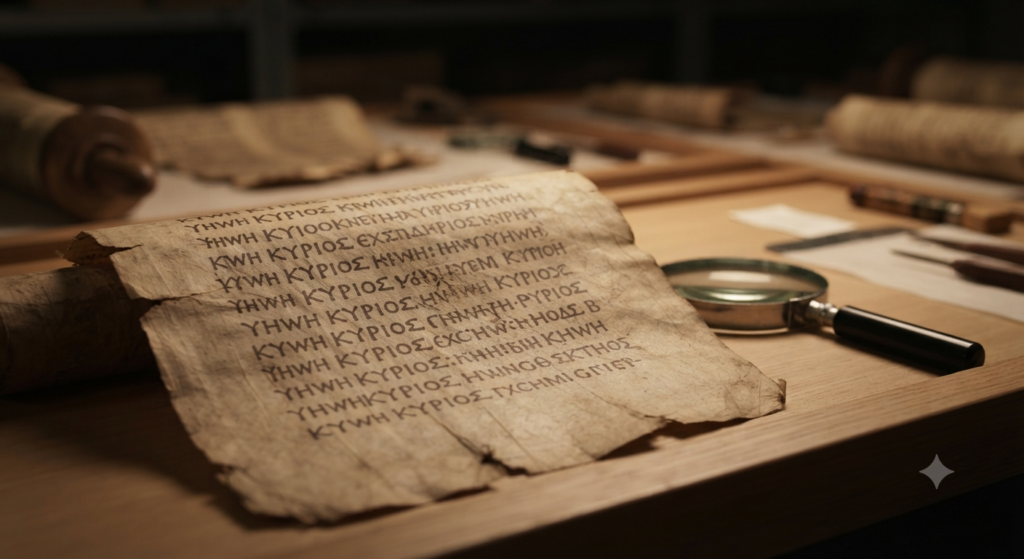
Between the third and second centuries before Christ, the Hebrew Scriptures were translated into Greek in Alexandria, producing the version known as the Septuagint (LXX). Following the established custom of substitution, most surviving manuscripts of the Septuagint render the Tetragrammaton as Kyrios, meaning “Lord” (Tov, 2012). This is significant for Christian theology, because the inspired authors of the New Testament, who frequently quote the Old Testament through the lens of the Septuagint, apply the title Kyrios both to God the Father and to Jesus Christ — a striking testimony to the Church’s earliest confession of Christ’s divinity, since the New Testament writers apply to Jesus the very title used to translate the sacred, unspeakable name of God.
Did Jesus Pronounce the Tetragrammaton?
There is no evidence in the New Testament that Jesus publicly pronounced the divine name YHWH. Instead, throughout the Gospels He refers to God consistently as “Father,” as “Lord,” and as “God” — a usage entirely consistent with the Jewish reverence of His own day. In the Lord’s Prayer, for example, Jesus teaches His disciples to address God simply as “Our Father” (Matthew 6:9), and in His high priestly prayer He speaks of having “made your name known” to His disciples without Himself uttering the Tetragrammaton (John 17:6, 26). The New Testament’s consistent use of Kyrios for both God the Father and Christ reflects the same tradition already present in the Septuagint.
Where Did the Name “Jehovah” Come From?
Between the sixth and tenth centuries A.D., a group of Jewish scholars known as the Masoretes developed a system of vowel points to preserve the correct reading and pronunciation of the Hebrew Scriptures. Wherever the text contained YHWH, they inserted the vowel points belonging to Adonai as a reminder that the reader should say “Adonai” rather than attempt to pronounce the divine name itself. During the Middle Ages, some Christian scholars, unfamiliar with this Jewish reading convention, combined the consonants YHWH with the vowels of Adonai and produced the hybrid form “Jehovah.” This form entered wide circulation through translators such as William Tyndale and was later carried into the King James Version. Scholars today generally regard “Jehovah” not as a recovery of the original pronunciation but as a later composite reading (Reformed Faith & Practice, 2018).
Why Do Most Scholars Prefer “Yahweh”?
Modern biblical and Semitic scholarship favors “Yahweh” as the pronunciation closest to the original, though certainty is impossible given the loss of the ancient vocalization. This conclusion rests on several lines of evidence: the patterns of ancient Hebrew grammar, early Greek transliterations of the name preserved by Church Fathers and other ancient writers, and the shortened forms of the divine name — such as Yah or the -yahu/Yeho- elements found in many Hebrew personal names (for example, Elijah, “Eli-yahu”) and in the liturgical exclamation “Hallelujah,” meaning “praise Yah” (Würthwein & Fischer, 2014). While “Yahweh” is the scholarly consensus, absolute certainty about the ancient pronunciation cannot be recovered.
What Do the Dead Sea Scrolls Reveal About the Divine Name?
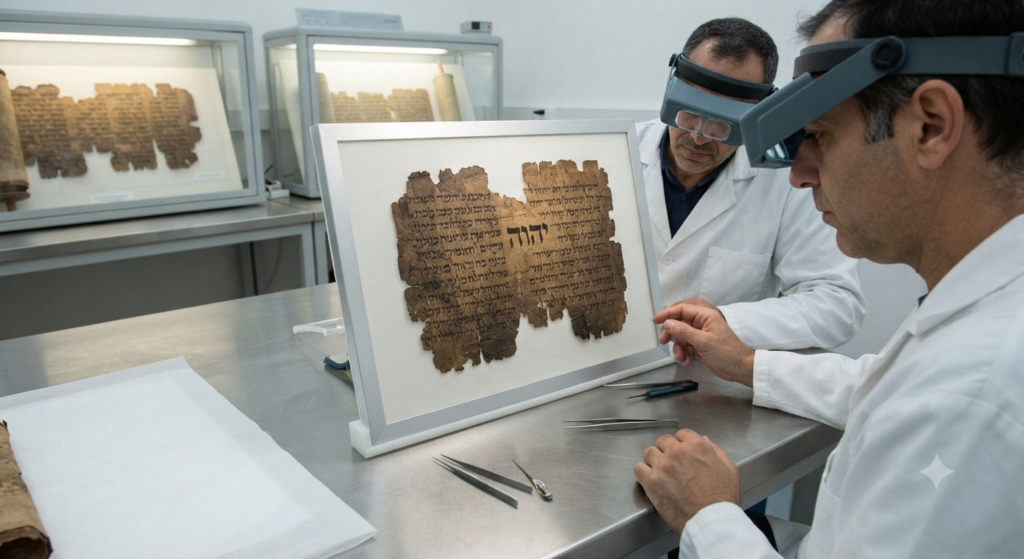
The Dead Sea Scrolls, discovered beginning in 1947 near Qumran, preserve some of the oldest surviving manuscripts of the Hebrew Bible and shed further light on ancient reverence for the divine name. In a number of these manuscripts, the Tetragrammaton is written in archaic paleo-Hebrew script even where the surrounding text is copied in the square Aramaic script otherwise used at the time, and other fragments employ dots or dashes in place of the name altogether (Tov, 2012). These scribal practices demonstrate the extraordinary care and reverence with which the ancient Jewish community treated the sacred name, distinguishing it visually from the rest of the sacred text.
What Is the Catholic Church’s Understanding of the Divine Name Today?
The Catholic Church recognizes YHWH as the sacred, personal name of God revealed to Moses and treasures it as a central moment in salvation history. The Catechism of the Catholic Church teaches that in revealing His name, God discloses His inexhaustible mystery — a God who is at once near to His people and yet infinitely beyond every name that human beings could devise for Him (Catechism of the Catholic Church, 2000, nn. 203–205). At the same time, following the tradition inherited from the Jewish people, the Septuagint, and the apostles themselves, the Church continues to use the title “Lord” rather than pronouncing the Tetragrammaton in the liturgy and at Mass.
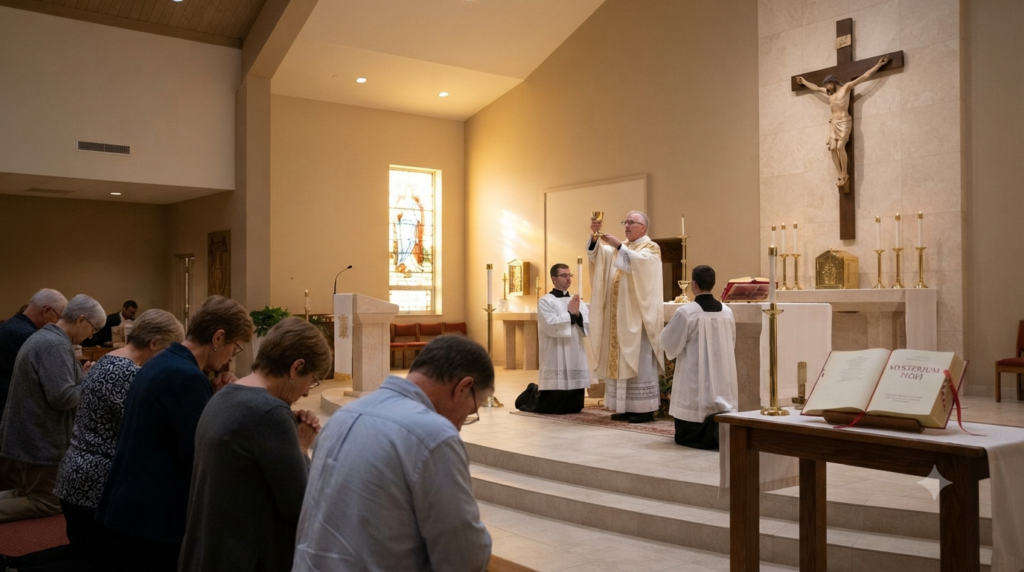
This practice was formally reaffirmed in 2008, when the Congregation for Divine Worship and the Discipline of the Sacraments directed that “in liturgical celebrations, in songs and prayers the name of God in the form of the tetragrammaton YHWH is neither to be used nor pronounced,” instructing that translations instead render it as “the Lord,” consistent with the ancient practice of the Septuagint and the Latin Vulgate (Congregation for Divine Worship and the Discipline of the Sacraments, 2008).
Far from a modern innovation, this reflects an unbroken continuity stretching from the reverence of ancient Israel, through the apostolic Church’s own use of Kyrios, to the worship of the Church today (EWTN, 2008).
Conclusion
The Tetragrammaton — יהוה — is the sacred, personal name of God revealed to Moses, appearing more than 6,800 times in the Hebrew Old Testament and standing as the most frequently used name for God in all of Scripture. Out of profound reverence, the Jewish people ceased pronouncing it aloud, substituting Adonai or Kyrios, a practice which the New Testament writers and the Church herself have continued by consistently referring to God, and to Christ, as “Lord.” The medieval hybrid form “Jehovah” arose from a misreading of Jewish scribal convention, while “Yahweh” is regarded by contemporary scholarship as the pronunciation closest to the ancient original, even though certainty is beyond recovery. For the Catholic faithful, the story of the divine name is ultimately a story of reverence: a reminder that God is not merely a concept to be defined but the living “I AM,” whose name is both revealed and, in humility before His majesty, left unspoken.
References
Catechism of the Catholic Church (2nd ed.). (2000). Libreria Editrice Vaticana.
Congregation for Divine Worship and the Discipline of the Sacraments. (2008, June 29). Letter to the bishops’ conferences on “the name of God.” Libreria Editrice Vaticana. https://www.usccb.org/resources/name-god
EWTN. (2008, November 21). Why Yahweh isn’t used in Catholic liturgy. https://www.ewtn.com/catholicism/library/why-yahweh-isnt-used-in-catholic-liturgy-4986
New American Bible, Revised Edition. (2011). United States Conference of Catholic Bishops.
Reformed Faith & Practice. (2018, October 9). Pulpit notes: The divine name. Reformed Theological Seminary. https://journal.rts.edu/article/pulpit-notes-the-divine-name/
Tov, E. (2012). Textual criticism of the Hebrew Bible (3rd ed.). Fortress Press.
Würthwein, E., & Fischer, A. A. (2014). The text of the Old Testament: An introduction to the Biblia Hebraica (E. F. Rhodes, Trans.; 3rd ed.). Eerdmans.