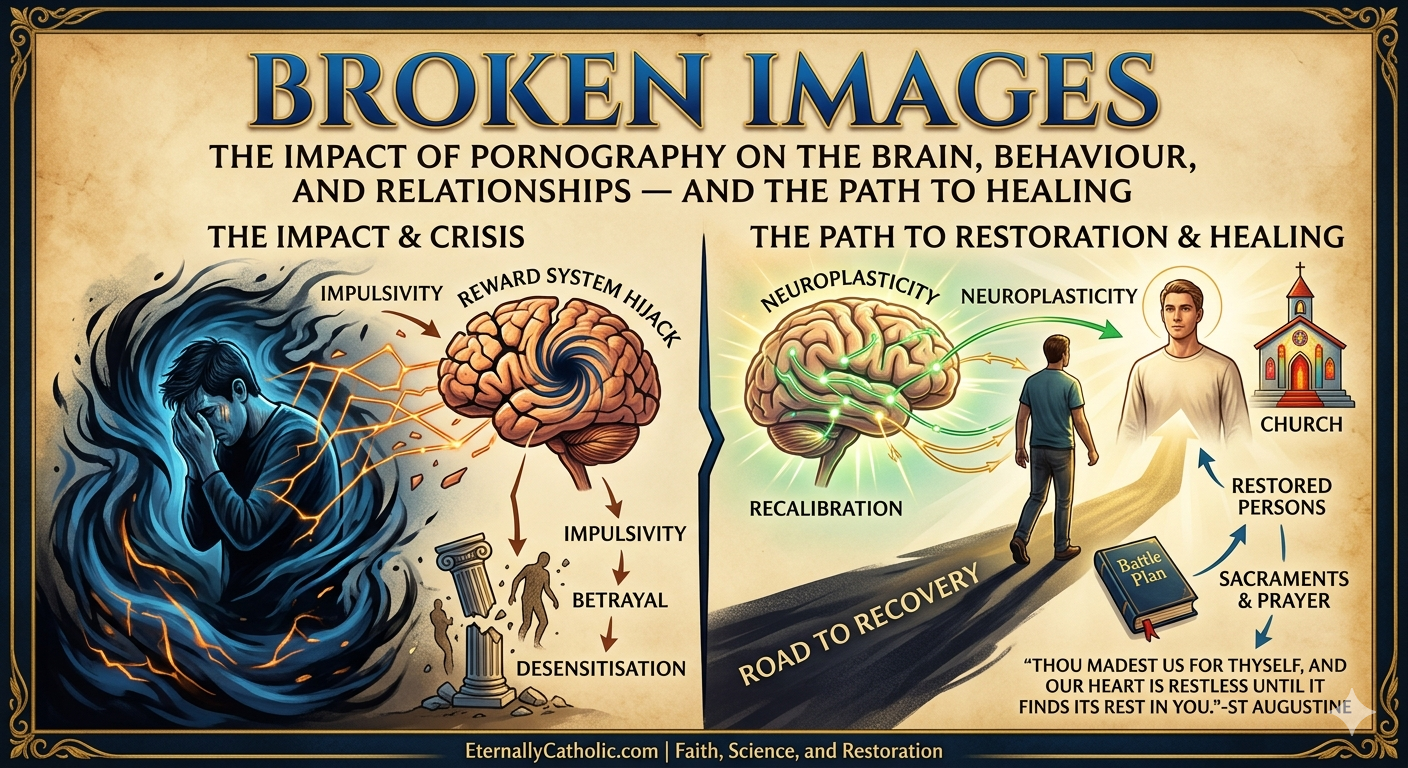
Broken Images: How Pornography Rewires the Brain, Destroys Relationships — and How Prayer and Grace Restore What Was Lost
In the digital age, pornographic material has become one of the most pervasive — and most overlooked — public health and spiritual crises of our time. What was once confined to back-street magazine racks now streams frictionlessly into bedrooms, classrooms, and workplaces through smartphones and high-speed internet. Researchers, psychologists, neurologists, and pastoral workers are increasingly alarmed at the scale of harm being done — not to society in the abstract, but to real human persons made in the image and likeness of God.
This article draws on peer-reviewed neuroscience, clinical psychology, and the wisdom of Catholic spiritual tradition to map the damage that pornography inflicts — and, crucially, to chart a genuine road to healing. The brain is plastic, virtue can be rebuilt, relationships can be restored, and grace is inexhaustible. But first, we must face the truth clearly.
“The use of pornography rewires the brain’s reward system in ways that closely mirror the neurological signatures of substance addiction.”— Hilton & Watts, 2011, Surgical Neurology International
Part I: Pornography and the Brain
1.1 The Reward System and Dopamine Hijacking
The human brain’s reward system evolved to reinforce survival behaviours — eating, bonding, reproduction — by releasing dopamine when those behaviours occur. Dopamine does not simply produce pleasure; it produces the anticipation of pleasure, the craving, the motivational drive that says “do that again.” This system can be co-opted by artificial stimuli that trigger dopamine release far beyond what natural rewards produce.
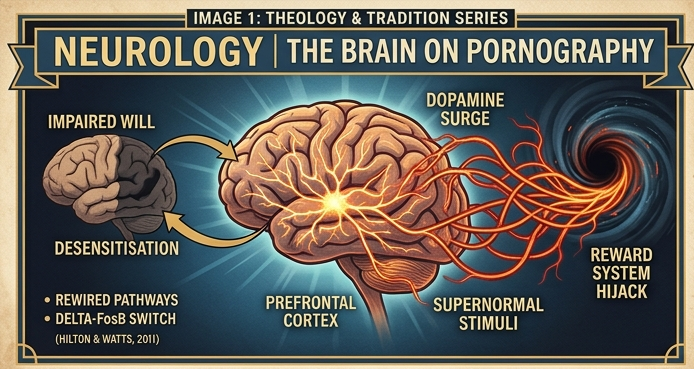
Sexual imagery — particularly novel, high-intensity pornographic content — triggers a dramatic dopamine surge in the nucleus accumbens, the brain’s primary reward hub. Critically, internet pornography provides what researchers call “supernormal stimuli”: an endless novelty loop that natural sexual experience cannot replicate. Each new image or video tab produces a fresh dopamine spike, conditioning the brain to crave ever-more stimulation (Hilton & Watts, 2011; Doidge, 2007).
Over time, with repeated pornography use, the brain undergoes measurable structural and functional changes. Neuroimaging studies have documented reductions in grey matter volume in the striatum — a key node of the reward circuit — correlated with hours of weekly pornography consumption (Kühn & Gallinat, 2014). This reduction in volume is associated with diminished functional connectivity between the striatum and the prefrontal cortex — the region responsible for impulse control, moral reasoning, and long-term planning.
⚠ Key Finding: Heavy pornography users show the same patterns of reduced prefrontal cortex regulation over limbic impulses as individuals with substance use disorders (Voon et al., 2014; Kühn & Gallinat, 2014).
| Brain Region | Effect of Pornography Use | Behavioural Consequence |
|---|---|---|
| Nucleus Accumbens (reward hub) | Dopamine spike; sensitisation to pornographic cues | Craving, compulsive seeking |
| Prefrontal Cortex | Reduced grey matter volume; weakened connectivity | Impaired impulse control, moral reasoning |
| Striatum | Structural volume reduction | Diminished response to natural rewards |
| Amygdala | Heightened reactivity to sexual cues | Emotional volatility, anxiety |
1.2 Desensitisation and Tolerance
A hallmark of addictive neurological processes is tolerance: the need for greater stimulation to achieve the same reward. Pornography produces exactly this effect. What initially produced a powerful dopamine response gradually loses its potency, driving users toward more extreme, novel, or deviant content to achieve the same neurological “hit” (Hilton, 2013; Love et al., 2015).
This desensitisation is not merely psychological — it is neurobiological. The delta-FosB protein, a molecular “switch” implicated in addiction, accumulates in the nucleus accumbens with repeated rewarding stimuli and is documented in association with compulsive sexual behaviour (Nestler, 2008; Hilton, 2013). Its accumulation causes lasting changes in gene expression that sensitise the reward circuit to pornographic cues while blunting response to everyday pleasures — a phenomenon researchers call “reward deficiency.”
The practical consequences are severe: users may find ordinary intimacy with a partner unstimulating; they may experience anhedonia — the inability to find joy in activities that once brought pleasure; and many young men develop what clinicians call “pornography-induced erectile dysfunction” (PIED) — a paradox in which a healthy young male cannot function with a real partner yet has no difficulty with pornographic imagery (Park et al., 2016).
1.3 Neuroplasticity: The Brain That Can Be Rewired
Here is the genuinely good news: the same neuroplasticity that makes the brain vulnerable to pornography’s rewiring also makes it capable of recovery. Donald Hebb’s famous principle — “neurons that fire together wire together” — applies in reverse: when a neural pathway is disused, it weakens. Repeated abstinence from pornography, combined with positive re-engagement of healthy reward circuits, allows the brain’s reward system to recalibrate (Doidge, 2007).
Research on recovery from behavioural addictions suggests that significant neurological restoration can occur within weeks to months of abstinence, particularly when combined with meaningful social connection, physical exercise, and purposeful activity (Koob & Volkow, 2010; Hilton & Watts, 2011). This is directly relevant to a spiritually integrated recovery programme, as we shall explore in Part III.
Part II: Pornography and Behaviour
2.1 Compulsivity and Loss of Control
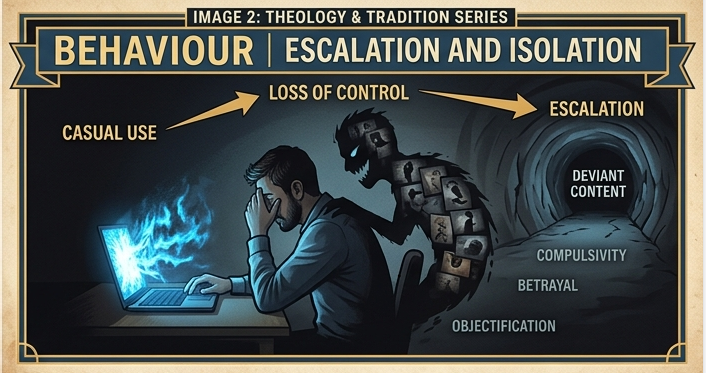
A defining feature of pornography’s behavioural impact is the progressive erosion of volitional control. Users frequently report beginning use as casual or occasional, but over time finding themselves unable to stop or limit their viewing despite genuine desire to do so and full awareness of its harmful consequences. This pattern — craving, loss of control, continued use despite negative consequences — mirrors the diagnostic criteria for substance use disorder (American Psychiatric Association, 2013).
Although “pornography addiction” does not appear as a formal DSM-5 diagnosis, the World Health Organisation’s ICD-11 formally recognises Compulsive Sexual Behaviour Disorder (CSBD), which explicitly includes out-of-control pornography use as a primary manifestation (WHO, 2019; Kraus et al., 2018). Clinicians describe intrusive urges, failed quit attempts, escalation, and withdrawal-like irritability — all hallmarks of addictive behaviour.
📊 Prevalence Note: A 2019 survey of 2,000 adults found that 64% of men and 18% of women reported viewing pornography at least weekly, with 37% of men self-reporting that their use felt out of control (Covenant Eyes, 2020).
2.2 Escalation Toward Increasingly Deviant Content
As desensitisation sets in, many users find themselves gravitating toward content they once found repugnant or morally objectionable. The neurological tolerance mechanism described in Part I drives this escalation, as the brain requires increasing novelty and intensity to produce the dopamine response the user is seeking. Research has confirmed that escalation toward more extreme genres — including depictions of aggression, coercion, and content involving minors — follows a predictable neurological and behavioural pattern (Oddone-Paolucci et al., 2000; Kingston et al., 2008).
This escalation poses profound moral, legal, and public safety concerns. The consumption of child sexual abuse material (CSAM) is a direct moral catastrophe and a criminal offence in most jurisdictions. The psychological research literature establishes a documented pathway from mainstream pornography consumption to consumption of increasingly extreme content for a meaningful subset of heavy users (Hald et al., 2010).
2.3 Attitudes, Objectification, and Sexual Violence
Empirical research has consistently found correlations between pornography consumption and attitudes that treat other persons as objects for sexual use. A landmark meta-analysis by Hald, Malamuth, and Yuen (2010) found a significant association between pornography consumption and sexually aggressive attitudes and behaviours. A comprehensive meta-analysis by Wright, Tokunaga, and Kraus (2016) confirmed a direct link between pornography use and acceptance of sexual aggression, across cultures and genders.
The mechanism appears to operate through classical and operant conditioning: the brain learns to associate sexual arousal with domination, coercion, and objectification, and this conditioning — particularly when established during adolescence — shapes the user’s expectations of real sexual encounters (Peter & Valkenburg, 2016).
2.4 Impact on Adolescents
The adolescent brain is uniquely vulnerable. The prefrontal cortex — responsible for impulse control and long-term consequence assessment — is not fully myelinated until the mid-twenties. Pornography exposure during the critical windows of adolescent brain development can establish compulsive patterns and distorted sexual scripts before the young person has the neurological architecture to resist them (Doidge, 2007; Giedd, 2008).
Studies show that the average age of first pornography exposure is now between 11 and 13 years in Western countries (Covenant Eyes, 2020). Many children encounter it accidentally, through social media, gaming platforms, or peer sharing. The documented effects include: distorted body image, unrealistic sexual expectations, normalisation of aggression, and early compulsive use patterns (Peter & Valkenburg, 2016; Braun-Courville & Rojas, 2009).
Part III: Pornography and Relationships
3.1 Intimate Partner Relationships
Pornography use — particularly when frequent, secret, or escalating — consistently emerges as a powerful predictor of relationship dissatisfaction, betrayal trauma, and dissolution. A comprehensive review by Perry (2018) using national longitudinal data found that beginning pornography use significantly increased the likelihood of divorce, independently of prior marital happiness.
The partner of a pornography user frequently experiences what trauma-informed clinicians call “betrayal trauma”: a psychologically shattering discovery that a trusted intimate partner has been engaging in secret sexual behaviour. Symptoms closely mirror post-traumatic stress disorder, including intrusive thoughts, hypervigilance, emotional numbing, and severe disruptions to sexual self-concept and relational trust (Steffens & Rennie, 2006; Schneider, 2000).
“When one partner discovers pornography use, the impact on the betrayed partner is often as severe as discovering a physical affair. Trust, identity, and intimacy are all shattered simultaneously.”— Steffens & Rennie, 2006
3.2 Sexual Dysfunction and Intimacy Disorders
As documented in Part I, desensitisation produced by pornography use can cause significant sexual dysfunction with real partners. Pornography-induced erectile dysfunction (PIED) is now recognised by urologists and sexual health clinicians as a distinct clinical phenomenon, particularly in young men who have no physiological cause for their dysfunction (Park et al., 2016; Wery & Billieux, 2016). The condition typically resolves with sustained abstinence from pornography and re-engagement with embodied intimacy.
Beyond physical dysfunction, pornography use erodes emotional and relational intimacy in more subtle ways. Users develop expectations shaped by pornography’s performative and depersonalised sexual templates, making genuine vulnerability, emotional attunement, and mutuality in the conjugal relationship increasingly difficult. The spouse or partner becomes an inadequate substitute for a fantasy world designed to produce maximum stimulation — a profound inversion of the Christian vision of marriage as a total self-gift ordered toward the good of the other (John Paul II, 1997).
3.3 Parenting and Family Systems
Pornography use within a family system has documented spillover effects. Parents who use pornography are less emotionally present and engaged with their children (Dew & Willoughby, 2011). Adolescents raised in homes where pornography is accessible or normalised are at significantly elevated risk of early compulsive pornography use themselves (Braun-Courville & Rojas, 2009).
The emotional withdrawal, irritability, secrecy, and relational disengagement that accompany compulsive pornography use create a toxic family atmosphere even when the source of the disturbance is unidentified. Children are acutely sensitive to relational disharmony between parents, and the downstream effects on their psychological development can be severe (Minuchin, 1974; Perry & Szalavitz, 2006).
Part IV: The Spiritual Dimension
4.1 The Body as Temple and the Theology of Purity
Catholic teaching has always understood the body not merely as a biological mechanism but as a sacramental reality — the locus through which the human person is present in the world and through which love is expressed and received. The Theology of the Body, developed by St John Paul II in his extraordinary Wednesday Audiences (1979–1984), offers one of the most profound accounts of human sexuality in the history of Christian thought.
In the Theology of the Body, human sexuality is understood as a “language” capable of expressing either truth or falsehood. Conjugal love — generous, faithful, total, and fruitful — speaks the truth of the body. Pornography, by contrast, is a radical falsification of this language: it reduces the other person to an object, severs sexuality from love and commitment, and habituates the will and imagination to a counterfeit of the spousal gift (John Paul II, 1997; West, 2004).
The Catechism of the Catholic Church states directly: ‘Pornography consists in removing real or simulated sexual acts from the intimacy of the partners, in order to display them deliberately to third parties. It offends against chastity because it perverts the conjugal act… It is a grave offense’ (CCC §2354). This is not a prudish or arbitrary rule, but a recognition that pornography does genuine violence to the human person — both those who produce it and those who consume it.
4.2 The Darkening of the Intellect and the Weakening of the Will
The Thomistic moral tradition identifies a precise spiritual mechanism by which habitual sin damages the soul. St Thomas Aquinas identifies lust as the capital sin that produces, among its “daughters,” the blinding of the mind (caecitas mentis), thoughtlessness, inconstancy, rashness, self-love, hatred of God, and despair (Summa Theologiae, II-II, Q. 153, A. 5).
This ancient theological analysis maps with striking precision onto the neurological and behavioural data reviewed above. The “blinding of the mind” corresponds to the documented reduction in prefrontal cortex activity and consequent impairment of moral reasoning. “Inconstancy” and “rashness” correspond to impulsivity. The tradition is not moralising — it is diagnostically precise.
Part V: The Path to Healing — Remedies, Prayer, and Restoration
Recovery from pornography use is not merely possible — it is abundantly documented in both clinical and spiritual literature. Healing is most effective when it integrates biological, psychological, relational, and spiritual dimensions. No single approach is sufficient; together, these pathways bring genuine, lasting restoration.
5.1 Prayer: The Indispensable Foundation
For the Catholic, healing from any disordered attachment begins with prayer — not as a supplement to other remedies, but as their indispensable foundation. Prayer opens the will to grace, which is the only power capable of fundamentally reordering the human heart. Without grace, willpower alone is insufficient; the neurological data confirms that compulsive pornography use involves changes in brain architecture that lie beyond the reach of mere resolution.
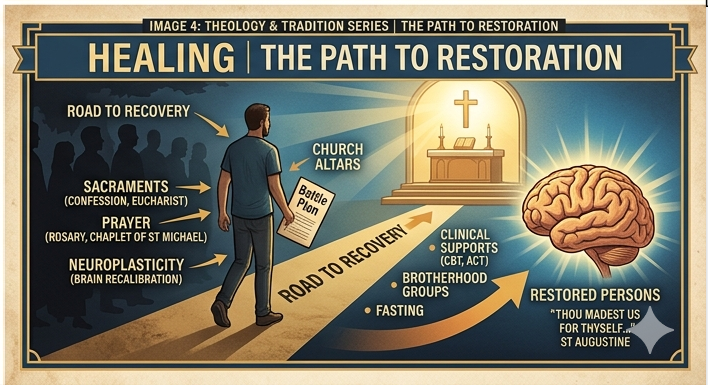
St Augustine, himself a convert from years of serious sexual disorder, wrote: “Our heart is restless, until it repose in Thee” (Confessions, I.1) — a recognition that the disordered seeking of pleasure in creatures is ultimately the misdirection of a desire that can only be satisfied by God. Recovery is, at its deepest level, the reorientation of desire toward its proper End.
Recommended Prayers and Devotions:
- The Daily Rosary: The Rosary has been recommended by numerous saints as a specific remedy against sins of impurity. Meditating on the mysteries of the life, death, and resurrection of Christ — through the eyes of His spotless Mother — reprograms the imagination with holy images and invites the grace of purity. St Louis de Montfort called it “the most powerful weapon against the flesh” (de Montfort, 2000).
- The Chaplet of St Michael: A powerful prayer invoking the intercession of St Michael the Archangel and the nine choirs of angels, recommended by spiritual directors and exorcists for those struggling with serious temptation.
- Prayer to St Joseph for Purity: St Joseph, as the chaste guardian of the Holy Family, is a powerful intercessor for purity and self-mastery. Pope Francis has emphasised Joseph’s role as protector and model of interior strength.
- Marian Consecration: Entrusting one’s struggle to Our Lady — through the Marian consecration traditions of St Louis de Montfort or the Fatima-inspired consecrations — has been reported by countless converts and reverts as transformative. Mary as Mediatrix of Grace channels the graces of healing and purity to those who have recourse to her.
- Liturgy of the Hours (Divine Office): Even beginning with Morning Prayer and Night Prayer (Compline) structures the day around the praise of God and leaves less interior space for temptation to take root.
5.2 The Sacraments: Objective Sources of Healing Grace
The sacraments are not merely symbols or commemorations — they are real, efficacious channels of grace that objectively communicate what they signify. For those struggling with pornography, two sacraments are of primary importance:
The Sacrament of Penance (Confession)
Regular, sincere Confession is perhaps the single most powerful practical tool available to a Catholic struggling with pornography. The grace of absolution does not merely forgive — it strengthens. The Council of Trent defined that Confession confers, beyond forgiveness, a special sacramental grace that provides “help to avoid sin in future” (Council of Trent, Session XIV). Frequent confession — weekly if necessary — removes the accumulated weight of guilt, repairs the relationship with God, and provides the sacramental grace specifically tailored to the penitent’s struggle.
A good confessor is also an invaluable pastoral guide. Catholics are encouraged to seek a regular confessor — preferably a priest trained in spiritual direction — who can accompany them over time, adjust their penance, and guide their growth in virtue.
The Holy Eucharist
Frequent, worthy reception of the Eucharist — the Body, Blood, Soul, and Divinity of Jesus Christ — is an irreplaceable source of healing and strength. The Eucharist is, as the Catechism teaches, ‘the source and summit of the Christian life’ (CCC §1324). The Real Presence of Christ received in Holy Communion has a divinising effect on the soul and body of the communicant. Many who have struggled with and overcome pornography addiction have testified to the transformative power of daily Mass and daily Communion as the foundation of their recovery. The Eucharist is the medicine of immortality — and that medicinal property extends to the wounds inflicted by disordered desire.
5.3 Psychological and Clinical Interventions
Alongside the spiritual remedies, which are primary and irreplaceable, clinical psychological support plays an important and well-evidenced role in recovery. The most effective approaches share a focus on understanding the function of pornography in the person’s life, developing alternative coping strategies, and rebuilding relational skills.
- Cognitive Behavioural Therapy (CBT): The strongest evidence base for treating compulsive sexual behaviours, targeting automatic thoughts, cognitive distortions, and behavioural patterns that sustain compulsive use, while equipping patients with urge management and relapse prevention skills (Crosby & Twohig, 2016; Hallberg et al., 2017).
- Acceptance and Commitment Therapy (ACT): Focuses on psychological flexibility, values-based living, and defusion from intrusive thoughts — with natural resonances with the spiritual tradition of detachment and recollection (Crosby & Twohig, 2016).
- Mindfulness-Based Approaches: Reduce the craving-driven automaticity of compulsive pornography use by strengthening metacognitive awareness — the capacity to observe urges without acting on them (Hallberg et al., 2017). Naturally integrated with contemplative prayer and Ignatian examination of conscience.
- Motivational Interviewing (MI): Particularly useful in early recovery, exploring and amplifying the person’s own intrinsic motivations for change — including their values, their faith, and the relationships they cherish (Miller & Rollnick, 2013).
5.4 Lifestyle Interventions and the ‘Battle Plan’
The neuroscience of recovery from compulsive behaviours consistently identifies lifestyle factors as critical modifiers of outcome. These are not mere self-help platitudes — they are biologically grounded interventions that directly support the neurological recalibration necessary for lasting recovery.
- Physical Exercise: Regular aerobic exercise increases dopaminergic tone in the reward system, providing a natural, non-addictive source of the neurochemical reward that pornography has hijacked (Koob & Volkow, 2010).
- Internet Accountability Software: Tools such as Covenant Eyes or Bark provide both filtering and accountability reporting. Accountability relationships dramatically improve recovery outcomes.
- The HALT Framework: Compulsive pornography use is most likely when the person is Hungry, Angry, Lonely, or Tired. Attending to these basic needs significantly reduces vulnerability.
- Community and Brotherhood/Sisterhood: Isolation is the oxygen of addiction. Recovery flourishes in community. Catholic men’s groups, accountability partnerships, and organisations like Integrity Restored or Magdala Ministry provide both practical support and the witness of others who have found freedom.
- Fasting: The Catholic tradition has always recognised fasting as a discipline that strengthens the will in its governance of bodily appetites. Christ Himself identified some spiritual battles as requiring “prayer and fasting” (Matthew 17:21). Even modest, regular Friday fasting trains the fundamental act of saying “no” to a strong bodily desire — precisely the capacity pornography erodes.
- Holy Leisure and Sacred Beauty: Pornography exploits the human hunger for beauty and transcendence. Recovery involves redirecting that hunger toward legitimate sources: sacred music, visual art, nature, great literature, and above all the liturgy (Ratzinger, 1999).
5.5 Healing for Partners and Families
The partner of a pornography user is never merely a bystander — they are a wounded party requiring their own healing pathway. Specialised therapeutic support for partners, including groups such as S-Anon or COSA (Co-dependents of Sex Addicts), and therapists trained in betrayal trauma, are essential elements of holistic family recovery. The Catholic tradition adds the particular resources of prayer, spiritual direction, and the example of saints who carried heavy crosses within their marriages with heroic charity.
Children in affected families benefit from age-appropriate transparency (carefully calibrated by a qualified therapist), restoration of parental emotional presence, and the re-establishment of a secure family routine structured around faith practice — daily prayer, Sunday Mass, and the rhythms of the liturgical year as a healing counter-narrative to the chaos that addiction introduces.
Conclusion: Broken Images, Restored Persons
Pornography is not a trivial matter of private entertainment choices. It is a scientifically documented neurological hazard, a behavioural disorder with addiction-like properties, a systematic threat to intimate relationships and family stability, and — most fundamentally — a spiritual wound that degrades the human person’s capacity for love, truth, and transcendence.
But the same tradition that names the wound clearly also proclaims with equal clarity that no wound is beyond the reach of Christ’s mercy. The brain can heal. The will can be strengthened. Relationships can be restored. The soul, no matter how darkened, can be illumined by grace. St Augustine testified from the other side of his own long struggle: “Thou madest us for Thyself, and our heart is restless, until it repose in Thee.” The restlessness that drives compulsive pornography use is, at its root, a hunger for God — misdirected and counterfeit, but not extinguished.
The path forward integrates the best of neuroscience, clinical psychology, and Catholic spiritual tradition. It requires honesty, humility, community, and above all, the daily choice to surrender oneself to the One who alone can make us truly free. That path is difficult — but it is real, it is well-lit, and it leads home.
References
American Psychiatric Association. (2013). Diagnostic and statistical manual of mental disorders (5th ed.). American Psychiatric Publishing. https://doi.org/10.1176/appi.books.9780890425596
Aquinas, T. (1947). Summa theologica (Fathers of the English Dominican Province, Trans.). Benziger Bros. (Original work completed c. 1274)
Augustine of Hippo. (2008). Confessions (H. Chadwick, Trans.). Oxford University Press. (Original work published c. 397 AD)
Bonino, S., Ciairano, S., Rabaglietti, E., & Cattelino, E. (2006). Use of pornography and self-reported engagement in sexual violence among adolescents. European Journal of Developmental Psychology, 3(3), 265–288.
Braun-Courville, D. K., & Rojas, M. (2009). Exposure to sexually explicit Web sites and adolescent sexual attitudes and behaviors. Journal of Adolescent Health, 45(2), 156–162. https://doi.org/10.1016/j.jadohealth.2008.12.004
Catechism of the Catholic Church. (1997). Libreria Editrice Vaticana.
Covenant Eyes. (2020). Pornography statistics: 250+ facts, quotes, and statistics about pornography use. Covenant Eyes Inc.
Crosby, J. M., & Twohig, M. P. (2016). Acceptance and commitment therapy for problematic internet pornography use: A randomized trial. Behavior Therapy, 47(3), 355–366. https://doi.org/10.1016/j.beth.2016.02.001
de Montfort, L. M. (2000). The secret of the rosary. TAN Books. (Original work published 1912)
Dew, J., & Willoughby, B. J. (2011). Do pornography use and marital quality decline together? Journal of Family Issues, 32(1), 2–20.
Doidge, N. (2007). The brain that changes itself. Viking.
Giedd, J. N. (2008). The teen brain: Insights from neuroimaging. Journal of Adolescent Health, 42(4), 335–343.
Hald, G. M., Malamuth, N. M., & Yuen, C. (2010). Pornography and attitudes supporting violence against women. Aggressive Behavior, 36(1), 14–20. https://doi.org/10.1002/ab.20328
Hallberg, J., et al. (2017). A randomized controlled study of group-administered CBT for hypersexual disorder in men. Journal of Sexual Medicine, 14(7), 950–958.
Hilton, D. L. (2013). Pornography addiction — A supranormal stimulus considered in the context of neuroplasticity. Socioaffective Neuroscience & Psychology, 3, 20767.
Hilton, D. L., & Watts, C. (2011). Pornography addiction: A neuroscience perspective. Surgical Neurology International, 2, 19. https://doi.org/10.4103/2152-7806.76977
John Paul II. (1997). The theology of the body: Human love in the divine plan. Pauline Books & Media.
Koob, G. F., & Volkow, N. D. (2010). Neurocircuitry of addiction. Neuropsychopharmacology, 35(1), 217–238.
Kraus, S. W., et al. (2018). Compulsive sexual behaviour disorder in the ICD-11. World Psychiatry, 17(1), 109–110.
Kühn, S., & Gallinat, J. (2014). Brain structure and functional connectivity associated with pornography consumption. JAMA Psychiatry, 71(7), 827–834. https://doi.org/10.1001/jamapsychiatry.2014.93
Love, T., et al. (2015). Neuroscience of internet pornography addiction: A review and update. Behavioral Sciences, 5(3), 388–433.
Miller, W. R., & Rollnick, S. (2013). Motivational interviewing: Helping people change (3rd ed.). Guilford Press.
Minuchin, S. (1974). Families and family therapy. Harvard University Press.
Nestler, E. J. (2008). Transcriptional mechanisms of addiction: Role of ΔFosB. Philosophical Transactions of the Royal Society B, 363(1507), 3245–3255.
Park, B. Y., et al. (2016). Is internet pornography causing sexual dysfunctions? Behavioral Sciences, 6(3), 17.
Perry, S. L. (2018). Pornography use and marital separation. Journal of Sex Research, 55(3), 357–369.
Peter, J., & Valkenburg, P. M. (2016). Adolescents and pornography: A review of 20 years of research. Journal of Sex Research, 53(4–5), 509–531.
Ratzinger, J. (1999). The spirit of the liturgy. Ignatius Press.
Schneider, J. P. (2000). Effects of cybersex addiction on the family. Sexual Addiction & Compulsivity, 7(1–2), 31–58.
Steffens, B. A., & Rennie, R. L. (2006). The traumatic nature of disclosure for wives of sexual addicts. Sexual Addiction & Compulsivity, 13(2–3), 247–267.
Voon, V., et al. (2014). Neural correlates of sexual cue reactivity in individuals with and without compulsive sexual behaviours. PLOS ONE, 9(7), e102419.
West, C. (2004). Theology of the body explained. Pauline Books & Media.
World Health Organization. (2019). International classification of diseases (11th rev.). WHO. https://icd.who.int/
Wright, P. J., Tokunaga, R. S., & Kraus, A. (2016). A meta-analysis of pornography consumption and actual acts of sexual aggression. Journal of Communication, 66(1), 183–205.