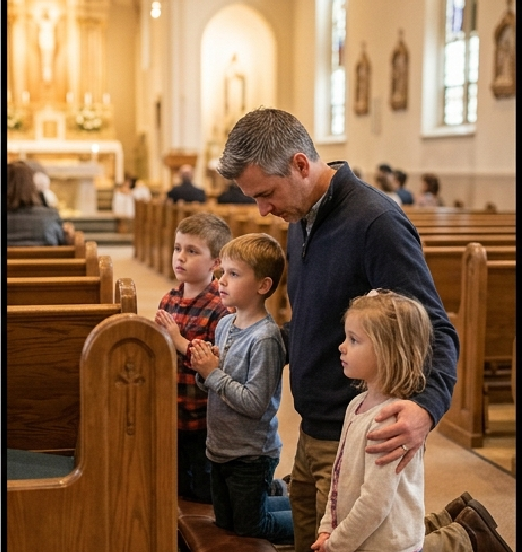
The Father Who Goes to Mass: Why Dad’s Sunday Habit May Be the Single Greatest Predictor of Your Children’s Faith
Have You Ever Wondered Why Your Adult Kids Stopped Going to Mass?
If you are a parent who lies awake at night wondering why your grown children no longer go to Mass — or if you are a husband who has not been to Confession since the Clinton administration — this article is written for you. Not to scold. Not to shame. To tell you the truth that almost no homily mentions, that almost no parish bulletin prints, and that almost every social-science researcher who has touched it has been astonished by.
The truth is this: when researchers look at the long-term data on who actually keeps the Faith as adults, one factor towers above every other. It isn’t the parish school. It isn’t the youth group. It isn’t even Catholic university. It is whether or not Dad goes to Mass.
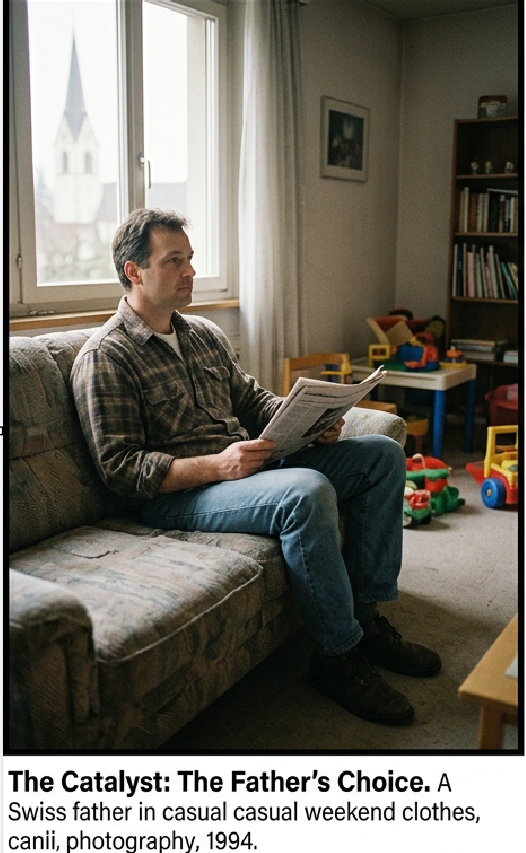
That sentence is going to sound strange to many Catholics, because for two generations the lived experience of the Church has been that Mum is the one who drags the kids to Mass while Dad reads the paper. But the research — done not by a pulpit-pounding preacher but by a secular Swiss demographer — says that the lived experience is precisely the problem.
Does It Really Matter If Dad Goes to Mass?
In 1994, the Swiss Federal Statistical Office in Neuchâtel ran an extra survey alongside the national census. The lead researchers, Werner Haug and Phillipe Warner, were not trying to start a culture war. They were trying to answer one simple question: When a child grows up in a religious household, what predicts whether that child will still be pracitising as an adult? Their findings were published in 2000 in Volume 2 of Population Studies No. 31 by the Council of Europe (Haug & Warner, 2000).
Anglican vicar Robbie Low — who later, with his wife, was received into the Catholic Church and ordained a Catholic priest — surfaced the data for the English-speaking world in a now-famous 2003 essay in Touchstone magazine. Low (2003) summarised the headline finding in one sentence: “It is the religious practice of the father of the family that, above all, determines the future attendance at or absence from church of the children.”
Read that again. Above all. Not “alongside the mother.” Not “as one factor among many.” Above all.
What Did the Swiss Researchers Actually Find?
The Swiss data sorted families into scenarios based on the practice of each parent. Here is what the numbers showed (Low, 2003; Haug & Warner, 2000):
Scenario 1 — Both parents attend regularly. Thirty-three percent of their children will grow up to be regular churchgoers, and another 41% will attend irregularly. Only about a quarter will drop away completely. In other words, when Mum and Dad both practise, roughly three out of four children carry the Faith into adulthood in some form.
Scenario 2 — Father irregular, Mother regular. Only 3% of the children become regular practitioners. About 59% become irregular attenders, and 38% are lost to the Church altogether.
Scenario 3 — Father non-practising, Mother regular. Only 2% of the children become regular worshippers. Just 37% attend irregularly. Over 60% are completely lost to the Church.
Scenario 4 — Father regular, Mother irregular. Now the picture flips dramatically. Thirty-eight percent of the children become regular churchgoers — higher than the rate when both parents attend.
Scenario 5 — Father regular, Mother non-practicing. A staggering 44% of children grow up to become regular practitioners. As Low (2003) put it, “loyalty to father’s commitment grows in proportion to mother’s laxity, indifference, or hostility.”
When Low summarised the bottom line, the sentence reads like a thunderclap: “If a father does not go to church, no matter how faithful his wife’s devotions, only one child in 50 will become a regular worshipper. If a father does go regularly, regardless of the practice of the mother, between two-thirds and three-quarters of their children will become churchgoers.”
Why Does the Father’s Day Pew Sit Empty?
If the data is so clear, you would think Catholic and Protestant churches alike would be packed on Father’s Day. They are not.
LifeWay Research, the research arm of the Southern Baptist Convention, polled 1,000 Protestant pastors and found a striking pecking order of attendance. Easter topped the list at 93%, followed by Christmas (84%) and Mother’s Day (59%). Father’s Day ranked dead last among every tested day, falling behind even Homecoming, special “invite a friend” days, and the Fourth of July — and this despite the fact that Father’s Day always falls on a Sunday while the Fourth almost never does (LifeWay Research, 2012; LifeWay Research, 2024).
Scott McConnell, then director of LifeWay Research, put it plainly: “The attendance difference between Mother’s Day and Father’s Day is telling. Either churches are less effective in affirming fathers, or families believe Christian fathers don’t value their participation in worship services.”
Said another way: when American Christianity is at the table, Mum shows up to be honoured, and the family shows up with her. When Dad is supposed to be honoured, the family goes fishing. We have, as a culture, communicated to fathers that worship is not really their thing. And the men have believed us.
Is It True That 93% of Families Follow the Father to Christ?
A statistic that has circulated in men’s ministry circles for almost three decades claims that if a child is the first to come to Christ in a household, only 3.5% of the family follows; if the mother is first, 17% follow; but if the father is first, 93% of the family follows. It has been quoted by countless pastors and is most often traced to Baptist Press’s April 3, 2003 article by Polly House, Want Your Church to Grow? Then Bring in the Men (House, 2003).
Honesty requires a caveat here. The figure originally appeared on page 111 of The Promise Keeper at Work by Bob Horner, Ron Ralston, and Dave Sunde (1996), where it was printed without any citation to primary research. Researcher Miranda Zapor Cruz (2022) attempted to track down the underlying study and was told that the author could no longer recall the source. No major religion-research organisation — Pew, Barna, PRRI, Baylor — claims authorship of the data. The honest summary is that the 93% figure is a memorable shorthand whose primary research foundation cannot be verified, even though the broader pattern it describes — that fathers matter disproportionately — is real and supported across multiple independent studies.
What is not in dispute is this: even setting that one unsourced number aside, every methodologically rigorous study we can verify points in the same direction. Fathers who practice the Faith pass it on at far higher rates than fathers who do not. The Pew Research Center (2016) found that among children raised by a Catholic mother and a Protestant father, 38% remain Catholic as adults, while among children raised by a Catholic father and a Protestant mother, only 14% remain Catholic — a stark gap that reflects how heavily the father’s religious identity weighs on Catholic transmission in mixed marriages.
What About the Children Who Are Already Walking Away?
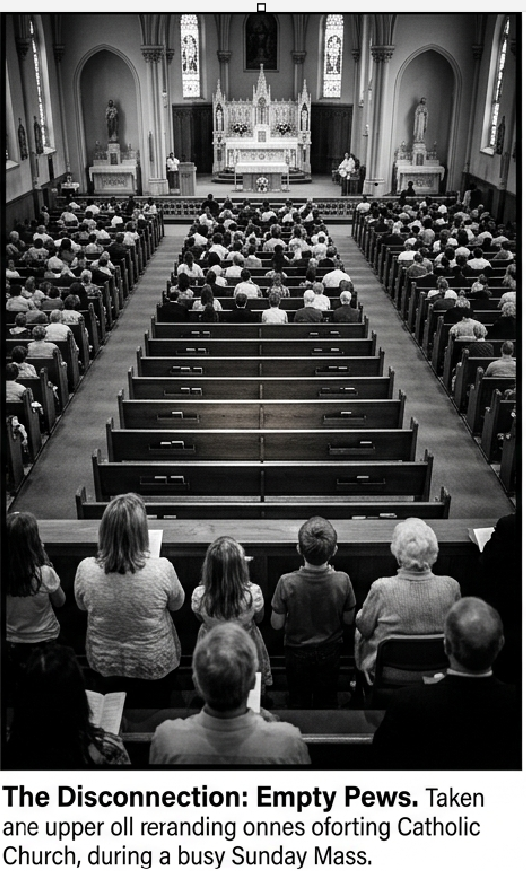
If the data above feels abstract, here is the urgent context. The Barna Group has been tracking what it calls the “dropout problem” among young Christians for over a decade. In David Kinnaman’s (2011) original You Lost Me study, 59% of young adults aged 18 to 29 who had grown up in church had dropped out of active church involvement by their late twenties. Eight years later, the dropout figure had risen to 64%: nearly two-thirds of U.S. 18–29-year-olds who grew up in church tell Barna they have withdrawn from church involvement as an adult after having been active as a child or teen (Barna Group, 2019).
These are not children of atheists. These are children of families that took them to church. And nearly two-thirds of them are walking away.
The picture inside the Catholic Church is, if anything, more sobering. The Center for Applied Research in the Apostolate at Georgetown reports that Sunday Mass attendance in person has held at approximately 24% — meaning only about one in four self-identified Catholics is actually at Mass on any given Sunday. And of those who walk away, the data consistently shows that they walked away from homes where the Faith was carried, if it was carried at all, mostly by their mothers.
What About Faithful Catholic Mothers?
This is where we must speak carefully — because no Catholic article on fatherhood is worth the page it is printed on if it crushes the heart of a faithful Catholic mother who has been praying her husband back to Mass for twenty years.
To you, dear mother, hear this clearly: nothing in the Swiss data, nothing in Pew, nothing in Barna, nothing in Touchstone says you do not matter. You matter immensely. The Catechism of the Catholic Church (1997) places mothers and fathers together as the “first heralds” of the Faith for their children (No. 2225). St. Paul reminds Timothy that his living faith dwelled “first in your grandmother Lois and your mother Eunice” (2 Tim. 1:5). St. Monica wept her son Augustine into sainthood. The history of the Church is, in large measure, the history of mothers refusing to give up.
What the Swiss data actually shows is more specific and more theological than “Mum doesn’t matter.” It shows that children draw their picture of the world outside the home from Dad. Mum shapes the warmth of the domestic hearth; Dad shapes how children interpret the world beyond the front door. When Dad treats Mass as something he gives an hour of his Sunday to, week in and week out, children absorb the message: this is what the world is really about. When he sleeps in, they absorb the opposite.
It is not a competition between mother and father. It is a complementarity. The Swiss study simply revealed that one half of that complementarity has been catastrophically missing from Christian homes for two generations — and the children have noticed.
What Does the Church Actually Teach About Fathers?
Long before any Swiss demographer ran the numbers, the Church had already said this in the language of revelation. The Catechism of the Catholic Church (1997) puts it plainly: “Through the grace of the sacrament of marriage, parents receive the responsibility and privilege of evangelising their children. Parents should initiate their children at an early age into the mysteries of the faith of which they are the ‘first heralds'” (No. 2225). Education in the Faith, the Catechism continues, “happens when family members help one another to grow in faith by the witness of a Christian life in keeping with the Gospel” (No. 2226).
Notice the word witness. Children learn the Faith not primarily from formal instruction but from watching the witness of their parents — and especially of the father, whose role outside the home anchors the child’s understanding of the world.
St. John Paul II (1981) developed this at length in Familiaris Consortio. In paragraph 25, addressing men specifically as husbands and fathers, he wrote that the father is called “to reveal and relive on earth the very fatherhood of God” by his presence, his sacrifice, and his witness within the family. The father, in other words, is not a backup parent. He is an icon — a living image — of God the Father for his children. When that icon is absent or indifferent, children develop a damaged picture of God Himself.
And under it all sits the ancient command of St. Paul to fathers in Ephesians 6:4: “Fathers, do not provoke your children to anger, but bring them up in the discipline and instruction of the Lord” (RSV-CE). Notice St. Paul does not say “parents.” He addresses fathers directly, because in the apostolic Church it was understood that the father bore a particular weight of responsibility for the spiritual formation of the children.
The Second Vatican Council taught the same thing in Gravissimum Educationis, calling parents — and naming fathers specifically among them — the “first and foremost educators” of their children in matters of faith (Second Vatican Council, 1965, No. 3). The Church has always known what the Swiss researchers stumbled across in their census data.
Why Does the Father’s Witness Carry Such Weight?
One reason offered by researchers, and echoed by spiritual writers, is developmental. Children take their cues about the inside of the home — its rhythms, its warmth, its emotional life — from Mum. They take their cues about the outside of the home — the world of work, of public conduct, of what serious adults take seriously — from Dad (Craven, 2011). When Dad treats Mass as something he gives an hour of his Sunday to, week in and week out, children read that as: this is what the world is really about.
There is also a deeper, sacramental reason. The Catholic priest at the altar is called Father. The first Person of the Trinity is Father. The covenants of Scripture are made through the patriarchs. The pattern is woven into revelation itself: God has chosen, over and over, to communicate Himself through fatherhood. When the human father of a Catholic home walks into Mass week after week, the child receives — in a way more powerful than any catechism class — the lesson that God Himself is worth showing up for.
Robbie Low (2003) saw this clearly: “You cannot buck the biology of the created order. Father’s influence is out of all proportion to his allotted, and severely diminished role, in Western liberal society.” Low’s argument was not that fathers are more important than mothers in some absolute sense. It was that fathers exercise a specific and irreplaceable role in the transmission of religious identity — a role the modern world has laboured mightily to dismiss.
What If You Are the Dad Who Hasn’t Been to Mass in Years?
If you are reading this and you are the lapsed father — the one who stopped going somewhere between Confirmation and college, the one whose wife takes the kids while you stay home — please do not put this article down feeling crushed. That is not why it is written.
It is written because your wife has been praying for you. Because your children, even the grown ones who would never admit it, are still watching you. Because the data says that you — not your parish priest, not your wife, not the religious-ed coordinator — hold the heaviest single key to whether the next generation of your family meets Jesus Christ.
You may feel like a hypocrite for walking back into Mass after years away. The hypocrite is the one who knows he should come back and doesn’t. The honest man is the one who walks in, sits in the back, and waits in the Confession line on Saturday afternoon. The priest has heard worse than your sins. He will be more glad to see you than you can possibly imagine.
You do not have to feel ready. You do not have to have it all figured out theologically. You do not have to like every homily. You only have to show up — and let your children see you show up. That is the witness. That is the icon. That is what the Swiss data, the Barna data, the Pew data, and two thousand years of Catholic teaching are all pointing at.
St. John Paul II (1981) wrote of Christian fathers that they are called to an “example of conduct” within the family (Familiaris Consortio, No. 25). Not a perfect example. An example.
Where Do We Go From Here?
If you are a Catholic father reading this, here are three things to do this week. Go to Mass on Sunday. Sit with your family. Let your children see you receive Communion — or, if you cannot yet receive, let them see you in the Communion line for a blessing while you make a plan to get to Confession. The example matters more than your interior feeling.
If you are a Catholic mother reading this, do not stop praying for your husband. The data is not a verdict against you; it is a vindication of every rosary you have ever offered for him. St. Monica prayed for seventeen years. Keep going.
If you are an adult child of a lapsed father, consider that you may be the one God is asking to invite your dad back. A son or daughter asking “Dad, will you come to Mass with me this Sunday?” carries a weight no priest can match.
And if you are a parish priest or deacon: preach this. Not as a guilt trip. As good news. Tell the men in your pews that their presence is not optional decoration in their families’ spiritual lives — it is the load-bearing wall. The men who hear it will rise to it. Most of them have been waiting their whole lives to be told they matter that much.
The Faith is handed down, generation to generation, not primarily through programs but through witnesses. And in the mysterious providence of God, the witness of the father carries a weight the world has forgotten and the data keeps rediscovering.
Dad — your family is waiting for you. The Lord, in His infinite patience, is waiting for you. The pew on the end of the third row from the back is waiting for you. Come home.
References
Barna Group. (2019, September 4). Church dropouts have risen to 64%—But what about those who stay? https://www.barna.com/research/resilient-disciples/
Catechism of the Catholic Church (2nd ed.). (1997). Libreria Editrice Vaticana.
Craven, S. M. (2011, June 19). Fathers: Key to their children’s faith. The Christian Post. https://www.christianpost.com/news/fathers-key-to-their-childrens-faith-51331/
Cruz, M. Z. (2022). The myth of the 93%. Missio Alliance. https://missioalliance.org/the-myth-of-the-93-fathers-and-mothers-are-not-a-competitive-hierarchy-in-the-home/
Haug, W., & Warner, P. (2000). The demographic characteristics of the linguistic and religious groups in Switzerland. In W. Haug, P. Compton, & Y. Courbage (Eds.), The demographic characteristics of national minorities in certain European states (Population Studies No. 31, Vol. 2). Council of Europe.
Horner, B., Ralston, R., & Sunde, D. (1996). The promise keeper at work. Focus on the Family Publishing.
House, P. (2003, April 3). Want your church to grow? Then bring in the men. Baptist Press. https://www.baptistpress.com/resource-library/news/want-your-church-to-grow-then-bring-in-the-men/
John Paul II. (1981, November 22). Familiaris consortio. Libreria Editrice Vaticana. https://www.vatican.va/content/john-paul-ii/en/apost_exhortations/documents/hf_jp-ii_exh_19811122_familiaris-consortio.html
Kinnaman, D. (2011). You lost me: Why young Christians are leaving church… and rethinking faith. Baker Books.
Kinnaman, D., & Matlock, M. (2019). Faith for exiles: 5 ways for a new generation to follow Jesus in digital Babylon. Baker Books.
LifeWay Research. (2012, May 11). Mother’s Day church attendance third among holidays, Father’s Day last. https://research.lifeway.com/2012/05/11/mothers-day-church-attendance-third-among-holidays-fathers-day-last/
LifeWay Research. (2024, March 26). Easter remains high attendance day for most churches. https://research.lifeway.com/2024/03/26/easter-remains-high-attendance-day-for-most-churches/
Low, R. (2003, June). The truth about men and church. Touchstone: A Journal of Mere Christianity, 16(5). https://www.touchstonemag.com/archives/article.php?id=16-05-024-v
Pew Research Center. (2016, October 26). The links between religious upbringing, current religious identity. https://www.pewresearch.org/religion/2016/10/26/links-between-childhood-religious-upbringing-and-current-religious-identity/
Second Vatican Council. (1965, October 28). Gravissimum educationis. Libreria Editrice Vaticana.