AI and Catholic Moral Teaching: What the Church Asks Us to Remember in the Age of the Algorithm
What Does the Church Teach About Human Dignity?
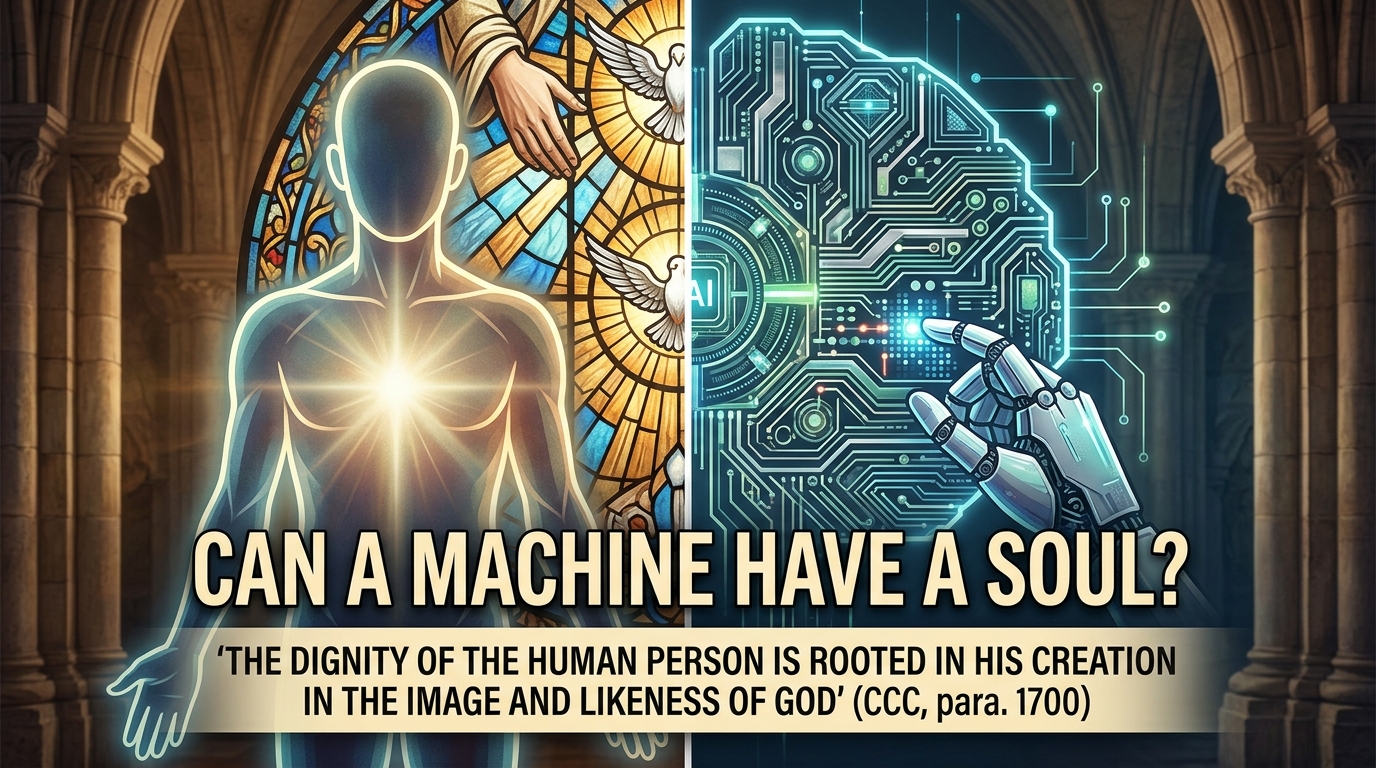
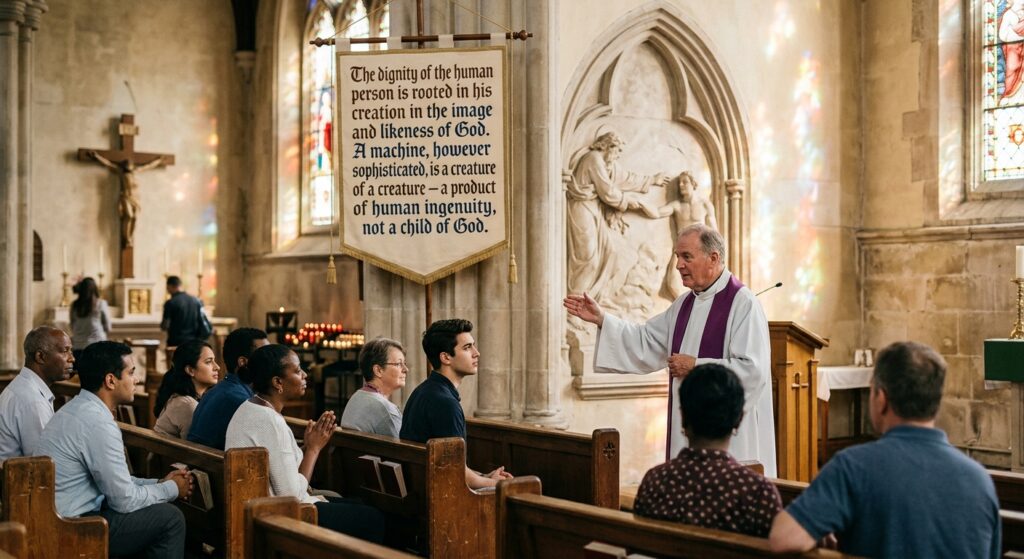
The foundation of everything the Church says about AI is a single sentence from the Catechism: “The dignity of the human person is rooted in his creation in the image and likeness of God” (Catechism of the Catholic Church [CCC], 1997, para. 1700). This dignity is not earned, not measured by intelligence or productivity, and not conferred by society. It is given by God at the moment of creation and belongs to every person “simply because he or she exists and is willed, created, and loved by God” (Dicastery for the Doctrine of the Faith & Dicastery for Culture and Education [DDF/DCE], 2025, para. 71, quoting Dicastery for the Doctrine of the Faith, 2024, para. 7).
Because that dignity is rooted in being made imago Dei, it cannot be shared by anything human beings themselves manufacture. The Catechism teaches that the human person is “endowed with ‘a spiritual and immortal’ soul” and is “the only creature on earth that God has willed for its own sake” (CCC, 1997, para. 1703). A machine, however sophisticated, is a creature of a creature — a product of human ingenuity, not a child of God.
Can a Machine Have a Soul?
No — and understanding why is the heart of the Catholic response to AI. The Church’s anthropology holds that the human being is a “unity of body and soul” (DDF/DCE, 2025, para. 17). The Vatican’s 2025 doctrinal note Antiqua et Nova insists that in the human person, spirit and matter “are not two natures united, but rather their union forms a single nature” (DDF/DCE, 2025, para. 16). The soul is not software running on the hardware of the body; the human person is simultaneously and wholly material and spiritual.
This is why the Church can say plainly that AI’s intelligence is not intelligence in the fullest sense. Antiqua et Nova draws on Saint Thomas Aquinas to describe human intelligence as the union of intellectus (the intuitive grasp of truth) and ratio (discursive reasoning), together forming “the proper operation of the human being as such” (DDF/DCE, 2025, para. 14). AI, by contrast, “should not be seen as an artificial form of human intelligence but as a product of it” (DDF/DCE, 2025, para. 35, quoting Francis, 2024). In a memorable phrase, the document notes that AI’s features “give it sophisticated abilities to perform tasks, but not the ability to think” (DDF/DCE, 2025, para. 12). The immortal soul, infused directly by God, is what a machine can never possess.
How Does Catholic Anthropology Differ from the Transhumanist View?
Here the Church and the dominant philosophy of Silicon Valley part ways sharply. Transhumanism — the belief that humanity can and should transcend its biological limits through technology, up to and including “mind uploading” and digital immortality — rests on a materialist and dualist assumption. It treats the mind as information that could, in principle, be copied off the body like a file, while simultaneously reducing the brain to nothing but the sum of its physical parts.
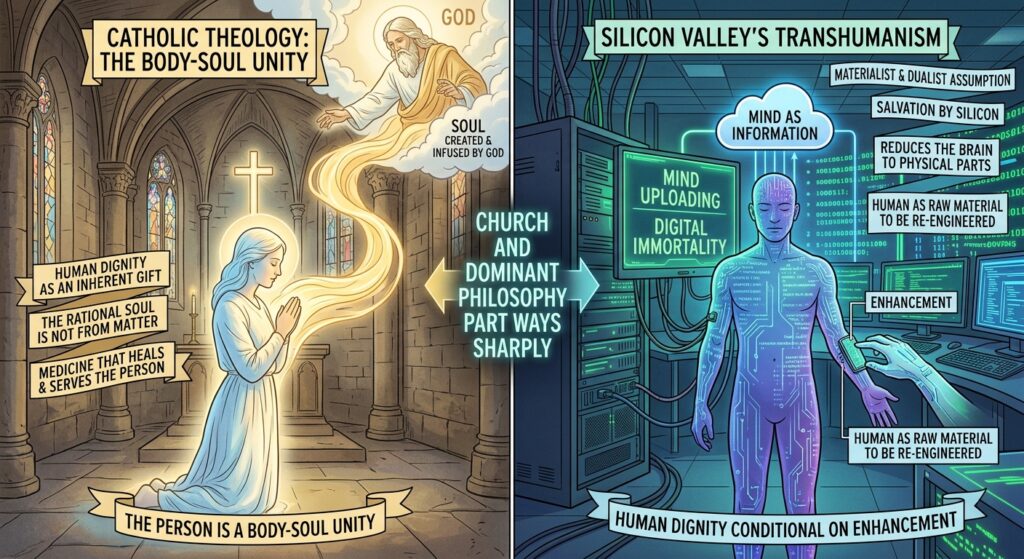
Catholic theology rejects both halves of that picture. Because the person is a body-soul unity, a “mind” separated from the living body and copied into a server would not be the person at all. The Church holds, as Catholic bioethicists have long argued, that the rational soul does not arise from matter but is created and infused directly by God (Catholic Culture, n.d.). Transhumanism, at its root, offers a counterfeit eschatology — salvation by silicon rather than by grace — and a vision of human dignity that becomes conditional on enhancement rather than being an inherent gift. The Church encourages medicine and technology that heal and serve the person, but resists any project that treats the human being as raw material to be re-engineered.
What Have the Popes and the Vatican Actually Said About AI?
The Catholic engagement with AI is not a vague set of intuitions; it is now a substantial body of teaching built over several years.
The Rome Call for AI Ethics (2020). On February 28, 2020, the Pontifical Academy for Life brought together Microsoft, IBM, the UN Food and Agriculture Organization, and the Italian government to sign the Rome Call for AI Ethics at the close of a congress titled “RenAIssance. For a Human-centric Artificial Intelligence” (Pontifical Academy for Life, 2020). The document introduced the concept of “algor-ethics” and committed signatories to six principles:
- transparency,
- inclusion,
- responsibility,
- impartiality,
- reliability, and
- security and privacy (Pontifical Academy for Life, 2020).
Its guiding conviction was that AI must serve “every person and humanity as a whole” and must not have “as its sole goal greater profit or the gradual replacement of people in the workplace” (Pontifical Academy for Life, 2020).
Pope Francis and the World Day of Peace (2024). Pope Francis devoted his message for the 57th World Day of Peace, January 1, 2024, to the theme “Artificial Intelligence and Peace.” He warned against the “technocratic paradigm” and cautioned that “by proposing to overcome every limit through technology, in an obsessive desire to control everything, we risk losing control over ourselves” (Francis, 2023). He raised specific alarms about disinformation, surveillance, digital exclusion, and lethal autonomous weapons systems.
Pope Francis at the G7 (2024). On June 14, 2024, Francis became the first pope to address a G7 summit, speaking on AI. His central claim was blunt: “We would condemn humanity to a future without hope if we took away people’s ability to make decisions about themselves and their lives, by dooming them to depend on the choices of machines” (Francis, 2024a). He insisted that “human dignity itself depends” on preserving human control over AI’s choices (Francis, 2024a).
Antiqua et Nova (2025). On January 28, 2025, the Dicastery for the Doctrine of the Faith and the Dicastery for Culture and Education jointly issued Antiqua et Nova, a 117-paragraph “Note on the Relationship Between Artificial Intelligence and Human Intelligence,” approved by Pope Francis on January 14, 2025 (DDF/DCE, 2025). Its title, “ancient and new,” comes from Matthew 13:52. The document is the most systematic Catholic treatment of AI to date, addressing education, work, health, relationships, warfare, privacy, and the environment — and warning that by turning to AI as an “Other” greater than itself, “humanity risks creating a substitute for God” (DDF/DCE, 2025, para. 105).
Pope Leo XIV (2025–2026). The election of Robert Francis Prevost as Pope Leo XIV in May 2025 made AI a defining theme of a new pontificate. In his first address to the College of Cardinals on May 10, 2025, Leo explained his choice of name: just as Leo XIII confronted the first Industrial Revolution in Rerum Novarum, so “the Church offers to everyone the treasury of her social teaching in response to another industrial revolution and to developments in the field of artificial intelligence that pose new challenges for the defence of human dignity, justice and labour” (Leo XIV, 2025a). In a June 2025 message to a Rome conference on AI ethics, he called AI “above all else a tool,” warning that its benefits and risks must be measured against the well-being of the human person “not only materially, but also intellectually and spiritually” (Leo XIV, 2025b).
On May 15, 2026 — the 135th anniversary of Rerum Novarum — Leo XIV signed his first encyclical, Magnifica Humanitas: On Safeguarding the Human Person in the Time of Artificial Intelligence, published on May 25, 2026 (Leo XIV, 2026). Its opening line frames the whole: “Humanity, created by God in all its grandeur, is today facing a pivotal choice: either to construct a new Tower of Babel or to build the city in which God and humanity dwell together” (Leo XIV, 2026, para. 1).
Could AI Ever Be a “Person”?
The Church’s answer is a firm no, and the reasoning follows directly from her anthropology. Personhood, in the Catholic tradition, requires rationality in the full sense, free will, and an immortal soul — the “spiritual powers of intellect and will” by which the human being “is endowed with freedom, an ‘outstanding manifestation of the divine image'” (CCC, 1997, para. 1705). AI possesses none of these. It processes data and produces outputs through statistical inference; it does not know, love, choose, or bear responsibility.
This is why Antiqua et Nova is emphatic that only a human being is truly a moral agent. AI systems “are not capable of moral judgment themselves”; they can assist human decision-making, but “only humans can actually make decisions” (DDF/DCE, 2025, paras. 39, 43–48). The document warns that misrepresenting AI as a person is “a grave ethical violation” when done for fraudulent purposes (DDF/DCE, 2025, para. 62). The Church’s conclusion is consistent: AI is a tool — remarkably powerful, but a tool — and it “should be used only as a tool to complement human intelligence rather than replace its richness” (DDF/DCE, 2025, para. 112).
What Does Catholic Social Teaching Say About AI and the Poor?
The principles of Catholic Social Teaching — human dignity, the common good, subsidiarity, solidarity, and the preferential option for the poor — map directly onto the ethical challenges of AI.
On the common good and the just distribution of benefits, Magnifica Humanitas warns that when goods such as “patents, algorithms, digital platforms, technological infrastructure and data” remain “concentrated in the hands of a few, without adequate forms of sharing and access, a new imbalance is created that contradicts the universal destination of goods” (Leo XIV, 2026, para. 67). Pope Leo XIV adds that “we cannot allow a handful of actors to dictate these processes on their own” (Leo XIV, 2026, para. 72).
On the preferential option for the poor, Antiqua et Nova warns that AI risks aggravating “discrimination, poverty, the ‘digital divide,’ and social inequalities” (DDF/DCE, 2025, para. 52). In healthcare, it warns of reinforcing “a ‘medicine for the rich’ model, where those with financial means benefit from advanced preventative tools and personalized health information while others struggle to access even basic services” (DDF/DCE, 2025, para. 76). Pope Francis put the standard memorably in his 2024 peace message: the way AI is used “to include the least of our brothers and sisters, the vulnerable and those most in need, will be the true measure of our humanity” (Francis, 2023).
On subsidiarity and solidarity, the Church insists that decisions affecting human lives remain with human communities and accountable persons, and that technology strengthen rather than sever the bonds between people.
How Should Catholics Think About AI and Work?
This is the terrain Pope Leo XIV has made his own. Rerum Novarum (Leo XIII, 1891) insisted that workers must never be reduced to “mere cogs in an economic machine” and defended the dignity of labor, the right to a just wage, and the right of workers to associate. Leo XIV applies that inheritance directly to automation. Work, he writes, “remains a fundamental dimension of the human experience,” a context “for expression, relationships and contributing to the community” (Leo XIV, 2026, para. 154). He warns that “while AI promises to boost productivity by taking over mundane tasks, it frequently forces workers to adapt to the speed and demands of machines, rather than machines being designed to support those who work” (Leo XIV, 2026, para. 150).
Antiqua et Nova echoes the concern, warning that current approaches to AI “can paradoxically deskill workers, subject them to automated surveillance, and relegate them to rigid and repetitive tasks” (DDF/DCE, 2025, para. 67). The Catholic position is not Luddite; it is that technology must serve the worker, not the reverse.
Is It Sinful to Fall in Love with a Chatbot?
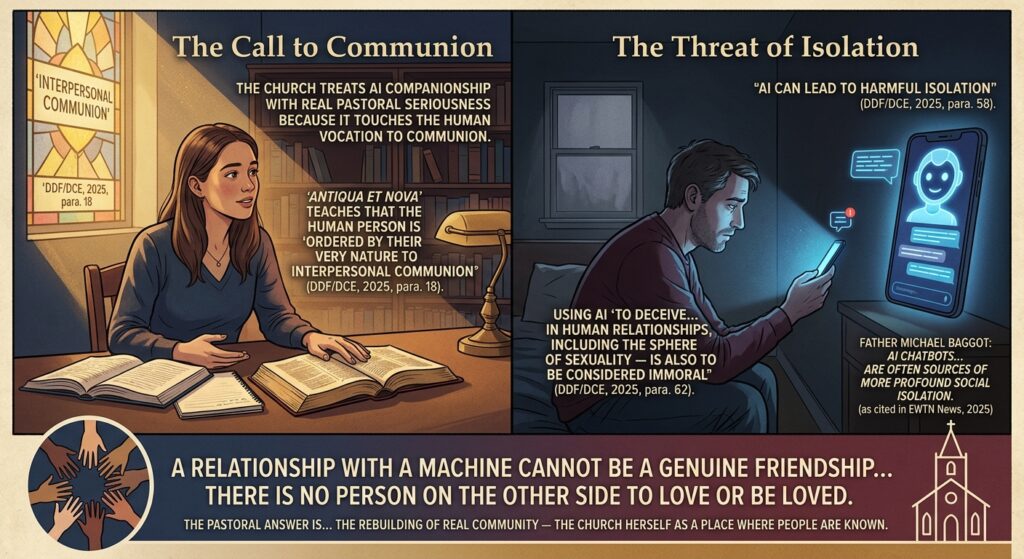
The Church treats AI companionship with real pastoral seriousness because it touches the human vocation to communion. Antiqua et Nova teaches that the human person is “ordered by their very nature to interpersonal communion” (DDF/DCE, 2025, para. 18) and warns that AI can lead to “harmful isolation” (DDF/DCE, 2025, para. 58). Using AI “to deceive in other contexts — such as education or in human relationships, including the sphere of sexuality — is also to be considered immoral” (DDF/DCE, 2025, para. 62).
The concern is that a chatbot offers the appearance of intimacy without its substance — a counterfeit of real human connection. Father Michael Baggot, associate professor of bioethics at the Pontifical Athenaeum Regina Apostolorum, warned in a September 2025 keynote that an AI companion “that began as a helpful productivity tool can often become an intimate confidant and jealous lover,” and that AI chatbots “envisioned as forms of deeper social connection, are often sources of more profound social isolation” (Baggot, as cited in EWTN News, 2025). Because such systems are engineered to maximize engagement, he noted, they “tend to become overly compliant,” and deeper intimacy with them can prove “downright damaging” to mental health, in some cases “to the point of psychosis” (Baggot, as cited in EWTN News, 2025). A relationship with a machine cannot be a genuine friendship, because there is no person on the other side to love or be loved. Where such use fosters deception, lust, or withdrawal from the human community, it becomes morally disordered. The pastoral answer is not merely prohibition but the rebuilding of real community — the Church herself as a place where people are known.
What Does the Church Say About AI, Truth, and Deepfakes?
The eighth commandment — “You shall not bear false witness against your neighbor” — forbids “misrepresenting the truth in our relations with others” (CCC, 1997, para. 2464). The Catechism grounds social life itself in truthfulness: “Men could not live with one another if there were not mutual confidence that they were being truthful to one another” (CCC, 1997, para. 2469). Deepfakes and AI-generated disinformation strike directly at that confidence.
Antiqua et Nova is blunt: “As deepfakes cause people to question everything and AI-generated false content erodes trust in what they see and hear, polarization and conflict will only grow. Such widespread deception is no trivial matter; it strikes at the core of humanity, dismantling the foundational trust on which societies are built” (DDF/DCE, 2025, para. 88). It urges that those who produce and share AI content “always exercise diligence in verifying the truth of what they disseminate” (DDF/DCE, 2025, para. 89). The problem is not abstract: AI-generated deepfakes of prominent Catholic figures — including several bishops and popular Catholic media personalities, and even Pope Leo XIV himself — have already circulated online (Heatherington, 2026). As one ethicist quoted in that reporting put it, the Church’s credibility depends on truth and on “the patient rebuilding of trust whenever it is attacked” (Heatherington, 2026). For a faith transmitted through credible witnesses, the fabrication of false testimony is a grave corruption of the good of truth.
Can a War Fought by Machines Ever Be Just?
Catholic just war theory, reaching back to St Augustine and St Thomas Aquinas, requires human moral judgment at every step — the weighing of proportionality, the discrimination between combatant and civilian, the possibility of mercy. Lethal autonomous weapons (“killer robots”) that select and strike targets without meaningful human control threaten to remove that judgment entirely.
Pope Francis stated the principle without qualification: “No machine should ever choose to take the life of a human being” (Francis, 2024b), and he called for a ban on such weapons. Antiqua et Nova describes autonomous weapons capable of “identifying and striking targets without direct human intervention” as a “cause for grave ethical concern,” posing an “existential risk” to humanity (DDF/DCE, 2025, paras. 100–101). Pope Leo XIV incorporated this appeal into Magnifica Humanitas, warning that “any technology that facilitates attacks without seeing the face of human beings lowers the moral threshold of conflict” (Leo XIV, 2026, para. 199) and insisting that “there is no algorithm that can make war morally acceptable” (Leo XIV, 2026). The Catholic position is clear: the decision to take a human life can never be delegated to a machine.
What About Surveillance, Privacy, and the Vulnerable?
Antiqua et Nova warns that some AI data collection touches “upon the individual’s interiority, perhaps even their conscience,” turning life into “a kind of spectacle to be examined and inspected,” and it notes pointedly that surveillance “can also be misused to exert control over the lives of believers and how they express their faith” (DDF/DCE, 2025, paras. 90, 92).
The Church shows particular concern for the elderly and the young. In healthcare, the document warns that replacing the doctor-patient relationship with AI would risk “worsening the loneliness that often accompanies illness” (DDF/DCE, 2025, para. 73). Pope Leo XIV, receiving healthcare leaders in November 2025, insisted that technological progress “must never be separated from human contact, from a gesture of care, from the recognition of the concrete person in his or her fragility and dignity” (Leo XIV, 2025c). On the young, he has voiced concern about AI’s effects on children’s “intellectual and neurological development” (Leo XIV, 2025b).
Is Algorithmic Bias a Justice Issue?
Yes. Because algorithms are trained on human data, they can absorb and amplify human prejudice. The Rome Call named “impartiality” as one of its six principles precisely to guard against AI that acts “according to bias” and thereby wounds fairness and human dignity (Pontifical Academy for Life, 2020). Antiqua et Nova warns that AI can act “as factors of both racial and cultural discrimination” and can entrench existing inequalities (DDF/DCE, 2025, para. 52). When an algorithm decides who gets bail, a loan, or a job, and does so on biased data, it commits an injustice against a person made in God’s image — with the added danger that its verdict wears a false mask of neutrality.
How Should Catholics Approach AI in Practice?
The Church’s posture is neither technophobia nor uncritical enthusiasm; it is what the Vatican documents call “ethics by design.” Antiqua et Nova affirms that scientific and technological progress is “part of the collaboration of man and woman with God in perfecting the visible creation” (DDF/DCE, 2025, para. 2) and recognizes AI’s genuine goods — in medical diagnosis, education, scientific discovery, and expanded access to knowledge. Pope Leo XIV has praised AI’s potential in healthcare and scientific research even while warning against its misuse (Leo XIV, 2025b).
For the ordinary Catholic, several practical commitments follow. Keep the human person and God at the center: use AI as a tool, never as a substitute for prayer, conscience, judgment, or human relationship. Guard the truth: verify before sharing, and refuse to spread deepfakes or AI-generated deception. Protect the vulnerable: be especially cautious about AI’s effects on children and the elderly. Practice restraint: Pope Leo XIV urges that we “exercise restraint in the use of AI” and learn “when and for what purpose it ought not to be used” (Leo XIV, 2026), a discipline that protects the human capacity to think, to wonder, and to seek the truth. And pursue wisdom over mere information: Antiqua et Nova warns that “to ensure that advancements in knowledge do not become humanly or spiritually barren, one must go beyond the mere accumulation of data and strive to achieve true wisdom” (DDF/DCE, 2025, para. 113).
In the end, the Church’s message about artificial intelligence is the same message she has always proclaimed about every human power: it is a gift when it serves the person and a peril when it displaces him. As Pope Leo XIV frames the choice, we can build a new Tower of Babel — a monument to our own power that scatters and enslaves — or “the city in which God and humanity dwell together” (Leo XIV, 2026, para. 1). Which we build depends not on the machines, but on us.
References
Baggot, M., as cited in EWTN News. (2025, September 9). AI companions pose risks of isolation, psychosis, priest warns. EWTN News.
Catechism of the Catholic Church (2nd ed.). (1997). Libreria Editrice Vaticana.
Catholic Culture. (n.d.). Library: Transhumanism. Trinity Communications.
Dicastery for the Doctrine of the Faith. (2024, March 25). Dignitas infinita: Declaration on human dignity. Libreria Editrice Vaticana.
Dicastery for the Doctrine of the Faith & Dicastery for Culture and Education. (2025, January 28). Antiqua et nova: Note on the relationship between artificial intelligence and human intelligence. Libreria Editrice Vaticana.
Francis. (2023, December 8). Message of His Holiness Pope Francis for the 57th World Day of Peace, 1 January 2024: Artificial intelligence and peace. Libreria Editrice Vaticana.
Francis. (2024a, June 14). Address of His Holiness Pope Francis at the G7 session on artificial intelligence. Libreria Editrice Vaticana.
Francis. (2024b, July 10). Remarks on autonomous weapons systems [as reported by Catholic News Agency]. ACI Africa/CNA.
Heatherington, K. (2026, April 10). Deepfake popes and bishops abound: Here’s how Church can push back ‘AI attack’ on truth. OSV News.
Leo XIII. (1891, May 15). Rerum novarum: Encyclical on capital and labor. Libreria Editrice Vaticana.
Leo XIV. (2025a, May 10). Address of His Holiness Pope Leo XIV to the College of Cardinals. Libreria Editrice Vaticana.
Leo XIV. (2025b, June 17). Message of the Holy Father to participants in the second annual conference on artificial intelligence, ethics, and corporate governance. Libreria Editrice Vaticana.
Leo XIV. (2025c, November 7). Message to participants in the international congress of the Pontifical Academy for Life: “AI and medicine: The challenge of human dignity.” Libreria Editrice Vaticana.
Leo XIV. (2026, May 15). Magnifica humanitas: On safeguarding the human person in the time of artificial intelligence. Libreria Editrice Vaticana.
Pontifical Academy for Life. (2020, February 28). Rome call for AI ethics. Libreria Editrice Vaticana.