How the Church Makes Saints: The History, Reform, and Controversies of the Canonization Process
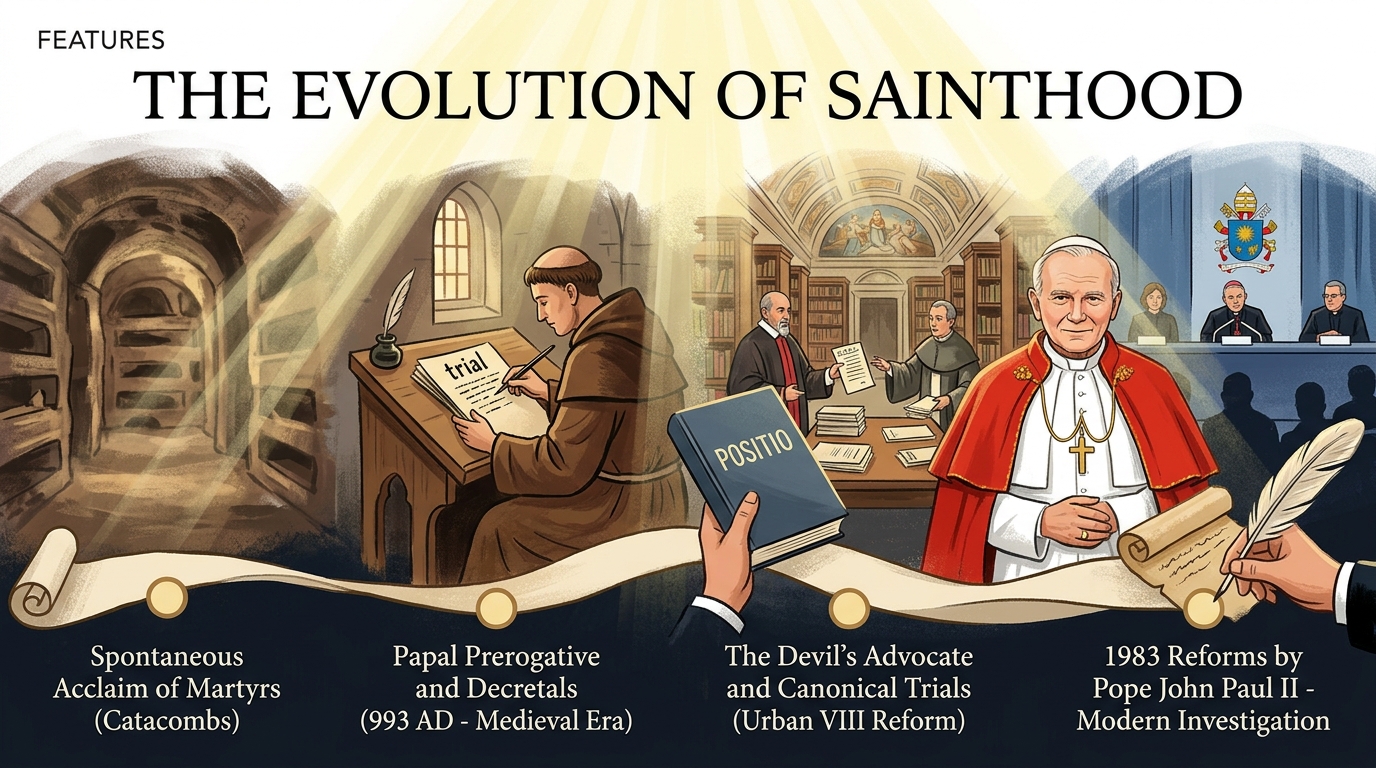
For most Catholics, the moment a pope pronounces the ancient formula declaring a man or woman a saint feels timeless — as if it has always been done exactly this way. It has not. The way the Church recognizes holiness has developed over two thousand years, moving from the spontaneous acclaim of the martyrs, through the tightly juridical “trials” of the medieval and early-modern periods, to the streamlined, historically-minded procedure that governs causes today. That development has been mostly organic and, in the eyes of the Church, guided by the Holy Spirit. But the most recent reforms — above all those of Pope St. John Paul II in 1983 — have also generated genuine debate among faithful Catholics, canon lawyers, and theologians about whether the modern process retains the rigor of its predecessors. This article traces that story honestly, from the catacombs to the present controversies.
How Did the Recognition of Saints Begin?
In the earliest centuries there was no “process” at all. As Britannica notes, in the early Christian church there was no formal canonization; instead the cult of local martyrs was widespread and regulated by the bishop of the diocese (Encyclopædia Britannica, n.d.). The word we now translate as “saint” was originally applied to every baptized believer — the New Testament hagioi, the “holy ones” set apart in Christ (EWTN, n.d.-b). In a stricter sense, however, the Church reserved special veneration for those in whom the victory of Christ was already complete: first and foremost the martyrs.
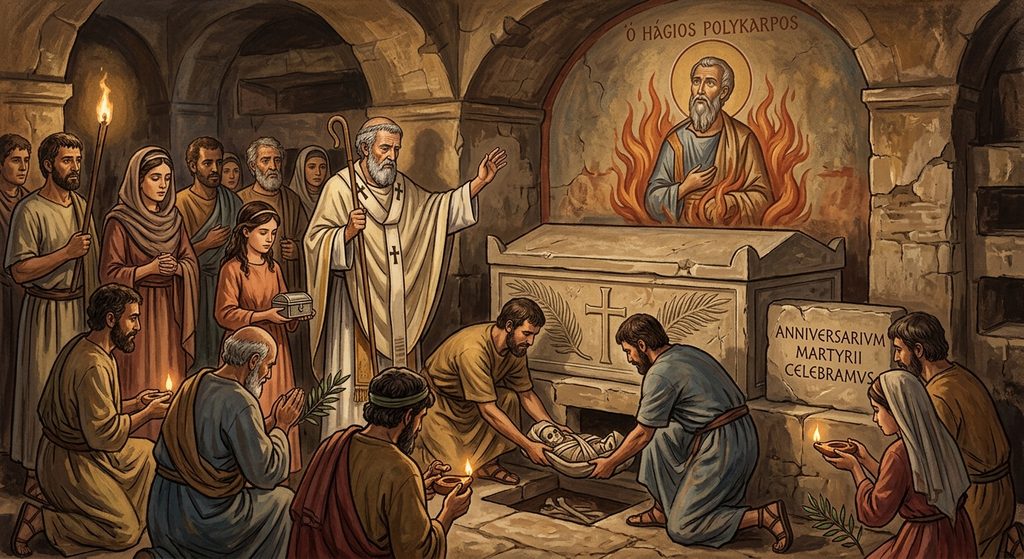
During the age of persecution, from Pentecost to the Edict of Milan in 311, Christians honored those killed in odium fidei — “in hatred of the faith” — by guarding their relics, celebrating the anniversary of their death as a heavenly “birthday,” and, most solemnly, inserting their names into the Canon of the Mass (EWTN, n.d.-b). The Martyrdom of Polycarp (c. 155) already testifies to this reverence: the faithful “took up his bones, as being more precious than the most exquisite jewels, and more purified than gold, and deposited them in a fitting place,” resolving to “celebrate the anniversary of his martyrdom” (Martyrdom of Polycarp, ch. 18). The bishop of the place where a martyr suffered decided whether the death was authentic, and, if so, communicated the martyr’s name and acta to neighboring churches so the cult could spread (Catholic Answers, n.d.).
After Constantine, as martyrdom became rarer, the Church began to venerate “confessors” — those whose heroic, holy lives constituted a kind of “white martyrdom.” Veneration remained essentially local, granted with the consent of the diocesan bishop, though the cults of the most famous figures naturally spread across many dioceses and, in some cases, the whole Church (EWTN, n.d.-b).
How Did Canonization Become a Papal Prerogative?
The turning point came in 993. St. Ulric (Ulrich) of Augsburg, a reforming bishop who had helped defend his city against the Magyars, died in 973; twenty years later Pope John XV declared him a saint at a Lateran synod, issuing a confirming bull. Ulric is universally recognized as the first saint canonized by a pope rather than by a local authority (Encyclopædia Britannica, n.d.; Encyclopedia.com, n.d.). The bishop of Augsburg had sought papal approval precisely because it carried greater prestige and a more universal witness than a local decree.
That custom hardened into law over the next two and a half centuries. The first properly canonical “cause” seems to have been that opened by Pope Urban II (1088–1099) for Nicholas of Trani, in which the local bishop was ordered to investigate and submit his findings to Rome (EWTN, n.d.-a). Pope Callistus II (1119–1124) required every cause to include a critical biography of the candidate. Then, around 1170, Pope Alexander III — himself one of the great canonists of the age — decreed that no one could be venerated as a saint without the permission of the Roman Pontiff. The immediate occasion, according to the traditional account, was scandalous: the Swedes were venerating “a certain man… slain while drunk” (hominem quendam in potacione et ebrietate occisum quasi sanctum venerantur), and Alexander’s own letter warned that “even if many signs and miracles were to happen through him… it shall be forbidden for you to openly venerate him as a saint unless the Roman church has authorized this” (Alexander III, c. 1171–1172). This reservation to the Holy See was formally incorporated into Church law by Pope Gregory IX in his Decretals around 1234, making papal canonization the only legitimate form (Encyclopædia Britannica, n.d.).
The Church’s own explanation for this centralization is theological, not merely bureaucratic. Local acclamation offers only “moral certainty” that a person is in heaven; to propose someone for the veneration of the universal Church, a higher guarantee was needed — that of the charism of infallibility, by which Christ protects His Church from error in matters of faith and morals (EWTN, n.d.-b). By the fourteenth century two distinct processes existed: a cause for beatification, permitting limited local veneration of a “Blessed,” and a cause for canonization, permitting universal veneration of a “Saint” (EWTN, n.d.-b).
What Was the “Devil’s Advocate,” and What Did Urban VIII Reform?
The late-medieval and Renaissance processes took the form of an adversarial trial. On one side stood the advocatus Dei, the promoter of the cause; on the other, an official whose duty was to attack the case at every point. This was the Promotor Fidei, the Promoter of the Faith, popularly known as the advocatus diaboli or “Devil’s Advocate.” His job, as Britannica describes it, was to critically examine the candidate’s life and alleged miracles, presenting “everything unfavourable to the candidate in order to uncover any character flaws or misrepresentations” (Encyclopædia Britannica, n.d.-c). The office is first attested under Pope Leo X (1513–1521) and was formally established by Pope Sixtus V, who in 1588, through the constitution Immensa Aeterni Dei, created the Sacred Congregation of Rites and entrusted to it the conduct of causes (Grokipedia, n.d.).
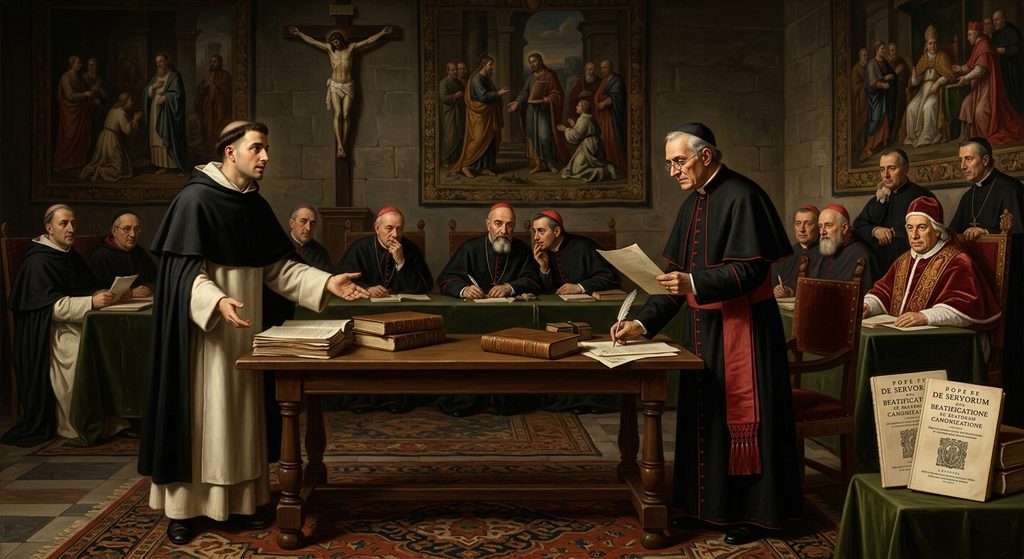
The next great consolidation came under Pope Urban VIII. Through the decree Caelestis Hierusalem Cives (1634) and his 1642 Decreta servanda, Urban forbade any public cult of a person not yet beatified or canonized — with an exception for cults “immemorial” or at least a century old — and reserved to the Holy See exclusively the right of both canonization and beatification (New World Encyclopedia, n.d.). Urban’s norms also fixed the famous fifty-year waiting period before a cause could even be introduced, a rule designed to let human enthusiasm cool so that only a stable, enduring reputation for holiness would survive (EWTN, n.d.-a). The operating presumption of the whole juridical apparatus, as one commentator puts it, was that the candidate was not a saint and that the alleged miracles were not valid until proven otherwise (DePaul University, 2018).
A century later these norms received their classic synthesis. The canonist Prospero Lambertini — later Pope Benedict XIV — produced his monumental treatise De Servorum Dei Beatificatione et Beatorum Canonizatione (1734–1738), which served as the effective rulebook of the Congregation of Rites for nearly two centuries and was substantially incorporated into the 1917 Code of Canon Law (Vatican, 1983). Lambertini’s requirements were demanding: heroic virtue proven to a high standard, and typically four miracles in all — two for beatification and two more for canonization.
What Changed Under Pope John Paul II in 1983?
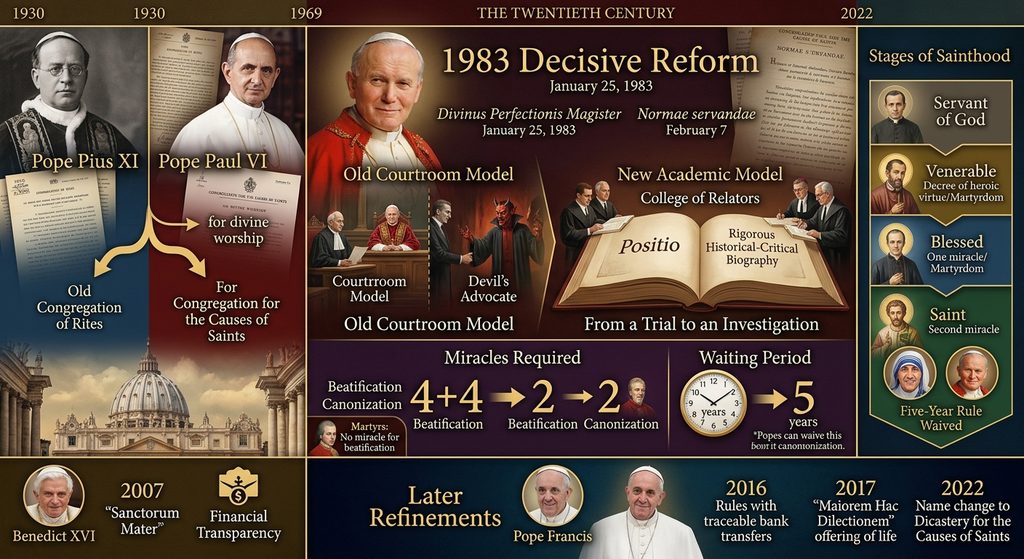
The twentieth century brought successive attempts to modernize this venerable but slow and costly machinery. Pope Pius XI created a “Historical Section” in 1930 to bring the tools of historical criticism to older causes. Pope Paul VI, in 1969, split the old Congregation of Rites into two — one for divine worship and one, the Congregation for the Causes of Saints, dedicated to sainthood — and reduced the process to a single investigative phase (Vatican, 1983).
The decisive reform, however, was Pope St. John Paul II’s apostolic constitution Divinus Perfectionis Magister, promulgated on January 25, 1983, together with the Normae servandae issued by the Congregation on February 7 (New World Encyclopedia, n.d.). John Paul II explicitly grounded the reform in the desire, expressed by many bishops, “for a simpler process while maintaining the soundness of the investigation,” and in the Second Vatican Council’s teaching on episcopal collegiality (Vatican, 1983). The changes were substantial:
First, the entire adversarial structure was dismantled. In place of the courtroom duel between postulator and Devil’s Advocate, a new “College of Relators” was created to supervise the writing of a rigorous historical-critical biography — the Positio — “according to the rules of critical hagiography” (Vatican, 1983). As one widely syndicated Catholic explainer puts it, the reform meant that “no longer did the process use a courtroom model for determining a truth concerning the saint’s life, but rather it employed the academic model of research and writing… it transformed the process from a trial to an investigation” (Gribble, 2025). The Promoter of the Faith survives as the “Prelate Theologian,” presiding over the theologians’ meeting, but the office no longer plays a prosecuting role (Encyclopædia Britannica, n.d.-c).
Second, the number of required miracles was cut in half — from four to two. Under the new law, one miracle is required for beatification and one more for canonization (SSPX, n.d.). Martyrs require no miracle for beatification; the fact of martyrdom suffices (Pew Research Center, 2014).
Third, the waiting period was reduced from fifty years to five, and this too may be waived by the pope. The stated rationale was practical: with a fifty-year delay, the witnesses who actually knew a candidate were usually dead, and many worthy causes languished for lack of living testimony (EWTN, n.d.-a).
Fourth, much of the investigation was devolved to the diocesan bishop, in keeping with collegiality — the bishop now gathers the evidence and builds the initial dossier before it is sent to Rome (SSPX, n.d.).
The stages that result are familiar today: a candidate whose cause is opened (after the five-year wait) is titled Servant of God; upon a decree recognizing heroic virtue or martyrdom, Venerable; upon one verified miracle (or proof of martyrdom), Blessed; and upon a second verified miracle, Saint (EWTN, n.d.-c). The five-year rule has been waived in prominent cases: John Paul II waived three years for Mother Teresa, and Benedict XVI waived the entire period for John Paul II himself (EWTN, n.d.-c). Later refinements continued: Benedict XVI’s 2007 instruction Sanctorum Mater, Pope Francis’s 2016 financial-transparency rules requiring traceable bank transfers and a two-thirds vote of the medical board (The Conversation, 2021), his 2017 Maiorem Hac Dilectionem creating a new path to beatification through the “offering of life” (oblatio vitae) (Vatican, 2017), and his 2022 constitution Praedicate Evangelium, which renamed the body the Dicastery for the Causes of Saints (Vatican News, 2025).
Why Do Supporters Defend the Modern Process?
Defenders of the post-1983 process argue that it is not a lowering of standards but a modernization of method, and that it flows directly from the Second Vatican Council. The Council’s Dogmatic Constitution on the Church, Lumen Gentium, taught that “all the faithful of Christ of whatever rank or status, are called to the fullness of the Christian life and to the perfection of charity” (Second Vatican Council, 1964, no. 40). If holiness is genuinely a universal vocation, defenders reason, then it is fitting that the Church hold up a far greater and more diverse array of models — laypeople, women, and figures from Asia, Africa, and Latin America — rather than an almost exclusively clerical and European roster.
John Paul II himself made this connection directly, insisting that the large number of beatifications “responds to the desire expressed by the Council,” because “it was the Council that put particular emphasis on the universal call to holiness” (as quoted in Saraiva Martins, n.d.). His prefect for the causes of saints, Cardinal José Saraiva Martins, answered the “saint factory” charge head-on, arguing that “neither the Congregation for the Causes of Saints nor the Pope ‘invent’ or ‘fabricate’ saints. The Holy Spirit has already singled them out,” and that saints are “recognized through a meticulous and prudent procedure” (Saraiva Martins, n.d.). He rejected the accusation that the Church had become a “saint factory,” saying the saints “are models of sanctity to the faithful of the world [and] there cannot be too many” (National Catholic Register, n.d.).
Supporters further stress that the historical-critical method is arguably more reliable than the old trial, not less. The Positio is a documented, scholarly biography drawing on the candidate’s complete writings and correspondence, reviewed by historical and theological consultors. The current prefect, Cardinal Marcello Semeraro, has described the reforms as a “rationalization” that streamlined paperwork while insisting that miracle claims still require doctors to say, in effect, “we exclude human intervention for this healing” (as quoted in National Catholic Register, 2025). Kenneth Woodward, whose landmark study Making Saints remains the standard journalistic account, observed that the point of canonization is fundamentally pastoral: “the primary purpose of canonization is to provide contemporary examples of holiness for the edification and, it is hoped, the emulation of the faithful” (as quoted in Encyclopedia.com, n.d.-b).
What Are the Criticisms of the Modern Process?
Yet serious criticisms have been raised, and not only by fringe voices. The most concrete concern is the sheer acceleration of saint-making. John Paul II canonized 482 saints — “more than the 300 or so canonizations in the previous 600 years” and, by most accounts, more than the combined tally of all his predecessors since the Congregation was founded in 1588 (Pew Research Center, 2014). Pope Francis went further still, canonizing 942, “breaking all previous records” — a total inflated by the group canonization of the 813 Martyrs of Otranto but nonetheless historically unprecedented (America, 2025). In their study Decisive, Chip and Dan Heath observe that after John Paul II “eliminated the office in 1983, ending 400 years of tradition… saints have been canonized at a rate about 20 times faster than in the early part of the twentieth century” (Heath & Heath, 2013).
Critics contend that this speed is the fruit of reduced safeguards. With the number of investigated miracles halved and the adversarial prosecutor removed, they argue, the process has become, in the words of one Thomist critic, “far less rigorous” (Crean, as cited in Protestant Truth Society, n.d.). Traditionalist commentator Christopher Ferrara warns that “the modern Church canonizes individuals with unprecedented speed, often before their legacy can be fully understood,” calling it “a dangerous innovation” (as quoted in Radical Fidelity, n.d.). The historian Roberto de Mattei argues that “after the reform of the procedure willed by John Paul II in 1983, this process of ascertaining the truth has become much weaker and there has been a change of the very concept of sanctity” (SSPX, n.d.-b).
A second, deeper concern involves the infallibility of canonizations. The majority opinion of pre–Vatican II theologians — represented by manualists such as Gerardus van Noort and going back to St. Thomas Aquinas and St. Robert Bellarmine — held that a formal papal canonization is an infallible act, so that the Church cannot err in declaring someone to be in heaven (Novus Ordo Watch, n.d.). But this was always the “common opinion” of theologians, never a defined dogma. A minority current, associated today with the late Msgr. Brunero Gherardini of the “Roman School,” argues that canonizations do not meet the conditions for infallibility laid down by the First Vatican Council, because their object is not a truth of faith or morals contained in revelation (SSPX, n.d.-b). This once-dormant debate was revived in the 2021 essay collection Are Canonizations Infallible?, edited by Peter Kwasniewski, whose contributors argue that the streamlined post-1983 process weakens one of the traditional grounds for the infallibility claim — namely, the “massive complex of investigations” that once preceded a canonization (Kwasniewski, 2021).
Third, critics point to specific controversial causes. The rapid elevation of Josemaría Escrivá, founder of Opus Dei — beatified in 1992, just seventeen years after his death in 1975, at what was then considered record speed — drew Woodward’s own reservations. He concluded that “the only fair-minded conclusion I can reach… is that Opus Dei subverted the canonization process to get its man beatified,” writing that Escrivá “entered the lists of the Blesseds with a huge asterisk after his name” (Woodward, as quoted in First Things, 1996; The Angelus, n.d.). The beatification of Pope Pius XII in 2000 was protested by Jewish groups and reform-minded Catholics over the Edgardo Mortara affair and Pius’s treatment of Rome’s Jews (CBS News, 2000). The advancing cause of Pius XII remains entangled in the decades-old controversy over his response to the Holocaust (Wikipedia, n.d.). And the canonizations of John XXIII, Paul VI, and John Paul II have been read by some traditionalists as an implicit canonization of the Second Vatican Council itself — a charge defenders reject as reading politics into holiness (Radical Fidelity, n.d.).
How Should Catholics Weigh These Concerns?
An honest assessment must hold several truths together. The canonization process has never been static; it has been revised repeatedly — under Alexander III, Gregory IX, Sixtus V, Urban VIII, Benedict XIV, Pius XI, Paul VI, and John Paul II — so the mere fact of change is not evidence of decline. As one traditional-minded critic candidly admits, if one tries to pinpoint the exact moment canonizations became (or ceased to be) infallible, “we are left with totally arbitrary, subjective determinations” (Unam Sanctam Catholicam, 2018). The reform genuinely did replace an adversarial trial with a scholarly investigation, and by many measures the historical documentation behind a modern cause is fuller than ever.
At the same time, the critics have identified real tensions the Church has not fully resolved: the reduction in required miracles and the diminishment of the Devil’s Advocate did remove structural checks; the waiving of waiting periods for popular figures does invite the perception of haste; and the theological status of canonization — infallible or not — remains, as the Kwasniewski volume shows, a legitimately open quaestio disputata rather than a settled dogma. The prudent Catholic position is neither uncritical triumphalism nor corrosive suspicion. The saints raised to the altars remain worthy models of Christian life, and the Church’s confidence in her ability to recognize holiness rests ultimately on the guidance of the Holy Spirit rather than on any single procedure. But faithful Catholics may, without disloyalty, discuss soberly whether the modern process would benefit from restoring some of the older safeguards — a genuinely critical voice within the cause, and perhaps a more disciplined use of the waiting period — precisely so that the Church’s most solemn declarations of holiness continue to command universal confidence.
What Does the Timeline Look Like at a Glance?
The table below traces the process’s major turning points, from the informal veneration of the martyrs to the current, streamlined procedure.
| Period | Milestone |
|---|---|
| c. 100–311 | Age of the martyrs. Local bishops approve veneration of those killed in odium fidei; relics are guarded and death-anniversaries kept as heavenly “birthdays.” |
| 4th century onward | After Constantine, the cult of “confessors” — the holy but unmartyred — spreads. Recognition remains diocesan, not papal. |
| 993 | St. Ulric of Augsburg becomes the first saint canonized by a pope, when John XV confirms his cult at a Lateran synod. |
| 1088–1124 | Popes Urban II and Callistus II begin requiring formal investigation and a critical biography before a cause proceeds. |
| c. 1170 | Pope Alexander III reserves the right of canonization to the papacy alone, prompted by a scandalous local cult in Sweden. |
| 1234 | Pope Gregory IX codifies the papal monopoly on canonization in his Decretals, closing off local canonization for good. |
| 1588 | Pope Sixtus V establishes the Sacred Congregation of Rites to administer causes of saints. |
| 1634–1642 | Pope Urban VIII fixes the fifty-year waiting period and formalizes the adversarial “Devil’s Advocate” system. |
| 1734–1738 | Prospero Lambertini (later Benedict XIV) writes the treatise that becomes the process’s standard rulebook for two centuries. |
| 1969 | Pope Paul VI splits the Congregation of Rites, creating a dedicated Congregation for the Causes of Saints. |
| 1983 | Pope John Paul II’s Divinus Perfectionis Magister replaces the adversarial trial with a historical-critical inquiry, halves the required miracles, and shortens the waiting period to five years. |
| 2007–present | Benedict XVI’s Sanctorum Mater (2007), Francis’s financial-transparency rules (2016) and Maiorem Hac Dilectionem (2017), and the 2022 renaming to the Dicastery for the Causes of Saints continue to refine the procedure. |
References
Alexander III. (c. 1171–1172). Letter to King K. of Sweden [Aeterna et incommutabilis]. In Corpus Iuris Canonici, Decretals of Gregory IX, lib. III, tit. XLV, c. 1.
America Magazine. (2025, April 23). Pope Francis canonized 942 saints during his papacy. What do they tell us about him? https://www.americamagazine.org/faith/2025/04/23/pope-francis-saints-canonizations-cummings-250439/
Catholic Answers. (n.d.). Beatification and canonization. https://www.catholic.com/encyclopedia/beatification-and-canonization
CBS News. (2000, September 3). Vatican controversy: Beatifying Pius IX. https://www.cbsnews.com/news/vatican-controversy-beatifying-pius-ix
DePaul University. (2018, March 26). Saint Vincent’s reading list LXI: The reform of canonization. https://news.library.depaul.press/full-text/2018/03/26/saint-vincents-reading-list-lxi-the-reform-of-canonization/
Encyclopædia Britannica. (n.d.). Canonization. https://www.britannica.com/topic/canonization
Encyclopædia Britannica. (n.d.-c). Devil’s advocate. https://www.britannica.com/topic/devils-advocate
Encyclopedia.com. (n.d.). Ulric of Augsburg, St. https://www.encyclopedia.com/religion/encyclopedias-almanacs-transcripts-and-maps/ulric-augsburg-st
Encyclopedia.com. (n.d.-b). Woodward, Kenneth L. 1935–. https://www.encyclopedia.com/arts/educational-magazines/woodward-kenneth-l-1935
EWTN. (n.d.-a). The history of canonization. https://www.ewtn.com/catholicism/library/history-of-canonization-13746
EWTN. (n.d.-b). What it means to be canonized. https://www.ewtn.com/catholicism/library/what-it-means-to-be-canonized-13863
EWTN. (n.d.-c). The process of beatification and canonization. https://www.ewtn.com/catholicism/library/process-of-beatification-and-canonization-13747
Grokipedia. (n.d.). Canonization. https://grokipedia.com/page/Canonization
Gribble, R. (2025). Making saints: How does the canonization process work? Catholic Review. https://catholicreview.org/making-saints-how-does-the-canonization-process-work/
Heath, C., & Heath, D. (2013). Decisive: How to make better choices in life and work. Crown Business.
Kwasniewski, P. (Ed.). (2021). Are canonizations infallible? Revisiting a disputed question. Arouca Press.
Martyrdom of Polycarp (Roberts-Donaldson, Trans.). (c. 155). Ch. 18.
National Catholic Register. (n.d.). Concerning canonization. https://www.ncregister.com/news/concerning-canonization
National Catholic Register. (2025, March 20). Meet the cardinal who oversees the making of saints. https://www.ncregister.com/interview/meet-the-cardinal-who-oversees-the-making-of-saints
New World Encyclopedia. (n.d.). Canonization. https://www.newworldencyclopedia.org/entry/Canonization
Novus Ordo Watch. (n.d.). Francis to “canonize” John XXIII and John Paul II. https://novusordowatch.org/2013/07/john-paul2-john23-canonization/
Pew Research Center. (2014, April 24). Papal saints: Once a given, now extremely rare. https://www.pewresearch.org/short-reads/2014/04/24/papal-saints-once-a-given-now-extremely-rare/
Protestant Truth Society. (n.d.). Cardinal Newman’s counterfeit miracles. https://protestanttruth.com/document/cardinal-newmans-counterfeit-miracles/
Radical Fidelity. (n.d.). Why faithful Catholics should view post–Vatican II canonisations with suspicion. https://radicalfidelity.substack.com/p/why-faithful-catholics-should-view
Saraiva Martins, J. (n.d.). Lives of saints show the world the divine in the human. EWTN. https://www.ewtn.com/catholicism/library/lives-of-saints-show-the-world-the-divine-in-the-human-5620
Second Vatican Council. (1964). Lumen gentium. https://www.vatican.va/archive/hist_councils/ii_vatican_council/documents/vat-ii_const_19641121_lumen-gentium_en.html
Society of St. Pius X (SSPX). (n.d.). Canonization doubts for John XXIII & John Paul II. https://sspx.org/en/news/canonization-doubts-john-xxiii-john-paul-ii-4799
Society of St. Pius X (SSPX). (n.d.-b). Canonizations not always infallible? https://sspx.org/en/news/canonizations-not-always-infallible-5082
The Angelus. (n.d.). The new canonizations: Doubt and confusion. https://isidore.co/misc/Res%20pro%20Deo/
The Conversation. (2021). What’s a ‘miracle’? Here’s how the Catholic Church decides. https://theconversation.com/whats-a-miracle-heres-how-the-catholic-church-decides-170183
Unam Sanctam Catholicam. (2018, October). Thoughts on the canonization of Paul VI. http://unamsanctamcatholicam.blogspot.com/2018/10/thoughts-on-canonization-of-paul-vi.html
Vatican. (1983, January 25). Divinus perfectionis magister. https://www.vatican.va/content/john-paul-ii/en/apost_constitutions/documents/hf_jp-ii_apc_25011983_divinus-perfectionis-magister.html
Vatican. (2017, July 11). Maiorem hac dilectionem. https://www.vatican.va/content/francesco/en/motu_proprio/documents/papa-francesco-motu-proprio_20170711_maiorem-hac-dilectionem.html
Vatican News. (2025). Dicastery for the Causes of Saints. https://www.vaticannews.va/en/vatican-city/news/2025-07/dicastery-for-the-causes-of-saints.html
Wikipedia. (n.d.). Canonization of Pope Pius XII. https://en.wikipedia.org/wiki/Canonization_of_Pope_Pius_XII
Woodward, K. L. (1990). Making saints: How the Catholic Church determines who becomes a saint, who doesn’t, and why. Simon & Schuster.