Coming Home to Rome: What Does Pew’s Global Data Reveal About Catholic Converts?
An Evidence-Based Look at Who Becomes Catholic Around the World, Why, and What It Means for the Church Today
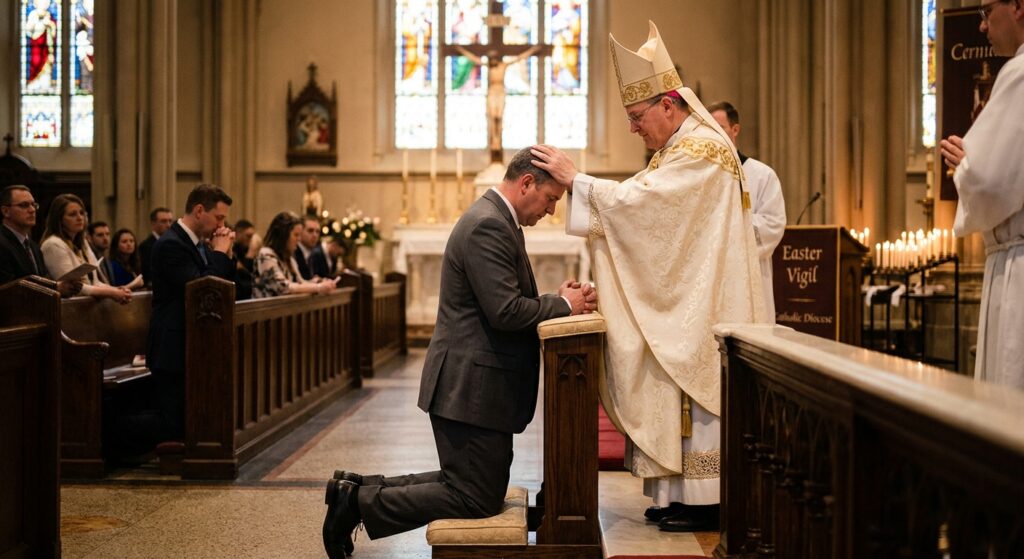
Every year, on every continent, adults kneel before a bishop, a priest, or a deacon and are received into the Catholic Church. Some come from Protestant congregations. Some come from no religious background at all. A few, like U.S. Vice President JD Vance, become minor cultural landmarks along the way; others are simply one face in a crowd of over 21,000 baptized in a single French Easter Vigil. But how common is this journey, really — and what does it say about the state of the Catholic faith worldwide? Thanks to the Pew Research Center’s most recent global surveys, spanning 24 countries across Asia, Europe, Latin America, North America, and sub-Saharan Africa, we now have some of the clearest data yet on who converts to Catholicism, why they do it, and how their experience of the faith compares to those who were baptized as infants and never left. The numbers tell a story that is neither pure triumph nor pure decline. It is something more interesting: a Church that is still losing more people than it gains in most of the world, even as the people who do come home — from Duluth to Paris to Manila — appear to be doing so for increasingly serious reasons.
What Does Pew’s Global Data Say About Religious Switching?
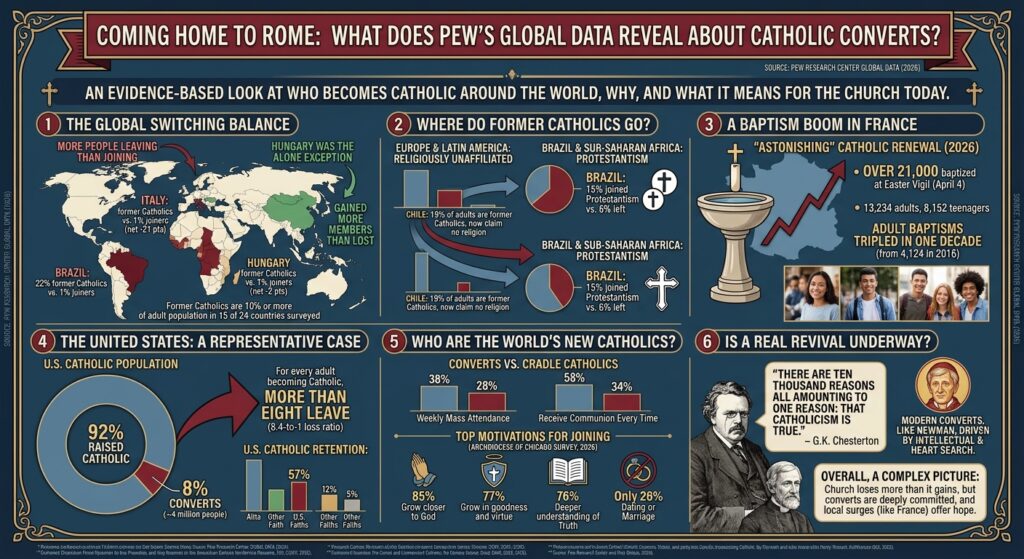
Pew’s most sweeping recent finding is also its most sobering: more people left Catholicism than joined it in 21 of the 24 countries analyzed (Lesage, Miner, & Leppert, 2026). The survey, drawing on Pew’s 2023–2024 Religious Landscape Study for U.S. data and a spring 2024 Global Attitudes Survey for the other 23 countries, found that former Catholics now make up 10% or more of the total adult population in 15 of the countries surveyed (Christian, 2026). Pew researcher Kirsten Lesage and her colleagues put the finding plainly: “relatively few adults in the countries analyzed enter the church after being raised in another religion or with no religion” (as cited in Christian, 2026).
Italy illustrates the pattern starkly: 22% of Italian adults are former Catholics, while only 1% of those raised outside the faith have joined it — a net loss of 21 percentage points (Lesage et al., 2026). Hungary was the lone exception among the 24 countries surveyed, gaining more members than it lost (Lesage et al., 2026). Michael Cooperman of Pew offered an important caveat for anyone tempted to read a single trend into this data: “there is a difference between national figures and local ones… I wouldn’t say nothing is happening, but we are looking at a small amount of data” (as cited in Lisi, 2026).
Where Do Former Catholics Go When They Leave?
Where people go after leaving the Church depends heavily on region. In much of Europe and Latin America, former Catholics most often become religiously unaffiliated — atheist, agnostic, or “nothing in particular.” In Chile, for instance, 19% of all adults are former Catholics who now claim no religious affiliation (Christian, 2026). But in Brazil, Kenya, Nigeria, Ghana, and the Philippines, the pattern reverses: former Catholics are more likely to become Protestant than to leave religion altogether (Lesage et al., 2026). Brazil shows this most clearly — 15% of Brazilians raised outside Protestantism, many of them former Catholics, have joined it in adulthood, against just 6% who have left (Deseret News, 2026). Two of the 24 countries surveyed, Ghana (62%) and Kenya (55%), are now majority-Protestant nations (Christian, 2026), a striking reversal in historically Catholic mission territories.
Protestantism’s own ledger is more mixed than Catholicism’s. Pew found Protestant net gains in nearly as many countries as net losses — concentrated in Latin America, where former Catholics are the main source of new Protestants — while Sweden, Germany, and the United Kingdom saw the largest net Protestant losses, mostly to religious unaffiliation (Christian Daily International, 2026). In Australia, for example, 15% of adults are former Protestants who now claim no religion (Christian Daily International, 2026).
Where Is Catholicism Still the Majority Faith?
The global picture is not one of uniform retreat. Catholicism remains the majority religion in eight of the 24 countries surveyed. Poland leads with 92% of adults still Catholic (96% were raised Catholic), followed by the Philippines at 80% (88% raised Catholic) and Italy at 69% (Lesage et al., 2026; OSV News, 2026). Mexico and Peru also retain substantial Catholic majorities: 66% of Mexican adults identify as Catholic today, out of 87% raised in the faith, while in Peru, 63% remain Catholic out of 81% raised Catholic (UCA News, 2026). Pew’s companion January 2026 report on Latin America found that the Catholic share of the population had nonetheless declined by nine percentage points or more in all six countries surveyed since 2013–14, with Colombia’s Catholic population falling from 79% to 60% — even as belief in God remains high across the region (Lesage, Evans, Corichi, & Thomas, 2026).
Why Is France Experiencing an Astonishing Baptism Boom?
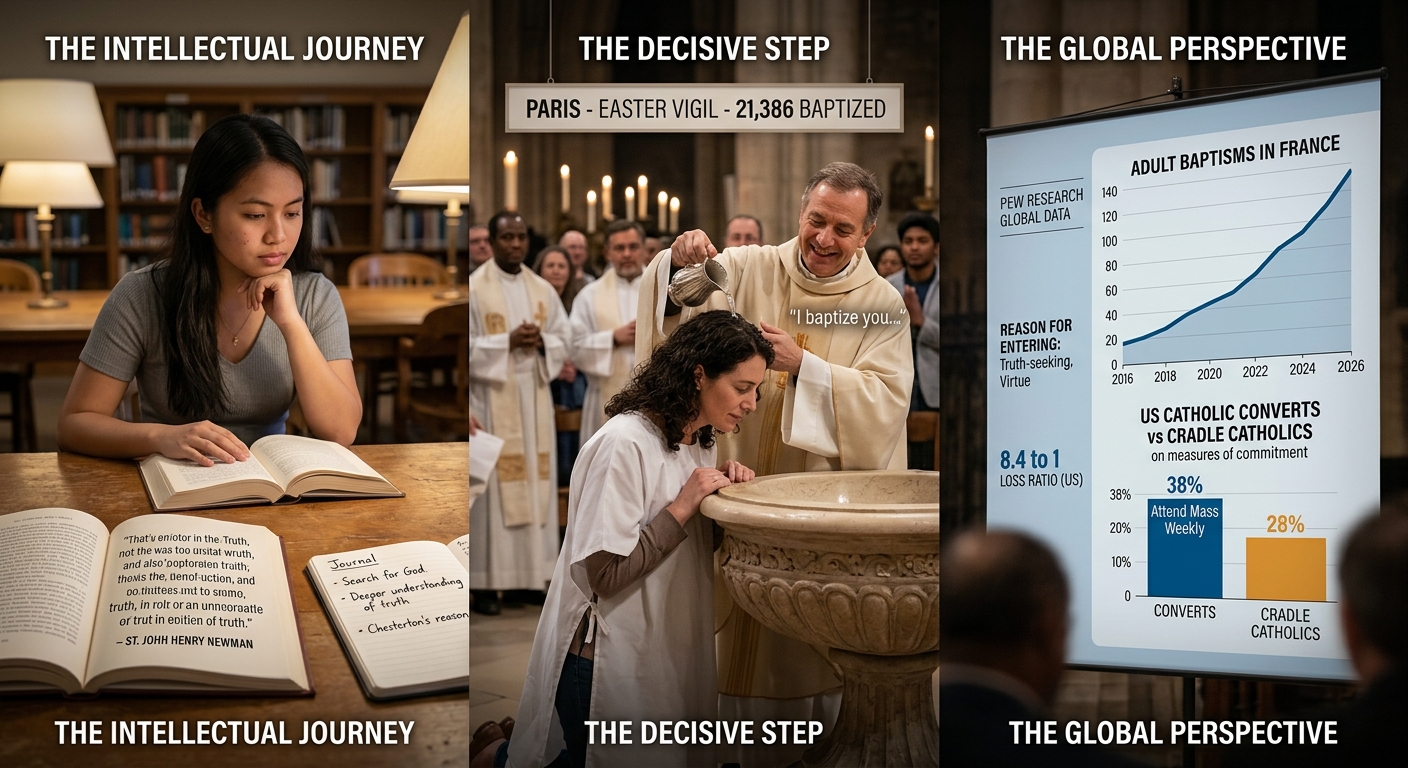
If Italy represents Catholicism’s global losses, France offers the clearest counter-story of 2026. At the Easter Vigil on April 4, French parishes baptized 21,386 adults and teenagers — 13,234 adults and 8,152 adolescents — a 20% increase over the already record-setting figures of 2025 (Aleteia, 2026). Adult baptisms alone have more than tripled over the past decade, rising from just 4,124 in 2016 (The Catholic Herald, 2026). French secular media described the phenomenon as “astonishing”; historian Christophe Dickès wrote in Le Figaro of a “renewal of faith,” while Le Monde described “a transformation of Catholicism in France” (America Magazine, 2026).
The demographics of the French surge complicate easy narratives. Women made up 62% of those baptized, not men, challenging the assumption that renewed Catholic interest is a primarily male phenomenon (The Catholic Herald, 2026). Nearly a third of new French Catholics were under 25, and 82% were under 40 (The Catholic Herald, 2026). Most strikingly, when the French bishops surveyed 1,450 of the newly baptized about their motivations, only 11% cited social media influencers — the two most common reasons instead involved difficult personal circumstances, such as illness or bereavement, and a deep search for meaning (Premier Christianity, 2026; Martínez-Bordiú, 2026). As in the United States and Chicago’s OCIA survey below, the French data points toward conviction and existential searching as the primary engines of conversion, not marriage or online trends.
Is the United States a Typical Case, or an Exception?
The United States turns out to be a fairly representative example of the wider global pattern — losing more Catholics than it gains, while still retaining a sizable and devout convert population. According to Pew’s 2023–2024 Religious Landscape Study, 92% of American Catholics were raised Catholic, and 8% are converts, amounting to roughly 1.5% of all U.S. adults, or about 4 million people (Tevington, 2026; Tevington & Smith, 2025). That convert population is comparable in size to the number of Americans who belong to entire mainline Protestant denominations such as the Presbyterians or Episcopalians (Tevington & Smith, 2025).
Yet the U.S. also mirrors the global loss pattern closely: for every American adult who becomes Catholic, more than eight raised Catholic leave the faith — an 8.4-to-1 loss ratio, worse than the 6.5-to-1 ratio Pew measured in 2014 (Pew Research Center, 2025b; Deseret News, 2026). By comparison, U.S. Protestantism loses only about 1.8 people for every convert it gains (Deseret News, 2026). Overall Catholic retention in America stands at 57% — lower than the retention rates of Hindus (82%), Muslims (77%), Jews (76%), and Protestants (70%), though higher than Latter-day Saints (54%) or Buddhists (45%) (Pew Research Center, 2025b). Thirteen percent of all U.S. adults are former Catholics, and 14% of those raised Catholic now identify as Protestant, while just 1% of those raised Protestant have become Catholic (Pew Research Center, 2025b).
The reasons Americans give for leaving echo the deeper, belief-driven pattern seen worldwide. Forty-six percent of former U.S. Catholics say they no longer believe the religion’s teachings; 39% cite clergy or leadership scandals; 37% cite disagreement with Church teaching on social or political issues; and only 7% cite marrying outside the faith (Pew Research Center, 2025b). Among Catholics who remain, the reasons are equally substantive: 54% say the faith meets their spiritual needs, 53% say they believe its teachings, and 46% say they simply like its traditions (Tevington & Smith, 2025).
Who Are the World’s New Catholics — and What Draws Them In?
Across very different cultures, the profile of the modern convert looks remarkably similar: religiously engaged, often young, and drawn less by circumstance than by conviction. In the United States, converts out-practice cradle Catholics on nearly every measure — 38% attend Mass at least weekly versus 28% of cradle Catholics, 58% receive Communion every time versus 34%, and 29% go to confession annually versus 23% (Tevington & Smith, 2025). Notably, converts are not disproportionately drawn to the Traditional Latin Mass specifically — 18% of converts had attended one in the past five years compared with 13% of cradle Catholics, a gap Pew found statistically insignificant (Tevington & Smith, 2025). Whatever draws converts toward deeper practice, it looks like a broader intensity of commitment across the whole sacramental life of the Church, not a narrow liturgical preference.
A 2026 survey of 2,127 initiates across twenty U.S. (arch)dioceses, coordinated by the Archdiocese of Chicago, offers the clearest window yet into modern convert motivation. Eighty-five percent named the desire to grow closer to God as their primary reason for entering the Church; 77% cited a desire to grow in goodness and virtue; and 76% cited a desire for “a deeper understanding of truth.” Sixty-eight percent were drawn to the Church’s sacred liturgy and sacraments, and 65% cited an attraction to “the wisdom of a 2,000-year-old Church.” Only about 26% cited dating or marrying a Catholic — a sharp contrast with the 72% that older CARA research, using Pew’s 2007 data, found among earlier generations of converts (Gray, 2014). Tim Weiske of the Archdiocese of Chicago also noted that the gender split among new Catholics was close to even, with women making up 54% of respondents: “That was the biggest surprise” (as cited in Chicago Catholic, 2026).
France’s data tells a strikingly similar story. New French Catholics were driven primarily by difficult life experiences and a search for meaning, not social media or peer influence (Premier Christianity, 2026). And in the U.S. context, roughly one in four married Catholics is married to a non-Catholic — the pattern Pew illustrates through Vice President Vance and his Hindu-raised wife, Usha — yet marriage no longer appears to be the dominant engine of conversion it once was (Tevington, 2026).
“There are ten thousand reasons all amounting to one reason: that Catholicism is true.” — G.K. Chesterton
Is the World Experiencing a Real Catholic Revival?
Beginning in 2025 and accelerating through 2026, mainstream press outlets on both sides of the Atlantic — from CBS’s 60 Minutes to Le Figaro and Le Monde — began reporting a Catholic “revival,” particularly among the young. Some of the underlying diocesan-level data is genuinely encouraging. In the United States, an analysis by the prayer app Hallow, drawing on figures from more than 140 of the 175 American dioceses, found dioceses experiencing an average 38% annual increase in adults entering the Church through OCIA in 2026, with the Diocese of Duluth reporting 145% growth and the Diocese of Pittsburgh 108%. In France, Easter baptisms have more than tripled over the past decade and continue to set new records year after year (The Catholic Herald, 2026).
Caution, however, remains warranted before declaring a global renewal. Pew’s own switching data measures lifetime religious identity, not year-over-year OCIA or catechumenate entries, so it cannot itself confirm a 2026 surge (Pew Research Center, 2025b). The National Catholic Reporter has cited research suggesting roughly twelve young people leave the Church for every young convert who enters it, and Pew’s own Cooperman cautioned that national figures still look very different from local pockets of growth (as cited in Lisi, 2026). Even in booming France, the vocations picture lags behind the baptism numbers — just 90 priests were ordained nationally in 2025, down from 105 in 2024 (The Catholic Herald, 2026) — suggesting that institutional capacity has not yet caught up with the surge in new believers. The honest conclusion, echoing commentator Ross Douthat, is that a faith can experience “revival and decline simultaneously”: diocesan-level growth in new Catholics appears real in several countries, but it remains an early, geographically uneven signal rather than a confirmed reversal of the broader losses Pew has documented for two decades.
What Can Newman and Chesterton Teach Us About the Modern Convert?
None of this is entirely new. Adult conversion to Catholicism has a long and intellectually serious pedigree in the English-speaking world. The historian Patrick Allitt observed that nearly all the major Catholic intellectuals writing in English between 1840 and 1960 were themselves converts (Allitt, 1997). The roll call is remarkable: St. John Henry Newman, received into the Church in 1845 and canonized in 2019; Cardinal Henry Edward Manning; G.K. Chesterton; Gerard Manley Hopkins; Ronald Knox; Graham Greene; Evelyn Waugh; Dorothy Day; and Thomas Merton.
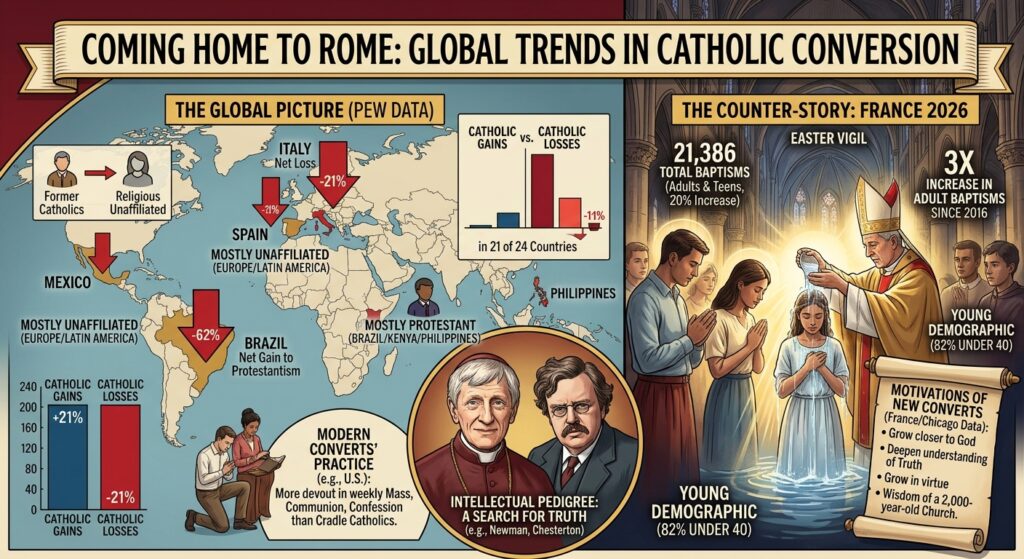
Newman’s own conversion grew out of years of patient study into the early Church, and his conclusion that the Catholic Church alone preserved the fullness of the apostolic faith across the centuries. It was a conversion of the intellect as much as the heart — precisely the kind of “truth-seeking” motive that today’s data suggests is re-emerging across very different cultures: 76% of Chicago’s 2026 OCIA respondents describe wanting “a deeper understanding of truth,” and French bishops report their newest Catholics driven by a comparable search for meaning rather than circumstance. If the data holds up over time, it may be less a modern novelty than a very old pattern reasserting itself worldwide: people continuing to be drawn to Catholicism, across two centuries and now across continents, for substantially the same reason Newman was — the conviction that it is simply true.
What Does This Global Data Mean for the Church Today?
Taken together, the numbers resist a simple headline. Worldwide, the Catholic Church is still losing considerably more people than it gains — a pattern true in 21 of 24 countries Pew surveyed, and especially stark in Italy and much of Latin America. In the United States specifically, an 8.4-to-1 loss ratio should give any believer pause, and a 57% retention rate lags several other American religious traditions. Most people who leave, in America and abroad, say they no longer believe the Church’s teachings — a challenge to catechesis and formation far more than a public relations problem.
And yet the same data shows real and encouraging counter-currents. Converts across cultures are, on the whole, more devout than those who were simply born into the faith. Strongholds such as Poland, the Philippines, and Italy still retain the overwhelming majority of those raised Catholic. And in specific places — French dioceses recording their largest baptism classes in a century, American dioceses reporting double-digit OCIA growth — a steady stream of adults, most citing a search for God, virtue, and truth rather than convenience or circumstance, continue to walk forward at the Easter Vigil and ask to be received.
For a Church that has weathered nearly every kind of headline over the past two decades, that is a sober but genuinely hopeful place to stand: not a uniform global revival, not a hopeless worldwide decline, but a community that continues — quietly, in RCIA and OCIA classes from Duluth to Paris to Manila — to persuade a steady stream of searching adults, on every continent, that the claims of Rome are, in fact, true.
References
Aleteia. (2026, March 27). Adult Easter baptisms hit a new record in France this year. https://aleteia.org/2026/03/27/adult-easter-baptisms-hit-a-new-record-in-france-this-year/
Allitt, P. (1997). Catholic converts: British and American intellectuals turn to Rome. Cornell University Press.
America Magazine. (2026, April 15). Record Easter baptisms in France reflect personal journeys of faith. https://www.americamagazine.org/news/2026/04/15/france-easter-record-baptism/
Chicago Catholic. (2026, July 8). Archdiocese survey finds new Catholics evenly split between men and women. Archdiocese of Chicago.
Christian, G. (2026, April 25). Pew: In US and other countries, Catholicism loses more members than it gains. OSV News. https://www.osvnews.com/pew-in-us-and-other-countries-catholicism-loses-more-members-than-it-gains/
Christian Daily International. (2026, April 30). Pew study finds Catholics losing members through switching while Protestants gain in some region. https://www.christiandaily.com/news/pew-study-finds-catholics-losing-members-through-switching-while-protestants-gain-in-some-region
Deseret News. (2026, April 25). Pew report: ‘Religious switching’ among Catholics and Protestants. https://www.deseret.com/faith/2026/04/25/faith-catholicism-protestantism-people-leaving-joining-religion/
Gray, M. M. (2014, April 11). Portrait of the American Catholic convert: Strength in new numbers. Nineteen Sixty-four (CARA). http://nineteensixty-four.blogspot.com/2014/04/portrait-of-american-catholic-convert.html
Gray, M. M. (2016, February 26). How many Catholic converts stay? A quick back of the envelope reality check. Nineteen Sixty-four (CARA). http://nineteensixty-four.blogspot.com/2016/02/how-many-catholic-converts-stay-quick.html
Lesage, K., Evans, J., Corichi, M., & Thomas, S. (2026, January 21). Catholicism has declined in Latin America over the past decade. Pew Research Center. https://doi.org/10.58094/93ce-0a97
Lesage, K., Miner, W., & Leppert, R. (2026, April 23). Catholicism has lost people to religious switching in many countries, while Protestantism has gained in some. Pew Research Center. https://doi.org/10.58094/6zk1-6058
Lisi, C. (2026, April 23). Global study finds Catholicism facing big losses from ‘religious switching’. Religion Unplugged. https://religionunplugged.com/news/2026/4/23/global-study-finds-catholics-facing-losses-from-religious-switching
Martínez-Bordiú, A. (2026, April 7). New record in France: More than 20,000 adults and teens baptized at Easter. EWTN News / National Catholic Register. https://www.ncregister.com/cna/2026-record-easter-baptisms-in-france
OSV News. (2026, April 25). Pew: In US and other countries, Catholicism loses more members than it gains. https://www.osvnews.com/pew-in-us-and-other-countries-catholicism-loses-more-members-than-it-gains/
Premier Christianity. (2026, March 31). Baptisms in France are set to break records again this Easter — here’s why. https://www.premierchristianity.com/opinion/baptisms-in-france-are-set-to-break-records-again-this-easter-heres-why/21279.article
Pew Research Center. (2025a, February 26). Decline of Christianity in the U.S. has slowed, may have leveled off. https://doi.org/10.58094/4kqq-3112
Pew Research Center. (2025b, December 15). Why do some Americans leave their religion while others stay? https://www.pewresearch.org/religion/2025/12/15/why-do-some-americans-leave-their-religion-while-others-stay/
Pew Research Center. (2026, June 30). Religious identity, practice and belief in the Philippines. https://www.pewresearch.org/
The Catholic Herald. (2026, April 9). France sees surge in adult baptisms as numbers rise 220 per cent in a decade. https://thecatholicherald.com/article/france-sees-surge-in-adult-baptisms-as-numbers-rise-220-per-cent-in-a-decade
Tevington, P. (2026, June 5). Vance is among 1.5% of Americans who have converted to Catholicism. Pew Research Center. https://doi.org/10.58094/2kzv-ev08
Tevington, P., & Smith, G. A. (2025, June 16). Profile of U.S. converts to Catholicism. Pew Research Center. https://www.pewresearch.org/religion/2025/06/16/profile-of-us-converts-to-catholicism/
UCA News. (2026, April 25). Catholicism loses members in most countries surveyed: Pew. https://www.ucanews.com/news/catholicism-loses-members-in-most-countries-surveyed-pew/113001