The Index of Forbidden Books: What the Church Actually Banned, and Why
What Was the Index of Forbidden Books?
For over four hundred years, the Index Librorum Prohibitorum — the Index of Forbidden Books — stood as the Catholic Church’s official list of publications Catholics were forbidden to read without special permission. Often caricatured today as pure censorship or intellectual repression, the Index in fact reflected a specific pastoral concern: safeguarding the faith and morals of ordinary believers in an age when literacy and print were spreading faster than the Church’s capacity to catechize. This article traces the Index from its founding in 1559 through its final abolition in 1966, and surveys who actually appeared on it — and, just as tellingly, who did not.
When and Why Did the Index Begin?
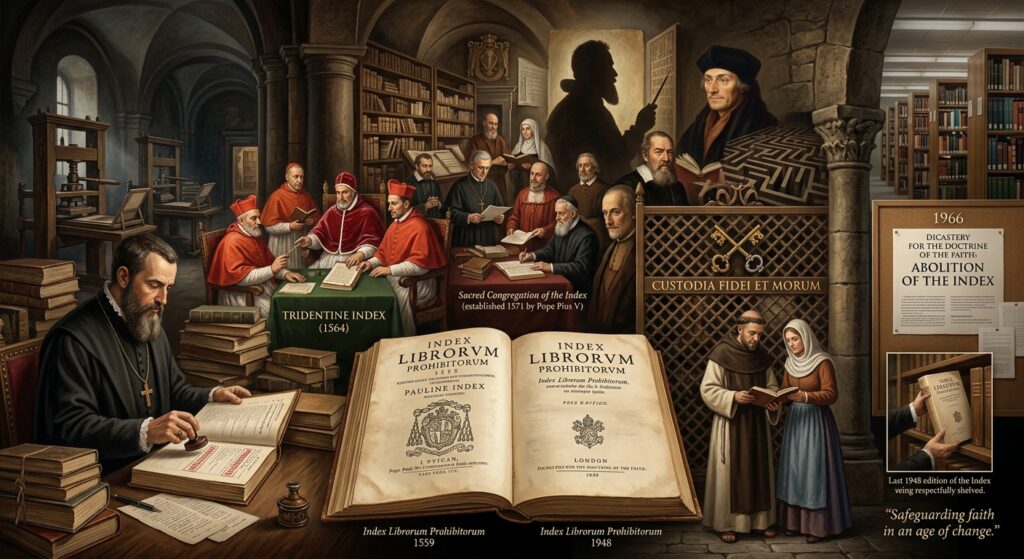
The first Roman Index, commonly called the “Pauline Index” after Pope Paul IV, was promulgated in 1559 and proved so severe in its initial form that the Holy Office issued a mitigating decree within the same year, on June 14, 1559. A more moderate successor, the “Tridentine Index,” emerged from the authority of the Council of Trent and was formally issued in 1564 under Pope Pius IV, accompanied by ten general rules governing the censorship of books going forward. In 1571, Pope Pius V established the Sacred Congregation of the Index specifically to maintain and periodically revise the list — a dedicated Vatican body that endured until 1917, when it was merged into the Holy Office, the institutional ancestor of today’s Dicastery for the Doctrine of the Faith. The Index continued to be revised and reprinted for centuries, with the final edition published in 1948.
How Did a Book Actually Get Placed on the Index?
The Index was not simply a blacklist drawn up arbitrarily; it operated through a formal review process. Official Church censors examined manuscripts and published works for theological error or moral danger; a work passing this review received a nihil obstat (“nothing forbids [publication]”) and, for the author’s own diocese, an imprimatur (“let it be printed”). Prohibitions were sometimes narrow, targeting a single problematic work, but were often expressed more broadly using set Latin phrases — opera omnia (“all works”) to ban an author’s entire output, or omnes fabulae amatoriae (“all love stories”) to exclude an entire literary genre at once. A 1940 clarification extended the interpretation of opera omnia to cover the entirety of a condemned author’s writings without exception, closing what had previously been a narrower reading.
Who Actually Appeared on the Index — and Who Notably Did Not?
The definitive modern scholarly catalog of the Index’s full contents is J. Martínez de Bujanda’s Index Librorum Prohibitorum, 1600–1966 (2002), and it confirms a list considerably more intellectually serious — and more surprising — than popular imagination usually credits.
Scientific works form one of the Index’s most famous categories. Copernicus’s De revolutionibus orbium coelestium was suspended “until corrected” in 1616 rather than banned outright; the Church’s general prohibition on defending heliocentrism as established fact was lifted in 1758, and the work was fully removed from the Index only in 1835. Galileo’s Dialogue Concerning the Two Chief World Systems was condemned following his 1633 trial and likewise removed in 1835. Kepler’s Epitome astronomiae Copernicanae remained listed from 1621 until 1835 as well.
Philosophers and Enlightenment writers are heavily represented: Descartes (from the 1660s), Voltaire, Rousseau, Immanuel Kant’s Critique of Pure Reason, and the complete works of David Hume all appear on the Index, alongside Giordano Bruno’s entire corpus, listed in 1600 — the very year of his execution for heresy.
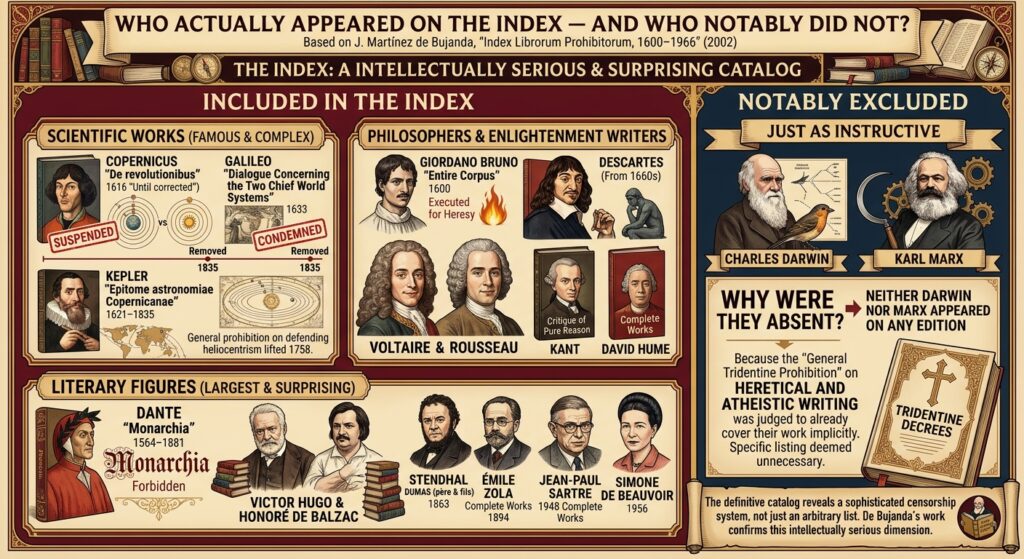
Literary figures make up perhaps the Index’s largest and most surprising category to modern readers: Dante’s political treatise Monarchia was listed in 1564 and remained forbidden until as late as 1881; Victor Hugo, Honoré de Balzac (whose love stories were banned in 1841), Stendhal, both Alexandre Dumas père and fils (1863), and Émile Zola’s complete works (1894) all appear. In the twentieth century, the Index was extended to Jean-Paul Sartre’s complete works in 1948 and to Simone de Beauvoir in 1956.
Just as instructive is who was never placed on the Index at all. Neither Charles Darwin nor Karl Marx ever appeared on any edition — not because their ideas escaped Church concern, but because the general Tridentine prohibition on heretical and atheistic writing was judged to already cover their work implicitly, making a specific listing unnecessary in the eyes of the censors.
When and How Was the Index Abolished?
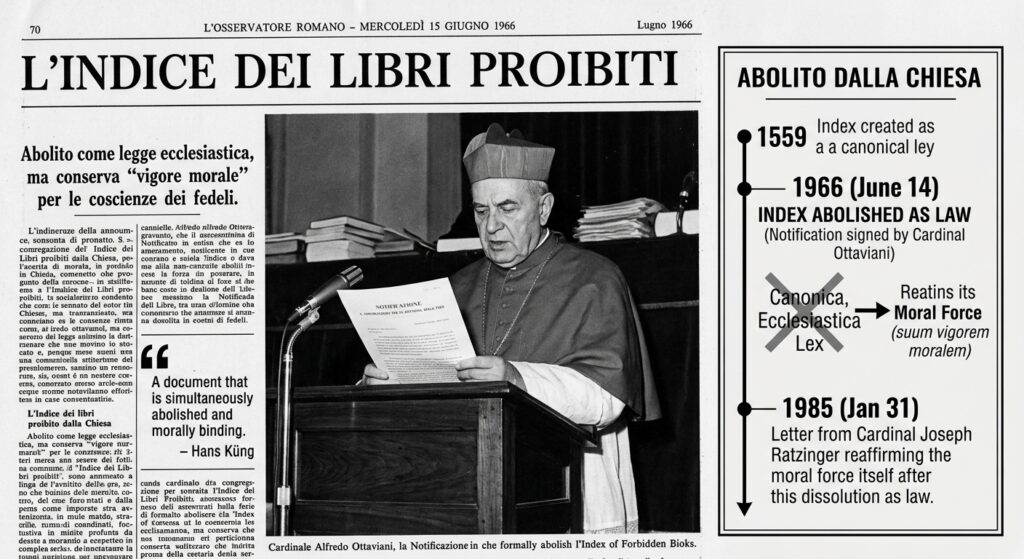
The Index’s formal end came on June 14, 1966, in the wake of the Second Vatican Council, through a Notification of the Congregation for the Doctrine of the Faith signed by Cardinal Alfredo Ottaviani. The Notification abolished the Index as a matter of canonical, ecclesiastical law — meaning it no longer carried automatic penalties or binding legal force for Catholics who read a listed work. Importantly, however, the same Notification explicitly stated that the Index “retains its moral force” (suum vigorem moralem), continuing to appeal to the conscience of the faithful to exercise prudence regarding writings dangerous to faith and morals, even after its legal teeth had been removed. Cardinal Joseph Ratzinger — the future Pope Benedict XVI — reaffirmed this same distinction in a January 31, 1985 letter, restating that the Index retained its moral force despite its formal dissolution as law, though theologians such as Hans Küng have noted the resulting ambiguity of a document that is simultaneously abolished and morally binding.
What Should Catholics Make of the Index Today?
The Index of Forbidden Books is easy to caricature from a modern vantage point as pure obscurantism, and easy to romanticize from a traditionalist one as simple fidelity betrayed by Vatican II. The documented history supports neither caricature cleanly. It was a real, centuries-long instrument of pastoral protection, administered through an actual (if imperfect) process of theological review, applied to genuinely significant currents of anti-Catholic and heterodox thought — and its formal abolition in 1966 changed its legal status without erasing the underlying pastoral concern that first brought it into being in 1559.
References
British Library European Studies Blog. (n.d.). [Discussion of the final 1948 edition of the Index].
Cassell, A. K. (2004). The Monarchia controversy. Catholic University of America Press.
Congregation for the Doctrine of the Faith. (1966). Notification [Signed by A. Ottaviani]. Acta Apostolicae Sedis; L’Osservatore Romano, June 15, 1966.
Encyclopædia Britannica. (n.d.). Index Librorum Prohibitorum. https://www.britannica.com
Martínez de Bujanda, J. (2002). Index librorum prohibitorum, 1600–1966. Librairie Droz.
New World Encyclopedia. (n.d.). Index Librorum Prohibitorum.