The Holy Souls in Purgatory: Understanding November’s Extraordinary Graces for the Church Suffering
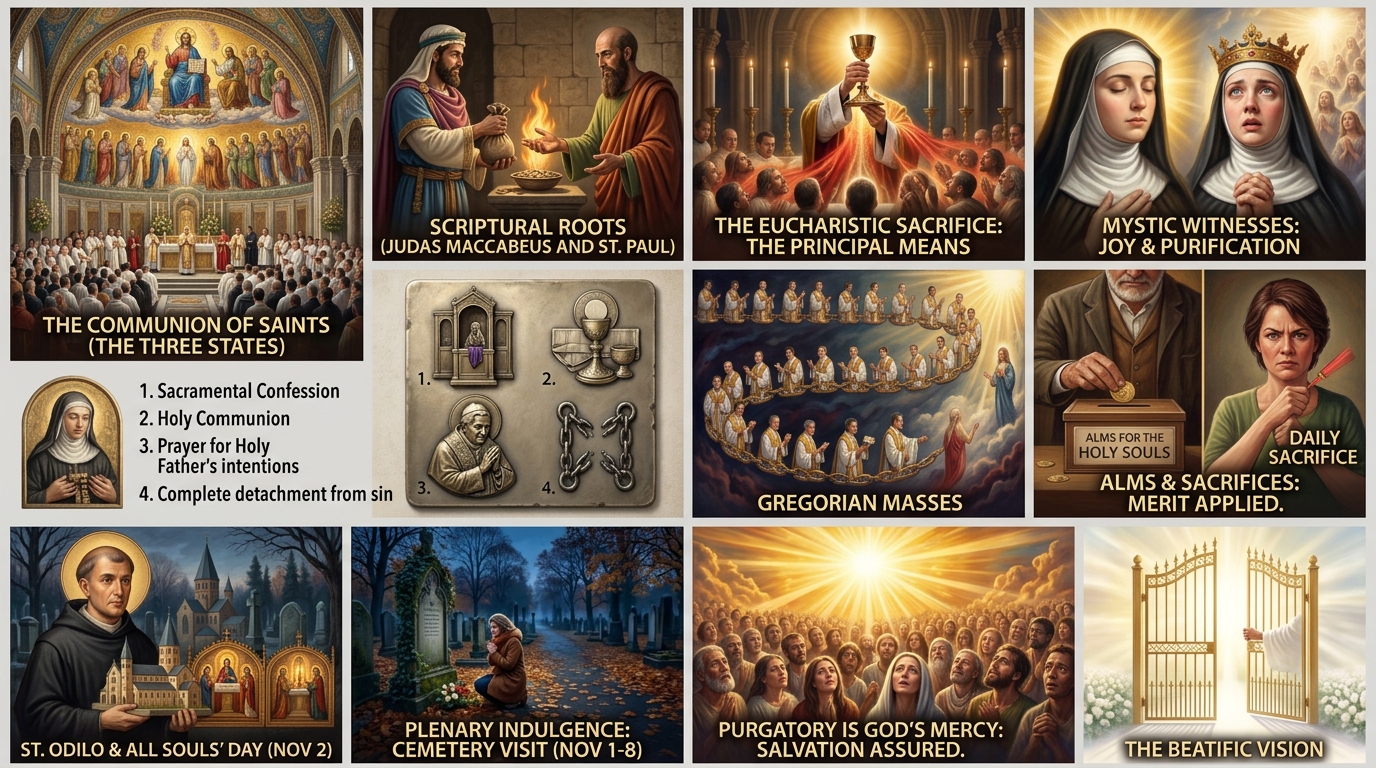
Every November, the Catholic Church turns her gaze toward the faithful departed. Few realize just how much spiritual power is placed in the hands of the ordinary believer during this month — most especially in its first eight days, when the Church offers the extraordinary opportunity to gain a plenary indulgence, once per day, on behalf of a soul in purgatory. This article explores what purgatory is, why the Church teaches it, and how the faithful can put its graces into practice.
What Makes November Sacred to the Church?
November is dedicated in its entirety to the faithful departed — the souls of the Church Suffering, who are being purified before entering the fullness of heaven. This dedication flows from the doctrine of the Communion of Saints, which the Church has always understood as embracing three states of the one Body of Christ: the Church Militant, still striving on earth; the Church Suffering, undergoing purification; and the Church Triumphant, already united to God in glory (Catechism of the Catholic Church [CCC], 1997, para. 954).
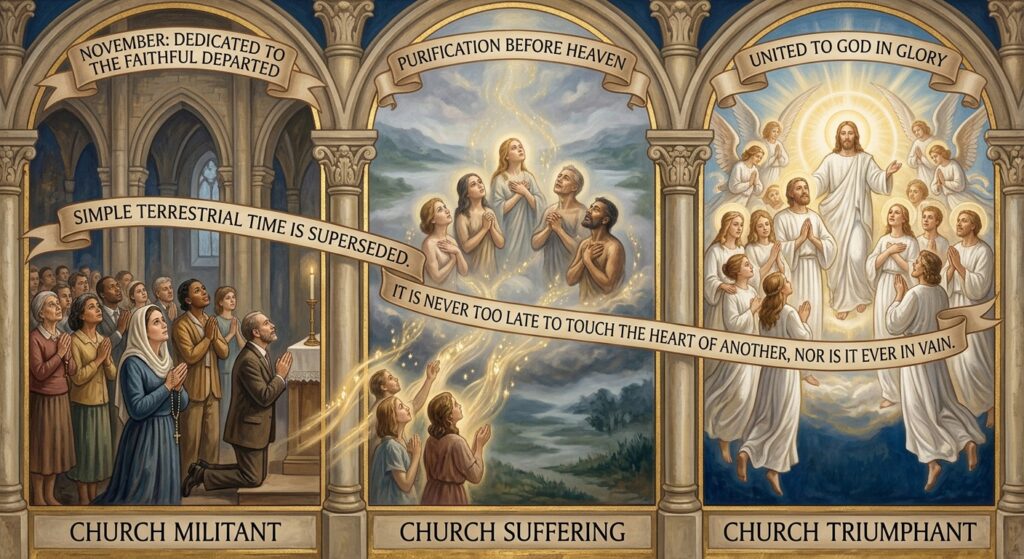
The Second Vatican Council affirmed this bond in Lumen Gentium, teaching that “some of His disciples are exiles on earth, some having died are purified… but all in various ways and degrees are in communion in the same charity of God and neighbor” (Second Vatican Council, 1964, para. 49). The Council went further, professing “with great devotion this venerable faith of our ancestors regarding this vital fellowship with our brethren who are in heavenly glory or who having died are still being purified” (Second Vatican Council, 1964, para. 51).
Pope Benedict XVI (2007) added a striking reflection on how this fellowship transcends ordinary time: in the communion of souls, “simple terrestrial time is superseded. It is never too late to touch the heart of another, nor is it ever in vain” (para. 48). A prayer offered today, in other words, can still reach a soul who died decades ago — in God’s eternal present, exactly when it is needed.
What Is Purgatory, According to the Catechism?
The Catechism defines purgatory with precision:
“All who die in God’s grace and friendship, but still imperfectly purified, are indeed assured of their eternal salvation; but after death they undergo purification, so as to achieve the holiness necessary to enter the joy of heaven” (CCC, 1997, para. 1030).
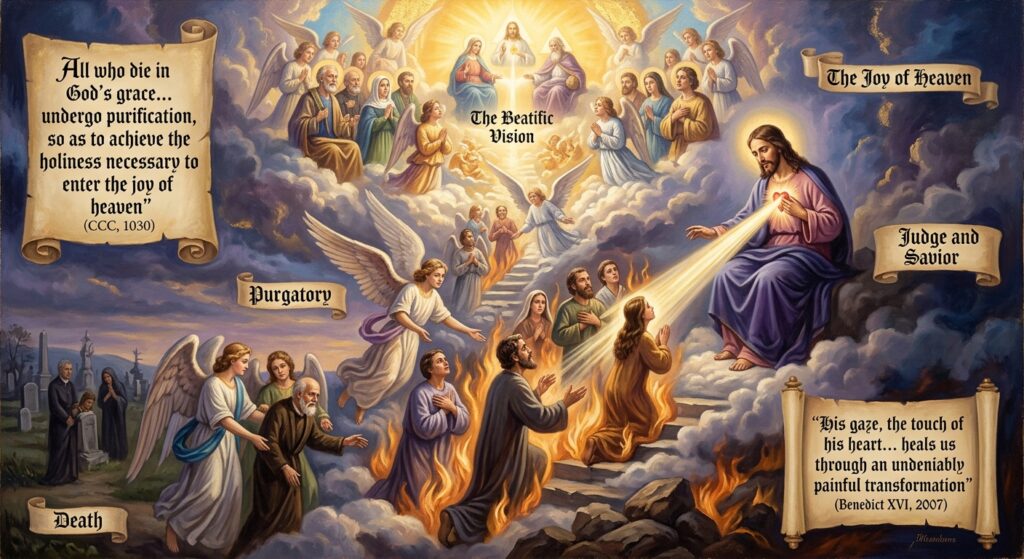
This single paragraph corrects the most common misunderstanding of purgatory: it is not a second hell, nor a place of uncertain outcome. Souls in purgatory are saved. Their eternal destiny is already secure; what remains is the final purification needed to enter fully into God’s presence (CCC, 1997, para. 1031).
Pope Benedict XVI (2007) offered a theologically rich image of what this purification involves, describing purgatory as an encounter with Christ the Judge and Savior — an encounter that both burns and heals. “His gaze, the touch of his heart,” he wrote, “heals us through an undeniably painful transformation… but it is a blessed pain, in which the holy power of his love sears through us like a flame, enabling us to become totally ourselves and thus totally of God” (Benedict XVI, 2007, para. 47).
Where Does Purgatory Appear in Scripture?
The doctrine of purgatory is rooted in Scripture and was affirmed by the Church Fathers from the earliest centuries. Two passages are most frequently cited. In the Old Testament, Judas Maccabeus takes up a collection to atone for the sins of fallen soldiers:
“It is a holy and wholesome thought to pray for the dead, that they may be loosed from their sins” (2 Maccabees 12:46).
In the New Testament, St. Paul describes a purifying fire that tests the works of the believer, from which the individual is saved even as his work is tried:
“…the fire will test what sort of work each one has done… he himself will be saved, but only as through fire” (1 Corinthians 3:13, 15).
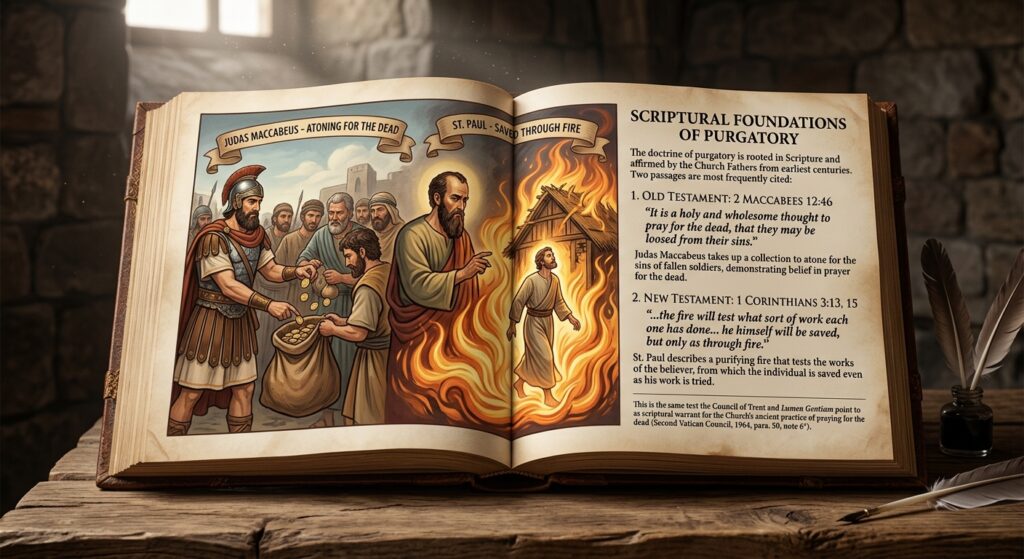
This is the same text the Council of Trent and Lumen Gentium point to as scriptural warrant for the Church’s ancient practice of praying for the dead (Second Vatican Council, 1964, para. 50, note 6*).
Who Goes to Purgatory?
Only those who die in a state of grace undergo purgatory. Those who die in unrepented mortal sin are, by definition, outside this process entirely (CCC, 1997, para. 1033). Purgatory is reserved for souls who die in friendship with God but still carry unforgiven venial sin, unpaid temporal punishment for sins already forgiven, disordered attachments to created things, or simple imperfections in virtue.
Far from resenting this purification, the saints describe souls in purgatory as embracing it willingly. St. Catherine of Genoa, whose mystical experiences produced one of the most influential treatises on the subject, wrote that the joy of these souls “is so great that it can be compared only to that of the saints in heaven” — a joy that coexists with real suffering, because the soul knows with certainty where it is bound (Catherine of Genoa, 1858).
What Is an Indulgence, and How Does It Work?
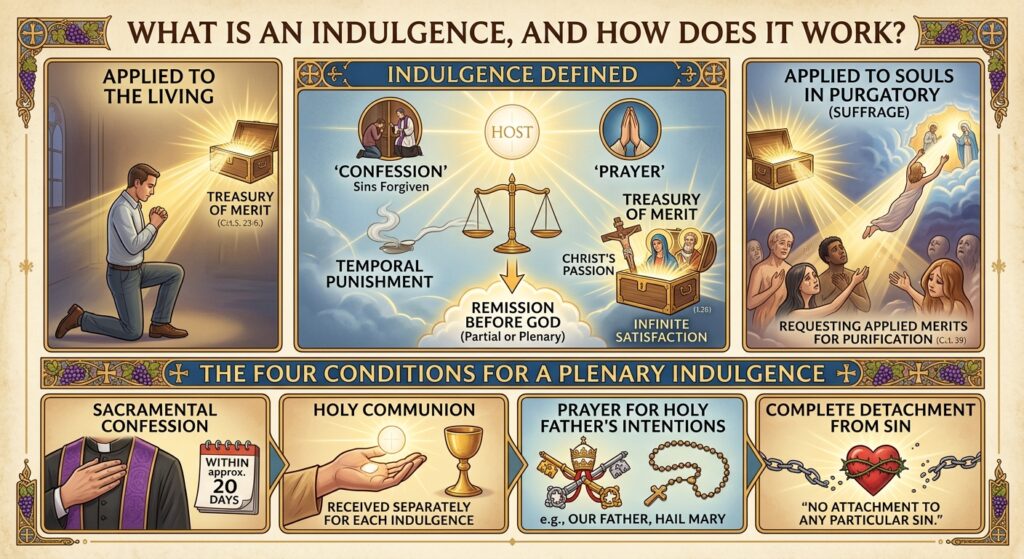
An indulgence is the remission before God of the temporal punishment due for sins already forgiven in confession (CCC, 1997, para. 1471). A partial indulgence removes part of this punishment; a plenary indulgence removes all of it. Both draw upon what the Church calls the treasury of merit — the infinite satisfaction won by Christ, joined to the superabundant merits of Mary and the saints (CCC, 1997, para. 1476–1477).
As the Church’s steward of this treasury, she can apply these merits to the living or, by way of suffrage, to the souls in purgatory (CCC, 1997, para. 1479). When a member of the faithful gains a plenary indulgence and offers it for a specific soul, they are asking God to apply the merits of Christ’s Passion directly to that soul’s purification — a request the Church has taught can, according to God’s will, bring about a soul’s release from purgatory (Apostolic Penitentiary, 1999).
What Are the Four Conditions for a Plenary Indulgence?
To gain a plenary rather than a partial indulgence, four conditions must be fulfilled completely. If even one condition is missed or fulfilled imperfectly, the indulgence automatically becomes partial (Apostolic Penitentiary, 1999).
- Sacramental confession, made within approximately twenty days before or after the indulgenced act. A single confession may cover multiple plenary indulgences within that window.
- Holy Communion, received separately for each individual indulgence sought.
- Prayer for the intentions of the Holy Father — traditionally one Our Father and one Hail Mary, though any prayer offered according to one’s own devotion fulfills the requirement. A separate prayer is required for each indulgence.
- Complete detachment from sin, even venial sin. This does not require sinlessness, but it does require that the will harbor no attachment to any particular sin — no exception clause of “I will give up everything except this one.”
What Can the Faithful Do During the First Eight Days of November?
The Church’s Manual of Indulgences (Apostolic Penitentiary, 1999) sets out two specific opportunities during this period, both applicable exclusively to the souls in purgatory:
- Cemetery visits (November 1–8): A plenary indulgence is granted each day to those who devoutly visit a cemetery and pray, even if only mentally, for the departed — repeatable once per day across all eight days.
- Church or oratory visit (November 2): A plenary indulgence is granted to those who visit a church or oratory and recite one Our Father and the Creed. This may be gained in addition to a cemetery visit on the same day.
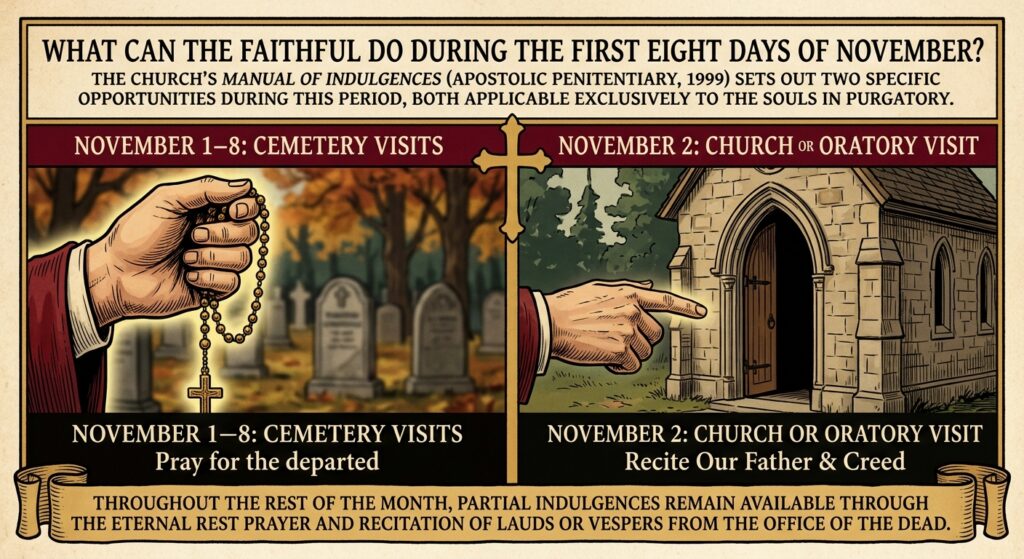
Throughout the rest of the month, partial indulgences remain available through the Eternal Rest prayer and through the recitation of Lauds or Vespers from the Office of the Dead (Apostolic Penitentiary, 1999).
Why Do November 1 and November 2 Matter So Much?
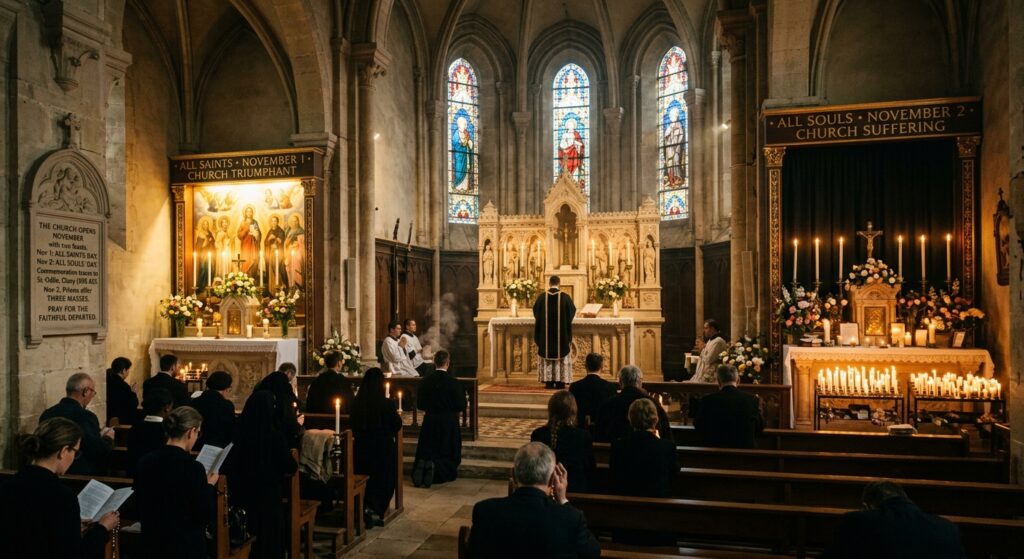
The Church opens November with two feasts that together frame the entire month. November 1, All Saints Day, honors the Church Triumphant — every soul already in heaven, canonized or not. November 2, All Souls’ Day, turns immediately to the Church Suffering, calling the faithful to intercede for those still being purified.
The commemoration traces to St. Odilo, fifth abbot of Cluny, who instituted a day of prayer, fasting, and Mass for the dead across the Cluniac monasteries — traditionally dated to the year 998, though some historians place its formal establishment slightly later, after 1030 (Catholic Encyclopedia, n.d.; Marian Fathers of the Immaculate Conception, n.d.). The custom spread rapidly through the Western Church, and on November 2 priests retain the privilege of offering three Masses instead of one — a mark of how seriously the Church takes this day of intercession.
Why Is the Mass the Greatest Help for the Dead?
Above every other form of suffrage, the Catechism identifies the Mass as the Church’s principal means of helping the departed: “The Church… offers her suffrages for them, above all the Eucharistic sacrifice, so that, thus purified, they may attain the beatific vision of God” (CCC, 1997, para. 1032). The Mass is not merely commemorative. Because it makes present the one sacrifice of Calvary, the graces offered for a soul at Mass apply Christ’s infinite merit directly to their purification.
The faithful may request a Mass be offered for a deceased loved one at their parish — among the most meaningful gifts one can give the dead. A related tradition, the Gregorian Masses, involves thirty consecutive Masses offered for a single soul; pious tradition holds this practice to be associated with that soul’s release from purgatory.
What Prayers Can the Faithful Offer for the Holy Souls?
Several prayers are traditionally associated with the holy souls. The Eternal Rest prayer is among the most widely used:
Eternal rest grant unto them, O Lord, and let perpetual light shine upon them. May the souls of all the faithful departed, through the mercy of God, rest in peace. Amen.
The Church also designates Psalm 130 — the De Profundis — as her own official prayer for the holy souls: “Out of the depths I cry to you, O Lord; Lord, hear my voice” (Psalm 130:1–2). A Rosary offered for the holy souls, with each decade assigned to a different group of souls — forgotten souls, one’s own family, priests and religious, those who died suddenly, and souls nearest to heaven — is another traditional devotion, as are the Stations of the Cross, offered specifically to unite Christ’s Passion with the purification of the dead.
What Traditions Have Catholics Practiced for the Holy Souls?
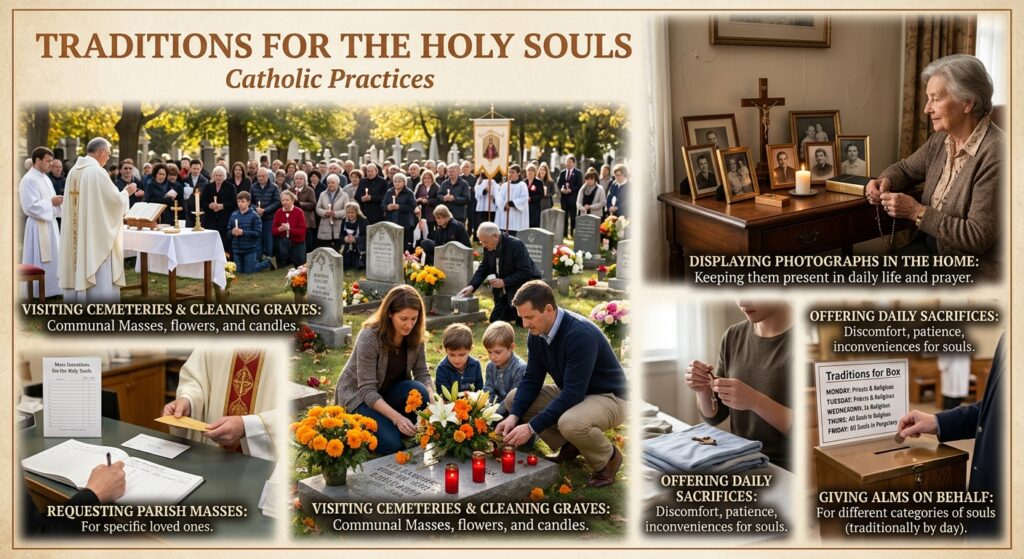
- Visiting cemeteries to clean graves, place flowers, and light candles — often as part of a parish’s communal cemetery Mass.
- Displaying photographs of deceased family members in the home, keeping them present in daily life and prayer.
- Offering small daily sacrifices — an inconvenience, a discomfort, a moment of patience — explicitly for the holy souls.
- Requesting Masses for specific loved ones through one’s parish.
- Giving alms on behalf of the deceased, a practice traditionally assigned by day of the week to different categories of souls.
Which Saints Were Especially Devoted to the Holy Souls?
Several saints left a distinctive witness to devotion for the dead. St. Padre Pio offered himself as a victim for sinners and the souls in purgatory, and souls were reported to have appeared to him seeking prayer — including, in one account, a soul who foretold the exact date and manner of his own death, later confirmed accurate.
St. Catherine of Genoa (1858) drew on her own mystical experience to write what became one of the most influential treatises on purgatory in the Catholic tradition, describing souls who willingly and even joyfully embraced their purification. St. Gertrude the Great likewise received visions, recorded in The Herald of Divine Love, describing large numbers of souls released through her intercessory prayer (Gertrude the Great, 1877).
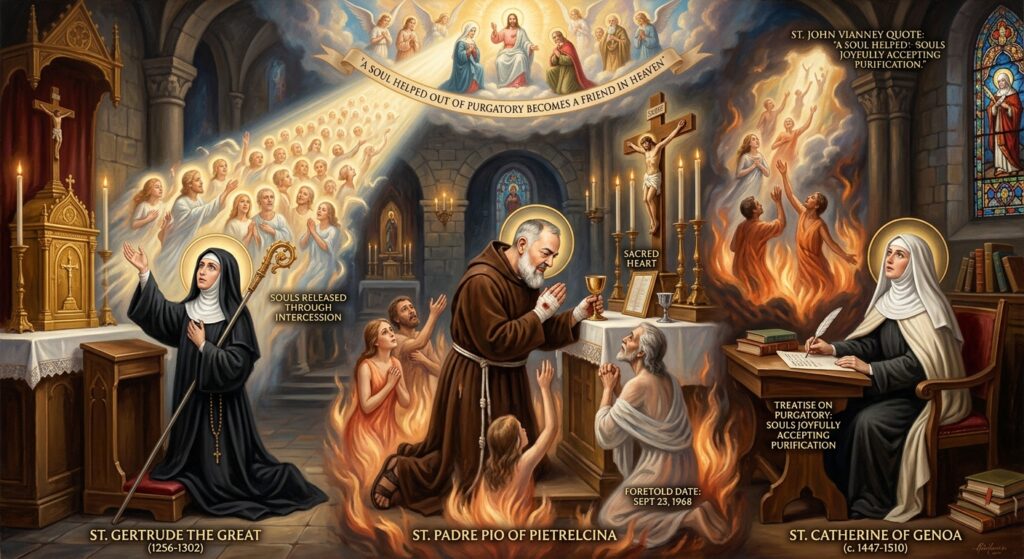
These accounts converge on a single conviction voiced by St. John Vianney: a soul helped out of purgatory becomes, in gratitude, a lasting friend in heaven.
What Does the Church Not Teach About Purgatory?
Popular devotion around November can drift into exaggeration, so it is worth being precise about what the Church does not teach. She does not teach that souls are automatically released each November, that the month possesses any inherent “magical” power, that the exact nature or duration of purgatory’s purification is known, or that purgatory offers a second chance at salvation for those who died apart from grace (CCC, 1997, para. 1030–1032; Apostolic Penitentiary, 1999).
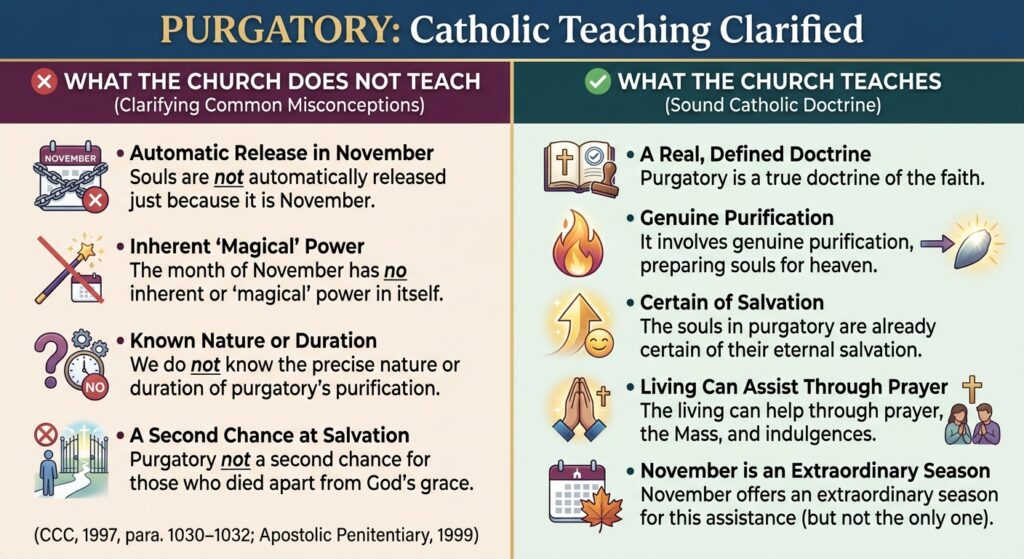
What she does teach is more modest and more solid: that purgatory is a real, defined doctrine of the faith; that it involves genuine purification; that the souls there are certain of salvation; that the living can assist them through prayer, the Mass, and indulgences; and that November provides an extraordinary — though not the only — season for doing so.
Why Is Purgatory Good News?
Rightly understood, purgatory is not a doctrine to fear but a mercy to be grateful for. It means that God’s love reaches beyond the grave to complete what it began in every soul who died in His friendship. It means that imperfection at the moment of death is not the end of the story. And it means that those who grieve are never without recourse — the dead can still be helped, through Mass, indulgence, prayer, and sacrifice, by the real and abiding bonds of the Mystical Body of Christ.
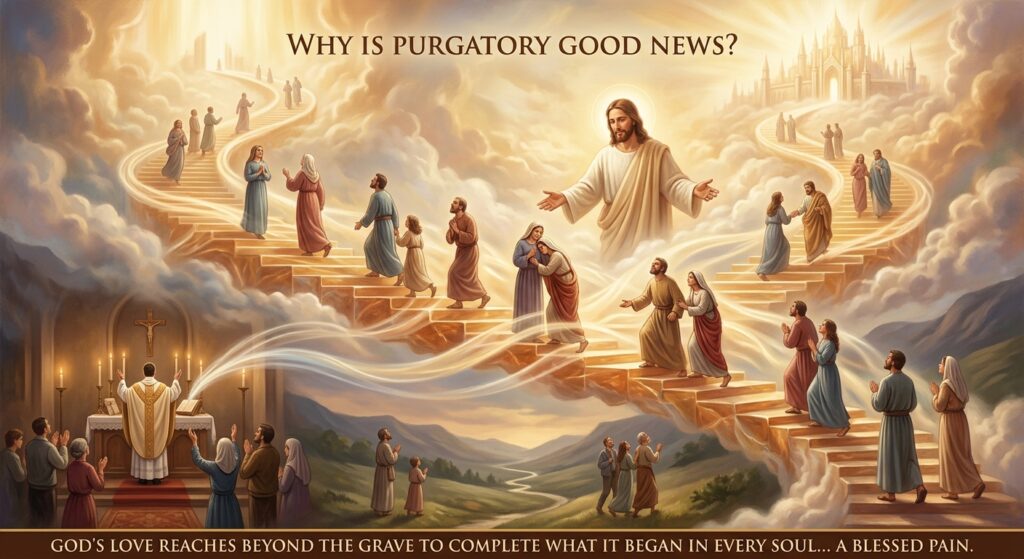
Pope Benedict XVI’s words remain a fitting close: the encounter with Christ heals “through an undeniably painful transformation… but it is a blessed pain” (Benedict XVI, 2007, para. 47). Christian love, forged in Christ, is stronger than death — and the grave cannot sever what that love has joined.
References
Apostolic Penitentiary. (1999). Enchiridion indulgentiarum: Normae et concessiones [Manual of indulgences: Norms and grants] (4th ed.). Libreria Editrice Vaticana.
Benedict XVI. (2007). Spe salvi [Encyclical letter on Christian hope]. Libreria Editrice Vaticana. https://www.vatican.va/content/benedict-xvi/en/encyclicals/documents/hf_ben-xvi_enc_20071130_spe-salvi.html
Catechism of the Catholic Church (2nd ed.). (1997). Libreria Editrice Vaticana.
Catherine of Genoa, St. (1858). Treatise on purgatory (H. D. Rawnsley, Trans.). Rivingtons. (Original work written c. 1510)
Catholic Encyclopedia. (n.d.). St. Odilo. In New Advent. Retrieved August 14, 2026, from https://www.newadvent.org/cathen/11207c.htm
Gertrude the Great, St. (1877). The herald of divine love (M. Frances Clare Cusack, Trans.). Burns and Oates. (Original work written c. 1289–1302)
Marian Fathers of the Immaculate Conception. (n.d.). Who was St. Odilo of Cluny? Marian.org. Retrieved August 14, 2026, from https://marian.org/videos/who-was-st-odilo-cluny
Second Vatican Council. (1964). Lumen gentium [Dogmatic constitution on the Church]. Libreria Editrice Vaticana.
The Holy Bible: Revised Standard Version, Catholic Edition. (1966). Ignatius Press.