St. Joseph: The Silent Saint the Church Made Patron of All
Who Was St. Joseph?
Of all the major figures of the New Testament, none is more silent than Joseph of Nazareth — and none has been more richly meditated upon by the Church precisely because of that silence. Scripture records not a single word spoken by him, yet the tradition has drawn from his few recorded actions a portrait of quiet, obedient fatherhood that the Church has increasingly honored across the centuries, culminating in his formal declaration as Patron of the Universal Church. This article traces what Scripture actually says about Joseph, how devotion to him developed, and what the popes have taught about his role in the life of the Church.
What Does Scripture Actually Tell Us About Joseph?
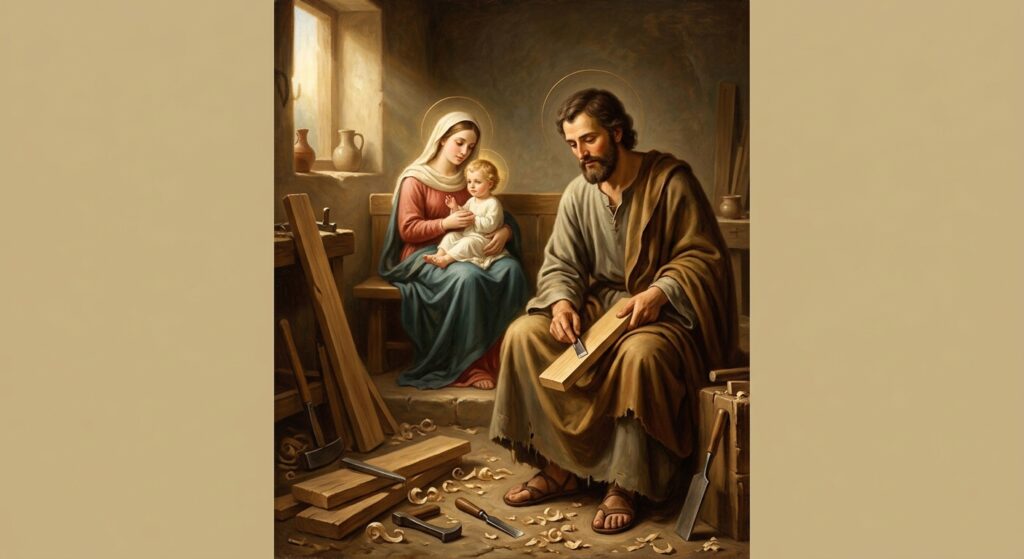
Joseph appears only in the infancy narratives of Matthew and Luke (Matthew 1–2; Luke 1–2) and is entirely absent from Mark, John, and the rest of the New Testament, apart from passing references to Jesus as “the carpenter’s son” (Matthew 13:55). He is identified as a descendant of David (Matthew 1:1–16; Luke 3:23–38) and described in a single, weighty phrase as a “righteous man” (Matthew 1:19) — the entirety of his explicit characterization in Scripture. He is a craftsman by trade, traditionally rendered “carpenter,” though the underlying Greek term (tekton) more broadly denotes a builder or artisan. Luke records that Joseph and Mary offered “a pair of turtledoves or two young pigeons” at the Presentation (Luke 2:24) — the sacrifice prescribed for those too poor to afford a lamb, a small but telling detail about the family’s modest circumstances.
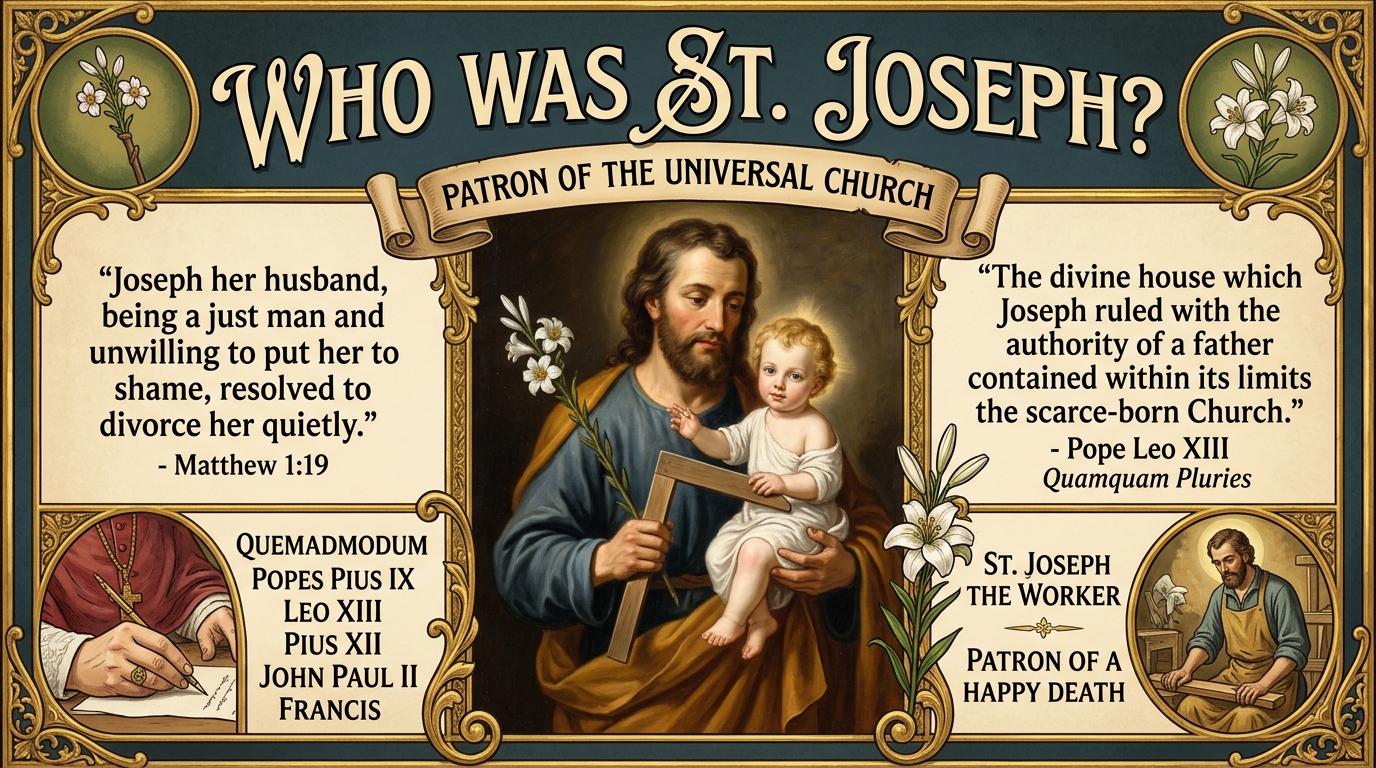
“Joseph her husband, being a just man and unwilling to put her to shame, resolved to divorce her quietly.” — Matthew 1:19 (RSV)
Beyond these episodes, Scripture is silent. Everything else the Church has come to believe about Joseph’s character has been drawn by inference from these few verses and developed through centuries of theological reflection and devotional writing.
How Did Devotion to St. Joseph Develop Over the Centuries?
Given his scriptural silence, it is striking how gradually devotion to St Joseph developed relative to devotion to other major saints. Major medieval and early-modern spiritual writers were instrumental in fostering it, including St Bernard of Clairvaux, St Thomas Aquinas, St Gertrude the Great, St Bridget of Sweden, and St Alphonsus Liguori. St Teresa of Ávila, the great Carmelite reformer, became one of his most fervent promoters, famously testifying that she never asked Joseph for anything he did not obtain for her. The first church formally dedicated to him was built at Bologna in 1129, and Pope Sixtus IV, reigning from 1471 to 1484, added his feast day of March 19 to the general Roman calendar — a comparatively late formal liturgical recognition for so central a figure in the Gospel narrative.
Recommended Book on St Joseph. Use code CARMEL15 at checkout for 15% OFF. Not applicable to sale items.
The Life of St. Joseph as Seen by the Mystics
What Have the Popes Officially Taught About St. Joseph?
The most decisive moment in St Joseph’s formal veneration came on December 8, 1870, when Pope Pius IX, through the decree Quemadmodum Deus of the Sacred Congregation of Rites, declared St. Joseph Patron of the Universal Church and elevated his March 19 feast to the highest liturgical rank — an act carried out near the very close of the First Vatican Council.
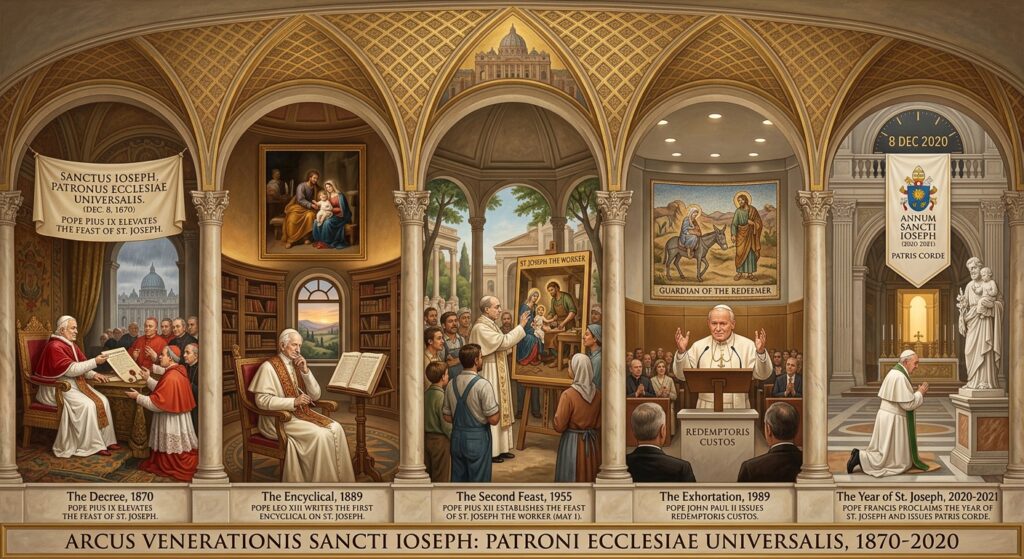
In 1889, Pope Leo XIII issued Quamquam Pluries, the first papal encyclical ever devoted entirely to St. Joseph, teaching that “the divine house which Joseph ruled with the authority of a father contained within its limits the scarce-born Church.” Pope Pius XII, in 1955, established a second feast — St. Joseph the Worker, on May 1 — deliberately positioned as a Catholic counter-witness to the secular, communist observance of May Day. On August 15, 1989, Pope John Paul II issued the apostolic exhortation Redemptoris Custos (“Guardian of the Redeemer”), written to mark the centenary of Leo XIII’s encyclical and offering the most extensive papal treatment of Joseph’s spiritual fatherhood to that point.
Most recently, on December 8, 2020 — the 150th anniversary of Pius IX’s original declaration — Pope Francis issued the apostolic letter Patris Corde (“With a Father’s Heart”) and proclaimed a Year of St. Joseph, running from December 8, 2020, to December 8, 2021, the first such dedicated year in the Church’s history. Across this arc of teaching from 1870 to 2020, the papal magisterium has steadily deepened its reflection on Joseph, moving from formal patronage to increasingly rich meditation on fatherhood, silence, and hidden faithfulness as models for Christian life.
What Titles and Feasts Are Associated With St. Joseph?
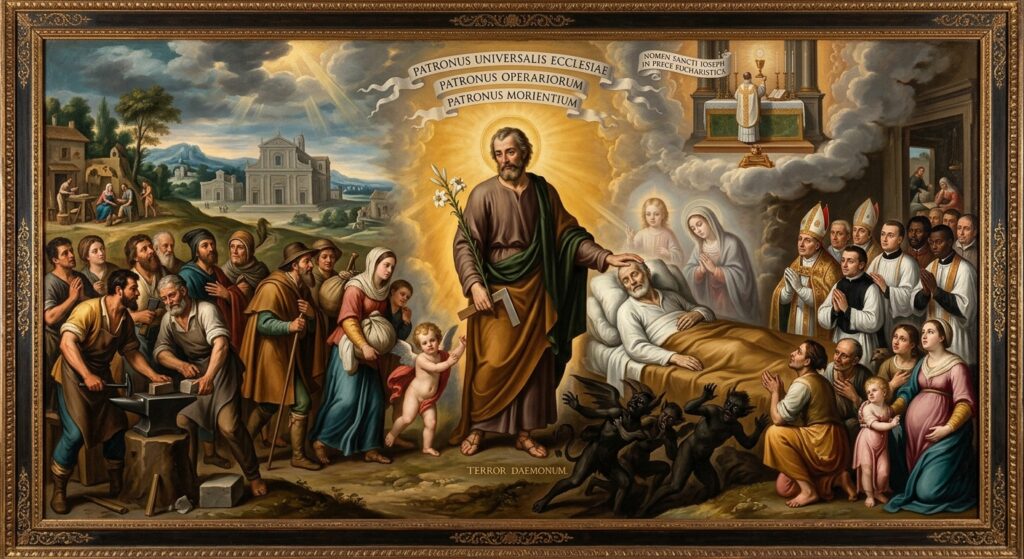
St Joseph carries an unusually broad portfolio of patronages accumulated over centuries: Patron of the Universal Church, of fathers and families, of workers and craftsmen, of travelers, of immigrants and exiles, of the sick, and — under the traditional title Patron of a Happy Death, owing to the pious belief that he died in the presence of Jesus and Mary — of the dying. He is also invoked as patron of the unborn and, in a striking older title less commonly heard today, as “Terror of Demons.” The Church keeps two major feasts in his honor: the Solemnity of St. Joseph on March 19 (a day of such liturgical weight that it dispenses the faithful from ordinary Lenten penitential observance when it falls during Lent) and the Feast of St. Joseph the Worker on May 1. His name was formally added to Eucharistic Prayers II, III, and IV of the Roman Missal, ensuring he is now commemorated at the altar itself at the vast majority of Masses celebrated throughout the world.
Why Does St. Joseph Matter for Catholics Today?
St Joseph’s enduring appeal lies precisely in his silence and hiddenness. In an age that prizes visibility and self-assertion, the Church holds up a man who is never quoted, who obeyed difficult and disorienting instructions without recorded complaint, and whose entire recorded legacy is fidelity carried out in obscurity. For traditional Catholics in particular, his witness offers a corrective model of quiet, sacrificial headship — a fatherhood defined not by words but by steady, protective action on behalf of the Holy Family entrusted to him.
References
Congregation for Divine Worship. (n.d.). Eucharistic Prayers II, III, and IV [with the inclusion of St. Joseph]. Roman Missal.
Francis. (2020). Patris corde [Apostolic letter]. The Holy See. https://www.vatican.va
John Paul II. (1989). Redemptoris custos [Apostolic exhortation]. The Holy See. https://www.vatican.va
Leo XIII. (1889). Quamquam pluries [Encyclical]. The Holy See. https://www.vatican.va
Pius IX. (1870). Quemadmodum Deus [Decree of the Sacred Congregation of Rites]. EWTN Library. https://www.ewtn.com
The Holy Bible: Revised Standard Version. (1971). Matthew 1:19, 1:1–16, 13:55; Luke 2:24, 3:23–38.
Wf-f.org. (n.d.). Feast of St. Joseph — March 19th & St. Joseph the Worker — May 1. https://archive.wf-f.org/stjoseph.html
Wikipedia. (n.d.-a). Saint Joseph. https://en.wikipedia.org/wiki/Saint_Joseph
Wikipedia. (n.d.-b). Saint Joseph’s Day. https://en.wikipedia.org/wiki/Saint_Joseph%27s_Day