The History of the Inquisition: Separating Documented Fact from Popular Myth
What Was “The Inquisition,” Actually?
Few subjects in Church history are more distorted by popular imagination than the Inquisition. The word conjures a single, centuries-long campaign of torture and mass execution — an image built more from anti-Catholic propaganda and Hollywood than from archival evidence. In reality, “the Inquisition” was never one institution. It was a series of distinct ecclesiastical and, later, state-run tribunals, separated by centuries and geography, each with its own scope, procedures, and — crucially — very different historical records. This article traces the four principal phases and sets the popular myth against what modern archival scholarship has actually found.
How Did the Medieval Inquisition Begin?
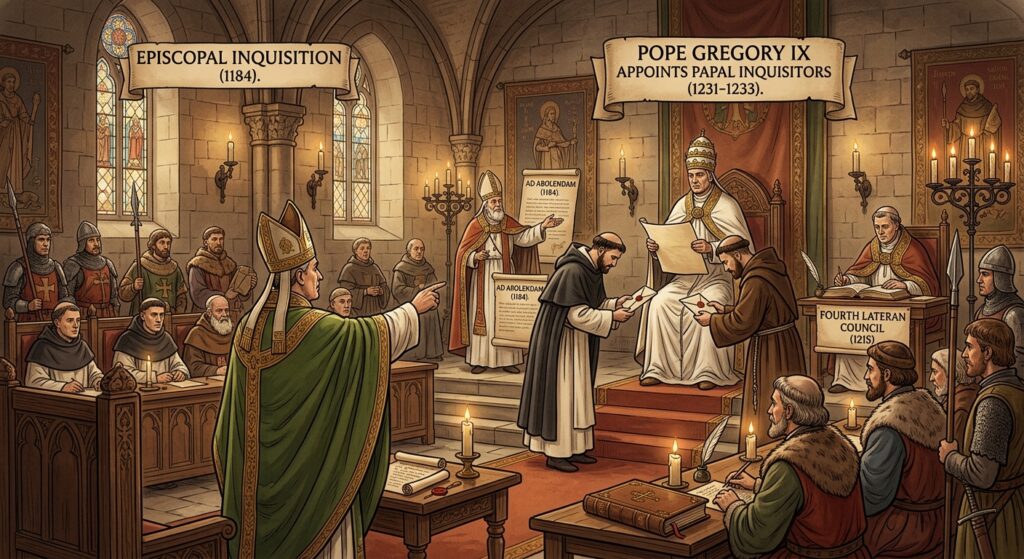
The roots of ecclesiastical inquiry into heresy trace to 1184, when Pope Lucius III’s bull Ad abolendam, issued at the Council of Verona, directed bishops to investigate heresy within their own dioceses — the so-called “episcopal inquisition.” The Fourth Lateran Council (1215) under Innocent III renewed and strengthened these efforts, chiefly against the Cathars (Albigensians) and Waldensians of southern France. A turning point came when Pope Gregory IX, through the bull Excommunicamus (1231) and subsequent bulls in 1233, began appointing dedicated papal inquisitors — mostly Dominican and Franciscan friars — rather than relying solely on local bishops; more than one hundred such inquisitors had been appointed by the time of his death (Grokipedia, n.d.). Pope Innocent IV’s bull Ad extirpanda (1252) permitted the use of torture under strict procedural limits, a practice already common in contemporary secular courts of the era.
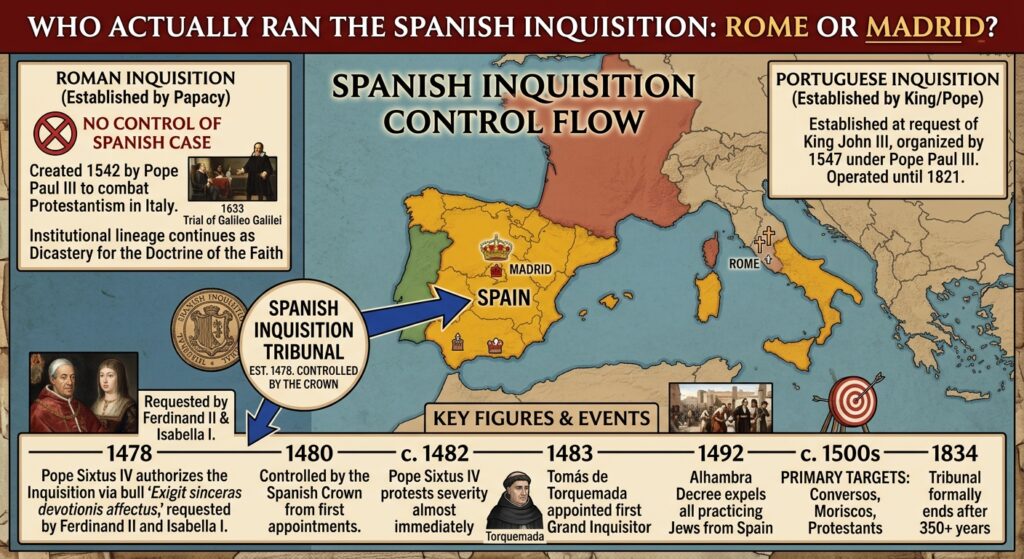
Who Actually Ran the Spanish Inquisition — Rome or Madrid?
This is the single most important corrective for readers to grasp: the Spanish Inquisition, established in 1478 by the bull Exigit sinceras devotionis affectus, was requested by King Ferdinand II of Aragon and Queen Isabella I of Castile and was, from its first appointments in 1480, controlled by the Spanish Crown, not the papacy (Wikipedia, n.d.-a; Britannica, n.d.). Pope Sixtus IV himself protested its severity almost immediately after authorizing it. Tomás de Torquemada became the first Grand Inquisitor in 1483 (Wikipedia, n.d.-b). The tribunal’s targets were primarily conversos (Jewish converts to Christianity suspected of secretly practicing Judaism) and, later, Moriscos (Muslim converts) and Protestants; the Crown’s Alhambra Decree of 1492 separately expelled practicing Jews from Spain entirely. This tribunal operated for over 350 years, formally ending only in 1834.
Two related tribunals should be distinguished from the Spanish case. The Roman Inquisition was created in 1542 by Pope Paul III specifically to combat the spread of Protestantism in Italy; its most famous case is the 1633 trial of Galileo Galilei. Its institutional lineage continues today, transformed, as the Dicastery for the Doctrine of the Faith. The Portuguese Inquisition was established at the request of King John III and formally organized by 1547 under Pope Paul III (Wikipedia, n.d.-c), operating until 1821.
Who Carried Out Executions — the Church or the State?
A structural fact routinely omitted from popular accounts is that ecclesiastical inquisitors investigated, tried, and pronounced sentences of heresy — but they did not themselves carry out capital punishment. When a defendant was condemned and unrepentant, the Church “relaxed” (handed over) the person to secular civil authorities, who alone possessed the legal power to execute. This division between ecclesiastical judgment and secular punishment was standard medieval and early-modern legal practice, not a unique invention of the Inquisition, though it is frequently collapsed in retellings that treat the Church as the direct executioner.
How Many People Actually Died — and Where Did the Higher Numbers Come From?
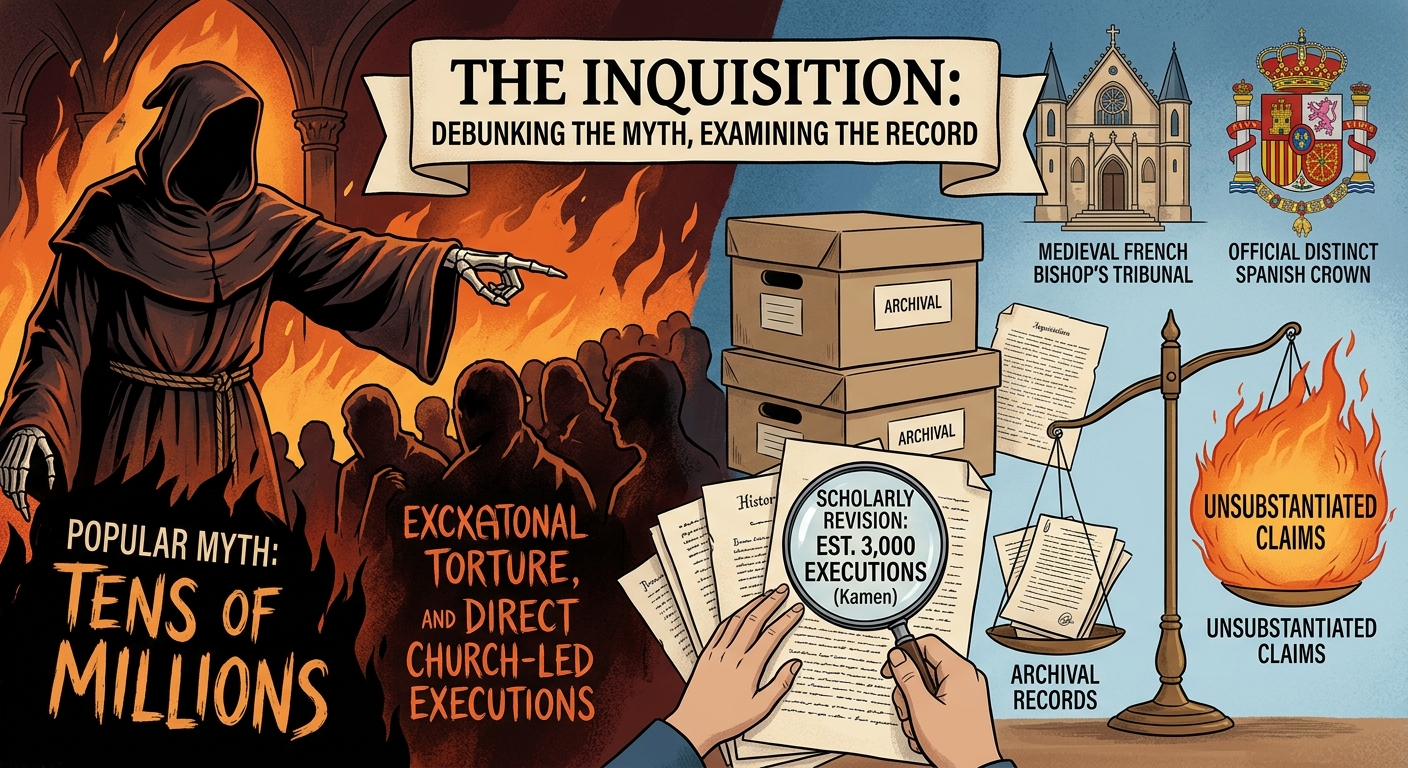
Popular claims of fifty to sixty-eight million deaths across the Inquisition’s history are, according to every serious modern historian, wildly fabricated and untraceable to any credible source (Patheos, n.d.). The scholarly picture, built from archival research into roughly 44,000 surviving trial records, is dramatically smaller.
Henry Kamen, whose 2014 fourth edition of The Spanish Inquisition: A Historical Revision remains the standard scholarly reference, concludes: “We can in all probability accept the estimate, made on the basis of available documentation, that a maximum of three thousand persons may have suffered death during the entire history of the tribunal” — and notes that fewer than two thousand were likely executed for heresy specifically before roughly 1530 (Kamen, 2014, p. 253).
Edward Peters, in his standard academic study Inquisition, arrives at a closely comparable figure: “The best estimate is that around 3000 death sentences were carried out in Spain by Inquisitorial verdict between 1550 and 1800, a far smaller number than that in comparable secular courts” (Peters, 1989, p. 87). Historian Ricardo García Cárcel’s widely cited synthesis places the total number of people prosecuted by the Spanish Inquisition at roughly 150,000, of whom approximately 3,000 to 5,000 — around two percent — were executed, a scale confirmed independently by historian Brian Levack’s comparative work on early-modern persecution.
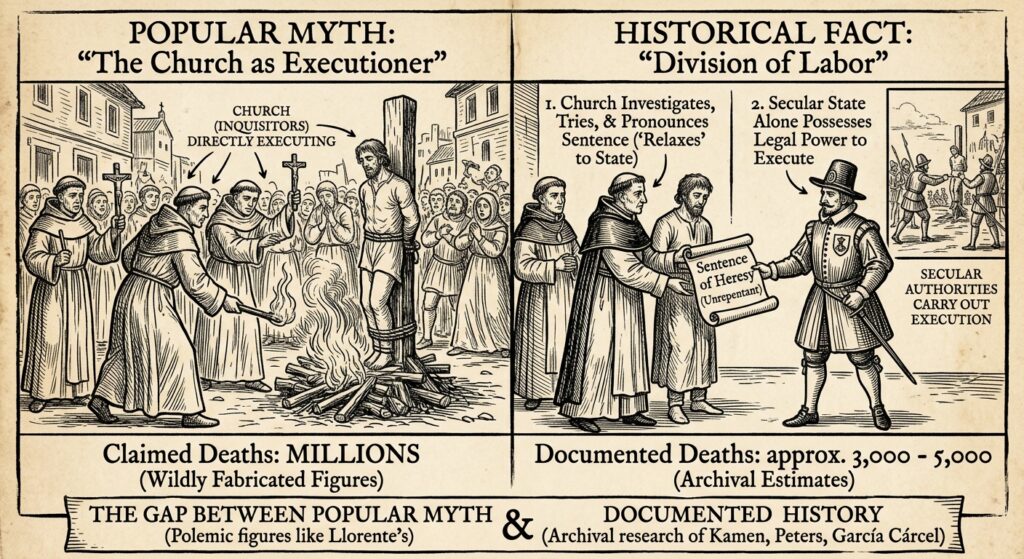
Where, then, did the far larger, still-circulating numbers originate? The commonly repeated figure of 31,912 executions (plus 291,450 additional “condemned to serve penances”) traces to Juan Antonio Llorente (1756–1823), a former secretary of the Spanish Inquisition turned anti-clerical propagandist writing after the French Revolution, in his Critical History of the Inquisition (1817–1819). As historian William D. Rubinstein observes, “most recent historians regard even this figure as far too high” (Rubinstein, 2004, p. 34) — and Llorente’s number is itself understood today as a politically motivated inflation, not an archivally supported count. The gap between Llorente’s 19th-century polemic and the 20th- and 21st-century archival scholarship of Kamen, Peters, and García Cárcel is, in essence, the entire gap between the popular myth and the documented history.
Why Does This History Still Matter for Catholics Today?
None of this revisionist scholarship is offered to minimize genuine abuses, wrongful convictions, or theological error that occurred under various tribunals across four centuries and three kingdoms — nor to deny that torture, however procedurally bounded, was a real and serious wrong. But a faithful Catholic engaging honestly with history owes both the record and potential inquirers precision rather than either defensive denial or wholesale acceptance of anti-Catholic caricature. The documented Inquisition — regional, procedurally bounded, largely administered by secular authority for its harshest penalties, and responsible for a death toll in the low thousands rather than the tens of millions — remains a serious chapter of Church history. It is also, demonstrably, a very different chapter than the one popular culture continues to tell.
References
Britannica. (n.d.). Spanish Inquisition: Key facts. Encyclopædia Britannica. https://www.britannica.com/summary/Spanish-Inquisition-Key-Facts
Grokipedia. (n.d.). Medieval Inquisition. https://grokipedia.com/page/Medieval_Inquisition
History.com Editors. (n.d.). Inquisition — Spanish, Roman & torture. HISTORY. https://www.history.com/articles/inquisition
Kamen, H. (2014). The Spanish Inquisition: A historical revision (4th ed.). Yale University Press.
Patheos. (n.d.). Were “50–68 million” people killed in the Inquisition? https://www.patheos.com/blogs/davearmstrong/2015/08/50-68-million-killed-in-the-inquisition.html
Peters, E. (1989). Inquisition. University of California Press.
Rubinstein, W. D. (2004). Genocide: A history. Routledge.
The Cripplegate. (n.d.). How many people died in the Inquisition? https://thecripplegate.com/how-many-people-died-in-the-inquisition/
Wikipedia. (n.d.-a). Spanish Inquisition. https://en.wikipedia.org/wiki/Spanish_Inquisition
Wikipedia. (n.d.-b). Tomás de Torquemada. https://en.wikipedia.org/wiki/Tomás_de_Torquemada
Wikipedia. (n.d.-c). Portuguese Inquisition. https://en.wikipedia.org/wiki/Portuguese_Inquisition