“Catholic”: Whose Word Is It? A Defence of the Catholic Church’s Ownership of Her Own Name
What Does the Word “Catholic” Actually Mean?
The English word Catholic is a transliteration of the Greek adjective katholikos (καθολικός). The Oxford English Dictionary (2nd ed., 1989) traces the etymology precisely: it derives from late Latin catholicus, itself from Greek katholikos, meaning “general” or “universal,” formed from kath’ holou (i.e., kata + holos) — “according to the whole” or “on the whole.” The term thus carries the sense of organic completeness and wholeness, not merely numerical or geographic spread.
This nuance is critical for the argument that follows. The Latin Church already possessed the word universalis (“universal”) in her own tongue, yet she consistently chose to borrow the Greek katholikos. The choice signals that “Catholic” means more than “found everywhere”; it means possessing the fullness — the whole deposit of faith, all seven sacraments, and the complete apostolic ministry. The Catechism of the Catholic Church (1992), §830, captures both senses: “The word ‘catholic’ means ‘universal,’ in the sense of ‘according to the totality’ or ‘in keeping with the whole.’ The Church is Catholic in a double sense.”
A secondary meaning also attests to the word’s depth. As the patristic scholar J. N. D. Kelly (1978) noted, the adjective katholikos was applied in pre-Christian Greek to mean “general” in the broadest sense — “general history,” “general council,” “things in general” — and it was this connotation of comprehensiveness across all times, places, and doctrines that early Christians found so apt for the one Church that holds the totality of revealed truth (Kelly, 1978, p. 190).
When and Where Was the Word “Catholic” First Used?
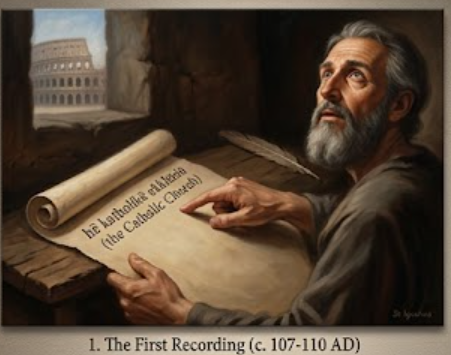
The earliest surviving use of the phrase “the Catholic Church” (Greek: hē katholikē ekklēsia) appears in the Letter to the Smyrnaeans, chapter 8, written by St. Ignatius of Antioch around 107–110 AD as he travelled under military guard to his martyrdom in Rome (Ignatius of Antioch, c. 107–110/1992). The text reads:
“Wherever the bishop appears, there let the congregation be; just as wherever Jesus Christ is, there is the Catholic Church.” (Ignatius of Antioch, c. 107–110/1992, Letter to the Smyrnaeans 8:2)
Two observations are immediately warranted.
First, Ignatius does not pause to define the term; he uses “Catholic Church” as though it were already familiar to his readers in Smyrna. This implies the term was already in circulation in the sub-apostolic Christian community of Antioch — the very city where, according to Acts 11:26, the disciples were first called “Christians.”
Second, the immediate context is hierarchical and sacramental: the sentence appears in a passage insisting on unity around the bishop and the validity of the Eucharist celebrated under his authority. From its first recorded use, therefore, “Catholic” is structurally tied to the visible, episcopal, sacramental Church.
The Anglican patristic scholar J. B. Lightfoot, in his standard critical edition of the Apostolic Fathers, observed that for Ignatius the word still primarily meant “universal” in the classical sense, and that the technical meaning — “the Catholic Church” as opposed to heretical sects — crystallised by around 200 AD (as cited in Kelly, 1978, p. 190). This concession from Protestant scholarship is an honest one and should be noted: the word’s meaning developed over time even as its referent — the one apostolic communion — remained constant.
How Did the Word Develop Among the Early Church Fathers?
St. Polycarp and the Martyrdom of Polycarp (c. 155–157 AD)
The Martyrdom of Polycarp (c. 155–157 AD), an account of the death of the disciple of the Apostle John, opens with a greeting to “all the congregations of the Holy and Catholic Church in every place” and refers to Christ as “the Shepherd of the Catholic Church throughout the world.” Here the word simultaneously embraces universality of geography and singularity of identity: there is one Catholic Church, and congregations throughout the world belong to it.
Tertullian (c. 155–220 AD)
In his Prescription Against Heretics (c. 200 AD), Tertullian developed a juridical argument that the apostolic, “Catholic” churches alone possess the rule of faith (regula fidei) and the Scriptures by right of descent from the apostles, and that heretics have no legal standing even to appeal to the Bible, which belongs to the Church (Tertullian, c. 200/1885). The entire logical structure of the work — that truth is identified by unbroken apostolic lineage through the recognised churches — supplies the framework within which “Catholic” functions as a proper name of the true Church, not a loose generic adjective.
St. Cyril of Jerusalem (c. 313–386 AD)
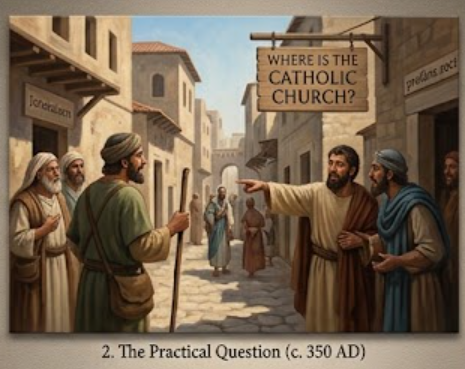
In his Catechetical Lectures (c. 350 AD), Lecture 18, Cyril of Jerusalem offered the most explicit early definition of the word’s theological content and the most practical pastoral guidance on its use:
“[The Church] is called Catholic then because it extends over all the world, from one end of the earth to the other; and because it teaches universally and completely one and all the doctrines which ought to come to men’s knowledge, concerning things both visible and invisible, heavenly and earthly.” (Cyril of Jerusalem, c. 350/1894, Catechetical Lectures 18:23)
More strikingly still, Cyril gave catechumens practical directions for using the word in travel:
“And if ever you are sojourning in cities, inquire not simply where the Lord’s House is (for the other sects of the profane also attempt to call their own dens houses of the Lord), nor merely where the Church is, but where is the Catholic Church. For this is the peculiar name of this Holy Church, the mother of us all.” (Cyril of Jerusalem, c. 350/1894, Catechetical Lectures 18:26)
This instruction — do not ask simply where “the church” is, but specifically where “the Catholic Church” is — is inexplicable unless “Catholic” was already a proper, discriminating name that identified one particular visible body and not others.
St. Pacian of Barcelona (c. 310–391 AD)
When a Novatianist correspondent named Sympronian objected to the bishop’s claim to the name “Catholic,” Pacian of Barcelona replied in his Epistle 1 to Sympronian (c. 375 AD) with the celebrated epigram:
“Christian is my name, Catholic my surname [Christianus mihi nomen est, Catholicus vero cognomen]. The former gives me a name, the latter distinguishes me.” (Pacian of Barcelona, c. 375/1999, Epistle 1 to Sympronian, §4)
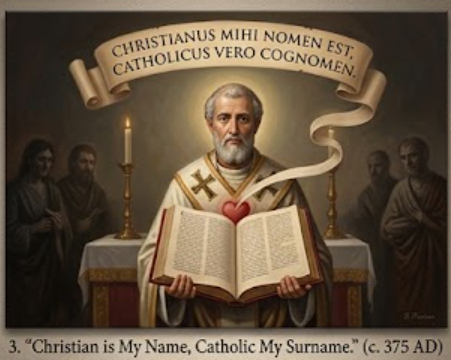
Pacian explains immediately afterward that “Catholic” distinguishes the faithful from the Marcionites, Cataphrygians, and Novatianists — who, he notes, also called themselves “Christians.” The surname “Catholic,” therefore, has from the beginning served as a differentiating mark, not a vague honorific shared by all who bear the name “Christian” (Pacian of Barcelona, c. 375/1999).
St. Optatus of Milevis (d. c. 385 AD)
In his seven-book refutation Against the Donatists (c. 367–384 AD), Optatus of Milevis tied catholicity inseparably to communion with the Chair of Peter in Rome. He challenged the Donatists to trace the episcopal lineage of their rival cathedra and declared that any bishop who set up a chair against “the unique chair” of Peter was “already a schismatic and a sinner” (Optatus of Milevis, c. 367–384/1917, Book 2). For Optatus, catholicity and Roman communion were not two separate criteria but a single ecclesial reality; to be out of communion with Rome was to be ipso facto outside the Catholic Church.
St. Augustine of Hippo (354–430 AD)
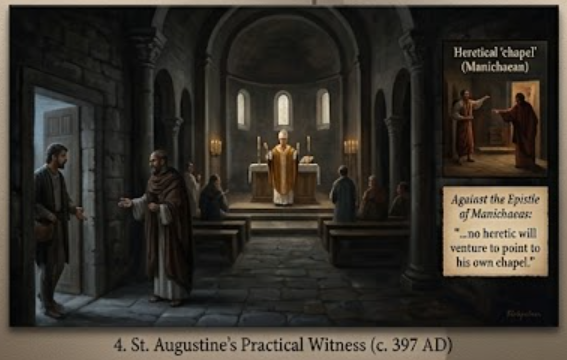
St Augustine repeatedly appealed to the very name “Catholic” as empirical evidence of the true Church. In his Against the Epistle of Manichaeus Called Fundamental (c. 397 AD), he listed among the reasons he remained in the Church:
“[There are many things that] keep me in [the Church’s] bosom … And so, lastly, does the name itself of Catholic, which, not without reason, amid so many heresies, the Church has thus retained; so that, though all heretics wish to be called Catholics, yet when a stranger asks where the Catholic Church meets, no heretic will venture to point to his own chapel or house.” (Augustine of Hippo, c. 397/1887, Against the Epistle of Manichaeus 4:5)
This is perhaps the single most decisive patristic witness for the Catholic case. Augustine’s argument is sociological and practical, not merely theoretical: the word “Catholic” denotes one identifiable, locatable institution, and even those outside it — including those who covet the name — concede in practice which community it designates (Augustine of Hippo, c. 397/1887).
St. Vincent of Lérins (d. c. 445 AD)
In his Commonitorium (c. 434 AD), Vincent of Lérins provided the classic test for genuine catholicity — the “Vincentian Canon”:
“In the Catholic Church itself, all possible care must be taken, that we hold that faith which has been believed everywhere, always, by all [quod ubique, quod semper, quod ab omnibus creditum est]. For that is truly and in the strictest sense Catholic, which, as the name itself and the reason of the thing declare, comprehends all universally.” (Vincent of Lérins, c. 434/1894, Commonitorium 2)
St Vincent’s canon embeds the word’s etymology into a theological test: the church that holds the faith across all places (ubique), all times (semper), and by the consent of all (ab omnibus) is, by the very meaning of the word, “Catholic.” This standard, as we shall see, turns against Protestant bodies that arose in a particular time and place in the 16th century (Vincent of Lérins, c. 434/1894).
When Did “Catholic” Become a Formal Title?
The Edict of Thessalonica (380 AD)
On 27 February 380 AD, the emperors Theodosius I, Gratian, and Valentinian II issued the edict Cunctos populos (the Edict of Thessalonica). The edict mandated that all peoples of the Empire hold “the faith delivered to the Romans by the divine Apostle Peter,” as professed “by the Pontiff Damasus [of Rome] and by Peter, Bishop of Alexandria.” Most significantly, it decreed:
“We order the followers of this law to embrace the name of Catholic Christians; but as for the others … we decree that they shall be branded with the ignominious name of heretics.”
Here “Catholic” was enshrined in Roman imperial law as the legal name of orthodox, Nicene, Rome-communing Christianity — explicitly and legally opposed to heresy.
The Nicene-Constantinopolitan Creed (381 AD)
The First Council of Constantinople (381 AD) gave final form to the creed recited at Mass to this day, which confesses belief “in one, holy, catholic and apostolic Church” (Latin: unam, sanctam, catholicam et apostolicam ecclesiam; Greek: εἰς μίαν, ἁγίαν, καθολικὴν καὶ ἀποστολικὴν ἐκκλησίαν). “Catholic” is thus one of the four marks — or notes — of the Church professed by the whole Christian world, placed alongside “one,” “holy,” and “apostolic” as co-equal descriptors. The creed in this form was formally received at the Council of Chalcedon (451 AD).
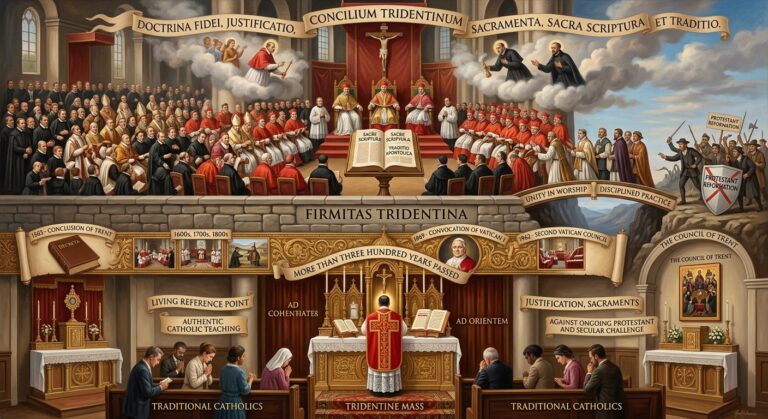
The Catechism of the Council of Trent (1566)
Issued under St. Pius V following the Council of Trent, the Roman Catechism (1566/1923) expounds catholicity as one of the four identifying marks of the Church, explaining:
“The third mark of the Church is that she is Catholic; that is, universal. And justly is she called Catholic, because, as St. Augustine says, she is diffused by the splendour of one faith from the rising to the setting sun.” (Roman Catechism, 1566/1923, Part 1, Article 9)
The Roman Catechism further presents catholicity as “a most reliable criterion, by which to distinguish the true from a false Church” (1566/1923, Part 1, Article 9) — a directly apologetic application occasioned by the Protestant Reformation then in full force.
The Catechism of the Catholic Church (1992)
The current Catechism of the Catholic Church (1992) explains catholicity in two complementary senses.
First (§830), the Church “is catholic because Christ is present in her … in her subsists the fullness of Christ’s body united with its head” and “she receives from him ‘the fullness of the means of salvation.'”
Second (§831), she is catholic “because she has been sent out by Christ on a mission to the whole of the human race.” Notably, the Catechism (1992, §830) quotes Ignatius directly — “Where there is Christ Jesus, there is the Catholic Church” — completing a thread of continuous use from c. 107 AD to the present.
What Are the Main Protestant Objections — and How Do They Hold Up?
Objection 1: “‘Catholic’ just means ‘universal,’ so it applies to all Christians.”
This is the Protestant claim most frequently encountered, and it contains a genuine etymological half-truth. Yes, katholikos literally means “universal.” However, as Kelly (1978) conceded — himself a Protestant patristics scholar — “in the latter half of the second century at latest, we find it conveying the suggestion that the Catholic is the true Church as distinct from heretical congregations” (pp. 190–191). The word’s semantic trajectory moved rapidly from a descriptive adjective to a proper name.
Cyril of Jerusalem’s instruction (c. 350/1894, Catechetical Lectures 18:26) — “inquire not simply where the Church is, but where is the Catholic Church” — is inexplicable on the purely etymological reading: if “catholic” merely meant “universal” and applied to any Christian gathering, the distinction Cyril draws is nonsensical. Augustine’s observation (c. 397/1887, Against the Epistle of Manichaeus 4:5) is even sharper: heretics “wish to be called Catholics,” but when a stranger asks for “the Catholic Church,” no heretic points to his own assembly. The word does, in practice, denote one specific body — and it has done so since at least the late second century.
Objection 2: “The early Church was not the Roman Catholic Church.”
This objection exploits a legitimate observation about historical development. No informed Catholic claims that the Church of the second century was institutionally identical in every external form to the post-Tridentine Church. St. Vincent of Lérins (c. 434/1894) himself explicitly allowed for genuine doctrinal development — what he called development as distinguished from mutation or corruption. The question is not identity of external form, but continuity of essence.
The marks that the Fathers attached to the word “Catholic” — episcopal hierarchy (Ignatius of Antioch, c. 107–110/1992), apostolic succession and the rule of faith (Tertullian, c. 200/1885), the Real Presence and the bishop’s Eucharist (Ignatius of Antioch, c. 107–110/1992), and communion with the Chair of Peter at Rome (Optatus of Milevis, c. 367–384/1917) — are precisely the features that distinguish the Catholic Church and not the confessional communities that emerged in the 16th century. The continuity is in the visible, hierarchical, sacramental body, not in an invisible fellowship of the elect.
Objection 3: “We say ‘I believe in the holy catholic church’ in the Apostles’ Creed — it means the universal body of believers.”
Lutheran, Reformed, and Anglican Christians do recite “catholic” (and in some Lutheran usage “Christian”) in the Apostles’ Creed, and typically interpret it as the company of all the elect or of all the baptised. The Reformed tradition systematised this as the distinction between the “invisible church” (all the elect, known to God alone) and the “visible church.” Calvin (1559/1960), in the Institutes of the Christian Religion (Book IV, Chapter 1), explicitly drew this distinction, and the Westminster Confession of Faith (1646), Chapter 25, §1, defines “the catholic or universal Church which is invisible” as “the whole number of the elect.”
The Catholic response is twofold.
First, as Kelly (1978) noted, the early Fathers “had little or no inkling of the distinction which was later to become important between a visible and an invisible Church” — for them the Catholic Church “was almost always the empirical, visible society” (p. 190). The invisible/visible church distinction is itself a 16th-century theological innovation, foreign to the entire patristic tradition.
Second, the Apostles’ Creed was itself a product of the visible, hierarchical Church: it grew from ancient Roman and North African baptismal symbols administered by bishops in the apostolic succession. To recite “catholic” in the creed while denying that the word names a visible, identifiable Church is to use the Fathers’ word against the Fathers’ meaning.
Objection 4: “The term ‘Roman Catholic’ was not used until much later, which shows the name is not ancient.”
This objection is correct as stated — and, properly understood, actually strengthens the Catholic case rather than undermining it. The compound “Roman Catholic” is indeed a relatively late coinage. According to the Oxford English Dictionary (1989), the phrase appears to have arisen in the early 17th century; the earliest illustrative quotation it gives is from Edwin Sandys’s Europae Speculum (1605). The compound gained wider currency during the negotiations connected with the Spanish Match (c. 1618–1624) for conciliatory, diplomatic reasons, and thereafter was widely adopted as a non-controversial term (Wernz & Thurston, 1912).
The compound was subsequently promoted by 19th-century Anglican theologians, most notably William Palmer and John Keble, who held the “branch theory” — the idea that the one Catholic Church subsists in three parallel “branches” (Roman, Eastern Orthodox, and Anglican). On this reading, “Roman” was needed to differentiate one branch from the others. The Holy See explicitly rejected this theory. In its letter Apostolicae Sedis Nuntiatum (16 September 1864), the Holy Office condemned the branch theory, denying that “the true Church of Jesus Christ consists partly of the Roman Church … partly of the Photian schism and the Anglican heresy” as a principle that “overthrows the divine constitution of the Church” (as cited in Wernz & Thurston, 1912).
At the First Vatican Council (1870), a group of approximately 35 English-speaking bishops, concerned that the draft phrase Sancta Romana Catholica Ecclesia might be construed as endorsing the Anglican branch theory, succeeded in having the wording amended. The final text of Dei Filius read Sancta catholica apostolica romana Ecclesia — with “Roman” now one of four adjectives, not the primary modifier (as cited in Wernz & Thurston, 1912). The Church’s own preferred self-designation, then and now, remains simply “the Catholic Church.” The lateness of “Roman Catholic” demonstrates not that the Catholic Church’s claim to the name is a late development, but the opposite: “Catholic” simpliciter is the ancient, original name, and “Roman Catholic” is a modern compound introduced largely by others.
Objection 5: Lutheran, Reformed, and Anglican Appeals to Catholicity
The Lutheran Augsburg Confession (Melanchthon, 1530) famously insisted that the Lutheran Reformers taught “nothing that varies from the Scriptures, or from the Church Catholic, or from the Church of Rome as known from its writers” — claiming continuity with the catholic faith while accusing Rome of novelty. Anglican divines such as John Jewel and Richard Hooker described the Church of England as “reformed catholic” and appealed to the Vincentian Canon (quod ubique, quod semper, quod ab omnibus) to argue that Anglicanism, not Rome, preserved the ancient faith (as cited in Pearson, 1659/1847).
The Catholic response grants the sincerity of these appeals while contesting their success. Vincent’s own canon includes the criterion of universality of place and consensus — agreement with the whole Church across the world in communion with the apostolic sees. A national church established by an Act of Parliamentary Supremacy in 1534, or a confessional movement dating to 1517, cannot satisfy “always” (semper) and “everywhere” (ubique) in the sense the canon requires. Moreover, the Fathers who formulated and invoked the test — Vincent (c. 434/1894), Augustine (c. 397/1887), Optatus (c. 367–384/1917) — consistently located catholicity in visible communion with Rome and identified schism from Rome as definitional exclusion from the Catholic Church.
St Augustine’s famous verdict, delivered in a different but related context — securus iudicat orbis terrarum (“the verdict of the whole world is secure”) — was precisely the argument that led John Henry Newman (1845/2008) out of Anglicanism and into full communion with Rome. The argument from universal Catholic consent, properly applied, points to Rome.
Conclusion
From its first recorded appearance in the Letter to the Smyrnaeans of St. Ignatius of Antioch (c. 107–110/1992) to its codification in the creeds (381 AD), imperial law (380 AD), the Catechism of Trent (1566/1923), and the Catechism of the Catholic Church (1992), the word “Catholic” has served as the proper, distinguishing name of one visible, hierarchical, sacramental community in communion with the Bishop of Rome. The Fathers — Polycarp, Tertullian, Cyril of Jerusalem, Pacian, Optatus, Augustine, and Vincent of Lérins — used the term not as a vague honorific applicable to any Christian gathering, but as a precise ecclesiological mark identifying the one true Church over against heretical and schismatic bodies.
The major Protestant objections all fail under historical scrutiny. The first collapses against Augustine’s sociological observation. The second confuses development with discontinuity. The third imports a 16th-century theological innovation (the visible/invisible church distinction) into documents formed wholly within the visible, hierarchical Catholic Church. The fourth is precisely backwards: “Roman Catholic” is a 17th-century diplomatic coinage, while plain “Catholic” is the sub-apostolic name.
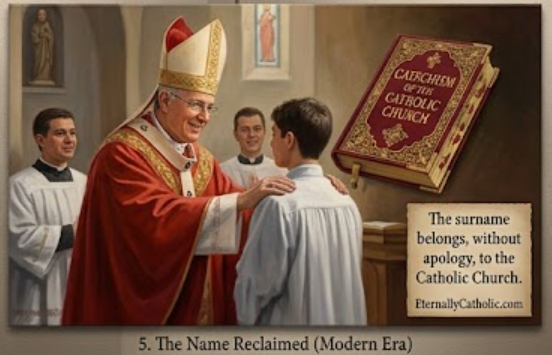
As St. Pacian of Barcelona (c. 375/1999) declared with lapidary elegance: Christianus mihi nomen est, Catholicus vero cognomen. “Christian is my name, Catholic my surname.” The surname belongs, without apology, to the Catholic Church.
References
Apostolicae Sedis Nuntiatum [Letter of the Holy Office to the English Bishops]. (1864, September 16). Holy Office. (As cited in Wernz & Thurston, 1912)
Augustine of Hippo. (1887). Against the epistle of Manichaeus called fundamental (R. Stothert, Trans.). In P. Schaff (Ed.), A select library of the Nicene and post-Nicene Fathers of the Christian Church (1st ser., Vol. 4, pp. 129–150). Christian Literature Company. (Original work written c. 397 AD)
Calvin, J. (1960). Institutes of the Christian religion (F. L. Battles, Trans.; J. T. McNeill, Ed.). Westminster Press. (Original work published 1559)
Catholic Church. (1992). Catechism of the Catholic Church. Libreria Editrice Vaticana.
Catholic Church. (1923). The catechism of the Council of Trent (J. Donovan, Trans.). Catholic Publication Society. (Original work published 1566)
Cyril of Jerusalem. (1894). The catechetical lectures (E. H. Gifford, Trans.). In P. Schaff & H. Wace (Eds.), A select library of Nicene and post-Nicene Fathers of the Christian Church (2nd ser., Vol. 7). Christian Literature Company. (Original work written c. 350 AD)
Ignatius of Antioch. (1992). Letter to the Smyrnaeans. In J. B. Lightfoot & J. R. Harmer (Eds. & Trans.), The Apostolic Fathers: Greek texts and English translations (2nd ed., pp. 238–243). Baker Book House. (Original work written c. 107–110 AD)
Kelly, J. N. D. (1978). Early Christian doctrines (Rev. ed.). HarperSanFrancisco.
Melanchthon, P. (2005). The Augsburg Confession (T. G. Tappert, Trans.). In The Book of Concord: The confessions of the Evangelical Lutheran Church (R. Kolb & T. J. Wengert, Eds., pp. 27–105). Fortress Press. (Original work published 1530)
Newman, J. H. (2008). An essay on the development of Christian doctrine. University of Notre Dame Press. (Original work published 1845)
Optatus of Milevis. (1917). Against the Donatists (O. R. Vassall-Phillips, Trans.). Longmans, Green. (Original work written c. 367–384 AD)
Oxford English Dictionary (2nd ed.). (1989). Oxford University Press.
Pacian of Barcelona. (1999). Epistle 1 to Sympronian. In C. L. Hanson (Trans.), Iberian Fathers, Vol. 3: Pacian of Barcelona, Orosius of Braga (Fathers of the Church, Vol. 99). Catholic University of America Press. (Original work written c. 375 AD)
Pearson, J. (1847). An exposition of the Creed. John Henry Parker. (Original work published 1659)
Tertullian. (1885). The prescription against heretics (P. Holmes, Trans.). In A. Roberts & J. Donaldson (Eds.), The Ante-Nicene Fathers (Vol. 3, pp. 243–265). Christian Literature Company. (Original work written c. 200 AD)
Vincent of Lérins. (1894). The commonitory (C. A. Heurtley, Trans.). In P. Schaff & H. Wace (Eds.), A select library of Nicene and post-Nicene Fathers of the Christian Church (2nd ser., Vol. 11, pp. 131–156). Christian Literature Company. (Original work written c. 434 AD)
Wernz, F. X., & Thurston, H. (1912). Roman Catholic. In C. G. Herbermann et al. (Eds.), The Catholic Encyclopedia (Vol. 13, pp. 121–122). Robert Appleton Company.
Westminster Assembly. (1647). The Westminster Confession of Faith. Church of Scotland.