Chronicle of Marian Apparitions, Part 6: The Poor, the Sorrowful, and a Warning of Genocide
Chronicle of Marian Apparitions, Part 6
The Poor, the Sorrowful, and a Warning of Genocide: Our Lady of Beauraing to Our Lady of the Rosary of San Nicolas (1932–1983)
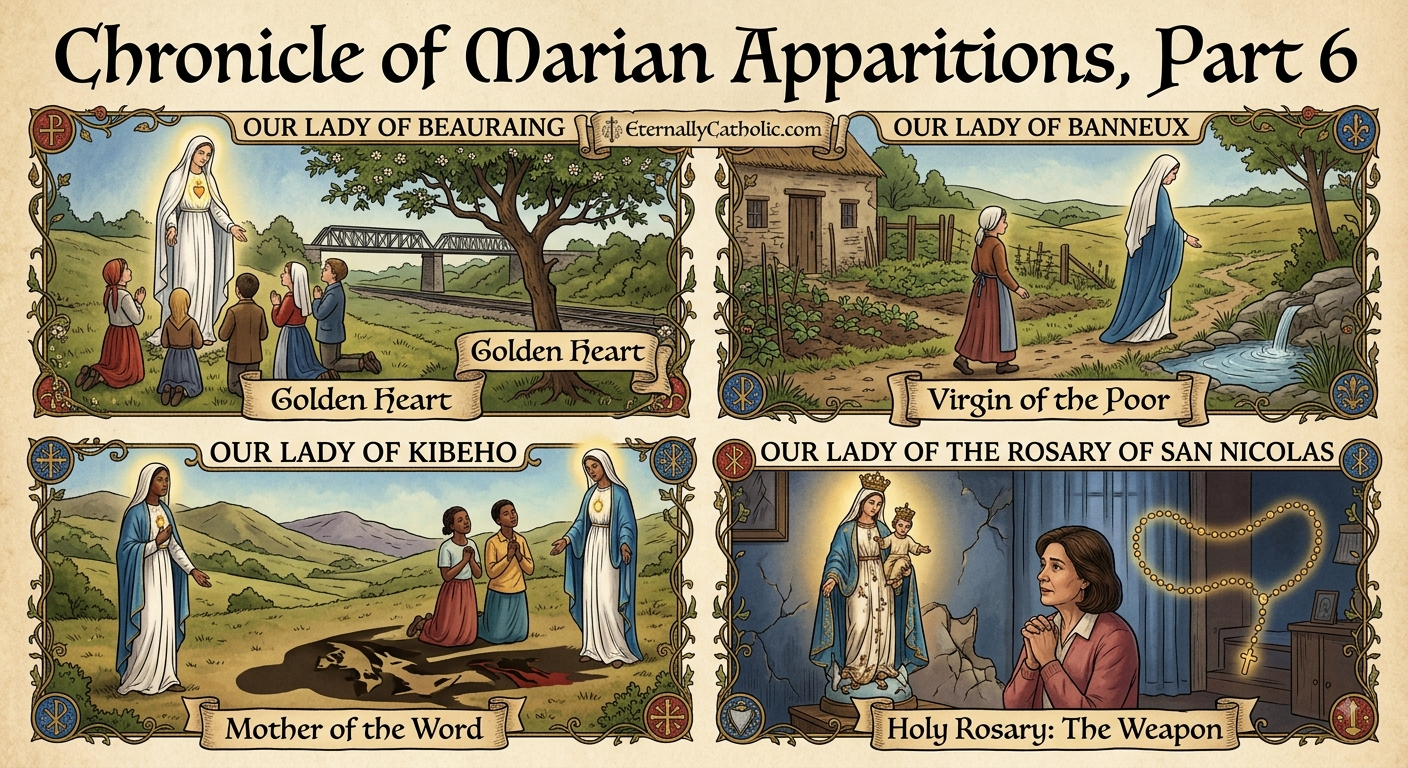
This sixth and final installment closes the chronicle with four of the more recent Church-approved Marian apparitions, spanning barely fifty years yet crossing three continents. Two apparitions occurred within months of one another in neighboring Belgian towns during the depths of the Great Depression; a third, in Rwanda, stands as the only fully Vatican-approved apparition on the African continent and carries a chilling prophecy later fulfilled in tragedy; and a fourth, still continuing in Argentina, represents one of the longest and most extensively documented series of approved messages in Church history.
What Happened at Our Lady of Beauraing in Belgium (1932–1933)?
Beauraing, Belgium — 29 November, 1932 to 3 January, 1933 — Witnesses: Fernande, Albert, and Gilberte Voisin; Andrée and Gilberte Degeimbre
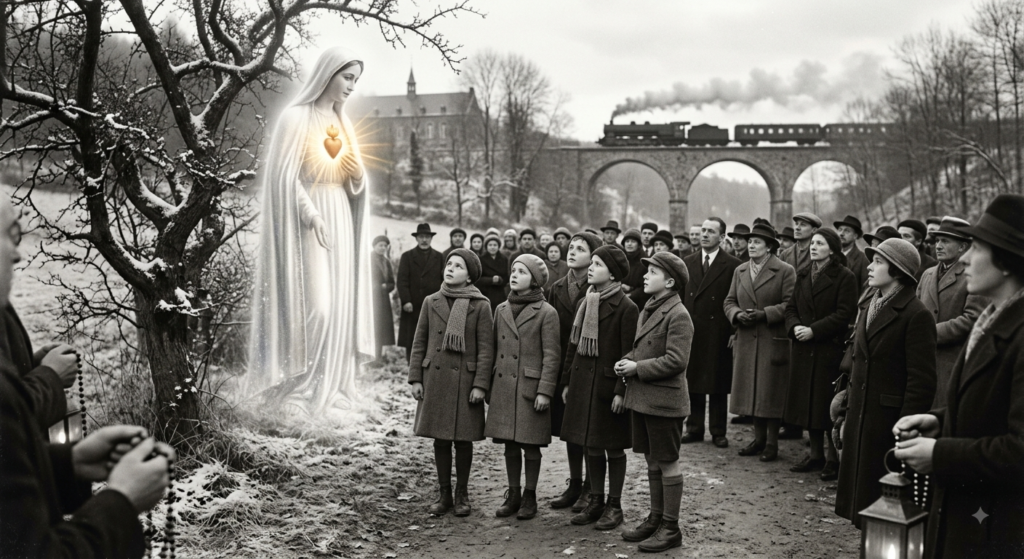
Beginning on 29 November 1932, five children from two neighboring families, aged nine to fifteen, reported seeing a beautiful lady dressed in white walking above a railway bridge near a convent garden in the small Belgian town of Beauraing. Over the following five weeks, the apparitions recurred thirty-three times, witnessed by the children even as growing crowds of townspeople and eventually thousands of pilgrims looked on without seeing anything themselves. The lady appeared before a hawthorn tree with a heart that seemed to glow gold at her breast, leading to the devotional title Our Lady of the Golden Heart, and asked the children to be good, to pray for the conversion of sinners, and to have a chapel built in her honor. In the final apparition, on 3 January 1933, she identified herself and gave the children a farewell before withdrawing her visible presence, though not, she promised, her intercession. Following an extensive investigation, the Bishop of Namur formally approved the apparitions in 1949.
What Was Our Lady’s Message at Beauraing?
“I am the Immaculate Virgin.”
The message at Beauraing was simple and repeated across many apparitions: pray always, be good, sacrifice for the conversion of sinners, and trust in her intercession as the Immaculate Virgin. The devotion to her Golden Heart, emphasized in the final weeks of the apparitions, presents Mary’s heart as a source of consolation and refuge for a world then only beginning to emerge from economic depression and moving toward a second global war.
What Happened at Our Lady of Banneux in Belgium (1933)?
Banneux, Belgium — 15 January to 2 March, 1933 — Witness: Mariette Beco
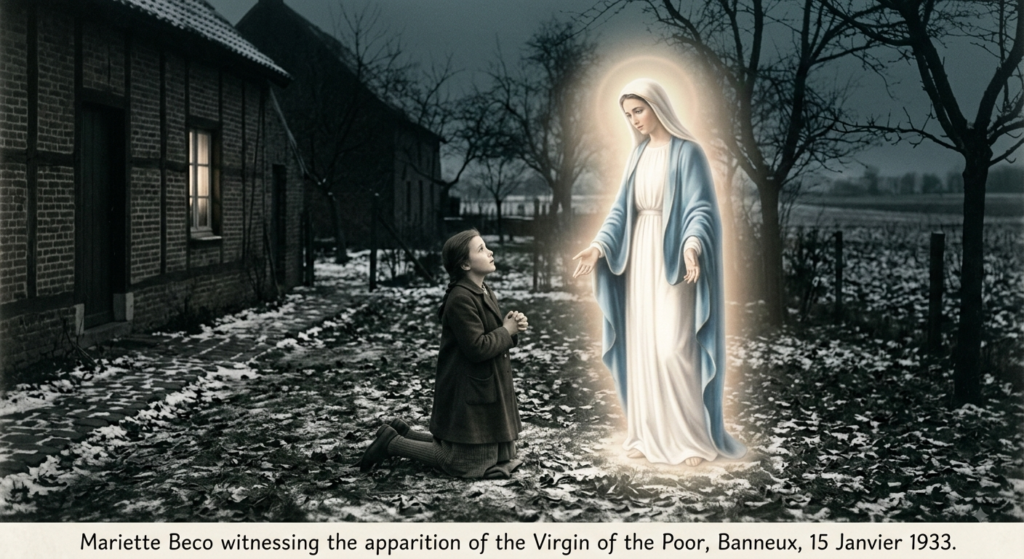
Just weeks after the apparitions at Beauraing concluded some sixty miles away, an eleven-year-old girl named Mariette Beco, from a poor family in the village of Banneux, reported seeing a luminous lady in the garden behind her family’s home on the evening of 15 January 1933. Over eight subsequent apparitions through early March, the lady led Mariette to a small spring in a nearby field and told her the water was intended to relieve the sick of all nations. She identified herself to the child as the Virgin of the Poor, a title reflecting both Mariette’s own family’s poverty and Mary’s particular closeness to the suffering and the destitute. Unlike Beauraing, the events at Banneux involved a single visionary and unfolded with quiet simplicity in a rural setting far from any shrine or convent. The Bishop of Liège approved the apparitions in 1949, the same year as Beauraing, and the spring at Banneux continues to draw pilgrims, including many who are sick, seeking healing and consolation.
What Was Our Lady’s Message at Banneux?
“I am the Virgin of the Poor… This spring is reserved for all nations, to relieve the sick.”
Banneux’s message emphasizes Mary’s solidarity with the poor and the suffering, her intercession offered without distinction of nation or status, and a simple call to prayer, especially the rosary. Mariette Beco herself lived a largely private life following the apparitions, and the shrine at Banneux remains known above all for its ministry to the sick, who come to the spring seeking both physical and spiritual relief.
What Happened at Our Lady of Kibeho in Rwanda (1981–1989)?
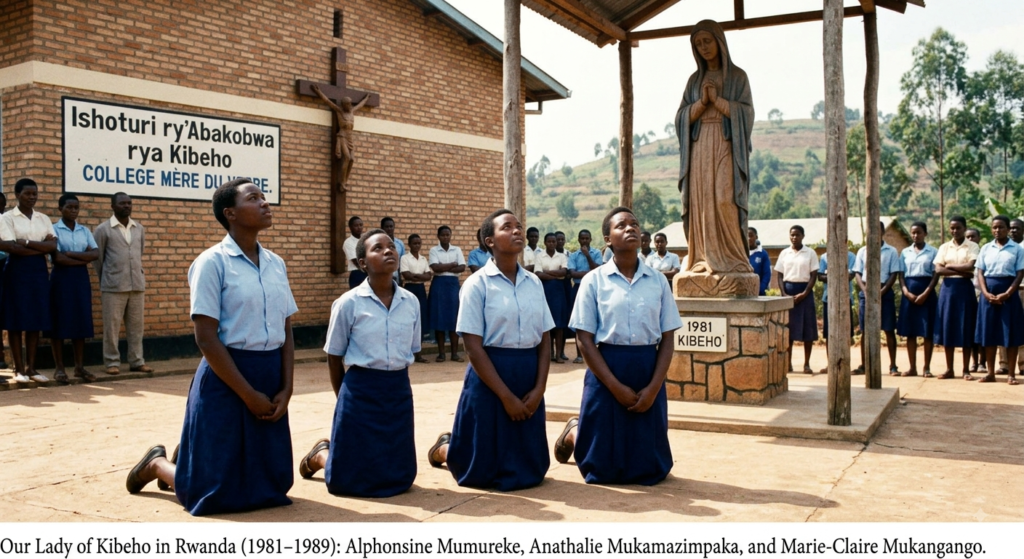
Kibeho, Rwanda — 28 November, 1981 to 1989 — Witnesses: Alphonsine Mumureke, Anathalie Mukamazimpaka, and Marie-Claire Mukangango
On 28 November 1981, a secondary school student named Alphonsine Mumureke reported the first of what would become a lengthy series of apparitions at Kibeho, a village in southern Rwanda, of a lady who identified herself as Nyina wa Jambo, Mother of the Word. Two of her classmates, Anathalie Mukamazimpaka and Marie-Claire Mukangango, soon reported similar visions, each receiving distinct messages over the following years. Mary called the young women, and through them the wider community, to conversion, penance, and prayer, teaching them a devotion known as the Rosary of the Seven Sorrows centered on her compassion for a suffering world. In several later apparitions the visionaries described disturbing visions of violence, rivers of blood, and bodies left unburied, a warning many Rwandans came to understand, in painful hindsight, as a prophecy of the 1994 genocide against the Tutsi, in which roughly eight hundred thousand people were killed, including Marie-Claire Mukangango herself. The Bishop of Gikongoro approved the apparitions in 2001, making Kibeho the first and, to date, only fully Vatican-approved Marian apparition on the African continent.
What Was Our Lady’s Message at Kibeho?
“If you do not turn to God and repent while you have time, you will fall into the abyss.”
Kibeho’s message combines a maternal call to repentance and prayer with an urgent, sorrowful warning of coming catastrophe unless conversion took place, a warning that acquired tragic weight when genocide engulfed Rwanda little more than a decade later. The apparitions are remembered today both as a call to ongoing reconciliation in Rwanda and as a somber reminder of Mary’s grief over humanity’s capacity for violence against itself.
What Happened at the Rosary of San Nicolas in Argentina (1983)?
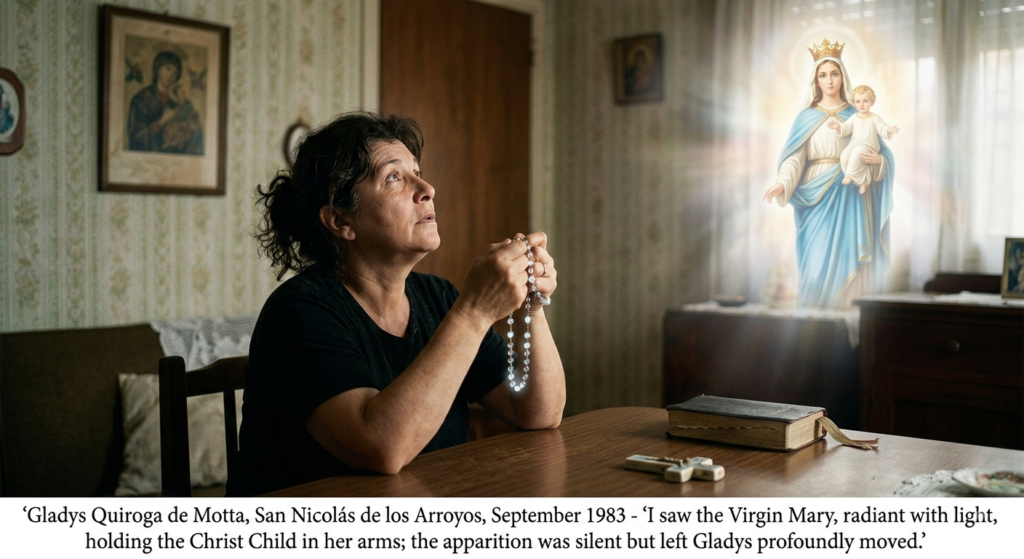
San Nicolás de los Arroyos, Argentina — beginning 25 September, 1983 — Witness: Gladys Quiroga de Motta
In September 1983, residents of the Argentine city of San Nicolás de los Arroyos began noticing that rosary beads in their homes appeared to glow. On 25 September, a forty-six-year-old wife and mother of two, Gladys Quiroga de Motta, was praying the rosary at home when she saw the Virgin Mary, radiant with light, holding the Christ Child in her arms; the apparition was silent but left Gladys profoundly moved (House of Mary, n.d.). Visits continued and, from mid-October, Mary began speaking, eventually asking that a church be built at a location she indicated near the city. In November, Gladys was led to identify an old, damaged statue of Our Lady of the Rosary, blessed decades earlier by Pope Leo XIII and long forgotten in the cathedral bell tower, as matching the figure of her visions. Over the following years Gladys recorded more than 1,800 messages from both Mary and, on numerous occasions, Jesus himself, calling for daily prayer, fasting, the Eucharist, and conversion. Bishop Hector Cardelli of San Nicolás formally approved the messages given between 1983 and 1990 in 2016, and reported apparitions to Gladys have, by the accounts of local authorities, continued since.
What Was Our Lady’s Message at San Nicolas?
“The Holy Rosary is the weapon which the enemy fears. It is also the refuge of those who look for relief for the sufferings, and it is the door to enter into my heart.”
The messages of San Nicolás reiterate and extend the calls given at Fatima and Lourdes: prayer, especially the daily rosary, fasting, frequent reception of the Eucharist, and heartfelt conversion, framed as urgently needed responses to a world Mary describes as increasingly indifferent to her invitations. The devotion has grown into one of Argentina’s most significant Marian pilgrimage sites, notable among approved apparitions for the sheer volume of recorded messages and their continuation, according to the visionary’s testimony, into recent years.
References
House of Mary. (n.d.). San Nicolas, Argentina. https://houseofmaryomd.org/apparitions/approved/23-sannicolas-argentina/
Margefenelon.com. (2016, May 27). The rosary: Door to Mary’s heart—Marian apparitions in San Nicolas, Argentina approved. https://margefenelon.com/4932/the-rosary-door-to-marys-heart-marian-apparitions-in-san-nicolas-argentina-approved/
Wikipedia. (n.d.-a). Our Lady of Beauraing. In Wikipedia. Retrieved August 8, 2026, from https://en.wikipedia.org/wiki/Our_Lady_of_Beauraing
Wikipedia. (n.d.-b). Our Lady of Banneux. In Wikipedia. Retrieved August 8, 2026, from https://en.wikipedia.org/wiki/Our_Lady_of_Banneux
Wikipedia. (n.d.-c). Our Lady of Kibeho. In Wikipedia. Retrieved August 8, 2026, from https://en.wikipedia.org/wiki/Our_Lady_of_Kibeho
Wikipedia. (n.d.-d). Our Lady of the Rosary of San Nicolás. In Wikipedia. Retrieved August 8, 2026, from https://en.wikipedia.org/wiki/Our_Lady_of_the_Rosary_of_San_Nicol%C3%A1s