Why Did Lucifer Fall — And What Did Mary Say Instead?
What Does an Ancient Angel’s Fall Have to Do With Us Today?
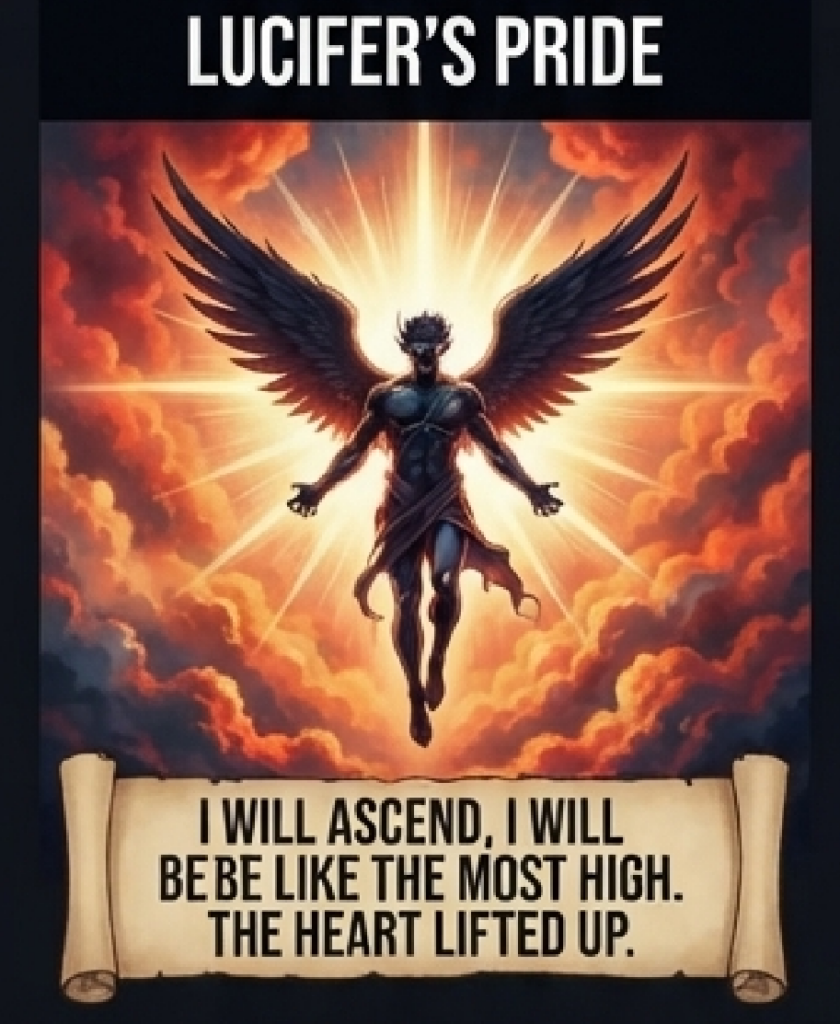
A single graphic can sometimes say what a shelf of theology books takes chapters to unpack. Seven traditional markers of Lucifer’s fall are often summarized this way:
- Self-promotion,
- Authority without obedience,
- Wanting the throne,
- Perfection curdling into corruption,
- Gifts becoming identity,
- A sudden and total collapse, and
- Rejection of truth.
The real thesis underneath all seven, though, is simpler: the biggest danger isn’t out there — it’s the “I will” within.
That single word, will, is the hinge on which the entire drama of salvation history turns. It is the same hinge Adam and Eve turned in the garden, the same hinge every reader turns dozens of times a day in far smaller ways — at the office, at the dinner table, scrolling a phone at eleven at night.
Scripture gives us not only a case study in how that hinge swings toward ruin, but a second case study, in the same book, of a created will that swung the opposite way completely. Her name is Mary of Nazareth, and where Lucifer’s whole rebellion can be summarized in the words
“I will,” her whole life can be summarized in the words she gave the angel Gabriel:
“Be it done unto me according to thy word” (Luke 1:38).
This article holds those two figures side by side — not as a literary device, but because the Church herself has always read them that way. It walks through what Scripture and Tradition say about why Lucifer fell, shows point by point how Mary’s life is the deliberate, historical answer to each mark of that fall, looks honestly at how the same seven temptations attack ordinary believers today, and offers concrete, practicable ways devotion to Mary forms the will against them — closing with real examples, biblical and historical, of both catastrophe and recovery.
What Does Scripture Actually Say About Why Lucifer Fell?
The Church has never possessed a systematic, blow-by-blow narrative of the angelic fall the way she possesses a Gospel narrative of the Passion. What she has are fragments — oracles delivered against pagan kings whose arrogance so perfectly mirrored the original rebellion that the Fathers read straight through the human figure to the spiritual reality behind him. Two texts carry the weight of the tradition.
The first is Isaiah’s taunt against the king of Babylon, applied typologically by the Fathers and the Church’s later tradition to Satan’s fall from heaven. The oracle puts five declarations into the fallen figure’s mouth, and every one of them begins with the same word:
“How you are fallen from heaven,
O Day Star, son of Dawn!
How you are cut down to the ground,
you who laid the nations low!
You said in your heart,
‘I will ascend to heaven;
above the stars of God
I will set my throne on high;
I will sit on the mount of assembly
in the far north;
I will ascend above the heights of the clouds,
I will make myself like the Most High.’
But you are brought down to Sheol,
to the depths of the Pit.” (Isaiah 14:12–15, Douay-Rheims)
The second is Ezekiel’s lament over the king of Tyre, read the same typological way. Here the emphasis shifts from ambition to endowment — this is a being who did not lack gifts, who was in fact perfect, and whose perfection became the very material of his ruin:
“Thou wast the seal of resemblance, full of wisdom, and perfect in beauty… Thou wast perfect in thy ways from the day of thy creation, until iniquity was found in thee.” (Ezekiel 28:12, 15, Douay-Rheims)
The New Testament confirms both the reality and the suddenness of the event. Christ tells the seventy-two disciples returning from their mission, full of joy at their own success, “I saw Satan like lightning falling from heaven” (Luke 10:18) — a single, instantaneous image, not a gradual decline. St. John adds the consequence: “he was a murderer from the beginning, and he stood not in the truth” (John 8:44). And St. James supplies what might be called the general theorem behind all seven marks: “God resisteth the proud, and giveth grace to the humble” (James 4:6).
Why Does the Church Insist It Was Pride, Not Weakness, That Brought Him Down?
It would be easier, in a strange way, if Lucifer had fallen through some deficiency — a lack of intelligence, a lack of grace, a design flaw. But nothing in the tradition supports that reading, and everything in it points the opposite direction. St. Thomas Aquinas, synthesizing centuries of patristic reflection, teaches that the highest angel was endowed with the greatest natural gifts of any creature, and that it was precisely this excellence, not any lack, that became the material of his sin (Aquinas, 1920, Summa Theologiae I, Q.63, A.7). The angel who fell furthest fell from the highest place.
St Thomas Aquinas’s formal definition of pride, drawn from St. Gregory the Great, is worth sitting with: pride is “inordinate desire of one’s own excellence” (Aquinas, 1920, Summa Theologiae II-II, Q.162, A.1). Notice what the definition does not condemn. It does not condemn excellence itself — intelligence, beauty, talent, holiness are all good, and all were present in Lucifer before his fall. What it condemns is disorder: excellence detached from its source and referred back to the self rather than to God. Every one of Isaiah’s five “I will” statements is precisely this disorder in miniature — a real capacity severed from the One who gave it and claimed instead as a private possession.
This distinction matters enormously for anyone trying to apply the lesson honestly, because it means the danger is never simply “having gifts.” The danger is the small, almost imperceptible move of attributing the gift to oneself rather than to God — the same move, on a created scale, that Lucifer made on an angelic one.
How Does Genesis Answer Lucifer’s Rebellion With a Woman Rather Than Another Angel?
The Church has always read the aftermath of Eden as more than a punishment; embedded inside the curse on the serpent is the first promise of a rescue, traditionally called the Protoevangelium, the “first gospel”:
“I will put enmities between thee and the woman, and thy seed and her seed: she shall crush thy head, and thou shalt lie in wait for her heel.” (Genesis 3:15, Douay-Rheims)
The detail worth pausing on is who God chooses to place at the center of this enmity. Not an army of angels. Not a rival power matched force for force. A woman — and by extension, in the Church’s later reading of this text, one particular woman, the New Eve, whose son would be the definitive answer to the serpent’s rebellion (Catechism of the Catholic Church [CCC], 1997, para. 410–411, 2853). Pope St. John Paul II describes Mary’s whole vocation in exactly these terms: she stands, throughout salvation history, as the one through whom the “enmity” announced in Genesis becomes concrete and effective (John Paul II, 1987, para. 11).
There is a fittingness here that is worthy of reflection. Lucifer’s sin was fundamentally a refusal to serve — the old tradition renders his rebellion in the single Latin phrase non serviam, “I will not serve.” The answer to that refusal is not another being of Lucifer’s own order asserting greater power. It is a creature of a lower order — human, not angelic — whose entire posture is the deliberate opposite: total willingness to serve. Where pride miscalculates its own importance, service correctly locates it.
What Did Mary Actually Say When She Was Given the Chance to Say “I Will” Instead?
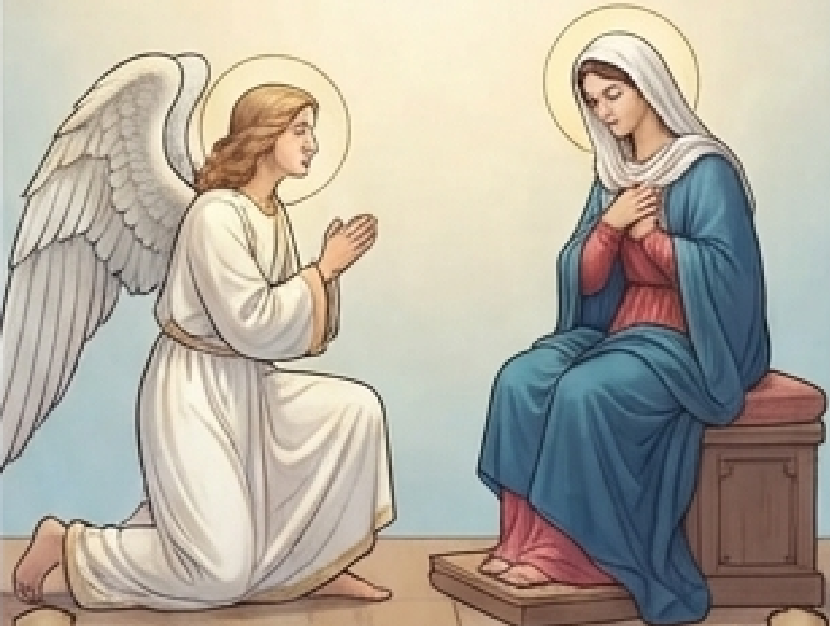
The Annunciation narrative in St. Luke’s Gospel is worth reading slowly, because it is easy to flatten into sentimental art and miss how much is actually being asked of a teenage girl in a small Galilean village. The angel Gabriel does not simply inform Mary of a plan already settled; he asks for something, and the entire future of the Incarnation, in the mystery of how God ordinarily works through free creatures, waits on her answer.
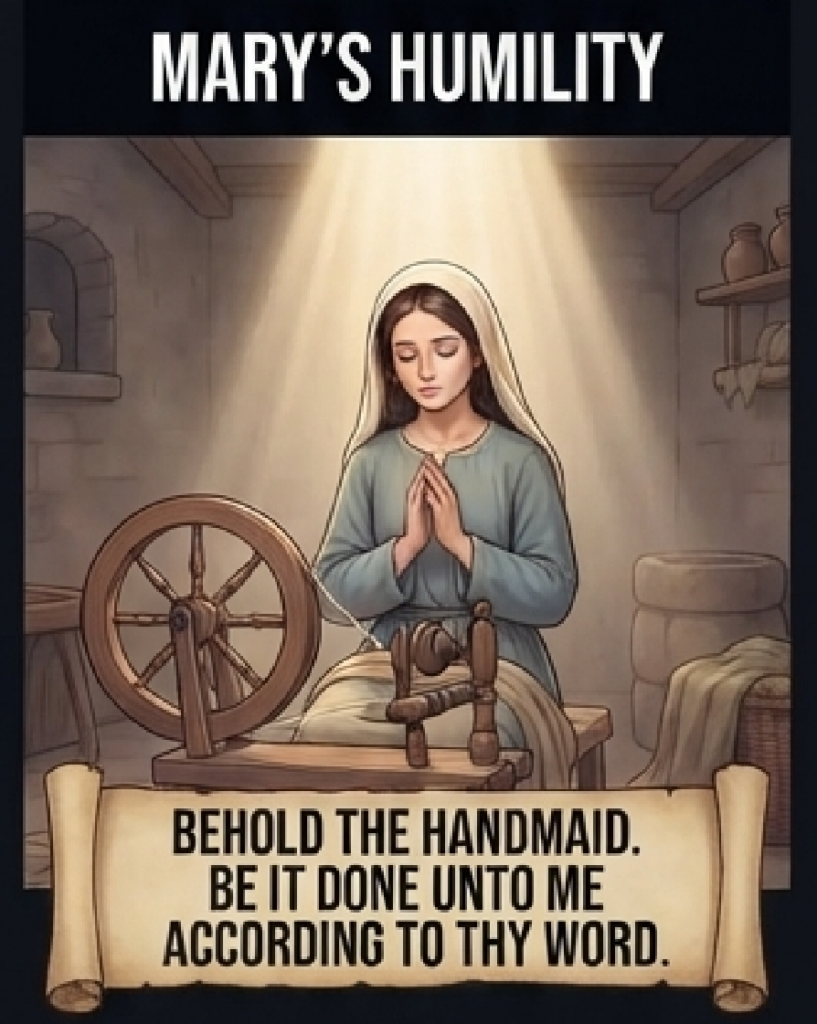
“And the angel said to her: The Holy Ghost shall come upon thee, and the power of the most High shall overshadow thee… And Mary said: Behold the handmaid of the Lord, be it done to me according to thy word.” (Luke 1:35, 38, Douay-Rheims)
Notice the structure of her response against the structure of Lucifer’s. His five clauses are all first-person and active: I will ascend, I will exalt, I will sit, I will ascend, I will be. Hers is passive and other-directed: be it done unto me. She does not ask to be exalted; she asks, in effect, to be used. She does not name a plan of her own devising; she receives one she did not originate and could not fully explain, even to herself. Pope John Paul II calls this the moment of Mary’s “faith-obedience,” a free assent that embraces the entirety of God’s plan without reservation (John Paul II, 1987, para. 13). It is, point for point, the mirror image of the angelic rebellion — offered, not coincidentally, by a woman, in the lineage of the woman first named in Genesis 3:15.
How Does Mary’s Hidden Life at Nazareth Answer Lucifer’s Self-Promotion?
The fall started in the heart. It began with self-promotion instead of servant leadership. Set that beside the plain historical fact of Mary’s life: Scripture records perhaps a handful of days in any detail, and the overwhelming majority of her life was spent in a village so unremarkable that one of Christ’s own future apostles could dismiss it with a sneer — “can any thing of good come from Nazareth?” (John 1:46).
She had, by any reckoning, the single greatest claim to public honor of any human being in history: she carried God in her womb. And she made no public announcement of it. She did not correct Nazareth’s low opinion of itself. When her cousin Elizabeth, filled with the Holy Spirit, was the one who first cried out, “blessed art thou among women” (Luke 1:42), Mary did not claim the title for herself; she turned the praise immediately toward God in the Magnificat. St. Bernard of Clairvaux, preaching on this episode, makes the paradox explicit: her glory is inseparable from the fact that she never sought it (Bernard of Clairvaux, 1993, Homily II). Where Lucifer’s fall “began in the heart,” Mary’s exaltation began in an equally hidden place — and stayed hidden until God himself chose to reveal it.
How Does Mary’s Obedience Answer Lucifer’s Demand for Authority Without Submission?
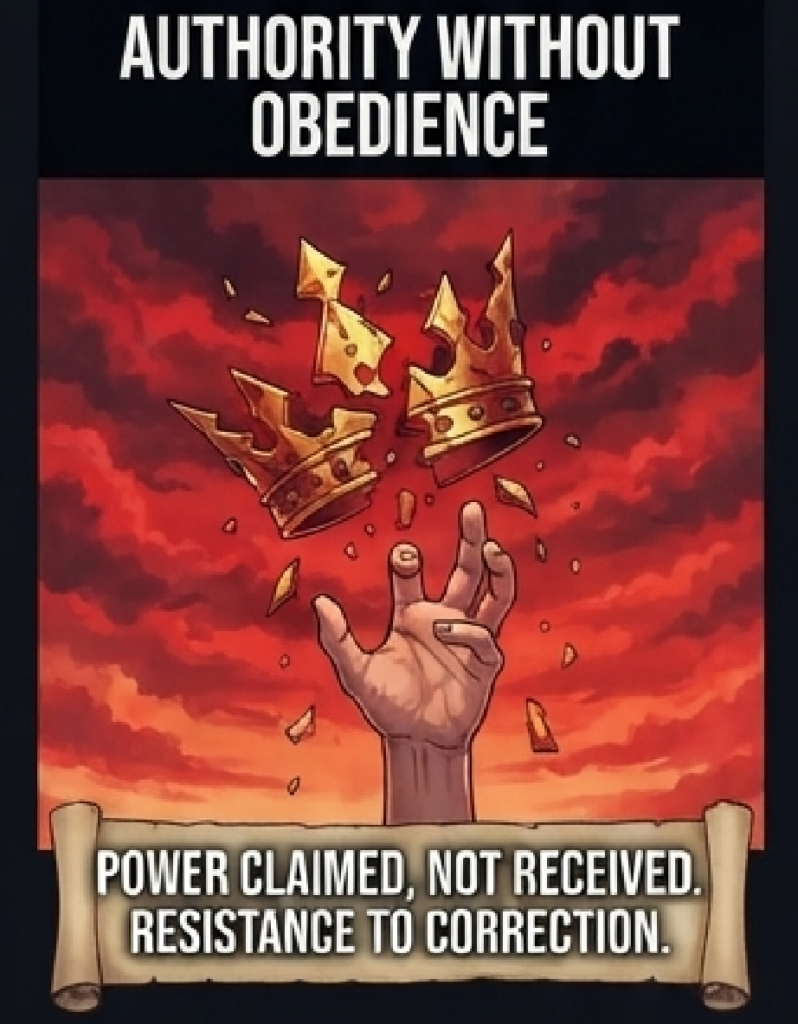
Satan wanted power, position, and influence without submitting to God. This is worth distinguishing carefully from a simple desire for responsibility, which is not itself sinful. The sin is in the without. Lucifer wanted the fruits of authority while refusing its precondition, which is submission to a higher will.
Mary’s obedience is remarkable precisely because it was not blind or automatic; she asks a real question first — “how shall this be done, because I know not man?” (Luke 1:34) — and then submits before the mechanism is explained to her in any further detail. She is given the barest outline of an impossible request and she says yes to the outline. This is the reverse of a very modern instinct: the demand for full comprehension, full control, or a personal veto before cooperating with any authority — a spouse, a pastor, an employer, the Church’s own teaching office. Mary’s fiat models authority received rightly: not surrendered blindly, but not withheld until every term is renegotiated either.
How Does Mary’s Acceptance of the Lowest Place Answer Lucifer’s Grasping for a Throne?
“I will exalt my throne above the stars of God… I will be like the Most High” (Isaiah 14:13–14) is not a request for a share in ministry; it is a bid for the throne itself, on the fallen angel’s own terms and by his own initiative. He did not just want to serve in God’s kingdom; he wanted to replace God.
Mary is, in fact, given a throne. The Church has always confessed her as Queen of Heaven, crowned above every angel, including the one who fell for wanting exactly that crown (CCC, 1997, para. 966). But notice the order of events. The crown comes at the end of a life spent entirely in the lowest places available to her: bringing forth the Saviour in a stable because there was no room at the inn (Luke 2:7), fleeing by night into Egypt as a refugee (Matthew 2:13–14), standing in silence at the foot of a cross where her Son died the death reserved for slaves and criminals (John 19:25). She never once petitioned for the throne. It was given to her by her Son, after a lifetime that looked, by every worldly measure, like its opposite. This is exactly the ordering Christ himself lays down as the law of his kingdom: “whosoever will be first among you, shall be the servant of all” (Mark 10:44).
How Did Mary’s Perfection Stay Humble While Lucifer’s Perfection Corrupted?
Ezekiel’s oracle contains what may be the single most sobering line in the whole tradition on the angelic fall: this being was “perfect in thy ways from the day of thy creation, until iniquity was found in thee” (Ezekiel 28:15). Perfection itself did not save him. Lucifer fell from perfection, not from weakness or lack of ability.
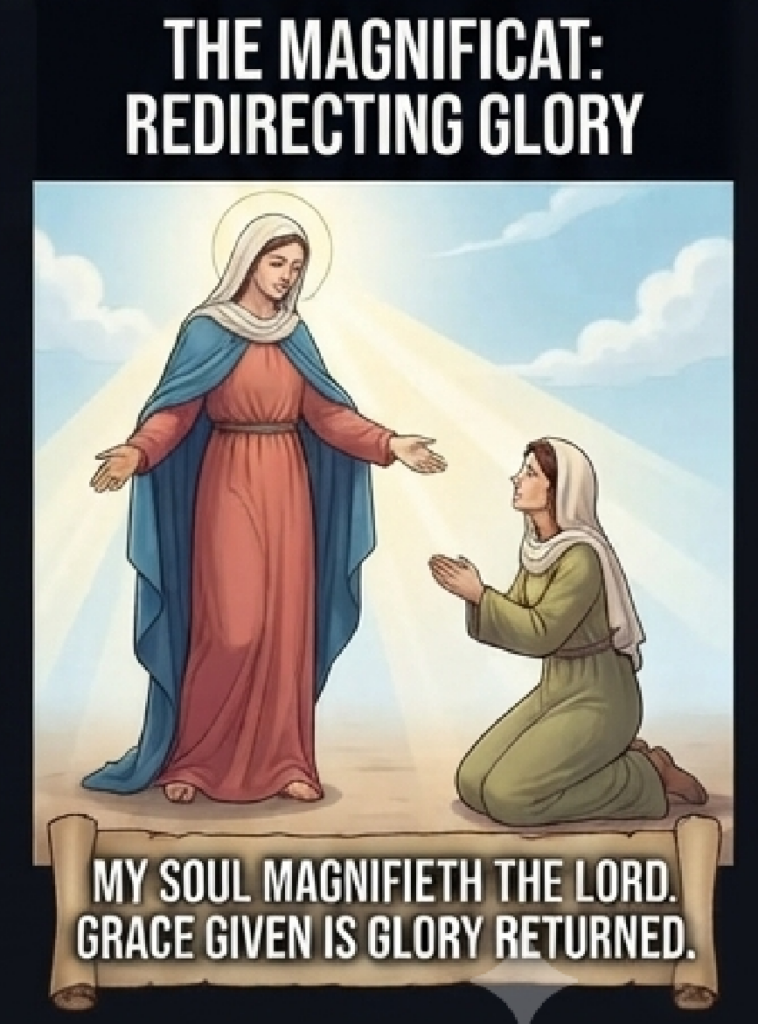
The Church teaches that Mary, too, possessed a created perfection with no rival among human beings — preserved, in the Immaculate Conception, from the stain of original sin from the very first moment of her existence (CCC, 1997, para. 490–493). If perfection alone were dangerous, Mary would have been in more peril than any other human soul who ever lived. And yet nothing in her life shows the faintest trace of vanity, entitlement, or self-regard. Her own explanation of her graces, delivered in the Magnificat, is the clearest possible answer to how this is possible: “He that is mighty hath done great things to me… he hath regarded the humility of his handmaid” (Luke 1:49, 48). The gift is fully acknowledged — she does not pretend to be ordinary — but the glory for it is redirected, in the same breath, to its Giver. That single habitual redirection is the entire difference between Ezekiel’s tragedy and Mary’s Magnificat.
Why Didn’t Mary’s Extraordinary Gifts Become Her Identity the Way Lucifer’s Did?
For Lucifer, his beauty, wisdom, and glory became his identity, and pride became his rights — drawing on Ezekiel’s charge, “thy heart was lifted up because of thy beauty” (Ezekiel 28:17). Gifts, left unchecked, have a way of quietly replacing the giver as the center of one’s self-understanding. A person stops saying “I have been given intelligence” and starts saying, functionally, “I am the intelligent one” — a shift from gratitude to entitlement that can happen without ever being consciously chosen.
Mary is addressed by the angel Gabriel with a title that, on its face, invites exactly this kind of identity-formation: “hail, full of grace” (Luke 1:28). By any measure this is a greater endowment than anything Ezekiel attributes to the king of Tyre. And her identity, expressed in her own words at the Annunciation and repeated throughout the Gospel, remains simply “handmaid” (Luke 1:38, 48) — not “the graced one,” not “the favored one” in any sense that centers herself. Even more tellingly, the very first extended speech Scripture places in her mouth does not describe her at all. Its opening line is not about her: “my soul doth magnify the Lord” (Luke 1:46). Where Lucifer’s gifts became a mirror turned back on himself, Mary’s gifts became, in her own description, a magnifying glass turned toward God.
How Does a Lifetime of Small Fidelities Answer a Sudden and Total Collapse?
Christ’s description of Satan’s fall is instantaneous — “I saw Satan like lightning falling from heaven” (Luke 10:18). What took time to build was destroyed in an instant; rebellion has consequences. There is something almost architectural about the image: a structure built up over an unimaginable span of angelic existence, brought down in the time it takes lightning to strike.
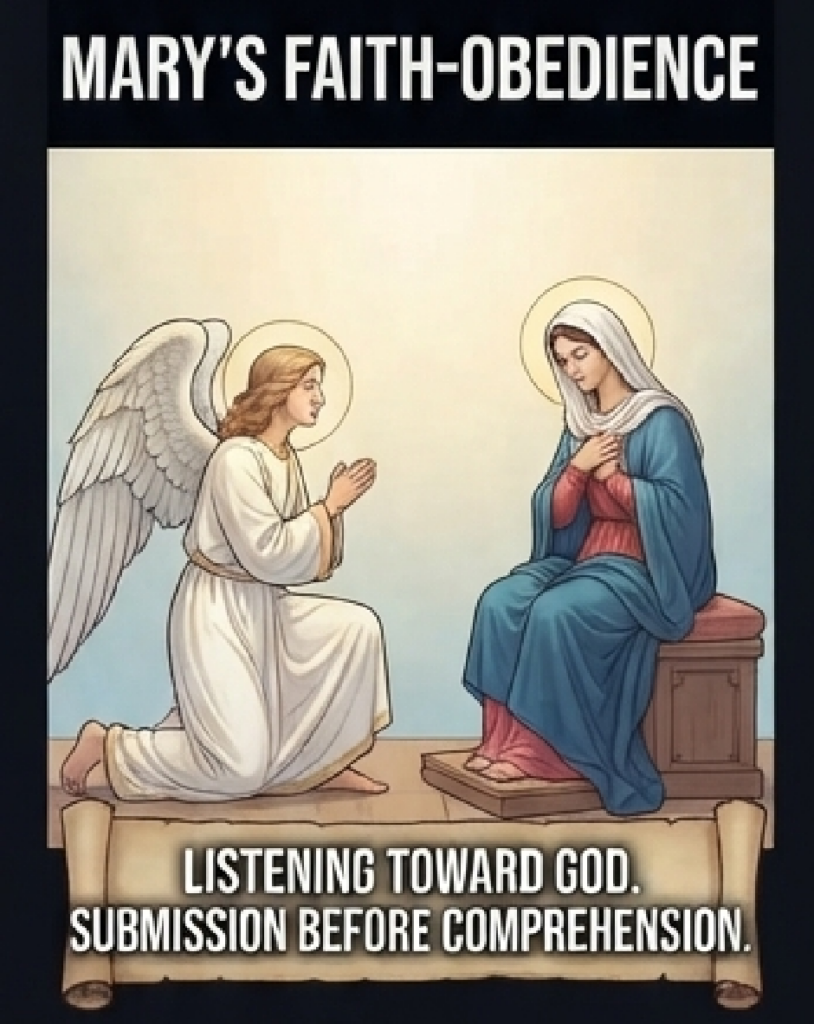
Mary’s fiat, read across the whole of the Gospel, is the structural opposite. It is not a single dramatic yes uttered once at the Annunciation and then left to run on its own momentum.
It is renewed, unglamorously, across decades: through the uncertainty of an unexplained pregnancy, through poverty and homelessness at Bethlehem, through becoming a refugee in Egypt, through three days of searching in anguish for a lost twelve-year-old in Jerusalem (Luke 2:48), through a hidden life about which Scripture says almost nothing at all, and finally through standing — not fleeing — at the foot of the Cross while her Son died (John 19:25).
Each of those moments was itself an opportunity to withdraw the original fiat. She renewed it every time. What made her able to stand at Calvary without collapsing was not a single act of heroism summoned in the moment; it was the accumulated weight of years of ordinary, unrecorded faithfulness.
A house built on that kind of foundation does not fall in an instant, however hard the storm.
How Does Mary’s Docility to Revealed Truth Answer Lucifer’s Rejection of It?
St. John’s diagnosis of the devil’s ongoing character, not merely the moment of his fall, is severe: “he was a murderer from the beginning, and he stood not in the truth… when he speaketh a lie, he speaketh of his own” (John 8:44). Once truth is rejected, chaos, lawlessness, and destruction become the end. Truth, for the fallen angel, becomes something to be edited, evaded, or replaced with self-generated alternatives — “he speaketh of his own.”
Mary’s characteristic posture toward truth she does not yet fully understand is recorded twice by St. Luke, almost as a refrain: after the shepherds’ account of the angels’ announcement, “Mary kept all these words, pondering them in her heart” (Luke 2:19), and again after finding the boy Jesus in the Temple, “his mother kept all these words in her heart” (Luke 2:51). She does not demand that revelation conform itself to her own prior expectations before she will accept it; she receives it, holds it, and lets it slowly disclose its own meaning over time. This is close to the literal root of the word obedience, from the Latin ob-audire, “to listen toward” or “to hear thoroughly” — a receptivity to truth that is the precise reversal of Lucifer’s refusal to stand in it.
What Does This Same Pride Look Like When It Attacks Us at Home and at Work?
None of the preceding is a museum piece. The seven marks traced above describe recognizable patterns in ordinary life, and it is worth naming them plainly rather than leaving them safely abstract.
Self-promotion rarely announces itself as such; it usually looks like an instinct to make sure one’s contribution to a project, a conversation, or a family decision is noticed and credited. Authority without obedience shows up as the quiet conviction that one’s own judgment is the final court of appeal on a moral question the Church has already settled, or as resistance to correction from a spouse, employer, or pastor whenever that correction is unwelcome. Wanting the throne is office politics conducted under the language of “vision” or “leadership,” or a parish council maneuvered less for the good of souls than for the satisfaction of being the one whose ideas prevail.
Perfection turning to corruption is the talented person — the gifted athlete, the sharp student, the naturally charismatic leader — who begins, almost without noticing, to believe that ability earns exemption from the ordinary rules of honesty or kindness that bind everyone else. Gifts becoming identity is the deeper and quieter danger underneath: a sense of self built so completely on looks, achievement, or reputation that any loss of these — illness, failure, simple aging — registers not as a setback but as an identity crisis. A sudden collapse is the marriage, the sobriety, or the practice of faith that looked solid from the outside and unraveled overnight, because it was never actually renewed in the small, unglamorous moments that precede every crisis. And rejection of truth is the increasingly common instinct to speak of “my truth” as though it were interchangeable with the truth — treating an inconvenient teaching as a negotiable opinion rather than something received.
What Does This Same Pride Look Like on a Screen?

Digital life has not invented any new sin, but it has built remarkably efficient machinery for the oldest one. A social media profile is, structurally, an instrument for self-promotion refined to an art the ancient world never had access to — curated, filtered, and quantified in real time by likes and follower counts that function as a kind of running scoreboard for exactly the impulse Isaiah describes: I will ascend, I will be seen, I will be admired.
The same platforms make “authority without obedience” almost frictionless: it is entirely possible to construct an information diet that never once submits to correction, surrounding oneself only with voices that confirm what one already believes and calling the resulting echo “doing my own research.” And the collapse pattern plays out with uncomfortable regularity in public life — a reputation built for years on a curated image, undone in a single news cycle, because the private, unglamorous fidelity behind the public image was never actually there. None of this is a reason to abandon technology; it is a reason to bring the discipline of hidden, unglamorous fidelity — Mary’s discipline — deliberately into a space engineered to reward its opposite.
Do the Scriptures Give Us Real Examples of This Same Pattern Playing Out?
Two Old Testament kings and one apostle offer instructive, and encouraging, variations on the theme, because unlike Lucifer’s fall, theirs were not final.
King Nebuchadnezzar of Babylon, at the height of his power, looked out over his capital and declared, “is not this the great Babylon, which I have built… by the might of my power?” (Daniel 4:27). The echo of Isaiah’s “I will” is unmistakable — the same reflexive claiming of a gift as a private achievement. Scripture records that he was struck with a period of madness as a direct consequence, driven from human company, “till he knew that the most High ruleth in the kingdom of men” (Daniel 4:29). And then, remarkably, the text records his restoration once humility was learned: “at the same time… my reason returned to me… I blessed the most High” (Daniel 4:33). Unlike Lucifer, a human king’s pride, however severe, remained correctable within his lifetime.
King Herod Agrippa provides the darker counter-example. Receiving a crowd’s flattery that he spoke “the voice of a god, and not of a man,” and accepting the praise rather than deflecting it, he was struck down immediately — “because he had not given the honour to God” (Acts 12:22–23). The parallel to Lucifer’s own refusal to refer glory back to its source is exact, and the New Testament records it, deliberately, right alongside the growth of the early Church, as a warning.
And then there is St. Peter, who at the Last Supper insisted, “although all shall be scandalized in thee, I will never be scandalized” (Mark 14:29) — another first-person claim of self-sufficiency, followed within hours by a threefold denial. What distinguishes Peter’s story from Lucifer’s is not that he never fell; it is what he did afterward. Scripture records that he “went out and wept bitterly” (Luke 22:62), and the Church’s tradition holds that his humility in that weeping, not any claim to have never failed, became the foundation of his later strength as the first pope. Pride’s danger is not that it makes failure possible — every human being fails — but that it makes repentance, the one path back, feel unnecessary until it is too late.
What Practical Marian Practices Can Actually Help Us Overcome This Pride?
The Church does not merely diagnose pride and leave the sufferer to figure out a cure. She offers Mary as a concrete, livable pattern, and centuries of Marian spirituality have distilled that pattern into practices any Catholic can begin today.
- Pray a daily “Fiat” offering each morning — a short prayer such as “be it done unto me according to Thy word” — as a direct, repeated counter-formula to the day’s coming temptations to say “I will” instead.
- Practice one deliberately hidden act of service each week: give without mentioning it, help without being credited, in conscious imitation of the thirty hidden years at Nazareth.
- Pray or read the Magnificat (Luke 1:46–55) as a nightly examen, asking honestly where the day’s gifts were quietly claimed for oneself rather than referred back to God.
- Undertake a formal Marian consecration, such as the thirty-three day preparation outlined in Fr. Michael Gaitley’s 33 Days to Morning Glory, which is explicitly structured to form the will in habitual submission to God through Mary (Gaitley, 2010).
- Bring the specific temptation to confession by name rather than a vague “I struggle with pride” — self-promotion, refusal of correction, resentment of authority, envy of another’s gifts — following the pattern of concrete self-examination St. Louis de Montfort commends to those consecrated to Mary (de Montfort, 1985).
- When faith feels shaken by a single dramatic trial, deliberately return to the small, ordinary fidelities — the daily Rosary, Sunday Mass, evening prayer — that Mary practiced for thirty hidden years before Calvary, rather than waiting for one heroic act to restore stability.
- When tempted to “edit” an uncomfortable teaching to fit personal preference, imitate Mary’s posture at the Annunciation: ask the honest question — “how shall this be?” — and then receive the answer rather than negotiating it.
How Can a Daily Examen Rooted in Mary Keep This Pride in Check?
St. Ignatius of Loyola’s examen — a short, structured daily review of conscience — can be adapted directly to the seven marks traced throughout this article, turning an ancient theological framework into a five-minute practice. Each evening, it is worth asking, in order:
- Where today did I seek to be noticed rather than to serve?
- Where did I resist correction or submit only on my own terms?
- Where did I seek influence for its own sake rather than for the good of others?
- Did any gift or success today tempt me toward contempt for someone with less?
- Did I attribute today’s good moments to my own effort, or to God?
- Did I renew my “yes” to God in the small, unnoticed moments, or only in the dramatic ones?
- Where did I hear an uncomfortable truth today, and how did I respond to it?
This is not a scrupulous inventory meant to induce guilt; it is the same instinct behind the Magnificat itself — a daily habit of naming God’s action honestly rather than one’s own. Prayed consistently, even imperfectly, it trains the will in exactly the direction Mary’s fiat points, one ordinary day at a time.
What Is the Final Lesson of Two Falls, One Fiat, and Every Ordinary Day In Between?
Pride exalts itself, and is cast down; humility is exalted, but not by its own effort — by God (Luke 1:52; James 4:6, 10). Lucifer’s entire catastrophe fits inside five short clauses beginning with the same word: I will. Mary’s entire glory fits inside five words that refuse that word completely: “be it done unto me.”
Every reader stands, many times over, in far smaller ways, at the same fork Lucifer and Mary each faced once, definitively, at the origin of their respective stories. The choice rarely announces itself with angelic drama. It shows up as the instinct to take credit, the resistance to being told no, the identity quietly built on a talent rather than on the God who gave it, the faith that was never renewed in the boring middle of an ordinary Tuesday and so was not there when the real test came. The Blessed Mother is not offered to the Church merely as a beautiful example among many. She is proposed, in Scripture and in two thousand years of consistent teaching, as the one creature who most perfectly reversed the angelic sin at its very root — and therefore as the surest, most practical, most imitable guide back to the humility that alone, in the end, withstands it.
References
Aquinas, T. (1920). Summa theologiae (Fathers of the English Dominican Province, Trans.). Benziger Brothers. (Original work published ca. 1265–1274)
Augustine. (1961). Confessions (R. S. Pine-Coffin, Trans.). Penguin Classics. (Original work published ca. 397–400)
Bernard of Clairvaux. (1993). Homilies in praise of the Blessed Virgin Mary (M. B. Say, Trans.). Cistercian Publications. (Original work published ca. 12th century)
Catechism of the Catholic Church (2nd ed.). (1997). United States Catholic Conference.
de Montfort, L. M. G. (1985). True devotion to Mary (F. W. Faber, Trans.). Montfort Publications. (Original work published 1712)
Gaitley, M. E. (2010). 33 days to morning glory: A do-it-yourself retreat in preparation for Marian consecration. Marian Press.
Holy Bible: Douay-Rheims version. (1899). John Murphy Company.
John Paul II. (1987). Redemptoris Mater [Encyclical letter on the Blessed Virgin Mary in the life of the pilgrim Church]. Libreria Editrice Vaticana. https://www.vatican.va/content/john-paul-ii/en/encyclicals/documents/hf_jp-ii_enc_25031987_redemptoris-mater.html
Thérèse of Lisieux. (1996). Story of a soul (J. Clarke, Trans., 3rd ed.). ICS Publications. (Original work published 1898)