What’s in a Name? The Surprising Origins of the Word “Christian”
Most of us have used the word Christian our entire lives without ever pausing to ask where it actually came from. It rolls off the tongue so naturally that it seems like it must have always existed — a timeless label for followers of Jesus Christ. But dig a little deeper, and you discover a fascinating, even surprising story. The word has Greek and Latin roots, it was almost certainly coined by outsiders as a kind of nickname, and for much of the early Church it carried real social stigma. Far from being a badge of honour from the start, “Christian” was closer to a slur — and the early believers chose to wear it with pride anyway.
This article traces that story from first-century Antioch all the way to the rich theological meaning the name carries in Catholic tradition today.
Where Does the Word “Christian” Actually Come From?
The English word “Christian” comes to us through Latin Christianus, which itself comes from the Greek Christianós (Χριστιανός). To understand what that word meant to the people who first heard it, we need to pull it apart into two pieces.
The first part — Christós (Χριστός) — is the Greek word for “anointed one.” It was the word Greek-speaking Jews used to translate the Hebrew māšîaḥ (מָשִׁיחַ), which we know in English as Messiah, the Anointed One. Every time the Old Testament speaks of a king or priest being anointed with oil, the Septuagint (the Greek translation of the Hebrew scriptures) uses the word Christós. So from the very first syllable, “Christian” is soaked in the language of anointing, kingship, and messianic expectation.
The second part — the suffix -ianós — is where things get interesting. This is not a Greek ending at all; it is a Latinism (from Latin -ianus) that Romans used to describe the adherents or household members of a powerful figure. Think of the Hērōdianoi (“Herodians,” followers of Herod; Mark 3:6) or the Caesariani (the household or party of Caesar). When you added -ianus to someone’s name, you were saying: “these are his people.” You were labelling a group as partisans — devoted followers of a particular leader (Horrell, 2007).
Put the two halves together and you get Christianós: “a partisan of the Anointed One” or “one belonging to Christ’s household.” It is, linguistically speaking, a political-style label applied to a religious movement.

Did Early Believers Call Themselves Christians, or Was the Name Given to Them?
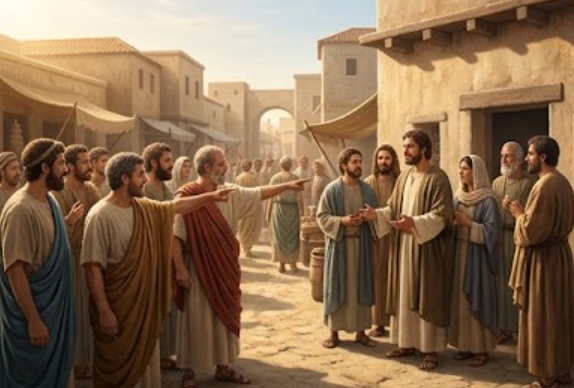
The first time the word “Christian” appears in history is in the Acts of the Apostles: “And in Antioch the disciples were first called Christians” (Acts 11:26). That single sentence has generated centuries of debate. Who did the calling?
The Greek verb used here is chrēmatisai (χρηματίσαι), which can mean to bear a name, to be styled, or even to receive a divine designation. A minority of scholars, most notably Elias Bickerman (1949), have argued that the believers may have named themselves. But the majority scholarly view is that outsiders — most likely pagan inhabitants of Antioch — invented the label (Horrell, 2007).
Several clues point in this direction.
First, the early believers never called themselves “Christians” — they called themselves mathētai (disciples), adelphoi (brothers and sisters), hoi hagioi (the saints), or followers of hē hodos (the Way).
Second, the Latinate -ianos suffix would not have come naturally from Greek-speaking Jewish converts; it smells of Roman or Gentile coinage.
Third, Antioch was a thoroughly cosmopolitan Roman city — exactly the kind of place where local pagans or Roman officials would coin a political-style nickname for a new and puzzling sect.
It is also worth noting the timing. Acts 11:26 places this naming during the year Barnabas and Saul spent teaching in Antioch, around AD 44. By that point the community included not just Jewish believers but Gentiles — it was visibly something new, neither fully Jewish nor pagan, and Antioch’s population apparently needed a name for it (Ferguson, 2003).
Was “Christian” Used as an Insult?
To modern ears, “Christian” is simply a description — neither flattering nor hostile. But in the Roman world, the word carried a sharp social edge.
The -ianos suffix, while not inherently abusive, had a distinctly political flavour. It was the kind of label attached to groups seen as the devotees of a would-be powerful figure — or, more ominously, as household slaves or low-status dependants of a master. Calling someone a “Caesarian” or a “Herodian” implied subordination to an authority figure. Applied to followers of a crucified Jew from the provinces, it would have sounded at best dismissive and at worst sinister.
The Roman writers who mention Christians make this hostility unmistakable. Around AD 116, the historian Tacitus described the community as a group “hated for their abominations” and called their movement an exitiabilis superstitio — a “pernicious superstition.” He noted that Nero had blamed them for the great fire of Rome, and that the originator of the name, Christ, had been executed under Pontius Pilate (Annals, 15.44).
The biographer Suetonius, writing around the same time, described Christians as “a class of men given to a new and mischievous superstition” (Nero, 16.2).
Around AD 112, the Roman governor Pliny the Younger wrote to the Emperor Trajan asking whether it was the nomen ipsum — “the name itself” — that should be punished, or only crimes associated with the name. His letter reveals a chilling reality: in Roman courts, simply admitting to being a Christian could be sufficient grounds for execution, regardless of any other proven wrongdoing (Pliny, Epistulae, 10.96). Being called a Christian, in other words, could get you killed.
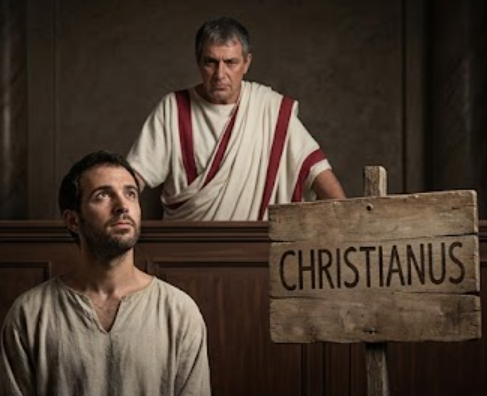
It is also telling that pagan Romans frequently mispronounced the name as Chrestianus (from chrēstós, meaning “useful” or “good”), suggesting they had not the faintest interest in understanding what Christós actually meant. The name was a label for a dangerous foreign cult — nothing more.
How Does the Word Appear in the New Testament — and What Does That Tell Us?
Remarkably, the word “Christian” appears only three times in the entire New Testament, and in each case the context is revealing.
Acts 11:26 — “And in Antioch the disciples were first called Christians.” As discussed above, this is the birth certificate of the name, and the context strongly implies outsiders doing the naming.
Acts 26:28 — King Agrippa, after hearing Paul’s defence, says: “In a short time you think to make me a Christian!” The tone is unmistakably dismissive. Agrippa is not warming to Paul’s argument; he is brushing it off. The word “Christian” here functions as the label an outsider uses with irony or contempt.
1 Peter 4:16 — “Yet if anyone suffers as a Christian, let him not be ashamed, but let him glorify God in this name.” Here the stigma-label is explicitly transvalued: the believer suffers under the contemptuous name yet is told to feel no shame but to glorify God “in this name.”
The New Testament scholar David Horrell (2007) argues that 1 Peter represents a pivotal moment: the early Church is taking a stigma-label — a name imposed by hostile outsiders — and deliberately turning it into a badge of honour. This is not unique in history; oppressed groups throughout time have reclaimed the insults hurled at them and transformed them into sources of pride. The early Christians were doing exactly the same thing.
How Did the Early Church Reclaim and Embrace the Name?
What is extraordinary is the speed and confidence with which the early Church not only accepted the name “Christian” but transformed it into something to glory in.
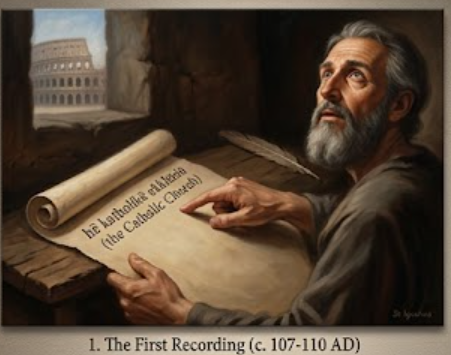
Ignatius of Antioch (c. 35–110 AD) is the first writer to use the abstract noun Christianismos — “Christianity” — as a distinct category of life and identity. Writing his famous letters on his way to martyrdom in Rome, he insists on authenticity over mere labelling: “It is fitting not only to be called a Christian, but to be one in reality” (Letter to the Magnesians, 4). He uses the name “Christian” across five of his letters with no apology or hesitation.

Justin Martyr (c. 100–165 AD) confronted the injustice of prosecuting people for a name directly. In his First Apology, addressed to the Emperor Antoninus Pius, he wrote: “By the mere application of a name, nothing is decided, either good or evil, apart from the actions implied in the name” (First Apology, 4, as cited in Roberts & Donaldson, 1885). He also seized on the pagan mispronunciation — Chrestianus — and turned it into an argument: if they called believers “the good ones,” then surely the name itself testified to the goodness of the movement.
Tertullian (c. 155–220 AD), writing in Carthage, was even more direct. In his Apology, he exposed the absurdity of punishing people for a name: “You hate us for the very name… The Christian glories in his name” (Apology, 3, as cited in Roberts & Donaldson, 1885). He pointed out that Christianus means “anointed one,” derived from Christós, and that even the garbled pagan version — Chrestianus — meant “the useful” or “the good.” Either way, the name convicts them of nothing.
What these writers share is a common move: they accept the name imposed on them, they unpack its meaning, and they find within it a theological treasure. The insult becomes a title.
What Does the Name “Christian” Mean in Catholic Teaching?
Catholic theology takes this reclamation one step further and gives the name a profound sacramental meaning. It is not merely a label — it is an identity conferred by God.
The Catechism of the Catholic Church is explicit:
“The name ‘Christian’… means ‘anointed’ and derives from that of Christ himself whom God ‘anointed with the Holy Spirit'” (CCC, 1289).
At baptism, when a person is anointed with sacred chrism, they receive the name “Christian” in its deepest sense — they are made an anointed one, configured to Christ who is the Anointed One par excellence.
This connects to one of the richest doctrines in Catholic tradition: the threefold office of Christ as priest, prophet, and king. Christ is the great High Priest who offers himself in sacrifice; the supreme Prophet who speaks the Word of God; and the eternal King who reigns over all creation. When you are baptised and anointed, the Catechism teaches, you are drawn into all three of these roles: “By Baptism they share in the priesthood of Christ, in his prophetic and royal mission” (CCC, 1268).

To be called a Christian, then, is to be called an anointed one — a sharer in Christ’s own anointing, mission, and identity. The name that was once hurled as a political insult by Roman pagans has become, in Catholic understanding, a description of the most intimate union possible: to bear the name of Christ because you have been configured to him, anointed as he was anointed, sent as he was sent.
The great fourth-century Church historian Eusebius of Caesarea captured this connection beautifully when he explained that the very title “Christ” encompasses his roles as priest, prophet, and king — and that all who are called by his name share in those roles (Ecclesiastical History, 1.3.2–8). The name is not incidental. It is a vocation.
Conclusion: A Name Turned Inside Out
The story of the word “Christian” is, in miniature, the story of the early Church itself. It began as something imposed from outside — a political-style nickname, coined by pagans in Antioch, carrying the faint whiff of contempt. In Rome’s courts it became something almost criminal: a name that, when confessed, could lead to death. And yet the early believers — Ignatius, Justin, Tertullian, and countless unnamed martyrs — refused to be ashamed of it. They took the insult, turned it inside out, and found at its heart the most magnificent truth: to be a Christian is to be an anointed one, named after the Christ, the Messiah, the Anointed King of all creation.
The next time you say the word “Christian,” you are speaking a word that has survived ridicule, persecution, and empire — and come out the other side shining.
Bibliography
Bickerman, E. J. (1949). The name of Christians. Harvard Theological Review, 42(2), 109–124. https://doi.org/10.1017/S0017816000019039
Catholic Church. (1997). Catechism of the Catholic Church (2nd ed.). Libreria Editrice Vaticana.
Eusebius of Caesarea. (1890). Ecclesiastical history (A. C. McGiffert, Trans.). In P. Schaff & H. Wace (Eds.), Nicene and Post-Nicene Fathers, Second Series, Vol. 1. Christian Literature Publishing. (Original work written c. 313 CE)
Ferguson, E. (2003). Backgrounds of early Christianity (3rd ed.). Eerdmans.
Horrell, D. G. (2007). The label Χριστιανός: 1 Peter 4.16 and the formation of Christian identity. Journal of Biblical Literature, 126(2), 361–381. https://doi.org/10.2307/27638448
Hurtado, L. W. (2016). Destroyer of the gods: Early Christian distinctiveness in the Roman world. Baylor University Press.
Ignatius of Antioch. (1885). The epistle of Ignatius to the Magnesians (A. Roberts & J. Donaldson, Trans.). In A. Roberts & J. Donaldson (Eds.), Ante-Nicene Fathers, Vol. 1. Christian Literature Publishing. (Original work written c. 107 CE)
Justin Martyr. (1885). The first apology of Justin (A. Roberts & J. Donaldson, Trans.). In A. Roberts & J. Donaldson (Eds.), Ante-Nicene Fathers, Vol. 1. Christian Literature Publishing. (Original work written c. 155 CE)
Meeks, W. A. (2003). The first urban Christians: The social world of the apostle Paul (2nd ed.). Yale University Press.
Pliny the Younger. (1969). Letters and Panegyricus, Vol. 2 (B. Radice, Trans.). Harvard University Press (Loeb Classical Library). (Original work written c. 112 CE)
Roberts, A., & Donaldson, J. (Eds.). (1885). Ante-Nicene Fathers, Vol. 1: The apostolic fathers, Justin Martyr, Irenaeus. Christian Literature Publishing.
Sherwin-White, A. N. (1966). The letters of Pliny: A historical and social commentary. Oxford University Press.
Suetonius. (1914). The lives of the twelve Caesars (J. C. Rolfe, Trans.). Harvard University Press (Loeb Classical Library). (Original work written c. 121 CE)
Tacitus. (1937). Annals (J. Jackson, Trans.). Harvard University Press (Loeb Classical Library). (Original work written c. 116 CE)
Wright, N. T. (2013). Paul and the faithfulness of God. Fortress Press.
1