Why Was Communion in the Hand Forbidden — and Why Was It Restored? A History of the Reception of Holy Communion
The manner in which the faithful receive the Most Holy Eucharist is among the most reverent, contested, and historically rich topics in Catholic liturgical theology. The story is, at its heart, a story of human weakness and ecclesial wisdom: a practice that flourished in the apostolic and patristic era was ultimately suppressed not because of widespread abuses — profanation, theft of the sacred Host, irreverence, and heretical misuse — rendered its continuation pastorally indefensible. For over a millennium, the Church’s answer was unambiguous: the tongue, not the hand.
This article traces that full arc — and then confronts the painful history of the twentieth century, in which hand reception returned not through organic development or conciliar mandate, but through organised disobedience in northern European dioceses. The resulting papal indult of 1969, granted reluctantly by Pope Paul VI against the wishes of a majority of the world’s bishops, was an accommodation of a fait accompli, not an affirmation that the practice was superior or even equal. The governing norm — reception on the tongue — was never abrogated. Understanding this history is essential for every Catholic who desires to approach the Most Blessed Sacrament with the reverence it deserves.
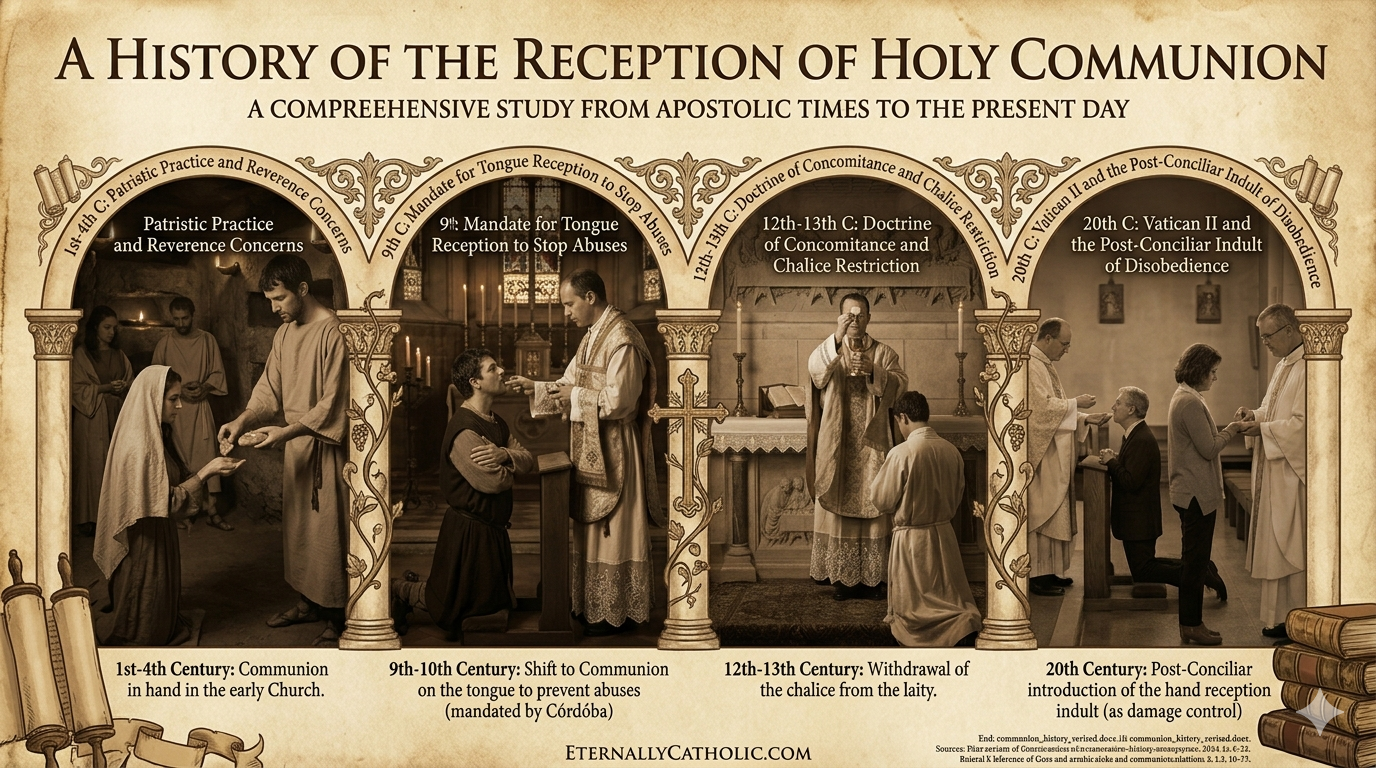
Historical Timeline at a Glance
| Period | Practice | Key Authority |
|---|---|---|
| 1st–4th Century | Communion in the hand; both species; reception standing | Didache; St. Justin Martyr; Tertullian |
| 4th Century | Detailed hand reception rites; both forms standard — but growing reverence concerns emerge | St. Cyril of Jerusalem (c. 350 AD) |
| 5th–7th Century | Mounting abuses prompt first conciliar restrictions; tongue reception introduced as remedy | Council of Rouen (650 AD); Pope St. Gregory I |
| 9th Century | Council of Córdoba mandates tongue reception — hand reception effectively outlawed in the West | Council of Córdoba (839 AD) |
| 12th–13th Century | Chalice withdrawn from laity; doctrine of concomitance clarified | Fourth Lateran Council (1215); St. Thomas Aquinas |
| 15th–16th Century | Hussite/Protestant demands for both kinds rejected; Tridentine norms codified | Council of Constance (1415); Council of Trent (1562) |
| 20th Century | Vatican II opens chalice to laity; hand reception spreads illicitly in northern Europe | Sacrosanctum Concilium (1963); Memoriale Domini (1969) |
| 1970s–Present | Reluctant indult granted due to widespread disobedience; tongue reception remains the norm | GIRM (2002); various episcopal conferences |
Part One: What Did the Early Church Actually Do?
The Apostolic and Patristic Era (1st–4th Centuries)
What does Scripture itself indicate about Eucharistic reception?
The celebration of the Lord’s Supper traces its origin to the Upper Room, where Our Lord took bread, broke it, and gave it to His disciples with the words: “Take and eat; this is my body” (Matthew 26:26). He then passed the cup, commanding: “Drink from it, all of you” (Matthew 26:27). Both the giving of the bread and the sharing of the cup were integral to the institution narrative, and this twofold form — bread and wine, Body and Blood — characterised the primitive Eucharistic rite from its inception.
The Acts of the Apostles records the earliest Christians gathering on the first day of the week for “the breaking of the bread” (Acts 20:7; cf. Acts 2:42), a phrase widely understood by the Fathers as a reference to the Eucharist. In these emerging gatherings — often in private homes, catacombs, and later purpose-built basilicas — the manner of reception was shaped by Jewish table customs, apostolic instruction, and the eschatological urgency of a persecuted community.
What is the earliest documentary evidence for Communion in the hand?
The Didache (“Teaching of the Twelve Apostles”), composed in Syria between approximately 50 and 120 AD, provides the first extended treatment of the Eucharist outside the New Testament. While the Didache does not specify the precise physical manner of reception, its eucharistic prayers reveal that both the cup and the broken bread were central to the liturgy. The instruction in Didache 9:5, “Let no one eat or drink of your Eucharist except those baptised in the name of the Lord,” implies that the reception of both elements was the ordinary expectation for the baptised faithful.
St. Justin Martyr (c. 100–165 AD), writing his First Apology to Emperor Antoninus Pius around 155 AD, provides the earliest explicit description of the Sunday Eucharistic assembly and the distribution of Communion:
“When the president has given thanks and all the people have expressed their assent, those who are called by us deacons give to each of those present to partake of the bread and wine mixed with water over which the thanksgiving was pronounced, and they carry it away to those who are absent.”
— St. Justin Martyr, First Apology, c. 67 (c. 155 AD)
Justin specifies that both elements were distributed to all present. He makes no mention of any restriction on the faithful’s reception of the cup. The context and subsequent documentation overwhelmingly favour hand reception as the primitive norm.
Tertullian of Carthage (c. 160–220 AD) and St. Cyprian of Carthage (d. 258 AD) similarly presuppose a community in which both hand reception and the chalice were standard. Tertullian refers to the faithful carrying the Eucharist home from the Sunday liturgy — a practice requiring hand reception — as entirely uncontroversial. Cyprian’s De Lapsis vividly describes both forms being received by the faithful, including small children.
How did St. Cyril of Jerusalem describe hand reception — and what did he say about reverence?
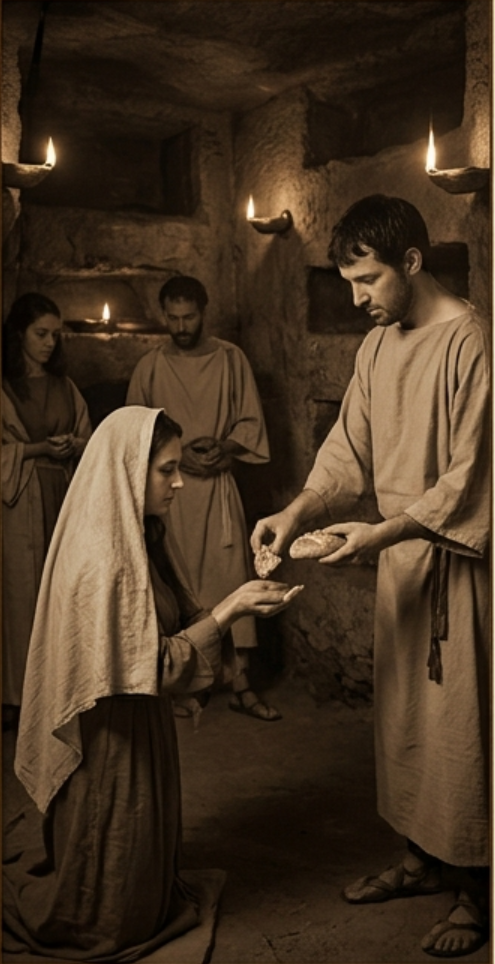
The most celebrated patristic account of Communion in the hand comes from St. Cyril of Jerusalem (c. 313–386 AD) in his Mystagogical Catecheses, delivered around 350 AD. His instructions are critically important — not only for what they say about the practice, but for the extraordinary emphasis they place on reverence and the avoidance of any loss of sacred particles:
“When you come forward, do not come with your wrists extended or your fingers spread, but make your left hand into a throne for the right, since it is about to receive the King. Cup your receiving hand, take the Body of Christ, and say ‘Amen.’ Then carefully sanctify your eyes by touching them with the holy Body, being careful not to drop any of it. For if you lose any of it, it is as if you lost one of your own limbs. Tell me, if anyone had given you gold-dust, would you not hold it with the greatest care for fear of losing any of it?”
— St. Cyril of Jerusalem, Fifth Mystagogical Catechesis, c. 22 (c. 350 AD)
This passage is critically instructive for the honest historian. Cyril is already concerned — in the fourth century, during a period of hand reception — about the loss of sacred particles. The very rationale he articulates for extreme care (the analogy of gold-dust, the identification of a dropped particle with the loss of a limb) would, within a few generations, be cited as the principal reason to abandon hand reception altogether. The patristic tradition surrounded hand reception with an atmosphere of the deepest awe. The tragedy of subsequent centuries is precisely that this awe proved impossible to maintain universally.
Cyril’s instructions for the reception of the Precious Blood are equally detailed: communicants were to bow the head and receive without extending the hands — a separate and reverent posture for the chalice, offered to all the faithful.
What did Sts. Basil, John Chrysostom, and other Fathers contribute to this history?
St. Basil of Caesarea (330–379 AD), in his Epistle 93, confirms that lay self-communication in the hand was a recognised practice in persecution contexts and among desert hermits. St. John Chrysostom (347–407 AD), preaching on the Eucharist, presupposes hand reception among his flock while simultaneously lamenting the carelessness with which many approach the Lord’s Table:
“I say these things to you who receive and to those who minister to you; for it is necessary to address both the recipients and the distributors.”
— St. John Chrysostom, Homily 82 on Matthew’s Gospel
This emphasis on reverence — found in Chrysostom, Ambrose, and Augustine alike — reflects a sacramental consciousness that was deepening precisely in this era. The Fathers who document hand reception most fully are also the Fathers who most urgently demand that it be accompanied by scrupulous care. Their urgent warnings anticipate, and help explain, what came next.
Part Two: Why Did the Church Forbid Communion in the Hand?
The Transition to Tongue Reception (5th–10th Centuries)
Was the suppression of hand reception an arbitrary innovation, or was it a response to real abuses?
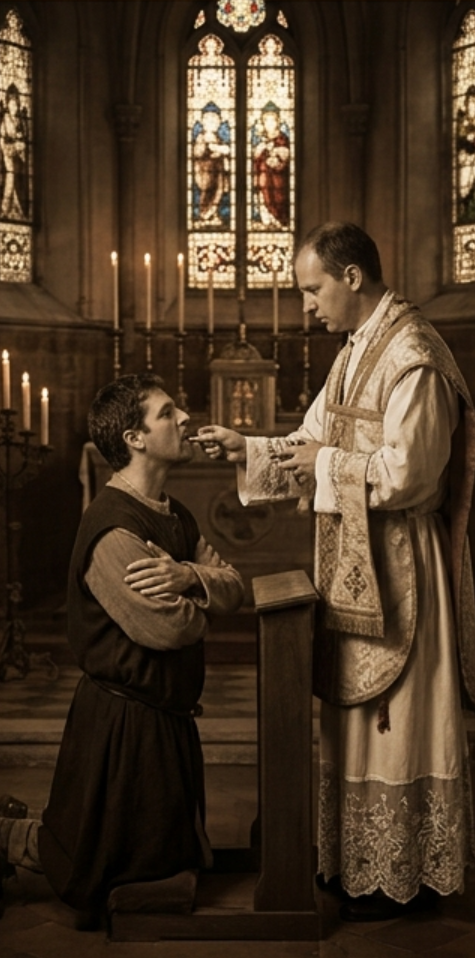
The transition from hand reception to tongue reception was not the result of arbitrary clericalism or theological speculation divorced from pastoral reality. It was a direct and deliberate response to documented and serious abuses. Historians identify a convergence of causes, all rooted in the failure of the faithful to maintain the reverence that the patristic teachers had demanded:
- Profanation: Sacred particles were being dropped, lost, and trodden underfoot.
- Theft: Individuals were concealing the Host and removing it from church, either for superstitious private use, for magical practices, or for acts of deliberate sacrilege.
- Heretical misuse: Gnostic and Manichaean sects were obtaining the Eucharist under false pretences to use in their own rites.
- Irreverence: The casual or careless manner in which many of the faithful handled the consecrated Host at home and in transit gave scandal and reflected poorly on Eucharistic faith.
These were not theoretical concerns. They were documented realities that forced the hand of the bishops and councils. The deeply reverential instructions of Cyril and Basil had not, in practice, been sufficient to prevent abuses across a geographically sprawling and often poorly catechised Church. The move to tongue reception was the Church’s considered response: if the faithful could not reliably handle the Body of Christ with adequate reverence, then the faithful should not handle it at all.
What specific councils and decrees outlawed hand reception, and when?
The first conciliar legislation restricting hand reception appears in the fifth and sixth centuries. The Council of Saragossa in Spain (380 AD) condemned those who did not consume the Eucharist immediately on reception — already signalling that the home removal of the Host was becoming an abuse, not merely a discipline.
The pivotal decree is that of the Council of Rouen in France (650 AD), which states plainly:
“Do not put the Eucharist in the hands of any layman or laywoman, but only in their mouths.”
— Council of Rouen, 650 AD
This is the first explicit conciliar mandate of tongue reception. It applies directly to the laity (the hand remaining appropriate for the ordained). The Council of Toledo III (589 AD) and the Council of Mâcon (585 AD) similarly addressed Eucharistic discipline, focusing on reverence and the prevention of the specific abuses that had made hand reception untenable.
By the ninth century, the practice of tongue reception had become sufficiently universal in the West that the Council of Córdoba (839 AD) could mandate it for its entire jurisdiction — effectively concluding what the earlier councils had begun. Hand reception for the laity was now not simply discouraged but outlawed in the Western Church. The Eastern Churches developed their own solutions (the holy spoon or labida in the Byzantine rite), but arrived at the same underlying conclusion: the faithful should not directly handle the sacred species.
How did the theology of priestly ordination reinforce this prohibition?
A critical theological development that accompanied and reinforced the shift to tongue reception was the growing emphasis on the anointed hands of the priest as specially consecrated for the handling of sacred things. The rite of priestly ordination in the Western church had, from at least the ninth century, included the anointing of the priest’s hands — the “chrismation” of the hands — as a visible and theologically laden sign that the ordained minister’s hands were uniquely set apart for the touching of the sacred Body of Christ.
This theology, articulated systematically by the Scholastic theologians of the twelfth and thirteenth centuries, created a sharp and logical theological distinction: if the priest’s hands were sacred precisely because they were to touch the Body of Christ, then the unanointed hands of the laity should not perform the same action. This argument, powerful in its internal coherence, became one of the principal theological rationales for tongue reception as the exclusive norm — and it has never been refuted, only set aside.
What role did the theology of the Real Presence play in this transition?
The increasingly elaborate and precise theology of the Eucharist that developed in the West from the fourth century onward — shaped decisively by the thought of St. Ambrose of Milan — elevated the faithful’s sense of the overwhelming holiness of the sacred species. The Carolingian theological controversies of the ninth century — above all the Eucharistic debates between Paschasius Radbertus and Ratramnus of Corbie — dramatically intensified clerical and popular attention to the mode of Christ’s presence in the Eucharist.
Paschasius’s strongly realist understanding — that the consecrated bread and wine are truly, physically, the Body born of the Virgin and the Blood shed on Calvary — fostered a climate of overwhelming awe before the sacred species. In this theological climate, the direct handling of the Host by unconsecrated hands came to seem not merely imprudent but almost unthinkable. The suppression of hand reception was thus not a retreat from Eucharistic faith but an expression of it: precisely because the Real Presence was so keenly believed, every precaution must be taken.
Part Three: Why Was the Chalice Withdrawn from the Laity?
Reception of One Kind (12th–16th Centuries)
What led the Church to restrict the chalice to the clergy alone?
While the transition from hand to tongue reception was gradual and largely organic, the withdrawal of the chalice from the lay faithful was a more deliberate canonical and theological development concentrated in the twelfth and thirteenth centuries. Several practical factors had already reduced the frequency with which the chalice was offered at ordinary Masses: the logistics of a large congregation sharing a single chalice, the risk of spilling the Precious Blood, the length of the communion rite, and the growing practice of infrequent lay reception (the Fourth Lateran Council in 1215 was forced to mandate annual reception as a bare minimum).
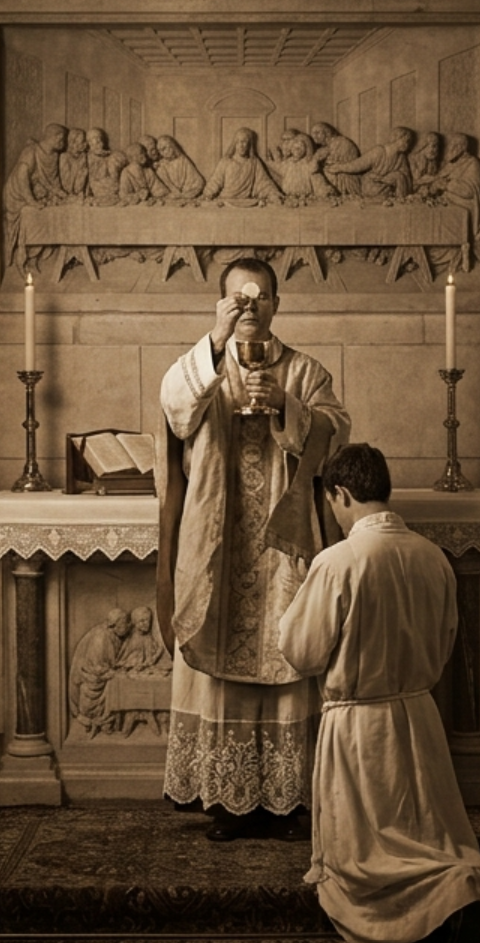
The principal theological justification was the doctrine of concomitance: the whole Christ — Body, Blood, Soul, and Divinity — is fully present under each of the two species. Reception of the Host alone therefore constitutes complete sacramental reception of the whole Christ. This doctrine, rooted in patristic reflection, was systematised above all by St. Thomas Aquinas (1225–1274 AD) in the Summa Theologiae (ST III, Q. 80). St Thomas teaches that the priest alone must receive both species at Mass because it is his ministerial duty to complete the sacrifice in all its ritual integrity. For the laity, reception of the Host alone is sacramentally sufficient.
How did the Hussite controversy clarify the Church’s teaching on this matter?
The most dramatic challenge to communion under one kind came from the Hussite movement in Bohemia, inspired by the reforming preacher Jan Hus (c. 1369–1415 AD) and his followers. The Hussites championed the return of the chalice to the laity — a practice they called utraquism — and made it a central element of their theological programme. They argued from John 6:53 (“Unless you eat the flesh of the Son of Man and drink his blood, you have no life in you”) and Matthew 26:27 (“Drink from it, all of you”) that the Church had no authority to withhold the cup from the faithful.
The response of the Council of Constance (1415) to the Hussite demands was decisive and negative:
Council of Constance (1415) — Key Definition: “…although in the primitive church this sacrament was received by the faithful under both kinds, yet this custom has been reasonably introduced, for the avoidance of some dangers and scandals, that it be received by the celebrants under both kinds but by the laity only under the kind of bread; since it is most firmly to be believed, and in no wise doubted, that the whole body and blood of Christ is truly contained as much under the form of bread as under the form of wine.”
The Council of Trent (1545–1563) confirmed this teaching definitively in its twenty-first session (1562), responding to Protestant demands for the chalice. Trent decreed: (1) the Church has authority to establish discipline around sacramental reception; (2) the whole Christ is received under either species by virtue of concomitance; (3) those who communicate only under the form of bread are not defrauded of any grace necessary for salvation. The Tridentine settlement — tongue reception, one kind for the laity, kneeling posture, reception from the priest’s hand alone — remained the universal norm of the Western Church for the next four hundred years.
Part Four: How Did Hand Reception Return in the Twentieth Century?
The Second Vatican Council and the Post-Conciliar Crisis
Did the Second Vatican Council authorise Communion in the hand?
This is perhaps the most important question for the contemporary Catholic to answer honestly: No. The Second Vatican Council did not authorise Communion in the hand. This point cannot be overstated, because it is frequently misrepresented.
The Constitution on the Sacred Liturgy, Sacrosanctum Concilium (SC), promulgated on 4 December 1963, was the first document issued by the Council. It restored the chalice to the laity in specific, limited circumstances (Masses of ordination, religious profession, and baptism — see Article 55), but it said nothing whatsoever about the manner of receiving the Host. The universal norm of tongue reception was not touched by any conciliar document.
The restoration of the option to receive Communion in the hand did not emerge from the Council. It emerged, in the late 1960s, from organised disobedience.
How exactly did hand reception spread in the twentieth century — was it through legitimate reform?
In the years immediately following the Council, in several northern European countries — notably the Netherlands, Belgium, Germany, and France — the practice of receiving Communion in the hand began to spread. It did so without prior authorisation from Rome, without the approval of the Holy See, and in explicit violation of existing liturgical law. Bishops and priests, carried along by a spirit of self-styled renewal, simply began allowing it, presenting it as a “restoration” of the apostolic practice witnessed in Cyril and Chrysostom.
This framing was, to say the least, selective. It ignored the reasons why the Church had suppressed hand reception in the first place — the centuries of documented abuses that had made it necessary. It also ignored the fact that the Church’s own living authority, not historical precedent alone, determines what is normative for the faithful. The practice spread not because Rome had judged it appropriate, but because ecclesiastical discipline in parts of northern Europe had broken down.
What did Pope Paul VI actually teach about this — and what did the world’s bishops say?
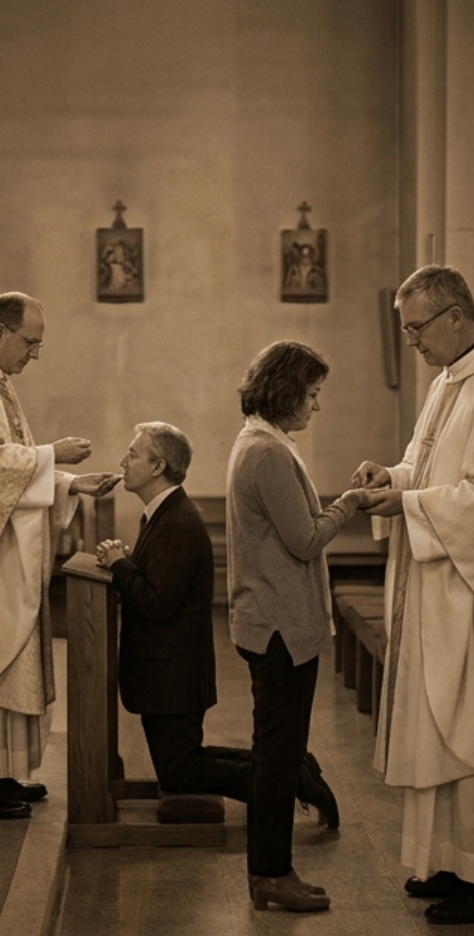
Pope Paul VI was aware of the arguments in favour of hand reception and took them seriously. He was also deeply aware of the pastoral and doctrinal risks. In 1968, he convened a formal consultation of the world’s bishops on the question. The response was unambiguous: a majority of the bishops consulted — 1,233 opposed to only 567 in favour — opposed the introduction of hand reception, citing concerns about reverence, the risk of the Host being taken away and desecrated, and the danger of breaking with the centuries-long tradition.
Responding to this consultation, Pope Paul VI issued the instruction Memoriale Domini (“Memorial of the Lord”) on 29 May 1969. The document is unambiguous about which practice the Church regards as normative:
“The practice of placing communion on the tongue of the communicants must be retained, not only because it rests on a venerable tradition of many centuries but especially because it expresses the faithful’s reverence for the Eucharist. The custom does not detract in any way from the personal dignity of those who approach this great sacrament: it is part of that preparation that is needed for the most fruitful reception of the Body of the Lord.”
— Memoriale Domini, Pope Paul VI (1969)
The Pope was confirming, not overturning, the norm of tongue reception. He was also, implicitly, identifying hand reception with a lesser degree of reverence — not as a matter of dogma, but as a matter of pastoral reality.
If tongue reception was reaffirmed, why was hand reception permitted at all?
Here is the critical point that Catholic apologists and faithful alike must understand: the indult permitting hand reception was granted as an accommodation of disobedience already entrenched, not as an affirmation that the practice was equal or superior. In the same document (Memoriale Domini), Pope Paul VI granted an indult to episcopal conferences where hand reception had already become widespread — provided certain conditions were met:
- The faithful must receive catechetical formation about the equal dignity of both methods.
- Special care must be taken against desecration of the Host.
- The practice must be introduced with proper pastoral preparation.
The indult mechanism was an act of pastoral governance, not doctrinal endorsement. It preserved the normative status of tongue reception while acknowledging, regrettably, the pastoral reality on the ground. To grant the indult was the lesser of two evils: a continued unregulated and illicit practice, or a regulated but non-normative option. The Pope chose the latter as a practical measure, not as a positive affirmation that hand reception was good, desirable, or conducive to Eucharistic faith.
Key Fact: The indult for Communion in the hand was granted because of disobedience, not because of the practice’s merit. A majority of the world’s bishops had voted against it. Pope Paul VI himself reaffirmed tongue reception as the norm. The indult was damage control, not liturgical reform.
How did lay reception of the chalice develop separately in the post-conciliar period?
The restoration of the chalice to the ordinary faithful proceeded through a legitimate legislative process, unlike the irregular spread of hand reception. The General Instruction of the Roman Missal (GIRM), first issued in 1969 and subsequently revised in 1975, 2000, and 2002, progressively expanded the circumstances under which both species could be offered to the laity.
The 2002 GIRM (the currently normative text) allows episcopal conferences to determine the manner of distributing both species, and lists numerous occasions on which both kinds are offered as a matter of course. Article 281 notes: “Holy Communion has a fuller form as a sign when it takes place under both kinds. For in that form the sign of the Eucharistic banquet is more clearly evident.” This does not mean that Communion under one kind is incomplete or defective — the doctrine of concomitance ensures the whole Christ is received — but that the liturgical sign is enriched by the use of both species.
Part Five: What Does the Church Teach Today — and What Does Genuine Reverence Require?
Theological Reflections and Contemporary Norms
What is the actual current teaching of the Church on how to receive Communion?
The current discipline of the Latin Church, as expressed in the General Instruction of the Roman Missal (2002/2010) and subsequent documents, is as follows:
Reception of the Host: The normative method remains reception on the tongue from a priest, deacon, or authorised extraordinary minister. In countries where the episcopal conference has received the indult, the faithful may choose to receive in the hand. The communicant’s stated choice must be respected by the minister. The Host must be consumed immediately and not carried away.
Posture: In the ordinary form of the Roman Rite, communicants typically stand to receive, bowing profoundly before reception as a gesture of reverence (GIRM 160). Kneeling remains permissible at any time and must never be refused. In the extraordinary form (the Traditional Latin Mass), Communion is received kneeling at the altar rail on the tongue.
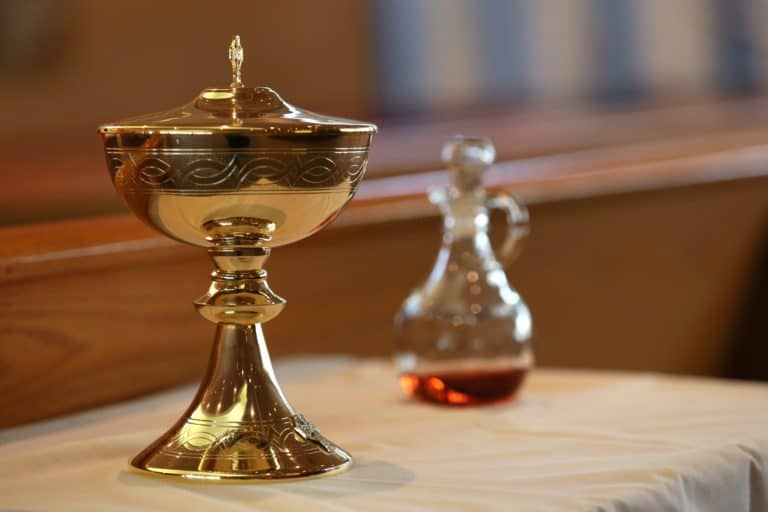
Reception of the Chalice: Where both kinds are offered, the faithful may receive from the chalice by drinking directly, or by intinction administered by the minister. Self-intinction by the communicant is not permitted in the Latin Rite. Reception by spoon is the norm in most Eastern rites.
What did Pope Benedict XVI teach and demonstrate about Eucharistic reverence?
Pope Benedict XVI’s personal practice and magisterial teaching on this subject deserve particular attention, because they represent the most recent and authoritative papal statement on the theology of Eucharistic reception. In his Apostolic Exhortation Sacramentum Caritatis (“Sacrament of Love”, 2007) and Motu Proprio Summorum Pontificum (2007), Pope Benedict significantly reshaped the contemporary Eucharistic landscape.
In his own papal Masses, he regularly distributed Communion only on the tongue to kneeling communicants — a practice he maintained consistently throughout his pontificate. He did not merely tolerate this as a personal preference; he articulated its theological rationale in Sacramentum Caritatis, noting that “kneeling before the Eucharist is… an act of adoration” and that the postures and gestures of Eucharistic reception form an important part of the Church’s mystagogical education in the faith.
By kneeling communicants before him and placing the Host on the tongue, he visually enacted a theology: the Lord bends down to feed His people; the people adore the divine majesty they receive. This is not mere aesthetics. It is doctrine made visible.
What does the abuse history reveal about the risks of hand reception today?
The history of abuses that originally prompted the Church to forbid hand reception has not become less relevant with the passage of time. If anything, the concerns documented in the patristic and early medieval period are magnified in the contemporary context:
- Eucharistic desecration has increased dramatically in the post-conciliar period. Documented cases of satanic groups obtaining the Host for use in black masses have proliferated worldwide.
- The casual cultural atmosphere of the contemporary West makes the kind of scrupulous reverence demanded by Cyril (“if you lose any of it, it is as if you lost one of your own limbs”) effectively impossible to catechise universally.
- The drop in Eucharistic belief among Catholics in the post-conciliar decades coincides historically with the widespread adoption of hand reception, though correlation does not establish causation.
- The practical reality of how hand reception is exercised in most parishes today — casually, without the left-hand throne, without touching the Host to the eyes, without any of the patristic reverence — bears no resemblance to what Cyril described.
These realities do not establish that hand reception is intrinsically sinful or that it cannot be performed with genuine reverence. But they do establish that the pastoral concerns which led the Church to forbid hand reception in the seventh century are at least as serious today as they were then — and that the indult, granted as damage control in 1969, has not resolved those concerns.
What does this history ask of the faithful Catholic today?
This history calls the faithful Catholic to several concrete responses:
- A renewed commitment to receiving on the tongue as the normative and historically preferred manner, recognising that the indult for hand reception was a concession, not a commendation.
- A recovery of the practice of kneeling for Holy Communion wherever possible, particularly at the Traditional Latin Mass.
- Renewed catechesis on the Real Presence and on the theological reasons for the Church’s centuries-long insistence on tongue reception.
- Vigilance against the casual and irreverent manner of hand reception that has become culturally normalised but is entirely at odds with the patristic tradition from which the practice nominally draws its authority.
- A spirit of reparation for the many desecrations — deliberate and inadvertent — that have accompanied the spread of the practice in the post-conciliar period.
The Church’s supreme norm in this area has never changed. It was stated by St. Cyril in the fourth century, repeated by councils across fifteen centuries, reaffirmed by Pope Paul VI in 1969, and embodied in the practice of Pope Benedict XVI: the Body of the Lord deserves the utmost reverence, and every gesture, posture, and practice of reception should express that reverence without ambiguity or exception.
Conclusion: What Does This History Ultimately Reveal?
The history of the reception of Holy Communion is, at its deepest level, a history of the Church’s enduring effort to do justice to an inexhaustible mystery — and to protect the faithful from their own tendencies toward carelessness. The cupped hands of St. Cyril’s neophytes, the opened mouths of medieval communicants kneeling at the altar rail, the shared chalice of the primitive communities, the single Host given by the priest’s anointed fingers in the age of Trent: each of these has been, in its own historical moment, an authentic expression of the Church’s faith.
But the twentieth-century return of hand reception cannot be placed in this same narrative of organic development. It was not a recovery of a lost treasure. It was the regularisation, under pastoral duress, of a practice that had spread through disobedience — a practice that the world’s bishops had, by majority vote, asked the Pope not to permit. The indult granted by Paul VI was an act of pastoral mercy toward those already engaged in the practice, accompanied by a clear reiteration that tongue reception remained the norm.
For the faithful Catholic in the pew, this history offers a clear pastoral direction. The Church’s centuries-long judgment — confirmed by councils, popes, and the weight of patristic and theological tradition — is that tongue reception best expresses the reverence due to the Most Blessed Sacrament. The option to receive in the hand exists; it is not sinful to use it. But it is not what the Church recommends, it is not what her history commends, and it is not what the full weight of her theological tradition supports.
The Eucharist is the Body and Blood of the eternal Son of God. How the faithful receive it is not a matter of mere preference or cultural comfort. It is a matter of faith made visible — and the Church’s tradition speaks with one voice about what that faith requires.
References
[1] Didache (The Teaching of the Twelve Apostles), c. 50–120 AD. Critical edition: Kirsopp Lake, trans., The Apostolic Fathers, Loeb Classical Library, 1912.
[2] Justin Martyr, First Apology, c. 66–67. Text in ANF I (Ante-Nicene Fathers), ed. Alexander Roberts and James Donaldson, 1885.
[3] Tertullian, De Oratione (On Prayer), XIX; Ad Uxorem (To His Wife), II.5; De Corona (The Crown), III. ANF III.
[4] Cyprian of Carthage, De Lapsis (On the Lapsed), XXII; Epistle LXIII (To Caecilius). ANF V.
[5] Cyril of Jerusalem, Mystagogical Catecheses, V, 21–22. Text in NPNF Series II, Vol. VII.
[6] John Chrysostom, Homilies on 1 Corinthians, Homily XXIV; Homilies on Matthew, Homily LXXXII. NPNF Series I, Vol. X.
[7] Basil of Caesarea, Epistola XCIII (To Caesaria). NPNF Series II, Vol. VIII.
[8] Council of Rouen, 650 AD; Council of Córdoba, 839 AD. Text in Mansi, Sacrorum Conciliorum Nova et Amplissima Collectio.
[9] Thomas Aquinas, Summa Theologiae, III, Q. 80, aa. 1–12. Translated by Fathers of the English Dominican Province, 1920.
[10] Council of Constance, Session XIII, 15 June 1415. Text in Tanner, ed., Decrees of the Ecumenical Councils, Vol. I. Georgetown UP, 1990.
[11] Council of Trent, Session XXI, Decree on Communion Under Both Kinds (1562). Tanner, Decrees, Vol. II.
[12] Paul VI, Sacrosanctum Concilium (Constitution on the Sacred Liturgy), 4 December 1963. Vatican: AAS 56 (1964).
[13] Paul VI, Memoriale Domini (Instruction on the Manner of Distributing Holy Communion), 29 May 1969. Vatican: AAS 61 (1969).
[14] General Instruction of the Roman Missal (GIRM), 2002. Vatican: Congregation for Divine Worship.
[15] Benedict XVI, Sacramentum Caritatis (Apostolic Exhortation on the Eucharist), 22 February 2007. Vatican: AAS 99 (2007).
[16] Congregation for Divine Worship, Redemptionis Sacramentum (Instruction on the Eucharist), 25 March 2004. Vatican.
[17] Jungmann, Josef, S.J. The Mass of the Roman Rite: Its Origins and Development. New York: Benziger Brothers, 1951.
[18] Bouyer, Louis. Eucharist: Theology and Spirituality of the Eucharistic Prayer. Notre Dame: University of Notre Dame Press, 1968.
[19] Fortescue, Adrian. The Mass: A Study of the Roman Liturgy. London: Longmans, Green & Co., 1914.
[20] Ratzinger, Joseph Cardinal. The Spirit of the Liturgy. San Francisco: Ignatius Press, 2000.