Catholic Church History: Biblical Origins and the Apostolic Age
Part One
Introduction
The Catholic Church maintains that it alone possesses the fullness of Christian truth through apostolic succession, papal primacy, and the guidance of the Holy Spirit (Catechism of the Catholic Church, 1997, para. 811). This claim to divine origin rests on biblical evidence from both Old and New Testaments, the unanimous testimony of the Church Fathers, and two millennia of historical continuity (McBrien, 2008). From its origins in first-century Jerusalem to its present status as a global faith of 1.3 billion adherents, the Church has maintained its essential character while adapting to changing historical circumstances.
Traditional Catholic theology emphasizes three fundamental principles that distinguish Catholic ecclesiology from other Christian interpretations: (1) apostolic succession—the unbroken chain of episcopal ordination from the Apostles to current bishops; (2) papal primacy—the universal jurisdiction of the Bishop of Rome as successor of Peter; and (3) the development of doctrine—the organic unfolding of revealed truth under the magisterium’s guidance (Newman, 1845/1989). These principles provide the framework for understanding Catholic Church history.
This article is part of a five part series that presents a comprehensive historical account organized chronologically and thematically, examining how the Catholic Church understands its own origins, development, and mission. It explores biblical prefigurements, and the apostolic age. Throughout, the analysis maintains fidelity to traditional Catholic interpretation while engaging with historical scholarship.
What Did Scripture Foreshadow About the Catholic Church?
Old Testament Prefigurements
The Catholic Church’s claim to divine origin rests substantially on biblical evidence demonstrating God’s preparation throughout salvation history for the establishment of the New Covenant community (Dulles, 2002). Traditional Catholic exegesis identifies numerous Old Testament types and prophecies that find fulfillment in the Church’s structure and mission.
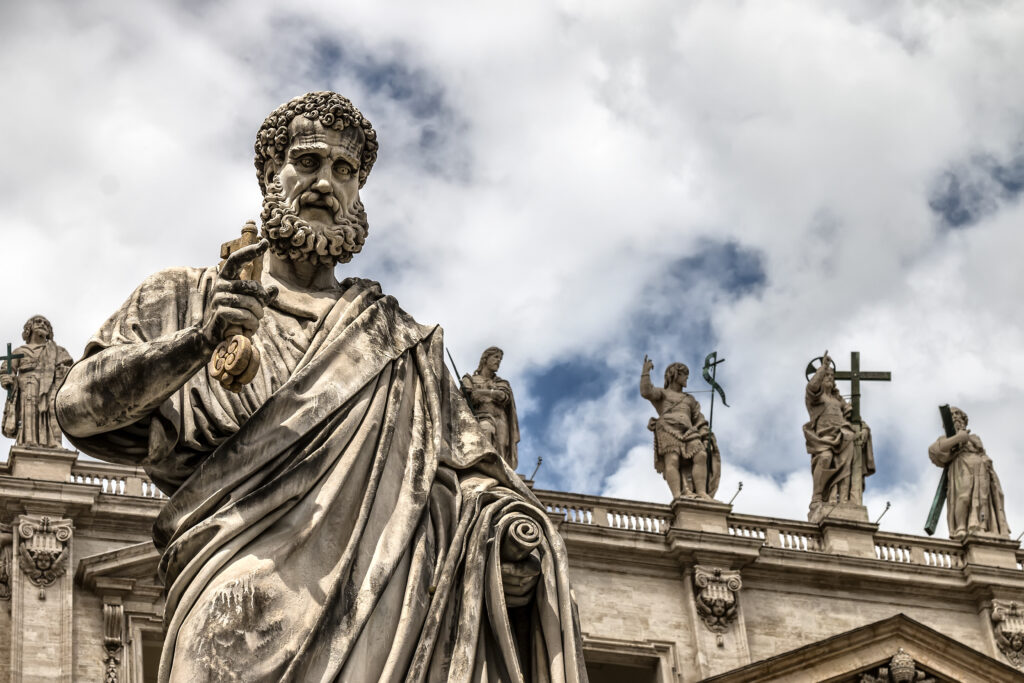
Isaiah 22:15-25 prophesies the office of chief steward under the Davidic king, where Eliakim receives ‘the key of the house of David’ with authority ‘to open and shut’ (NRSV, 1989/2021). Catholic exegesis recognizes this as a direct type of Peter’s office, as Jesus quotes this passage nearly verbatim in Matthew 16:19 when granting Peter ‘the keys of the kingdom of heaven’ (Hahn, 2009). The parallel is striking: both Eliakim and Peter receive keys symbolizing delegated royal authority, both exercise stewardship over the king’s household, and both possess binding juridical power.
Daniel’s vision of the stone ‘cut without human hands’ that grows into a great mountain filling the earth (Daniel 2:34-35) represents Christ’s kingdom—the Church—beginning small but spreading throughout the world by divine power rather than human effort (Augustine, 401/2009). Augustine of Hippo interpreted this as the Church’s miraculous growth from its humble apostolic beginnings to its eventual transformation of the Roman Empire and beyond.
Jeremiah’s prophecy of the New Covenant (Jeremiah 31:31-34), where God writes His law on hearts rather than stone tablets, finds fulfillment in the Church’s sacramental system through which the Holy Spirit transforms believers from within (Pitre, 2016). This internalization of divine law through grace, effected sacramentally, distinguishes the New Covenant community from the old dispensation.
New Testament Establishment
The New Testament provides explicit establishment of Catholic structures and doctrines through Christ’s words and apostolic practice (Ratzinger, 1987). Matthew 16:13-19 records Christ’s institution of the papacy when He declares Simon to be Peter (‘rock’) and promises to build His Church upon this rock. Christ grants Peter alone the keys of the kingdom and the power to bind and loose—terminology from rabbinic Judaism indicating teaching authority and jurisdictional power (Keener, 1999).
The threefold commission of Peter in John 21:15-17 (‘Feed my lambs…Tend my sheep…Feed my sheep’) establishes pastoral primacy over the entire flock, not merely administrative precedence (Brown et al., 1978). The distinction between lambs (the faithful) and sheep (including other shepherds/bishops) indicates universal jurisdiction. Peter’s leadership role appears throughout Acts, where he speaks for the Twelve, receives the first Gentile converts, and presides at the Council of Jerusalem.
Christ’s high priestly prayer in John 17 emphasizes unity: ‘that they may all be one…so that the world may believe’ (John 17:21). This unity requires visible structure and authoritative teaching, not merely spiritual communion (Dulles, 1974). The Church appears in Paul’s letters as hierarchically ordered, with distinct offices of episcopate, presbyterate, and diaconate evident in the Pastoral Epistles (1 Timothy 3:1-13; Titus 1:5-9).
The Last Supper institution of the Eucharist (Luke 22:19-20; 1 Corinthians 11:23-26) establishes the sacrificial priesthood and sacramental system. Christ’s command ‘Do this in remembrance of me’ confers priestly power to re-present His sacrifice, not merely commemorate it (O’Collins, 2013). Paul’s language of ‘the Lord’s supper’ (1 Corinthians 11:20) and warning about eating and drinking unworthily (1 Corinthians 11:27-29) presupposes Real Presence, as later defined by Catholic doctrine.
How Did the Church Begin in the Apostolic Age?
Pentecost and Early Growth
The Catholic Church regards Pentecost (approximately 30 AD) as its birthday, when the Holy Spirit descended upon the Apostles gathered with Mary in the Upper Room (Acts 2:1-4). Peter’s immediate assumption of leadership, preaching to the crowd and receiving 3,000 converts, demonstrates the papal office’s activation (Bokenkotter, 2004). The nascent community immediately manifests key Catholic characteristics: apostolic teaching, communal life, Eucharistic celebration (‘the breaking of bread’), and prayer (Acts 2:42).
The Jerusalem church, led by Peter and the Twelve, served as mother church to emerging Christian communities. Peter’s healing miracles and authoritative teaching established apostolic credibility (Acts 3:1-10, 5:15). When persecution scattered believers, Philip’s evangelization of Samaria required Peter and John’s confirmation through the laying on of hands (Acts 8:14-17)—an early instance of episcopal confirmation as distinct from baptism (Kelly, 1978).
The expansion to Gentiles marked a crucial development. Peter’s vision at Joppa and subsequent baptism of Cornelius (Acts 10) opened the Church to non-Jews, a decision Peter defended before the Jerusalem church (Acts 11:1-18). This demonstrates papal authority to make binding decisions on faith and discipline, even when initially controversial.
Paul’s Mission and the Council of Jerusalem
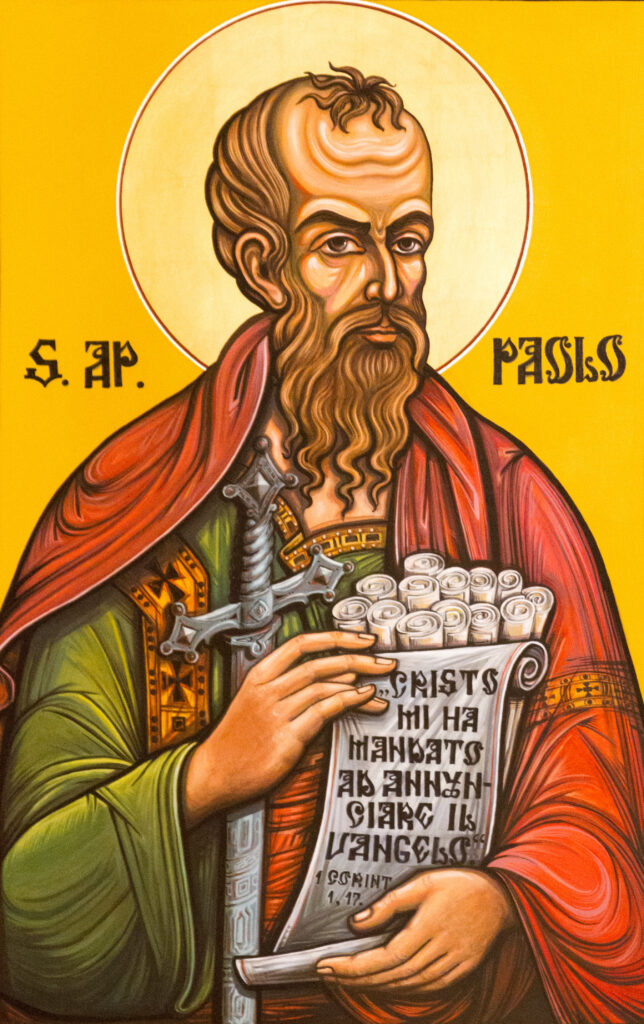
Paul’s conversion (circa 34 AD) and subsequent missionary journeys established churches throughout Asia Minor, Greece, and eventually Rome. Though the ‘apostle to the Gentiles,’ Paul recognized Peter’s primacy and sought communion with the Jerusalem leadership (Galatians 2:1-10). This unity between the Petrine and Pauline missions manifests the Church’s essential catholicity—universality in both geographical extent and doctrinal unity (Brown & Meier, 1983).
The Council of Jerusalem (circa 49 AD) represents the first ecumenical council, establishing a pattern for resolving doctrinal disputes through episcopal collegiality under papal leadership (Acts 15:1-29). The controversy over Gentile circumcision required authoritative resolution. After extensive debate, Peter spoke definitively (Acts 15:7-11), and James, as bishop of Jerusalem, proposed practical directives. The council’s decree, binding on all churches, demonstrates the magisterium’s authority—apostolic consensus under Peter’s guidance (Sullivan, 1983).
Paul’s letters reveal emerging ecclesiastical structure. He appoints presbyters/bishops in each church (Acts 14:23, Titus 1:5), distinguishes offices (1 Corinthians 12:28), and emphasizes unity through apostolic tradition (1 Corinthians 11:2, 2 Thessalonians 2:15). His insistence on testing teachings against apostolic tradition (Galatians 1:8-9) establishes the principle of authoritative doctrine distinct from private interpretation.
Peter and Paul in Rome
The convergence of Peter and Paul in Rome, where both suffered martyrdom under Nero (circa 64-67 AD), established Rome’s unique authority as the see founded by the two greatest apostles (Eusebius, 325/1890). Early Christian tradition universally attests to Peter’s Roman episcopate and crucifixion there, as well as Paul’s beheading (Irenaeus, 180/1868). Archaeological evidence from the Vatican excavations confirms veneration of Peter’s tomb from the mid-second century onward (O’Connor, 1969).
The succession from Peter to Linus, Anacletus, and Clement established the principle of apostolic succession—that bishops receive authority through episcopal ordination in continuity with the Apostles (Irenaeus, 180/1868). Clement of Rome’s letter to Corinth (circa 96 AD) demonstrates early Roman primacy, as the Roman church authoritatively intervenes in another diocese’s affairs to restore order (Chadwick, 1993).
By the end of the apostolic age, the Church possessed its essential structure: episcopal hierarchy under papal primacy, sacramental worship centered on the Eucharist, apostolic tradition as authoritative norm, and missionary expansion. The canonical Gospels and apostolic letters began circulating, though the New Testament canon remained unsettled for several centuries (Metzger, 1987).
Conclusion: The Foundation Established
The apostolic age established the Catholic Church’s essential character and structure. From Christ’s institution of the papacy through Peter to the first ecumenical council in Jerusalem, from Pentecost’s outpouring of the Holy Spirit to the martyrdom of the apostles in Rome, these foundational decades set patterns that would define the Church for two millennia.
But the Church’s greatest test was just beginning. In Part 2, we will explore how Christianity not only survived but thrived through three centuries of brutal persecution, and how the great ecumenical councils defined the doctrines of the Trinity and the Incarnation with stunning philosophical precision. The story of how a persecuted minority became the religion of the Roman Empire is one of the most dramatic reversals in human history.
References
Alberigo, G., & Komonchak, J. A. (Eds.). (1995). History of Vatican II (Vols. 1-5). Orbis Books.
Aubert, R. (1990). The Church in a secularized society. Paulist Press.
Augustine of Hippo. (2009). The city of God. (M. Dods, Trans.). Hendrickson Publishers. (Original work published 401)
Bailey, G. A. (2003). Art of colonial Latin America. Phaidon Press.
Bainton, R. H. (1950). Here I stand: A life of Martin Luther. Abingdon-Cokesbury Press.
Barnes, T. D. (1981). Constantine and Eusebius. Harvard University Press.
Barnes, T. D. (1993). Athanasius and Constantius: Theology and politics in the Constantinian Empire. Harvard University Press.
Baynes, N. H. (1972). Constantine the Great and the Christian Church (2nd ed.). Oxford University Press.
Bokenkotter, T. (2004). A concise history of the Catholic Church (Revised ed.). Doubleday.
Brock, S. P. (2005). The hidden pearl: The Syrian Orthodox Church and its ancient Aramaic heritage (Vols. 1-3). TransWorld Film Italia.
Brown, R. E., Donfried, K. P., & Reumann, J. (Eds.). (1978). Peter in the New Testament. Augsburg Publishing House.
Brown, R. E., & Meier, J. P. (1983). Antioch and Rome: New Testament cradles of Catholic Christianity. Paulist Press.
Butler, C. (1962). The Vatican Council: The story told from inside in Bishop Ullathorne’s letters (Vols. 1-2). Longmans.
Cameron, E. (1991). The European Reformation. Clarendon Press.
Catechism of the Catholic Church. (1997). Catechism of the Catholic Church (2nd ed.). Libreria Editrice Vaticana.
Chadwick, H. (1993). The early Church (Revised ed.). Penguin Books.
Christiansen, D., & Grazer, W. (Eds.). (1996). ‘And you welcomed me’: Migration and Catholic social teaching. United States Catholic Conference.
Clendinnen, I. (1991). Aztecs: An interpretation. Cambridge University Press.
Coppa, F. J. (1990). Pope Pius IX: Crusader in a secular age. Twayne Publishers.
Curran, C. E. (2002). Catholic social teaching, 1891-present: A historical, theological, and ethical analysis. Georgetown University Press.
Cyprian of Carthage. (1868). The epistles of Cyprian. In A. Roberts & J. Donaldson (Eds.), Ante-Nicene Fathers (Vol. 5). Christian Literature Publishing Co. (Original work published 251)
Davis, L. D. (1983). The first seven ecumenical councils (325-787): Their history and theology. Liturgical Press.
Davis, L. D. (1990). The first seven ecumenical councils (325-787) (2nd ed.). Michael Glazier.
Dawson, C. (1950). Religion and the rise of Western culture. Sheed & Ward.
Duggan, M. T. (2009). The Mass at the frontiers of space and time: The Eucharist in the thought of Joseph Ratzinger. Sapientia Press.
Dulles, A. (1974). Models of the Church. Doubleday.
Dulles, A. (1988). The reshaping of Catholicism: Current challenges in the theology of Church. Harper & Row.
Dulles, A. (2002). A history of apologetics (2nd ed.). Ignatius Press.
Eusebius of Caesarea. (1890). Church history, life of Constantine, oration in praise of Constantine. (A. C. McGiffert, Trans.). Christian Literature Publishing Co. (Original work published 325)
Frend, W. H. C. (1965). Martyrdom and persecution in the early Church. Basil Blackwell.
Frend, W. H. C. (1972). The rise of the monophysite movement. Cambridge University Press.
Gambero, L. (1999). Mary and the Fathers of the Church: The Blessed Virgin Mary in patristic thought. Ignatius Press.
Grillmeier, A. (1975). Christ in Christian tradition: From the apostolic age to Chalcedon (451) (2nd ed.). John Knox Press.
Hahn, S. (2009). Kinship by covenant: A canonical approach to the fulfillment of God’s saving promises. Yale University Press.
Hales, E. E. Y. (1960). Revolution and papacy, 1769-1846. Hanover House.
Hanson, R. P. C. (1988). The search for the Christian doctrine of God: The Arian controversy, 318-381. T&T Clark.
Haskins, C. H. (1927). The renaissance of the twelfth century. Harvard University Press.
Irenaeus of Lyons. (1868). Against heresies. In A. Roberts & J. Donaldson (Eds.), Ante-Nicene Fathers (Vol. 1). Christian Literature Publishing Co. (Original work published 180)
Jedin, H. (1957-1961). A history of the Council of Trent (Vols. 1-2). Thomas Nelson & Sons.
Keener, C. S. (1999). A commentary on the Gospel of Matthew. Eerdmans.
Kelly, J. N. D. (1978). Early Christian doctrines (5th ed.). Harper & Row.
Lamb, M. L., & Levering, M. (Eds.). (2008). Vatican II: Renewal within tradition. Oxford University Press.
Lane, A. N. S. (2006). A reader’s guide to the Council of Trent. Baker Academic.
Latourelle, R. (1988). Theology of revelation. Alba House.
Latreille, A. (1970). Napoleon and the Church. In G. Bruun (Ed.), The new Cambridge modern history (Vol. 9, pp. 522-544). Cambridge University Press.
Lawrence, C. H. (2001). Medieval monasticism (3rd ed.). Longman.
Lumen Gentium. (1964). In A. Flannery (Ed.), Vatican Council II: The conciliar and post conciliar documents. Costello Publishing.
Markus, R. A. (1990). The end of ancient Christianity. Cambridge University Press.
Markus, R. A. (1997). Gregory the Great and his world. Cambridge University Press.
McBrien, R. P. (2008). The Church: The evolution of Catholicism. HarperOne.
McClory, R. (1995). Turning point: The inside story of the papal birth control commission. Crossroad.
McGuckin, J. A. (2004). Saint Cyril of Alexandria and the Christological controversy. St. Vladimir’s Seminary Press.
Metzger, B. M. (1987). The canon of the New Testament: Its origin, development, and significance. Clarendon Press.
Mullett, M. A. (1999). The Catholic Reformation. Routledge.
Newman, J. H. (1989). An essay on the development of Christian doctrine. University of Notre Dame Press. (Original work published 1845)
New Revised Standard Version Bible. (2021). National Council of Churches of Christ in the United States of America. (Original work published 1989)
O’Collins, G. (2013). The second Vatican Council on other religions. Oxford University Press.
O’Connor, D. W. (1969). Peter in Rome: The literary, liturgical, and archaeological evidence. Columbia University Press.
O’Malley, J. W. (1993). The first Jesuits. Harvard University Press.
O’Malley, J. W. (2000). Trent and all that: Renaming Catholicism in the early modern era. Harvard University Press.
O’Malley, J. W. (2008). What happened at Vatican II. Belknap Press of Harvard University Press.
Pelikan, J. (1971). The Christian tradition: A history of the development of doctrine, Vol. 1: The emergence of the Catholic tradition (100-600). University of Chicago Press.
Pelikan, J. (1974). The Christian tradition: A history of the development of doctrine, Vol. 2: The spirit of Eastern Christendom (600-1700). University of Chicago Press.
Pitre, B. (2016). Jesus and the Jewish roots of the Eucharist: Unlocking the secrets of the Last Supper. Image Books.
Ratzinger, J. (1987). Principles of Catholic theology: Building stones for a fundamental theology. Ignatius Press.
Ratzinger, J. (2000). The spirit of the liturgy. Ignatius Press.
Reid, A. (2005). The organic development of the liturgy. Ignatius Press.
Rowland, T. (2008). Ratzinger’s faith: The theology of Pope Benedict XVI. Oxford University Press.
Schatz, K. (1996). Papal primacy: From its origins to the present. Liturgical Press.
Sullivan, F. A. (1983). Magisterium: Teaching authority in the Catholic Church. Paulist Press.
Sullivan, F. A. (1988). The Church we believe in: One, holy, catholic and apostolic. Paulist Press.
Suttner, E. C. (2008). Church unity. St. Vladimir’s Seminary Press.
Tanner, N. P. (Ed.). (1990). Decrees of the ecumenical councils (Vols. 1-2). Sheed & Ward.
Tavard, G. H. (1959). Holy writ or holy Church: The crisis of the Protestant Reformation. Harper.
Tertullian. (1885). Apologeticum. In A. Roberts & J. Donaldson (Eds.), Ante-Nicene Fathers (Vol. 3). Christian Literature Publishing Co. (Original work published 197)
Thils, G. (1969). Papal infallibility reconsidered. Sheed and Ward.
Tierney, B. (1988). Origins of papal infallibility, 1150-1350: A study on the concepts of infallibility, sovereignty and tradition in the Middle Ages (New ed.). Brill.
Tillard, J. M. R. (1987). Church of churches: The ecclesiology of communion. Liturgical Press.
Ullmann, W. (1970). A short history of the papacy in the Middle Ages. Methuen.
Weigel, G. (2002). The courage to be Catholic: Crisis, reform, and the future of the Church. Basic Books.
Weisheipl, J. A. (1974). Friar Thomas D’Aquino: His life, thought, and works. Doubleday. Wright, W. J. (2005). Saints and their cults. Paulist Pre