What Leads to the Three Days of Darkness?
Few Catholic prophecies have captured the imagination quite like the Three Days of Darkness. The phrase calls up an image of shuttered windows, a single blessed candle burning on a table, and a family kneeling before the crucifix while the world outside is given over to judgement. Yet the darkness is rarely understood as it was revealed: not as a sudden, isolated catastrophe, but as the culmination of a long sequence of warnings, crises and signs.
No mystic described that sequence in greater detail than Marie-Julie Jahenny, the stigmatist of La Fraudais in Brittany. Her ecstasies, compiled and translated by E. A. Bucchianeri in We Are Warned (2011), trace a path that runs from interior warnings and a crisis in the Church, through civil war, plague and a strange red rain, to two separate periods of darkness, and finally to the restoration of Christendom under a Great Monarch and a holy Pope. Throughout, Our Lord’s purpose is stated plainly:
“I do not want My people to be surprised … I want My people to be warned” (Bucchianeri, 2011, p. 19).
This article follows that path stage by stage, using the infographic below as a map.
An interior warning in every heart. “They will already feel in the heart the effect of My Justice; it will be the heart that will say the hour is not far off.” 9 Mar 1878
Warnings through nature. The Lord “will give His warnings by nature, at the beginning of each year.” 20 Sep 1880
Indifference provokes Justice. “Today, it deserves My justice.” 4 Jan 1884
Counterfeit religion and schism. “This is the schism entering France.” 25 Oct 1881
Bishops break with the Pope. Many bishops “will not submit to orders of the Roman Pontiff.” 26 Oct 1882
The Holy See vacant. “Two successive anti-popes … will reign all this time over the Holy See.” 29 Sep 1882
Possession. “Many souls will be possessed a few months before (the crisis).” 14 Dec 1881
The signal: civil war in June–July. “It will be the signal of punishment, civil war.” 27 Apr 1877
Paris first. “The chastisements will begin with Paris.” 8 Dec 1874
The second crisis: 45 days. “France will be invaded to the diocese where Brittany begins.” 28 Sep 1882
An unknown malady. It “will attack the heart first, then the mind, and at the same time, the tongue.” 5 Aug 1880
The red rain. “My people will remain locked up for seven weeks.” 9 Mar 1878
No more Masses. “There will not be any more Sacrifice, any more Masses, we can call it the Holy Quarantine.” 27 Oct 1876
About 40 days of terror. The editor reads this as forty days of persecution before the Three Days.
Tabernacles carried away. Angels “would carry away many tabernacles from the churches.” 23 Dec 1881
Signs in the firmament. “Twenty four hours before the burst of this storm so black.” 18 Dec 1874
Four hours of darkness over Brittany. Noon to four, in spring: “the beginning of My punishment of Justice.” 5 Oct 1882
The sun darkened. “A precursor to the real darkness.” 28 Nov 1881
A low purple-and-red sky. “Two days of horrible darkness, separate from the three days.” 20 Sep 1880
Fire-hail and black water. Burning rain, scorched trees, “a frightening black” water.
Calm days, violent nights. The blessed candle burns at night; by day “they will be able to go without it.”
A vast cemetery. “Three-quarters of men will perish.” 4 Jan 1884
Barren years. “For two or three years, she will feel the ruins and the deep misery.” 30 Nov 1880
The earth repopulated. “The Lord will repopulate the earth with seedlings.” 9 Mar 1878
A King returns from exile. “He will revive the Church and deliver the Holy Father.” 31 Dec 1874
Crowned on the ruins of Paris. By a young pastor from the diocese of Aix. 26 May 1882
Henri de la Croix and the white banner. “The sign of victory.” 9 Feb 1882
A most holy Pope. “The third Pope will be the most holy.” 16 May 1882
Figure 1. The sequence of events leading to and following the Three Days of Darkness, as revealed to Marie-Julie Jahenny. Adapted from We Are Warned: The Prophecies of Marie-Julie Jahenny, by E. A. Bucchianeri (Ed. & Trans.), 2011.
Who Was Marie-Julie Jahenny?
Marie-Julie Jahenny was born on 12 February 1850 at Blain, near La Fraudais in Brittany, the eldest of five children of a pious peasant family. A member of the Third Order of St. Francis, she received the stigmata from 21 March 1873, and over the following months the wounds of the Crown of Thorns, the shoulder, the scourging and the espousal ring followed (Bucchianeri, 2011, pp. 7–8).
The Bishop of Nantes, Monseigneur Fournier, wasted no time in investigating. Dr. Imbert-Gourbeyre of the Faculty of Medicine at Clermont-Ferrand examined her and reported that there was “no fraud at La Fraudais.” The bishop wrote on 6 June 1875 that “what she manifests is supernatural,” and he remained her supporter until his death (Bucchianeri, 2011, p. 9).
Marie-Julie lived until 1941, and her ecstasies spanned decades. Their recurring themes were the love of the Cross, reparation for the sins of France, the coming chastisements, and the promised restoration under the Great Monarch and the Angelic Pontiff (Bucchianeri, 2011, pp. 7, 18–19).
How Does Heaven Warn First?
The first stage is not a catastrophe but a summons to the conscience. On 9 March 1878 Our Lord told Marie-Julie that “some time before these sinister signs are seen on the Earth, they will already feel in the heart the effect of My Justice; it will be the heart that will say the hour is not far off” (Bucchianeri, 2011, p. 87). Before anything is seen, something is felt.
The interior warning is accompanied by an exterior one. In an ecstasy of 20 September 1880, it was revealed that the Lord “will give His warnings by nature, at the beginning of each year” (Bucchianeri, 2011, p. 245). The editor connects this with the great natural disasters that have struck near the turn of recent years, though the text itself names none.
What provokes these warnings is spiritual indifference. “When My people have fallen into indifference, I have begun to threaten him,” Our Lord said on 4 January 1884. “Today, it deserves My justice” (Bucchianeri, 2011, p. 343). The warnings are an act of mercy, offered while there is still time to turn back.
How Does the Crisis Enter the Church?
The second stage is a crisis within the Church herself. On 25 October 1881 Our Lord lamented the weakness of His priests and foretold that “religion will be counterfeited, attacked and instead of this beautiful religion (i.e., Catholicism), there will be infamous writings. This is the schism entering France” (Bucchianeri, 2011, p. 299).
A year later the prophecy became sharper. On 26 October 1882 the Lord spoke of a “frightful religion” imposed throughout the kingdom, and of bishops who would “not submit to orders of the Roman Pontiff.” He added with evident grief, “I see Bishops joining … and the whole flock following them, all of it without hesitation” (Bucchianeri, 2011, p. 336). The same ecstasies describe an assembly of churchmen forming “councils against the Father of the universe” (Bucchianeri, 2011, p. 336).
Rome itself would not be spared. “The Church will have its seat vacant for long months … There will be two successive anti-popes that will reign all this time over the Holy See,” Marie-Julie was told on 29 September 1882 (Bucchianeri, 2011, p. 334). Alongside this, Our Lady warned on 14 December 1881 of diabolical apparitions and that “many souls will be possessed a few months before (the crisis) … the world will be mad with fear” (Bucchianeri, 2011, p. 302). That phrase, “a few months before,” is one of the few time markers the texts attach to this stage.
What Befalls France and the Nations?
The third stage brings the crisis into the streets. On 27 April 1877 Our Lord named its signal: “The month of the Sacred Heart (June) and My Blood (July), it will be the signal of punishment, civil war.” When the government sees the turmoil, “it will be like a bird,” taking flight to another country and abandoning Paris (Bucchianeri, 2011, pp. 53–54).
Paris stands at the centre of these punishments. As early as 8 December 1874, Marie-Julie heard that “the chastisements will begin with Paris,” though “the storm of Rome is even worse than the storm in France” (Bucchianeri, 2011, p. 32). On 28 November 1881 the warning became explicit: “If the Centre (Paris) does not convert, it will be burned” (Bucchianeri, 2011, p. 301).
War from without follows war from within. Through St. Michael, Marie-Julie learned on 28 September 1882 that “the second and violent crisis will commence and go up to 45 days. France will be invaded to the diocese where Brittany begins,” with the invaders reaching Paris “only in the middle of the crisis” (Bucchianeri, 2011, pp. 333–334).
Plague and portent complete the picture. A new disease “will attack the heart first, then the mind, and at the same time, the tongue,” accompanied by a consuming red fever, for which an infusion of hawthorn leaves was given as the remedy (Bucchianeri, 2011, p. 578). On 9 March 1878 Our Lord foretold “a red rain that will remain coagulated on the earth for seven weeks,” during which “My people will remain locked up for seven weeks”; a horrible “burning” would rise from the earth after it (Bucchianeri, 2011, pp. 86–87). In a vision of 8 April 1880, Marie-Julie saw a cross bearing the imprint of Christ formed within this rain (Bucchianeri, 2011, p. 232).
When Does the Holy Sacrifice Cease?
The fourth stage is the most sorrowful for the faithful: the suppression of the Mass. In an ecstasy of 27 October 1876, Our Lord described a time of devastation in which “there will not be any more Sacrifice, any more Masses, we can call it the Holy Quarantine … it will be three days of hell. Satan will travel the Earth to turn over the shrines, but he will be rejected, broken and defeated” (Bucchianeri, 2011, p. 43).
The word quarantaine means a period of forty days, and Bucchianeri reads the passage accordingly: before the Three Days of Darkness “there would be 40 days of terror where Catholicism will be persecuted, Mass shall be forbidden” (Bucchianeri, 2011, p. 44). This is the editor’s interpretation, though it is a natural one; the same ecstasy closes by saying that “in these three days, the lights of the heavens will be extinguished” (Bucchianeri, 2011, pp. 43–44).
Even in this desolation, Heaven protects what is most holy. On 23 December 1881 Marie-Julie “understood that the angels would carry away many tabernacles from the churches to shield the Holy Sacrament from the outrages” (Bucchianeri, 2011, p. 303).
What Signs Announce the Darkness?
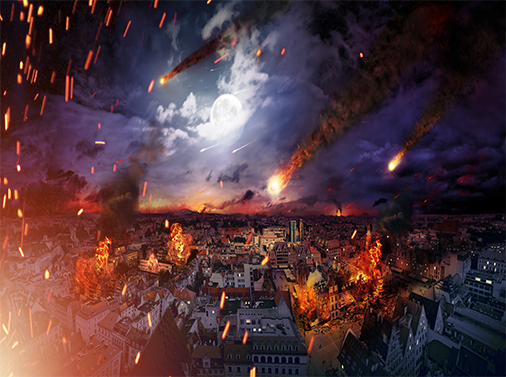
The fifth stage turns the eyes of the faithful to the heavens. As early as 18 December 1874, Marie-Julie was told that “twenty four hours before the burst of this storm so black, our Lord will give signs in the firmament” (Bucchianeri, 2011, p. 32).
A foretaste of the darkness is also given. On 5 October 1882 Our Lord described a darkness of four hours, “from 12:00 to 4:00 in France,” when “the sun will be like a veil of mourning; it will be darkened, without light.” It would come in spring, “when the wheat is not the third node of growth,” and would mark “the beginning of My punishment of Justice.” For Brittany, however, it would be “simply a small fright” (Bucchianeri, 2011, p. 334).
These signs are explicitly called precursors. “The sun shall be darkened before,” the ecstasy of 28 November 1881 says, “looking ahead (i.e. a precursor) to the real darkness” (Bucchianeri, 2011, p. 301). The heavens, in other words, rehearse what is coming.
What Are the Two Days of Darkness?
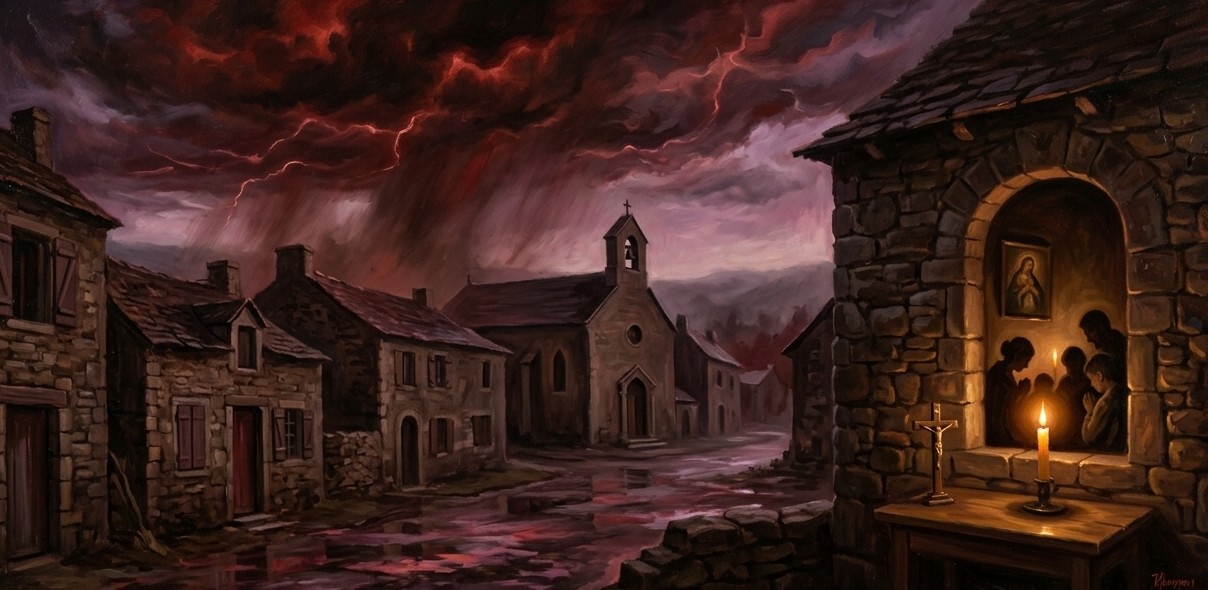
One of the most distinctive features of Marie-Julie’s prophecies is a second, earlier darkness that most accounts of the Three Days overlook. In the ecstasy of 20 September 1880, the Flame of the Holy Spirit announced “two days of horrible darkness, separate from the three days that many souls have announced. The sky will be purple and red; it will be so low that a clump of tall trees will be lost within it” (Bucchianeri, 2011, p. 245).
These two days are described as both a mercy and a judgement, “a genuine cachet of Goodness” but also “the descent of God in His wrath on the earth.” Foul-smelling rain will fall “as a big hailstone of fire,” trees will be scorched so that they bear no fruit the following year, and “the water that will be poured on the earth will be black, a frightening black.” Homes of solid construction will be preserved (Bucchianeri, 2011, p. 245).
The instructions for these days differ subtly from those for the Three Days. “If the day is calm, the night will be violent,” and “at night, the blessed candle … should not be put out. During the day, they will be able to go without it” (Bucchianeri, 2011, pp. 245–246). Marie-Julie was warned elsewhere that the candles must be of pure wax, since candles mixed with anything else will not light (Bucchianeri, 2011, p. 247). An ecstasy of 23 December 1881 seems to describe the same period in Paris: “For two days and two nights, no repose, nor sleep. Many people will perish” (Bucchianeri, 2011, p. 302).
How Long Between the Two Days and the Three?
The interval between the two darknesses is one of the few that the texts state precisely. On 28 November 1881 Marie-Julie was told that the precursor signs would look ahead “to the real darkness that will arrive 37 days after the signs of the darkening of the sun and of signs of the earth and the announced storm” (Bucchianeri, 2011, p. 301). Bucchianeri concludes that the Two Days and the Three Days “shall be about 37–40 days apart from each other” (Bucchianeri, 2011, pp. 301, 577).
What Happens During the Three Days of Darkness?
The seventh stage is the chastisement itself. On 4 January 1884 Our Lord declared: “There will be three days of physical darkness. For three days less one night, there will be a continual night. The blessed wax candles will be the only ones that give light in this terrible darkness: only one will suffice for three days, but in the homes of the wicked, they will not give any light” (Bucchianeri, 2011, p. 342).
The days themselves are named. The darkness “will be on a Thursday, Friday, and a Saturday. Days of the Most Holy Sacrament, of the Cross and Our Lady” (Bucchianeri, 2011, p. 420). The choice is deeply liturgical: the Thursday of the Eucharist, the Friday of the Passion and the Saturday dedicated to the Blessed Virgin.
What fills the darkness is terrifying. “The demons will appear under the most hideous forms. You will hear in the air the most horrible blasphemies. The lightning will enter your homes, but will not extinguish the candles” (Bucchianeri, 2011, pp. 342–343). “Red clouds like blood will ride across the sky,” the earth “will be shaken down to the foundations,” and the sea “will rise thundering waves that will spread across the continent” (Bucchianeri, 2011, p. 343). Our Lady added on 20 September 1882 that “the Earth will be covered in darkness, and Hell will be loosed on Earth,” and that “no windows must be opened, because no one will be able to see the earth and the terrible colour it will have in those days of punishment without dying at once” (Bucchianeri, 2011, p. 420). On 8 December 1882 she was blunter still: “No one outside a shelter … will survive” (Bucchianeri, 2011, p. 420).
How Are the Faithful Kept Safe?
The same revelations that describe the terror also describe the refuge. Our Lady promised that “everything will shake except the piece of furniture on which the blessed candle is burning,” and instructed: “You will all gather around the crucifix and my blessed picture. This is what will keep away this terror” (Bucchianeri, 2011, p. 420). Bucchianeri’s summary of the advice given to Marie-Julie adds the Rosary, heavy window coverings, and the firm warning not to look outside; her suggestion of placing Miraculous and St. Benedict medals on doors and windows is offered as her own (Bucchianeri, 2011, p. 577). Two further counsels belong to Heaven directly: “When you hear a blasphemy, say a Glory Be,” and, from 21 April 1921, “there are three shelters, My Divine Heart, My Divine Cross, My Beloved Immaculate Mother” (Bucchianeri, 2011, p. 577).
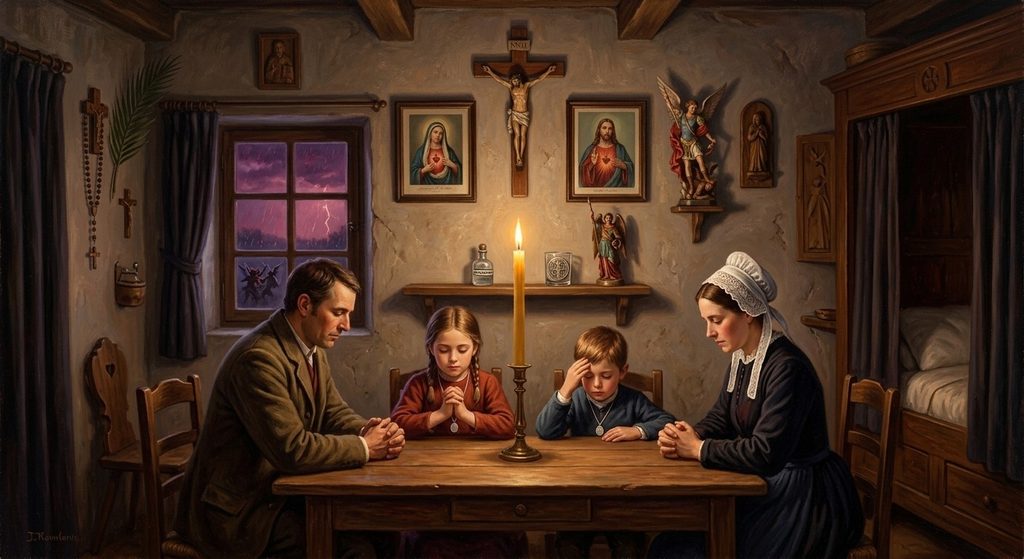
Above all of these, Our Lady gave a principle on 15 April 1900 that keeps the practical advice in its place: “It is the Faith, it is confidence, the most beautiful prayer that obtains the most and more” (Bucchianeri, 2011, p. 577). The candle protects because of the faith of those who keep it.
What Remains When the Light Returns?
The eighth stage is a world emptied. “Blood will flow in such abundance that the earth will become a vast cemetery. The corpses of the wicked and the righteous ones will litter the ground. The famine will be great. Everything will be in turmoil and three-quarters of men will perish” (Bucchianeri, 2011, p. 343). In a related prophecy of a three-day storm, Our Lord said simply, “After these three days, you will find only corpses” (Bucchianeri, 2011, p. 418).
Recovery will be slow. Our Lady told Marie-Julie on 30 November 1880 that “for many years the earth will produce nothing. France will be unhappy, even after its triumph. For two or three years, she will feel the ruins and the deep misery” (Bucchianeri, 2011, p. 274). Yet the survivors are not abandoned: “The Lord will repopulate the earth with seedlings that will grow up and go to the last generation” (Bucchianeri, 2011, p. 87).
How Are the Church and France Restored?
The ninth and final stage is the triumph that gives meaning to everything before it. On 31 December 1874 Marie-Julie spoke of “a King who has not tarnished his crown and who lived far away in exile,” who would raise France from its captivity and “revive the Church and deliver the Holy Father” (Bucchianeri, 2011, p. 32). Our Lord later named him “My real servant Henri de La Croix,” over whose forehead the triumph of the Church would be seen (Bucchianeri, 2011, p. 309).
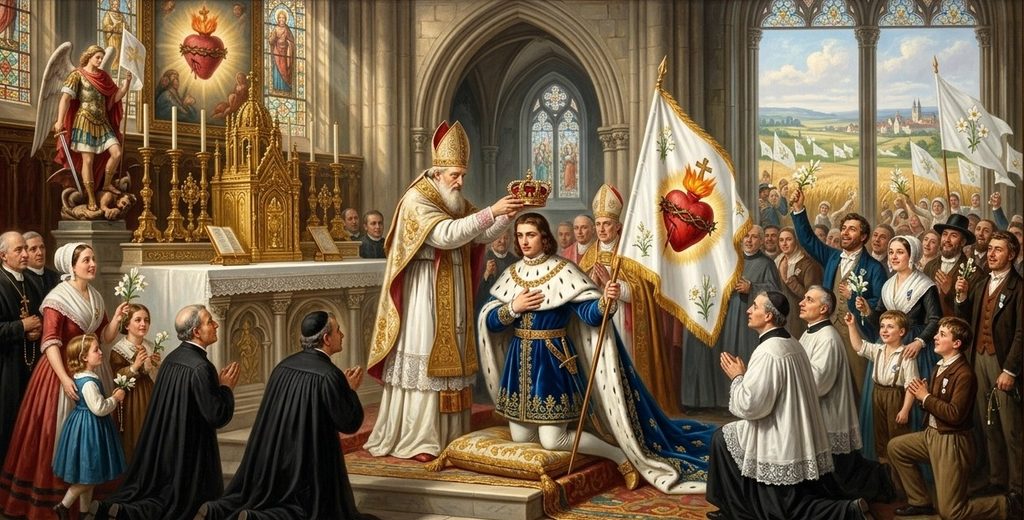
The details of his coming are strikingly concrete. He will be crowned “on the ruins of the Centre, when the earth will be much deserted,” not by a bishop of Paris but by a young pastor from the diocese of Aix whose “45 years will not have sounded” (Bucchianeri, 2011, p. 318). After his blessing he will carry the white banner to La Fraudais and set it down there as “the sign of victory” (Bucchianeri, 2011, p. 309).
The Church, too, will be renewed. After the long vacancy of the Holy See, “the third Pope will be the most holy, but will not reign but three years before God calls him for his reward” (Bucchianeri, 2011, p. 317). Darkness, in Marie-Julie’s prophecies, is never the last word; it is the night before the dawn of restoration.
How Can You Protect Yourself, Your Family, Your Home and Your Animals?
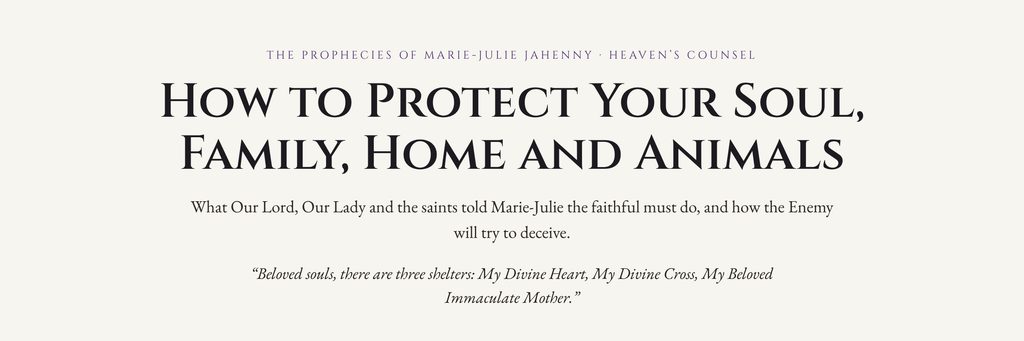
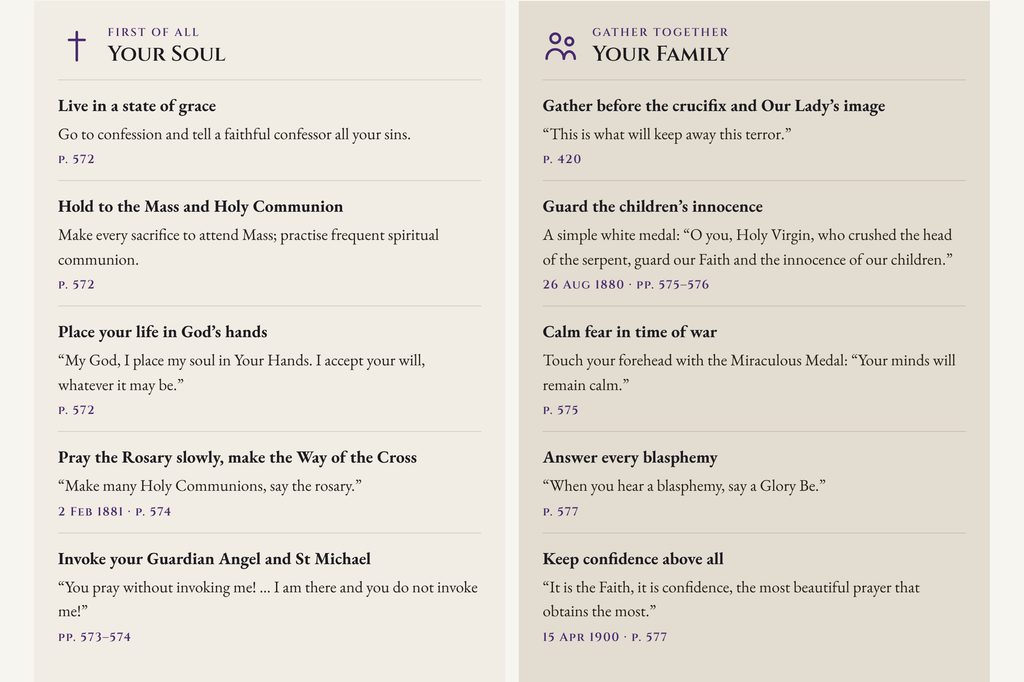
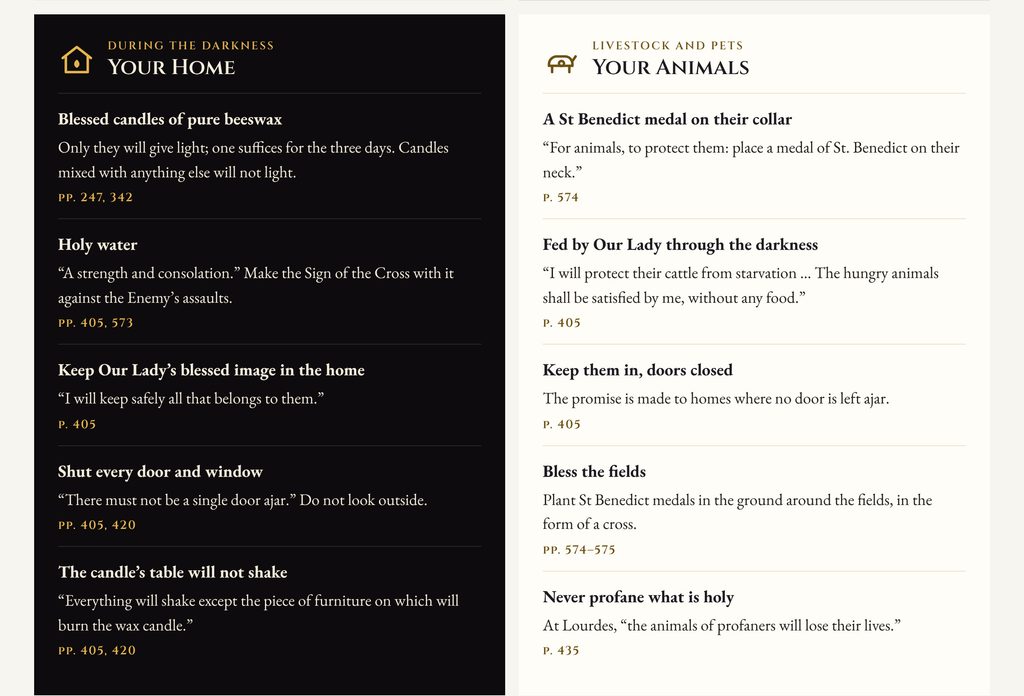
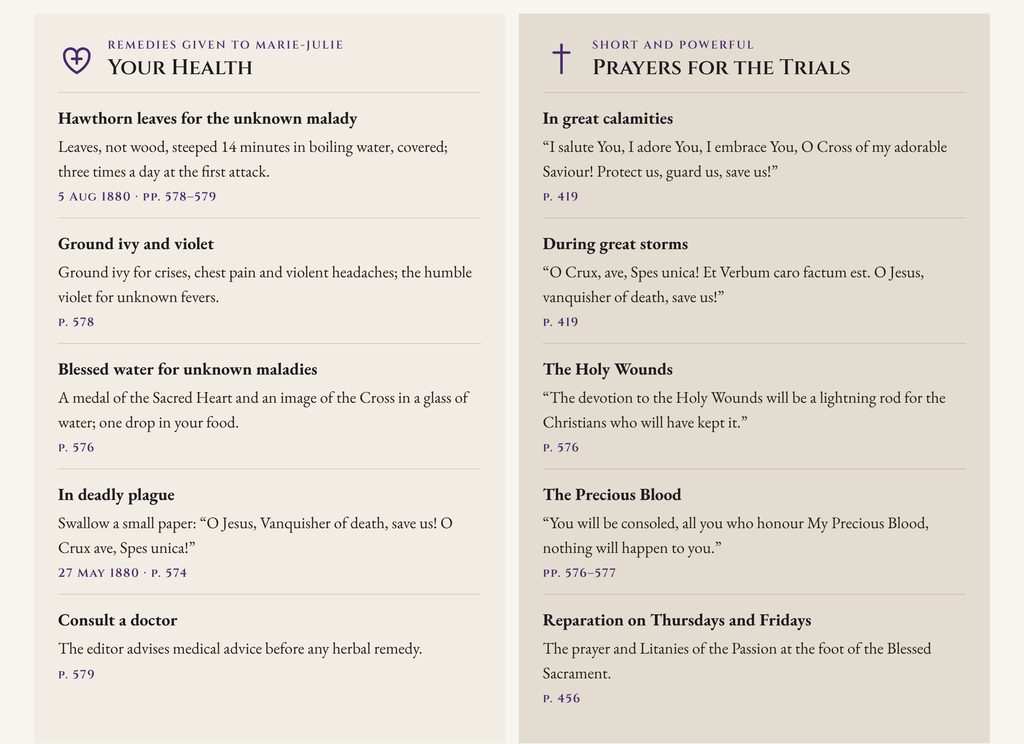
The prophecies never leave the faithful without defence. Alongside every warning, Marie-Julie received counsel: what to do for the soul, how to gather the family, how to prepare the home, how to care for animals, what remedies to use in sickness, and how to recognise the Enemy.
Figure 2 gathers that counsel in one place; the sections that follow explain it.
How Do You Protect Your Soul?
The book’s section on protection begins not with candles but with the soul. The first counsel is to place one’s whole life in God’s hands: “My God, I place my soul in Your Hands. I accept your will, whatever it may be, if I live or if I die.” The faithful are to live in a state of grace, going to confession and telling “a faithful confessor all your sins,” and to “make every sacrifice to always attend Holy Mass and to receive Holy Communion as frequently as possible,” practising spiritual communion when they cannot (Bucchianeri, 2011, p. 572).
Prayer follows. Our Lady asked on 2 February 1881: “Pray much for the Church, for the priests and for sinners … make the Way of the Cross … make many Holy Communions, say the rosary.” The Rosary is to be prayed slowly, meditating on the mysteries, and the Guardian Angel and St. Michael are to be invoked often. Marie-Julie’s own angel once reproached her: “You pray without invoking me! … I am there and you do not invoke me!” (Bucchianeri, 2011, pp. 573–574).
How Do You Protect Your Family?
During the darkness the family’s place is together, before the crucifix and an image of Our Lady: “You will all gather around the crucifix and my blessed picture. This is what will keep away this terror” (Bucchianeri, 2011, p. 420). Every blasphemy heard is to be answered: “When you hear a blasphemy, say a Glory Be. It is a consolation for Heaven” (Bucchianeri, 2011, p. 577).
Children receive special care. On 26 August 1880 Our Lady asked parents to give their children a simple white medal bearing the words “O you, Holy Virgin, who crushed the head of the serpent, guard our Faith and the innocence of our children,” to guard their purity “when corruption will spread everywhere” (Bucchianeri, 2011, pp. 575–576). In time of war, Our Lord said, the faithful should touch their foreheads with the Miraculous Medal: “Your minds will remain calm” (Bucchianeri, 2011, p. 575). And over all of this stands Our Lady’s principle of 15 April 1900: “It is the Faith, it is confidence, the most beautiful prayer that obtains the most and more” (Bucchianeri, 2011, p. 577).
How Do You Protect Your Home?
The home is where the faithful will pass both darknesses, and its preparation is described in detail. Blessed candles are essential, but they must be of pure wax: “To resist all these signs, holy water is a strength and consolation, and the candle, but with wax. All those that are not of this paste will not help” (Bucchianeri, 2011, p. 405). Marie-Julie was warned that candles mixed with anything else will not light (Bucchianeri, 2011, p. 247). During the Three Days a single candle “will suffice for three days,” and lightning entering the house will not put it out (Bucchianeri, 2011, p. 342).
Holy water “possesses a sovereign power against the assaults of the Enemy,” and the faithful are to make the Sign of the Cross with it (Bucchianeri, 2011, p. 573). Our Lady promised a particular protection to homes that honour her image: “Those who make me well served and invoke me, and that will keep in their homes my blessed image, I will keep safely all that belongs to them.” In those homes “everything will shake except the piece of furniture on which will burn the wax candle” (Bucchianeri, 2011, p. 405).
Finally, the house must be closed. “There must not be a single door ajar” (Bucchianeri, 2011, p. 405), no window may be opened, and no one should look outside (Bucchianeri, 2011, p. 420). The editor adds her own suggestions of heavy window coverings and of Miraculous and St. Benedict medals on doors and windows (Bucchianeri, 2011, p. 577).
How Do You Protect Your Animals?
It surprises many readers that the prophecies speak of animals at all, yet they do so tenderly. In the same ecstasy that promises protection to homes that keep her image, Our Lady says: “During these three days, I will protect their cattle from starvation … there must not be a single door ajar. The hungry animals shall be satisfied by me, without any food” (Bucchianeri, 2011, p. 405). The animals of the faithful, kept safely inside, will be fed by Heaven itself.
For everyday protection the counsel is simple: “For animals, to protect them: place a medal of St. Benedict on their neck,” that is, on their collar (Bucchianeri, 2011, p. 574). For farms, St. Benedict medals are to be planted in the ground around the fields “in the form of a cross” (Bucchianeri, 2011, pp. 574–575). There is also a warning. At Lourdes, Our Lady said, she would punish those who give their animals water from the spring she brought forth, and “the animals of profaners will lose their lives” (Bucchianeri, 2011, p. 435). What is holy is to be reverenced, even in the care of beasts.
What Remedies Were Given for Sickness?
On 5 August 1880 Marie-Julie was told of “serious diseases that human art cannot alleviate,” a malady that attacks the heart, the mind and the tongue with a consuming red fever (Bucchianeri, 2011, p. 578). The remedy given was the hawthorn of the hedgerows: “You must pick the leaves, not the wood. Even dry, they will retain their effectiveness. Put them in boiling water and leave them there for 14 minutes, covering the container so that the steam remains,” taken three times a day at the first attack (Bucchianeri, 2011, p. 579). Ground ivy (rendered “St. John’s wort” in the translation) was given for crises, chest pain and violent headaches, and “the humble violet” for unknown fevers (Bucchianeri, 2011, p. 578).
The remedies are never merely natural. For unknown maladies Our Lord asked that a medal of His Divine Heart and an image of the Cross be placed in a glass of water, so that a single drop of this “twice blessed, twice purified” water in one’s food would turn aside “the blights of My Justice” (Bucchianeri, 2011, p. 576). In deadly plague, the faithful were to swallow a small piece of paper bearing the words “O Jesus, Vanquisher of death, save us! O Crux ave, Spes unica!” (Bucchianeri, 2011, p. 574). The editor rightly advises readers to consult a doctor before taking any herbal preparation (Bucchianeri, 2011, p. 579).
Which Prayers and Devotions Were Given for the Trials?
Short prayers were given for moments of crisis. In great calamities: “I salute You, I adore You, I embrace You, O Cross of my adorable Saviour! Protect us, guard us, save us!” During great storms: “O Crux, ave, Spes unica! Et Verbum caro factum est. O Jesus, vanquisher of death, save us!” (Bucchianeri, 2011, p. 419).
Several devotions carry explicit promises. “The devotion to the Holy Wounds will be a lightning rod for the Christians who will have kept it,” and to those who honour the Precious Blood, “nothing will happen to you” (Bucchianeri, 2011, pp. 576–577). Devotion to the Wound of Our Lord’s Shoulder, the wound made by the weight of the Cross, carries the promise “I will dispel the darkness that will come to their heart” (Bucchianeri, 2011, p. 443). And a prayer of reparation, with the Litanies of the Passion, is to be said before the Blessed Sacrament on Thursday mornings at nine and on Friday afternoons; to those who say it, Our Lord promised that “at their death, I will almost immediately attract them in the eternal sojourn” (Bucchianeri, 2011, p. 456). Above them all stand the “three shelters” given on 21 April 1921: “My Divine Heart, My Divine Cross, My Beloved Immaculate Mother” (Bucchianeri, 2011, p. 577).
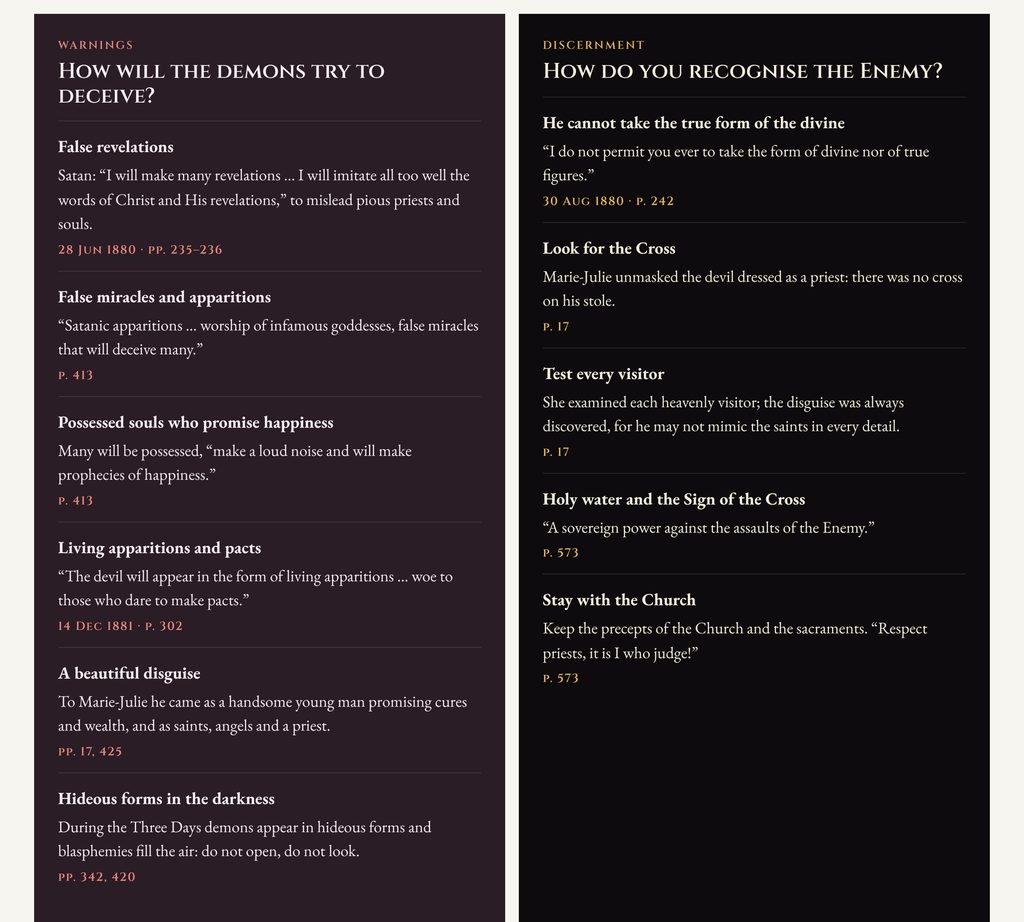
How Will the Demons Try to Deceive?
The prophecies warn that the greatest danger of the last times is not fear but deception. Satan’s own words to Marie-Julie on 28 June 1880 set out his strategy: “I will make many revelations … It will be impossible to expose my language. I will imitate all too well the words of Christ and His revelations.” He intended to mislead pious priests and lay souls alike, and where he could not lose a soul, to ruin its reputation with “heavy slander” (Bucchianeri, 2011, pp. 235–236).
The deceptions take several forms. Our Lady warned of “satanic apparitions,” of “worship of infamous goddesses,” of “false miracles that will deceive many,” and of many souls “that will be possessed and make a loud noise and will make prophecies of happiness,” that is, of earthly happiness without the Cross (Bucchianeri, 2011, p. 413). On 14 December 1881 she said that “the devil will appear in the form of living apparitions … woe to those who dare to make pacts with these personages who appear in diabolical visions,” and that in the madness of fear he would make people “deny their baptism and the cross” (Bucchianeri, 2011, p. 302). In one vision, on the feast of St. Michael, the cries of men and demons were so mixed that “we can no longer distinguish the voices of Christians from that of hell” (Bucchianeri, 2011, p. 148).
The devil’s favourite disguise is beauty. To Marie-Julie he came as “a young man of great beauty” promising “cures, wealth and all the vain trappings of the world” (Bucchianeri, 2011, p. 17). On 8 December 1882 she rebuked him for dressing in finery to seduce her: “You beautify yourself to come and see me and to deceive me; you are only a mask … I recognize you anywhere” (Bucchianeri, 2011, p. 425). During the Three Days the mask falls, and the demons appear “under the most hideous forms” with blasphemies filling the air (Bucchianeri, 2011, p. 342). The faithful are not to open the door or look out.
How Can the Enemy Be Recognised?
The same book gives the means of discernment. First, there is a limit God has placed on Satan. When Satan asked “for the authority to take on all forms,” Our Lord answered, “I leave you permission to tempt My people, but I do not permit you ever to take the form of divine nor of true figures” (Bucchianeri, 2011, p. 242). His imitations are always imperfect: he “was not permitted by Heaven to mimic the saints or angels in every detail,” so Marie-Julie examined every visitor and “his disguise was always discovered” (Bucchianeri, 2011, p. 17).
Second, look for the Cross. When the devil appeared to her dressed as a priest, she recognised him “as he did not have a cross on his stole” (Bucchianeri, 2011, p. 17). A message that flatters, promises comfort without sacrifice, or turns souls away from the Cross bears his signature. Third, use the Church’s weapons: holy water and the Sign of the Cross, which possess “a sovereign power against the assaults of the Enemy” (Bucchianeri, 2011, p. 573), together with the sacraments, the Rosary and respect for the priesthood: “Respect priests, it is I who judge!” (Bucchianeri, 2011, p. 573). The surest protection against a false revelation is fidelity to the true one.
How Should Catholics Read These Prophecies?
Two cautions help in reading this sequence well. The first concerns order. Marie-Julie’s ecstasies were not delivered in the order in which their events would unfold, and only some links between stages rest on stated intervals: the twenty-four hours of signs, the forty-five days of crisis, the seven weeks of red rain, and the thirty-seven days between the two darknesses. The remaining connections, including the forty days of the Holy Quarantine, rest on the editor’s notes or on the logic of the texts, and the infographic marks them as inferred.
The second concerns authority. The Church teaches that private revelations, even those she recognises, “do not belong … to the deposit of faith. It is not their role to improve or complete Christ’s definitive Revelation, but to help live more fully by it in a certain period of history” (Catechism of the Catholic Church, 1997, para. 67). Bishop Fournier’s judgement that Marie-Julie’s experiences were supernatural gives her words weight (Bucchianeri, 2011, pp. 9–10), but it does not oblige belief in each detail.
Read in that spirit, the prophecies are less a timetable than a call. Their constant refrain is conversion, devotion to the Cross and the Sacred Heart, fidelity to the Mass, and confidence in Our Lady. In the counsel given to Marie-Julie in the name of St. Gregory the Great on 19 August 1878: “What are you to do? Wait, pray, do what God wants” (Bucchianeri, 2011, p. 577).
References
Bucchianeri, E. A. (Ed. & Trans.). (2011). We are warned: The prophecies of Marie-Julie Jahenny. Scribd.
Catechism of the Catholic Church (2nd ed.). (1997). Libreria Editrice Vaticana.