“Grant Me Chastity, But Not Yet”: The Saints Who Struggled with Lust and the Mercy That Made Them Holy
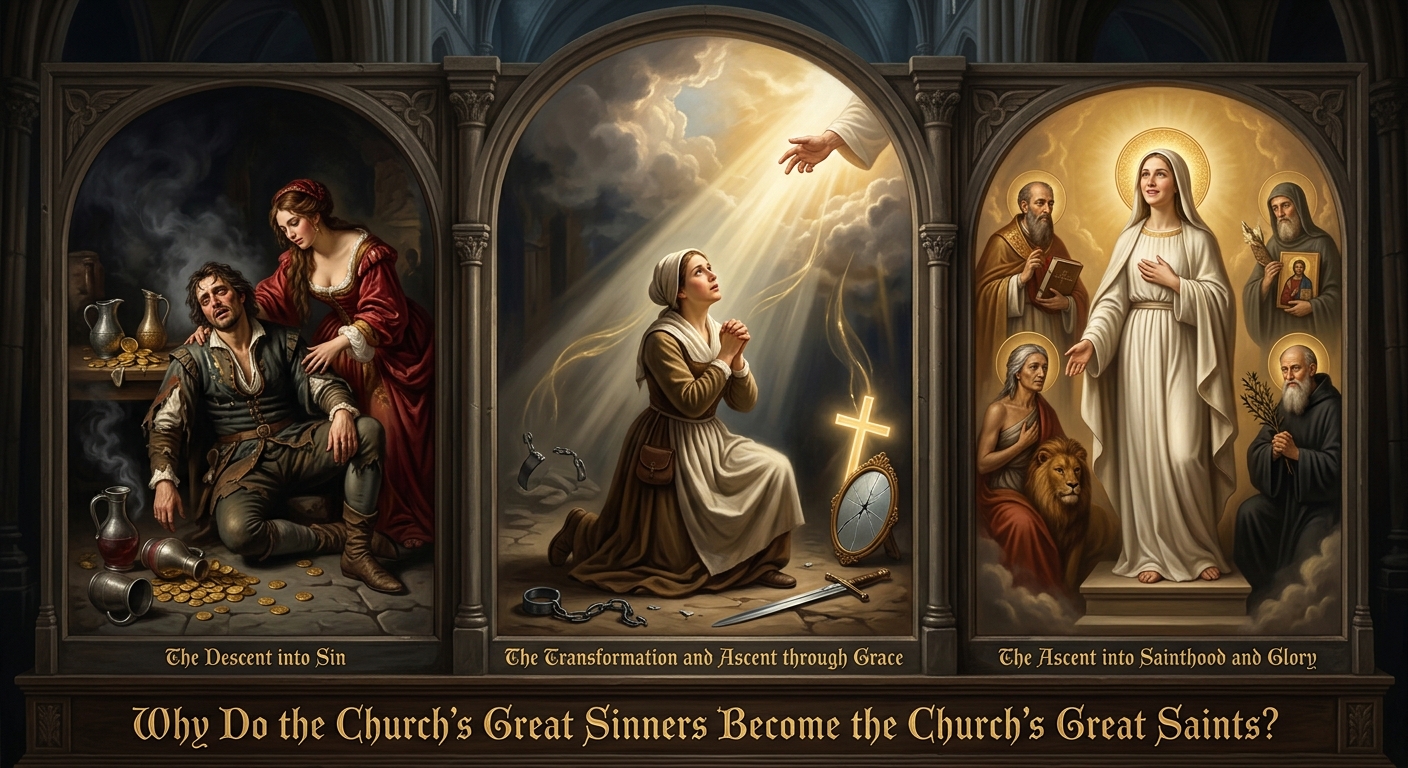
Why Do the Church’s Great Sinners Become the Church’s Great Saints?
Few themes in Catholic hagiography are as consoling, or as easily sensationalized, as the story of the saint who once burned with lust. The Church has never hidden these figures away. On the contrary, she has canonized them, written their lives into her liturgy, and held them up on the altars precisely because their conversions display the reach of grace. This article examines the most significant of them with pastoral care and doctrinal precision, drawing on the primary hagiographical sources, the Catechism of the Catholic Church, and modern scholarship. It also treats an essential distinction the tradition insists upon: the difference between those who fell into sexual sin and repented, and those who never fell but fought severe temptations against chastity all their lives.
What Does the Church Actually Teach About Lust, Concupiscence, and Temptation?
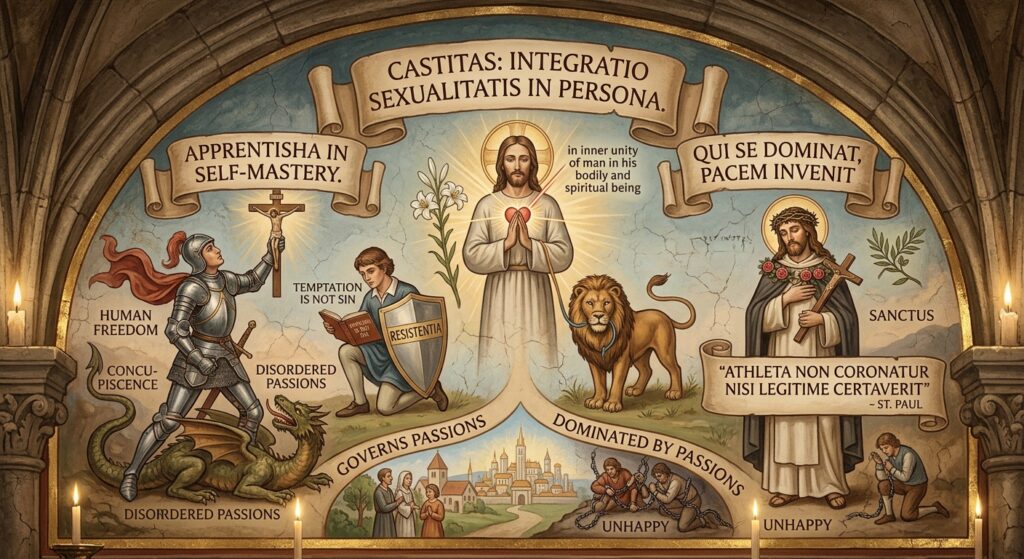
Before turning to the saints, the theological framework must be clear, because it governs how their stories should be read. The Catechism defines chastity as “the successful integration of sexuality within the person and thus the inner unity of man in his bodily and spiritual being” (Catechism of the Catholic Church [CCC], 2003, no. 2337). It is not mere abstinence but wholeness. Chastity “includes an apprenticeship in self-mastery which is a training in human freedom,” and the Catechism frames the alternative starkly: “either man governs his passions and finds peace, or he lets himself be dominated by them and becomes unhappy” (CCC, 2003, no. 2339). This self-mastery is “a long and exacting work” that “one can never consider acquired once and for all” (CCC, 2003, no. 2342).
Crucially, the Church distinguishes between temptation and sin. Concupiscence, the disordered inclination toward sin that remains even after baptism, is not itself sin. The Catechism teaches that this “inclination to sin” which “Tradition calls concupiscence” is “left for us to wrestle with” and “cannot harm those who do not consent but manfully resist it by the grace of Jesus Christ,” adding the Pauline image that “an athlete is not crowned unless he competes according to the rules” (CCC, 2003, no. 1264). This single doctrinal point unlocks the entire tradition: a saint may be assaulted by ferocious sexual temptation and remain sinless, because temptation resisted is not sin but the very arena of merit. It is why the Church can canonize both the penitent who fell and the ascetic who fought without falling.
How Did St. Augustine Move From Profligate to Bishop?
No account of lust and holiness can begin anywhere but with Augustine of Hippo (354–430), whose Confessions remains the West’s foundational narrative of sexual sin transfigured by grace. Born at Thagaste in Roman North Africa to the pagan Patricius and the Christian Monica, Augustine confessed that at sixteen the frenzy of desire gripped him and he surrendered himself entirely to lust (Christian History Institute, n.d.). For about fifteen years he lived faithfully with an unnamed concubine who bore him a son, Adeodatus. Augustine describes the relationship with unflinching candor: “In those days I lived with a woman, not my lawful wedded wife but a mistress whom I had chosen for no special reason but that my restless passions had alighted on her. But she was the only one and I was faithful to her” (Augustine, trans. 1887, Book IV).
The drama of his conversion is inseparable from his sexuality. When Monica arranged an advantageous marriage in Milan, Augustine dismissed the mother of Adeodatus — an act he recalled with genuine anguish — yet, unable to wait the two years until his betrothed came of age, he took another concubine (Christian History Institute, n.d.). It was in this period that he prayed the most famous prayer in the history of chastity: “Grant me chastity and continency, but not yet” (da mihi castitatem et continentiam, sed noli modo), explaining with pitiless honesty, “I was afraid lest You should hear me soon, and soon deliver me from the disease of concupiscence, which I desired to have satisfied rather than extinguished” (Augustine, trans. 1887, Book VIII). The knot was cut in a Milan garden in the summer of 386, when, weeping “in the most bitter contrition of my heart,” he heard a child’s voice chanting tolle lege — “take up and read” — and opened Paul’s letter to the Romans (Augustine, trans. 1887, Book VIII). He was baptized by Ambrose at Easter 387. His mother Monica and his spiritual instrument Ambrose were the human agents of a conversion that was nonetheless, in his telling, entirely the work of grace.
Augustine died on August 28, 430, as the Vandals besieged Hippo. His canonization was pre-Congregation — by immemorial cult rather than formal process — and he was declared a Doctor of the Church by Pope Boniface VIII in 1298 (Hallow, n.d.). His feast is August 28.
Who Was St. Mary of Egypt, and Why Is Her Story So Extreme?
If Mary Magdalene was wrongly cast as the penitent harlot, Mary of Egypt is the genuine article — and the archetype of the desert penitent. The traditional introduction to her Life records that the account was written down in the seventh century by St. Sophronius, Patriarch of Jerusalem, roughly a hundred years after her death on April 1, 522 (Sophronius, trans. 1996). The account is deeply revered in both East and West; it was read into the record at the Second Council of Nicaea (787) and is proclaimed liturgically in the Byzantine tradition on the Fifth Sunday of Great Lent.
According to Sophronius, Mary fled her parents in Egypt at age twelve for Alexandria, where she lived seventeen years not as a mercenary prostitute but as an insatiable seductress, refusing payment and living by begging and spinning flax. Joining a pilgrim ship to Jerusalem — by her own confession seducing the pilgrims en route — she found herself physically unable to cross the threshold of the Church of the Holy Sepulchre at the feast of the Exaltation of the Cross, repelled by an invisible force. Weeping before an icon of the Theotokos, she repented, crossed the Jordan, and disappeared into the desert, where she lived alone in penance for forty-seven years. There she was discovered near the end of her life by the monk Zosimas, to whom she recounted her story, confessing that for seventeen years in the desert she had continued to battle wild beasts of mad desire and passion (Sophronius, trans. 1996). She received communion from Zosimas and died; he found her body a year later and, according to the tradition, a lion helped him bury her. As an ancient saint, her cult is pre-Congregation; her feast is April 1 (April 2 in the pre-1969 Roman Martyrology).
What was St. Margaret of Cortona?
Margaret of Cortona (1247–1297) is the great medieval exemplar, and her life is unusually well documented because her confessor, the Franciscan Fra Giunta Bevegnati, composed the Legenda de vita et miraculis beatae Margaritae de Cortona largely from her own dictated confessions (New Advent, n.d.-a). Born to a farming family at Laviano in Tuscany, Margaret lost her mother at seven and endured a hostile stepmother. At about seventeen she fled with a young nobleman of Montepulciano — later tradition names him Arsenio — and lived openly as his mistress in his castle for nine years, bearing him a son, while he repeatedly promised and repeatedly declined to marry her (New Advent, n.d.-a).
Her conversion was violent and precise. When her lover failed to return from a journey, his dog led Margaret to his murdered body, hidden in a ditch or shallow grave. The shock of the corpse — half-decayed, the man for whose sake she had sinned — struck her with such terror of divine judgment that she became, in the old phrase, a perfect penitent (Catholic.net, n.d.). She returned to her father, who turned her away, then sought refuge with the Franciscans at Cortona. Under Fra Giunta’s direction — he had frequently to restrain her extravagant penances — she became a Third Order Franciscan in 1277, founded a hospital and a congregation of tertiary nurses, and passed twenty-nine years in penance, charity, and mystical prayer. She died on February 22, 1297. Her cult was immediate; Pope Leo X approved it in 1515, and Pope Benedict XIII canonized her on May 16, 1728. Her feast is February 22, and her incorrupt body rests at Cortona. She is patroness of reformed prostitutes, single mothers, penitents, and the falsely accused.
How Did St. Pelagia the Penitent and St. Thaïs Fit the Pattern — and How Reliable Are Their Stories?
Two further women belong to the desert-penitent tradition, though both require scholarly caution. St. Pelagia the Penitent was, by legend, the most celebrated actress and courtesan of Antioch, known as “Margarita” for the pearls she wore. Passing the bishops gathered at a synod, she scandalized all but Bishop Nonnus of Edessa, who wept at her beauty and preached so movingly the next day that she sought baptism, gave away her wealth, and fled to the Mount of Olives, where she lived disguised as the male hermit “Pelagius” until her sex was discovered at her death (Loyola Press, n.d.). The Catholic Encyclopedia is frank that the tale, attributed to a “Deacon Jacob,” is a legendary recasting drawn from a homily of St. John Chrysostom about an anonymous converted actress of Antioch (New Advent, n.d.-b). Her feast is October 8; her cult is pre-Congregation.
St. Thaïs of Egypt follows the same pattern: a wealthy Alexandrian courtesan converted by a desert monk — variously named Paphnutius, Serapion, or Bessarion — who walled her into a cell for three years of penance, after which she was released and died fifteen days later (Encyclopedia.com, n.d.). The New Catholic Encyclopedia notes that in the earliest accounts the penitent is nameless and that the story is a morality tale that enjoyed great diffusion in the Middle Ages (Encyclopedia.com, n.d.). Her feast is October 8. These two should be received as edifying tradition rather than documented biography — a distinction that strengthens rather than weakens their spiritual value.
What Does St. Moses the Black Teach About Fighting Temptation After Conversion?
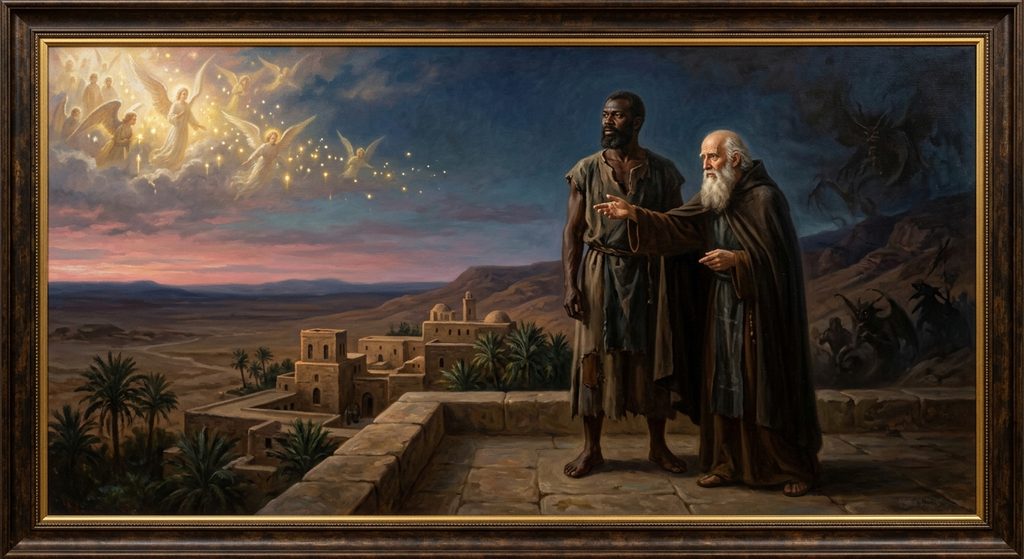
Moses the Black (c. 330–405), an Ethiopian by birth, was a runaway slave who became the violent leader of a band of robbers before his conversion drove him into the Egyptian desert at Scetis. His life illustrates a truth the tradition insists on: conversion does not end temptation. Even as a monk Moses was tormented night and day by the demon of fornication, assaulted by memories and lustful visions (Orthodox Road, n.d.). His spiritual father, Abba Isidore, counseled fasting, vigilance, and unceasing prayer, and in one of the most beloved sayings of the desert took Moses to the terrace before dawn: pointing west he showed him hordes of demons preparing to attack, and pointing east an innumerable multitude of shining angels, telling him that these were sent by the Lord to the saints to bring them help (Ward, trans. 1975). Isidore also taught him that the light only gradually drives away the darkness, so only slowly does one become a contemplative. Moses eventually found peace, was ordained a priest, gathered seventy-five disciples, and was martyred by raiders. His sayings are preserved in the Apophthegmata Patrum (Sayings of the Desert Fathers). His cult is pre-Congregation.
Why Did St. Charles de Foucauld Take So Long to Convert?
The modern era’s most striking case is Charles de Foucauld (1858–1916), canonized only recently. Born into the old French nobility at Strasbourg and orphaned at six, he lost his faith as a teenager and pursued, by his own admission, a dissolute life of food, drink, and women. As a cavalry officer posted to Algeria he insisted on bringing his mistress, known as Mimi, and when ordered to give her up he refused and was dismissed from the army (Franciscan Media, n.d.). He later reenlisted, distinguished himself, then resigned to explore Morocco, producing a celebrated book.
The devotion of Muslim believers he encountered awakened a spiritual hunger. Back in Paris, prompted by his cousin Marie de Bondy, he approached the Abbé Henri Huvelin at the church of Saint-Augustin in late 1886. When Charles said he had come only to ask about the faith, the priest instead commanded him to make his confession then and there; kneeling, Charles wept, confessed years of sin, and received communion (Aleteia, 2025). He became a Trappist, then a hermit, and finally settled among the Tuareg at Tamanrasset in the Sahara, living in radical poverty and adoration until he was killed by raiders on December 1, 1916. He was beatified on November 13, 2005, under Pope Benedict XVI, and canonized by Pope Francis on May 15, 2022. His feast is December 1.
How Did St. Angela of Foligno Turn a Sinful Life Into Mystical Theology?
Angela of Foligno (1248–1309) was a wealthy, married Umbrian woman who, by her own account and that of her confessor’s Memorial, spent her first decades in a worldly and adulterous life, even making bad confessions out of shame (Vatican News, n.d.). In her late thirties a moral crisis and the fear of hell drove her to a genuine confession that began her conversion. Widowed — she lost husband, mother, and children — she became a Franciscan tertiary and, under the direction of the friar Arnaldo, dictated the visions and instructions that earned her the title Magistra Theologorum, “Mistress of Theologians.” She died January 4, 1309. Beatified by Pope Clement XI on July 11, 1701, she was canonized by Pope Francis on October 9, 2013, through the rare procedure of equivalent (equipollent) canonization, by which the pope extends a long-standing cult to the universal Church without the usual juridical process and miracle. Her feast is January 4.
Which Saints Fought Lust Fiercely — but Never Fell?
The tradition is equally rich in saints who never committed serious sexual sin yet waged ferocious war against temptation, and these are, doctrinally, just as important, for they embody the Catechism’s teaching that resisted concupiscence “cannot harm those who do not consent” (CCC, 2003, no. 1264).
The most dramatic is St. Thomas Aquinas (1225–1274). When the young Thomas resolved to join the Dominicans, his family imprisoned him in the family castle and, according to the testimony gathered at his canonization, sent a seductress into his room to break his resolve. Thomas seized a burning brand from the fire, drove her out, and scorched a cross onto the door; falling asleep, he dreamed that two angels girded him with a cord of chastity, and he is said never again to have suffered such temptation (Marshall, 2011). He was canonized by Pope John XXII on July 18, 1323, and declared a Doctor of the Church; his feast is January 28.
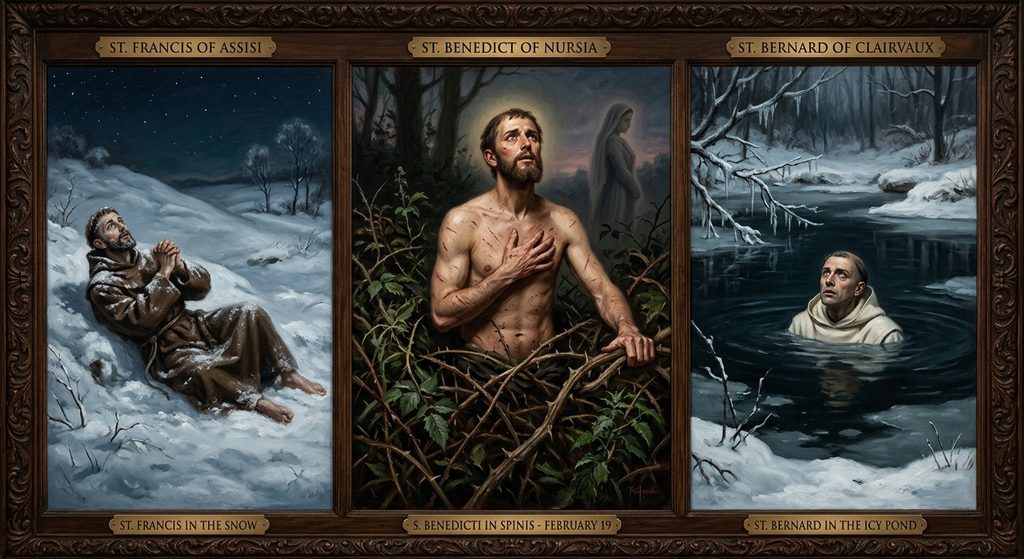
Two founders of Western monasticism gave the tradition its most physical images of resistance. St. Benedict of Nursia, according to St. Gregory the Great’s Dialogues, was so violently assailed by the memory of a woman that he stripped and threw himself into a patch of briars and nettles until the wounds of his body cured the wound of his soul, and never again was he troubled in the same way; the Benedictine calendar long commemorated the victory on February 19 as S. Benedicti in Spinis (St. Benet Oblates, 2022). St. Francis of Assisi, by a parallel tradition, rolled in the snow to quench temptation — a pairing enshrined in the maxim of St. Josemaría Escrivá: “To defend his purity, Saint Francis of Assisi rolled in the snow, Saint Benedict threw himself into a thorn bush, Saint Bernard plunged into an icy pond” (Escrivá, n.d.).
St. Jerome (c. 347–420) left the most searing first-person account. Writing to Eustochium of his years as a hermit in the desert of Chalcis, he confessed that in the remotest part of a wild and stony desert, burnt by the sun, he seemed to himself to be surrounded by the delights and crowds of Rome, haunted by visions of dancing Roman girls even as his body wasted with fasting (Jerome, trans. 1893). He conquered the fantasies by hurling himself into the study of Hebrew — a strikingly practical redirection of desire. Jerome, a Doctor of the Church, has a pre-Congregation cult; his feast is September 30.
St. Catherine of Siena (1347–1380) endured a sustained assault of lascivious visions and impure imaginings, according to her confessor Blessed Raymond of Capua’s Legenda Maior. When the trial lifted, Catherine asked where her Lord had been while her heart was disturbed by all those temptations, and Christ replied that He had been in her heart. When she protested that her heart had been full of filthy thoughts, he answered that the very sorrow and displeasure those thoughts caused her were proof he was hidden at its centre (Raymond of Capua, trans. 1980). She was canonized by Pope Pius II on June 29, 1461, declared a Doctor of the Church by Paul VI in 1970, and named co-patroness of Europe; her feast is April 29.
Rounding out this group are saints of heroic preserved purity and dissolute-but-not-primarily-lustful youth. St. Aloysius Gonzaga (1568–1591), the young Jesuit who died nursing plague victims, made a vow of perpetual virginity at nine and, the traditional accounts hold, was by a special grace ever exempted from temptations against purity; he practised such rigorous custody of the eyes that he became a byword for angelic purity. Beatified by Paul V in 1605 and canonized by Benedict XIII on December 31, 1726, he is patron of youth; his feast is June 21.
St. Ignatius of Loyola (1491–1556) was in his soldiering years, by his own Autobiography, a man given to the vanities of the world whose morals were far from stainless, though pride more than lust ruled him (Britannica, n.d.); canonized by Gregory XV on March 12, 1622, feast July 31.
St. Alphonsus Liguori (1696–1787), the Church’s great moral theologian of chastity and patron of confessors, is relevant chiefly as teacher rather than penitent; canonized by Gregory XVI on May 26, 1839, and made a Doctor in 1871.
St. Camillus de Lellis (1550–1614) and St. John of God (1495–1550) had genuinely dissolute youths — Camillus a compulsive gambler and brawler, John a wayward soldier — but the sources frame their vices as gambling, violence, and worldliness rather than lust specifically, a distinction worth preserving for accuracy.
What Should the Faithful Take From These Lives?
The lesson of this tradition is pastoral before it is dramatic.
First, no sexual sin places a soul beyond mercy: Augustine, Margaret, Mary of Egypt, and Angela were not merely forgiven but raised to the altars and, in several cases, made Doctors and mystics whose teaching now instructs the Church.
Second, conversion is ordinarily mediated through human instruments — a mother (Monica), a bishop (Ambrose, Nonnus), a confessor (Giunta Bevegnati, Huvelin, Raymond of Capua) — so those who would help sinners should not underestimate patient, persistent accompaniment.
Third, temptation is not defeat; the saints who fought without falling teach that the battle itself, sustained by grace and sacrament, is the path to the crown.
Concretely: the reader who struggles should imitate the saints’ means — frequent confession (Angela’s good confession was the hinge of her whole conversion), the Eucharist, prayer, spiritual direction, custody of the senses, and the redirection of desire into work and charity (Jerome’s Hebrew, Moses’ water-carrying, Margaret’s hospital).
The benchmark that changes the counsel is not the intensity of temptation, which may never fully cease this side of heaven, but consent: as long as the will resists, concupiscence cannot harm the soul (CCC, 2003, no. 1264).
References
Aleteia. (2025, December 1). How one Confession led to conversion for Charles de Foucauld. https://aleteia.org/2025/12/01/how-one-confession-led-to-conversion-for-charles-de-foucauld/
Augustine of Hippo. (1887). The confessions of St. Augustine (J. G. Pilkington, Trans.). Christian Literature Publishing. (Original work composed ca. 397–400 CE). https://www.newadvent.org/fathers/110108.htm
Britannica. (n.d.). St. Ignatius of Loyola. https://www.britannica.com/biography/St-Ignatius-of-Loyola
Catechism of the Catholic Church (2nd ed.). (2003). Libreria Editrice Vaticana. https://www.vatican.va/archive/ENG0015/_INDEX.HTM
Catholic.net. (n.d.). St. Margaret of Cortona. https://catholic.net/op/articles/2353/cat/1205/st-margaret-of-cortona.html
Christian History Institute. (n.d.). Augustine’s sex-life change: From profligate to celibate. https://christianhistoryinstitute.org/magazine/article/augustines-sex-life-from-profligate-to-celibate
Encyclopedia.com. (n.d.). Thaïs, St. New Catholic Encyclopedia. https://www.encyclopedia.com/religion/encyclopedias-almanacs-transcripts-and-maps/thais-st
Escrivá, J. (n.d.). The way, point 143. https://www.escrivaworks.org/book/the_way-point-143.htm
Franciscan Media. (n.d.). Saint Charles de Foucauld. https://www.franciscanmedia.org/saint-of-the-day/saint-charles-de-foucauld/
Hallow. (n.d.). St. Augustine of Hippo. https://hallow.com/saints/augustine-of-hippo/
Haskins, S. (1993). Mary Magdalen: Myth and metaphor. Harcourt Brace.
Jerome. (1893). Letter 22 to Eustochium (W. H. Fremantle, Trans.). Christian Literature Publishing. (Original work composed 384 CE). https://www.newadvent.org/fathers/3001022.htm
Loyola Press. (n.d.). Saint Pelagia the Penitent. https://www.loyolapress.com/catholic-resources/saints/saints-stories-for-all-ages/saint-pelagia-the-penitent/
Marshall, T. (2011, January). The miraculous cord of Saint Thomas Aquinas and the Angelic Warfare. https://taylormarshall.com/2011/01/miraculous-cord-of-saint-thomas-aquinas.html
New Advent. (n.d.-a). St. Margaret of Cortona. Catholic Encyclopedia. https://www.newadvent.org/cathen/09653b.htm
New Advent. (n.d.-b). Pelagia. Catholic Encyclopedia. https://www.newadvent.org/cathen/11601d.htm
Orthodox Road. (n.d.). Saint Moses the Black. https://www.orthodoxroad.com/saint-moses-the-black/
Patheos. (2016, April). St. Mary Magdalene: Former prostitute? https://www.patheos.com/blogs/davearmstrong/2016/04/st-mary-magdalene-former-prostitute.html
Raymond of Capua. (1980). The life of Catherine of Siena (C. Kearns, Trans.). Dominican Publications. (Original work composed ca. 1385–1395 CE).
Sophronius of Jerusalem. (1996). Life of St. Mary of Egypt (M. Kouli, Trans.). In A.-M. Talbot (Ed.), Holy women of Byzantium: Ten saints’ lives in English translation (pp. 65–93). Dumbarton Oaks. (Original work composed 7th century CE).
St. Benet Oblates. (2022, February 19). Monastic saints – Saint Benedict in the brambles. https://stbenetoblates.wordpress.com/2022/02/19/monastic-saints-saint-benedict-in-the-brambles-19-february/
Traditional Catholic. (n.d.). St. Margaret of Cortona, the second Magdalene. http://www.traditionalcatholic.co/st-margaret-of-cortona-the-second-magdalene/
Vatican News. (n.d.). St. Angela of Foligno. https://www.vaticannews.va/en/saints/01/04/st–angela-of-foligno–franciscan.html
Ward, B. (Trans.). (1975). The sayings of the Desert Fathers: The alphabetical collection. Cistercian Publications. (Original work composed 4th–5th century CE).