Why Did Christ Promise to Remain “All Days” With a Church of Mortal Men?
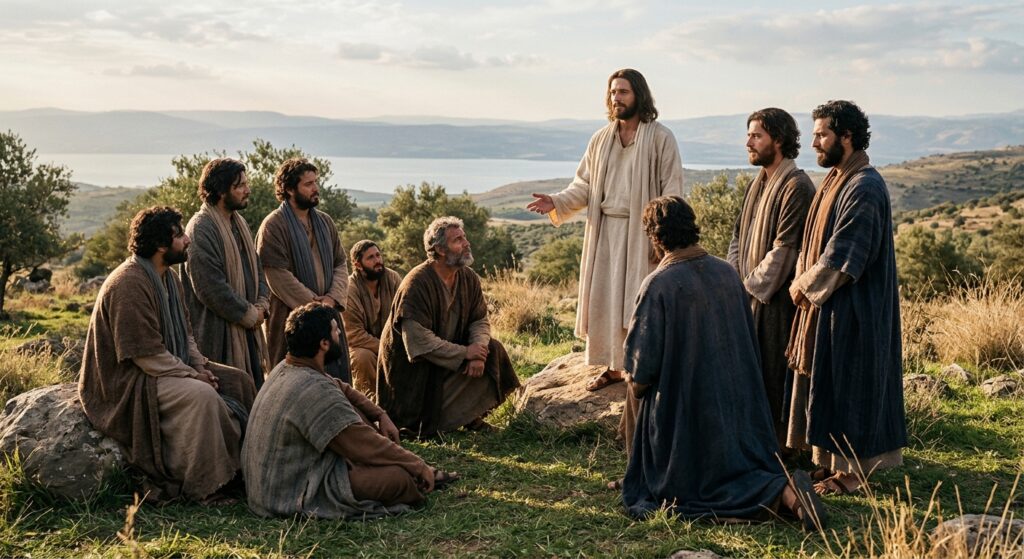
Saint Matthew closes his Gospel on a hillside in Galilee with eleven men who had every reason to expect that the story was ending. Their Master had been killed, raised, and was about to be taken from their sight. Yet the words He speaks to them do not sound like a farewell. He claims universal authority, hands them a mission that stretches to every nation on earth, and then promises something no dying man could receive for himself: that He will be with them every day until the world itself is finished (The Holy Bible, 2009, Matthew 28:18–20).
Those eleven men are long dead. Every one of them was buried, most of them violently. The promise, however, was not buried with them. That simple observation is the hinge on which a great deal of Catholic theology turns, and it is worth following carefully, because it leads directly to the altar.
What Exactly Did Christ Commission on That Mountain?
The passage has a tight architecture that is easy to miss when it is read devotionally rather than closely. Christ first declares the foundation: all authority in heaven and on earth has been given to Him. Only then does He issue the mandate — go, make disciples of all nations, baptise them in the name of the Father, the Son and the Holy Ghost, and teach them to keep everything He has commanded. Finally comes the guarantee: His own abiding presence.
The Latin of the Vulgate underlines the sweep of it with a fourfold omnis. All authority, all nations, all things commanded, all days. Nothing is fenced off. There is no suggestion of a mission that expires, a doctrine that may be trimmed, or a presence that thins out with distance from the first century.
Three things are being established here at once, and they cannot be separated without damaging each other. There is a teaching office, since someone must transmit “all things whatsoever.” There is a sacramental office, since baptism requires a minister and a form of words. And there is a divine presence that underwrites both. A merely human association could carry the first two badly for a generation or so. Only a body indwelt by Christ could carry them faithfully for two thousand years.
Why Does a Promise Made to Mortal Men Reach to the End of the World?
This is the question that will not go away. If the promise terminated with its original hearers, it should have been phrased differently — “I am with you until you die” would have been both accurate and consoling. Instead Christ names a horizon that none of the eleven would live to see.
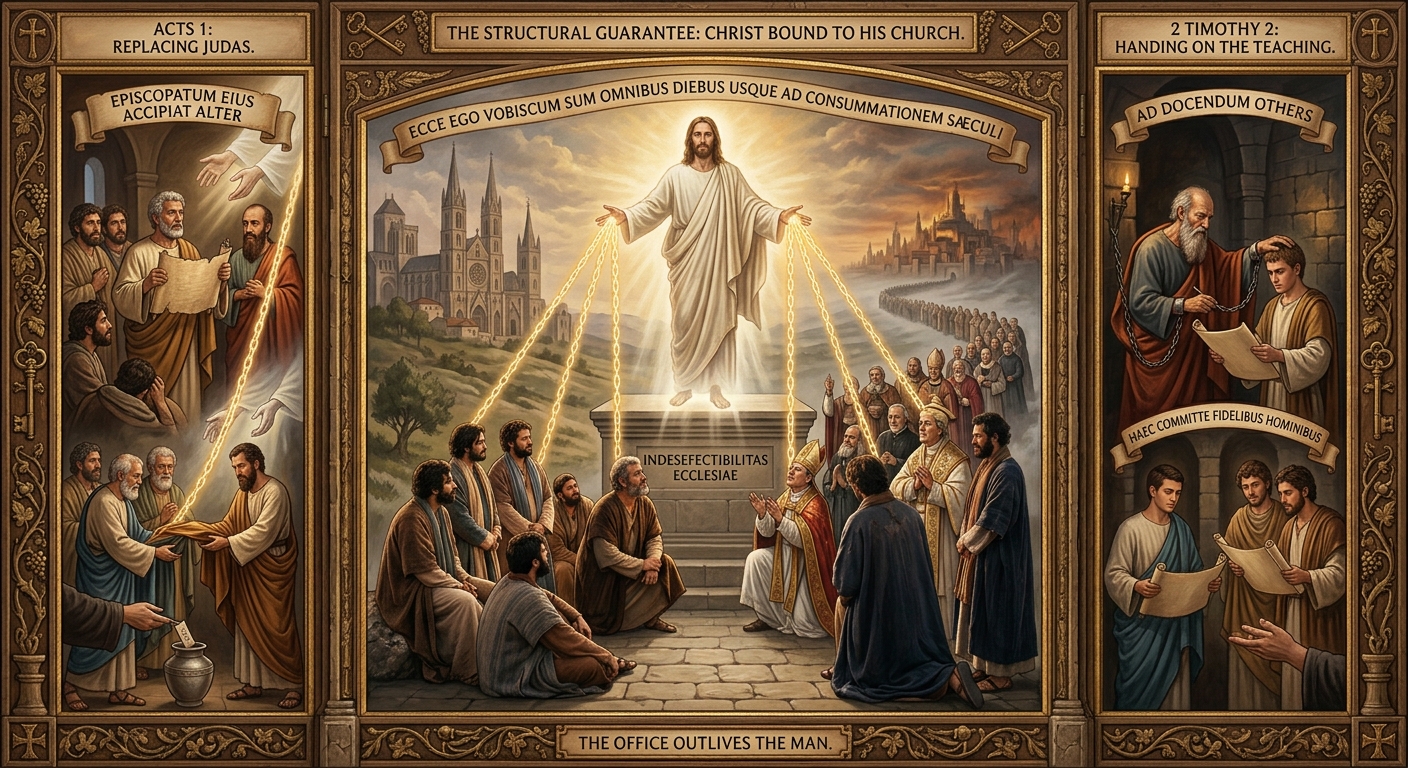
The only coherent reading is that He is addressing them not merely as eleven individuals but as the first holders of an office that would outlive them. Scripture itself shows the apostles drawing exactly that conclusion. Almost immediately after the Ascension they gather to replace Judas, and Saint Peter grounds the decision in the conviction that the apostolic charge is a position another man must take up (Acts 1:15–26). Saint Paul later instructs Timothy to hand on what he has received to reliable men who will in turn be capable of teaching others (2 Timothy 2:2). The vocabulary of succession is already in place inside the New Testament, well before any council or canon.
So the promise is not a sentimental reassurance offered to eleven anxious friends. It is a structural guarantee attached to an institution — what the Church calls her indefectibility. The Church cannot fail, not because her members are impressive, but because her Head has bound Himself to her.
How Did the First Christians Understand That Succession?
The generation that immediately followed the apostles did not treat succession as a later innovation requiring defence. They treated it as an obvious fact of Church life.
Writing to Corinth around the end of the first century, Clement of Rome describes the apostles appointing bishops and deacons and arranging that when these men died, other approved men should take over their ministry (Clement of Rome, 1885). Ignatius of Antioch, on his way to martyrdom, insists that no Eucharist is valid apart from the bishop or the one he appoints, and gives us the earliest surviving use of the phrase “Catholic Church” (Ignatius of Antioch, 1885). Irenaeus of Lyons, confronting Gnostic teachers who claimed a hidden apostolic tradition of their own, answered by listing the bishops of Rome in unbroken order from Peter, arguing that public, traceable succession is precisely what distinguishes authentic teaching from invention (Irenaeus of Lyons, 1885). Cyprian of Carthage pressed the point further, holding that the unity of the episcopate is the visible unity of the Church herself (Cyprian of Carthage, 1886).
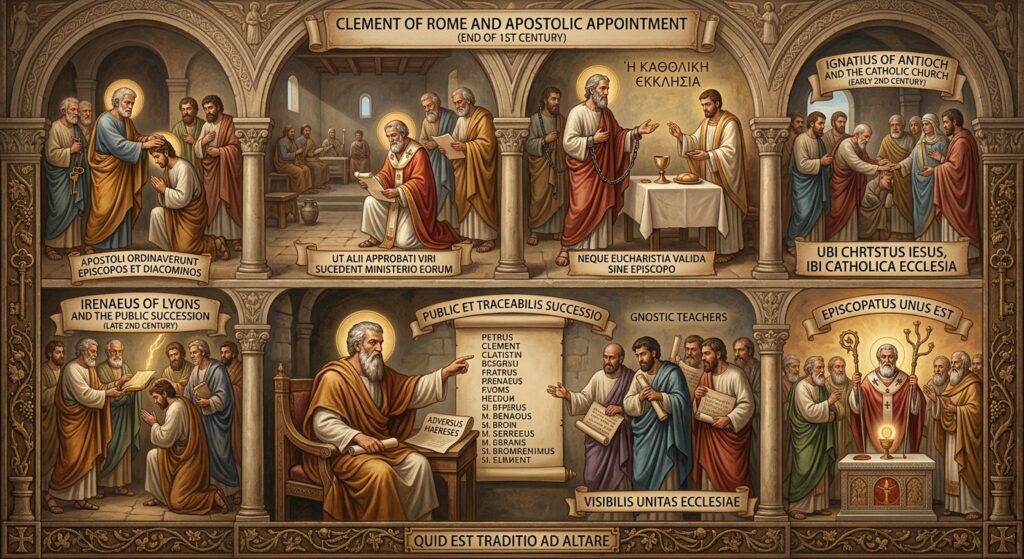
These men were not building a theory. They were describing how they already knew Christ’s promise was being kept. The presence Christ pledged was located, for them, in a visible communion with identifiable pastors, celebrating identifiable sacraments.
Is Christ Present Only in Memory, or in Reality?
Everything depends on how the final clause is heard. Christ does not say that His teaching will endure, or that His example will inspire, or that His followers should remember Him. He speaks in the present tense of His own person: I am with you.
The Church has always read this as an assertion of real, ongoing presence rather than influence at a distance. Pius XII developed the point at length in Mystici Corporis Christi, teaching that Christ is the Head of a Body that is genuinely His own, so that the Church’s life is His life communicated to her members (Pius XII, 1943). The Second Vatican Council took up the same theme, describing the Church as one complex reality in which the visible society and the spiritual community are not two things but one, comparable to the union of the divine and human natures in Christ Himself (Second Vatican Council, 1964, para. 8).
This is why Catholics do not experience the Church as an organisation that discusses Jesus. She is the means by which He continues to act. And if that presence is real, the obvious question becomes: where is it most concentrated?
Where Is Christ Present When His Church Gathers for Mass?
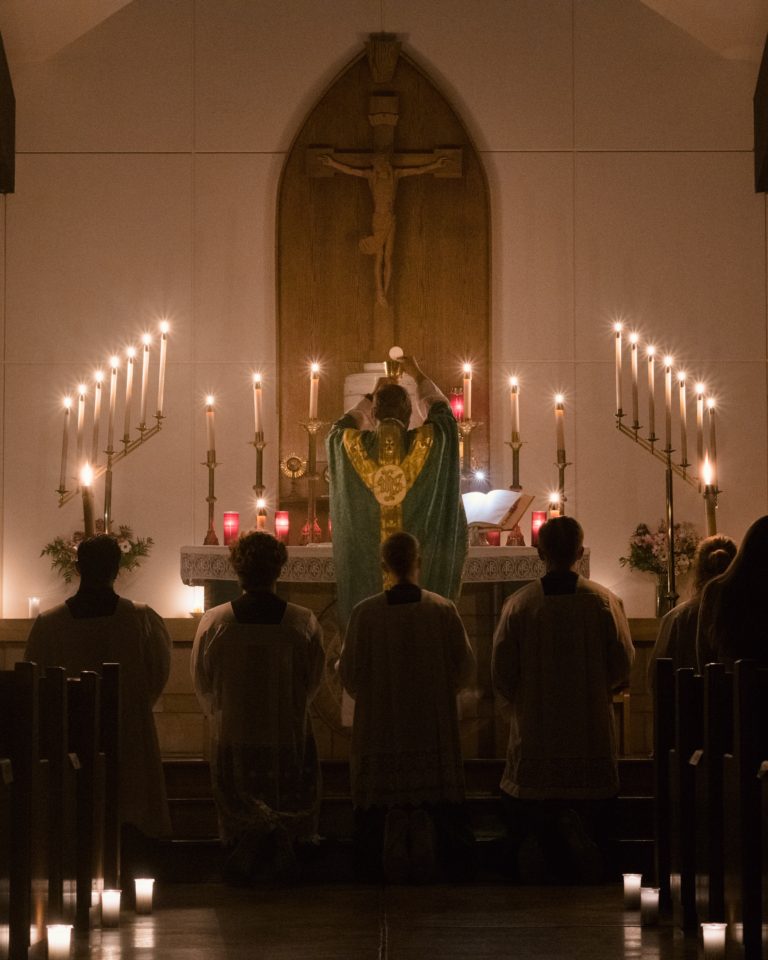
The Council answered that question with unusual precision. In the sacred liturgy Christ is present in several distinct ways at once: in the person of the priest who offers, since the same one who offered Himself on the Cross now offers through the ministry of His priests; in the sacramental species; in His word, since He speaks when the Scriptures are read; and in the praying and singing assembly (Second Vatican Council, 1963, para. 7).
Notice how exactly this matches the commission in Matthew. Christ said the Church would teach and would baptise, and He said He would be present. At Mass, the teaching happens in the proclaimed word, the sacramental economy is exercised at the altar and the font, and the promised presence is not an inference but the very substance of the rite. Pius XII had already insisted that the liturgy is Christ’s own priestly action continued in His Body, and not merely a devotional exercise the Church has designed for herself (Pius XII, 1947).
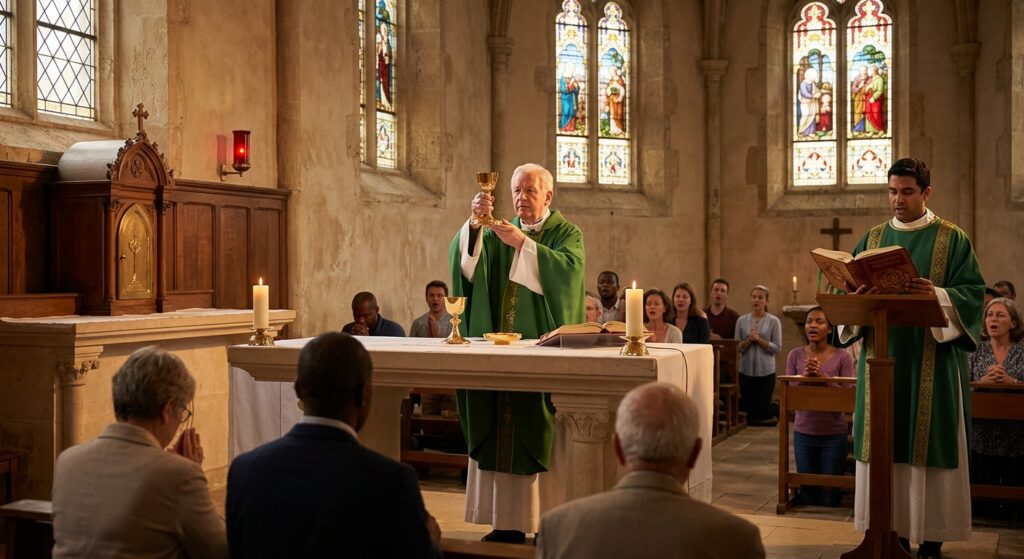
The Great Commission, in other words, is not a historical instruction the Church remembers. It is a description of what happens in every parish on a Tuesday morning.
Why Is the Eucharist the Deepest Fulfilment of “I Am With You”?
Among the modes of Christ’s presence, one stands apart. Paul VI called the Eucharistic presence a presence in the fullest sense, because in it Christ is made present whole and entire, God and man, substantially (Paul VI, 1965, para. 39). The Council of Trent had defined the same truth against the Reformers, teaching that after the consecration the body and blood of Christ are truly, really and substantially contained under the appearances of bread and wine (Schroeder, 1978). The Catechism preserves that language exactly, describing the Eucharistic presence as unique because it makes Christ present in a manner the other sacraments do not (Catholic Church, 2000, para. 1374).
Augustine, preaching on the sixth chapter of Saint John, had drawn out the consequence centuries earlier: the food we receive is not converted into us, as ordinary food is, but converts us into itself (Augustine, 1888). The Eucharist does not merely deliver grace; it configures the recipient to Christ.
John Paul II drew the threads together at the end of his pontificate. The Church, he wrote, draws her life from the Eucharist, so that the sacrament is not one activity among many but the source of everything else she is (John Paul II, 2003, para. 1). Benedict XVI made the same connection to Matthew’s closing promise, arguing that the Eucharist is where the risen Lord’s pledge to remain with His own becomes tangible rather than abstract (Benedict XVI, 2007).
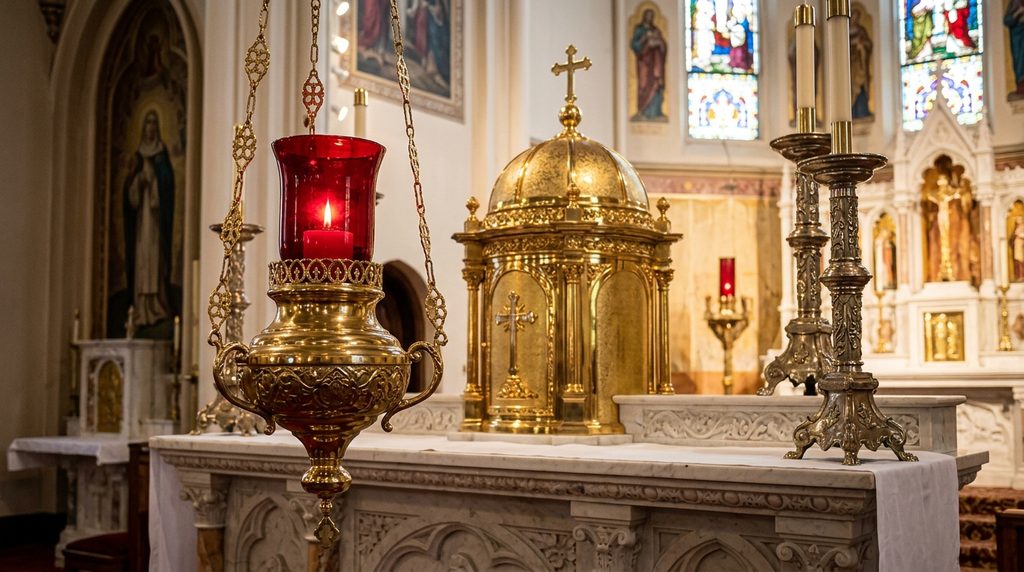
Read against this background, the tabernacle lamp in a country church is a commentary on Matthew 28:20. Christ said He would remain all days. He did not say He would remain invisibly, or only interiorly, or only when believers happened to feel devout. He remains under the appearance of bread, in a specific place, at a specific address, available at any hour.
Does the Passage Point Specifically to the Roman Catholic Church?
Honesty requires a careful answer here, because the text alone does not name a denomination. What the text does establish is a set of requirements, and the identification follows from asking which body actually meets them.
Christ’s words demand a community that is visible rather than invisible, since it must baptise and teach publicly. It must be universal, since it is sent to all nations. It must be authoritative, since it transmits everything He commanded and not a selection. It must be continuous, since the promise runs to the end of the world. And it must possess His presence in fact, not merely claim it.
Leo XIII argued that a Church answering this description must be one visible society with a visible governing authority, since Christ founded a body men could actually join and recognise (Leo XIII, 1896). The Second Vatican Council expressed the resulting identification with deliberate care: the Church of Christ subsists in the Catholic Church, governed by the successor of Peter and the bishops in communion with him, while acknowledging that genuine elements of sanctification and truth exist beyond her visible boundaries (Second Vatican Council, 1964, para. 8). The Congregation for the Doctrine of the Faith later clarified that this formula asserts full and continuing identity rather than one option among several (Congregation for the Doctrine of the Faith, 2000, para. 16).
Other Christians read the same verses differently, generally by locating the promised presence in the invisible fellowship of all believers rather than in a governed and sacramental body. The Catholic response is not that such readers are insincere, but that their reading struggles to account for the concrete verbs Christ actually uses. Baptism requires a minister. Teaching requires a teacher with standing. “All things whatsoever I have commanded” requires a custodian able to say what those things are. A presence promised to an invisible fellowship cannot easily explain why the apostles immediately organised, ordained and disciplined the way they did. The argument for the Catholic claim is cumulative rather than a single knock-down proof from one verse — but it is the reading that leaves the fewest words of Christ doing no work.
What Should This Mean for a Catholic Today?
If the promise is true, several ordinary habits become reasonable rather than pious.
It means that Sunday Mass is not primarily an obligation to be discharged but an encounter to be kept. It means that a few minutes before the tabernacle is time spent with a Person, not before a symbol of one. It means that the Church’s teaching, when it is genuinely her teaching, carries an authority that no individual conscience can simply overrule, because the guarantee attached to it is Christ’s rather than any bishop’s. And it means that the failures of churchmen, real and grievous as they have been, cannot finally destroy what Christ has bound Himself to sustain. The promise was never that the Church’s members would be worthy. It was that He would not leave.
Why Does an Ancient Promise Still Matter?
Every generation of Christians has faced some version of the same anxiety the eleven must have felt on that hillside: that the Lord has gone, that the age of His nearness is over, that what remains is memory and effort. Matthew’s final sentence exists to answer that anxiety in advance, and to answer it permanently.
The apostles died. The promise did not. It was not made to eleven mortal men considered simply as individuals, but to the Church they were about to become — a Church that would teach in His name, baptise with His authority, and gather at an altar where He would give Himself again under the form of bread. That is what “all days, even to the consummation of the world” means. Not a memory carefully preserved, but a Person still present.
References
Augustine. (1888). Tractates on the Gospel of John (J. Gibb, Trans.). In P. Schaff (Ed.), A select library of the Nicene and post-Nicene Fathers of the Christian Church (Vol. 7). Christian Literature Company.
Benedict XVI. (2007). Sacramentum caritatis [Post-synodal apostolic exhortation]. Libreria Editrice Vaticana.
Catholic Church. (2000). Catechism of the Catholic Church (2nd ed.). Libreria Editrice Vaticana.
Clement of Rome. (1885). The first epistle of Clement to the Corinthians. In A. Roberts, J. Donaldson, & A. C. Coxe (Eds.), The Ante-Nicene Fathers (Vol. 1). Christian Literature Publishing.
Congregation for the Doctrine of the Faith. (2000). Dominus Iesus [Declaration on the unicity and salvific universality of Jesus Christ and the Church]. Libreria Editrice Vaticana.
Cyprian of Carthage. (1886). On the unity of the Church. In A. Roberts, J. Donaldson, & A. C. Coxe (Eds.), The Ante-Nicene Fathers (Vol. 5). Christian Literature Publishing.
The holy Bible: Translated from the Latin Vulgate. (2009). Logos Bible Software. (Original work published 1899)
Ignatius of Antioch. (1885). Epistle to the Smyrnaeans. In A. Roberts, J. Donaldson, & A. C. Coxe (Eds.), The Ante-Nicene Fathers (Vol. 1). Christian Literature Publishing.
Irenaeus of Lyons. (1885). Against heresies. In A. Roberts, J. Donaldson, & A. C. Coxe (Eds.), The Ante-Nicene Fathers (Vol. 1). Christian Literature Publishing.
John Paul II. (2003). Ecclesia de Eucharistia [Encyclical letter]. Libreria Editrice Vaticana.
Leo XIII. (1896). Satis cognitum [Encyclical letter on the unity of the Church]. Libreria Editrice Vaticana.
Paul VI. (1965). Mysterium fidei [Encyclical letter on the holy Eucharist]. Libreria Editrice Vaticana.
Pius XII. (1943). Mystici corporis Christi [Encyclical letter on the mystical body of Christ]. Libreria Editrice Vaticana.
Pius XII. (1947). Mediator Dei [Encyclical letter on the sacred liturgy]. Libreria Editrice Vaticana.
Schroeder, H. J. (Trans.). (1978). The canons and decrees of the Council of Trent. TAN Books. (Original work published 1564)
Second Vatican Council. (1963). Sacrosanctum concilium [Constitution on the sacred liturgy]. Libreria Editrice Vaticana.
Second Vatican Council. (1964). Lumen gentium [Dogmatic constitution on the Church]. Libreria Editrice Vaticana.