Have We Stopped Fearing Sin Because We Stopped Fearing Hell?
When Did the Fires Go Out?
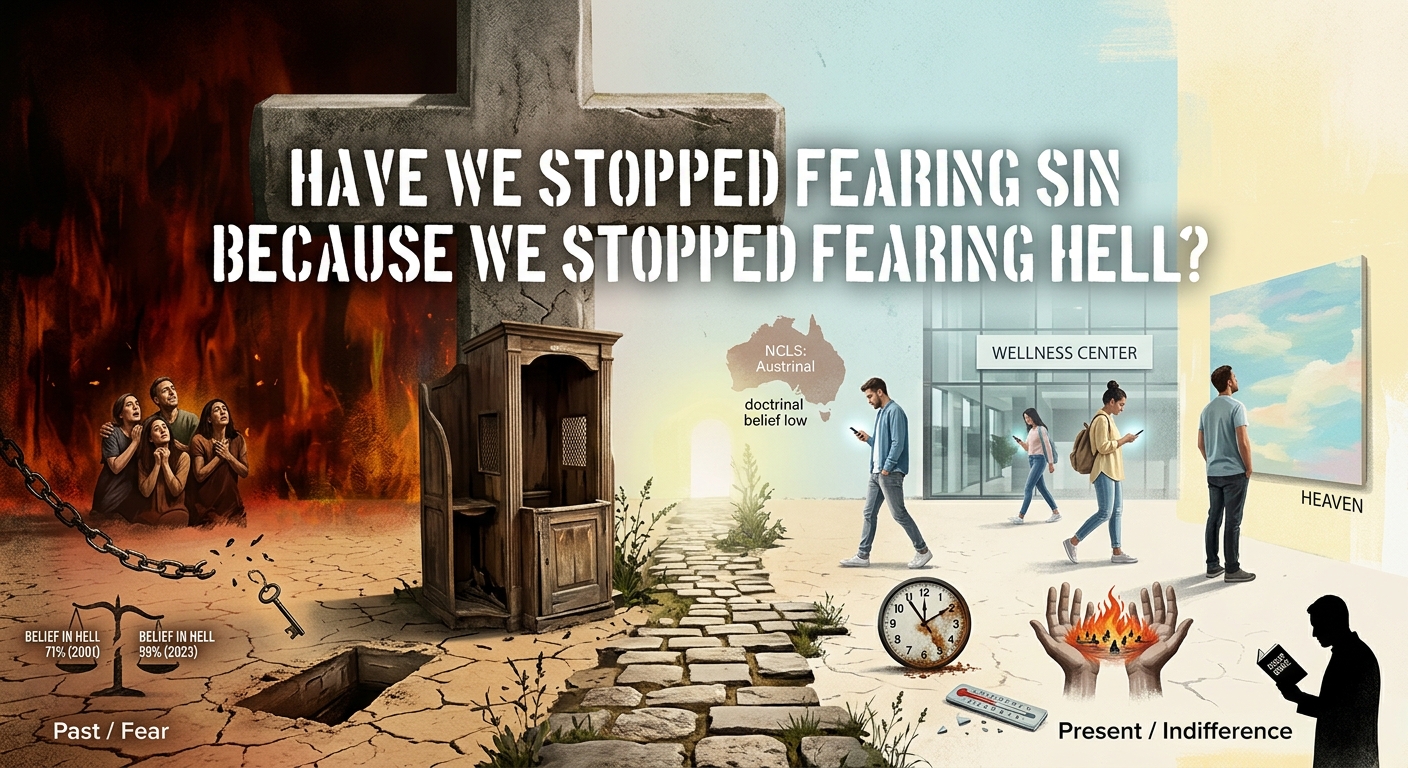
There is a sentence that keeps appearing, in slightly different forms, on Catholic notice-boards and social-media feeds: “People are no longer afraid of sin because they are no longer afraid of hell.” It is the kind of moral principle that is easy to dismiss as reactionary nostalgia — and yet the data suggest it names something real. This article takes the thesis seriously, tests it against the evidence, and then asks the harder question the slogan itself cannot answer: is fear the right foundation for holiness at all?
What Does the Data Actually Show About Belief in Hell?
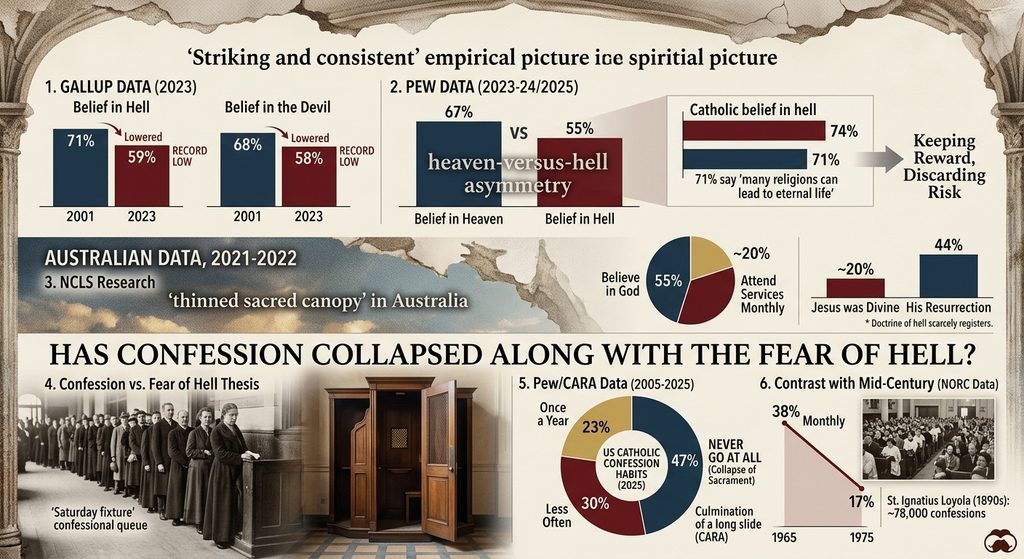
The empirical picture is striking and consistent. In the United States, Gallup found that belief in hell fell to 59% in its May 1–24, 2023 poll of 1,011 adults — down twelve points from 71% in 2001, and the lowest point in the more than two decades Gallup has asked the question (Gallup, 2023). Belief in the devil sat at 58% in the same poll, down ten points from 68% in 2001 — also a record low. Pew Research Center’s vast 2023–24 Religious Landscape Study reported belief in heaven at 67% but hell at only 55% (Pew Research Center, 2025).
That gap — the heaven-versus-hell asymmetry — is the most telling single finding. Americans consistently believe in heaven far more than in hell, and the gap widens among Catholics: as Pew reports, while roughly nine in ten Protestants in the evangelical and historically Black traditions believe in hell, only about seven in ten mainline Protestants (69%) and 74% of Catholics share this belief (Pew Research Center, 2021). Catholics are also the Christian group most likely — 71% — to say that many religions can lead to eternal life (Pew Research Center, 2021). People are, in effect, keeping the reward and quietly discarding the risk.
In Australia — the readership this article primarily addresses — the sacred canopy has thinned dramatically. NCLS Research’s 2021 Australian Community Survey found that 55% of Australians still say they believe in God, and around six in ten pray or meditate in some form (NCLS Research, 2022). But only about one in five Australians attends religious services monthly, and belief in specifically Christian doctrines is far lower: only two in ten Australians affirm that Jesus was divine, and only 44% believe in his resurrection in any sense (NCLS Research, 2021). The doctrine of hell scarcely registers in public consciousness at all.
Has Confession Collapsed Along With the Fear of Hell?
If the thesis is correct, we would expect the sacrament most directly tied to the fear of sin — Confession — to have collapsed. It has. Pew’s 2025 survey of U.S. Catholics found that just 23% go to confession at least once a year, 30% go less often, and 47% say they never go at all (Pew Research Center, 2025b). This is the culmination of a long slide: Georgetown University’s Center for Applied Research in the Apostolate (CARA) found in 2005 and again in 2008 that three-quarters of Catholics never participate in the sacrament of reconciliation, or do so less than once a year. Boston College historian James O’Toole has documented the fall across a century in his study of the sacrament in America.
The contrast with the mid-twentieth century is stark. According to the National Opinion Research Center, the proportion of Catholics going to confession monthly fell from 38% in 1965 to 17% by 1975. A single New York parish — St. Ignatius Loyola on Park Avenue — recorded roughly 78,000 confessions in a single year in the 1890s. The confessional queue, once a Saturday fixture, has largely disappeared.
Did the Popes See This Coming?
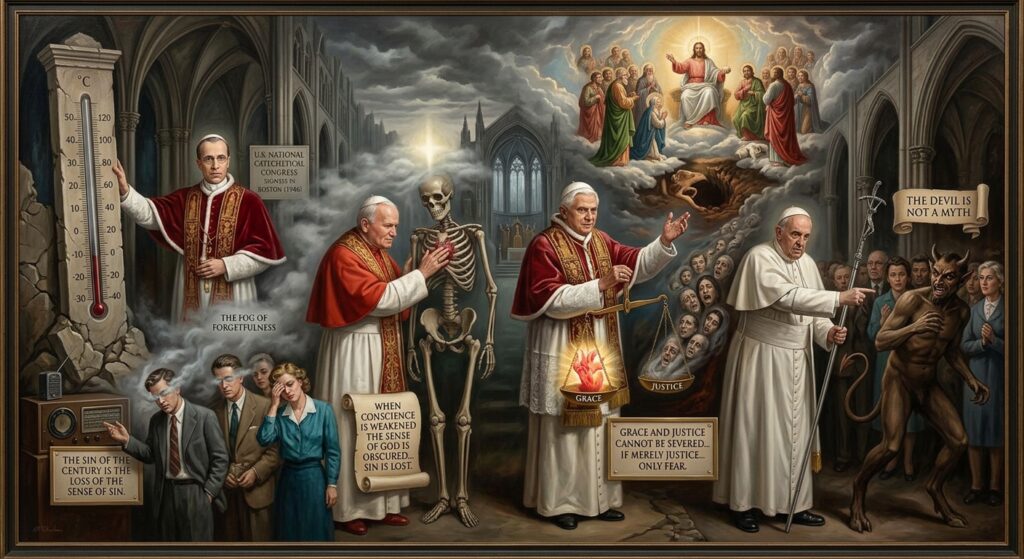
They did, and with remarkable prescience. In a radio message to the U.S. National Catechetical Congress in Boston on October 26, 1946, Pope Pius XII declared that the sin of the century is the loss of the sense of sin (Pius XII, 1946, as cited in John Paul II, 1984). Nearly four decades later, John Paul II built an entire section of his apostolic exhortation Reconciliatio et Paenitentia around that line. In §18, “The Loss of the Sense of Sin,” he diagnosed the mechanism: “When the conscience is weakened the sense of God is also obscured, and as a result, with the loss of this decisive inner point of reference, the sense of sin is lost” (John Paul II, 1984, §18). The sense of sin, he wrote, is the “thermometer” of the moral conscience.
Pope Benedict XVI addressed the other end of the chain — the Last Things — in his 2007 encyclical Spe Salvi. In its section on judgement as a setting for learning and practising hope (§§41–48), he insisted that grace and justice cannot be severed: “If it were merely grace, making all earthly things cease to matter, God would still owe us an answer to the question about justice…. If it were merely justice, in the end it could bring only fear to us all” (Benedict XVI, 2007, §47). Pope Francis, for his part, has been relentless about the reality of the devil, warning in Gaudete et Exsultate that “we should not think of the devil as a myth, a representation, a symbol, a figure of speech or an idea” (Francis, 2018, §161), and telling a congregation in 2014 that the devil exists and must be fought.
What Did Christ Himself Say About Hell?
Any honest reckoning must begin with the fact that hell is not a medieval invention but a theme of Jesus’ own preaching. He spoke of “Gehenna,” the “unquenchable fire” (Mark 9:43–48); he warned, “do not fear those who kill the body but cannot kill the soul; rather fear him who can destroy both soul and body in hell” (Matthew 10:28); he told the parable of Dives and Lazarus with its “great chasm” fixed between torment and consolation (Luke 16:19–31); and in Matthew 25:31–46 he pronounced the sentence: “Depart from me, you cursed, into the eternal fire.” As Avery Cardinal Dulles observed, throughout his preaching Jesus holds forth two and only two final possibilities for human existence (Dulles, 2003).
The Catechism codifies this without flinching. Hell is “the state of definitive self-exclusion from communion with God and the blessed” (Catechism of the Catholic Church [CCC], 1993, §1033); the teaching of the Church affirms the existence of hell and its eternity (§1035). Crucially, the Catechism frames hell not as arbitrary divine cruelty but as the ratification of a human choice: its chief punishment is eternal separation from God. Hell, in this account, is what love looks like when it is finally and freely refused.
What Is the “Fear of the Lord” — and Is It the Same as Being Afraid?
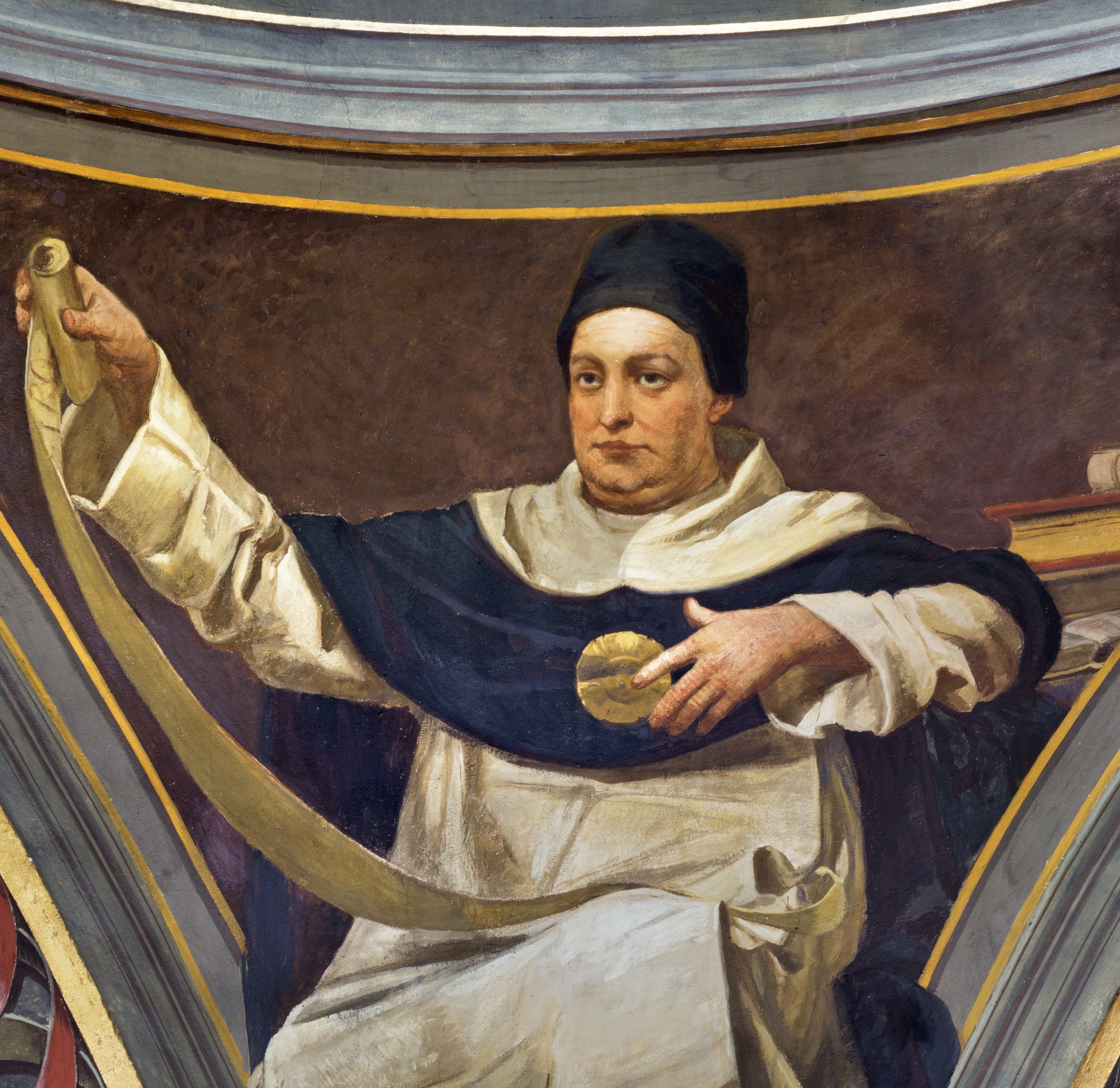
Here the slogan requires refinement, because Scripture and Tradition do not treat all fear as equal. “The fear of the Lord is the beginning of wisdom” (Proverbs 9:10; Psalm 111:10; cf. Sirach 1:11–20) — but the tradition distinguishes carefully between kinds of fear. St. Thomas Aquinas, in the Summa Theologiae (II-II, q. 19), lays out the classic taxonomy. Servile fear turns from sin through dread of punishment; filial fear (also called chaste or reverential fear) shrinks from sin because it fears to offend a beloved Father; and initial fear stands between the two. St Thomas Aquinas is clear: “if a man turn to God and adhere to Him, through fear of punishment, it will be servile fear; but if it be on account of fear of committing a fault, it will be filial fear” (Aquinas, trans. 1920, II-II, q. 19, a. 2). Only filial fear is numbered among the seven gifts of the Holy Spirit — and, importantly, as charity grows, servile fear loses its servility.
This distinction matters enormously for the thesis. Servile fear — the raw fear of hell — is not the summit of the Christian life. But neither is it worthless. St Thomas Aquinas calls it a genuine principle disposing a man to wisdom. The tradition treats it as a doorway, not a destination.
Does the Church Really Teach That Fear of Hell “Works”?
Yes — with a precise qualification. The Council of Trent, in its Fourteenth Session (1551), defined that imperfect contrition, which is called attrition, arising from the consideration of the heinousness of sin or from the fear of hell and of punishment, is a gift of God and an impulse of the Holy Spirit, and disposes the sinner to grace within the sacrament of Penance (Council of Trent, 1551). The Catechism echoes this: attrition, born even of the fear of eternal damnation, is a supernatural gift that “disposes one to obtain forgiveness in the sacrament of Penance” (CCC, 1993, §1453). Trent also anathematised the opposite error — the Lutheran claim that fear-driven sorrow makes a man a hypocrite and a greater sinner.
So the Church’s answer is nuanced: fear of hell is a real and legitimate starting point, but perfect contrition — sorrow arising “from a love by which God is loved above all else” (CCC, 1993, §1452) — is higher. Grace begins where the sinner is and draws him toward love.
What Did the Saints See, and Why Did They Preach It?
The saints who most deeply loved God were also, strikingly, the ones most vivid about hell. St. Teresa of Ávila, in Chapter 32 of her Life, describes a vision in which the Lord showed her the place prepared for her in hell — a narrow, suffocating recess in a wall — a vision she credits with detaching her from sin (Teresa of Ávila, trans. 1911). St. Ignatius of Loyola made a meditation on hell the climax of the First Week of his Spiritual Exercises. St. Alphonsus Liguori returned again and again to the “Four Last Things” — Death, Judgement, Heaven, and Hell — in his Preparation for Death and his Sunday sermons.
In the twentieth century, St. Faustina Kowalska recorded a vision of hell in her Diary, writing: “I am writing this at the command of God, so that no soul may find an excuse by saying there is no hell.” She added a chilling observation: “most of the souls there are those who disbelieved that there is a hell” (Kowalska, 2005, §741). Yet the same passage ends not in terror but in love: “I would rather be in agony until the end of the world… than to offend You by the least sin.” The vision produced not paralysis but ardour.
Why Does Fatima Matter to This Argument?
The single most influential modern instance of hell being shown rather than merely preached is Fatima. On July 13, 1917, according to the testimony Sister Lúcia later set down at her bishop’s request, Our Lady opened her hands and the rays of light seemed to penetrate the earth, revealing what the children described as a sea of fire filled with demons and souls like transparent burning embers (dos Santos, as cited in de Marchi, 1952). The children were so terrified, witnesses reported hearing Lúcia cry out. Our Lady then taught them the prayer now added after each decade of the Rosary by millions: “O my Jesus, forgive us our sins, save us from the fires of hell; lead all souls to Heaven, especially those most in need of Thy mercy” (EWTN, n.d.).
Fatima is significant precisely because it was, in effect, a heavenly intervention against the loss of the sense of hell — and it came from the same apparition that stressed mercy, the Immaculate Heart, and prayer for sinners. Fear and love were not opposed but woven together.
What Do Sociologists Say Replaced the Fear of Hell?
The most influential secular diagnosis matches the Catholic one almost exactly. Sociologist Christian Smith, drawing on the National Study of Youth and Religion, coined the term Moralistic Therapeutic Deism (MTD) to describe the actual, de facto creed of American teenagers (Smith & Denton, 2005). Its tenets: a God exists who created the world; God wants people to be good and nice; the central goal of life is to be happy and feel good about oneself; God is not particularly involved except when needed to solve a problem; and good people go to heaven when they die. Note what is absent: sin, judgement, repentance, the cross — and hell. MTD is Christianity with the fear, and the demand, surgically removed.
Behind MTD lies a longer story. Charles Taylor’s A Secular Age describes the shift to a society in which belief in God is no longer axiomatic but one option among many, lived within an “immanent frame” that brackets out transcendence (Taylor, 2007). Philip Rieff had earlier named the triumph of the therapeutic, in which psychological well-being displaces moral salvation. And in 1973 the psychiatrist Karl Menninger — founder of the Menninger Clinic — asked Whatever Became of Sin?, observing that the very word “sin,” which seems to have disappeared, was a proud word, its content redistributed into the categories of crime and sickness (Menninger, 1973). Dietrich Bonhoeffer had already given the theological name for the result: cheap grace — “the preaching of forgiveness without requiring repentance… grace without discipleship, grace without the cross” (Bonhoeffer, 1959).
Does Believing in Hell Actually Make People Behave Better?
Here the empirical evidence is more provocative than many expect. In a widely cited study, psychologists Azim Shariff and Mijke Rhemtulla analysed 26 years of data from 143,197 people across 67 countries and found that the proportion of people who believe in hell negatively predicts national crime rates, whereas belief in heaven predicts higher crime rates (Shariff & Rhemtulla, 2012). The authors add that these effects remain after accounting for a host of covariates, and ultimately prove stronger predictors of national crime rates than economic variables such as GDP and income inequality.
This is, on its face, strong support for the thesis. But the authors themselves warn against over-reading it: the findings are correlational, and Shariff explicitly cautioned that they do not indicate that belief in hell reduces crime. There is also a darker side: a companion literature on the emotional toll of hell links hell-belief to lower personal well-being. Fear may deter, but it does not, by itself, sanctify.
Is Fear a Good Foundation for Holiness — or a Dangerous One?
This is where intellectual honesty requires the article to turn on its own thesis. The Church has never taught that terror is the perfection of the Christian life — quite the opposite. “There is no fear in love, but perfect love casts out fear” (1 John 4:18). The whole point of St Thomas Aquinas’s taxonomy is that servile fear is meant to be outgrown, not clung to. St. Francis de Sales built his entire spirituality on gentleness and the primacy of the love of God. And history furnishes a genuine cautionary tale: Jansenism, the rigorist movement condemned by the Church, produced a religion so dominated by fear of damnation and unworthiness that many of the faithful stayed away from Communion for years — a spiritual pathology, not health.
There is also the real danger of scrupulosity, the obsessive, anxious fear of sin that torments sensitive consciences and can drive people from God rather than toward him. A purely fear-based religion tends to collapse either into despair — the sin against hope by which a man ceases to hope for his personal salvation from God — or, when the fear finally lifts, into the very indifference we now see. The Catechism explicitly names both presumption and despair as sins against hope (CCC, 1993, §§2091–2092). Fear that is not transformed into love is unstable; it does not last.
So Is the Thesis True?
Yes — but as a diagnosis, not a cure. The evidence genuinely supports the observation embedded in the slogan: belief in hell has declined faster than belief in heaven; the practice of Confession has collapsed alongside it; the sense of sin has faded into therapeutic self-acceptance; and there is even cross-national data linking the eclipse of hell to weaker moral restraint. Pius XII, John Paul II, and a chorus of sociologists from Menninger to Smith all describe the same phenomenon. To that extent the slogan is not reactionary nostalgia; it is an accurate reading of the age.
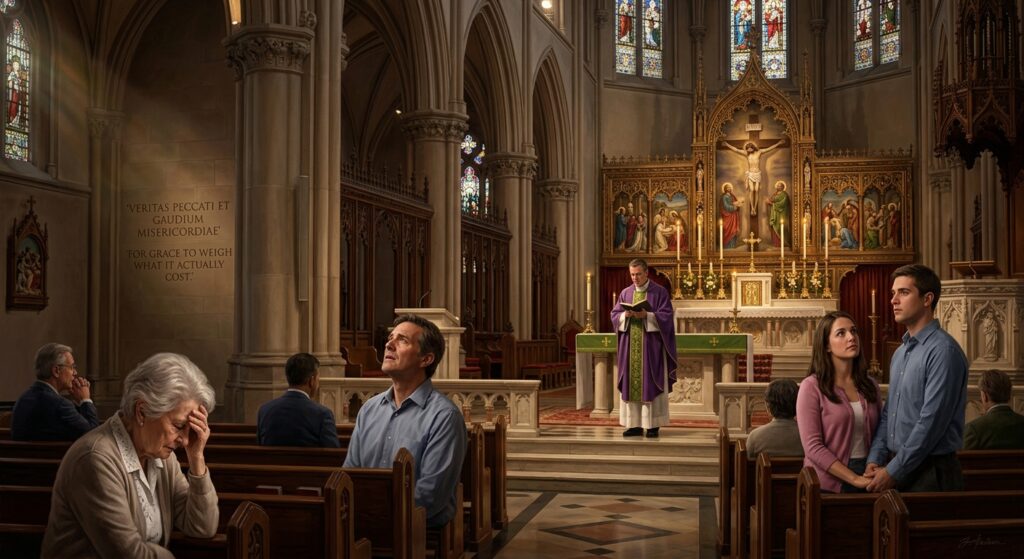
But the deeper Catholic answer is that the solution is not simply to frighten people back into the pews. The Church’s own tradition insists that servile fear is a doorway to be passed through, not a house to be lived in. The recovery Catholics should pray and work for is not a religion of terror but the restoration of the whole moral drama — the reality of sin, the seriousness of judgement, the possibility of loss, and, precisely because of all this, the astonishing, costly, and utterly serious mercy of God. Hell must be preached again not to make people cower, but to make grace weigh what it actually cost.
What Should Be Done?
The renewal begins in the pulpit and the confessional. Preachers might recover the ancient custom of preaching the Four Last Things during Advent, and resist the “instant canonisation” of every funeral, which quietly teaches that judgement is a fiction. Catechesis should present sin honestly — not as neurosis to be managed but as a rupture in a love relationship to be healed. And the sacrament of Confession, above all, should be made abundantly available and warmly commended, since it is there that the fear of hell is meant to be transfigured into the love that casts fear out. The goal is not fear for its own sake, but saints — and, as the saints themselves show, those who love God most are never the ones who take hell least seriously.
References
Aquinas, T. (1920). The Summa Theologica of St. Thomas Aquinas (2nd rev. ed., Fathers of the English Dominican Province, Trans.). Burns Oates & Washbourne. (Original work composed c. 1265–1274)
Benedict XVI. (2007). Spe salvi [Encyclical letter]. Libreria Editrice Vaticana. https://www.vatican.va/content/benedict-xvi/en/encyclicals/documents/hf_ben-xvi_enc_20071130_spe-salvi.html
Bonhoeffer, D. (1959). The cost of discipleship (R. H. Fuller, Trans.). SCM Press. (Original work published 1937)
Catechism of the Catholic Church. (1993). Libreria Editrice Vaticana.
Council of Trent. (1551). The fourteenth session: The doctrine on the sacraments of penance and extreme unction. https://www.papalencyclicals.net/councils/trent/fourteenth-session.htm
de Marchi, J. (1952). The true story of Fatima. Catholic Book Publishing.
Dulles, A. (2003, May). The population of hell. First Things, (133), 36–41. https://www.firstthings.com/article/2003/05/the-population-of-hell
EWTN. (n.d.). The Fatima prayer. https://www.ewtn.com/catholicism/teachings/fatima-prayer-102
Francis. (2018). Gaudete et exsultate [Apostolic exhortation]. Libreria Editrice Vaticana. https://www.vatican.va/content/francesco/en/apost_exhortations/documents/papa-francesco_esortazione-ap_20180319_gaudete-et-exsultate.html
Gallup. (2023, July 20). Belief in five spiritual entities edges down to new lows. https://news.gallup.com/poll/508886/belief-five-spiritual-entities-edges-down-new-lows.aspx
John Paul II. (1984). Reconciliatio et paenitentia [Apostolic exhortation]. Libreria Editrice Vaticana. https://www.vatican.va/content/john-paul-ii/en/apost_exhortations/documents/hf_jp-ii_exh_02121984_reconciliatio-et-paenitentia.html
Kowalska, M. F. (2005). Diary: Divine mercy in my soul (3rd ed.). Marian Press.
Menninger, K. (1973). Whatever became of sin? Hawthorn Books.
NCLS Research. (2021). Middle aged Australians most sceptical about Jesus. https://www.ncls.org.au/articles/middle-aged-australians-most-sceptical-about-jesus/
NCLS Research. (2022). ‘No religion’ part of ongoing trend, but not whole story. https://www.ncls.org.au/articles/no-religion-part-of-ongoing-trend-but-not-whole-story/
Pew Research Center. (2021, November 23). Views on the afterlife. https://www.pewresearch.org/religion/2021/11/23/views-on-the-afterlife/
Pew Research Center. (2025, February 26). Religious and spiritual beliefs. https://www.pewresearch.org/religion/2025/02/26/religious-and-spiritual-beliefs/
Pew Research Center. (2025b, June 16). Catholic practices and devotions in the U.S. https://www.pewresearch.org/religion/2025/06/16/catholic-practices-and-devotions/
Shariff, A. F., & Rhemtulla, M. (2012). Divergent effects of beliefs in heaven and hell on national crime rates. PLoS ONE, 7(6), e39048. https://doi.org/10.1371/journal.pone.0039048
Smith, C., & Denton, M. L. (2005). Soul searching: The religious and spiritual lives of American teenagers. Oxford University Press.
Taylor, C. (2007). A secular age. Belknap Press of Harvard University Press.
Teresa of Ávila. (1911). The life of St. Teresa of Jesus, of the Order of Our Lady of Carmel (D. Lewis, Trans.). Thomas Baker. (Original work published 1588)