Who Were the Oldest People in the Bible?
Why Did People in the Bible Live So Long?
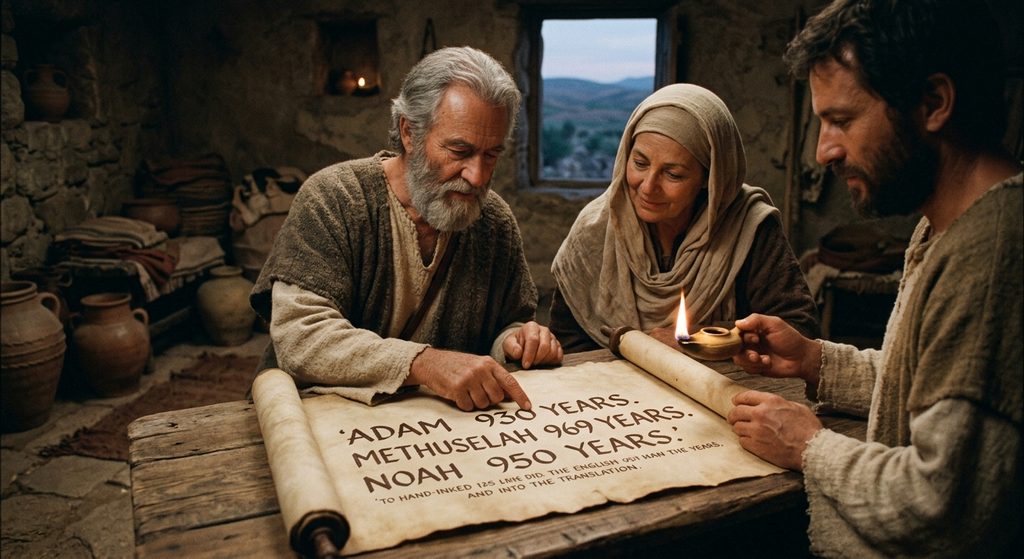
Long before medicine, refrigeration, or clean water systems, Scripture tells us that certain men and women lived for centuries. Adam died at 930. Methuselah, the oldest man ever recorded, lived 969 years. Noah survived the Flood and lived on for another 350 years after it. To a modern reader these numbers can seem like the stuff of legend, yet the sacred writers record them with the same sober, list-like precision they use for ordinary genealogies — no fanfare, no mythic flourish, just years, sons, and deaths, one after another down the family line.
The Catholic tradition has never treated these ages as a throwaway detail. Saint Augustine devoted several chapters of The City of God to defending them as literal solar years, arguing pointedly against those in his own day who tried to shrink them down to something more familiar.
He insisted that the ancient day was a full twenty-four hours, just as it is now. At the same time, the Church has never bound Catholics to a single method of reading these numbers. The Catechism teaches that the early chapters of Genesis convey real, primeval events even while using a distinctive and sometimes figurative literary language (CCC 390), and Pope Pius XII urged scholars to attend carefully to the ancient literary forms in which Genesis was written rather than judging it by the standards of modern history-writing.
So why the long lives? The patristic answer begins with Eden itself. Adam and Eve were created in what the Catechism calls “original holiness and justice” (CCC 375), a state of integrity that death entered only through sin.
“For in the day that you eat of it you shall surely die.” — Genesis 2:17
The patriarchs nearest to that original state, on this reading, still carried something of humanity’s undamaged vitality — a vitality that eroded, generation by generation, as sin’s consequences deepened. That erosion shows up in the text itself as a visible pattern: lifespans holding above 900 years before the Flood, dropping to the 200–600 range in the century after it, and falling further still after the scattering at Babel, until they settle into the “seventy, or even by reason of strength eighty” years of Psalm 90:10 that we still recognize today. Monsignor Charles Pope of the Archdiocese of Washington put the pastoral point plainly: whatever the precise nature of the numbers, we don’t live that long today because of the collective effect of sin upon us.
Scholars have also proposed less literal explanations worth knowing, if only to answer the objection that these numbers are simply errors. Genesis was written into a world that used a base-60 counting system, and geologist Carol Hill has shown that all thirty of the antediluvian age-numbers in Genesis 5 are built from combinations of the “sacred” numbers 60 and 7 — a pattern she calculates has roughly a one-in-a-billion chance of arising by accident. Others point to the Sumerian King List, a genuinely ancient Mesopotamian document in which pre-Flood kings reign for tens of thousands of years, as evidence that longevity itself was simply how the ancient Near East chose to honor its founding ancestors. And translators have long known that the Hebrew Masoretic Text, the Greek Septuagint, and the Samaritan Pentateuch disagree with one another on several of the exact “begetting ages” in these genealogies. What no ancient text tradition does, however, is make these figures ordinary — every manuscript family we possess still has the patriarchs living for centuries.
Whichever explanation a reader finds most persuasive, the Church leaves this specific question open. What she asks us to hold is the deeper truth these genealogies were written to protect: an unbroken human history running from Adam to Abraham, a real Fall with real consequences, and real foreshadowing of Christ himself.
Who Was the Oldest Person in the Bible?
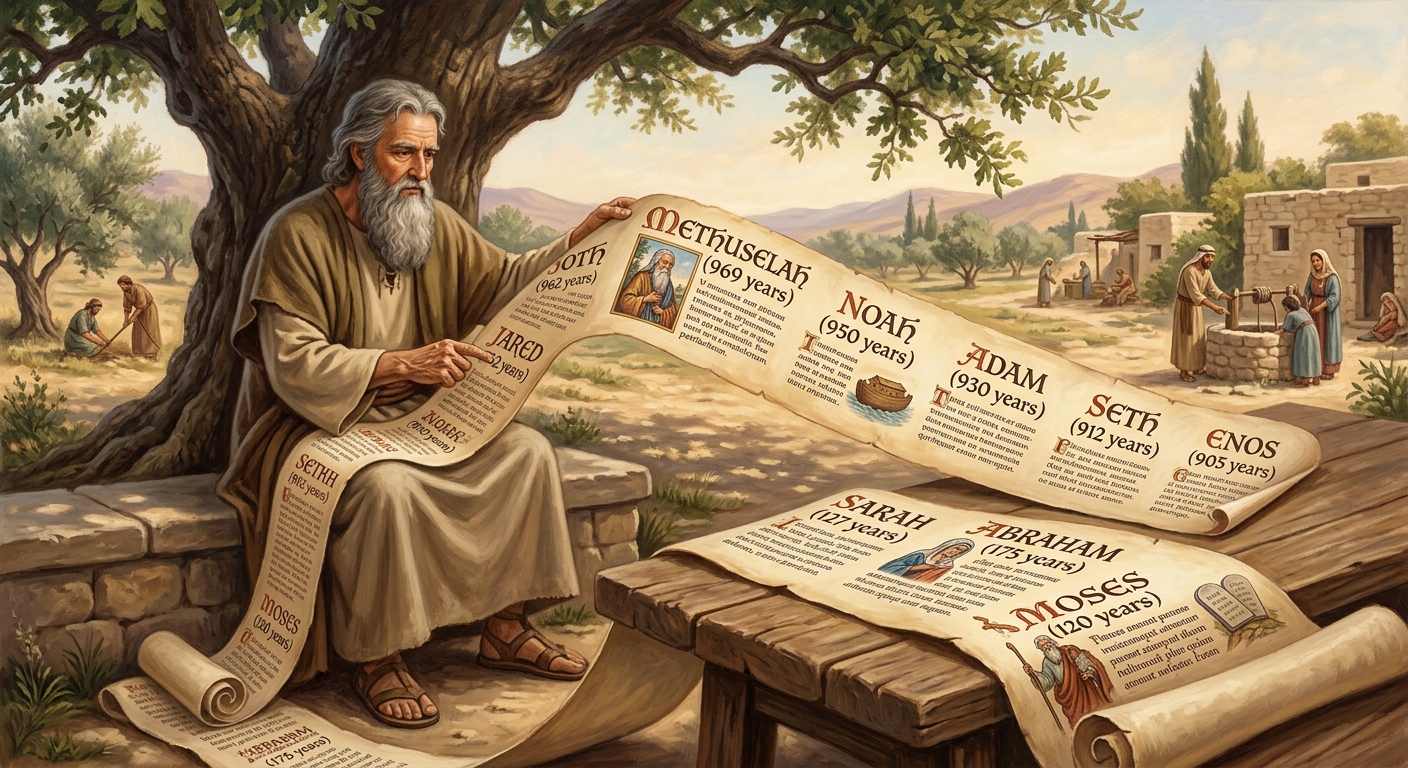
That distinction belongs to Methuselah, whose 969 years make his name proverbial to this day — we still say “old as Methuselah” of anyone remarkably aged. He appears in Scripture almost entirely through his genealogy: son of Enoch, father of Lamech at the age of 187, and by the traditional Masoretic chronology, a man who died in the very year the Flood began.
“Thus all the days of Methuselah were nine hundred sixty-nine years; and he died.” — Genesis 5:27
Scripture records nothing else about him — no deeds, no speech, no adventure — and that silence is itself worth noticing. Methuselah’s whole significance is bound up with the man who fathered him and the man he fathered: he is the hinge between Enoch, who walked so closely with God that he never tasted death, and Noah’s grandfather Lamech, who named his son Noah in hope of relief from the curse on the ground. Methuselah’s centuries simply carried that hope forward until it could be fulfilled.
Which Ten Patriarchs Lived Before the Flood?
Genesis 5 gives us an unbroken chain of ten men stretching from Adam to Noah, each one named, each one’s lifespan numbered to the year. Reading through them in order is like watching a single thread of hope run through the earliest and darkest chapters of human history.
It begins with Adam himself, who lived 930 years (Genesis 5:5) — the first man, formed directly by God and placed in Eden, whose disobedience brought death into a world that had not known it before. Adam fathered Seth at 130, after Cain had killed Abel and been driven out, and Scripture closes his long life with the plainest of sentences: “and he died.” Saint Paul would later call Adam “a type of the one who was to come” (Romans 5:14), setting him against Christ, the “last Adam” who reverses through obedience what the first Adam lost through sin (1 Corinthians 15:45).
Seth, whose name means “appointed,” lived 912 years (Genesis 5:8) and became the ancestor through whom the faithful line — and eventually the Messianic line — would run. His son Enosh lived 905 years (Genesis 5:11); it was in Enosh’s lifetime, Genesis tells us, that “men began to call upon the name of the LORD” (Genesis 4:26), the first recorded stirring of public worship. Enosh’s son Kenan lived 910 years (Genesis 5:14), and Kenan’s son Mahalalel — whose name itself means “praise of God” — lived 895 years (Genesis 5:17).
Mahalalel’s son Jared lived 962 years (Genesis 5:20), the second-longest life recorded in all of Scripture, and fathered a son whose story breaks the pattern entirely. Enoch lived only 365 years (Genesis 5:23) — strikingly brief for his era, and matching, whether by design or not, the days of a solar year. But Enoch did not die.
“Enoch walked with God, and he was not, for God took him.” — Genesis 5:24
The Letter to the Hebrews later confirms this: “By faith Enoch was taken up so that he should not see death” (Hebrews 11:5). Only one other figure in the Old Testament, the prophet Elijah, is taken from the earth in the same way, and both men became, for later Christian readers, a sign that bodily death is not God’s final word for the just.
Enoch’s son was Methuselah, whose 969 years we’ve already considered, and Methuselah’s son Lamech lived 777 years (Genesis 5:31) — a number the patristic and rabbinic traditions alike found symbolically resonant, three sevens stacked into a single figure. It was Lamech who named his own son Noah, saying, “Out of the ground that the LORD has cursed, this one shall bring us relief” (Genesis 5:29), a prophecy that would prove truer than Lamech could have known.
And Noah himself lived 950 years (Genesis 9:29), the tenth and final patriarch of this antediluvian line, and by far the most consequential. Genesis calls him “righteous… blameless in his generation,” a man who “walked with God” (Genesis 6:9) in an age when almost no one else did. At God’s command he built the ark and preserved eight souls — himself, his wife, his three sons, and their wives — through the Flood that destroyed everything else (Genesis 7–8; 1 Peter 3:20).
“This prefigured baptism, which saves you now.” — 1 Peter 3:21
St. Augustine spends an entire chapter of The City of God showing how the ark, in its very dimensions, is a figure “in every respect of Christ and the Church.” Noah fathered his sons starting at 500, entered the ark at 600, and lived 350 years after the floodwaters receded — long enough to see the world begin again.
What Happened to Lifespans After the Flood?
The genealogy in Genesis 11 picks up where Genesis 5 leaves off, tracing the line from Noah’s son Shem down to Abraham’s father Terah — and the ages fall dramatically as it goes. Shem lived 600 years (Genesis 11:10–11) and fathered Arphaxad just two years after the Flood; Arphaxad lived 438 years (Genesis 11:12–13); his son Shelah lived 433 years (Genesis 11:14–15); and Shelah’s son Eber — the man from whom the very word “Hebrew” is thought to descend — lived 464 years (Genesis 11:16–17), the last of this line to pass the four-century mark.
Eber’s son Peleg lived only 239 years (Genesis 11:18–19), roughly half what his father saw, and Genesis tells us why: “in his days the earth was divided” (Genesis 10:25), a phrase the tradition — St Augustine among them — connects to the scattering of languages at Babel. From Peleg onward, the decline continues but slows: his son Reu lived 239 years as well (Genesis 11:20–21); Reu’s son Serug lived 230 years (Genesis 11:22–23); Serug’s son Nahor, the shortest-lived of this generation, lived just 148 years (Genesis 11:24–25); and Nahor’s son Terah — Abraham’s father, who led his family out of Ur of the Chaldeans toward Canaan and settled instead in Haran — lived 205 years (Genesis 11:32).
By the time we reach Terah’s grandchildren, the ages have settled into something closer to what we might call a very long human life rather than an almost mythic one, and they stay there for the rest of the Old Testament.
Which Later Biblical Figures Lived Remarkably Long Lives?
Even after the centuries-long ages of Genesis 5 and 11 give way to shorter spans, Scripture keeps marking certain lives as long “by reason of strength” and divine blessing.
Sarah is the only woman in the entire Bible whose exact age at death is recorded: 127 years (Genesis 23:1). Wife of Abraham and mother of Isaac — whom she bore at the astonishing age of ninety (Genesis 17:17) — she died at Kiriath-arba, present-day Hebron, and was buried in the cave of Machpelah that Abraham purchased for her. Saint Paul would later draw on her as a figure of “the Jerusalem above… our mother” (Galatians 4:26), the free woman whose long-delayed son was born through promise rather than mere human effort.
Abraham himself lived 175 years (Genesis 25:7), “an old man, and full of years,” as Genesis puts it — called out of Ur by God, given the covenant of circumcision, and tested most severely when God asked him to offer his beloved son Isaac on Mount Moriah, a scene the tradition has always read as a foreshadowing of the Father’s own offering of the Son (Genesis 22; Romans 8:32). His son Isaac outlived him, reaching 180 years (Genesis 35:28), the longest life of any of the three great patriarchs, and is himself remembered as carrying the wood for his own sacrifice up that same mountain — a detail early Christians could hardly read without thinking of Calvary.
Isaac’s son Jacob, renamed Israel after wrestling with God, lived 147 years (Genesis 47:28), the last seventeen of them in Egypt under his son Joseph’s protection. Yet when Pharaoh asked his age, Jacob answered with a kind of weary honesty:
“Few and evil have been the days of the years of my life, and they have not attained to the days of the years of the life of my fathers.” — Genesis 47:9
A striking admission from within Scripture itself that the patriarchs were aware their own lifespans, however long, no longer matched those of Noah’s generation.
Jacob’s son Joseph lived 110 years (Genesis 50:26), sold into slavery by his own brothers, raised to become Pharaoh’s vizier, and eventually the savior of his family during famine — a life whose betrayal, exaltation, and forgiveness have long made him one of the clearest Old Testament types of Christ. Interestingly, 110 years was not an arbitrary number for an Egyptian setting: Egyptologists note that Egyptian inscriptions repeatedly describe 110 years as the ideal span of a well-lived life, the very same figure Scripture gives for Joseph and, later, for Joshua — a small but telling mark of historical authenticity in the text.
Moses, the great lawgiver who led Israel out of Egypt, lived 120 years and died within sight of the Promised Land he was never permitted to enter, his “eye… not dim, nor his natural force abated” (Deuteronomy 34:7). His brother Aaron, the first high priest of Israel, lived 123 years and died on Mount Hor (Numbers 33:39). Their successor Joshua, who finally led the people into Canaan, lived 110 years (Joshua 24:29) — again, the same ideal Egyptian span Joseph had reached.
And Job, the righteous sufferer whose story stands almost alone in the Old Testament for the sheer weight of what he endured, was restored by God after his trials:
“And after this Job lived one hundred and forty years, and saw his sons, and his sons’ sons, even four generations. So Job died, being old and full of days.” — Job 42:16–17
A life that ends, after everything, in blessing rather than bitterness.
Scripture never tells us Elijah’s age, which sets him apart from every other figure in this list — but his departure from the world belongs here all the same, because like Enoch centuries before him, he never died at all.
“And as they still went on and talked, behold, a chariot of fire and horses of fire separated the two of them. And Elijah went up by a whirlwind into heaven.” — 2 Kings 2:11
The great prophet of Mount Carmel, having anointed his successor Elisha, was carried off in full view of his companion, in a scene so dramatic it needed no age or number to make its point. Christian tradition has always paired Elijah with Enoch as the two men who “went up” rather than “died,” and the Church has long read their appearance together at the Transfiguration — where Elijah stands beside Moses, speaking with the transfigured Christ (Matthew 17:3) — as confirmation that his story does not end with the fiery chariot.
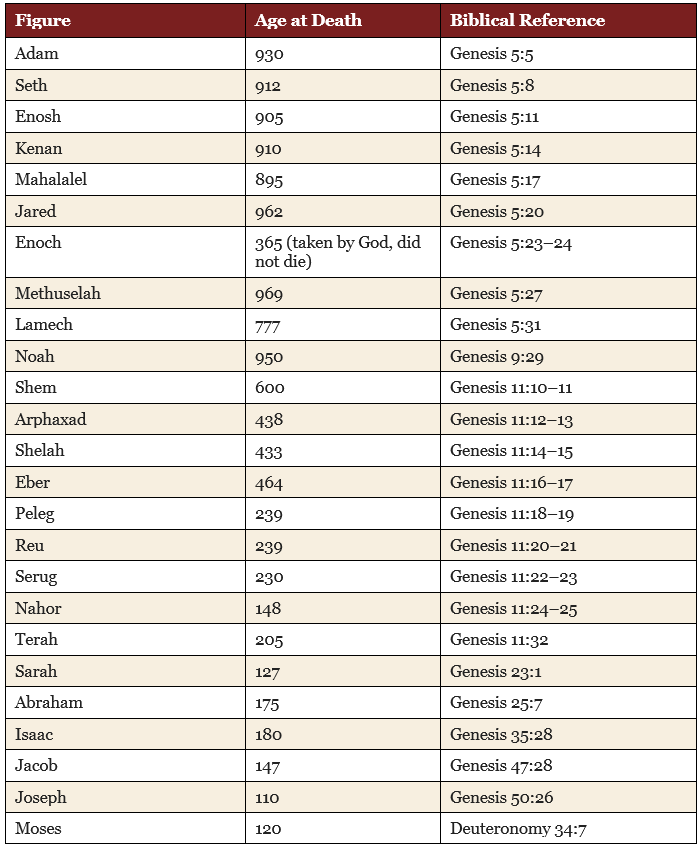
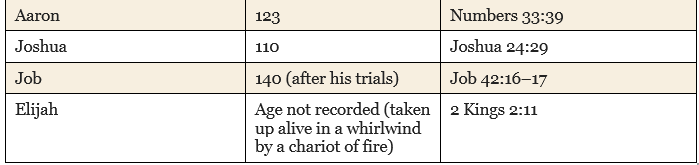
Bible Longevity at a Glance
The table below summarizes the ages and biblical references of every figure discussed above, in the order they appear in Scripture.
What Does the Church Actually Teach About These Ages?
Faithful Catholics are free to disagree about whether these figures should be read as literal solar years, as St. Augustine insisted, or as numbers carrying symbolic and honorific weight, as some modern scholars propose. The Church has not settled that question, and it does not need to be settled for the text to do its work.
“The account of the fall in Genesis 3 uses figurative language, but affirms a primeval event, a deed that took place at the beginning of the history of man.” — Catechism of the Catholic Church, §390
What the Magisterium asks us to hold is the historical core beneath the numbers: a real Adam, a real Fall, and a real, unbroken line of descent running from Eden to Abraham and, through him, to Christ.
Read that way, these strange and staggering numbers stop being a puzzle to be explained away and become instead what the sacred author likely intended them to be: a record of how far humanity had fallen from Eden, generation by generation, and a quiet promise, carried across nearly two thousand years of family lines, that God had not abandoned the world he made.
References
Augustine of Hippo. (2009). *The City of God* (M. Dods, Trans.). New Advent. https://www.newadvent.org/fathers/120115.htm (Original work published ca. 426)
Catholic Church. (1997). *Catechism of the Catholic Church* (2nd ed.). Libreria Editrice Vaticana.
Hill, C. A. (2003). Making sense of the numbers of Genesis. *Perspectives on Science and Christian Faith, 55*(4), 239–251.
Pope, C. (2015, August 11). Did the patriarchs really live to be 900 years old? Perhaps, but here’s why we do not. *Community in Mission*, Archdiocese of Washington.
Souvay, C. (1911). Patriarch. In *The Catholic Encyclopedia*. Robert Appleton Company.
University College London. (2002). *Digital Egypt for universities: Lifespan of 110 years.*