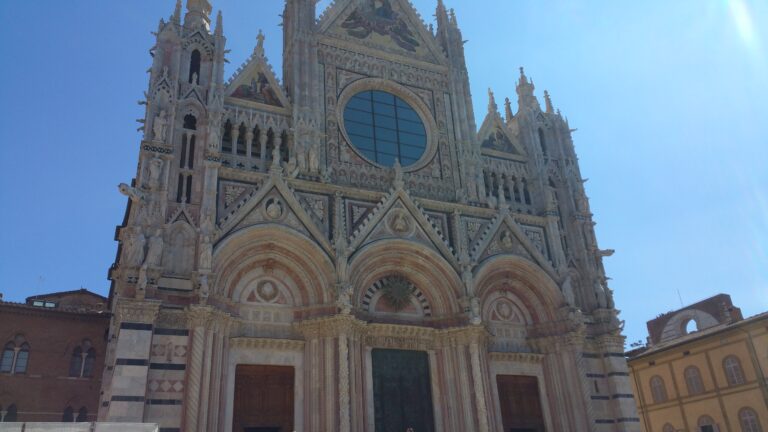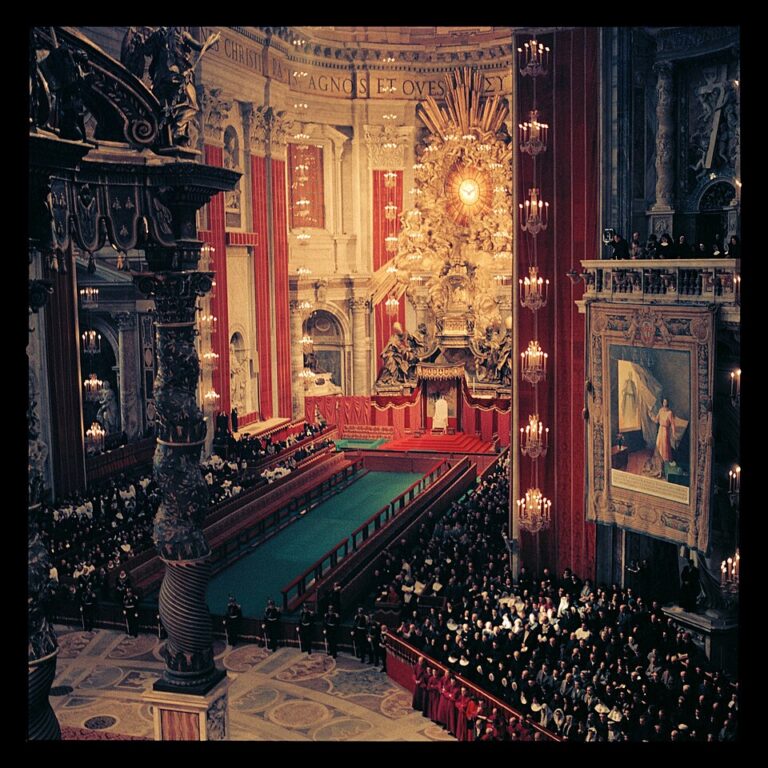
The Council of Trent: How the Church Answered the Reformation, 1545–1563
What Was the Council of Trent?
The Council of Trent stands as one of the most consequential councils in the history of the Church — the nineteenth ecumenical council, convened as the Catholic Church’s definitive theological and disciplinary response to the Protestant Reformation. Meeting intermittently across eighteen years, Trent did not merely react defensively to Luther and Calvin; it clarified Catholic doctrine with a precision the Church had rarely before required, and it launched sweeping internal reforms whose effects shaped Catholic life for the next four centuries. This article traces the council’s structure, its major doctrinal and disciplinary decrees, and its enduring legacy up to the Second Vatican Council.
Why Was the Council Convened, and How Was It Structured?
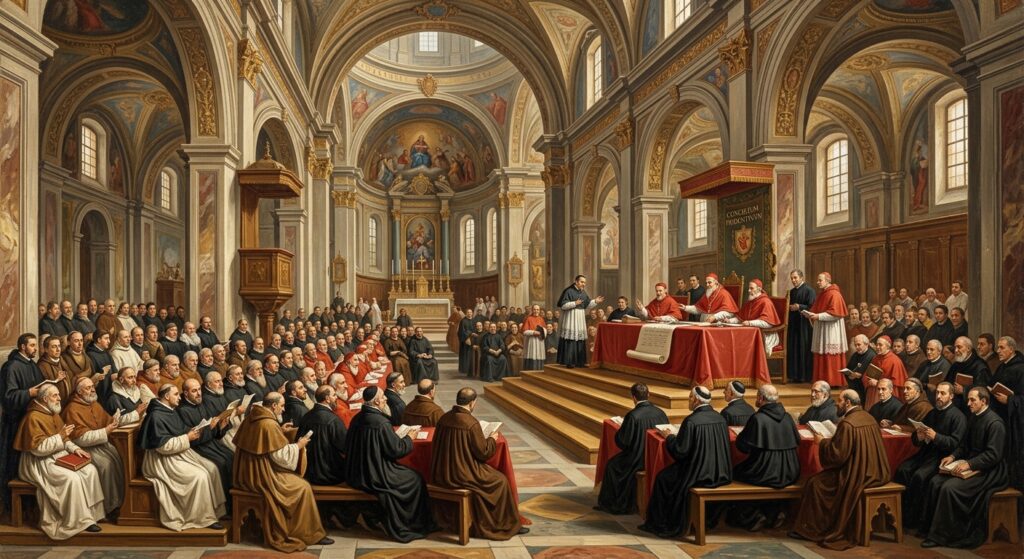
Pope Paul III convened the council specifically to formulate the Church’s authoritative answer to the rapidly spreading Reformation. It met in three distinct periods, interrupted repeatedly by war, disease, and papal politics: 1545 to 1547 under Paul III, 1551 to 1552 under Julius III, and 1562 to 1563 under Pius IV. A typhus outbreak forced an early suspension in 1547; Protestant military action disrupted the second period in 1552; and the council lay entirely dormant during the anti-conciliar pontificate of Paul IV from 1555 to 1559. When the council finally reached its concluding sessions, it counted a maximum of roughly 255 voting members — predominantly Italian and Spanish cardinal-legates, archbishops, bishops, and theologians, a composition considerably less geographically representative than many assume. Pope Pius IV formally confirmed all of the council’s decrees through the bull Benedictus Deus in 1564.
What Did Trent Decide About Scripture and Tradition?
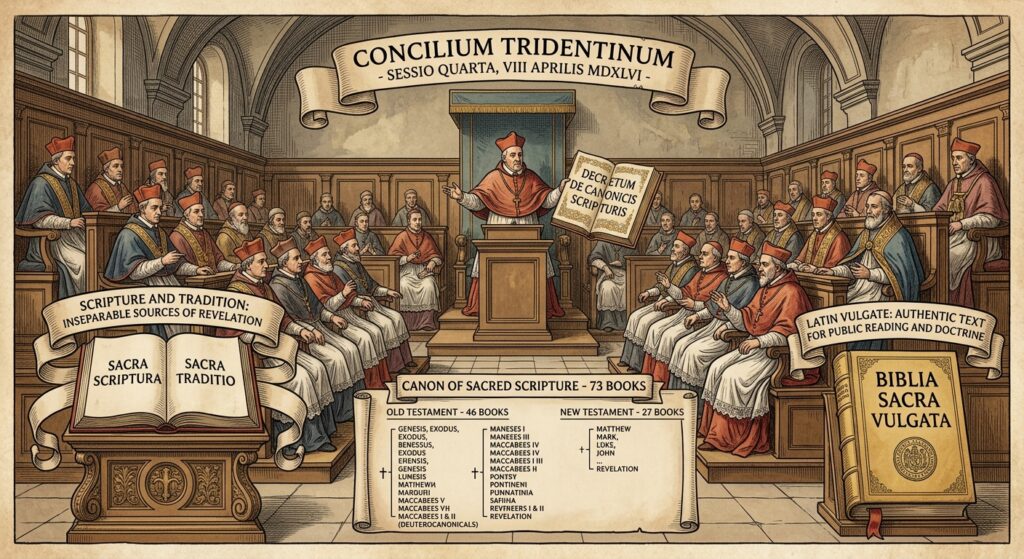
In its Fourth Session, held April 8, 1546, the council addressed a foundational question dividing Catholics from the Reformers: the relationship between Scripture and Tradition. Trent affirmed both as twin, inseparable sources of divine revelation, rejecting the Reformation principle of sola scriptura. In the same session, the council fixed the canon of Scripture at seventy-three books — forty-six in the Old Testament, including the deuterocanonical books that Protestant reformers had begun excluding, and twenty-seven in the New Testament — and declared the Latin Vulgate the Church’s authentic biblical text for public reading and doctrinal argument.
How Did Trent Answer the Reformation on Justification and the Sacraments?
The Fifth Session (1546) addressed original sin, while the pivotal Sixth Session, concluded January 13, 1547, tackled the doctrine of justification — arguably the theological center of the entire Reformation dispute. Trent rejected the Reformers’ understanding of justification by faith alone (sola fide) apart from cooperating grace and good works, articulating instead a vision in which authentic faith necessarily works in cooperation with grace toward a genuine, ongoing transformation of the believer. The Seventh Session, held March 3, 1547, affirmed all seven sacraments — Baptism, Confirmation, the Eucharist, Penance, Extreme Unction, Holy Orders, and Matrimony — as instituted by Christ himself, against Protestant reduction of the sacraments typically to two or three.
Later sessions, resuming in 1551 amid the council’s second period, took up the Eucharist directly, formally defining the doctrine of transubstantiation, alongside detailed treatment of Penance and Extreme Unction. In its final period (1562–1563), Trent addressed Communion under both species, Holy Orders, and Matrimony — including the Tametsi decree, which for the first time required a specific canonical form (marriage before a priest and witnesses) for a Catholic marriage to be considered valid — along with Purgatory, the veneration of saints, relics, and sacred images, the doctrine of indulgences, and a definitive affirmation of the Mass as a true and propitiatory sacrifice, directly countering Reformation rejection of the sacrificial character of the Eucharist.
What Disciplinary Reforms Did Trent Enact?
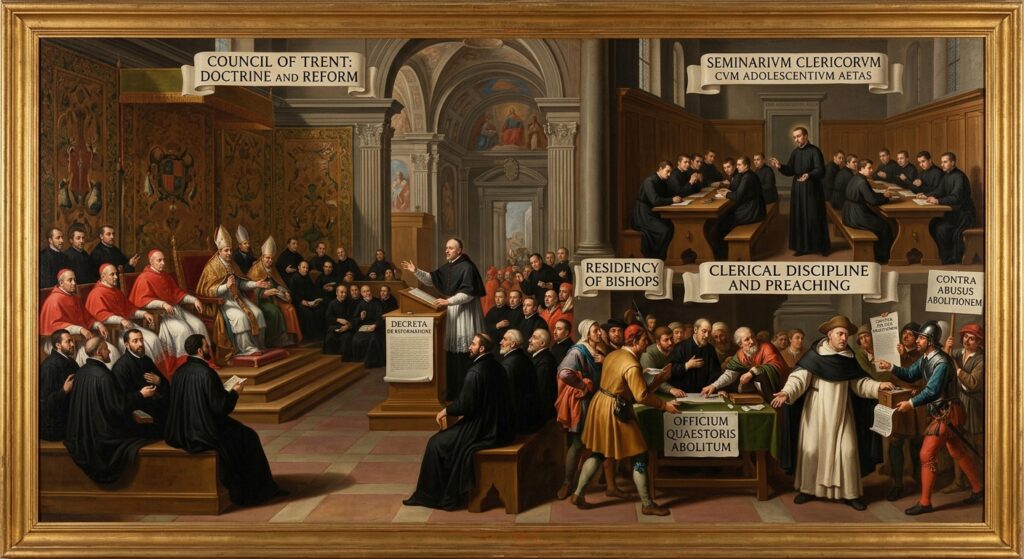
Trent was not only a doctrinal council; it was, in equal measure, a reforming one, and its disciplinary decrees addressed genuine abuses that had helped fuel the Reformation in the first place. The council’s decree Cum adolescentium aetas, issued in its twenty-third session, mandated for the first time that every diocese establish a proper seminary for the systematic formation of priests — a structural reform whose basic model remains the foundation of Catholic priestly formation to this day. Trent also firmly enforced the residency of bishops in their own dioceses, reformed clerical discipline and preaching standards, and abolished the office of the quaestor — the itinerant indulgence-preacher whose abuses, memorably embodied by Johann Tetzel, had directly provoked Martin Luther’s Ninety-Five Theses a generation earlier.
What Lasting Works Did the Council Produce?
Rather than attempting to resolve every practical detail itself, Trent entrusted several follow-up projects to the popes, and their execution shaped Catholic worship for centuries. Pope Pius V issued the Roman Catechism (Catechismus ex decreto Concilii Tridentini ad parochos) in 1566, intended as a resource for parish clergy rather than the laity directly, followed by a revised Roman Breviary in 1568. Most consequential of all was the revised Roman Missal (Missale Romanum) of 1570, promulgated by the bull Quo Primum on July 14, 1570, which codified what became known as the Tridentine Mass — the standard form of the Roman Rite celebrated for roughly the next four hundred years, until the liturgical reforms of the Second Vatican Council produced the 1969 Missal of Paul VI. The Tridentine period also produced a revised Index of Forbidden Books in 1564 and Pope Clement VIII’s revised edition of the Vulgate in 1592.
Recommended Books. Use code CARMEL15 at checkout for 15% OFF. Not applicable to sale items.
A History of the Protestant Reformation
Catechism of the Council of Trent
Why Does Trent Still Matter for Catholics Today?
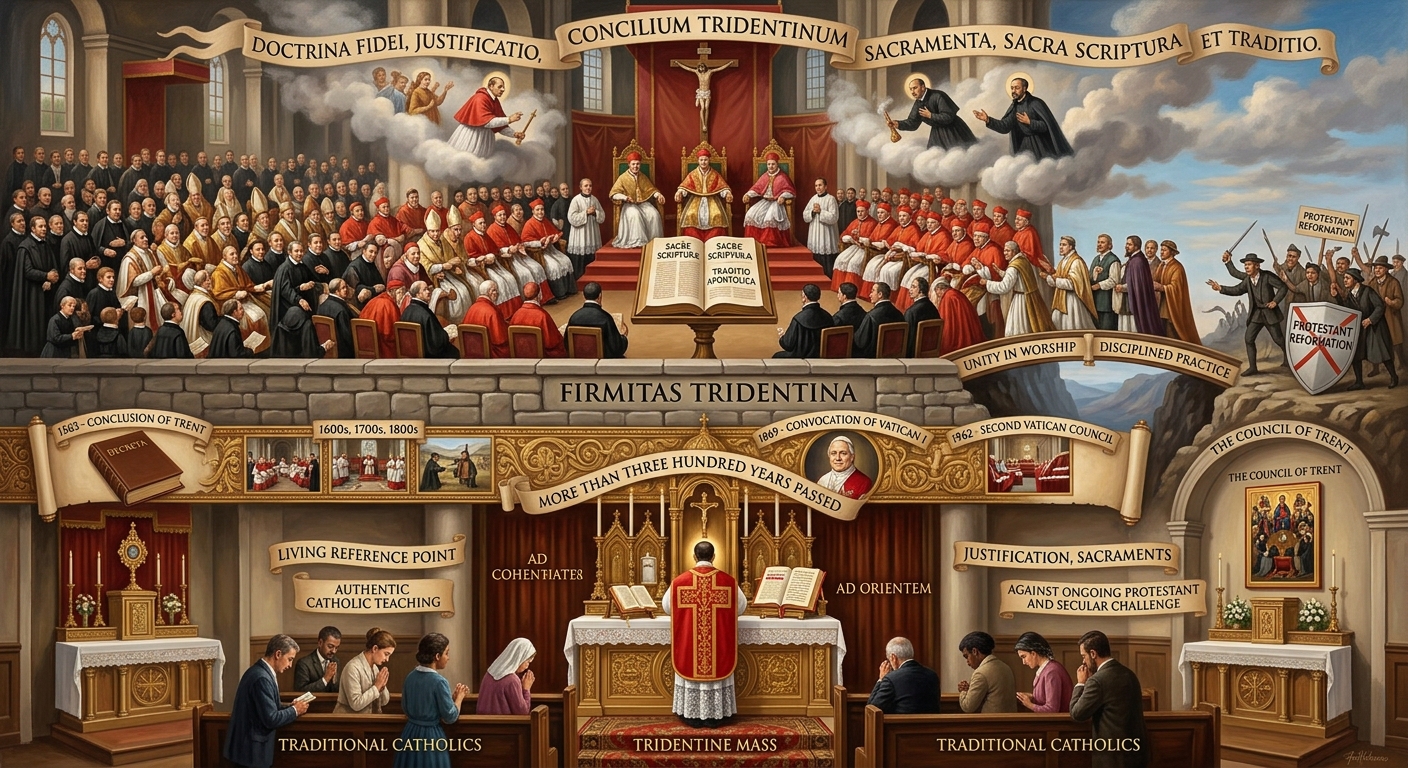
The Council of Trent decisively shaped what became known as Counter-Reformation Catholic identity — a Church clarified in doctrine, disciplined in practice, and unified in worship in ways it had not fully achieved before the Reformation forced the question. So thorough was its work that more than three hundred years passed before the Church convened its next ecumenical council, Vatican I, in 1869. For traditional Catholics today, Trent remains not merely a historical episode but a living reference point — the council whose Missal defined Catholic worship for four centuries and whose doctrinal decrees on justification, the sacraments, and the authority of Scripture and Tradition continue to define authentic Catholic teaching against ongoing Protestant and secular challenge alike.
References
O’Malley, J. W. (2013). Trent: What happened at the council. Harvard University Press (Belknap Press).
St Andrews Encyclopaedia of Theology. (n.d.). The Council of Trent. https://www.saet.ac.uk
Encyclopædia Britannica. (n.d.). Council of Trent. https://www.britannica.com
Encyclopedia.com. (n.d.). Tridentine Mass. https://www.encyclopedia.com/religion/encyclopedias-almanacs-transcripts-and-maps/tridentine-mass
Garrett Ham. (n.d.). Council of Trent 1545–1563: Doctrine, reform, Catholic identity. https://garrettham.com/council-of-trent/
Waterworth, J. (Ed. & Trans.). (1848). The canons and decrees of the sacred and ecumenical Council of Trent. Dolman.