Exorcism in the Catholic Church: The Rite, the Canon Law, and the Discernment Behind the Ministry
What Does the Catholic Church Actually Teach About Exorcism?
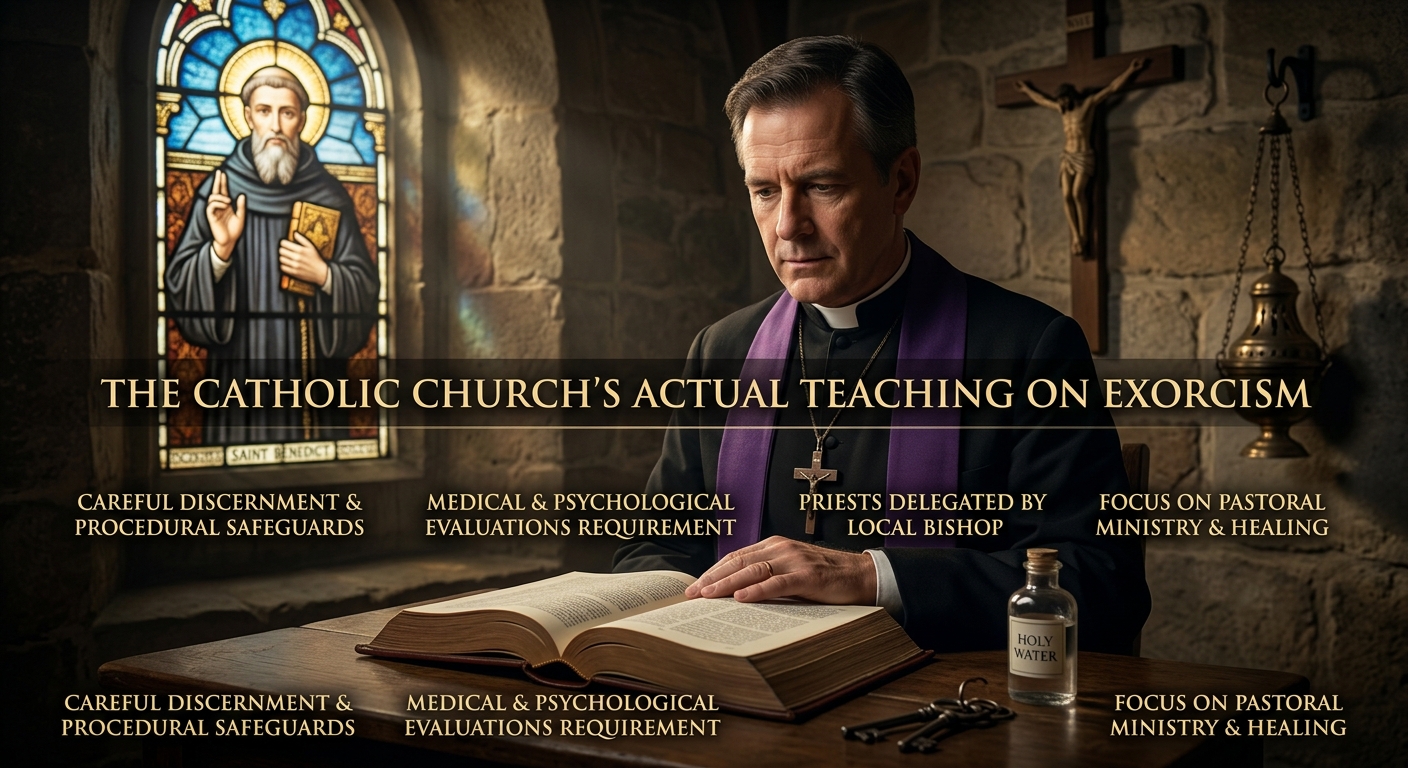
Exorcism occupies an unusual place in the modern Catholic imagination — simultaneously a subject of horror films and genuine, carefully regulated pastoral ministry. Contrary to sensationalized portrayals, the Church approaches exorcism with considerable caution, extensive procedural safeguards, and a strong presumption toward natural and medical explanations before any question of the demonic is entertained. This article surveys the official rite, the canon law governing who may perform it, the criteria used to discern genuine possession, and the ministry as it exists in the Church today.
What Is the Official Rite of Exorcism, and When Was It Last Revised?
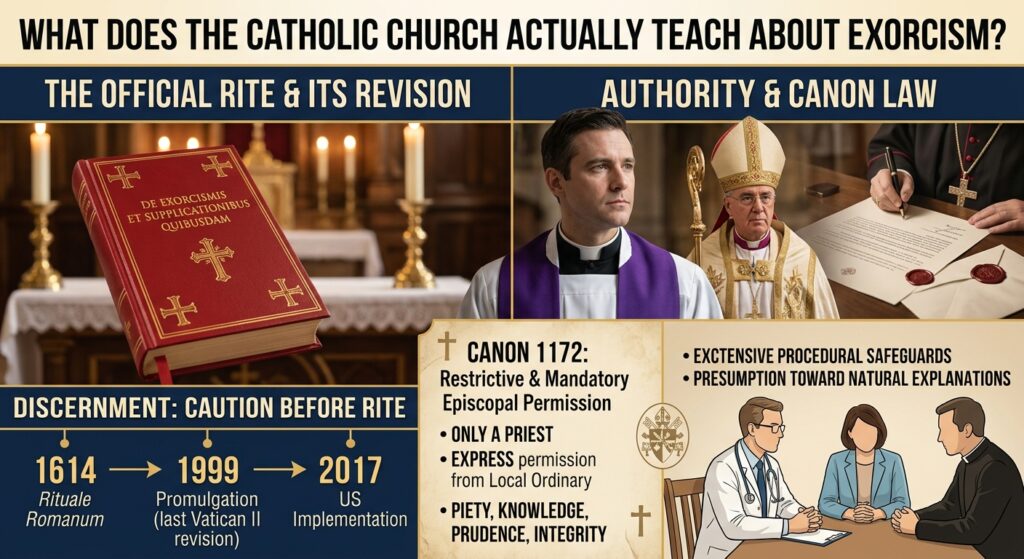
The Church’s current liturgical book governing exorcism is De Exorcismis et Supplicationibus Quibusdam (“Of Exorcisms and Certain Supplications”), an eighty-four-page text promulgated on January 26, 1999, by the Congregation for Divine Worship and the Discipline of the Sacraments. Notably, this was the last liturgical book to be revised in the wake of the Second Vatican Council, replacing the exorcism rite that had stood largely unchanged since the 1614 Rituale Romanum. A slightly amended editio typica followed in 2004. The official English translation, Exorcisms and Related Supplications, was approved by the United States Conference of Catholic Bishops in November 2014, confirmed by the Holy See in December 2016, and put into effect in American dioceses on June 29, 2017 — meaning the current English-language rite is, in practical terms, a fairly recent development in the life of the American Church.
Who Is Permitted to Perform an Exorcism?
Canon law is unambiguous and restrictive on this point. Canon 1172 of the 1983 Code of Canon Law states that no one may lawfully perform exorcisms over the possessed unless he is a priest who has obtained express and specific permission from the local bishop (ordinary) — and that such permission is to be granted only to a priest distinguished by piety, knowledge, prudence, and integrity of life (USCCB, n.d.). An exorcism is therefore never a matter of individual initiative; it is a delegated ministry, exercised under direct episcopal authority, and typically reserved to a priest specifically appointed as diocesan exorcist rather than exercised freely by any cleric.
How Does the Church Distinguish Possession From Mental Illness?
This is, in practice, the central and most consequential question in the entire ministry. The 1999 rite explicitly cautions ministers against confusing psychological or psychiatric illness with demonic possession, describing the devil in traditional terms as “a spirit without body, without colour and without odour” — a formulation meant to underline that possession, properly understood, is not itself a physical or medically detectable condition. Church protocol requires a full medical, psychological, and psychiatric evaluation to rule out natural causes before any exorcism proceeds, and the ultimate determination of genuine possession rests with the Church’s own discernment process, not with the anguished individual or family’s own conviction. The tradition has long pointed to indicators such as an aversion to sacred objects or prayer, xenoglossy (speaking or understanding languages the person has never learned), preternatural physical strength, and knowledge of hidden or distant things — though these are treated as evidentiary starting points for careful investigation, not a simple diagnostic checklist.
Who Trains Exorcists, and How Common Is the Ministry Today?
The International Association of Exorcists (Associazione Internazionale Esorcisti, AIE) was founded in 1994 by six priests, including Fr. Gabriele Amorth — the Diocese of Rome’s chief exorcist from 1925 to 2016 — and Fr. Jeremy Davies. The association’s statutes received formal Vatican approval on June 13, 2014, placing what had previously been an informal network of practitioners on solid institutional footing. Since 2005, the Pontifical Athenaeum Regina Apostolorum in Rome has offered an annual training course on exorcism and the prayer of liberation, reflecting a deliberate effort to professionalize and standardize formation for priests entering this ministry.
Fr. Amorth himself claimed to have performed at least 60,000 exorcisms over roughly thirty years of ministry — though, by his own account in An Exorcist Tells His Story, only about one hundred of those cases (some accounts say closer to ninety-four) involved what he judged to be genuine, full possession, a distinction canon-law scholar Edward Peters has called “astounding” given how often the larger figure circulates without that crucial qualification (Amorth, 1999). More recently, Sicilian exorcist Fr. Benigno Palilla told Vatican Radio in February 2018 that requests for exorcism had roughly tripled in preceding years, and cited a figure of some 500,000 alleged cases recorded annually in Italy alone — while cautioning in the same interview that the great majority of these cases prove, on investigation, to have psychological rather than demonic origins. In March 2026, the International Association of Exorcists formally petitioned Pope Leo XIV to ensure every diocese maintains a trained exorcist and presented updated “Guidelines for the Ministry of Exorcism” for wider adoption.
Recommended Reading. Use code CARMEL15 at checkout for 15% OFF. Not applicable to sale items.
Fr. Gabriele Amorth: Rome’s Exorcist
Spiritual Warfare Q and A: For Priests and Laity
What Should Catholics Take Away From This Teaching?
The Church’s actual practice around exorcism is, in nearly every respect, the opposite of its popular depiction: slow rather than dramatic, medically cautious rather than credulous, and hedged by canonical permission rather than freely exercised. A Catholic encountering claims of possession — whether their own fear or a friend’s — is best served by directing the matter through ordinary pastoral and diocesan channels, not by seeking out independent practitioners, and by trusting that the Church’s own discernment process exists precisely to protect the vulnerable from both spiritual and psychological harm alike.
References
Amorth, G. (1999). An exorcist tells his story (N. MacKenzie, Trans.). Ignatius Press.
Congregation for Divine Worship and the Discipline of the Sacraments. (1999). De Exorcismis et Supplicationibus Quibusdam. Libreria Editrice Vaticana.
Code of Canon Law. (1983). Canon 1172. The Holy See. https://www.vatican.va
United States Conference of Catholic Bishops. (n.d.). Exorcism. https://www.usccb.org
Wikipedia. (n.d.-a). Of Exorcisms and Certain Supplications. https://en.wikipedia.org/wiki/Of_Exorcisms_and_Certain_Supplications
Wikipedia. (n.d.-b). Gabriele Amorth. https://en.wikipedia.org/wiki/Gabriele_Amorth
Wikipedia. (n.d.-c). International Association of Exorcists. https://en.wikipedia.org/wiki/International_Association_of_Exorcists