Why the Catholic Faith Is the True Religion: A Philosophical and Theological Case for the Honest Inquirer
An extended essay in apologetics for a general readership
Introduction: The Courage to Follow the Argument Wherever It Leads
Every honest person, sooner or later, comes to a halt before the oldest and most stubborn questions. Why is there something rather than nothing? Is there a God? If there is, has He spoken to us? And if He has spoken, where—among the thousands of competing voices—do we find His word reliably preserved? These are not questions for the credulous alone. They are questions for anyone who refuses to live an unexamined life.
This article makes a deliberately bold claim, and it makes it to a mixed audience: secular readers who suspect that religion is wishful thinking, Protestant readers who love Christ but doubt Rome, and adherents of other traditions who hold their own convictions sincerely. The claim is this: reason, followed honestly and without flinching, leads first to the existence of God; the evidence of history then points to Jesus of Nazareth, risen from the dead; and the internal logic of divine revelation points, finally, to the Catholic Church as the divinely appointed custodian of that revelation.
The case is weighted toward philosophy, and for a principled reason. Philosophy is the common ground we share regardless of creed. Before we can argue about which revelation is true, we must establish that there is a God who could reveal anything at all, and that truth itself is the kind of thing worth pursuing. Theology and history then supply the second movement of the argument. As St. John Henry Newman understood, conviction in religion rarely comes from a single knock-down proof; it comes from the convergence of many independent probabilities, each reinforcing the others until the cumulative weight becomes, for the honest mind, morally certain (Newman, 1870/1985).
What follows, then, is not an exercise in browbeating. It is an invitation. The reader is asked only to do what Socrates asked: to follow the argument wherever it leads.
Can We Know God Exists Through Reason Alone?
Before we ask which religion is true, we must ask whether the human mind can reach God at all without the aid of faith. The Catholic answer is a confident yes—and this confidence is itself one of the most distinctive features of the Catholic intellectual tradition.
The First Vatican Council, in its dogmatic constitution Dei Filius (1870), defined the matter dogmatically: “The same Holy mother Church holds and teaches that God, the source and end of all things, can be known with certainty from the consideration of created things, by the natural power of human reason” (First Vatican Council, 1870/1990, ch. 2). The Council attached its canon with characteristic firmness: “If anyone says that the one, true God, our creator and lord, cannot be known with certainty from the things that have been made, by the natural light of human reason: let him be anathema” (First Vatican Council, 1870/1990, canons on revelation, no. 1). The Council was citing St. Paul, who wrote that “ever since the creation of the world his invisible nature… has been clearly perceived in the things that have been made” (Romans 1:20, RSV-CE).
Notice what this means. Catholicism does not say that belief in God is a leap in the dark, a posture adopted in defiance of evidence. It says the opposite: that the existence of God is, in principle, demonstrable—a conclusion available to reason as such. Faith goes beyond reason, but it does not begin by contradicting it. This is why the tradition has always taken the philosophical arguments with full seriousness rather than treating them as decorative.
The Argument from Motion and Causation: St Thomas Aquinas’s First and Second Ways
The most influential of all natural-theological arguments are the “Five Ways” of St. Thomas Aquinas, presented in Summa Theologiae I, q. 2, a. 3. The First Way begins from the plainest fact of experience: things change. St Thomas Aquinas, following Aristotle, analyzes change as the reduction of potency to act—the passage of a thing from what it could be to what it actually is. A cold object becomes hot; an acorn becomes an oak. But nothing can actualize itself; “whatever is in motion must be put in motion by another” (Aquinas, 1274/1947, I, q. 2, a. 3). Such a series of actualizers, St Thomas Aquinas argues, cannot regress to infinity in the relevant (essentially ordered) sense, for without a first member there would be no actualizing at all. Therefore “it is necessary to arrive at a first mover, put in motion by no other; and this everyone understands to be God” (Aquinas, 1274/1947, I, q. 2, a. 3). The Second Way runs the same structure through efficient causation, terminating in an Uncaused First Cause.
A crucial clarification is owed here, because the arguments are routinely misunderstood. St Thomas Aquinas is not arguing for a first event at the beginning of time, like the first domino in a row. As the contemporary philosopher Edward Feser (2008, 2009) has tirelessly emphasized, the causal series St Thomas Aquinas has in mind is hierarchical and simultaneous, not temporal. The question is not “what got things started long ago?” but “what sustains things in existence right now?” A coffee cup resting on a desk is held up by the desk, the desk by the floor, the floor by the building’s frame—a series in which every member’s causal power is derived, here and now, from a higher member. Such a series requires a first member whose causal power is not borrowed from anything else.
The Argument from Contingency and the Real Distinction
The deepest version of the cosmological argument, and the one Feser regards as the most rigorous, concerns contingency—and it turns on what St Thomas Aquinas called the “real distinction” between essence and existence (Feser, 2009). Consider any ordinary thing: a tree, a star, yourself. You can fully grasp what it is—its essence—without thereby knowing that it is, whether it exists. This shows that existence is not part of the essence of finite things; existence must be, as it were, conjoined to them from outside. Such things are contingent: they exist, but they need not have, and they do not contain within themselves the reason for their own being.
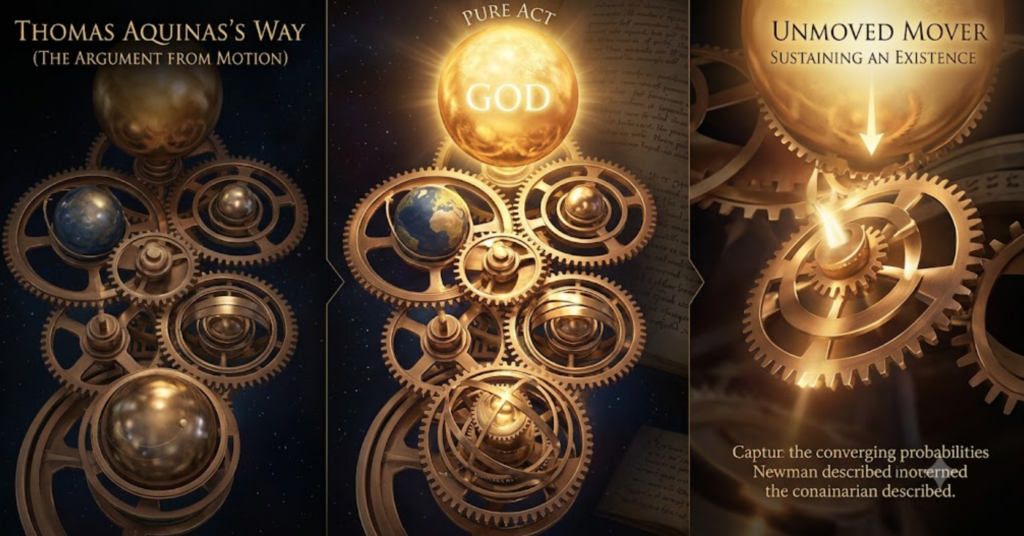
But a chain of contingent things, however long, cannot account for itself; “anything that has being has it from itself or from another,” and contingent things by definition have it from another (Feser, 2015). The series must therefore terminate in a being whose essence simply is its existence—a being that does not have existence but is Existence Itself, Pure Actuality with no admixture of unrealized potential. This is precisely what the Catholic tradition means by God, and it is no accident that it echoes the divine name revealed at the burning bush: “I AM WHO I AM” (Exodus 3:14, RSV-CE; cf. Feser, 2015).
The Kalam Cosmological Argument
A different route is taken by the Kalam cosmological argument, named for the medieval Islamic theological tradition and revived for modern philosophy by William Lane Craig (1979). Its structure is disarmingly simple: (1) Everything that begins to exist has a cause; (2) the universe began to exist; (3) therefore the universe has a cause (Craig & Sinclair, 2009). Craig defends the second premise on two fronts: philosophically, by arguing that an actually infinite past is metaphysically impossible (you could never “complete” an infinite series of past events to arrive at today); and scientifically, by appeal to Big Bang cosmology and the second law of thermodynamics, both of which point to a cosmos with a finite age. The cause of the universe, being the cause of space, time, and matter, must itself be spaceless, timeless, immaterial, and—since it freely brought a temporal effect from a changeless state—personal (Craig & Sinclair, 2009).
No single argument here is beyond dispute; philosophers have contested each. But taken together they establish a serious cumulative conclusion: that the existence of a contingent, changing, finite cosmos cries out for explanation, and that the explanation terminates in a necessary, purely actual, transcendent cause. That conclusion alone already rules out atheistic naturalism.
Does the Fine-Tuning of the Universe Point to a Designer?
If the cosmological arguments ask why there is a universe at all, the teleological or design argument asks why the universe is the way it is. And here the findings of twentieth- and twenty-first-century physics have proven strikingly congenial to theism.
The argument from fine-tuning observes that the fundamental constants and initial conditions of the universe appear calibrated, with breathtaking precision, to permit the existence of life. Fr. Robert Spitzer, S.J., in New Proofs for the Existence of God (2010), assembles the relevant physics and argues that the cumulative improbability of a life-permitting universe arising by chance is, in his words, such that “the odds against an anthropic condition occurring are astronomically high, making any life form… exceedingly improbable” (Spitzer, 2010, as cited in Wartick, 2011).
The numbers involved are not merely large; they are almost incomprehensible. The mathematical physicist Sir Roger Penrose has calculated the odds against the universe’s initial low-entropy state arising by chance at roughly 1 in 10^(10^123)—a figure so vast it cannot be written out even if every digit were placed on a separate proton in the observable universe (Penrose, 2004). The cosmological constant, which governs the expansion rate of the universe, appears fine-tuned to something on the order of 1 part in 10^120; a deviation in either direction would have yielded either runaway expansion that prevented galaxies from forming or a rapid recollapse (Holder, as discussed in First Things).
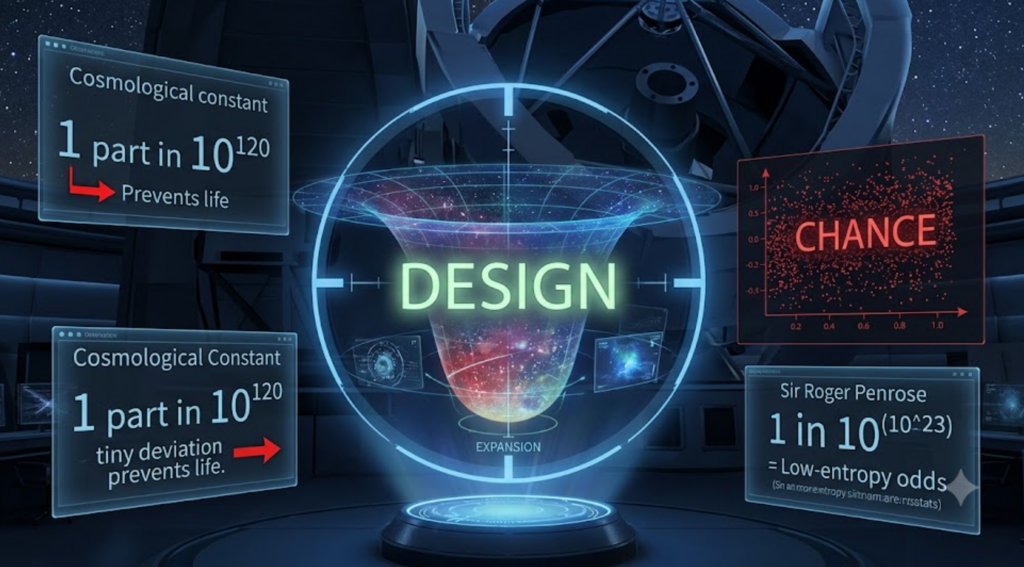
There are, broadly, three responses to such data: physical necessity (the constants had to be as they are), chance, or design. Physical necessity has no independent support—there is no known reason the constants must take life-permitting values. Chance, given the improbabilities just cited, strains credulity. This drives many to the multiverse hypothesis: perhaps there are countless universes with varied constants, and we naturally find ourselves in a hospitable one. But as Spitzer and his collaborator Bruce Gordon argue, the multiverse hypothesis is itself speculative, requires its own fine-tuning to generate universes at all, and is arguably less parsimonious than the design hypothesis (Spitzer, 2010). The teleological argument concludes, modestly but powerfully, that intelligent design is the best explanation of the data we actually possess.
Is the Ontological Argument More Than a Clever Trick?
No argument in the history of philosophy has provoked more fascination and suspicion than the ontological argument, first advanced by St. Anselm of Canterbury in the Proslogion (1077–78). Unlike the cosmological and teleological arguments, which reason from the world to God, the ontological argument proceeds from the very concept of God.
St Anselm defines God as “that than which nothing greater can be conceived” (Anselm, 1078/1965, ch. 2). Even the fool who denies God, St Anselm notes, understands this phrase; thus God exists at least in the understanding. But—and here is the pivot—a being that exists in reality is greater than one that exists in the mind alone. Therefore, if “that than which nothing greater can be conceived” existed only in the mind, we could conceive of something greater (the same being existing in reality), which is a contradiction. Hence God must exist in reality as well as in the understanding (Anselm, 1078/1965, ch. 2).
The argument was challenged in St Anselm’s own day by the monk Gaunilo and later rejected by St Thomas Aquinas, who held that we cannot move so directly from concept to reality. Yet it has refused to die. In the twentieth century the analytic philosopher Alvin Plantinga reformulated it with the tools of modal logic and possible-worlds semantics (Plantinga, 1974). Plantinga defines a “maximally great being” as one possessing “maximal excellence”—omnipotence, omniscience, and moral perfection—in every possible world. His argument runs: (1) It is possible that a maximally great being exists; (2) so there is a possible world in which it exists; (3) but a being that is maximally great in one world, by definition, exists in every world; (4) therefore it exists in the actual world (Plantinga, 1974). The entire weight of the argument rests on premise (1)—the mere possibility of God. Plantinga concedes that the argument does not compel assent from one who denies that possibility; but he contends it shows that belief in God can be entirely rational, since the premise is at least as plausible as its denial (Plantinga, 1974).
Why Can’t All Religions Be Equally True? The Nature of Truth Itself
Before proceeding from God to revelation, we must clear away the most popular obstacle of our age: the comfortable assumption that all religions are, at bottom, equally valid paths up the same mountain. This view, religious pluralism, is not a finding of evidence but a philosophical claim—and it collapses under the weight of the very logic that makes any thought possible.
The classical definition of truth is correspondence: a statement is true if it corresponds to reality, false if it does not. To say “the cat is on the mat” is true if and only if the cat is, in fact, on the mat. This is not a parochial Western prejudice; it is simply what we mean when we call something true. Allied to it is the law of non-contradiction, which Aristotle identified as the first principle of all reasoning: the same thing cannot both be and not be in the same respect at the same time. Deny it, and you cannot think or speak coherently at all—for the denial itself claims to be true rather than false.
Now apply this to religion. The world’s great traditions do not merely offer different flavors of the same dessert; they make contradictory claims about the most fundamental matters. Christianity affirms that Jesus of Nazareth is God incarnate, crucified and risen; Islam explicitly denies both the divinity and the crucifixion; Judaism denies the Messiahship; classical Buddhism is, in its original form, non-theistic and denies a permanent self; Hinduism in many strands affirms an impersonal Absolute and reincarnation. These claims cannot all be true, any more than a coin can land simultaneously heads and tails. To say “all religions are true” is therefore not generous; it is incoherent, for it requires contradictory propositions to be true together.
This does not mean every religion is wholly false—Catholicism teaches that other traditions often contain “rays of that truth which enlightens all men” (Nostra Aetate, 1965). It means that where they contradict, at most one can be right, and the question of which cannot be dodged by appeals to sincerity or sentiment. The pluralist who says “it’s all relative” has, without noticing, made an absolute claim about reality. Truth, by its nature, is exclusive. The only question worth asking is which claims are true.
Does the Restless Human Heart Point Beyond This World? The Argument from Desire
We turn now from arguments about the world to arguments about ourselves—and the first concerns the curious structure of human longing.
C.S. Lewis gave the argument its most memorable expression in Mere Christianity: “Creatures are not born with desires unless satisfaction for those desires exists. A baby feels hunger: well, there is such a thing as food. A duckling wants to swim: well, there is such a thing as water. Men feel sexual desire: well, there is such a thing as sex. If I find in myself a desire which no experience in this world can satisfy, the most probable explanation is that I was made for another world” (Lewis, 1952/2001, pp. 136–137). The observation is that human beings possess a persistent, ineradicable longing—Lewis called it Joy—that no finite good ever fully satisfies. Marriage, achievement, travel, beauty: each promises fulfillment and each, at its best, leaves a residue of ache. The argument, which Lewis offers not as a proof but as a “pretty good indication,” is abductive: the existence of this desire is best explained by the existence of a transcendent object capable of satisfying it (Williams, 2018).
Sixteen centuries earlier, St. Augustine had voiced the same intuition in the opening lines of his Confessions, in words that have echoed down the ages: “You have made us for yourself, O Lord, and our heart is restless until it rests in you” (Augustine, 397–401/1991, I.1). The restlessness is not a defect to be medicated away but a signpost. Honest atheists have felt its force; the longing is data, and naturalism must explain it away as an evolutionary accident or a “fraud,” while theism takes it at face value as a homing instinct for God.
Where Does the Voice of Conscience Come From? Newman’s Moral Argument
A second argument from the interior life concerns the strange authority of conscience. We do not merely have moral feelings; we experience certain actions as carrying an absolute, unconditional obligation—a “you must” and “you must not” that we did not invent and cannot revoke by preference.
St. John Henry Newman made this the centerpiece of his approach to God. In his Letter to the Duke of Norfolk and An Essay in Aid of a Grammar of Assent, he described conscience as “the aboriginal Vicar of Christ, a prophet in its informations, a monarch in its peremptoriness, a priest in its blessings and anathemas” (Newman, 1875, as cited in Sydney Catholic Archdiocese, 2019; Newman, 1870/1985). For Newman, conscience is not subjective self-will but “the voice of another in the mind and heart”—the felt presence of a “judge holy, just, and powerful” (Newman, 1870/1985, as discussed in Barron, n.d.). Man, he wrote, “has within his breast a certain commanding dictate, not a mere sentiment, not a mere opinion or impression or view of things, but a law, an authoritative voice, bidding him do certain things and avoid others.”
Peter Kreeft has formalized Newman’s intuition into a tight syllogism: conscience possesses absolute, exceptionless, binding moral authority over us, demanding unqualified obedience; but only a perfectly good, righteous divine will could possess such authority and the right to such obedience; therefore conscience is the voice of the will of God (Kreeft, as presented in Word on Fire, n.d.). The materialist must reduce this commanding voice to social conditioning or evolutionary instinct—yet neither conditioning nor instinct can generate genuine obligation, only describe what we happen to feel. The “ought” cannot be derived from the “is” of biology. The best explanation of the categorical authority of conscience is a personal, moral Lawgiver to whom we are accountable.
Is Naturalism Self-Defeating? The Argument from Reason
Perhaps the most philosophically devastating argument against the secular worldview is that it cannot account for the very rationality on which it relies. This is the argument from reason, advanced by C.S. Lewis and sharpened by contemporary philosophers Victor Reppert and Alvin Plantinga.
Lewis, in Miracles (1947/1960), pointed to the “cardinal difficulty of naturalism.” If naturalism is true, then everything—including every human thought—is the product of non-rational physical causes: neurochemistry, blind forces, the impersonal grinding of matter. But a belief produced entirely by non-rational causes gives us no reason to think it true; it is merely an event that happened. As Lewis put it, a chain of reasoning is reliable only if it cannot be wholly explained by non-rational causes (Lewis, 1947/1960; Wikipedia, “Argument from reason”). The naturalist trusts his reason to deliver truth—indeed, he claims to have reasoned his way to naturalism—but naturalism itself, if true, undercuts the trustworthiness of that very reasoning. The position saws off the branch on which it sits.
Plantinga (1993, 2011) developed this into the rigorous Evolutionary Argument Against Naturalism (EAAN). His thesis, stated formally, is that the probability that our cognitive faculties are reliable, given both naturalism and unguided evolution, is low or inscrutable. Natural selection rewards behavior conducive to survival and reproduction, not true belief; a creature could in principle behave adaptively while holding systematically false beliefs, so long as the false beliefs happened to yield useful behavior. If that is so, then the naturalist who accepts evolution has a defeater for the reliability of all his beliefs—including his belief in naturalism and evolution. The conjunction is therefore self-defeating and cannot be rationally held (Plantinga, 1993, 2011). Theism, by contrast, has no such problem: a God who designed us to know truth grounds the reliability of reason. Far from religion being the enemy of reason, it turns out that reason itself is more at home in a theistic universe than in a naturalistic one.
If God Has Revealed Himself, Is a Visible, Authoritative Church Necessary?
Suppose the foregoing arguments succeed and a personal, intelligent, good God exists. A new question arises: would such a God leave us to grope after Him unaided, or would He speak? And if He has spoken, how would He preserve that speech from corruption across the centuries? Here philosophy hands the baton to theology—but the transition is itself a piece of reasoning.
The argument, classically associated with Newman, is one from fittingness. If God reveals saving truth, He presumably intends it to be transmitted accurately to all generations, not distorted within a few decades by “the mass of mere human speculation, extravagance, corruption, and error” (Newman, 1845/1989). A God who went to the trouble of revealing Himself but provided no means of preserving that revelation intact would be like a teacher who delivers a vital lesson and then guarantees it will be garbled in transmission. Newman concluded that “an infallible developing authority is to be expected” precisely because doctrine develops and must be authenticated (Newman, 1845/1989). In his Apologia he reasoned that if the Church was established “for the direct object of protecting, preserving, and declaring the Revelation,” then by the providence of its divine Author it must be infallible—”for what is meant by infallibility in teaching but that the teacher in his teaching is secured from error?” (Newman, 1864/1989). This is, it should be stressed, an argument from fittingness and probability, not a strict demonstration; Newman frames it as what is “to be expected,” and the honest apologist presents it as such.
Did such a God in fact establish such an authority? The Christian claim is that He did, in the person of Christ, who told Simon: “You are Peter, and on this rock I will build my church, and the powers of death shall not prevail against it. I will give you the keys of the kingdom of heaven, and whatever you bind on earth shall be bound in heaven, and whatever you loose on earth shall be loosed in heaven” (Matthew 16:18–19, RSV-CE). Two features of this text repay attention. First, the wordplay: in the Aramaic Jesus spoke, the same term Kepha would have stood in both clauses—”You are Kepha, and on this Kepha I will build my church”—identifying Peter himself as the foundation-rock (cf. John 1:42). Second, and more striking, the “keys of the kingdom” deliberately echo Isaiah 22:22, where the office of royal steward over the house of David is conferred on Eliakim: “I will place on his shoulder the key of the house of David; he shall open, and none shall shut; and he shall shut, and none shall open” (Isaiah 22:22, RSV-CE). The point is conceded even by the eminent Protestant scholar F.F. Bruce, who notes that the keys were “entrusted to the chief steward or major domo,” carried “as a badge of the authority entrusted to him,” and that Jesus is invoking precisely this dynastic, successive office (Bruce, 1983, pp. 143–144). The royal steward’s office did not die with its holder; Eliakim succeeded Shebna. The keys thus imply not a personal honor for Peter alone but a perpetual office of governance in Christ’s kingdom, the Church.
The First Vatican Council made this dogmatically explicit in Pastor Aeternus (1870): “That which our Lord Jesus Christ… established in the blessed apostle Peter, for the continual salvation and permanent benefit of the Church, must of necessity remain for ever, by Christ’s authority, in the Church which, founded as it is upon a rock, will stand firm until the end of time” (First Vatican Council, 1870b, ch. 2). The Catechism summarizes the resulting structure: “The task of giving an authentic interpretation of the Word of God, whether in its written form or in the form of Tradition, has been entrusted to the living teaching office of the Church alone” (Catholic Church, 1997, no. 85), while carefully adding that “this Magisterium is not superior to the Word of God, but is its servant” (no. 86). The philosophical force of the argument is this: a revelation without an authoritative interpreter is not really a stable revelation at all, but a text endlessly refracted through private opinion—which is exactly the situation we will examine when we come to sola scriptura.
Did Jesus of Nazareth Rise From the Dead?
The Christian claim stands or falls on a historical event. As St. Paul bluntly conceded, “if Christ has not been raised, then our preaching is in vain and your faith is in vain” (1 Corinthians 15:14, RSV-CE). The honest inquirer is therefore entitled to ask: what is the historical evidence?
The most rigorous contemporary approach is the “minimal facts” argument developed by the historian and philosopher Gary Habermas, drawn from his survey of some 3,400 scholarly publications on the resurrection produced since 1975 (Habermas & Licona, 2004). The method deliberately restricts itself to facts that are (a) supported by strong historical evidence and (b) conceded by the overwhelming majority of scholars across the ideological spectrum—including skeptics. Habermas identifies a core that roughly 90% of critical scholars grant: that Jesus died by crucifixion; that his disciples sincerely believed they experienced him alive afterward; that the persecutor Saul of Tarsus (Paul) was converted by what he took to be such an appearance; and that the skeptic James, Jesus’s own brother, was likewise converted (Habermas & Licona, 2004, pp. 47–48). A fifth fact, the empty tomb, is conceded by a smaller but still substantial majority—Habermas reports that “roughly 75 percent of scholars on the subject accept the empty tomb as a historical fact” (Habermas & Licona, 2004, p. 70).
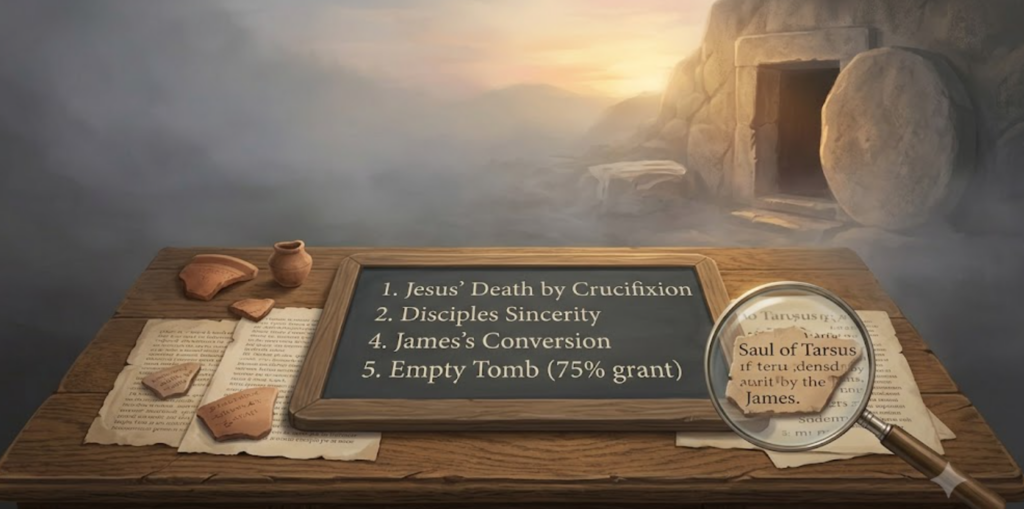
The strength of this approach is that it does not presuppose the inspiration or even the general reliability of the New Testament. Its premises are granted by hostile witnesses. The agnostic New Testament scholar Bart Ehrman states flatly that “one of the most certain facts of history is that Jesus was crucified on orders of the Roman prefect of Judea, Pontius Pilate.” The Jesus Seminar co-founder John Dominic Crossan, no friend of orthodoxy, concurs: “That he was crucified is as sure as anything historical can ever be” (Crossan, 1994, p. 145).
The question then becomes: what best explains this cluster of agreed facts? The naturalistic alternatives have been weighed and found wanting. The “swoon theory” (Jesus merely fainted) cannot explain how a man scourged and crucified would, days later, convince anyone he was the conqueror of death rather than a desperate invalid. The theft theory cannot explain why the disciples would die for a claim they knew to be fabricated—”liars make poor martyrs,” as Habermas observes. The hallucination theory cannot account for group appearances, the conversion of hostile skeptics like Paul and James, or the empty tomb. The bodily resurrection, by contrast, accounts for the entire data set at once. For the open-minded inquirer, it is the inference to the best explanation.
Is the Catholic Church the Fulfillment of the Old Testament?
If Jesus rose, then His own interpretation of Israel’s Scriptures carries unique weight—and that interpretation is typological. Typology is the principle, embraced by the New Testament authors themselves, that persons, events, and institutions of the Old Covenant prefigure and are fulfilled in the New. St. Augustine compressed it into a maxim: “The New is hidden in the Old and the Old is revealed in the New” (cited in Catholic-Link, n.d.).
The biblical scholar Scott Hahn has done much to recover the richness of this reading for a popular audience (Hahn, n.d.). St. Paul calls Adam “a type of the one who was to come” (Romans 5:14); St. Peter presents the flood as a figure of baptism (1 Peter 3:20–21); the Letter to the Hebrews calls the old Law “a shadow of the good things to come” (Hebrews 10:1). The Passover lamb, whose blood spared Israel from death, prefigures the Lamb of God whose sacrifice is made present in the Eucharist; the manna in the wilderness prefigures the Bread of Life (cf. John 6); the todah or thank-offering of bread and wine prefigures the Eucharist, whose very name means “thanksgiving” (Catholic-Link, n.d.).
For the Catholic argument, the most significant typology is institutional. The kingdom of David possessed a structure—a king, a queen mother (the gebirah), and a royal steward holding the keys—that maps onto the structure of the Church: Christ the Davidic King, Mary the Queen Mother, and Peter the steward holding the keys of Matthew 16 (Hahn, n.d.). The Davidic kingdom, in other words, was a divinely intended blueprint, and the Catholic Church—hierarchical, sacramental, with a Petrine office—matches that blueprint with a precision that a merely human institution would be unlikely to stumble upon. The Old Testament, on this reading, is not abolished but fulfilled; and what it is fulfilled in looks remarkably like Catholicism.
What Are the Four Marks, and Why Does Apostolicity Matter Most?
The Nicene Creed professes belief in “one, holy, catholic, and apostolic Church.” The Catechism affirms that “these four characteristics, inseparably linked with each other, indicate essential features of the Church and her mission,” possessed not by the Church’s own power but by Christ’s gift (Catholic Church, 1997, no. 811). Of the four marks, apostolicity—the Church’s historical continuity with the apostles—bears the heaviest apologetic weight, because it is the most empirically testable.
The doctrine of apostolic succession holds that the authority Christ gave the apostles was transmitted, by the laying on of hands, to bishops in an unbroken line. This was no later invention. St. Clement of Rome, writing around A.D. 96, attests that the apostles “appointed their firstfruits [bishops]… and afterward gave instructions, that when these should fall asleep, other approved men should succeed them” (1 Clement 42–44). St. Ignatius of Antioch, a disciple of the Apostle John writing around A.D. 107, insisted that nothing be done in the Church “without the bishop” (Letter to the Smyrnaeans 8). Most decisively, St. Irenaeus of Lyons, writing around A.D. 180 against the Gnostics, deployed succession as the very test of true doctrine: heretics could not trace their teaching to the apostles, but the Church could. Irenaeus provided the earliest extant list of the bishops of Rome, beginning with Peter and Paul, who “committed into the hands of Linus the office of the episcopate” (Irenaeus, Against Heresies 3.3.3), and continuing through Anacletus, Clement, and beyond. Of Rome specifically he declared that “with this Church, because of its superior origin, all Churches must agree” (Against Heresies 3.3.2).
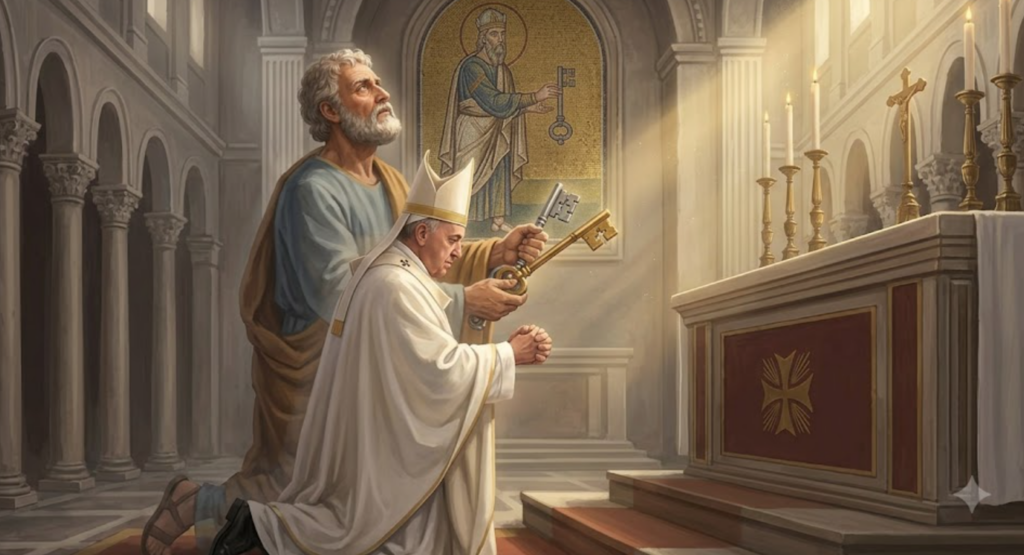
The force of this for the modern inquirer is straightforward. The Catholic Church—and, in a real but contested sense, the Eastern Orthodox—can trace an unbroken chain of episcopal ordination back to the apostles themselves. The communities born of the sixteenth-century Reformation cannot; their ministry began, by their own admission, in the 1500s. If Christ established a visible Church with a transmissible authority, then historical continuity with that founding is not a triviality but a criterion. The mark of apostolicity asks a question no amount of sincerity can answer in the abstract: Are you connected to the original?
Does Doctrine Develop, or Does the Church Contradict Itself?
A standard objection runs: the Catholic Church teaches things—the Marian dogmas, papal infallibility, transubstantiation in its technical form—that are not found, at least not explicitly, in the early centuries. Has the Church not therefore changed, contradicting its own claim to preserve an unchanging deposit of faith?
It was precisely this question that drove the Anglican Newman to the most consequential study of his life, published as An Essay on the Development of Christian Doctrine (1845). Newman distinguished authentic development—the organic unfolding of what was implicitly present from the beginning, as an oak unfolds from an acorn—from corruption, a genuine departure from the original type. To tell them apart he proposed seven “notes” or tests: preservation of type, continuity of principle, power of assimilation, logical sequence, anticipation of its future, conservative action upon its past, and chronic vigor (Newman, 1845/1989). Doctrine that grows while preserving its identity across these tests is true development; doctrine that mutates into something contrary is corruption.
Applying this lens to history, Newman—who began the study expecting to vindicate Anglicanism—found instead that the trajectory of Christian doctrine led unmistakably toward Rome, and that the early Church looked far more “Catholic” than Protestant. His conclusion has become proverbial: “To be deep in history is to cease to be a Protestant” (Newman, 1845/1989). The acorn-to-oak model answers the objection: the Church does not contradict its past; it draws out what was always contained in the deposit, under the guidance of the same Spirit who, Christ promised, would “guide you into all the truth” (John 16:13, RSV-CE).
Why Does Sola Scriptura Collapse Under Its Own Logic?
The Protestant Reformation rested on two great principles: sola fide (justification by faith alone) and sola scriptura (Scripture as the sole infallible rule of faith). It is the second that concerns us, because it is, on examination, philosophically self-defeating—a point pressed not only by Catholic apologists but felt by many thoughtful Protestants themselves.
The first difficulty is that sola scriptura is not taught in Scripture. The verse most often cited, 2 Timothy 3:16–17, affirms that Scripture is “inspired by God and profitable for teaching”—but “profitable” and “sufficient as the sole rule” are different claims, and the passage nowhere states that Scripture alone, apart from Church and Tradition, is the formal rule of faith (Catholic Answers, n.d.). The doctrine thus fails its own test: a principle asserting that all doctrine must be found in Scripture is itself a doctrine not found in Scripture, and so refutes itself.
The second difficulty is the canon. The Bible did not arrive with an inspired table of contents. The question of which books belong in Scripture cannot be answered by Scripture, for no book of the Bible lists the others. Historically, the canon was settled by the Church: the 73-book canon was promulgated at the Council of Rome under Pope Damasus I in 382, listed explicitly in Canon 36 of the Synod of Hippo (393), reaffirmed by the Councils of Carthage (397 and 419), and definitively defined against the Reformers at the Council of Trent on April 8, 1546 (Catholic Answers, n.d.). The Protestant who holds the Bible as his sole authority holds a book whose very contents were determined by the authority of the Church he rejects. As one convert put it, “If we did not have Scripture, we would still have the Church. But without the Church, there would be no New Testament Scripture” (Catholic Answers, n.d.).
The third difficulty is practical and is perhaps the most telling: sola scriptura has not produced unity but fragmentation. Lacking a final, authoritative interpreter, Protestantism has splintered into thousands of denominations, each appealing to “the Bible’s clear teaching” and each arriving at different conclusions on baptism, the Eucharist, church government, and morality. The analogy is to a nation with a constitution but no supreme court: when interpretations conflict, there is no principled way to settle them (Catholic Answers, n.d.). A book cannot interpret itself; it requires a living authority. This is precisely the function that, as we saw, the logic of revelation requires and that Christ provided in the Petrine office.
Has the Church’s Survival Itself Been a Kind of Miracle?
There is, finally, an argument that is less a syllogism than a standing fact: the sheer indestructibility of the Catholic Church across two millennia. The Church has weathered persecution under the Caesars, barbarian invasions, the corruptions of the Renaissance papacy, the Reformation, the French Revolution, and the totalitarianisms of the twentieth century. It has, at intervals, been governed by men of spectacular incompetence and even vice—and it has survived them all.
Hilaire Belloc gave this observation its most famous and disarming formulation. The Catholic Church, he remarked to the future Archbishop of Canterbury William Temple, “is an institution I am bound to hold divine—but for unbelievers a proof of its divinity might be found in the fact that no merely human institution conducted with such knavish imbecility would have lasted a fortnight” (Belloc, as recorded in Speaight, 1957). The point is double-edged and shrewd: the Church’s leaders have, often enough, given every human reason for the institution to collapse, and yet it endures. As Belloc elsewhere observed, “the Church is a perpetually defeated thing that always outlives her conquerors.” This is not a strict proof—institutions survive for many reasons—but it is a powerful confirmation, a fulfillment of Christ’s promise that “the powers of death shall not prevail against it” (Matthew 16:18, RSV-CE). The First Vatican Council appealed to exactly this: the Church, “with her marvellous propagation, eminent holiness, and inexhaustible fruitfulness… her catholic unity and invincible stability, is a great and perpetual motive of credibility and an irrefutable witness of her divine mission” (cited in Catholic Church, 1997, no. 812).
To this many add Pascal’s wager—not as a proof of God, but as a goad to the hesitant. Blaise Pascal argued that the inquirer is not a neutral spectator but a participant forced to bet with his life: “If you gain, you gain all; if you lose, you lose nothing…. There is here an infinity of an infinitely happy life to gain, a chance of gain against a finite number of chances of loss, and what you stake is finite” (Pascal, 1670/1910, §233). Pascal’s deeper purpose was not to coerce belief but to dislodge complacency—to show the skeptic that indifference is itself a choice, and a reckless one.
Conclusion: An Invitation to Honest Intellectual Inquiry
We began with the oldest questions and have traced a path through them. Reason, examining the contingency of the world, arrives at a necessary, purely actual First Cause. Examining the fine-tuning of the cosmos, it finds the fingerprints of intelligence. Examining the restless heart, the authority of conscience, and the very reliability of reason itself, it finds signposts that point beyond nature to a personal God—and discovers, in the argument from reason, that atheistic naturalism cannot even account for the rational thought it depends upon. From the existence of such a God, the logic of revelation leads to the fittingness of an authoritative Church. History then presents the Resurrection as the best explanation of a cluster of facts conceded even by skeptics, and presents the Catholic Church as the one community that fulfills the Old Testament’s institutional types, bears the four marks, traces an unbroken apostolic succession, develops its doctrine without contradiction, and supplies the living authority that sola scriptura fatally lacks. No single thread is beyond dispute. But the threads, woven together, form a cord of remarkable strength.
None of this is offered as a substitute for faith, which is a gift and a free act. It is offered as a clearing of the ground—a demonstration that the Catholic Faith is not the enemy of reason but its friend and its fulfillment. The reader is asked for nothing more than what every honest mind owes itself: to follow the evidence without flinching, to weigh the arguments fairly, and to refuse the easy refuge of indifference. As Pascal saw, on this question no one is permitted to remain a spectator. The invitation, then, is not to credulity but to courage—the courage to ask whether the Church that claims to be founded on a rock might, after all, be telling the truth.
References
Anselm of Canterbury. (1965). Proslogion (M. J. Charlesworth, Trans.). Oxford University Press. (Original work composed 1077–1078)
Aquinas, T. (1947). Summa theologica (Fathers of the English Dominican Province, Trans.). Benziger Brothers. (Original work composed ca. 1265–1274)
Augustine of Hippo. (1991). Confessions (H. Chadwick, Trans.). Oxford University Press. (Original work composed ca. 397–401)
Barron, R. (n.d.). St. John Henry Newman. Word on Fire. https://www.wordonfire.org
Bruce, F. F. (1983). The hard sayings of Jesus. InterVarsity Press.
Catholic Answers. (n.d.). A quick ten-step refutation of sola scriptura and According to Scripture. https://www.catholic.com
Catholic Church. (1997). Catechism of the Catholic Church (2nd ed.). Libreria Editrice Vaticana.
Craig, W. L. (1979). The Kalām cosmological argument. Macmillan.
Craig, W. L., & Sinclair, J. D. (2009). The Kalam cosmological argument. In W. L. Craig & J. P. Moreland (Eds.), The Blackwell companion to natural theology (pp. 101–201). Wiley-Blackwell.
Crossan, J. D. (1994). Jesus: A revolutionary biography. HarperSanFrancisco.
Feser, E. (2008). The last superstition: A refutation of the new atheism. St. Augustine’s Press.
Feser, E. (2009). Aquinas: A beginner’s guide. Oneworld.
Feser, E. (2015, June). Religion and superstition [Blog post]. Edward Feser. http://edwardfeser.blogspot.com
First Vatican Council. (1990). Dogmatic constitution Dei Filius on the Catholic faith. In N. P. Tanner (Ed.), Decrees of the ecumenical councils. Sheed & Ward. (Original work promulgated 1870)
First Vatican Council. (1870b). Pastor aeternus: First dogmatic constitution on the Church of Christ. Eternal Word Television Network. https://www.ewtn.com
Habermas, G. R., & Licona, M. R. (2004). The case for the resurrection of Jesus. Kregel.
Hahn, S. (n.d.). Typology. https://www.scotthahn.com/typology
Irenaeus of Lyons. (1885). Against heresies (A. Roberts & J. Donaldson, Trans.). In Ante-Nicene Fathers (Vol. 1). (Original work composed ca. 180)
Kreeft, P., & Tacelli, R. K. (2009). Handbook of Catholic apologetics: Reasoned answers to questions of faith. Ignatius Press.
Lewis, C. S. (1960). Miracles: A preliminary study (Rev. ed.). Macmillan. (Original work published 1947)
Lewis, C. S. (2001). Mere Christianity. HarperOne. (Original work published 1952)
Newman, J. H. (1985). An essay in aid of a grammar of assent. University of Notre Dame Press. (Original work published 1870)
Newman, J. H. (1989). An essay on the development of Christian doctrine. University of Notre Dame Press. (Original work published 1845)
Newman, J. H. (1989). Apologia pro vita sua. (Original work published 1864)
Nostra aetate: Declaration on the relation of the Church to non-Christian religions. (1965). Second Vatican Council.
Pascal, B. (1910). Pensées (W. F. Trotter, Trans.). Dent. (Original work published 1670)
Penrose, R. (2004). The road to reality: A complete guide to the laws of the universe. Jonathan Cape.
Plantinga, A. (1974). The nature of necessity. Oxford University Press.
Plantinga, A. (1993). Warrant and proper function. Oxford University Press.
Plantinga, A. (2011). Where the conflict really lies: Science, religion, and naturalism. Oxford University Press.
Speaight, R. (1957). The life of Hilaire Belloc. Hollis & Carter.
Spitzer, R. J. (2010). New proofs for the existence of God: Contributions of contemporary physics and philosophy. Eerdmans.
Wartick, J. W. (2011, January 7). Book review: New proofs for the existence of God by Robert Spitzer. https://jwwartick.com
Williams, D. T. (2018). Made for another world: C. S. Lewis’s argument from desire revisited. Christian Research Journal, 41(2).