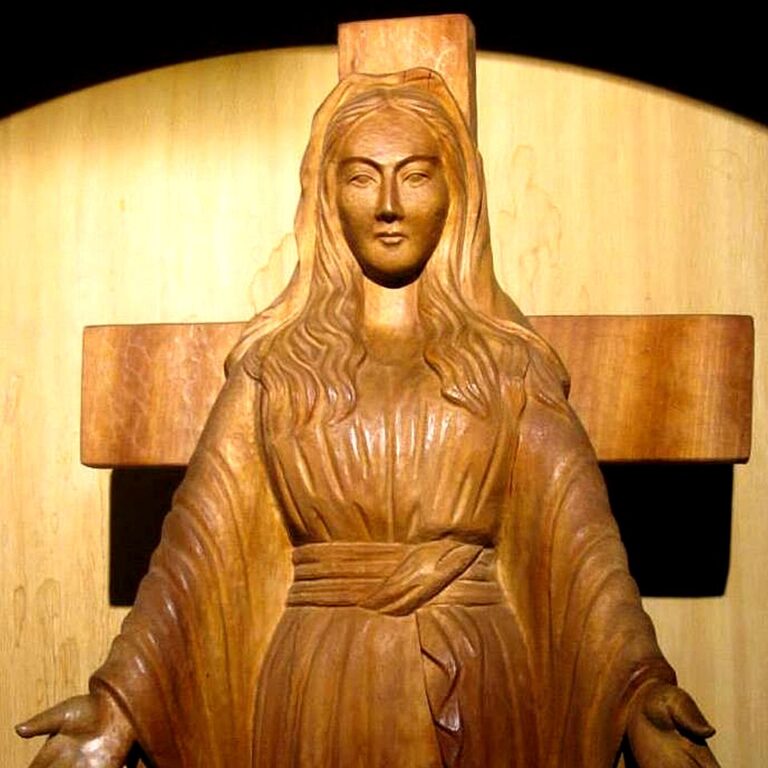
The Vision of Hell at Fatima: Did Our Lady Confirm the Fewness of the Saved?
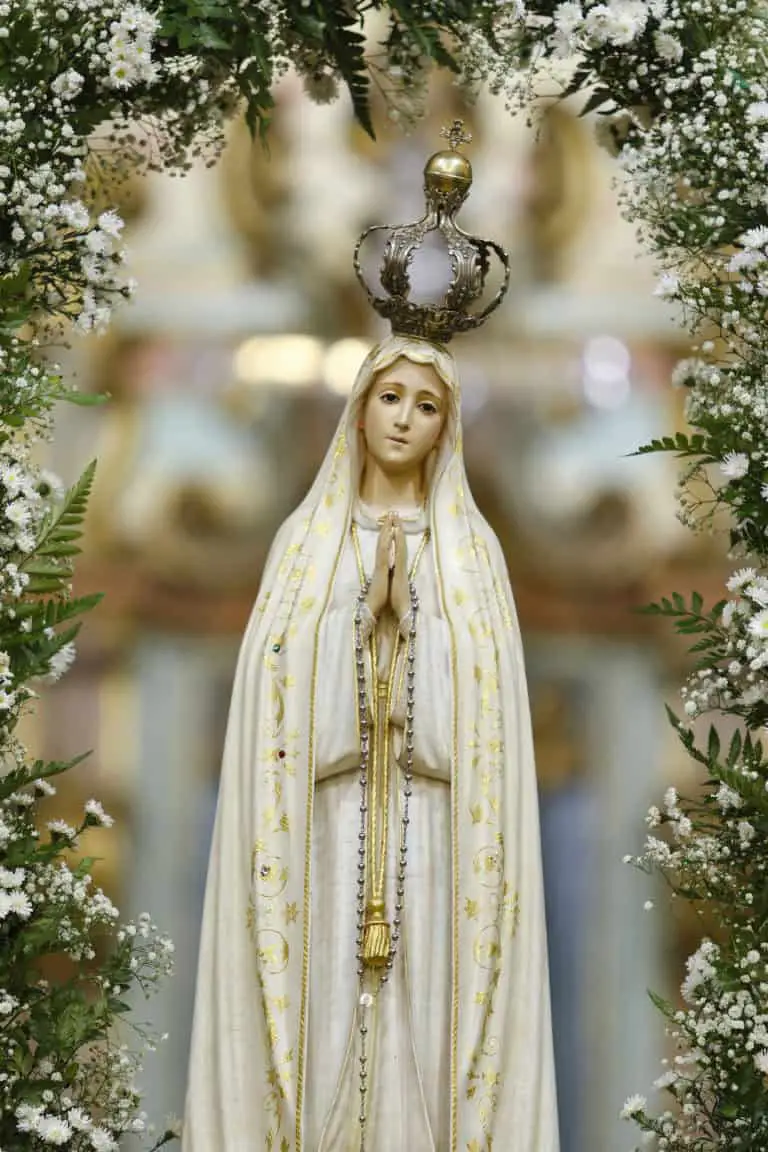
On a summer afternoon in 1917, three peasant children stood before a Lady clothed in light, and she opened her hands. What poured out was not more light. It was fire. This is the story of July 13, 1917, at the Cova da Iria — the single apparition that contains the vision of hell, the Three Secrets of Fatima, and a warning that Catholic tradition had been quietly repeating for centuries: that few, not many, are saved.
What Happened at the Cova da Iria on July 13, 1917?
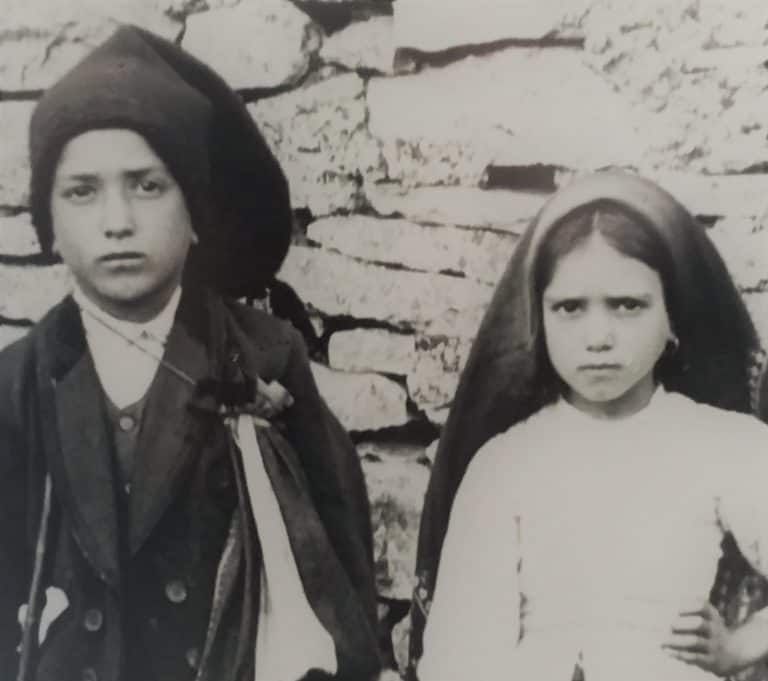
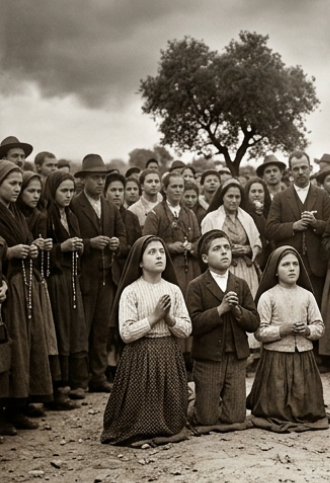
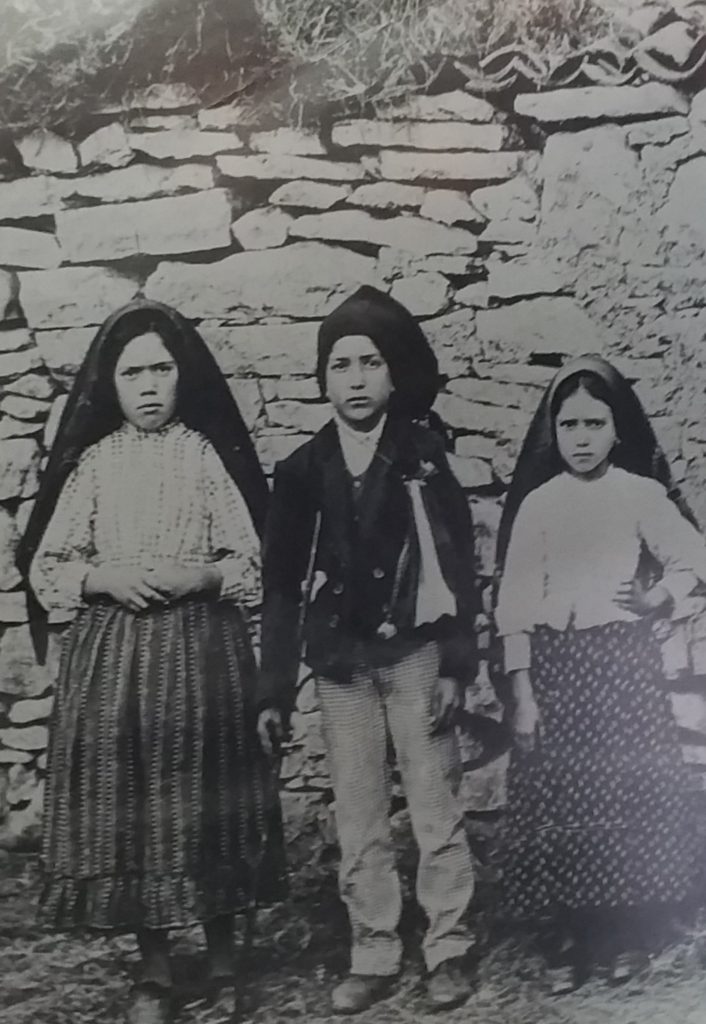
By July 1917, word had spread through the Portuguese countryside. Two months earlier, three shepherd children — Lucia dos Santos, age ten, and her younger cousins Francisco and Jacinta Marto, ages nine and seven — had reported seeing a beautiful Lady above a small holm oak tree at the Cova da Iria, outside the village of Fatima, and she had asked them to return on the thirteenth of each month (Walsh, 1947). By the third apparition, a crowd had gathered to see for themselves. No photograph or press count survives from that date, so estimates vary: the Fatima Center’s timeline states that roughly five thousand people came to the Cova that day, while eyewitness accounts recorded by the Fatima Shrine in Detroit suggest a smaller crowd of two to three thousand, and the historian Frère Michel de la Sainte Trinité (1989) places the number lower still, between one and two thousand. What can be said with confidence is that several thousand people, in a Portugal torn by war and by a government openly hostile to the Church, had gathered around a small tree to pray the Rosary together.
Jacinta’s own father, Manuel Marto, known locally as “Ti Marto,” was present that day, though like the rest of the crowd he did not see the Lady. He did, however, notice the sky dim as if a small grey cloud had settled over the tree, felt the air turn suddenly cool in the middle of a Portuguese summer, and heard something he could only describe as a sound “like flies inside an empty jug” (de Marchi, 1952). He also watched his own daughter and her cousins gasp in visible terror at something he could not see.
Lucia, who alone spoke with Our Lady in all six apparitions, asked what was wanted of the children. Our Lady told them to keep coming back each month and to continue praying the Rosary daily, “because only she can help you” (dos Santos, 2007). When Lucia asked for a miracle so that the crowd would believe, Our Lady promised one in October, for all to see. She then asked for sacrifice on behalf of sinners, teaching the children a short prayer still recited today at the end of every Rosary decade: “O my Jesus, it is for love of You, for the conversion of sinners, and in reparation for the sins committed against the Immaculate Heart of Mary” (dos Santos, 2007).
What Did the Children See When Our Lady Opened Her Hands?
It was at this point in the apparition that Our Lady, in Lucia’s words, “opened her hands” — and the ground itself seemed to open beneath the children. Sister Lucia’s own account, recorded years later in her Memoirs, deserves to be read in full:
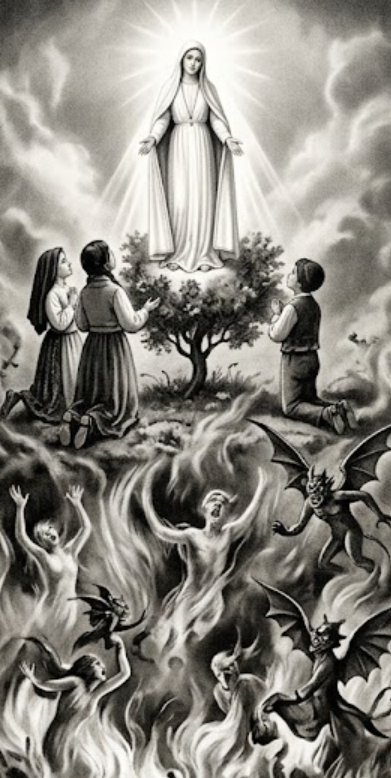
“Our Lady showed us a great sea of fire which seemed to be under the earth. Plunged in this fire were demons and souls in human form, like transparent burning embers, all blackened or burnished bronze, floating about in the conflagration, now raised into the air by the flames that issued from within themselves together with great clouds of smoke, now falling back on every side like sparks in a huge fire, without weight or equilibrium, and amid shrieks and groans of pain and despair, which horrified us and made us tremble with fear. The demons could be distinguished by their terrifying and repulsive likeness to frightful and unknown animals, all black and transparent. This vision lasted but an instant.” (dos Santos, 2007)
Lucia added that she was grateful Our Lady had already promised, at the very first apparition in May, that the children would one day be taken to Heaven — “Otherwise,” she wrote, “I think we would have died of fear and terror” (dos Santos, 2007). Ti Marto, watching from the crowd, recalled that Lucia’s face turned “white as death” and that everyone present heard her cry out in terror to the Lady she alone could see (de Marchi, 1952).
Little Jacinta, only seven years old, was marked by the vision for the rest of her short life. From that day forward she would cry out, seemingly without warning, “Oh, Hell! Hell! How sorry I am for the souls who go to hell!” This was not the invention of a frightened child’s imagination. It was a vision given by the Mother of God to three children too young and too uneducated to construct such a thing on their own, witnessed in its effects by a crowd who saw the sky change and felt the air grow cold, even though they could not see what the children saw.
Our Lady then spoke the words that explain why she had shown them hell in the first place: “You have seen hell, where the souls of poor sinners go. To save them, God wishes to establish in the world devotion to my Immaculate Heart. If what I say to you is done, many souls will be saved, and there will be peace” (dos Santos, 2007). It is worth noting what she does not say. She does not say that hell is empty, or that all souls eventually reach Heaven regardless. She shows three children the opposite reality, and then, in the same breath, hands them the remedy.
What Are the Three Secrets of Fatima — and Why Does the Third Still Divide Catholics?
That single apparition of July 13 contained what history now calls the Three Secrets of Fatima. The First Secret is the vision of hell described above. The Second Secret is a prophecy: the First World War, still raging in 1917, would end, but if men did not cease offending God, a worse war would break out during the pontificate of Pius XI, preceded by “a night illumined by an unknown light” (dos Santos, 2007). Sister Lucia later identified this sign with an extraordinary aurora borealis that lit up the skies of northern Europe on the night of January 25, 1938 (Fatima Shrine Detroit, n.d.) — roughly a year and a half before the outbreak of the Second World War. To prevent the greater catastrophe, Our Lady asked for two specific things: the Consecration of Russia to her Immaculate Heart, and the Communion of Reparation on the First Saturdays of five consecutive months. These requests were later specified in full at Pontevedra in 1925, where Our Lady defined the Five First Saturdays devotion of confession, Communion, the Rosary, and fifteen minutes of meditation offered in reparation, and again at Tuy in 1929, where she asked for the Consecration of Russia “in union with all the Bishops of the world” (dos Santos, 2007).
The Third Secret has proven far more difficult to settle. Sister Lucia wrote it down in January 1944, sealed it, and sent it to Rome with instructions that it not be opened until 1960. When 1960 came and went with no disclosure, speculation multiplied for forty years, until the Vatican finally released a text in June 2000: a vision of an angel crying “Penance! Penance! Penance!” and a “Bishop dressed in White” climbing a mountain past a half-ruined city, only to be killed, along with other bishops, priests, religious, and laypeople, by a group of soldiers (Congregation for the Doctrine of the Faith, 2000). Rome interpreted this as a symbolic foretelling of the 1981 assassination attempt on Pope John Paul II, who himself attributed his survival to Our Lady, saying that “a mother’s hand guided the bullet’s path.”
Did the Vatican Really Release the Whole Third Secret?
A traditionally minded reader deserves an honest account of this question rather than a comfortable silence. Serious and faithful Catholic scholars have raised real doubts about whether the full Third Secret was ever made public. Sister Lucia’s own text of the Second Secret ends with an unexplained “etc.” — “In Portugal, the dogma of the faith will always be preserved, etc.” — and many have argued that this dangling phrase points to a continuation of Our Lady’s own explanatory words that Rome has never released.
The Italian journalist Antonio Socci set out to debunk these doubts and instead concluded, in his book The Fourth Secret of Fatima, that a second text containing “the actual words of Our Lady” exists and remains withheld (Socci, 2009). The American canon lawyer Christopher Ferrara documented a further discrepancy in The Secret Still Hidden: Cardinal Ottaviani, who had read the sealed original, described a text of roughly twenty-five lines, while the version released in 2000 runs to sixty-two lines, a gap that Cardinal Bertone’s televised explanation did not fully reconcile (Ferrara, 2008). And Cardinal Mario Ciappi, who served as papal theologian to five popes between 1955 and 1989, wrote privately in 1995 that the Secret foretells, in his words, that “the great apostasy in the Church will begin at the top” (as cited in Ferrara, n.d.).
To be clear, the Catholic Church teaches that private revelation, even revelation as authenticated and beloved as Fatima, is never part of the deposit of faith, and no one is bound under pain of sin to accept any particular interpretation of it (Catechism of the Catholic Church, para. 67). But the existence of this teaching does not require silence on the question. On the matter of whether the full Third Secret has truly been disclosed, plenty of faithful, orthodox voices remain unsatisfied, and their reasoning deserves a fair hearing.
Why Does This Vision Echo an Older Warning on the Fewness of the Saved?
Here lies a connection almost never made, though it should be. Two centuries before Fatima, the Franciscan missionary St. Leonard of Port Maurice preached one of the most sobering sermons in Catholic history, The Little Number of Those Who Are Saved, opening with the words: “The subject I will be treating today is a very grave one; it has caused even the pillars of the Church to tremble, filled the greatest Saints with terror and populated the deserts with anchorites” (St. Leonard of Port Maurice, n.d.).
St. Leonard was not inventing a new doctrine. He was gathering together what the greatest minds of the Church had already taught. St. Augustine had written that “few are saved in comparison to those who are damned.” St. Gregory the Great taught that “many attain to faith, but few to the heavenly kingdom.” St. Thomas Aquinas held that “those who are saved are in the minority.” And behind them all stands Our Lord’s own warning in the Gospel of Luke: “Strive to enter by the narrow gate; for many, I say to you, will seek to enter, and will not be able” (Lk 13:24).
What happened at Fatima did not merely repeat this teaching in words to three children who had almost certainly never heard of St. Leonard. It showed them the reality behind it — a genuine vision of a genuine hell, filled with real souls. Fatima did not invent the doctrine of the fewness of the saved. Fatima confirmed it, in the plainest terms three shepherd children could understand.
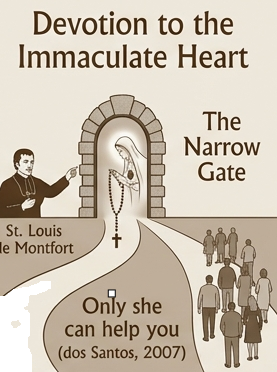
What Did St. Louis de Montfort Teach About the Narrow Gate?
Our Lady did not stop at the warning, however. In the very same breath she said, “To save them, God wishes to establish in the world devotion to my Immaculate Heart” (dos Santos, 2007). This is precisely the path that St. Louis Marie Grignion de Montfort had already laid out a century earlier in his classic work, True Devotion to Mary. Montfort taught that consecration to Mary is not an optional devotion for the especially pious but a sure and easy road to Jesus Christ, and of the Rosary in particular he wrote with striking confidence: “Never will anyone who says his Rosary every day be led astray by the devil” (St. Louis-Marie Grignion de Montfort, 1983).
This is the whole logic of Fatima compressed into a single sentence. The gate is narrow, and many will not find it, as Our Lord Himself warned. But Our Lady stands in that same narrow road, holding out the one weapon she promises will carry souls through it.
What Must We Do Now?
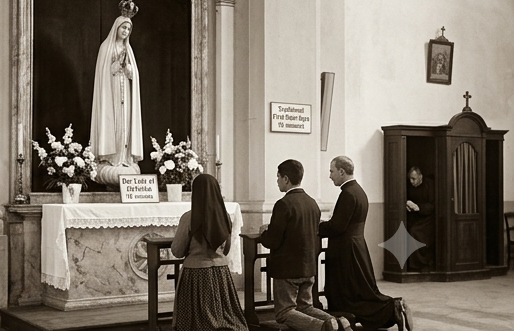
Our Lady’s requests on July 13, 1917, were not complicated, and none of them require special theological training or ecclesiastical permission. She asked for the daily Rosary. She asked for prayer and sacrifice offered for sinners, telling the children a month later, in August, “many souls go to hell because they have no one to make sacrifices and pray for them” (dos Santos, 2007). She asked for the Five First Saturdays devotion of confession, Communion, the Rosary, and fifteen minutes of meditation in reparation to her Immaculate Heart. And she asked for the Consecration of Russia, a request the Popes have wrestled with for over a century.
St. Leonard of Port Maurice, having preached what may be the most frightening sermon of his life, did not end in despair, and neither should this reflection. He closed with these words: “Whether there are many or few that are saved, I say that whoever wants to be saved, will be saved; and that no one can be damned if he does not want to be” (St. Leonard of Port Maurice, n.d.). This is the real message of Fatima as well. Our Lady promised that in the end, her Immaculate Heart will triumph. The invitation of July 13, 1917, is simply not to wait for that end before beginning to believe her.
Bibliography
Catechism of the Catholic Church. (1994). Libreria Editrice Vaticana.
Congregation for the Doctrine of the Faith. (2000). The message of Fatima. Libreria Editrice Vaticana. https://www.vatican.va/roman_curia/congregations/cfaith/documents/rc_con_cfaith_doc_20000626_message-fatima_en.html
de Marchi, J. (1952). The true story of Fatima. Catechetical Guild Educational Society.
dos Santos, L. (2007). Fatima in Lucia’s own words: Sister Lucia’s memoirs (L. Kondor, Ed.; Dominican Nuns of Perpetual Rosary, Trans.). Secretariado dos Pastorinhos. (Fourth Memoir originally written 1941)
Fatima Shrine Detroit. (n.d.). Fatima story. https://www.fatimashrinedetroit.org/fatima-story
Ferrara, C. A. (2008). The secret still hidden. Good Counsel Publications.
Ferrara, C. A. (n.d.). The three stages of apostasy: Guess which stage we are seeing now? Fatima Perspectives, no. 1350. The Fatima Center. https://fatima.org/news-views/fatima-perspectives-1350/
Frère Michel de la Sainte Trinité. (1989). The whole truth about Fatima, Vol. I: Science and the facts (J. Collorafi, Trans.). Immaculate Heart Publications.
St. Leonard of Port Maurice. (n.d.). The little number of those who are saved [Sermon]. https://www.olrl.org/snt_docs/fewness.shtml
St. Louis-Marie Grignion de Montfort. (1985). True devotion to Mary (F. W. Faber, Trans.). TAN Books. (Original work written c. 1712)
St. Louis-Marie Grignion de Montfort. (1983). The secret of the Rosary (M. Barbour, Trans.). TAN Books.
Socci, A. (2009). The fourth secret of Fatima. Loreto Publications. (Original work published 2006)
The Fatima Center. (n.d.). The complete Fatima timeline. https://fatima.org/the-complete-fatima-timeline/
Walsh, W. T. (1947). Our Lady of Fátima. Macmillan.