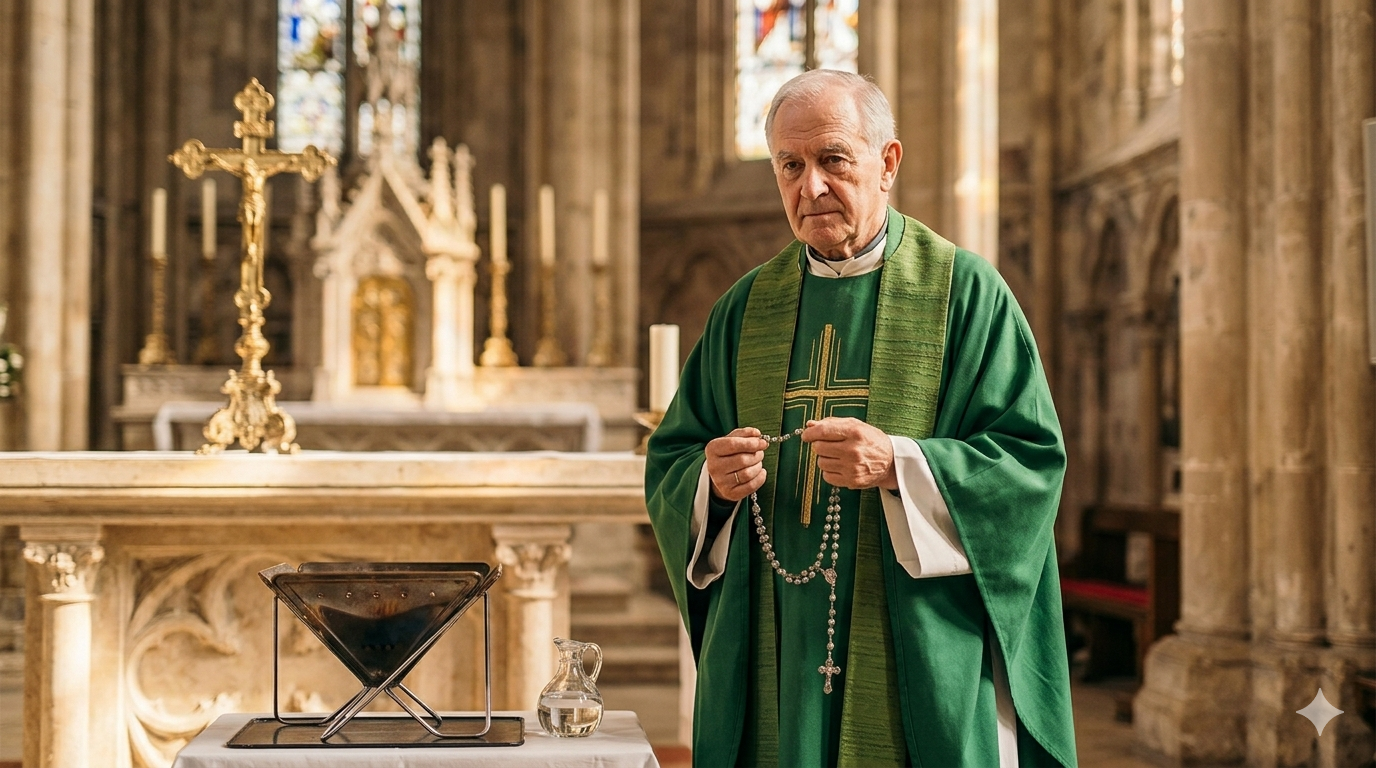
How to Dispose of Sacramentals and Holy Objects: What the Church Actually Teaches
You have probably encountered this moment. You are going through a drawer, or an elderly relative passes away, and you find yourself holding a broken rosary, a faded prayer card, or a chipped statue of Our Lady — and you have absolutely no idea what to do with it. Can you simply throw it out? Does it matter? The answer, according to the Church, is unequivocal: yes, it matters deeply.
The Catholic tradition holds that sacramentals and holy objects are not merely decorative artefacts but instruments that, through the Church’s blessing and the faithful’s devotion, mediate grace and orient the soul toward God. When such objects become damaged, worn, or obsolete, their reverent disposal is not an optional courtesy — it is a theological and canonical obligation. This comprehensive guide draws on the Catechism of the Catholic Church, the Code of Canon Law, the General Instruction of the Roman Missal, and the Directory on Popular Piety and the Liturgy to provide a complete answer.
What Are Sacramentals, and Why Do They Deserve Reverent Treatment?
A foundational question must be addressed before any practical discussion of disposal can proceed: what, precisely, is a sacramental, and why should it be treated with care when its useful life has ended?
The Catechism of the Catholic Church provides the authoritative definition: sacramentals are sacred signs instituted by the Church that bear a resemblance to the sacraments. They signify effects, particularly of a spiritual kind, which are obtained through the Church’s intercession (CCC, §1667). Unlike the seven sacraments, which were instituted by Christ Himself and confer grace ex opere operato, sacramentals derive their efficacy from the prayer of the Church and from the dispositions of the faithful who use them (CCC, §1670).
The Second Vatican Council affirmed this understanding in Sacrosanctum Concilium, noting that sacramentals sanctify almost every event in people’s lives with divine grace flowing from the paschal mystery of Christ’s passion, death, and resurrection (Paul VI, 1963, §61). Far from being superstitious tokens, sacramentals function as channels through which the Church’s prayer and the Christian’s faith encounter the mystery of redemption.
Given this theological weight, the question of disposal is not trivial. An object that has been blessed — set apart from the profane sphere and consecrated to sacred use — retains a certain dignity even in its deterioration. To discard a blessed rosary in an ordinary rubbish bin would be an act of irreverence that fails to honour the blessing it received and the prayer it facilitated. As the Directory on Popular Piety and the Liturgy notes, the faithful’s veneration of sacred images and objects reflects their understanding that these things point beyond themselves to the living God (Congregation for Divine Worship and the Discipline of the Sacraments [CDWDS], 2001, §§237–238).
What Does Canon Law Say About the Care and Disposal of Sacred Objects?
Canon Law provides the juridical framework within which the Church governs the use, care, and disposal of sacred objects. Several canons are directly relevant.
Canon 1171 of the 1983 Code of Canon Law states: “Sacred objects, which are designated for divine worship by dedication or blessing, are to be treated reverently and are not to be employed for sordid or inappropriate use even if they are owned by private persons” (John Paul II, 1983, c. 1171). This canon establishes that the obligation of reverence attaches to the object itself by virtue of its blessing or dedication, regardless of who owns it. A privately owned crucifix is no less sacred than one displayed on a church wall.
Canon 1212 further specifies that sacred objects lose their dedication or blessing if they are permanently given over to sordid uses by decree of the competent ordinary or in fact (John Paul II, 1983, c. 1212). This canon is important for understanding disposal: if a sacred object is destroyed or irreparably damaged, it ceases to function as a sacred object. However, the process by which it ceases to exist must itself be conducted reverently. The object does not lose its dignity in the moment of destruction; it must be returned to the sacred through the very act of disposal.
Canon 1220 adds that all those responsible for the care of churches are to ensure that in them the sacred vessels and vestments are carefully kept, the sacred furnishings worthily adorned, and everything required for divine worship properly maintained (John Paul II, 1983, c. 1220). While this canon speaks primarily to church administrators, it reflects the broader principle that sacred objects require proactive, attentive stewardship throughout their entire life cycle.
What Are the Traditional Methods of Disposal, and What Is Their Theological Rationale?
The Church recognises two primary methods for the disposal of blessed and sacred objects — burning and burial — and a third method specifically reserved for holy water.
Burning
Fire is one of the most ancient and universal symbols of purification and transformation. In the Old Testament, the burnt offering (Hebrew: ‘olah) represented complete self-offering to God; nothing was retained for human use (Leviticus 1:1–17). In the New Testament and subsequent Christian tradition, fire symbolises the purifying action of the Holy Spirit (Acts 2:3) and the eschatological judgment that will refine all things in the last days (1 Corinthians 3:13–15).
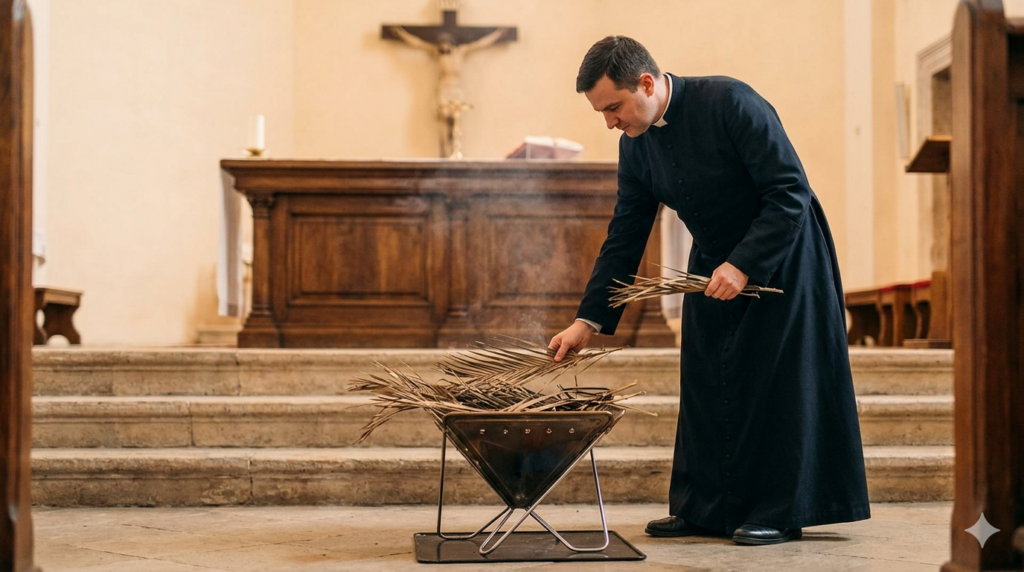
The burning of sacramentals accomplishes several theological purposes. First, it destroys the physical form of the object completely, ensuring that it cannot be retrieved and subjected to profane or sacrilegious use. Second, it reflects the transformation of the material into the immaterial—the object’s sacred dedication is, in a symbolic sense, returned to God. Third, the act of intentional, respectful burning itself constitutes a liturgical gesture, a final act of worship in the life of the object.
The most well-known application of this principle is the burning of blessed palms from Palm Sunday, whose ashes are then used for the following year’s Ash Wednesday (CDWDS, 2001, §237). The same logic applies to worn rosaries, damaged prayer cards, and other sacramentals that have reached the end of their useful life.
Burial
Burial is the second approved method, and it carries its own rich theological symbolism. In the Catholic tradition, burial is the preferred treatment of the human body because it expresses faith in the resurrection of the body (CCC, §2300). The same principle — returning what is sacred to the earth in anticipation of resurrection and transformation — is applied analogically to sacred objects.

Burial is particularly appropriate for objects that cannot be safely burned (metal items, ceramics), objects too large for domestic burning, or objects in regions where open burning is prohibited. The burial should take place in clean ground — a garden, churchyard, or other dignified location — not alongside refuse.
Pouring into the Ground: The Special Case of Holy Water
Holy water occupies a unique category among sacramentals. Unlike physical objects, it cannot be burned or buried in the conventional sense. The approved method for the disposal of holy water that is no longer needed is to pour it respectfully into the ground rather than down a drain. This practice ensures that water blessed in the name of the Trinity does not mingle with sewage or waste water, preserving the dignity of the blessing (Catholic Dailies, 2024). The earth, created by God and sanctified by the Incarnation, receives the blessed water as a kind of return to sacred ground

How Are Sacramentals (Personal Blessed Items) to Be Disposed Of?
The first category of sacred objects requiring disposal guidance is sacramentals proper—personal blessed items used for private devotion. These are the objects most commonly encountered in Catholic households and include the following, with their specific disposal protocols drawn from the Church’s tradition and contemporary catechetical guidance (Catholic Dailies, 2024):
| Item | Condition Requiring Disposal | Approved Method |
|---|---|---|
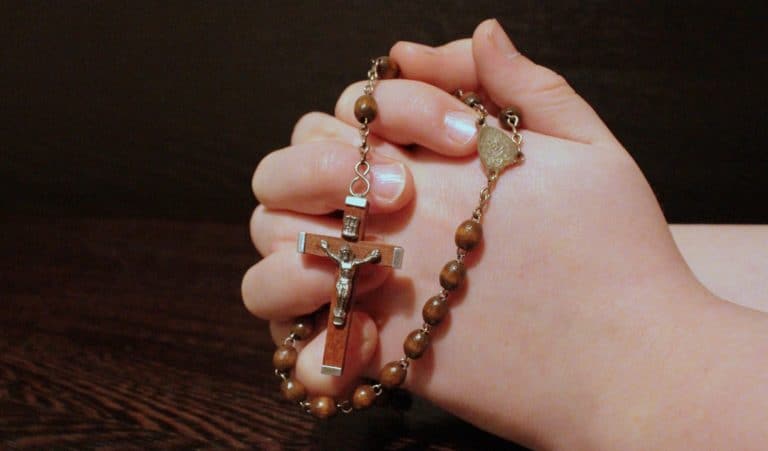
| Rosaries | Broken beyond repair | Burn or bury |
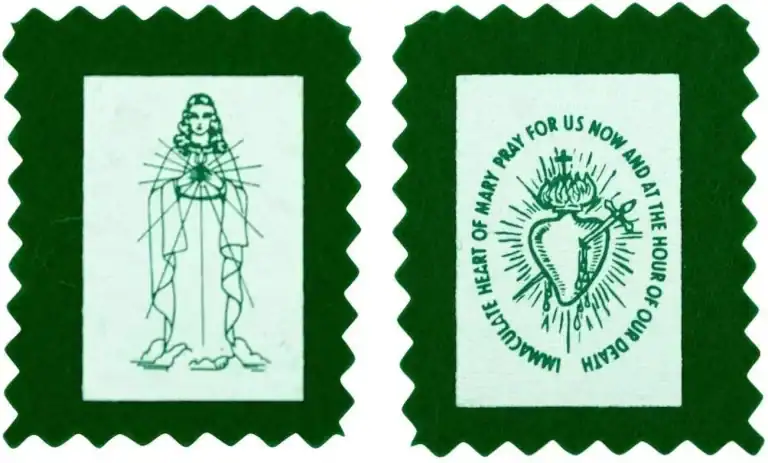
| Scapulars | Worn out or damaged | Burn or bury |
| Blessed Medals | Damaged or unusable | Burn or bury |
| Blessed Palms | After they become old | Burn or bury |
| Holy Cards / Prayer Cards | Badly damaged or torn | Burn or bury |
| Blessed Candles | No longer usable | Burn or bury |
| Holy Water | No longer needed | Pour respectfully into the ground |
Several observations are warranted regarding this category.
First, the triggering conditions matter: the obligation to dispose reverently arises when an object is genuinely damaged or unusable, not merely when it is old or unfashionable. A rosary with a broken link that has been repaired is not in need of disposal; a rosary ground into fragments is.
Second, repair should always be the first option considered: the goal is prolonged sacred use, not premature disposal.
Third, donation to a parish, Catholic school, or missionary organisation should be considered before disposal when an object is still usable but no longer needed by its owner
How Are Holy Objects Used in the Home to Be Disposed Of?
A second category comprises holy objects kept in the home for devotional purposes but not strictly classified as sacramentals in the technical sense. These include statues, crucifixes, sacred images, religious paintings, bibles, prayer books, and domestic holy water fonts. Their disposal follows protocols similar to those for sacramentals, with some nuances.
Statues and sacred images serve as visual anchors of prayer and catechesis in the home. When they are severely damaged beyond repair, the preferred methods are burning (where material permits) or burial, with respectful storage as an interim measure if immediate disposal is not possible. Crucifixes, as representations of the central mystery of the Christian faith, warrant particular care; if burning is not possible, burial is the appropriate alternative.
Bibles and prayer books present a distinctive consideration: as the written Word of God, the Scriptures possess a sacredness that transcends their physical substrate. The General Instruction of the Roman Missal (GIRM) emphasises the dignity of the Book of the Gospels as a liturgical object (Congregation for Divine Worship, 2003, §117), and this reverence extends analogically to personal copies of Scripture used for prayer. When a Bible is damaged beyond use, burning or burial is preferred. If the book is merely outdated or surplus to needs, donation to a parish library, prison ministry, or Catholic charitable organisation is strongly recommended as the first option.
Domestic holy water fonts, when broken and irreparable, may be burned, buried, or—given that they are often made of ceramic, glass, or metal—recycled through a process that involves first removing or destroying any sacred images and handling the remnants with care.
| Item | Condition | Approved Method |
|---|---|---|
| Statues | Severely damaged, cannot be repaired | Burn or bury; store respectfully if immediate disposal is not possible |
| Crucifixes | Broken beyond repair | Burn or bury |
| Sacred Images / Pictures | Damaged and unusable | Burn or bury |
| Bibles / Prayer Books | Damaged beyond use | Burn or bury (donate first if still readable) |
| Holy Water Fonts (Home) | Broken, cannot be fixed | Burn, bury, or recycle respectfully |
How Are Church Items Used in Divine Worship to Be Disposed Of?
The third and most solemn category comprises items used directly in the liturgy of the Church. These items are not merely blessed; many are consecrated—set apart with a higher degree of sacred dedication that reflects their proximate role in the celebration of the Eucharist and other sacraments. Their disposal requires particular care and, in many cases, the involvement of diocesan authorities.
Pews and Church Furniture
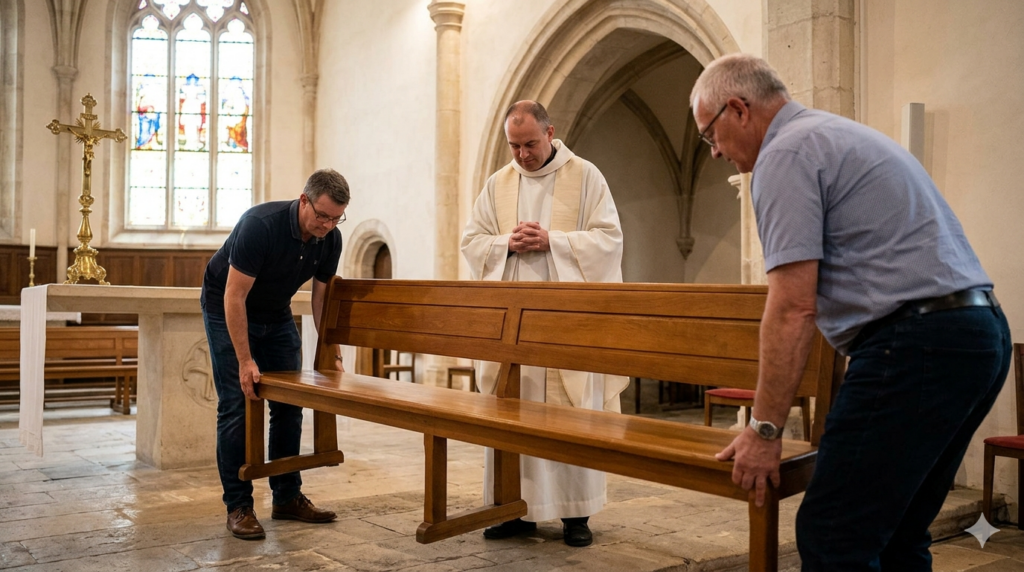
Church furniture, including pews, altars, and confessionals, is blessed upon installation and thereby set apart for sacred use. When such items are replaced during renovation, they should be reused in another church, donated to a mission church or Catholic school, or otherwise retained in sacred or quasi-sacred use. If this is not possible, they should be disposed of respectfully rather than simply sent to landfill. Some dioceses have specific guidelines for the disposition of church furnishings; the local ordinary’s office should be consulted (John Paul II, 1983, c. 1220).
Holy Water Fonts (Church)
Font basins that hold holy water in church are sacred objects of considerable importance. When they are removed or replaced, the same hierarchy applies: restoration, reuse, and donation to another church are preferred. If none of these options is available, disposal should be carried out respectfully, in consultation with the pastor or diocesan heritage office.
Altar Linens and Vestments
Altar linens (corporals, purificators, and other cloths that may come into contact with the Blessed Sacrament) and vestments used in the celebration of Mass possess a high degree of liturgical dignity. The GIRM specifies that all objects destined for liturgical use are to be worthy, becoming, and beautiful (Congregation for Divine Worship, 2003, §351). When such items are worn out and unsuitable for continued liturgical use, the approved method of disposal is burning or burial. They should under no circumstances be converted to secular use or donated to non-religious organisations for general household or decorative purposes.
Sacred Vessels
Sacred vessels—chalices, patens, ciboria, and other vessels used for the Eucharist—occupy the highest level of liturgical dignity among portable church objects. Canon 1292 requires that the alienation of precious items of significant historical or artistic value requires the written permission of the Holy See (John Paul II, 1983, c. 1292). When a sacred vessel is damaged beyond repair, it should be returned to the local church or diocese for proper disposition. This may involve official deconsecration, melting down of precious metal elements, or other formally supervised processes. The laity should not unilaterally dispose of sacred vessels; this is a matter for legitimate ecclesiastical authority.
| Item | Condition | Approved Method |
|---|---|---|
| Pews / Church Furniture | If replaced or removed | Restore, reuse, or donate to another church; if impossible, dispose respectfully |
| Holy Water Fonts (Church) | If replaced | Restore, reuse, or donate; if impossible, dispose respectfully |
| Altar Linens (Corporals, Purificators) | Worn out and unusable | Burn or bury; never convert to secular use |
| Old Vestments | Worn out, cannot be used liturgically | Burn or bury |
| Sacred Vessels (Chalices, Patens) | Damaged beyond repair | Return to Church or Diocese for proper disposition |
Sacred vessels — chalices, patens, ciboria, and other vessels used for the Eucharist — occupy the highest level of liturgical dignity among portable church objects. When a sacred vessel is damaged beyond repair, it should be returned to the local church or diocese for proper disposition. Canon 1292 requires formal oversight for the alienation of objects of significant historical or artistic value. The laity should not unilaterally dispose of sacred vessels; this is a matter for legitimate ecclesiastical authority.
What Are the Five Key Principles Governing the Disposal of Holy Objects?
Drawing together the canonical, theological, and practical threads of this discussion, five foundational principles emerge as governing the entire domain of sacramental disposal.
PRINCIPLE 1: REVERENCE — Not Superstition
Reverence is the animating virtue. Blessed and sacred objects are to be treated with respect not because they possess magical power or because improper disposal will bring misfortune, but because they have been dedicated to God and bear a relationship to Him. The CCC is explicit: “Sacramentals do not confer the grace of the Holy Spirit in the way that the sacraments do, but by the Church’s prayer, they prepare us to receive grace and dispose us to cooperate with it” (CCC, §1670). Reverent disposal is an act of worship, not an act of fear.
PRINCIPLE 2: BALANCE — Avoiding Both Superstition and Careless Disposal
The Church steers between two errors. On one side lies superstition—the belief that sacred objects have intrinsic power independent of God’s grace and the Church’s prayer, or that their disposal will attract divine punishment. On the other side lies careless indifference—the secular attitude that a worn-out religious object is simply rubbish. Both errors misunderstand the nature of sacramentals. The Directory on Popular Piety and the Liturgy warns against an uncritical multiplication of sacramentals as well as an attitude of disrespect (CDWDS, 2001, §14).
PRINCIPLE 3: INTENTION — What Matters Most Is How the Action Honours God
The moral quality of disposal is determined not merely by the method but by the intention. A faithful Catholic who burns a damaged rosary in a spirit of grateful return to God performs an act of piety. The same action performed carelessly or contemptuously misses the point entirely. This principle applies across all categories: the question to ask is not merely ‘Have I followed the correct protocol?’ but ‘Is my intention in this act to honour God?’
PRINCIPLE 4: CONSULTATION — When in Doubt, Ask Your Priest or Parish
The Church does not impose a single universal method for disposing of every type of sacramental or holy object. Different dioceses, cultures, and circumstances may nuance the application of general principles. When uncertainty exists—particularly regarding church items, consecrated objects, or items of historical or artistic significance—the faithful should consult their pastor or diocesan office. This is not a sign of scrupulosity but of ecclesial communion.
PRINCIPLE 5: VARIATION — Practices May Vary by Diocese, Parish, Culture, or Circumstance
The universal Church encompasses an immense diversity of cultures, traditions, and practical circumstances. A rural parish in Australia may have different practical options from an urban parish in Rome or a mission church in sub-Saharan Africa. The principles governing disposal are universal; their application is local. Faithful Catholics should be informed by universal principles and guided by local pastoral authority.
Where Does the Church Formally Teach These Principles?
The guidance outlined in this article draws from several magisterial and authoritative Church documents. Understanding the provenance of these teachings helps the faithful distinguish between universal doctrine, authoritative pastoral guidance, and local custom.
- Directory on Popular Piety and the Liturgy (2001), §§14 and 237–238: Provides pastoral guidance on the right ordering of popular religious practices, including the use and veneration of sacred images and objects, with particular attention to the balance between genuine piety and superstition.
- Catechism of the Catholic Church (CCC), §§1667–1679: Provides the definitive theological treatment of sacramentals, including their nature, the categories of those who confer them, and their relationship to the sacramental economy of grace.
- Code of Canon Law (1983), Canons 1171, 1212, 1220, and 1292: Establishes the juridical framework governing the use, care, alienation, and disposal of sacred objects, with specific provisions for both personal sacramentals and church property.
- General Instruction of the Roman Missal (GIRM), §§117, 345, and 351: Addresses the dignity, care, and proper treatment of liturgical objects used in the celebration of the Mass, including vestments, altar linens, and sacred vessels.
What Is the Scriptural Foundation for the Reverent Treatment of Sacred Objects?
While the specific protocols for sacramental disposal are ecclesial rather than scriptural in origin, they rest upon a broader scriptural anthropology that affirms the goodness of the material world and the appropriateness of consecrating material things to sacred use.
The book of Exodus provides extensive detail on the construction and veneration of sacred objects in the Tabernacle: the Ark of the Covenant, the menorah, the altar of incense, and the priestly vestments (Exodus 25–40). Far from condemning these objects, the sacred text presents their construction as an act of obedience to divine command and their use as integral to Israel’s covenant worship. The detailed prescriptions governing their care—including who may touch them, how they are to be transported, and what happens to those who treat them irreverently (cf. 2 Samuel 6:6–7)—establish a scriptural precedent for the Church’s own approach to sacred objects.
In the New Testament, Jesus’ act of driving the money changers from the Temple (Matthew 21:12–13; John 2:13–17) reveals His deep commitment to the sanctity of sacred space and sacred things. His condemnation of those who had turned the house of prayer into a den of thieves is not merely an ethical critique; it is an assertion that what has been dedicated to God must not be reduced to merely profane utility.
Saint Paul’s teaching in 1 Corinthians 10:31—’Whatever you do, do everything for the glory of God’—provides the ultimate theological ground for reverent disposal. Every act, including the final act in the life of a sacred object, is to be ordered toward the glory of God. This is the scriptural foundation upon which the entire edifice of Catholic practice regarding sacramentals is built.
What Are the Practical Implications for Catholic Households Today?
Contemporary Catholic households encounter the question of sacramental disposal with increasing frequency, particularly as families receive inherited religious objects, cull devotional items during house moves, or encounter damaged sacramentals in their regular domestic life. Several practical recommendations follow from the theological and canonical analysis above.
Establish a Household Protocol
Catholic families benefit from having a clear, agreed protocol for managing sacred objects. This might include a designated drawer or box for items awaiting prayerful disposal, an annual review of damaged or unused sacramentals, and a family ritual for the actual burning or burial to ensure that the act is performed with appropriate gravity.
Prioritise Repair and Donation
Disposal is a last resort. A rosary with a broken clasp, a statue with a chipped base, or a prayer book with worn pages should first be repaired if possible. If an object is genuinely surplus to the family’s needs but still usable, donation to a parish sacramental bank, nursing home ministry, or missionary organisation is the preferred option.
Differentiate Between Categories
Not all sacred objects require the same level of care. Personal sacramentals (rosaries, medals, scapulars) may generally be burned or buried by the faithful without any special ceremony beyond a simple prayer. Church items (vestments, sacred vessels, liturgical furniture) require consultation with the pastor and may require diocesan involvement. Understanding this hierarchy prevents both excessive scrupulosity and insufficient care.
Reclaim the Sacred Dimension of Ordinary Objects
Finally, the question of sacramental disposal invites a deeper reflection on the Catholic understanding of the material world. In a culture that treats everything as disposable and commodified, the Church’s insistence on reverent disposal is a countercultural witness to the dignity of the sacred, the goodness of creation, and the truth that not everything dedicated to God can simply be discarded when it is no longer convenient. This is, ultimately, a question about the kind of people we wish to be: people who take seriously the things they have offered to God.
Conclusion
The reverent disposal of sacramentals and holy objects is a practice rooted in theology, grounded in canon law, and expressed in centuries of Catholic tradition. It is not a matter of superstition or excessive piety but of consistent witness to the Catholic understanding that what has been given to God retains its dignity even in its dissolution. Whether burning a worn rosary, burying a damaged statue, pouring holy water into the garden, or returning a broken chalice to the diocese, the faithful Catholic is performing an act of worship—one final, quiet act of devotion that acknowledges the sacred character of objects that have mediated grace and pointed toward God.
In the words of 1 Corinthians 10:31: ‘Whatever you do, do everything for the glory of God.’ This is the alpha and omega of Catholic sacramental practice. Let it be the principle that governs not only how we use what is holy, but how we return it.
References
Congregation for Divine Worship and the Discipline of the Sacraments. (2001). Directory on popular piety and the liturgy: Principles and guidelines. Vatican City: Libreria Editrice Vaticana.
Congregation for Divine Worship and the Discipline of the Sacraments. (2003). General instruction of the Roman missal (3rd ed.). United States Conference of Catholic Bishops.
John Paul II. (1983). Code of canon law: Latin-English edition. Canon Law Society of America.
John Paul II. (1992). Catechism of the Catholic Church. Libreria Editrice Vaticana.
Paul VI. (1963). Sacrosanctum Concilium: Constitution on the sacred liturgy. Second Vatican Council. Libreria Editrice Vaticana.
Schouppe, J.-P. (1992). The sacramentals: An introduction to the devotional practices and pious customs of the Church. TAN Books.
Thurston, H. (1912). Sacramentals. In The Catholic Encyclopedia (Vol. 13). Robert Appleton Company.