The 9 Hidden Sins Good Catholics Never Confess (But God Sees Every One)
Introduction: The Sins No One Sees — Except God
When we examine our consciences, the sins that surface most readily tend to be the visible, external transgressions — the harsh word spoken in anger, the missed Sunday obligation, the lie told for convenience. But there exists a second and far more treacherous category: the hidden interior disorder that conceals itself beneath pious exteriors, polished reputations, and even well-intentioned behaviour.
Sacred Scripture is explicit: “I, the LORD, search the heart and examine the mind” (Jeremiah 17:10). Christ Himself focused much of His teaching not on external conduct but on the interior dispositions that external conduct merely expresses — teaching that hatred is tantamount to murder (Matthew 5:21–22) and lust to adultery (Matthew 5:27–28).
This article examines nine hidden sins that devout, churchgoing Catholics most frequently leave unexamined — and therefore unconfessed and unconquered. Each sin is explored with concrete examples drawn from ordinary life. The purpose is not condemnation but illumination: to shed the light of truth into the interior rooms we prefer to keep dark, so that genuine conversion, healing, and freedom may follow.
As St. Augustine of Hippo observed in his Confessions, the human heart is restless until it rests in God — and that rest cannot be found while the heart harbours unacknowledged disorder (Augustine, 397/1961). The examination of hidden sin is therefore not a morbid exercise in self-accusation but an act of radical honesty that opens the soul to divine mercy.
1. Envy — “The Rot That Hides Behind a Smile”
“A tranquil heart gives life to the flesh, but envy makes the bones rot.”
Proverbs 14:30 (NRSVCE)
Envy is defined in the Catholic moral tradition as sadness or distress at the good fortune of a neighbour, together with a disordered desire to possess what belongs to another. St Thomas Aquinas classified envy as one of the seven capital sins precisely because it is a root from which numerous other sins spring — including detraction, calumny, and rejoicing in another’s misfortune (Aquinas, 1265–1274/1981, II–II, q.36). The Catechism of the Catholic Church (1997) describes envy as “a capital sin” that “can lead to the worst crimes” (para. 2539).

What makes envy particularly hidden is its tendency to disguise itself as concern, fairness, or even justice. The envious person rarely announces their emotion. Instead, they rationalise, minimise the other’s achievement, subtly undermine, or withdraw into silent resentment. The confession “I secretly compare myself to others and wish I had what they have” captures exactly this interior disposition — one kept hidden precisely because it shames its host.
Examples in Everyday Life
- A woman in a parish prayer group is privately devastated when her close friend announces an unexpected promotion and salary increase. Rather than confronting the envy directly, she finds herself mentally cataloguing the friend’s weaknesses and recalling occasions when the friend failed professionally. She praises the friend to her face, but her private thoughts are consumed by comparison. Over time, she distances herself from the friendship without ever acknowledging why.
- A man scrolls through social media and observes a former classmate’s photographs of overseas travel, a new home, and a growing family. He has a comfortable life of his own, yet he finds himself consumed by a persistent low-level discontent. He mutters dismissive comments about the classmate’s apparent shallowness. His prayer becomes half-hearted because, on some level, he is quietly angry at God for what others appear to have received. DeYoung (2009) notes that envy is uniquely poisonous because, unlike greed, it cannot be satisfied even in theory — there will always be another person whose advantages provoke fresh comparison (p. 44).
- A seminarian notices that a fellow student receives public praise from a professor for a theological essay. Though his own work was commended privately, he harbours a growing resentment that quietly erodes his fraternal charity. He begins to subtly undercut the praised student in conversations with peers — not through outright lies but through ironic remarks and damning with faint praise. St Thomas Aquinas would identify this as the sin of “detraction” flowing directly from the root of envy (Aquinas, 1265–1274/1981, II–II, q.73).
The antidote to envy, in both Scripture and the tradition, is the cultivation of gratitude and the practice of genuinely rejoicing in the good of others — what the Greek New Testament calls
The antidote to envy is the cultivation of gratitude and the practice of genuinely rejoicing in the good of others — what the Greek New Testament calls synchairete (1 Corinthians 12:26). Spiritual direction and regular, honest examination of conscience are strongly recommended for those who recognise this pattern.
2. Sloth — “The Sin That Looks Like Being Busy”
Proverbs 6:6 (NRSVCE)
“Go to the ant, you lazybones; consider its ways, and be wise.”
The capital sin traditionally translated as “sloth” (Latin: acedia) is considerably more than physical laziness. St Thomas Aquinas describes acedia as a spiritual torpor — a sadness or aversion regarding the Divine good, manifesting as a reluctance to pursue God, fulfil one’s vocation, or do the work to which one has been called (Aquinas, 1265–1274/1981, II–II, q.35). Pieper (1952/2009) offers the most penetrating modern analysis: acedia is, at its core, a refusal of the greatness of one’s own being as a creature made for God. It is not merely the failure to do things but a flight from what one is called to become.

In practical terms, sloth manifests as chronic procrastination, half-hearted engagement with prayer and the sacraments, the avoidance of difficult but important work, and a restless seeking of distraction. “I procrastinate and avoid the work God has called me to do.” This is a particularly apt definition because it makes explicit the theological dimension — it is not merely productivity that is at stake but a person’s response to their divine vocation.
Examples in Everyday Life
- A Catholic father of three consistently intends to begin family prayers, read the Bible with his children, and establish a regular Sunday routine beyond the bare minimum of Mass attendance. Month after month, these intentions remain unfulfilled. He is not a bad man — he is genuinely well-intentioned — but he perpetually defers the sacred work of his vocation as a domestic patriarch. Kreeft (2000) argues that sloth is the sin most characteristic of affluent Western Christians, precisely because comfort and entertainment provide infinite means of escape from the demanding good (p. 152).
- A woman discerns, with genuine clarity, that she is called to use her professional skills in service of her parish or a local charity. She makes the initial inquiries, attends one meeting, and then retreats into inactivity — not because of external obstacles but because sustained commitment feels costly. Years pass, and the call remains unanswered. This pattern of serial intention without follow-through is what Proverbs 6:6–11 characterises through the image of the sluggard who “folds his hands” and defers the harvest until poverty overtakes him.
- A student preparing for the priesthood consistently underperforms in his theological studies — not from lack of intelligence but from a deep-seated avoidance of the intellectual labour required by his vocation. He prays well when prayer is easy and externally affirmed, but sustains no interior life of contemplation or disciplined study. St Thomas Aquinas, himself the patron of students, would recognise this as a failure of the theological virtue of prudence operating in conjunction with the capital sin of acedia (Aquinas, 1265–1274/1981, II–II, q.47).
3. Resentment — “The Prison You Built for Yourself”
Romans 12:17 (NRSVCE)
“Do not repay anyone evil for evil, but take thought for what is noble in the sight of all.”
Resentment — the practice of dwelling on past offences and refusing to release them — occupies an interesting theological space. It is not always recognised as a sin because it can feel entirely justified. “I dwell on past offences instead of letting them go” is a statement that many sincere Christians would recognise in themselves yet struggle to classify as sinful, particularly where real harm was done to them. But the tradition is clear: to nurse grievance is to allow a wound to fester, and it ultimately harms the one who resents more than the one who offended.
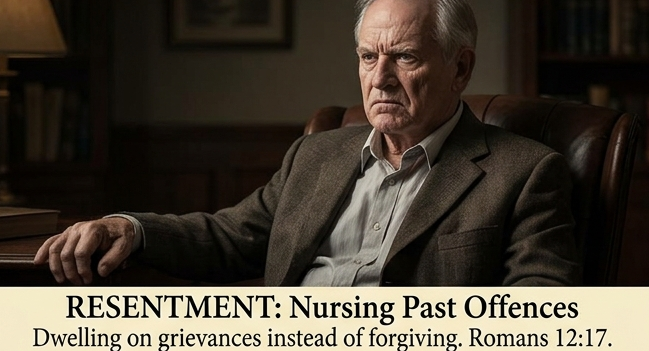
Resentment is theologically related to the sin of hatred and to a failure of the virtue of charity. Pope Francis (2013), in his apostolic exhortation Evangelii Gaudium, observes that Christians who carry unresolved resentments become closed, defensive, and ultimately sterile in their witness to the Gospel (para. 83). The Catechism (1997) teaches that forgiveness is a participation in God’s own mercy and is, therefore, a grave obligation of the Christian life (para. 2840).
Examples in Everyday Life
- A man whose business partner betrayed him fifteen years ago continues to rehearse the details of that betrayal in mental soliloquy, particularly when facing new difficulties. He has formally forgiven the partner — or believes he has — but the injury remains the lens through which he interprets present experience. His prayer is hampered by an underlying anger at God for permitting the original betrayal. Lewis (1960) in The Four Loves observes that resentment of this kind is a form of sustained attention given to evil, which gradually reshapes the character of the resentful person toward hardness and suspicion (p. 184).
- A woman raised in a dysfunctional household carries decades of unresolved pain regarding her parents’ failures. In her adult life, she is a faithful churchgoer and an apparently charitable person, but she has constructed subtle interior walls that prevent any genuine intimacy or vulnerability. Her confessions are regular but strangely superficial because she has never brought the deepest contents of her heart to Christ. The resentment has, in effect, sealed off the very room in which transformation needs to take place.
- A priest who was passed over for a leadership appointment harbours a quiet but persistent resentment toward his bishop. He continues to serve faithfully in his parish — his exterior conduct is above reproach — but in private conversations he subtly undermines the bishop’s authority, couching his criticisms in language of pastoral concern. Scripture is unambiguous: “Get rid of all bitterness, rage and anger… forgiving each other, just as in Christ God forgave you” (Ephesians 4:31–32, NRSVCE).
4. Worry and Doubt — “Faith on Sunday, Fear on Monday”
Philippians 4:6–7 (NRSVCE)
“Do not worry about anything, but in everything by prayer and supplication with thanksgiving let your requests be made known to God. And the peace of God, which surpasses all understanding, will guard your hearts and your minds in Christ Jesus.”
Theological Definition
Anxiety and chronic worry occupy an ambiguous moral category, and it is important to distinguish pathological anxiety (which is a medical condition deserving compassionate treatment) from the habitual spiritual disposition described in the infographic: “I say I trust God, but I live as if everything depends on me.” This latter condition — sometimes called functional atheism in spiritual theology — is a form of practical unbelief. It is not that the person has rejected God intellectually; it is that their daily lived experience does not reflect the trust they profess.
St Thomas Aquinas identifies the virtue opposed to this disposition as magnanimity operating in conjunction with the theological virtue of hope (1265–1274/1981, II–II, q.129). The person who truly hopes in God is not paralysed by future contingencies. Rolheiser (1999) describes the modern version of this anxiety as a form of “restlessness” that, unaddressed, prevents authentic encounter with God and keeps the soul in a state of perpetual distraction (p. 11).
Examples in Everyday Life
- A woman of deep faith, known for her prayer life and charitable works, cannot sleep on Sunday nights because of anxieties about her work week. She prays the Rosary nightly and receives Communion regularly, yet her interior life is dominated by catastrophic thinking about financial insecurity, her children’s futures, and her own health. She has never brought this specific interior pattern to Confession or to her spiritual director, perhaps because she regards worry as a weakness rather than a sin — but the sustained refusal to entrust these matters to Providence constitutes a practical rejection of hope.
- A man who would describe himself as devoutly Catholic nonetheless makes every significant life decision from a framework of pure pragmatic self-reliance. He plans meticulously for every contingency, rarely if ever discerning his choices in prayer, and speaks frequently about what “I have decided” or “I have planned” with no reference to God’s will. His faith is compartmentalised to Sunday morning and formal prayer times. Throughout the rest of his life, God is effectively absent from the decision-making process. This is the “functional atheism” described by Barron (2011, p. 34).
- A religious sister experiences a crisis in her ministry when the project she has led for years faces closure. Her response is to redouble her own efforts in an increasingly desperate and controlling manner, driving herself and her community toward exhaustion. She prays, but her prayer has become a vehicle for listing her anxieties rather than an act of surrender. The theological tradition’s remedy is precisely that which St. Paul prescribes in Philippians 4:6–7: the active transformation of worry into supplication, accompanied by gratitude — a discipline of trust that must be practised, not merely endorsed intellectually.
5. Discontent and Complaining — “The Sin God Judged Israel For”
1 Corinthians 10:10 (NRSVCE)
“And do not complain as some of them did, and were destroyed by the destroyer.”
Theological Definition
Discontent and habitual complaining are among the most socially tolerated sins in contemporary Western Christianity, perhaps because they are so universal and so easy to justify. The complainer always has a point: circumstances genuinely are imperfect; people genuinely do fail; life genuinely is difficult. But the habitual orientation of complaint is not primarily an observation about the world — it is a disposition of the heart that says, implicitly, that God’s management of one’s life is inadequate.
The Old Testament records Israel’s chronic murmuring in the wilderness as a paradigmatic instance of this sin, one that provoked divine displeasure not because the hardships were fictional but because the people’s response revealed a fundamental lack of trust in God’s goodness and provision (Numbers 11:1; 21:5). St Paul explicitly invokes this precedent in 1 Corinthians 10:10 as a warning to Christians who imagine themselves immune to the same spiritual failure. Vitz (1999) connects the psychology of chronic complaint to an underlying narcissism that perceives any difficulty as a personal affront (p. 67).
Examples in Everyday Life
- A parishioner is perpetually dissatisfied with the parish — the music is wrong, the priest’s homilies are inadequate, the volunteer rosters are unfair, the building is uncomfortable. Her criticisms are often accurate in themselves, but the underlying disposition is one of chronic discontent that no external improvement could ultimately satisfy. She has never consciously reflected that her interior murmuring is a spiritual condition rather than a series of legitimate observations. Barron (2011) identifies this pattern as a failure to perceive the gratuitous goodness of existence — the “gratuity” that is the foundation of genuine praise (p. 58).
- A young man navigating a period of financial difficulty and vocational uncertainty finds that his prayer life has become dominated by complaint. He asks God why, lists his grievances, and measures his faith by the absence of answered prayers rather than by the presence of God’s love. He has not considered that the discipline of thanksgiving, practised deliberately in the midst of privation, is itself a powerful spiritual act — one modelled by St Paul, who wrote Philippians from prison (Philippians 4:11). The condition of contentment, St Paul explicitly states, is “learned” — it is the fruit of spiritual formation, not merely a natural temperament.
- A mother of young children navigates a demanding season of life and has fallen into a pattern of low-level but sustained complaint — to her spouse, to her friends, and internally to God. Her complaints are not without foundation, but the pattern has solidified into a defining characteristic of her inner world, crowding out gratitude and peace. She would benefit from the ancient spiritual practice of the examen, pioneered by St. Ignatius of Loyola, which trains the practitioner to identify moments of consolation and gratitude throughout the day as an antidote to the natural drift toward complaint (Fleming, 2008, p. 47).
6. Pride — “The Sin Satan Died For”
Proverbs 16:18 (NRSVCE)
“Pride goes before destruction, and a haughty spirit before a fall.”
Theological Definition
Pride is universally recognised in the Christian tradition as the first and most fundamental of the capital sins — the root from which all others ultimately spring. St Augustine identified it as the original sin of Satan and the primary inheritance of the fallen human condition (Augustine, 397/1961, I.i). St Thomas Aquinas defines pride as an inordinate appetite for one’s own excellence — the disordered desire to be greater than one actually is, or to receive more credit than one deserves (Aquinas, 1265–1274/1981, II–II, q.162).
The particular form of pride identified in the infographic — “I put myself above others and trust in my own strength rather than God’s” — targets its most dangerous expression: spiritual pride. This is not the obvious arrogance of the braggart but the subtler disposition of the person who, deep down, believes themselves to be self-sufficient. They may perform piety admirably while their interior life remains sealed by an impenetrable self-reliance that renders authentic prayer — which requires the acknowledgment of need — effectively impossible.
Examples in Everyday Life
- A highly educated professional who is also a committed Catholic finds himself consistently dismissing the spiritual insights of those with less formal education — including his own parish priest. He frames this dismissal in terms of intellectual rigour, but its root is pride. He sits in the pew calculating the theological errors in the homily rather than allowing the Word of God to address him. Lewis (1952) in Mere Christianity famously observes that pride is essentially competitive: it is not the possession of good things that delights the proud man, but having more than the next person (p. 122).
- A woman who serves extensively in her parish and is widely admired for her generosity harbours a secret but profound pleasure in her own virtue. Her service is real, but it is performed, at some level, for the satisfaction of self-confirmation rather than purely for God. When a younger volunteer receives praise that she feels she has earned, the sting she experiences reveals the extent to which her virtue has been, at least partially, in service of pride. This is what the spiritual tradition calls the “last infirmity of noble minds” — pride in one’s own humility.
- A man facing a serious health crisis refuses to ask for help, refuses to be vulnerable with his family, and refuses to surrender the outcome to God in prayer. His stoicism is partly cultural, but its deeper root is a pride that cannot accept dependence, limitation, or need. His faith remains an intellectual commitment that has never been submitted to the purifying fire of authentic helplessness. The Gospel’s demand — “unless you become like a little child you will not enter the Kingdom” (Matthew 18:3, NRSVCE) — is addressed precisely to this disposition.
7. Impure Thoughts — “The Sin That Lives in the Dark”
Matthew 5:28 (NRSVCE)
“But I say to you that everyone who looks at a woman with lust has already committed adultery with her in his heart.”
Theological Definition
With a single verse, Christ radically interiorised the moral law regarding sexual ethics. The Sixth Commandment had historically been applied primarily to external acts; Jesus extended its scope to include the interior act of deliberately entertaining lustful desires. This teaching is consistent with His broader approach in the Sermon on the Mount, where He consistently deepens the law by addressing its internal roots rather than merely its external expressions.
The Catechism of the Catholic Church (1997) teaches that “the deliberate use of the sexual faculty, for whatever reason, outside of marriage is essentially contrary to its purpose” and that this principle applies to thought and imagination as well as to act (para. 2352). Theology of the Body, Pope John Paul II’s (1979–1984/2006) extended catechetical series, provides the most developed modern treatment of this subject, situating the struggle for purity within a positive theology of human love as an icon of the trinitarian self-gift (pp. 185–206).
Examples in Everyday Life
- A married man has never been unfaithful to his wife in action, and genuinely loves her, but has developed a habit of mentally dwelling on attractive women he encounters — in the street, on screens, in the workplace. He regards this as an essentially harmless interior activity — “just thoughts” — and has never brought it to Confession. Yet over years, this habit has subtly reshaped his capacity for genuine intimacy, reducing the other to an object of fantasy and feeding a low-grade dissatisfaction with his actual marriage. John Paul II (1979–1984/2006) explicitly addresses this pattern, noting that “adultery of the heart” is committed not only in the contemplation of another but also, at times, in the objectifying contemplation of one’s own spouse (p. 157).
- A single woman in her thirties, devout and active in her parish, struggles with a persistent pattern of romantic and sexual fantasising that she regards as a benign substitute for the intimacy she desires and has not found. She has never examined this pattern through the lens of chastity, partly because the cultural narrative around her has thoroughly normalised it. St Thomas Aquinas would categorise deliberate dwelling on such thoughts — as opposed to involuntary temptation — as a venial or mortal sin depending on its deliberateness and the consent of the will (1265–1274/1981, II–II, q.154).
- A teenager from a practising Catholic family has been exposed since early adolescence to pornographic content online. He attends Mass, receives Communion, but has never confessed this pattern — partly from shame, partly from an unclear understanding of its moral gravity. Doyle (2015) documents the neurological consequences of habitual pornography consumption, demonstrating measurable changes in brain reward circuitry analogous to substance addiction (p. 33). This is not merely a spiritual problem but a holistic one, requiring both sacramental grace and, in many cases, professional therapeutic support alongside spiritual direction.
8. Critical Spirit — “The Sin That Calls Itself Discernment”
Matthew 7:1 (NRSVCE)
“Do not judge, so that you may not be judged.”
Theological Definition
Matthew 7:1 is one of the most frequently quoted verses in contemporary culture, almost invariably deployed to silence moral critique of any kind. It is important, therefore, to establish its proper theological meaning. Christ is not prohibiting all moral evaluation — such a reading would contradict the entire corpus of His ethical teaching, as well as the necessity of justice and the obligation to correct error. What He is prohibiting is a specific interior disposition: the habitual orientation of judging others harshly, focusing on their failures and defects while remaining blind to one’s own.

St Thomas Aquinas distinguishes between the legitimate judgment of reason (necessary for justice, governance, and fraternal correction) and the sin of rash judgment, which consists in assuming without sufficient evidence that another person is morally deficient (1265–1274/1981, II–II, q.60). The critical spirit states: “I judge others harshly and focus on their flaws more than my own” — is precisely this rash judgment, compounded by the irony that the attention devoted to others’ sins functions as a displacement activity from one’s own necessary self-examination.
Examples in Everyday Life
- A traditionalist Catholic has developed a habit of rigorously evaluating the liturgical practice, theological precision, and personal conduct of every priest, bishop, and fellow parishioner he encounters. His standards are not entirely unjust — genuine liturgical abuse and theological error deserve to be named — but his disposition has hardened into a hermeneutic of suspicion that filters all experience through the question: “What is wrong here?” He is scrupulous in external observance yet has not examined his own spiritual pride, impatience, or the lovelessness that increasingly characterises his engagement with the Church.
- A woman in a close-knit Catholic community has become the unofficial chronicler of everyone else’s failings. She is not malicious — she is, in her own self-understanding, deeply concerned for the spiritual wellbeing of those around her. But her conversations are dominated by the analysis of other people’s faults, and she has developed a reputation, beneath the surface of polite community life, for being someone people guard themselves around. The spiritual tradition is explicit that this disposition, unless repented of and transformed, will erode one’s capacity for charity and ultimately for authentic encounter with God (Francis, 2016, para. 224).
- A father is intensely, almost professionally, critical of his children’s performance — academic, athletic, personal. His standards are framed in terms of love and future wellbeing, but the daily experience of his children is one of constant evaluation and chronic insufficiency. He has not examined the extent to which his exacting judgments of others mask an equally demanding and unexamined self-judgment — the two, in the tradition, are typically linked. Christ’s prescription in Matthew 7:3–5 is the removal of the “plank” from one’s own eye — a metaphor for the disproportionate attention paid to one’s own interior disorder relative to the meticulous attention paid to others’.
9. Greed and Materialism — “When Comfort Becomes Your God”
Matthew 6:24 (NRSVCE)
“No one can serve two masters; for a slave will either hate the one and love the other, or be devoted to the one and despise the other. You cannot serve God and wealth.”
Theological Definition
Greed — the inordinate love of and desire for material goods — is identified by St Thomas Aquinas as the capital sin of avarice (avaritia), which he defines as the excessive desire for possession beyond one’s legitimate needs (1265–1274/1981, II–II, q.118). Materialism, as a cultural form of this vice, goes further: it constitutes an implicit metaphysical claim that material reality is the primary — or only — reality, and that one’s worth, security, and identity are constituted by possession.
The particular expression identified — “I desire more things and place comfort or money above God” — is important precisely because it does not describe the caricature of the miser but the ordinary respectable person whose practical priorities are quietly ordered around acquisition, financial security, and material comfort. For this person, economic considerations consistently outweigh spiritual ones in actual decision-making, even though they would affirm, on a Sunday morning, that God comes first. Cavanaugh (2008) provides a searching theological analysis of consumerism as a rival liturgy that forms the desires of its practitioners toward an insatiable longing for novelty and acquisition (p. 34).
Examples in Everyday Life
- A successful professional gives generously to his parish and a number of charities — his giving is real and significant. Yet he also works seventy hours a week in pursuit of a financial position that, he privately acknowledges, exceeds any reasonable measure of sufficiency. He rarely attends daily Mass because of early morning work commitments. His children barely know him. His prayer life is perfunctory. He has never subjected his financial goals to serious discernment regarding what level of material provision actually constitutes the legitimate threshold beyond which accumulation becomes idolatry. Christ’s prescription in the Sermon on the Mount — “Seek first the Kingdom of God” (Matthew 6:33, NRSVCE) — has never been applied to his economic life.
- A young couple, both practising Catholics, have deferred starting a family repeatedly in favour of financial targets — a larger house, a higher income, a more comfortable lifestyle — that recede before them each time they are reached. They frame this as prudence and responsible planning, and these considerations are not entirely without weight. But they have not honestly examined the extent to which comfort has become a functional god in their decision-making, nor have they brought this question to prayer or to a spiritual director. The theological tradition is unambiguous that marriage and family are a vocation with its own intrinsic demands that cannot be indefinitely subordinated to economic preference.
- A woman experiences a growing anxiety whenever she contemplates a potential financial downturn — a level of anxiety disproportionate to her actual circumstances, which are comfortable and secure. Her security is not primarily located in her relationship with God but in her savings account, her property portfolio, and her career stability. She is generous when generosity is easy, but would experience genuine spiritual crisis if called to a level of giving that threatened her material security. St Thomas Aquinas identifies this disorder as a failure of the theological virtue of hope operating in its material dimension — a trust in created goods that should instead be placed in God alone (1265–1274/1981, II–II, q.17).
Conclusion: From Hidden to Healed
The nine hidden sins examined in this article share a common characteristic: they are the sins of the interior life, the sins of the practising Christian who has mastered external observance while leaving the inner room largely unexamined. They are, in that precise sense, the hardest sins to confess — not because they are the most grave but because they are the least visible, even to ourselves.
The Good News — and it must be stated emphatically, because this article is an exercise in truth-telling, not in despair — is that the God who sees these hidden sins sees them not as a prosecutor but as a physician. The medical metaphor is Christ’s own: “It is not the healthy who need a doctor, but the sick” (Mark 2:17, NRSVCE). The exposure of hidden sin to the light of God’s truth is not the end of the story but the beginning of healing.
Practically, the Catholic tradition offers a rich toolkit for addressing interior disorder: regular, detailed, and honest Confession that includes examination of the interior life; spiritual direction with a qualified director who can accompany the journey of conversion; the practice of lectio divina and contemplative prayer, which exposes the heart gradually to the transforming light of the Word; the examen of St. Ignatius, which trains the practitioner to notice interior movements throughout the day; and the cultivation of the specific virtues that are the antidotes to each capital sin.
The purpose of naming these sins is not condemnation but liberation. As Christ promised: “The truth will set you free” (John 8:32, NRSVCE). The first step toward that freedom is the willingness to acknowledge what is already fully visible to the One who searches every heart — and who, in searching it, desires only its wholeness.
References
Aquinas, T. (1981). Summa theologica (Fathers of the English Dominican Province, Trans.). Christian Classics. (Original work published 1265–1274)
Augustine of Hippo. (1961). Confessions (R. S. Pine-Coffin, Trans.). Penguin Classics. (Original work published 397)
Barron, R. (2011). Catholicism: A journey to the heart of the faith. Image Books.
Cavanaugh, W. T. (2008). Being consumed: Economics and Christian desire. Eerdmans.
Catechism of the Catholic Church (2nd ed.). (1997). Libreria Editrice Vaticana.
DeYoung, R. K. (2009). Glittering vices: A new look at the seven deadly sins and their remedies. Brazos Press.
Doyle, T. (2015). Have the talk of a lifetime: Understanding pornography addiction and the path to freedom. Ignatius Press.
Fleming, D. L. (2008). What is Ignatian spirituality? Loyola Press.
Francis. (2013). Evangelii gaudium [Apostolic Exhortation]. Libreria Editrice Vaticana.
Francis. (2016). Amoris laetitia [Post-Synodal Apostolic Exhortation]. Libreria Editrice Vaticana.
John Paul II. (2006). Man and woman he created them: A theology of the body (M. Waldstein, Trans.). Pauline Books & Media. (Original catecheses delivered 1979–1984)
Kreeft, P. (2000). Back to virtue: Traditional moral wisdom for modern moral confusion. Ignatius Press.
Lewis, C. S. (1952). Mere Christianity. Geoffrey Bles.
Lewis, C. S. (1960). The four loves. Harcourt, Brace.
New Revised Standard Version Catholic Edition Bible. (2010). National Council of Churches of Christ.
Pieper, J. (1966). The four cardinal virtues (R. Winston et al., Trans.). University of Notre Dame Press. (Original work published 1952)
Rolheiser, R. (1999). The holy longing: The search for a Christian spirituality. Doubleday.
Vitz, P. C. (1999). Faith of the fatherless: The psychology of atheism. Spence Publishing.