How to Live the 10 Commandments Catholic Way: A Modern Guide with Real Examples
What are we to make of these ancient words carved in stone? The Ten Commandments, as handed down through Catholic tradition, remain far more than historical artifacts. According to the Church Fathers, these divine precepts were “implanted in their hearts and in their souls” even before the Lord formally delivered them to Moses on Mount Sinai [5].
Much is known about learning these commandments in our youth, yet living them authentically presents considerable challenges in our modern age. The first commandment, for instance, extends beyond the worship of golden calves. We violate this sacred law whenever we seek ultimate happiness in anything other than God Himself [3]. As St. Paul teaches us, what Israel received through divine revelation, every person receives through “the law written on men’s hearts” [4].
These commandments address the very essence of our daily struggles. How we speak of our neighbors touches upon bearing false witness. Our conduct online relates directly to matters of coveting and purity. St. Thomas Aquinas observed that gossip constitutes a form of theft—stealing another’s reputation through our words [4].
The Ten Commandments provide us with a complete framework for authentic Catholic living. They are not mere prohibitions but pathways to true freedom and joy. Whether we struggle with the modern idols that compete for our devotion or seek to honor our parents with proper reverence, these ancient principles illuminate our path toward holiness.
Let us consider how each commandment speaks to our contemporary circumstances. This examination will reveal not burdensome rules but liberating truths that draw us closer to the Heart of Christ.
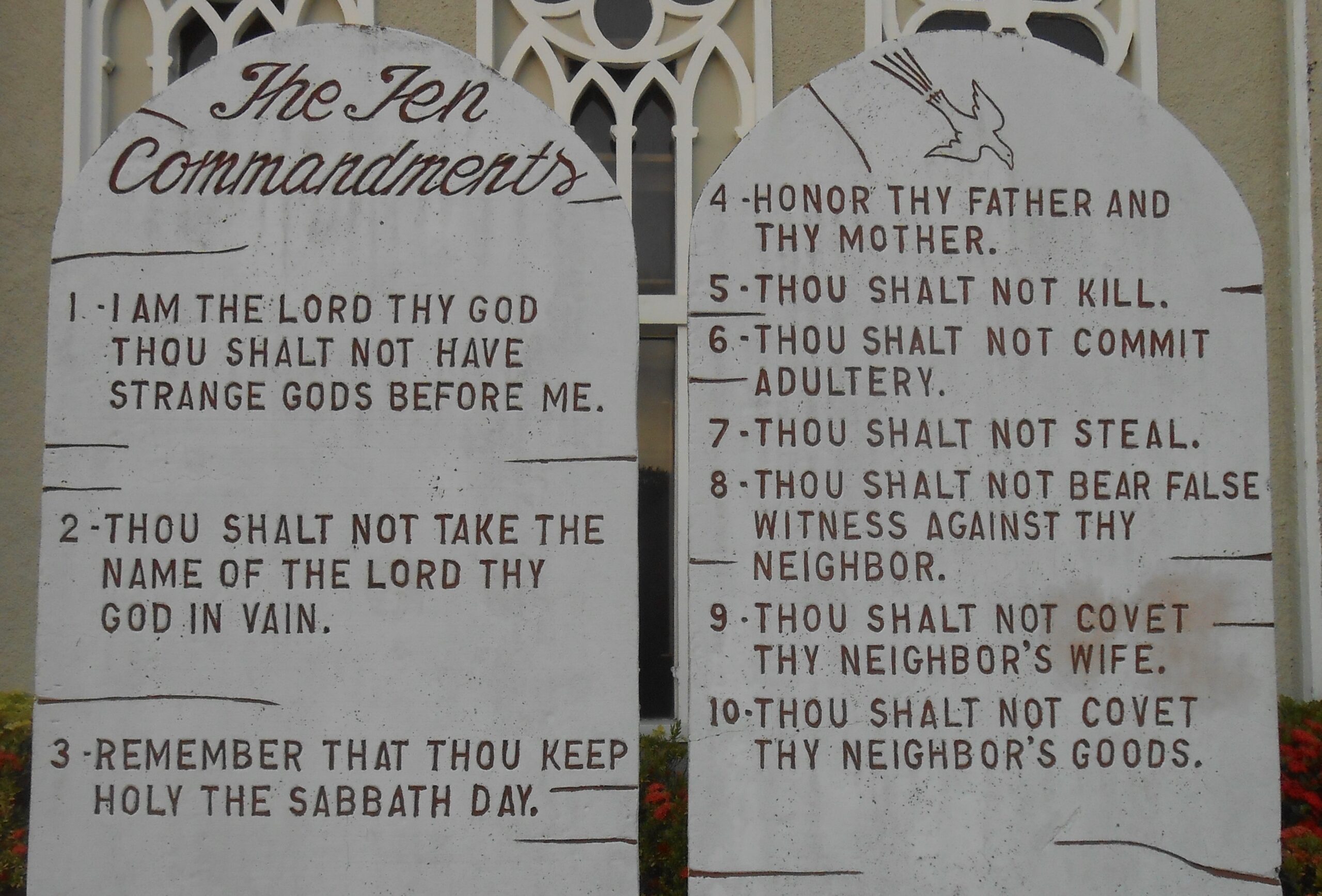
The First Commandment: “I am the Lord thy God. Thou shalt not have strange gods before Me”

Image Source: YouTube
Why does this commandment stand first among the ten? The answer reveals itself clearly: when our relationship with God becomes disordered, every other aspect of our spiritual life falls into chaos. “I am the Lord thy God. Thou shalt not have strange gods before Me” establishes the foundation upon which all other commandments rest.
The Four False Gods That Enslave Modern Hearts
Idolatry extends far beyond the golden calves of ancient times. As the Church teaches, we commit idolatry whenever we place anything above God as our ultimate source of security, identity, or happiness. Pope Francis describes this as “the idolatry of money” – a devotion that demands sacrifice just as ancient idols did [4].
St. Thomas Aquinas identified four primary forms these false gods assume in our lives:
-
Wealth – When money becomes our ultimate security rather than God
-
Pleasure – Pursuing comfort and avoiding pain at all costs
-
Power – Seeking control over others or our circumstances
-
Honor – Craving recognition and praise from others
These “false gods” distract us from our relationship with the true God [16]. As St. Paul warned, “greed or covetousness” is equivalent to idolatry [17]. This idolatry extends beyond material possessions – our phones, careers, and social media platforms can become idols when they displace God from His rightful place in our lives [18].
Prayer: The Measure of Our Priorities
How do we know whether God truly comes first in our lives? The answer lies in how we prioritize prayer. Recent studies reveal that only 51% of Catholics report praying daily, down from 59% in 2014 [19]. This decline demonstrates how easily other priorities creep into first place.
Making God our priority requires intentionally setting aside time. One priest observes how different his days become when he begins with prayer: “Even if things get crazy, on the days I pray I know I take it in better stride” [20]. Prayer remains essential for all Catholics, not merely clergy. We can incorporate prayer into our daily routines – during morning preparation, commutes, or before bed.
Pope Francis suggests a simple “Five Finger Prayer” method that helps us remember who to pray for when time is limited [20]. I highly recommend exploring different prayer forms – from traditional prayers like the rosary to contemplative silence – to maintain our connection with God.
The Rejection of Superstition and Divination
Does consulting horoscopes violate the first commandment? The Catechism of the Catholic Church provides a clear answer: “All forms of divination are to be rejected: recourse to Satan or demons, conjuring up the dead… astrology, palm reading, interpretation of omens and lots” [21].
These practices are not harmless entertainment. Rather, they “conceal a desire for power over time, history, and, in the last analysis, other human beings, as well as a wish to conciliate hidden powers” [22]. When we look to astrology, fortune-telling, or superstitions for guidance, we effectively place our trust in something other than God.
Instead of seeking control through these means, the first commandment calls us to surrender to God’s providence. Superstitions reveal something troubling about our hearts – specifically, our desire to control or predict the future rather than trusting in God’s goodness [18].
The first commandment demands that we recognize what truly has priority in our lives. St. Augustine spoke the truth when he declared, “Our hearts are restless until they rest in you.” Only by placing God first can we find the peace and purpose for which we were created.
The Second Commandment: Reverence for the Holy Name of God
The second commandment—”You shall not take the name of the Lord your God in vain”—governs how we speak of sacred matters. This divine precept belongs to the virtue of religion and extends far beyond simple prohibitions. The Catholic Church teaches that this commandment calls us to profound reverence in all our speech concerning God’s holy name.
The Sacred Nature of God’s Name
When Moses encountered the burning bush and inquired about God’s name, the Almighty revealed Himself as “I am who I am,” disclosing the divine name Yahweh. This name was considered so sacred that the ancient Hebrews would not pronounce it [21]. Only the high priest could speak this name once yearly during the feast of atonement in the Holy of Holies [21].
This reverence continues today. Many modern Jews write “G-d” instead of the full spelling [21]. The Catholic Church directs that the divine name (YHWH) should neither be used nor pronounced in liturgy, following an unbroken tradition from earliest Christianity [23].
According to the Catechism, “to disclose one’s name is to make oneself known to others; in a way it is to hand oneself over by becoming accessible” [24]. God’s name becomes a sacrament of His very person—not merely a label but a representation of His presence among us.
Forms of Speech That Dishonor God’s Name
The Catholic understanding identifies several violations of this commandment:
Blasphemy: Words expressing hatred, reproach, or defiance toward God [21]. This includes speaking ill of God or failing to show proper respect in speech [21]. The Catechism identifies blasphemy as a grave sin.
Cursing: Invoking God’s name to call down evil, as in the expression “God damn it” [20]. This involves commanding God to condemn someone or something to Hell—objectively a mortal sin.
Casual Misuse: The expression “Oh my God” commonly serves as an exclamation of surprise or frustration. While theoretically a prayer, it typically uses God’s name in vain—empty of real meaning [25].
Profane Language: Even when not directly involving God’s name, profane speech debases human dignity and builds barriers between people [20]. Such language reveals poor attitude and lack of respect for others.
Casual use of words like “Hell” shows disrespect for the reality of eternal damnation [20]. This reveals a spiritual problem—failure to recognize sacred realities.
Cultivating Reverent Speech
Positive speech about God involves:
-
Using God’s name to bless, praise, and glorify Him [20]
-
Showing reverence when discussing matters of faith
-
Correcting ourselves when we slip into disrespectful habits
I highly recommend this practical approach: if you accidentally say “Oh my God!” immediately correct yourself aloud by saying, “Oh, I mean to say, ‘May the name of the Lord be praised!'” This makes reparation while helping break the habit [25].
Genuine reverence reflects a deeper spiritual reality. Those who truly know God understand their proper place before Him [6]. Cultivating the “fear of the Lord”—a gift of the Holy Spirit—develops proper reverence. This isn’t terror but deep respect that gives the soul “a desire to avoid sin and a desire to flee from all attachments to created beings” [6].
From this awareness of God’s true majesty comes authentic reverence in both speech and action.
Keeping Holy the Lord’s Day
The third commandment presents a particular challenge to our contemporary world. “Remember to keep holy the Sabbath day” calls us to pause amidst the ceaseless demands of modern life. This divine instruction strikes at the very heart of a culture that values productivity above rest and worship.
What does Sunday mean to Catholics?
Sunday holds its place as the “little Easter” – the day Our Lord rose from the dead. Each week we celebrate not merely a historical event but our participation in Christ’s resurrection. As the Catechism teaches, Sunday worship fulfills the moral command of the Old Covenant, which consecrated a day to commemorate God’s rest after creation.
Pope John Paul II, in his apostolic letter Dies Domini, explains that Sunday represents both the “first day” and the “eighth day” – honoring both the original creation and the new creation begun in Christ’s resurrection. This is crucial because it establishes Sunday as fundamental to our Christian identity.
How do we balance our obligations with this commandment?
The Church recognizes that modern life requires certain accommodations. Healthcare workers, emergency responders, and others providing essential services may find themselves working on Sundays. What matters is maintaining a spirit of worship despite these responsibilities.
Catholics are called to:
-
Attend Mass as our primary Sunday obligation
-
Avoid unnecessary work and shopping that prevents others from resting
-
Create time for family togetherness and recreation
-
Engage in prayer and spiritual reading beyond Mass
-
Perform works of mercy as appropriate
Even brief moments of prayer throughout a working Sunday honor this commandment’s essence. The key lies in approaching Sunday with intentionality rather than treating it as merely another day for errands.
Making Mass a priority for families
For families, attending Mass together strengthens both faith and family bonds. Despite competing activities – sports leagues, homework, social events – making Sunday worship non-negotiable teaches children that faith deserves primacy.
Consider these approaches:
Prepare for Sunday liturgy by discussing the readings beforehand. This helps children connect more deeply with the Mass. Establish Sunday traditions that children anticipate – perhaps a special breakfast after church or family activities that associate positive experiences with worship.
Family prayer at home extends the Sunday experience. Simple practices like praying grace before meals with special attention or reading Scripture together deepen children’s understanding of Sunday’s sacred character.
Through such practices, we discover that keeping the Lord’s day holy offers liberation rather than restriction. It creates space for what truly matters amidst life’s constant demands. As one mother wisely observed, “Our children know Sunday is different because we make it different.”
This commandment ultimately invites us to trust in God’s providence – to believe that pausing from our work will not diminish our security but rather increase our dependence on Him who provides all good things.
Honoring Father and Mother: The Fourth Commandment
The fourth commandment serves as the cornerstone between our relationship with God and our relationships with fellow human beings. “Honor your father and your mother” establishes more than family obligations—it forms the very foundation of a just and God-fearing society.
The Threefold Duty Toward Parents
The Catholic Church teaches that this commandment creates three distinct obligations: love, reverence, and obedience toward our parents. Theologians refer to this as “filial piety” or dutiful observance [1]. While obedience may cease when children reach adulthood, the duties of love and reverence extend throughout our entire lives.
This reverence must be genuine, flowing from the heart rather than mere external compliance [1]. As the Catechism explains, divine fatherhood serves as the wellspring of human paternity, making the honor due to parents an extension of the honor we owe to God Himself [1]. Those who habitually treat their parents with cruelty, refuse assistance in times of need, or neglect their final wishes commit grave sins against this commandment [1]. Similarly, striking parents, causing them deep sorrow, cursing them, or denying them recognition violates this sacred law [1].
Practical Guidance for Young Catholics
Children and teenagers can fulfill this commandment through four essential practices:
-
Communicate openly and honestly, sharing both joys and struggles
-
Listen attentively to parental wisdom gained through life experience
-
Invite parents into your daily life and important decisions
-
Pray regularly for your parents, seeking God’s healing for any difficulties [11]
Children must obey their parents in all matters concerning family welfare and their own good [1]. However, should parents command anything contrary to God’s law, we must remember the words of St. Peter: “it is necessary to obey God rather than men” [12].
Caring for Aging Parents
The aging of our population presents particular challenges for living this commandment. By 2030, more than twenty percent of Americans will be sixty-five or older [13]. The Catechism instructs adult children to provide “material and moral support in old age and in times of illness, loneliness, or distress” [1].
Most elderly persons wish to remain in their own homes as long as possible [13]. Catholic adults can honor this preference through concrete actions:
-
Accompanying parents to medical appointments
-
Assisting with household maintenance and repairs
-
Arranging necessary transportation services
-
Most importantly, being a Christ-like presence through regular visits and prayer [13]
This commandment reminds us that honoring parents reflects our understanding of God’s own paternal love. Through such reverence, we participate in the very order that God has established for human flourishing.
Respecting Life: The Fifth Commandment and Human Dignity
The fifth commandment—”Thou shall not kill”—encompasses far more than the prohibition against murder. This sacred precept calls us to reverence the dignity of every human person, for each soul bears the image of God Himself [2]. To attack human dignity is to assault the very likeness of the Divine.
The Sins of Anger, Bullying, and Gossip
Our Lord Jesus expanded this commandment considerably during the Sermon on the Mount: “You have heard it was said, ‘You shall not kill’… But I say to you that everyone who is angry with his brother shall be liable to judgment” [14]. This reveals how deliberate hatred contradicts the virtue of charity and becomes grave sin when we desire serious harm to others [14].
Bullying, so prevalent in our schools today, represents a clear violation of this commandment. The statistics are troubling:
-
42% of bullied children experience it monthly or more frequently [15]
-
72% of youth bullied monthly report having stressful lives (compared to 44% of non-bullied youth) [15]
-
Children who bully are 37% more likely than non-bullies to commit crimes as adults [15]
When one child bullies another, they deny dignity to a fellow human being created in God’s image [2]. Catholic social teaching makes clear that “bullying is an attack on human life itself” [2].
Protecting Life from Conception to Natural Death
The Catholic Church proclaims human life as sacred from conception to natural death [5]. This commandment extends beyond opposing abortion and euthanasia—it includes caring for the vulnerable: the poor, elderly, marginalized, and victims of human trafficking [5].
Pope Francis warns against what he calls a “throwaway culture” where people are treated as consumer goods [5]. The dignity of each person forms the foundation of Catholic social teaching, requiring us to protect life at all stages [3].
Forgiveness: A Life-Giving Grace
Forgiveness represents another dimension of this life-giving commandment. Our Lord broke the cycle of retaliation by teaching unconditional forgiveness [4]. Through forgiveness, “the wounds of division and hatred are overcome” [4].
Forgiving others becomes the very basis upon which we request forgiveness for ourselves, as Jesus taught in the Lord’s Prayer [4]. When we forgive, we demonstrate both faith and hope—faith that God provides strength to forgive and hope for the other person’s transformation [16].
Forgiveness benefits the forgiver more than the forgiven—freeing us from bitterness and revenge [17]. This does not mean forgetting or excusing wrongdoing but choosing to move beyond hurt toward healing and peace.
This commandment shows us that respecting life encompasses our words, actions, and attitudes toward every person we encounter.
The Sixth Commandment: Purity of Heart and Body

Image Source: Catholic Singles
“You shall not commit adultery.” The sixth commandment addresses the sacred gift of human sexuality and calls us to live chastely according to our state in life. This divine precept extends far beyond marital fidelity—it governs the proper ordering of our hearts toward others.
What does the Catholic Church teach about sexuality?
The Catholic Church teaches that chastity represents “the successful integration of sexuality within the person and thus the inner unity of man in his bodily and spiritual being” [18]. This virtue enables self-mastery and upholds the dignity of each person as created in God’s image.
Human sexuality reflects our capacity for self-gift. The Catechism explains that “each of the two sexes is an image of the power and tenderness of God, with equal dignity though in a different way” [19]. Sexual intimacy belongs exclusively within marriage—a sacred covenant between man and woman that mirrors Christ’s love for the Church [20].
Chastity is not merely abstinence but a virtue that orders our sexuality according to God’s plan. All persons, whether single, married, or consecrated religious, are called to live chastely according to their state in life.
The grave offense of pornography and objectification
Pornography fundamentally opposes this commandment as it “consists in removing real or simulated sexual acts from the intimacy of the partners, in order to display them deliberately to third parties” [21]. Such practices treat persons as objects rather than subjects worthy of love and respect.
The consumption of pornographic material trains us to view others as collections of body parts rather than whole persons. One recovering user describes how “if you allowed yourself to be raised on soft-core pornography…your mind and body define attractiveness as body parts” [22].
The damage extends beyond individual users. Pornography “does grave injury to the dignity of its participants” [18] and maintains connections to the evils of human trafficking worldwide [21]. Within marriages, it damages trust, decreases satisfaction, and can lead to requests for degrading behavior or even divorce [21].
Building authentic relationships founded on trust
Trust forms the foundation of authentic, intimate relationships. “Without trust, even the mildest struggle can cause our relationship to unravel” [23]. This foundation requires specific actions:
-
Speak truthfully and consistently—matching actions with words
-
Communicate intentions clearly without expecting others to read our minds
-
Accept responsibility for mistakes rather than becoming defensive
-
Maintain honesty in all interactions, avoiding even seemingly harmless deceptions
-
Practice accountability through faithful commitment to our promises [24]
For those who are dating, trust develops gradually as emotional intimacy grows. Physical expressions of affection should remain chaste, respecting boundaries that protect against lustful temptation. This approach allows couples to build “a strong emotional and spiritual connection with each other” [20] that will serve as the proper foundation for potential marriage.
The sixth commandment invites us to see each person as whole and sacred—never as an object for use but always as a subject deserving of reverence and love.
Respecting Property and Practicing Generosity
The seventh commandment—”You shall not steal”—encompasses far more than simple theft. According to Catholic teaching, this commandment “commands justice and charity in the care of earthly goods and the fruits of men’s labor” [25]. The Church’s understanding reveals a divine directive calling us to respect the property of others while practicing true generosity with our own resources.
What constitutes theft in our modern age
The Catholic understanding of stealing extends well beyond common robbery or pickpocketing. The Church identifies three distinct categories of theft:
-
Unjust taking: This includes secret theft, robbery by force, and fraud or cheating in business transactions [6]
-
Unjust keeping: Retaining found items without seeking the rightful owner or knowingly keeping what belongs to another person [6]
-
Unjust damage: Causing loss to another through negligence or intentional harm to their property [6]
As theologians explain, stealing encompasses any “unjust violation of another’s right to property” [6]. This violation strikes at both divine and natural law, making it “an injury to God and to man” [6]. The gravity of this offense reminds us that property rights reflect human dignity and the order God established in creation.
Honesty in our work and financial dealings
Workplace integrity demands fairness from both employers and employees. Employers bear the obligation to provide workers with “a just and living wage” sufficient “to care for himself and his family” [26] [27]. This principle reflects the Church’s social teaching on the dignity of labor and the worker’s right to fair compensation.
Employees, for their part, must offer genuine effort in return. Wasting time at work effectively steals from employers [27], violating the trust placed in us. Financial integrity likewise requires complete transparency in all our transactions. Tax fraud, forgery, and manipulating prices for selfish gain all constitute violations of this sacred commandment [27].
The Church teaches that failing to meet contractual obligations or repay debts also constitutes theft [6]. Most importantly, “without restitution, the sin is not forgiven” [6]. This requirement for making amends shows that true repentance involves action, not merely regret.
Charitable giving as Christian stewardship
The Old Testament prescribed tithing ten percent of one’s income, yet Catholics today are not strictly bound to this specific percentage. Rather, each person should give “freely and cheerfully the amount they are able” [8]. Many dioceses recommend giving “5% of take-home pay to their parish and an additional 5% to other charities” [9].
Our giving should follow the principle that “each must do as already determined without sadness or compulsion, for God loves a cheerful giver” [8]. Charitable giving expresses our recognition that we serve merely as stewards of God’s gifts to us.
As one spiritual writer observes, “Even if we are very good at making money, that also is God’s gift” [28]. This perspective transforms our relationship with material possessions, helping us see them not as our own achievements but as divine blessings to be shared with others in need.
The Sacred Duty of Truth: Living the Eighth Commandment
Truth forms the cornerstone of all authentic relationships between souls. The eighth commandment—”You shall not bear false witness against your neighbor”—calls us to something far greater than merely avoiding outright lies. This divine precept demands that we guard the reputation of others as carefully as we guard our own .
As the Church teaches, this commandment forbids all attacks upon truth, particularly false testimony, rash judgment, lies, calumny, slander, and detraction . Much is at stake when we speak of our neighbors, for our words possess the power to build up or tear down the very fabric of Christian community.
The Grave Sin of Gossip and Detraction
What constitutes this “murder of character” that so easily slips from our tongues? The Catechism defines gossip as unnecessarily revealing someone’s faults to those who would not otherwise know of them . This seemingly innocent practice actually wounds three sacred relationships:
-
Our relationship with the person we speak about
-
Our relationship with those who hear our words
-
Our relationship with God Himself
Detraction and calumny violate both charity and justice, for each person possesses a right to a good name . St. Paul understood this well when he exhorted the faithful: “stop lying to one another” and “speak the truth, each one to his neighbor” .
The damage extends beyond the immediate conversation. When we engage in gossip, we train ourselves in the habit of focusing on others’ failings rather than their virtues. This practice hardens the heart against charity and disposes the soul toward further sins against truth.
Integrity in All Communications
The Catholic understanding of truthfulness extends to every form of communication, including our modern digital interactions. Our Lord Jesus gave us the standard: let your “‘Yes’ mean ‘Yes’ and your ‘No’ mean ‘No.’ Anything more is from the evil one” .
This commitment to truth does not require us to reveal everything we know. We are not morally obligated to disclose secrets we have promised to keep . Rather, truthfulness maintains the proper balance between what should be expressed and what should remain confidential. The wise person speaks what is necessary and beneficial while protecting what should be guarded.
Fraternal Correction: Truth Spoken in Love
When we must address another’s wrongdoing, Our Lord provides clear guidance: “If your brother sins against you, go and tell him his fault between you and him alone” . This fraternal correction, when performed properly, becomes an act of spiritual mercy—what theologians call a “spiritual almsdeed” .
Such correction requires great humility, for we must approach others with recognition of our own need for amendment. The goal remains not condemnation but restoration, not judgment but healing. Through this balanced approach, we honor both truth and the dignity of the human person.
The eighth commandment ultimately calls us to become guardians of truth in a world that often treats words carelessly. Each conversation presents an opportunity either to build up the Body of Christ or to wound it through careless speech.
Purity of Heart: The Ninth Commandment and Interior Life
Our Lord extends the commandments beyond external actions to the very depths of our hearts. “Everyone who looks at a woman lustfully has already committed adultery with her in his heart,” He teaches, showing us that the ninth commandment reaches into our interior life [36]. This commandment forbids “carnal concupiscence” or disordered sexual desire [37].
What does this mean for the Catholic seeking to live authentically? The commandment calls us to recognize that purity is fundamentally a matter of the heart.
The Dignity of Every Person
Lust reduces the human person to an object for gratification rather than recognizing their inherent dignity as created in God’s image [7]. This objectification represents a fundamental disorder in how we view others—seeing them as collections of body parts rather than whole persons deserving of reverence [38].
The Catholic understanding holds that every person deserves to be loved “for their own sake,” never as a means to satisfy our disordered desires [39]. This principle reflects the very nature of God’s love for us—unconditional and respectful of our dignity.
Spiritual Combat Against Temptation
How do we combat the inclinations that draw us away from purity? The saints teach us that this battle requires both supernatural assistance and natural discipline.
Prayer stands as our primary weapon. “I will, whenever I am tempted, instantly have recourse to Thee” [40]. This immediate turning to God recognizes our dependence on divine grace for victory over concupiscence.
Practical strategies complement our prayer life:
-
Custody of the eyes—immediately looking at someone’s face rather than allowing our gaze to wander [7]
-
Avoiding occasions of sin, including media and environments that trigger temptation [7]
-
Fasting and prayer, acknowledging that we cannot achieve self-mastery without God’s help [7]
-
Remembering that purity enables us “to see things according to God” [37]
This struggle forms part of our spiritual heritage as Catholics. Yet with patience and genuine humility, we can become stronger than any enemy that assails us [40]. The path to purity leads not to restriction but to the freedom of seeing others as God sees them—with infinite love and respect.
The Final Commandment: Freedom from Covetousness
The tenth commandment brings us to the interior movements of the heart. “You shall not covet your neighbor’s goods” addresses not merely external actions but the very desires that precede all other violations of God’s law. This commandment calls us to that interior peace which flows from recognizing God as the source of all good things.
What is envy and why does it destroy the soul?
St. Thomas Aquinas defined envy as “sorrow for another’s good” [41]. This deadly sin breeds “disorder and wickedness of every kind” [41], and St. Augustine described it as “the diabolical sin” [42]. Envy flows from a fundamental insecurity about God’s love for us, leading to bitterness when we witness another’s success [43].
The materialistic culture surrounding us constantly teaches us to want more [44]. Advertisements and social media feed this insatiable hunger for what others possess. Yet we must recognize that envy blinds us from seeing our own gifts [45] and trains the soul to focus perpetually on what we lack rather than the blessings we have received.
The practice of gratitude as an antidote to covetousness
Gratitude transforms our spiritual vision, enabling us to feel “genuinely happy when others succeed” [46]. This virtue reminds us that “God provides” everything we truly need [47]. The cultivation of thankfulness requires deliberate practice:
-
Keeping a gratitude journal, perhaps using the Ignatian Examen [48]
-
Counting the blessings received in the past twenty-four hours [49]
-
Offering prayers of thanksgiving for our loved ones [48]
Even during times of trial, we can practice what Blessed Solanus Casey called “the first sign of a thinking rational creature” [50]—grateful acknowledgment of God’s providence.
Rejoicing in the good fortune of others
The examination of conscience must address this question: “Am I jealous because God gives good gifts to my brothers and sisters?” [45]. The authentic Catholic response recognizes that another’s success does not diminish our own [46]. We combat jealousy through prayer and acts of kindness—specifically by thanking God for the blessings He bestows upon others [45].
This final commandment thus completes the moral framework given by God. When our hearts find contentment in His providence rather than in comparison with others, we discover the freedom for which Christ has set us free.
Conclusion
What does this examination of the Ten Commandments teach us? These divine precepts offer us a complete way of life—a pathway to authentic freedom that our hearts truly desire. According to Catholic tradition, these laws were given not to burden us but to guide us toward the happiness for which we were created .
Throughout our exploration of each commandment, we have seen how they form an integrated whole. The first three establish our proper relationship with God, while the remaining seven flow naturally from this foundation, governing our relationships with others. This shows the wisdom of divine order: when we love God first, everything else finds its proper place.
As Catholics, we recognize that living these commandments requires more than human effort alone. The grace of God empowers what His law requires. The commandments become not external impositions but internal guides that shape our conscience and direct our choices toward what is true, good, and beautiful.
In summary:
- Ultimately, the ten commandments serve as a roadmap to a fulfilling life in Christ.
- Practicing the ten commandments can transform our hearts and minds to reflect God’s love.
- The ten commandments are a gift that guide us towards a deeper relationship with God.
- The ten commandments remain a source of strength and encouragement for all believers.
- Embracing the ten commandments helps us cultivate a spirit of gratitude in our daily lives.
- The ten commandments invite us to pursue a life filled with integrity and purpose.
- In every generation, the ten commandments remain a timeless call to return to God.
- The ten commandments underscore the role of community in supporting one another’s spiritual journeys.
- Studying the ten commandments prompts us to consider how we can be more faithful to God’s word.
- The ten commandments highlight the importance of love and respect in our relationships with others.
- By understanding the ten commandments, we gain insight into God’s desire for justice and mercy.
- The ten commandments serve not only as laws but also as invitations to live authentically in faith.
- Integrating the ten commandments into our lives fosters a deeper commitment to our spiritual growth.
- Through reflecting on the ten commandments, we cultivate virtues essential for a meaningful faith journey.
- The ten commandments illuminate our path, guiding our decisions and actions daily.
- In observing the ten commandments, we align our lives with God’s will and purpose.
- Reflecting on the ten commandments can lead us to deeper understanding and connection with God.
- Every aspect of our lives can be enriched by the ten commandments, reminding us of God’s call to holiness.
- The ten commandments serve as guiding principles for our faith, encouraging us to reflect on their relevance in our lives.
I highly recommend dedicating time each week to examining how well we live these commandments. Perhaps choose one commandment for particular focus each month, allowing the Holy Spirit to work in your heart and reveal areas needing attention. The saints throughout history have found great joy in such spiritual exercises.
This is crucial because these commandments remain as relevant today as when they were first given to Moses. Modern challenges—whether involving technology, relationships, or material concerns—all find their proper resolution in these timeless principles. They address not merely our external actions but the movements of our hearts.
Living the Ten Commandments authentically leads us to the peace that surpasses all understanding. They guide us away from the false promises of worldly happiness and toward the lasting joy found only in God. Through faithful observance, we discover that what initially appears restrictive actually liberates us to become who God created us to be.
Praise God for His wisdom in providing these commandments—not as arbitrary rules but as expressions of His love, guiding us home to Him.
Key Takeaways
Living the 10 Commandments isn’t about following ancient rules but embracing a practical roadmap for authentic Catholic life in today’s world.
• Modern idolatry goes beyond golden calves – Money, social media, career success, and even our phones can become false gods when they displace our relationship with the true God.
• Sunday worship requires intentional prioritization – Making Mass and rest non-negotiable teaches families that faith deserves primacy over sports, homework, and social activities.
• Respect for life extends beyond abortion – This commandment includes avoiding bullying, gossip, and anger while practicing forgiveness as a life-giving act toward others.
• Chastity means seeing people as whole persons – Avoiding pornography and objectification while building trust through honest communication protects human dignity in all relationships.
• Truth-telling includes guarding against gossip – Speaking honestly online and offline while avoiding slander protects others’ reputations and strengthens community bonds.
• Contentment combats envy through daily gratitude – Practicing thankfulness and celebrating others’ success breaks the cycle of comparison that modern materialism promotes.
The commandments work as an integrated whole – when we honor God first, we naturally treat others with greater respect, honesty, and love. Small daily choices in prayer, speech, and attitude gradually reshape our character toward Christ-likeness, transforming ancient wisdom into living reality.
FAQs
Q1. How can Catholics apply the Ten Commandments in modern life? Catholics can apply the Ten Commandments today by striving to fulfill them in spirit through a life of service and love. This involves making intentional daily choices in prayer, speech, and attitude that gradually reshape one’s character to be more Christ-like. For example, limiting social media use, speaking respectfully to others, and practicing contentment instead of comparison.
Q2. Are the Ten Commandments still relevant in today’s society? Yes, the Ten Commandments remain highly relevant. They offer practical wisdom for navigating relationships with God, others, and ourselves in the modern world. While the specific applications may look different than in ancient times, the core principles – such as not stealing, lying, or murdering – continue to form the basis of ethical behavior and even many civil laws today.
Q3. How does the Catholic Church view the Ten Commandments? The Catholic Church sees the Ten Commandments as a fundamental expression of natural law that reflects God’s eternal plan for humanity. Rather than just a set of rules, they are viewed as an integrated moral framework designed to lead people toward human flourishing and closer relationship with God.
Q4. What are some modern forms of idolatry to be aware of? Modern idolatry often takes the form of placing ultimate trust or priority in things other than God. This can include an obsession with money, career success, social media validation, or even technology. Essentially, anything that displaces God from His rightful place of primacy in one’s life can become an idol.
Q5. How can Catholics practice the commandment to keep the Sabbath holy? Catholics can honor the Sabbath by making Sunday worship and rest a non-negotiable priority. This involves attending Mass, creating time for family togetherness, engaging in prayer and spiritual reading, and avoiding unnecessary work or shopping. The goal is to approach Sunday deliberately as a gift, creating space for what truly matters amid life’s constant demands.
References
[1] – https://www.catholic.com/magazine/print-edition/the-true-ten-commandments
[2] – https://www.catholicdigest.com/faith/201311-1810-ways-religious-people-break-the-commandments/
[3] – https://www.catholicworldreport.com/2024/06/21/why-so-much-ado-about-the-ten-commandments/
[4] – https://www.stjosephcommunity.org/2024/02/27/padre-pauls-ponderings-thinking-more-deeply-about-the-10-commandments/
[5] – https://www.ncronline.org/vatican/francis-comic-strip/francis-chronicles/idolatry-wealth-beauty-demands-costly-sacrifice-pope
[6] – https://medium.com/catholic-way-home/aquinas-the-four-false-idols-making-you-miserable-9bc5986c78a3
[7] – https://catholicexchange.com/money-idolatry/
[8] – https://catholictt.org/2025/08/13/modern-day-idols/
[9] – https://www.soulsandhearts.com/blog/the-secret-psychological-reasons-we-fail-to-make-time-for-prayer/
[10] – https://thecatholicsun.com/carrying-the-light-of-christ-october-3-making-time-for-god/
[11] – https://novenaprayer.com/2025/07/09/catholics-and-superstition-what-to-reject-and-why/
[12] – https://www.catholicculture.org/culture/library/catechism/index.cfm?recnum=5783
[13] – https://ascensionpress.com/blogs/videos/what-catholics-should-know-about-superstitions
[14] – https://www.vatican.va/content/catechism/en/part_three/section_two/chapter_one/article_2/i_the_name_of_the_lord_is_holy.html
[15] – https://www.archspm.org/what-is-the-second-commandment-and-why-is-gods-name-so-important/
[16] – https://www.usccb.org/prayer-and-worship/the-mass/frequently-asked-questions/the-name-of-god-in-the-liturgy
[17] – https://catholiceducation.org/en/culture/what-s-in-a-name.html
[18] – https://catholicstraightanswers.com/what-does-the-church-teach-regarding-bad-language/
[19] – https://www.simplycatholic.com/misusing-oh-my-god/
[20] – https://catholicexchange.com/reviving-the-practice-of-reverence/
[21] – https://www.catholic.com/encyclopedia/parents
[22] – https://lifeteen.com/honor-father-mother-even-dont-think-deserve/
[23] – https://opusdei.org/en-us/article/topic-30-the-fourth-commandment-the-family/
[24] – https://crisismagazine.com/opinion/our-duty-to-care-for-our-elderly
[25] – https://www.huffpost.com/entry/catholic-social-teaching-_b_994407
[26] – https://www.catholicculture.org/culture/library/catechism/index.cfm?recnum=6056
[27] – https://www.catholicregister.org/item/1126-make-prayer-a-key-part-of-battling-bullying
[28] – https://www.usccb.org/beliefs-and-teachings/what-we-believe/catholic-social-teaching/life-and-dignity-of-the-human-person
[29] – https://www.hli.org/resources/pro-life-meaning/
[30] – https://cnewa.org/magazine/a-catholic-perspective-on-forgiveness-30824/
[31] – https://www.miamiarch.org/CatholicDiocese.php?op=Blog_archdiocese-of-miami-the-transformational-power-of-forgiveness
[32] – https://www.catholicvoices.org.uk/blog/does-forgiveness-mean-the-other-person-gets-away-with-it
[33] – https://www.vatican.va/content/catechism/en/part_three/section_two/chapter_two/article_6/ii_the_vocation_to_chastity.html
[34] – https://catholicmoraltheology.com/catechism-commentary-the-sixth-commandment/
[35] – https://medium.com/@ytc9/traditional-catholic-dating-navigating-love-and-marriage-with-faith-fef03c3f2b94
[36] – https://www.usccb.org/issues-and-action/human-life-and-dignity/pornography/create-in-me-a-clean-heart-abridged-version
[37] – https://www.covenanteyes.com/blog/license-lust-porn-trains-objectification/
[38] – https://www.catholic.org/featured/headline.php?ID=1569
[39] – https://plus.catholicmatch.com/articles/5-steps-to-building-trust-in-your-relationship
[40] – https://www.vatican.va/content/catechism/en/part_three/section_two/chapter_two/article_7.html
[41] – https://catholicharboroffaithandmorals.com/Seventh.html
[42] – https://www.usccb.org/beliefs-and-teachings/what-we-believe/catholic-social-teaching/the-dignity-of-work-and-the-rights-of-workers
[43] – https://mycatholic.life/the-my-catholic-life-series/my-catholic-morals/chapter-7-stealing-and-coveting/
[44] – https://www.catholic.com/qa/what-is-the-churchs-position-on-tithing
[45] – https://hawaiicatholicherald.com/2022/05/25/father-kenneth-doyle-whats-the-catholic-view-on-tithing/
[46] – https://thecentralminnesotacatholic.org/the-catholic-practice-of-charity/
[47] – https://www.vatican.va/content/catechism/en/part_three/section_two/chapter_two/article_9.html
[48] – https://www.catholic.com/qa/how-does-the-ninth-commandment-apply-to-women
[49] – https://catholicgentleman.com/2014/06/custody-of-the-eyes-what-it-is-and-how-to-practice-it/
[50] – https://catholicexchange.com/must-never-use-people/
[51] – https://catholiccounselors.com/a-pure-way-of-looking-at-others-part-i/
[52] – https://www.knightsoftheholyeucharist.com/prayer-temptation-download/
[53] – https://catholic-link.org/envy-catholic-7-deadly-sins/
[54] – https://catholicspirit.com/news/tenth-commandment-teaches-envy-moves-minds-hearts-to-commit-even-more-terrible-sins
[55] – https://catholicpreaching.com/wp/the-envy-that-destroys-unity-2nd-thursday-ii-january-21-2016/
[56] – https://catholicmoraltheology.com/catechism-commentary-the-tenth-commandment-where-your-heart-is/
[57] – https://catholicwomeninbusiness.com/articles/2020/9/29/the-destructive-game-of-comparison
[58] – https://www.christianbusinesssisterhood.com/blog/how-to-stop-being-jealous-of-others-success
[59] – https://www.catholicdigest.com/faith/spirituality/a-guide-to-growing-in-gratitude/
[60] – https://www.catholicmom.com/articles/a-litany-of-gratitude
[61] – https://catholiceducation.org/en/religion-and-philosophy/how-to-exercise-the-discipline-of-gratitude.html
[62] – https://www.catholic.com/magazine/online-edition/even-when-its-bad-be-grateful