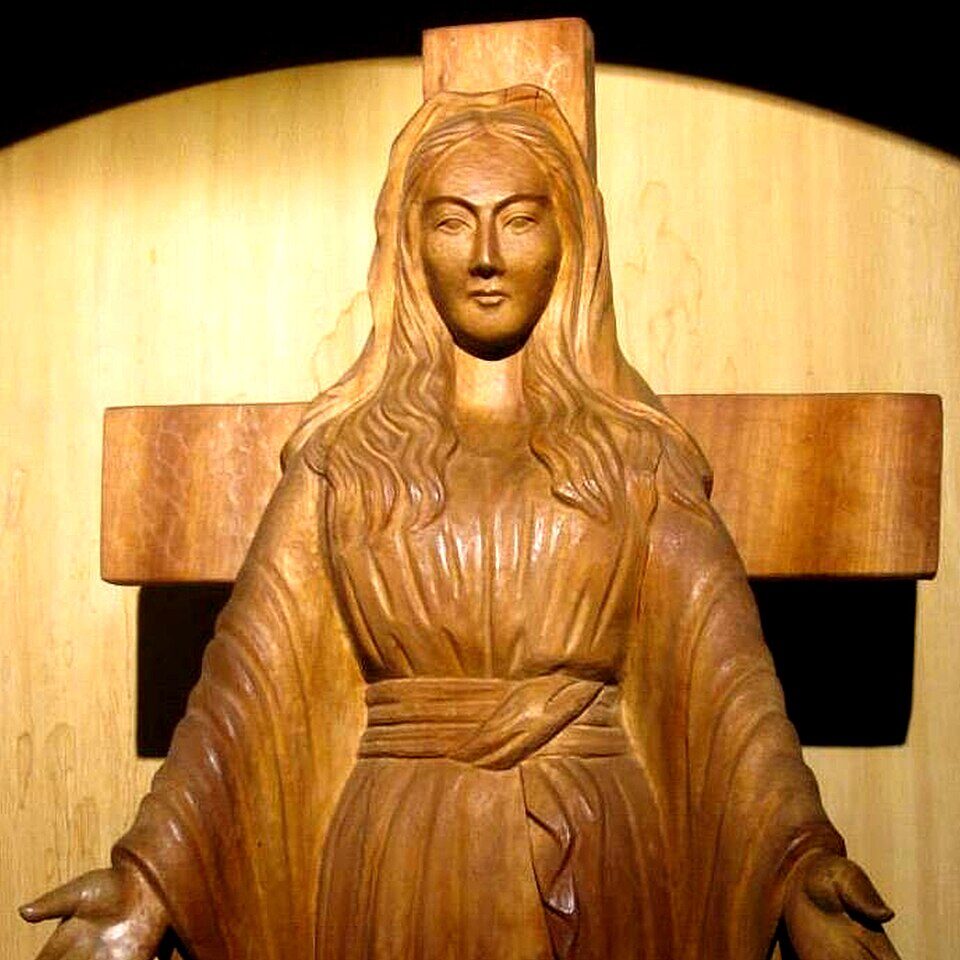
When Our Lady’s Own Words Contradict Vatican Officials: Church-Approved Marian Apparitions and the Co-Redemptrix Controversy
Introduction
On November 19, 2025, Father Maurizio Gronchi, a consultant to the Vatican’s Dicastery for the Doctrine of the Faith and professor of Christology at Pontifical Urban University, made a statement that sent shockwaves through traditional Catholic circles. In an interview with Catholic News Agency, Father Gronchi declared: “It is superstition to think that the Virgin Mary has the role of holding back God’s wrath. Whoever thinks this way is not in accordance with the Gospel” (Pullella, 2025, para. 8). This statement raises questions about the title ‘Co-Redemptrix’ and its theological implications.
This statement came just two weeks after the Vatican released a 20-page doctrinal note titled Mater Populi Fidelis, which declared that it is “always inappropriate” to use the title “Co-redemptrix” to define Mary’s cooperation in salvation (Dicastery for the Doctrine of the Faith, 2025, para. 22). The document further suggested that titles such as “Mediatrix of All Graces” have “limits that do not favor a correct understanding of Mary’s unique place” (Dicastery for the Doctrine of the Faith, 2025, para. 67).
There is, however, a profound problem with these statements: the very theology Father Gronchi dismisses as “superstition” and the Vatican document calls “always inappropriate” appears explicitly—in Mary’s own words—in multiple Church-approved Marian apparitions. These are not questionable private revelations or fringe devotions, but officially recognized, bishop-approved, and in some cases pope-affirmed apparitions spanning four centuries.
This article examines seven major approved Marian apparitions and demonstrates that Our Lady herself has consistently taught the theology that Vatican officials now reject. We face an unavoidable question: Can Church-approved apparitions teach theological error? If they cannot, then the 2025 Vatican document represents a significant departure from revealed truth. If they can, then the Church’s approval process has failed, and millions of Catholics have been misled for centuries.
As we delve into these apparitions, we must consider the role of Mary as Co-Redepmtrix, a title that encapsulates her unique participation in the redemption of humanity.
The Fundamental Question: Can Approved Apparitions Contain Doctrinal Error?
Before examining specific apparitions, we must understand what ecclesiastical approval means. When a bishop approves a Marian apparition after thorough investigation, he makes several declarations about its supernatural character and doctrinal content.
According to the criteria established by Pope Benedict XIV in his definitive work De servorum Dei beatificatione (1734-1738) and codified in subsequent Church documents, episcopal approval of an apparition means: (1) constat de supernaturalitate—it is established that the event is of supernatural origin; (2) the apparition contains nothing contrary to faith and morals; (3) the faithful may safely believe and promote the message; and (4) the apparition may be used for the instruction of the faithful (Benedict XIV, 1734-1738/1840).
While approved apparitions are not articles of faith requiring belief by all Catholics, the Church’s approval guarantees that the core message contains no theological error. As Cardinal Prospero Lambertini (the future Benedict XIV) explained in his exhaustive treatment of the subject, when the Church gives approval, she testifies “that there is nothing in them contrary to faith and good morals, and that they may be believed with human faith, according to the rules of prudence” (Benedict XIV, 1734-1738/1840, Book IV, Part 1, Chapter 1, para. 3).
This means that if multiple approved apparitions consistently teach a particular theology about Mary’s role, and Vatican officials declare that theology to be “superstition,” we face a serious contradiction. Either the apparitions were improperly approved and do contain error, or the Vatican officials’ assessment is incorrect.
Our Lady of La Salette (1846): “I Can No Longer Withhold the Arm of My Son”
Historical Background and Approval
On September 19, 1846, in the French Alps near the village of La Salette-Fallavaux, two shepherd children—Mélanie Calvat, age 14, and Maximin Giraud, age 11—witnessed an apparition of the Blessed Virgin Mary. The beautiful Lady, weeping and surrounded by brilliant light, delivered a message of warning and hope that would become one of the most significant Marian apparitions of the 19th century.
The apparition was thoroughly investigated by Bishop Philibert de Bruillard of Grenoble. After a five-year episcopal investigation involving extensive questioning of the children, examination of their characters, and assessment of the message’s orthodoxy, Bishop de Bruillard issued his formal approval on September 19, 1851—exactly five years after the apparition (Congregation for the Doctrine of the Faith, 1851). The Bishop’s declaration stated: “We judge that the Apparition of the Blessed Virgin to two cowherds on the 19th of September, 1846…bears within itself all the characteristics of truth, and that the faithful have grounds for believing it indubitable and certain” (as cited in Corteville & Revet, 1921, p. 87).
The title Co-Redepmtrix emphasizes Mary’s vital role in salvation history, linking her intercessory power with her participation in Christ’s redemptive work.
The apparition subsequently received papal recognition. Pope Leo XIII, in his 1879 decree elevating the shrine to a minor basilica, explicitly referenced “the Apparition of the Most Blessed Virgin” and granted indulgences to pilgrims visiting the site (Leo XIII, 1879). Multiple subsequent popes have spoken favorably of La Salette, and the apparition has been an integral part of Catholic devotion for 179 years.
The Message: Physical Restraint of Divine Justice
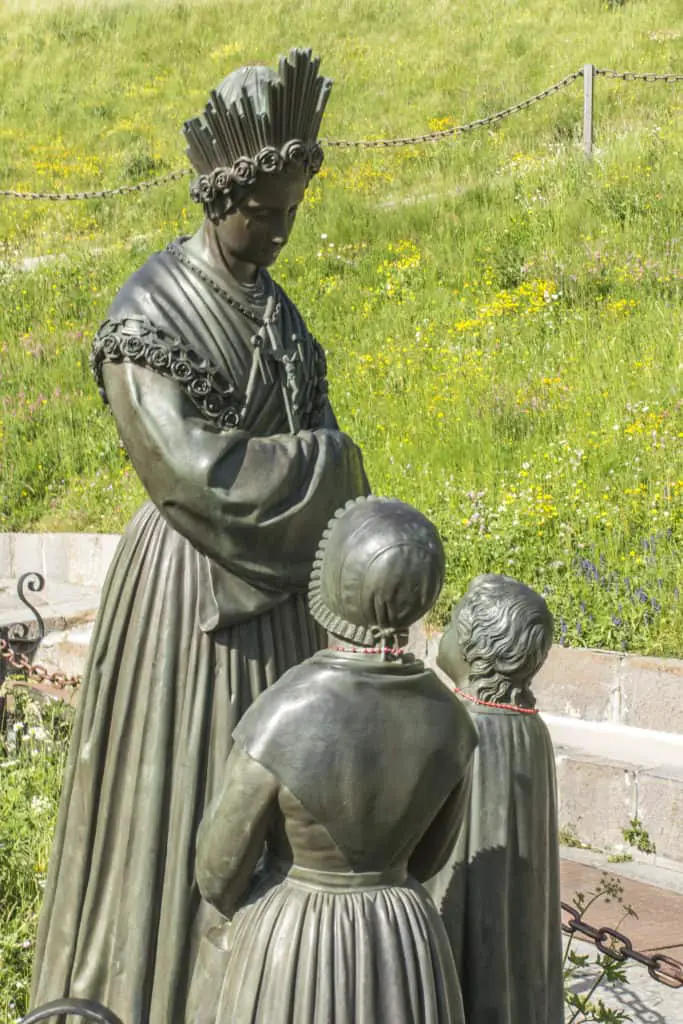
The central theological statement of Our Lady at La Salette directly contradicts Father Gronchi’s 2025 assertion. Mary told the children:
Come near, my children, be not afraid; I am here to tell you great news. If my people will not submit, I shall be forced to let fall the arm of my Son. It is so strong, so heavy, that I can no longer withhold it. For how long a time do I suffer for you! If I would not have my Son abandon you, I am compelled to pray to him without ceasing. (Apparition of Our Lady at La Salette, 1846, as cited in Corteville & Revet, 1921, p. 45)
The theological content of this message is explicit and unmistakable:
Physical imagery of restraint. Mary uses corporeal language—”the arm of my Son”—representing Christ’s instrument of justice and chastisement. She states that she can “no longer withhold it,” employing the verb “withhold” which denotes active restraint or holding back. This is not symbolic or metaphorical language but concrete imagery of Mary physically restraining divine justice.
Constant intercession. Mary declares she is “compelled to pray to him without ceasing,” indicating continuous, unrelenting intercession on behalf of humanity. The word “compelled” (contrainte in the original French) suggests both an internal necessity arising from her maternal love and an urgent need arising from the gravity of humanity’s sin.
Vicarious suffering. Mary asks rhetorically: “For how long a time do I suffer for you!” This indicates that Mary experiences real suffering on behalf of sinful humanity. Her suffering is not merely sympathetic but participatory—she suffers for humanity, in a redemptive sense.
Conditional mediation. The restraint is conditional upon human response: “If my people will not submit, I shall be forced to let fall the arm of my Son.” Mary’s ability to “withhold” divine chastisement depends on whether people convert and amend their lives.
Prevention of abandonment. Mary states: “If I would not have my Son abandon you…” This indicates that without her intercession, Christ would abandon humanity to the full consequences of sin. Her mediation stands between humanity and divine abandonment.
The Contradiction
Father Gronchi stated categorically: “It is superstition to think that the Virgin Mary has the role of holding back God’s wrath. Whoever thinks this way is not in accordance with the Gospel” (Pullella, 2025, para. 8). Yet La Salette, approved by a bishop in 1851 and recognized by Pope Leo XIII in 1879, explicitly teaches that Mary is “holding back” the “arm of my Son” and can “no longer withhold it.”
This presents a stark binary: Either (1) Bishop de Bruillard approved an apparition containing superstition, Pope Leo XIII affirmed it, and 179 years of Catholic devotion have been based on theological error, or (2) Father Gronchi’s characterization is incorrect, and the theology expressed at La Salette represents authentic Catholic teaching about Mary’s mediating role.
Our Lady of Akita (1973): “I Have Intervened to Appease the Wrath of the Father”
Historical Background and Approval
The apparitions at Akita, Japan represent one of the most rigorously investigated and comprehensively approved Marian apparitions of the 20th century. Sister Agnes Katsuko Sasagawa, a member of the Institute of the Handmaids of the Sacred Heart of Jesus in the Holy Eucharist, received apparitions of the Blessed Virgin Mary between 1973 and 1981. The apparitions were accompanied by extraordinary supernatural phenomena, including:
- A wooden statue of Mary in the convent chapel weeping 101 times between January 4, 1975, and September 15, 1981—witnessed by numerous individuals including skeptical observers, journalists, and scientists (Yasuda, 1989, pp. 47-62)
- Stigmata appearing on Sister Agnes’s hand in the same location as wounds on the statue’s hand
- Sister Agnes’s complete deafness being miraculously healed (medically verified) on Pentecost Sunday 1982
- A sweet fragrance emanating from the statue
- Scientific analysis of the tears showing they were composed of human tears (Yasuda, 1989, pp. 89-91)
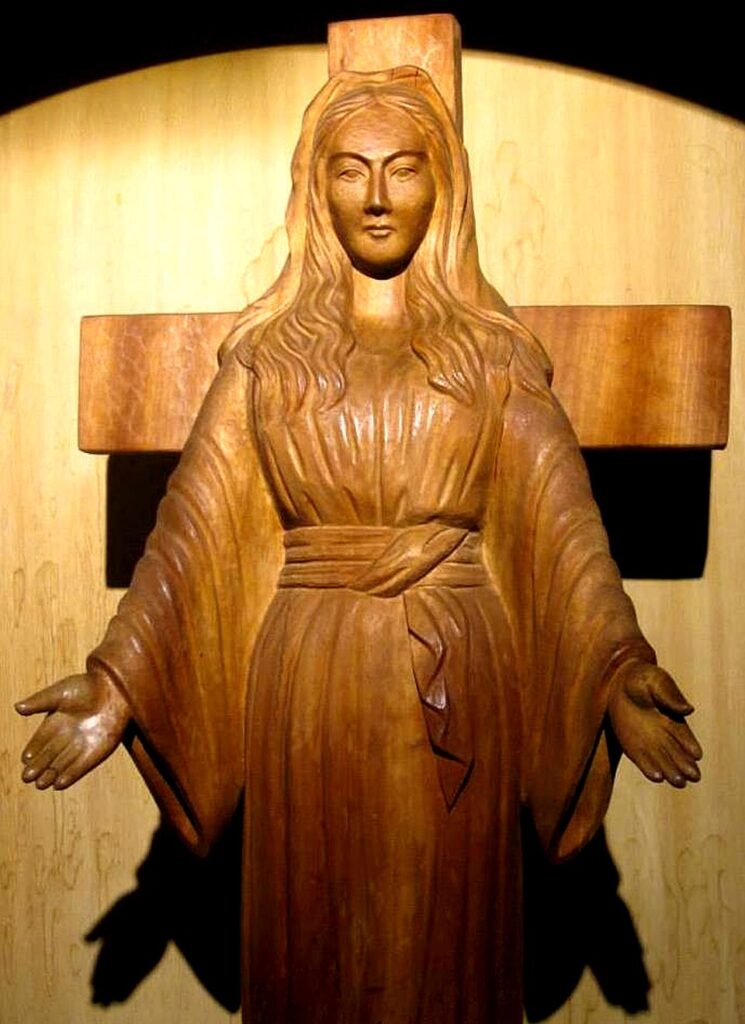
Bishop John Shojiro Ito of Niigata conducted an eight-year investigation involving medical examinations, scientific analysis of the tears, extensive interviews, and theological assessment of the messages. On April 22, 1984, Bishop Ito issued his formal approval, stating: “The events of Akita…cannot be explained in a natural way. We must therefore conclude that they have a supernatural character” (Ito, 1984, as cited in Yasuda, 1989, p. 117). The Bishop explicitly declared that the faithful could believe in and promote the Akita events.
Most significantly, Cardinal Joseph Ratzinger—Prefect of the Congregation for the Doctrine of the Faith and future Pope Benedict XVI—reportedly gave private assurances about Akita’s authenticity in 1988 to Bishop Ito (Yasuda, 1989, p. 122). This detail is crucial because it connects the highest levels of Church authority to the approval of an apparition that explicitly teaches the theology now being rejected.
The Messages: Explicit Mediation Between Divine Justice and Humanity
Our Lady gave three messages to Sister Agnes. The second message, delivered on August 3, 1973, contains perhaps the most explicit statement of Mary’s mediating role between divine justice and humanity in all approved apparitions:
Many men in this world afflict the Lord. I desire souls to console Him to soften the anger of the Heavenly Father. I wish, with my Son, for souls who will repair by their suffering and their poverty for the sinners and ingrates. In order that the world might know His anger, the Heavenly Father is preparing to inflict a great chastisement on all mankind. With my Son I have intervened so many times to appease the wrath of the Father. I have prevented the coming of calamities by offering Him the sufferings of the Son on the Cross, His Precious Blood, and beloved souls who console Him forming a cohort of victim souls. (Our Lady of Akita, 1973, as cited in EWTN, n.d.)
The theological content is comprehensive and explicit:
Active intervention. Mary states: “With my Son I have intervened so many times.” The verb “intervene” (intervenir in most translations) means to come between parties, to intercede, to interpose oneself. This is active mediation, not passive presence.
Appeasing divine wrath. The phrase “to appease the wrath of the Father” uses language of propitiation—satisfying or mollifying righteous anger. Mary claims to have repeatedly performed this mediating action.
Prevention of calamities. Mary explicitly claims causation: “I have prevented the coming of calamities.” She attributes to herself the prevention of historical disasters through her intercession.
Offering Christ’s merits. The mechanism of this prevention is Mary “offering Him the sufferings of the Son on the Cross, His Precious Blood.” Mary takes the redemptive merits earned by Christ and presents them to the Father on behalf of sinners. This is precisely the action denoted by “Mediatrix”—she mediates Christ’s graces to humanity and humanity’s needs to God.
Working “with my Son.” The phrase “with my Son” appears twice in the message. This indicates cooperation and joint action between Mary and Jesus in restraining divine justice—the theological concept underlying “Co-Redemptrix.”
Repeated, ongoing action. The phrase “so many times” indicates this is not a unique historical event but an ongoing role Mary continuously fulfills.
In the third message, given on October 13, 1973—exactly 56 years to the day after the Miracle of the Sun at Fatima—Mary declared: “I alone am able still to save you from the calamities which approach” (Our Lady of Akita, 1973, as cited in EWTN, n.d.). Bishop Ito explicitly connected Akita to Fatima, stating in his pastoral letter: “After the inquiries conducted up to the present day, we cannot deny the supernatural character of a series of inexplicable events relative to the Statue of Mary in Akita…The message of Akita is the message of Fatima” (Ito, 1984, as cited in Yasuda, 1989, p. 118).
The Akita Paradox
What we might call the “Akita Paradox” represents one of the most troubling contradictions in this entire controversy. Consider this timeline:
- 1973-1981: Akita apparitions occur; statue weeps 101 times
- 1984: Bishop Ito formally approves the apparitions after thorough investigation
- 1988: Cardinal Joseph Ratzinger, Prefect of the Congregation for the Doctrine of the Faith, gives private assurances of Akita’s authenticity
- 1996: The same Cardinal Ratzinger advises Pope John Paul II not to define Mary as Co-Redemptrix and Mediatrix as dogma, stating that “the precise meaning of these titles is not clear” and “the doctrine contained in them is not mature” (as cited in Miravalle, 2008, p. 203)
- 2025: Father Gronchi, citing Ratzinger’s position, declares that believing Mary “holds back God’s wrath” is “superstition”
How can Cardinal Ratzinger give assurances about Akita’s authenticity when Akita explicitly teaches that Mary has “intervened so many times to appease the wrath of the Father” and has “prevented the coming of calamities”—if he believed this theology was immature or unclear? The apparition teaches precisely the doctrine he advised against defining and which is now being called “superstition.”
The options are limited: Either (1) Ratzinger was mistaken to endorse Akita because it contains theological error, (2) Ratzinger was mistaken about the maturity and clarity of the Co-Redemptrix doctrine, (3) Ratzinger endorsed Akita without carefully examining its theological content, or (4) there is a distinction between the theology itself (which Ratzinger accepted) and the formal definition of titles (which he opposed for prudential reasons). None of these options resolves the fundamental tension between approved apparitions and current Vatican statements.
Our Lady of Fatima (1917): The Immaculate Heart as Instrument of Salvation
Historical Background and Approval
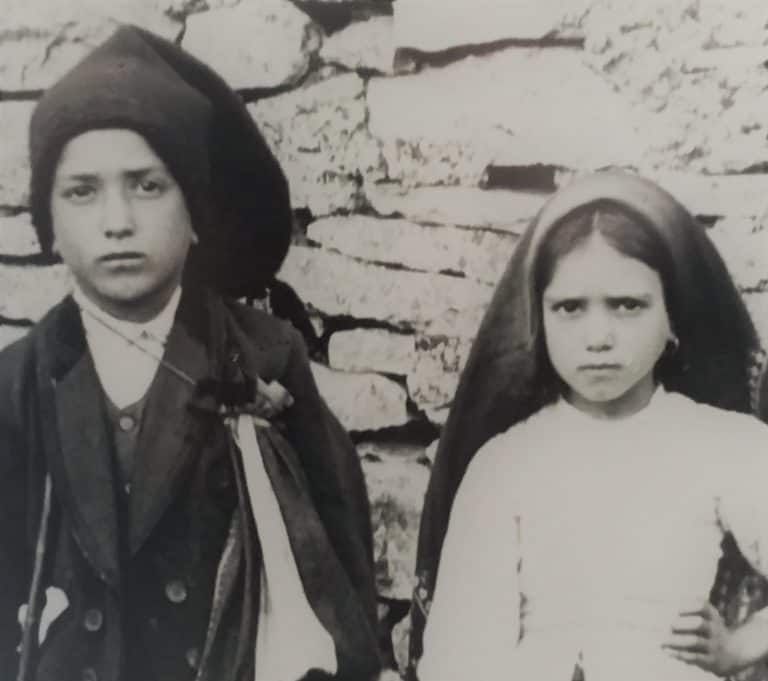
The apparitions of Our Lady of Fatima represent the most famous and extensively affirmed Marian apparitions of modern times. Between May 13 and October 13, 1917, the Blessed Virgin Mary appeared six times to three shepherd children—Lucia dos Santos (age 10), Francisco Marto (age 9), and Jacinta Marto (age 7)—in the Cova da Iria near Fatima, Portugal.
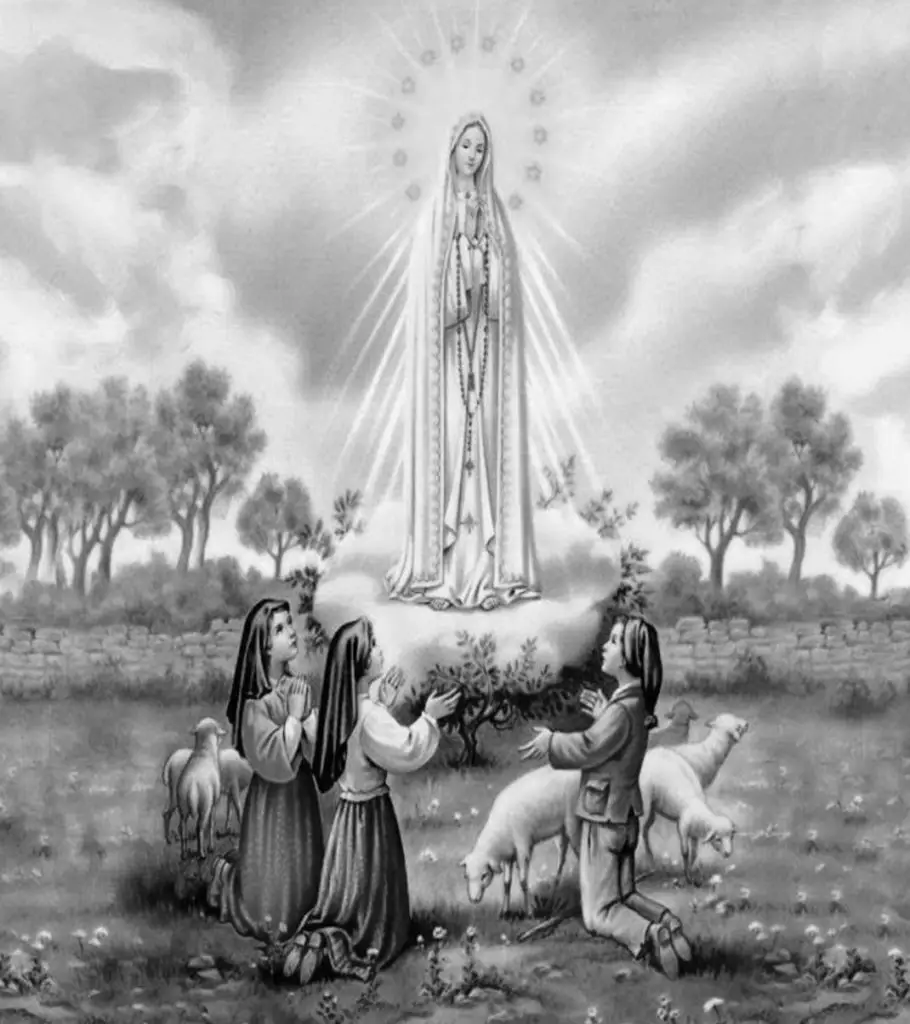
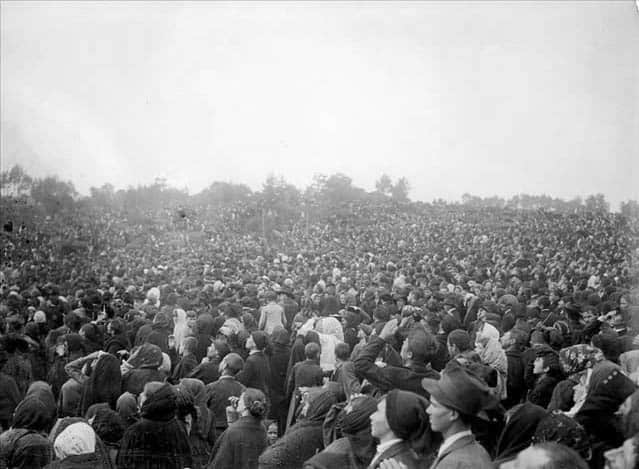
The apparitions concluded with the “Miracle of the Sun” on October 13, 1917, witnessed by approximately 70,000 people including skeptics, journalists, and scientists. The solar phenomenon was reported in secular newspapers, with O Século, Lisbon’s largest and most anticlerical newspaper, publishing detailed eyewitness accounts (O Século, 1917, October 15).
After a thirteen-year investigation, Bishop José Alves Correia da Silva of Leiria-Fatima issued his formal approval on October 13, 1930, declaring: “We hereby: (1) Declare worthy of belief, the visions of the shepherd children in the Cova da Iria, parish of Fatima, in this diocese, from the 13th May to 13th October, 1917. (2) Permit officially the cult of Our Lady of Fatima” (Correia da Silva, 1930, as cited in Kondor, 2007, p. 7).
The subsequent papal affirmations are extensive and unprecedented:
- Pope Pius XII (1942): Consecrated the world to Mary’s Immaculate Heart in explicit fulfillment of Fatima’s request
- Pope Paul VI (1967): First pope to visit Fatima; delivered homily on 50th anniversary of apparitions
- Pope John Paul II (1982, 1991, 2000): Visited Fatima three times; attributed his survival of the 1981 assassination attempt to Our Lady of Fatima; beatified Francisco and Jacinta in 2000
- Pope Benedict XVI (2010): Visited Fatima; affirmed the ongoing relevance of Fatima’s message
- Pope Francis (2017): Visited Fatima for centenary; canonized Francisco and Jacinta
Two of the three visionaries are now canonized saints. This level of papal affirmation is unparalleled in the history of Marian apparitions.
The Message: Mary’s Immaculate Heart as Means of Salvation
The July 13, 1917 message contains the core theological content relevant to our discussion. After showing the children a terrifying vision of hell, Our Lady stated:
You have seen Hell, where the souls of sinners go. To save them, God wishes to establish in the world the devotion to my Immaculate Heart. If what I say to you is done, many souls will be saved and there will be peace. The war is going to end; but if people do not cease offending God, a worse one will break out during the reign of Pius XI. (Sister Lucia, 1941/2003, p. 162)
She then issued a warning and a conditional promise:
When you see a night illumined by an unknown light, know that this is the great sign given you by God that He is about to punish the world for its crimes, by means of war, famine, and persecutions of the Church and of the Holy Father. To prevent this, I shall come to ask for the Consecration of Russia to my Immaculate Heart, and the Communion of Reparation on the First Saturdays…If my requests are heeded, Russia will be converted, and there will be peace; if not, she will spread her errors throughout the world, causing wars and persecutions of the Church. The good will be martyred, the Holy Father will have much to suffer, various nations will be annihilated. (Sister Lucia, 1941/2003, pp. 162-163)
The theological implications are profound:
Devotion to Mary’s Heart as God’s chosen means. Our Lady states that “God wishes to establish in the world the devotion to my Immaculate Heart” specifically to save souls from hell. God could save souls through any means He chooses, yet He has specifically chosen devotion to Mary’s Immaculate Heart as the instrument. This makes Mary’s Immaculate Heart an instrumental cause in salvation—precisely what “Mediatrix of All Graces” means.
Conditional prevention of chastisement. Wars, persecutions, the annihilation of nations—all are conditional upon whether Mary’s requests are fulfilled. Sister Lucia wrote that Our Lady explicitly stated: “If my requests are heeded, Russia will be converted, and there will be peace” (Sister Lucia, 1941/2003, p. 163). This means that devotion to Mary can prevent massive historical calamities.
The Consecration request. Mary’s request for the Pope, in union with all the bishops, to solemnly consecrate Russia to her Immaculate Heart presupposes that such an act of devotion has real historical efficacy. Why would a public ceremonial act of devotion to Mary prevent wars and the spread of errors unless Mary has genuine mediating power between divine providence and human history?
Mary’s Immaculate Heart paired with Christ’s Sacred Heart. Even before Mary’s apparitions began, in 1916, an angel appeared to the three children and taught them a prayer that would become central to Fatima spirituality:
Most Holy Trinity, Father, Son and Holy Spirit, I adore You profoundly. I offer You the most precious Body, Blood, Soul and Deity of Jesus Christ, present in all the tabernacles of the world, in reparation for the outrages, sacrileges and indifference by which He is offended. By the infinite merits of the Sacred Heart of Jesus and the Immaculate Heart of Mary, I beg the conversion of poor sinners. (Sister Lucia, 1941/2003, p. 159)
This prayer, taught by an angel—a perfect and infallible messenger of God’s will—explicitly links “the infinite merits of the Sacred Heart of Jesus and the Immaculate Heart of Mary” in a prayer for conversion. If Mary’s Immaculate Heart has no redemptive or mediating role, why would an angel pair it with Christ’s Sacred Heart in this manner?
Theological Question. If the 2025 Vatican document and Father Gronchi are correct that Mary does not have a role in “holding back” divine chastisement or mediating graces, then why did God arrange the entire Fatima message—the most pope-affirmed apparition in history—around devotion to Mary’s Immaculate Heart as the means of preventing global catastrophe? Why did Pope Pius XII perform the Consecration of the World to Mary’s Immaculate Heart in 1942? Why did Pope John Paul II credit Fatima with changing the course of world history?
Our Lady of Good Success (17th Century): “I Hold Back the Arm of Divine Justice”
Historical Background and Approval
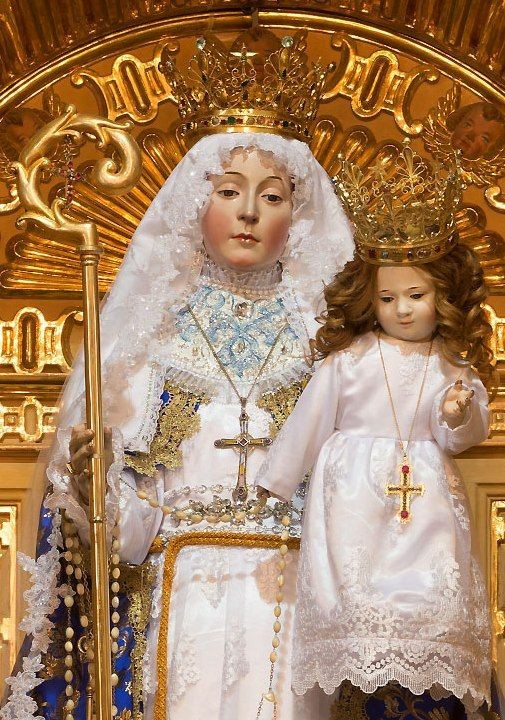
The apparitions of Our Lady of Good Success (Nuestra Señora del Buen Suceso) to Mother Mariana de Jesus Torres in Quito, Ecuador represent one of the earliest approved apparitions with extensive prophetic content about future centuries. Between 1594 and 1634, the Blessed Virgin Mary appeared numerous times to Mother Mariana, a Conceptionist nun and co-foundress of the Royal Convent of the Immaculate Conception.
The apparitions received approval from the Bishop of Quito, Salvador de Ribera, in 1611. The miraculous statue of Our Lady of Good Success, created according to the specifications given by Our Lady in the apparitions, has resided in the church for over 400 years and remains an object of veneration (Horvat, 2002, pp. 15-18). The cause for Mother Mariana’s canonization was officially opened in 1986, and she bears the title “Servant of God.”
What makes Our Lady of Good Success particularly significant is that Mary spoke extensively about the 20th and 21st centuries, predicting with remarkable accuracy the crisis of faith, the corruption of morals, the abandonment of priestly vocations, and the infiltration of Freemasonry into the Church—centuries before these crises manifested (Horvat, 2002, pp. 89-157).
The Message: Mother of Mercy Restraining Divine Justice
For our purposes, the most relevant content concerns what Our Lady said about her role as “Mother of Mercy” in relation to divine justice. She told Mother Mariana:
I am the Mother of Mercy and I desire to be known by this title. As Mother of Mercy, I hold back the arm of divine justice, which weighs heavily over this ungrateful world. If it were not for me, chastisement would have already come upon the earth…By my powerful intercession, I can prevent many punishments that my beloved Son’s justice wants to send to the earth because of the sins of men. (Our Lady of Good Success, 1634, as cited in Horvat, 2002, p. 134)
The theological content directly parallels La Salette’s message, though delivered 250 years earlier:
“I hold back the arm of divine justice.” This is precisely the same imagery as La Salette—the physical image of Mary restraining God’s arm of chastisement. The fact that this language appears in a 17th-century apparition demonstrates that it is not a modern innovation or a misunderstanding that emerged at La Salette.
“Mother of Mercy” as primary title. Mary explicitly requests to be known as “Mother of Mercy,” a title that presupposes a mediating role between divine justice (which humanity deserves) and divine mercy (which humanity needs).
Prevention of chastisements. “By my powerful intercession, I can prevent many punishments” uses the same language of prevention that appears in Akita. Mary’s intercession is not merely decorative or symbolic—it has real historical causation.
Tension between justice and mercy. There is an explicit tension between “what my beloved Son’s justice wants to send” and what Mary can prevent through intercession. This presupposes a real dynamic between divine justice (the natural consequence of sin) and Mary’s mediating mercy.
Historical significance. The appearance of this theology in a 17th-century apparition, approved by a bishop in 1611, demonstrates that the concept of Mary “holding back” divine justice has been part of approved Catholic revelation for over 400 years. This is not a 19th or 20th-century innovation—it has been consistently taught by Our Lady across centuries.
The Miraculous Medal (1830): Mary as Universal Dispenser of Graces
Historical Background and Approval
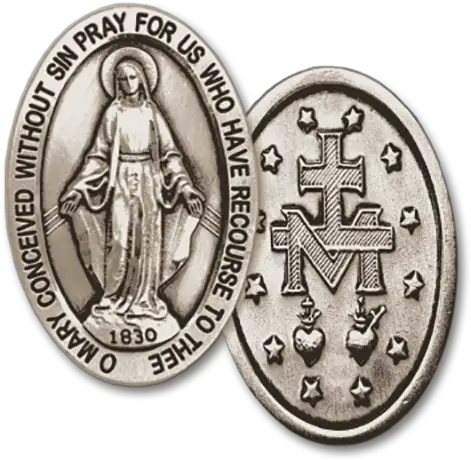
On the night of July 18-19, 1830, Sister Catherine Labouré, a novice with the Daughters of Charity in Paris, was awakened by her guardian angel and led to the convent chapel. There, the Blessed Virgin Mary appeared to her for over two hours. On November 27, 1830, Mary appeared again, standing on a globe with rays of light streaming from rings on her fingers toward the earth. Mary instructed Catherine to have a medal struck according to the vision she was seeing.
The devotion to the Miraculous Medal received approval with unprecedented rapidity. Archbishop Hyacinthe-Louis de Quélen of Paris approved the production and distribution of the medal in 1832—just two years after the apparition—after investigating thousands of miracles attributed to wearing the medal (Dirvin, 1958, pp. 98-112). The medal spread throughout the world with extraordinary speed; by 1842, over 100 million medals had been distributed (Dirvin, 1958, p. 135).
Sister Catherine Labouré was beatified by Pope Pius XI in 1933 and canonized by Pope Pius XII in 1947. A canonized saint received these apparitions, lending them the highest possible credibility.
The Vision: Visual Representation of Universal Mediation
The vision Mary showed to Catherine provides one of the clearest visual representations of the doctrine of Mediatrix of All Graces. Catherine described what she saw:
The Most Blessed Virgin was standing on a half-globe, or at least I saw only a half. Her feet were resting on a white globe, or at least I saw only the upper half…From her hands, as she stood with arms outstretched, came rays of dazzling light…I heard a voice saying to me: “These rays are a symbol of the graces I shed upon those who ask for them. The gems from which rays do not fall are the graces for which souls forget to ask.” (Catherine Labouré, 1830, as cited in Dirvin, 1958, pp. 72-73)
The theological content is explicit:
Mary as source of graces. The rays of light streaming from Mary’s hands represent graces. She actively “sheds” these graces upon humanity. This is not passive intercession but active distribution.
Universal scope. The globe beneath Mary’s feet and the rays streaming toward earth indicate the universal scope of her mediation. This is not limited to certain individuals or certain graces, but extends to the entire world.
Conditional upon asking. “The gems from which rays do not fall are the graces for which souls forget to ask” indicates that Mary desires to distribute these graces but human beings must ask. This presupposes that Mary has these graces at her disposal and is waiting to distribute them.
The prayer on the medal. Mary instructed that the medal bear the prayer: “O Mary, conceived without sin, pray for us who have recourse to thee” (Catherine Labouré, 1830, as cited in Dirvin, 1958, p. 73). The phrase “have recourse to thee” means to turn to Mary for help—presupposing that she can provide the help being sought.
Connection to papal teaching. The Miraculous Medal vision directly illustrates what Pope Leo XIII would teach 61 years later in his 1891 encyclical Octobri Mense: “Nothing at all of that very great treasure of all grace which the Lord brought us…nothing is imparted to us except through Mary, since God so wills” (Leo XIII, 1891, para. 4). The Pope was articulating in words what the Miraculous Medal had already shown in visual form.
The question arises: If the 2025 document is correct that “Mediatrix of All Graces” has “limits that do not favor a correct understanding,” was the vision given to St. Catherine Labouré misleading? Did a canonized saint receive a vision that taught confused theology about Mary’s role?
Our Lady of America (20th Century): Prevention Through Consecration
Historical Background and Approval Status
Between 1956 and 1959, Sister Mary Ephrem (Mildred Neuzil), a Sister of the Precious Blood in Rome City, Indiana, received apparitions of the Blessed Virgin Mary under the title “Our Lady of America.” The messages emphasized the importance of purity, family life, and the need for the United States to be consecrated to Mary’s Immaculate Heart.
The approval status of Our Lady of America is complex. Archbishop Paul Francis Leibold of Cincinnati granted an Imprimatur for a prayer to Our Lady of America in 1963, allowing its use and devotion (Neuzil, 1963/2008, p. ii). A beautiful statue was created according to Our Lady’s specifications and has been venerated by thousands of pilgrims. However, the apparitions have not yet received full formal approval at the highest levels of the Church, though they enjoy significant ecclesiastical support and have not been condemned.
While the approval status differs from apparitions like Fatima or Akita, Our Lady of America is included here because: (1) it has received official permission for prayer and devotion, (2) it follows the same theological pattern as fully approved apparitions, and (3) it demonstrates the consistency of Mary’s message across different apparitions in different countries.
The Message: Powerful Intercession to Prevent National Calamities
Our Lady appeared as the “Immaculate Virgin” specifically for the United States. She told Sister Mildred:
My child, I desire that my children honor me, especially by the purity of their lives…If my desires are not fulfilled much suffering will come to this land. My faithful one, I promise that by my powerful intercession, if the United States is dedicated to my purity, it will be saved from war and communism. (Our Lady of America, 1956, as cited in Neuzil, 1963/2008, p. 27)
In a later message, she stated:
I am Our Lady of America. I desire that my children honor me, especially by the purity of their lives…By my intercession, much can be accomplished for the salvation of souls and the peace of the world. (Our Lady of America, 1959, as cited in Neuzil, 1963/2008, p. 42)
The theological content follows the pattern established in other apparitions:
Prevention through consecration. If the United States is consecrated to Mary’s purity, it “will be saved from war and communism.” This is conditional prevention of massive historical evils (war and communist takeover) based on devotion to Mary.
“Powerful intercession.” Mary explicitly describes her intercession as “powerful,” indicating real efficacy and causal force in human affairs.
Salvation of souls. “By my intercession, much can be accomplished for the salvation of souls.” Mary’s intercession has salvific efficacy—it contributes to souls being saved.
Peace of the world. Her intercession can bring about “peace of the world,” affecting global historical outcomes, not merely individual spiritual lives.
Pattern across apparitions. The structure is identical to Fatima and La Salette: (1) a warning of coming chastisement, (2) a specific devotion to Mary requested, (3) a promise that fulfilling the devotion will prevent the chastisement. This pattern requires Mary to have real mediating power between divine providence and human history.
Our Lady of All Nations (1945-1959): Mary Calls Herself “Co-Redemptrix”
Historical Background and Approval
Between 1945 and 1959, Ida Peerdeman, a Catholic laywoman in Amsterdam, received 56 apparitions of the Blessed Virgin Mary under the title “Lady of All Nations” (Vrouwe van alle Volkeren). The apparitions contained messages about unity, prayer, and Mary’s role as Co-Redemptrix, Mediatrix, and Advocate.
The approval process for Our Lady of All Nations was lengthy and complicated. In 1974, Bishop Henricus Bomers issued a negative judgment, prohibiting public devotion. However, subsequent bishops reopened the investigation. In 1996, Bishop Henricus Bomers’s successor allowed private devotion. Finally, on May 31, 2002, Bishop Jozef Marianus Punt of Haarlem issued a comprehensive approval after thorough reinvestigation, declaring: “After profound investigation, considering all aspects, I hereby declare that the apparitions to Ida Peerdeman in Amsterdam from 1945 to 1959 have a supernatural origin” (Punt, 2002, para. 5).
The apparition thus has full ecclesiastical approval as of 2002, making it relevant to our discussion of approved Marian apparitions teaching the Co-Redemptrix theology.
The Message: Mary Explicitly Uses “Co-Redemptrix”
What makes Our Lady of All Nations absolutely crucial for our discussion is that Mary explicitly used the title “Co-Redemptrix” in the prayer she dictated to Ida. On February 11, 1951, Our Lady gave Ida a prayer that originally included:
Lord Jesus Christ, Son of the Father, send now Your Spirit over the earth. Let the Holy Spirit live in the hearts of all nations, that they may be preserved from degeneration, disaster and war. May the Lady of All Nations, the Blessed Virgin Mary, who once was Mary, be our Advocate. Lady of All Nations, who once was Mary, Mother of God and Mother of all peoples, Co-Redemptrix, Mediatrix and Advocate, pray for us. (Our Lady of All Nations, 1951, as cited in Stigter, 2003, p. 156)
The phrase “Co-Redemptrix, Mediatrix and Advocate” was dictated by Our Lady herself. After theological discussions about whether the title could be misunderstood, the prayer was later revised (with ecclesiastical approval) to avoid potential confusion, but the original message unambiguously shows that Mary used this title for herself.
In addition to the prayer, Mary made explicit statements about her role:
I come as Co-Redemptrix and Advocate. I have come to hasten the coming of my Son. The world is not in order. The world must return to the Cross. (Our Lady of All Nations, 1951, as cited in Stigter, 2003, p. 162)
The Lady of All Nations wishes to be your Advocate before the Father, the Son, and the Holy Spirit. By my Son’s blood, I may be your Advocate. This is the great work of the Redemption, completed by the Sacrifice of the Cross. (Our Lady of All Nations, 1954, as cited in Stigter, 2003, p. 189)
The theological content is comprehensive:
Explicit use of “Co-Redemptrix.” Mary herself dictates a prayer using this title. She is not uncomfortable with it or avoidant of it—she deliberately includes it. If the 2025 Vatican document is correct that this title is “always inappropriate,” then Mary used an inappropriate title for herself.
Advocate before the Trinity. Mary states she is advocate “before the Father, the Son, and the Holy Spirit,” indicating she mediates between humanity and all three Persons of the Trinity.
“By my Son’s blood.” Mary clarifies that her advocacy is made possible by Christ’s redemptive sacrifice. She is not claiming independence or equality—her mediating power flows from the Redeemer’s blood.
“Completed by the Sacrifice of the Cross.” The work of redemption was “completed” at Calvary, where Mary was present, united with her Son’s suffering. Her cooperation at that moment grounds her ongoing mediating role.
The Amsterdam vs. Vatican Irony. The irony is profound: An approved apparition from the 20th century has Mary explicitly using the title “Co-Redemptrix” for herself, and now in 2025, a Vatican document says it is “always inappropriate” to use this title. Was Mary wrong? Or is the Vatican document wrong?
Understanding “Co-“: Theological Distinctions That Matter
Much of the confusion and controversy surrounding the title “Co-Redemptrix” stems from misunderstanding what the prefix “co-” means in this theological context. Before we can properly evaluate whether the apparitions are teaching authentic Catholic theology, we must clarify what Catholic theology has actually meant by terms like “Co-Redemptrix” and “Mediatrix.”
The Meaning of “Co-“
The prefix “co-” in “Co-Redemptrix” derives from the Latin preposition cum, which means “with” or “together with.” It does not mean “equal to” or “on the same level as.” This is a crucial distinction that is often overlooked in critiques of the title.
St. Paul himself uses similar language when he describes Christians as “God’s fellow workers” (1 Corinthians 3:9, RSV: synergoi in Greek, cooperarii in Latin). No one interprets this to mean Christians are equal to God in creative or redemptive power. It means Christians work with God, subordinately and dependently, in the work God is doing.
Similarly, St. Paul writes: “Now I rejoice in my sufferings for your sake, and in my flesh I complete what is lacking in Christ’s afflictions for the sake of his body, that is, the church” (Colossians 1:24, RSV). Paul is not suggesting Christ’s sacrifice was insufficient. Rather, he is expressing the mystery that God allows—even wills—human cooperation in the application of redemption to the world.
When Catholic theology speaks of Mary as “Co-Redemptrix,” it means she cooperated with Christ in redemption, subordinately and dependently, in a way that was willed by God and has unique salvific efficacy. It emphatically does not mean she is a second redeemer or equal to Christ.
Primary vs. Secondary Causation
Catholic theology has always distinguished between different levels of causation in salvation:
Primary Causation: Christ alone is Redeemer in the primary, essential, sufficient sense. His sacrifice on Calvary is the one, unique, sufficient cause of all salvation. No other redemption is needed or possible. As 1 Timothy 2:5 states: “For there is one God, and there is one mediator between God and men, the man Christ Jesus.”
Secondary Causation: God has chosen to allow creatures to participate in the application and distribution of redemptive graces. This participation is real but always subordinate to and dependent upon Christ’s primary causation. Human beings become “instruments” of grace through which God works.
The Catechism of the Catholic Church explains this principle when discussing Mary’s mediation: “Mary’s function as mother of men in no way obscures or diminishes this unique mediation of Christ, but rather shows its power. But the Blessed Virgin’s salutary influence on men…flows forth from the superabundance of the merits of Christ, rests on his mediation, depends entirely on it, and draws all its power from it” (Catholic Church, 1994, para. 970).
St. Thomas Aquinas articulated this distinction using the philosophical categories of instrumental causation. Just as a pen is a true cause of writing but only instrumentally (the writer is the principal cause), so human beings are true causes in the work of salvation but only instrumentally—God is the principal cause (Aquinas, c. 1265-1274/1947, III, q. 27, a. 5).
Mary’s cooperation is unique among all secondary causes in that she cooperated at the very moment of redemption at Calvary. She was not merely a passive observer but an active cooperator, offering her Son and uniting her maternal suffering with His redemptive suffering. This cooperation at the source of redemption grounds her ongoing role in the distribution of redemptive graces.
Latria, Dulia, and Hyperdulia
Catholic theology has carefully maintained the absolute distinction between Creator and creature through the doctrine of three levels of honor:
Latria (Adoration/Worship): This highest form of honor is reserved exclusively for God—Father, Son, and Holy Spirit. Latria is characterized by recognition of divine sovereignty, absolute dependence, and sacrificial worship. It is offered to God alone because He alone is the Creator, the source of all being, the one upon whom all creatures absolutely depend.
Dulia (Veneration): This is honor given to saints and angels in recognition of their holiness and heroic virtue. We honor them for what God has accomplished in them and through them. We ask for their intercession, recognizing that their prayers are efficacious because of their union with God.
Hyperdulia (Special Veneration of Mary): This is a heightened degree of dulia reserved exclusively for the Blessed Virgin Mary because of her unique relationship to Christ. She is the Mother of God (Theotokos), Immaculately Conceived, Ever-Virgin, Assumed into Heaven, and Queen of Heaven and Earth. As St. Thomas Aquinas explained: “While latria is owed to [Mary’s] Son by reason of unity of his divine and human natures in the Person of the Word made flesh, hyperdulia is due to Mary as truly His Mother” (Aquinas, c. 1265-1274/1947, III, q. 25, a. 5).
Calling Mary “Co-Redemptrix” does not place her on the level of God (which would require latria). It recognizes her unique cooperation in redemption while maintaining the absolute distinction between Creator and creature. Mary receives hyperdulia—the highest honor possible for a creature—but never latria, which belongs to God alone.
Subordinate vs. Parallel Mediation
Another crucial distinction is between subordinate/dependent mediation and parallel/autonomous mediation:
Parallel/Autonomous Mediation (Heretical): This would mean Mary mediates independently of Christ, as a separate source of grace, or that she stands as an equal mediator alongside Christ. This would contradict 1 Timothy 2:5 and would indeed be heretical. The Catholic Church has never taught this and explicitly condemns it.
Subordinate/Dependent Mediation (Orthodox): This means Mary mediates through Christ, in Christ, and because of Christ. All her mediating power flows from His unique mediation. She has no grace to give except what she has received from Him. Her intercession is efficacious only because of His merits. As Vatican II stated: “Mary’s function as mother of men in no way obscures or diminishes this unique mediation of Christ, but rather shows its power” (Paul VI, 1964, section 60).
When the approved apparitions show Mary “offering” Christ’s blood to the Father, “presenting” His merits, or “distributing” graces, they are depicting subordinate mediation. Mary is not creating grace or redemption—she is cooperating in the application of what Christ has already fully accomplished.
Application to the Apparitions
With these distinctions clarified, we can properly evaluate the apparition messages:
When La Salette shows Mary “holding back the arm of my Son,” it depicts subordinate mediation—Mary interceding with her Son, not restraining an unwilling God.
When Akita shows Mary “offering Christ’s blood to the Father,” it depicts instrumental causation—Mary presenting Christ’s merits, not her own.
When the Miraculous Medal shows rays of grace flowing through Mary’s hands, it depicts secondary distribution—Mary dispensing what Christ has won, not creating grace herself.
When Our Lady of All Nations uses “Co-Redemptrix,” it expresses cooperation with Christ, not equality to Him.
All of this fits within orthodox Catholic theology when properly understood. The titles and imagery become problematic only when the theological distinctions are ignored or when “co-” is misunderstood to mean “equal.”
Seven Apparitions, One Consistent Message
Having examined each apparition individually, we can now step back and observe the remarkable consistency across all seven approved messages spanning four centuries:
Common Theological Themes
1. Mary intercedes to prevent divine chastisement
- Our Lady of Good Success (17th c.): “I hold back the arm of divine justice”
- La Salette (1846): “I can no longer withhold the arm of my Son”
- Fatima (1917): Devotion to Immaculate Heart prevents annihilation of nations
- Our Lady of America (1956-1959): “By my powerful intercession…will be saved from war and communism”
- Akita (1973): “I have prevented the coming of calamities”
2. Mary “holds back” or restrains divine justice
- Our Lady of Good Success: Explicit “I hold back the arm”
- La Salette: Explicit “I can no longer withhold it”
- Akita: “I have intervened so many times to appease the wrath of the Father”
3. Mary distributes/mediates graces
- Miraculous Medal (1830): Visual representation of graces flowing through Mary’s hands to earth
- Fatima (1917): “God wishes to establish devotion to my Immaculate Heart” as means of salvation
- Our Lady of All Nations (1945-1959): “Co-Redemptrix, Mediatrix and Advocate”
4. Devotion to Mary can change historical outcomes
- Fatima: Consecration of Russia will prevent war and annihilation
- Our Lady of America: Consecration will save U.S. from war and communism
- La Salette: Conversion of people determines whether chastisement falls
5. Mary’s intercession is powerful and efficacious
- All seven apparitions explicitly or implicitly teach this
Geographic and Temporal Spread
[Figure: World Map with Apparition Sites]
The apparitions are remarkably diverse in time and place:
- Ecuador (17th century): Our Lady of Good Success
- France (1830): Miraculous Medal
- France (1846): La Salette
- Portugal (1917): Fatima
- Netherlands (1945-1959): Our Lady of All Nations
- United States (1956-1959): Our Lady of America
- Japan (1973): Akita
These apparitions occurred:
- On three continents (Europe, Asia, South America)
- Across four centuries (17th, 19th, 20th, 21st)
- In six different countries with different languages and cultures
- Investigated and approved by different bishops in different eras
- To visionaries of different backgrounds (nuns, children, laypeople)
Yet all teach the same core theology about Mary’s mediating role.
The Pattern
This is not one apparition with ambiguous language that might be misinterpreted. This is not a regional devotion that got out of hand. This is seven major approved apparitions, spanning 400 years, on three continents, investigated by different bishops, in different cultural contexts, all teaching—in Mary’s own words—the same theology about her role.
The consistency is remarkable. Whether in 17th-century Ecuador or 20th-century Japan, whether to a Spanish nun or Portuguese shepherd children, the message remains the same: Mary intercedes to restrain divine justice, she prevents calamities, she distributes graces, she mediates between God and humanity.
The Question That Cannot Be Avoided
We now face a question that every Catholic must answer: Can Church-approved apparitions teach theological error?
The Church’s Traditional Answer
Catholic theology has consistently taught that when the Church approves an apparition, she guarantees that the core message contains no error contrary to faith and morals. As Pope Benedict XIV established in his definitive work on beatification, approved apparitions enjoy the Church’s testimony “that there is nothing in them contrary to faith and good morals, and that they may be believed with human faith, according to the rules of prudence” (Benedict XIV, 1734-1738/1840, Book IV, Part 1, Chapter 1).
When a bishop approves an apparition, he conducts a thorough investigation examining:
- The character and mental stability of the visionaries
- The theological content of the messages
- The conformity of the messages with Scripture and Tradition
- The fruits of the apparition (conversions, miracles, holiness)
- Whether the messages promote true devotion or lead to error
If any theological error were detected, the apparition would not be approved. When approval is given, the faithful may trust that the core message is safe to believe and can be used for spiritual instruction.
The Binary Choice
Given this understanding, we are left with only two possible conclusions:
If Father Gronchi and the 2025 Vatican Document Are Correct:
- Seven different bishops across four centuries all failed to detect theological error in their investigations
- Multiple popes who affirmed these apparitions (Leo XIII, Pius XII, Paul VI, John Paul II, Benedict XVI, Francis) were negligent in their duty to protect the faithful
- The Church’s process for approving apparitions is fundamentally flawed and unreliable
- Millions of Catholics have been misled for centuries by officially approved revelations
- The Holy Spirit failed to protect the Church from widespread error in its most popular Marian devotions
- St. Catherine Labouré (canonized saint) received a vision teaching confused theology
- Francisco and Jacinta Marto (canonized saints) witnessed apparitions containing error
- Cardinal Ratzinger was wrong to give assurances about Akita’s authenticity
If the Traditional Teaching of the Apparitions Is Correct:
- The 2025 document represents discontinuity with the consistent teaching of approved apparitions
- Father Gronchi’s characterization of this theology as “superstition” is inaccurate
- The document is motivated primarily by ecumenical concerns (Protestant objections) rather than fidelity to revealed truth
- The document represents ordinary (not extraordinary) magisterium and is therefore not irreformable
- The theology of Mary as Co-Redemptrix and Mediatrix represents authentic Catholic teaching confirmed by Heaven itself across four centuries
- Catholics who continue to use these titles and honor Mary in this way are standing in continuity with approved revelation
No Third Option
There is no middle ground here. These positions are mutually exclusive. One must be true; one must be false.
The question is not merely about two theological titles. The question is: Do we trust Heaven’s consistent message across 400 years of approved apparitions, or do we trust a 2025 Vatican document motivated explicitly by ecumenical concerns?
Conclusion: Mary’s Own Words vs. Vatican Officials
At La Salette in 1846, the Blessed Virgin Mary told two shepherd children: “I can no longer withhold the arm of my Son.” Bishop de Bruillard investigated thoroughly and approved the apparition in 1851. Pope Leo XIII affirmed it in 1879. Catholics have believed it for 179 years.
At Akita in 1973, the Blessed Virgin Mary told Sister Agnes: “With my Son I have intervened so many times to appease the wrath of the Father. I have prevented the coming of calamities.” Bishop Ito investigated thoroughly and approved the apparition in 1984. Cardinal Ratzinger gave assurances in 1988.
At Amsterdam in 1951, the Blessed Virgin Mary dictated a prayer calling herself “Co-Redemptrix, Mediatrix and Advocate.” After a long process, Bishop Punt approved the apparition as supernatural in 2002.
In November 2025, Father Maurizio Gronchi, a Vatican consultant, declared: “It is superstition to think that the Virgin Mary has the role of holding back God’s wrath.”
This is a direct, explicit contradiction.
The theology Father Gronchi calls “superstition” has been taught by the Blessed Virgin Mary herself in seven approved apparitions spanning four centuries. It has been investigated and approved by bishops. It has been affirmed by popes. It has produced countless conversions, miracles, and fruits of holiness. Two visionaries who heard this message are now canonized saints.
Every Catholic must now ask themselves:
Can the Mother of God teach superstition?
Can approved apparitions lead millions of faithful Catholics astray for four centuries?
Or is something else happening here?
The evidence presented in this article demonstrates beyond reasonable doubt that there is a profound contradiction between what Our Lady said in approved apparitions and what Vatican officials are saying today. The consistency of Mary’s message across seven apparitions—different times, places, languages, cultures, and bishops—points to Heaven speaking with remarkable clarity.
When Heaven speaks consistently for 400 years through approved revelations, and a Vatican document contradicts that message in 2025—motivated explicitly by ecumenical concerns to avoid offending Protestant sensibilities—faithful Catholics have not only the right but the duty to ask serious questions.
The words are Mary’s own. The approvals are the Church’s own. The contradiction is undeniable.
Each Catholic must now prayerfully discern: Who is teaching truth—Our Lady in approved apparitions, or Vatican officials in 2025?
The answer to that question will determine not only how we understand Mary’s role, but whether we can trust that the Holy Spirit truly protects approved apparitions from doctrinal error.
References
Aquinas, T. (1947). Summa Theologiae (Fathers of the English Dominican Province, Trans.). Benziger Bros. (Original work written c. 1265-1274)
Benedict XIV. (1840). De servorum Dei beatificatione et beatorum canonizatione [On the beatification of the servants of God and on the canonization of the blessed] (P. Lambertini, Ed.). Aldina Press. (Original work published 1734-1738)
Catholic Church. (1994). Catechism of the Catholic Church (2nd ed.). Libreria Editrice Vaticana.
Congregation for the Doctrine of the Faith. (1851). Decree of the Bishop of Grenoble approving the apparition of La Salette. Diocese of Grenoble Archives.
Correia da Silva, J. A. (1930). Pastoral letter approving the Fatima apparitions. Diocese of Leiria-Fatima.
Corteville, H., & Revet, R. (1921). La Salette: Documents authentiques [La Salette: Authentic documents]. Desclée, De Brouwer.
Dicastery for the Doctrine of the Faith. (2025, November 4). Mater Populi Fidelis: Doctrinal note on some Marian titles regarding Mary’s cooperation in the work of salvation. Holy See. https://www.vatican.va/roman_curia/congregations/cfaith/documents/rc_ddf_doc_20251104_mater-populi-fidelis_en.html
Dirvin, J. I. (1958). St. Catherine Labouré of the Miraculous Medal. TAN Books.
EWTN. (n.d.). Message from Our Lady—Akita, Japan. https://www.ewtn.com/catholicism/library/message-from-our-lady–akita-japan-5167
Horvat, M. T. (2002). Our Lady of Good Success: Prophecies for our times. Tradition in Action.
Kondor, L. (Ed.). (2007). Fatima in Lucia’s own words: Sister Lucia’s memoirs (Dominican Nuns of Perpetual Rosary, Trans.). Postulation Centre. (Original memoirs written 1935-1941)
Leo XIII. (1879). Decree elevating the shrine of La Salette. Acta Apostolicae Sedis.
Leo XIII. (1891, September 22). Octobri Mense [On the Rosary]. Holy See. https://www.vatican.va/content/leo-xiii/en/encyclicals/documents/hf_l-xiii_enc_22091891_octobri-mense.html
Miravalle, M. (2008). “With Jesus”: The story of Mary co-redemptrix. Queenship Publishing.
Neuzil, M. (2008). The diary of Sister Mildred Mary Neuzil: Our Lady of America. Missionary Association of Catholic Women. (Original diary entries 1956-1959; compiled 1963)
O Século [The Century]. (1917, October 15). Coisas espantosas! Como o sol bailou ao meio dia em Fátima [Amazing things! How the sun danced at midday in Fatima]. Lisbon, Portugal.
Paul VI. (1964, November 21). Lumen Gentium [Dogmatic constitution on the Church]. Second Vatican Council. https://www.vatican.va/archive/hist_councils/ii_vatican_council/documents/vat-ii_const_19641121_lumen-gentium_en.html
Pullella, P. (2025, November 19). Virgin Mary doesn’t have ‘the role of holding back God’s wrath,’ Vatican expert says. Catholic News Agency. https://www.catholicnewsagency.com/news/267921
Punt, J. M. (2002, May 31). Declaration regarding the supernatural character of the apparitions of Our Lady of All Nations in Amsterdam [Episcopal decree]. Diocese of Haarlem.
Sister Lucia. (2003). Fatima in Lucia’s own words (L. Kondor, Ed.; Dominican Nuns of Perpetual Rosary, Trans.). Postulation Centre. (Original memoirs written 1935-1941)
Stigter, C. (2003). The messages of the Lady of All Nations. Foundation of the Lady of All Nations.
Yasuda, T. (1989). Akita: The tears and message of Mary. 101 Foundation.