What does it mean when the Catholic Church proclaims Mary as the New Ark of the Covenant?
This profound typological connection reveals itself throughout the Sacred Scriptures, offering one of the most remarkable parallels between the Old and New Testaments.
Saint Paul establishes the pattern of biblical typology when he refers to Adam as a “figure” of Christ in Romans 5:14. According to this scriptural principle, the Old Testament prefigures what finds fulfillment in the New Testament. When we examine the original Ark of the Covenant, we discover striking parallels to the Blessed Virgin Mary’s role in salvation history.
The Ark of the Covenant contained three sacred objects that directly correspond to what Mary carried within her womb:
The stone tablets of the Law – Mary carried Christ, the living Word of God
The manna from heaven – Mary bore the true Bread of Life
Aaron’s rod that budded – Mary carried our eternal High Priest
The physical characteristics of the Ark provide additional evidence for this connection. Constructed of incorruptible acacia wood and overlaid with pure gold, the Ark symbolizes Mary’s purity as the vessel chosen to bear the Son of God. As we read in Saint Luke’s Gospel, the Holy Spirit “overshadowed” Mary at the Annunciation (Luke 1:35), using the same Greek word employed in the Septuagint to describe the cloud of God’s presence overshadowing the Ark in the Tabernacle.
Much is significant in the timing as well. The Ark remained in the house of Obed-edom for three months, precisely the same duration the Blessed Virgin Mary stayed with her cousin Elisabeth.
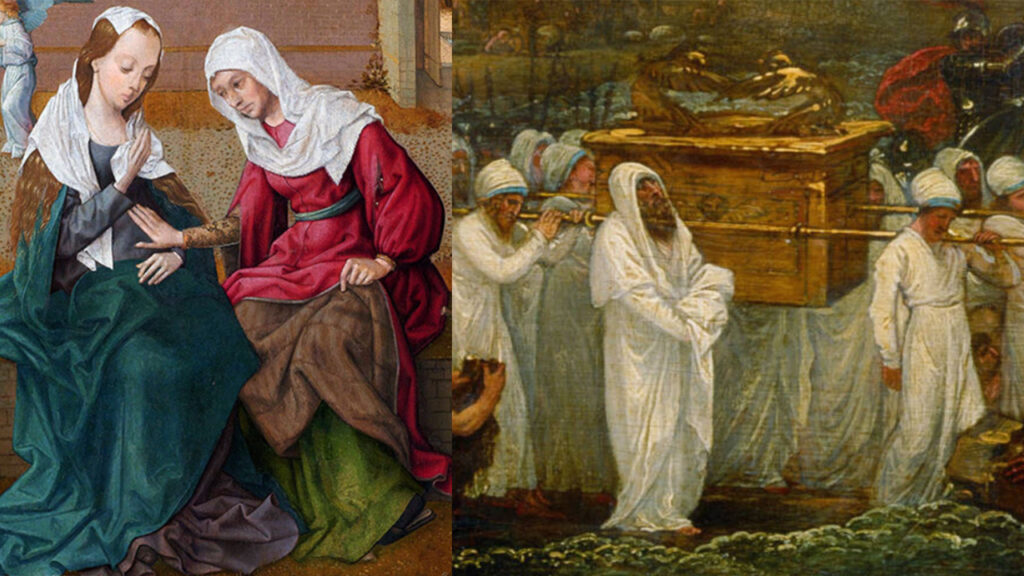
The early Church Fathers recognized Mary as the Ark of the New Covenant from the earliest centuries. This understanding forms part of the deposit of faith handed down through Sacred Tradition. After the original Ark was lost for approximately 600 years, its symbolic return appears beautifully in the Book of Revelation, where Mary is depicted as the woman clothed with the sun.
Throughout the following examination of these biblical proofs, we shall see how Sacred Scripture reveals Mary’s identity as the New Ark of the Covenant – a truth woven throughout both Testaments and affirmed by the constant teaching of the Catholic Church.
1) Genesis 3:15 – The Protoevangelium
The Book of Genesis provides the earliest scriptural foundation for understanding Mary as the New Ark of the Covenant through what theologians term the Protoevangelium – literally “the first gospel.” This foundational text contains God’s initial promise of salvation following the Fall: “I will put enmities between thee and the woman, and thy seed and her seed: she shall crush thy head, and thou shalt lie in wait for her heel. ” (Genesis 3:15).
i) Enmity between woman and serpent
This divine decree establishes permanent warfare between the serpent (Satan) and the woman. The Almighty declares complete opposition between good and evil, creating what theologians describe as absolute enmity. Unlike Eve, who succumbed to the serpent’s deception, this prophetic woman would stand in total opposition to Satan’s dominion. The text positions both the woman and her offspring against the serpent, indicating that neither would fall under his power.
This enmity reveals the extent of God’s mercy – He would not abandon humanity to eternal defeat but would raise up a champion from among the human race itself.
ii) Mary’s role in Christ’s victory
The reference to “her seed” provides crucial evidence for the virginal conception. Scripture typically traces lineage through the paternal line, making this maternal reference extraordinary. Biblical scholars recognize this woman as Mary, whose Son would deliver the decisive blow against Satan’s head.
The prophecy foretells both Christ’s suffering – Satan would “strike his heel” through the Crucifixion – and His ultimate triumph in crushing the serpent’s head through the Resurrection and Ascension.
iii) Immaculate Conception foreshadowed
The Catholic Church teaches that this complete enmity between the woman and Satan foreshadows Mary’s Immaculate Conception (see article on the Dogma of the Immaculate Conception). The text implies that neither the woman nor her seed would belong to Satan’s kingdom – that realm of those under sin’s dominion.
This shows the logical consistency of Catholic doctrine: if the woman’s offspring (Christ) was sinless, and God established identical enmity between the serpent and the woman herself, then Mary must also be free from sin’s stain. Pope Pius IX affirmed this truth when he declared that Mary was “always free from absolutely every stain of sin.”
The Blessed Virgin thus becomes the New Eve – like the first woman before the Fall, yet surpassing her through unwavering faithfulness to God’s will.
2) Isaiah 7:14 – The Virgin Shall Conceive
The prophet Isaiah delivers one of the most significant Messianic prophecies in all of Sacred Scripture, a text that points directly to Mary as the New Ark of the Covenant. This prophecy emerged during a critical moment when King Ahaz of Judah faced military threats from the kingdoms of Syria and Israel.
i) Virgin birth prophecy
As we read in Isaiah 7:14, the Lord proclaimed through His prophet: “Therefore the Lord himself will give you a sign. Behold, the virgin shall conceive and bear a son, and shall call his name Immanuel.” The Hebrew word employed here is ‘almah, which primarily means “young woman” or “maiden.”
What proves most significant is how Jewish scholars centuries before Christ’s birth translated this passage into Greek for the Septuagint. They chose the word parthenos, which explicitly means “virgin.” This translation choice reveals how the prophecy was understood even before the Blessed Virgin Mary’s time, showing the development of this understanding within the Jewish community itself.
ii) Emmanuel and Mary
The prophesied child bears the name Immanuel—”God with us”—which carries profound theological significance. This name originally served as a sign that the Almighty would protect Judah from immediate military threats. Yet the name ultimately revealed something far greater: God’s physical presence among His people through the virgin birth.
Isaiah addressed his prophecy to “the house of David” (Isaiah 7:13), establishing a direct connection to Mary’s lineage through Saint Joseph, who was “of the house of David” (Luke 1:27). This royal connection shows how Mary became the vessel through whom God would fulfill His covenant promises to David’s lineage.
iii) Fulfillment in Luke 1
The Evangelist Luke presents clear parallels to Isaiah’s ancient prophecy. The Angel Gabriel’s words to Mary—”Behold, you will conceive in your womb and bear a son, and you shall call his name Jesus” (Luke 1:31)—directly echo the prophet’s declaration: “Behold, the virgin shall conceive and bear a son, and shall call his name Immanuel.”
The original sign in Isaiah’s time indicated God’s protection over Judah during their immediate crisis. Luke’s Gospel reveals the prophecy’s ultimate fulfillment in Mary’s virginal conception of Jesus. The Evangelist’s narrative emphasizes Mary’s role as the dwelling place of God—a living ark carrying the divine presence within her virginal womb.
This prophecy demonstrates how God’s word operates on multiple levels, addressing King Ahaz’s immediate situation while establishing a pattern that finds complete expression in the Blessed Virgin Mary, who literally became the vessel containing God Himself.
3) Micah 5:2-3 – The Woman in Travail
The prophet Micah, a contemporary of Isaias, provides another remarkable witness to Mary’s role as the New Ark of the Covenant. Composed between 750-660 BC, this dual prophecy from Micah 5:2-3 would find its complete fulfillment centuries later through the Blessed Virgin Mary and the birth of Our Lord Jesus Christ.
i) Birth in Bethlehem
“But thou, Bethlehem Ephrata, art a little one among the thousands of Juda: out of thee shall he come forth unto me that is to be the ruler in Israel: and his going forth is from the beginning, from the days of eternity” (Micah 5:2).
The precision of this prophecy is remarkable. The specification of “Ephrata” distinguishes this Bethlehem in Juda from another town bearing the same name, demonstrating the detailed nature of God’s plan for the Messiah’s birth.
As we read in the Scriptures, the Jewish religious authorities immediately recognized this as a Messianic prophecy. When King Herod inquired where the Christ would be born, they cited this very passage from Micah (Matthew 2:6). The prophecy speaks of One whose “going forth is from the beginning, from the days of eternity,” indicating the divine nature of the promised Messiah.
ii) The Woman in Travail
The prophecy continues with these words: “Therefore will he give them up even till the time wherein she that travaileth shall bring forth” (Micah 5:3).
This sudden reference to “she that travaileth” introduces a woman in labor without any mention of a husband – most unusual according to Jewish custom and genealogical records. This absence points to the virginal conception prophesied by Isaias. The contextual phrases referring to “the ruler in Israel” and “his going forth” clearly indicate an individual person rather than a nation.
According to Catholic interpretation, this woman in travail refers directly to the Blessed Virgin Mary, who would give birth to the promised Messiah.
iii) Fulfillment in the Nativity
The events surrounding Our Lord’s birth perfectly fulfilled this ancient prophecy. Though Mary and Saint Joseph dwelt in Nazareth, Divine Providence arranged that a census decreed by Caesar Augustus would bring them to Bethlehem precisely when Mary’s time for delivery had arrived.
The prophecy’s detail about the humble birthplace – “a little one among the thousands of Juda” – was fulfilled when Jesus, the eternal ruler, was born in this small village. This shows how God chose the lowly and humble to accomplish His greatest work, much as He chose Mary, a young maiden from Nazareth, to be the vessel carrying His divine presence.
This connection between the humble birthplace and the humble mother further establishes Mary’s role as the New Ark of the Covenant – the sacred vessel chosen by God to carry His Son into the world.
4) Mary as the Ark of Noah
The word “ark” carries profound meaning beyond its association with the Covenant – it fundamentally signifies a sanctuary or place of refuge. This connection between Mary and Noah’s Ark reveals another dimension of her role as the New Ark, particularly meaningful as we contemplate Christ’s time within Mary’s womb [3].
i) Noah’s Ark as Refuge
According to the Genesis account, Noah’s Ark served as the sole haven for all living creatures during the great flood. As every child learns in Sunday School, this vessel contained the entire human race and all living animals [3]. These creatures found safety from destruction by taking refuge within the ark’s protective walls.
This physical salvation through Noah’s Ark foreshadows a deeper spiritual reality that finds its fulfillment in the Blessed Virgin Mary.
ii) Mary as Protector from Sin
The Catholic Church teaches that Mary offers spiritual protection to those seeking refuge from sin, much as Noah’s Ark protected its inhabitants from physical destruction. The comparison is remarkable: “while the brutes that entered the ark remained brutes, the wolf remaining a wolf, and a tiger a tiger—under the mantle of Mary, on the other hand, the wolf becomes a lamb, and the tiger a dove” [3].
This transformation illustrates Mary’s role not merely as protection but as a means of sanctification.
Saint Gertrude had a vision of the Blessed Virgin with her mantle open, sheltering many wild beasts—leopards, lions, and bears. Rather than driving them away, Mary welcomed and caressed them. The saint understood these wild animals represented sinners whom Mary welcomes with love when they turn to her [3].
iii) The Typology of Salvation
The parallel between these arks illuminates a profound truth: Noah’s Ark carried physical salvation, whereas Mary carried Christ, our spiritual salvation. As one source states, “The BVM is like the Ark because she carried the salvation of the world in her belly as well—she carried our Lord Christ, God Incarnate, without Whom we would all be lost” [2].
This typology connects the contents of both arks in a beautiful way. Noah’s vessel contained all beings preserved from destruction, while Mary contained Jesus, who saves humanity from eternal destruction. Through this understanding, Mary becomes, as the Orthodox tradition affirms, the “ark of salvation” for all believers seeking refuge in Christ [2].
Much is revealed through this comparison about God’s merciful plan of salvation, extending His protection through chosen vessels across salvation history.
5) Mary as the Burning Bush
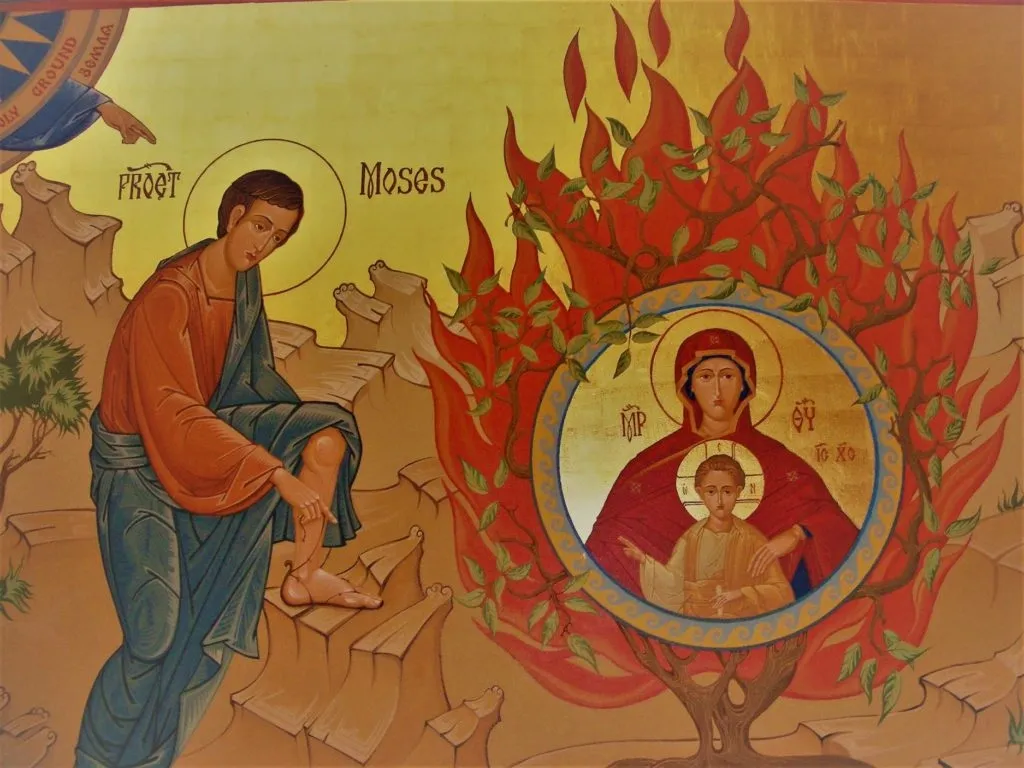
Image Source: Sarah Christmyer
The encounter of Moses with the burning bush presents one of the most striking prefigurations of Mary as the New Ark of the Covenant. As we read in the Book of Exodus, this mysterious vision has captivated the theological minds of the Church Fathers throughout centuries, revealing profound truths about the Blessed Virgin’s divine maternity.
i) Exodus 3 and divine presence
Moses discovered “a bush that is blazing with fire but is not consumed” on Mount Horeb. As he approached this marvel, the Almighty warned: “Do not come near; put off your shoes…for the place on which you are standing is holy ground” [4]. This divine fire represents the very glory of God—the same fire that would manifest on Mount Sinai (Exodus 19:18), above the Tabernacle (Exodus 40:38), through Elijah’s sacrifice (1 Kings 18:38), and at Pentecost (Acts 2:3) [4]. Throughout the Scriptures, fire symbolizes the manifest presence of God dwelling among His people.
ii) Mary bearing God without corruption
The central parallel becomes beautifully evident: just as the bush contained divine fire without being consumed, the Blessed Virgin Mary carried God Incarnate within her womb while remaining a virgin. Saint Gregory of Nyssa explained this mystery with these words: “What was prefigured at that time in the flame of the bush was openly manifested in the mystery of the Virgin… Just as on the mountain the bush burned but was not consumed, so also the Virgin gave birth to the light and was not corrupted” [4]. This typology affirms the Catholic doctrine that Mary remained intact—a virgin before, during, and after giving birth to Our Lord (see article on the Dogma of Mary’s Perpetual Virginity).
iii) Theotokos affirmed
The burning bush typology directly supports Mary’s ancient title “Theotokos” (God-bearer) (see article on the Dogma of Mother of God). Saint John of Damascus noted with reverence that “the virgin bore Fire within her, yet was not consumed, when she gave birth to the Benefactor Who brings us light” [5]. This title affirms Christ’s full divinity—the burning bush contained not merely any fire but God Himself. As the bush was “transfigured by the fire of the divine presence,” Mary was likewise transformed by bearing the Incarnate Word [6]. Orthodox iconography captures this profound connection by depicting the Mother of God with the Christ Child surrounded by the burning bush, visually proclaiming her as the vessel who contained the uncontainable God.
6) Mary as the Tower of David

i) Canticles 4:4
As we read in the Song of Songs, the beloved receives this praise: “Thy neck is as the tower of David, which is built with bulwarks” (4:4). Throughout the medieval period, theologians recognized this passage as referring to the Blessed Virgin Mary and her unique position in salvation history. Richard of St. Laurent, writing around 1250, interpreted this tower as representing Mary’s womb, which simultaneously provided life and protection to the infant Jesus [7]. This connection beautifully parallels the function of the Ark of the Covenant in safeguarding its sacred contents.
ii) Symbol of strength and purity
According to historical understanding, the Tower of David represented an impregnable fortress, symbolizing strength, beauty, and divine protection [8]. Saint Albert the Great, the renowned 13th-century German scholar and Doctor of the Church, expanded upon this understanding. He described Mary as the Tower of David insofar as she provides protection to all who seek refuge against temptation and spiritual danger [7]. Blessed John Henry Newman explained a remarkable aspect of Mary’s role as the Tower of David: her devotion serves as a defense of Christ Himself, since true devotion to Mary consistently reinforces truths about His divinity rather than diminishing them.
iii) Perpetual virginity
The imagery of the Tower powerfully reinforces the doctrine of Mary’s perpetual virginity. Just as an impenetrable fortress remains secure and inviolable, Mary remained “a virgin in conceiving her Son, a virgin in giving birth to him, a virgin in carrying him, a virgin in nursing him at her breast, always a virgin” [9]. This doctrine, held consistently by the early Church Fathers and affirmed throughout Catholic tradition, finds beautiful symbolic expression in the Tower of David title. The image of an enclosed, inviolable structure parallels Mary’s purity and virginity before, during, and after Christ’s birth, establishing her unique status as the New Ark who housed the divine presence without corruption.
7) Mary as the Enclosed Garden
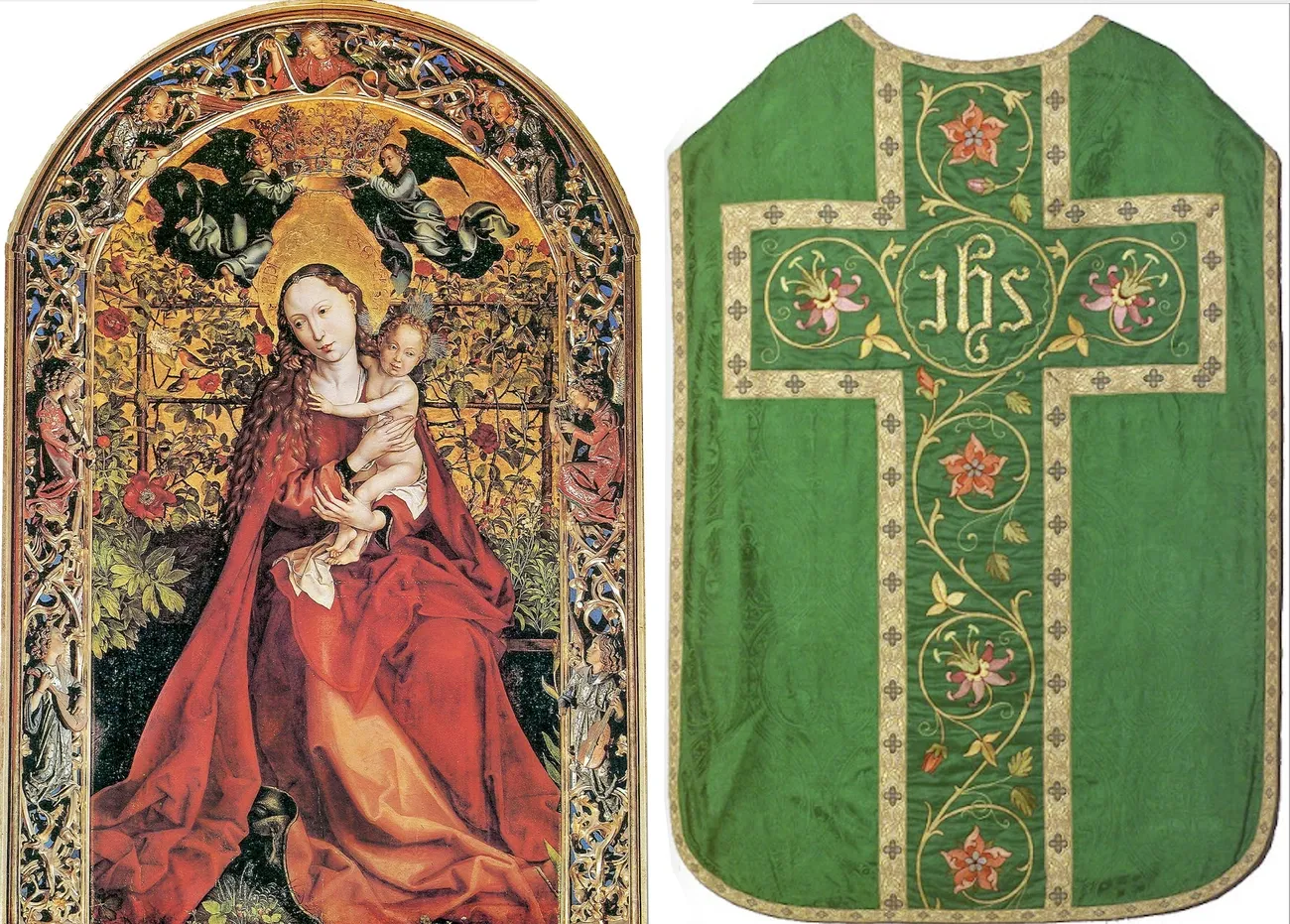
Image Source: Liturgical Arts Journal
The poetic imagery of the Song of Songs offers one of Scripture’s most beautiful symbols connecting Mary to her role as the New Ark of the Covenant. Through the metaphor of the enclosed garden, we discover profound theological truths about the Blessed Virgin’s unique place in salvation history.
i) Canticles 4:12
“My sister, my spouse, is a garden enclosed, a garden enclosed, a fountain sealed up” (Song of Songs 4:12). This passage from Canticles employs two parallel images—the enclosed garden and the sealed fountain—to represent something precious, protected, and set apart. Throughout Church history, this verse has been consistently applied to Mary’s virginity and purity. The Latin term hortus conclusus (enclosed garden) became specifically associated with Mary’s virginity and the mystery of the Incarnation [10]. This direct reference to the Song of Songs passage established a rich tradition of Marian symbolism [11].
ii) Symbol of inviolability
The enclosed garden represents complete protection from corruption. Just as a walled garden remains untouched by outside influences, the Blessed Virgin Mary remained free from the stain of sin. Saint Jerome expressed this connection beautifully: “In being closed and sealed, it bears resemblance to the Mother of the Lord, Virgin and Mother” [12]. This garden imagery joined other biblical symbols—Ezekiel’s closed gate and Moses’ burning bush—to express Mary’s unique sanctified status. Medieval art and literature frequently depicted Our Lady within enclosed garden settings, visually proclaiming her consecrated state [13].
iii) Typology of purity
The garden imagery reveals Mary’s perpetual virginity in its fullest sense—”virgin before, during, and after childbirth.” Ancient liturgical interpretations proclaimed: “Enclosed garden, sealed fountain… Virgo post partum, mater ante quam nupta” (Virgin after childbirth, mother before being married) [10].
This reveals how Mary’s virginity represents not merely physical integrity but the soul’s complete purity—untouched and prepared to receive the divine Logos [14]. The enclosed garden thus becomes the perfect dwelling place for God’s presence, making Mary truly the New Ark of the Covenant who contained the uncontainable God within her immaculate womb.
8) Mary as the Temple of God
Among the most profound connections between Mary and the New Ark of the Covenant, the parallel with Solomon’s Temple reveals how the Blessed Virgin became the literal dwelling place of the Most High. This sacred typology illuminates the theological significance of the Incarnation itself.
i) The Glory Cloud and the Annunciation
As we read in the First Book of Kings, when Solomon dedicated the Temple, “a cloud filled the house of the Lord” and “the glory of the Lord filled the house of the Lord” (1 Kings 8:10-11). This Shekinah glory represented God’s manifest presence dwelling among His chosen people.
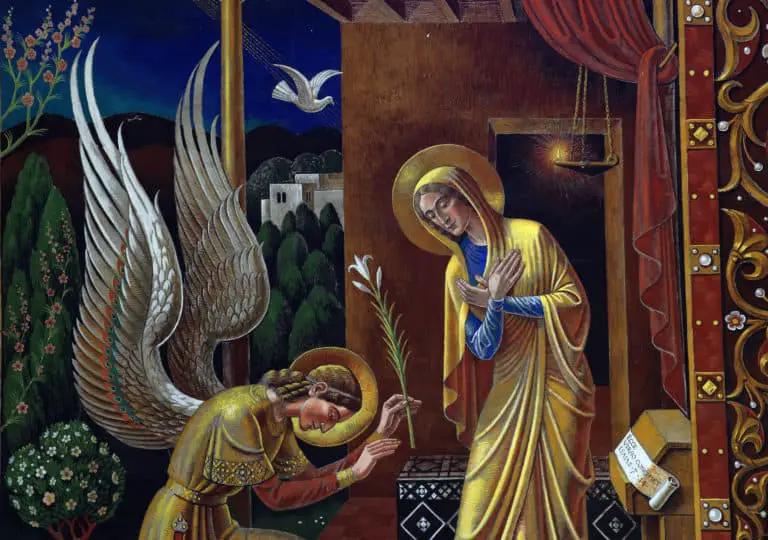
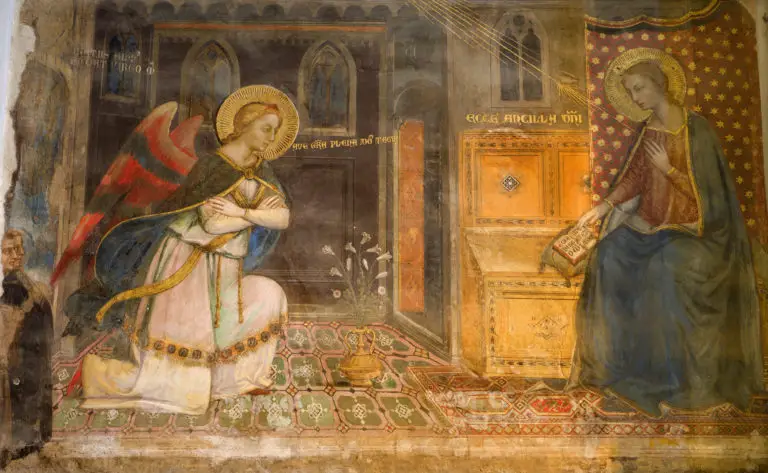
The parallel with Saint Luke’s account of the Annunciation cannot be overlooked. The Angel Gabriel announced to Mary: “The Holy Spirit shall come upon thee, and the power of the Most High shall overshadow thee” (Luke 1:35). The Greek word used for “overshadow” is the same term employed in the Septuagint to describe the cloud of God’s presence covering the Tabernacle that housed the Ark of the Covenant.
ii) Mary as the Living Temple
The Catechism of the Catholic Church affirms this connection: “Mary, in whom the Lord himself has just made his dwelling, is the daughter of Zion in person, the Ark of the Covenant, the place where the glory of God dwells” [15]. This teaching reveals how Mary’s role surpassed that of the Temple built by human hands.
While the Temple of Solomon contained the Ark with its symbolic contents, Mary carried within her womb the reality these symbols prefigured. The stone tablets represented God’s Law, yet Mary bore the living Word of God. The manna symbolized heavenly bread, but Mary carried the true Bread of Life. Aaron’s rod signified priestly authority, while Mary gave flesh to our eternal High Priest.
iii) The Perfect Dwelling Place
This typology demonstrates God’s providential plan for the Incarnation. As one theological source explains: “God wanted his words—inscribed on stone—housed in a perfect container covered with pure gold within and without. How much more would he want his Word—Jesus—to have a perfect dwelling place!” [15].
Mary thus becomes “the dwelling of God with men” [15] in the most literal sense possible. Unlike the Temple of Jerusalem, which would eventually be destroyed, Mary remains forever the sacred vessel who first housed the divine presence. Through her, God chose to dwell among His people not merely symbolically, but substantially—making her truly the New Ark of the New Covenant.
This reveals why the Catholic Church has always honored Mary’s unique role in salvation history, recognizing her as the living Temple who made the Incarnation possible.
9) Mary as the Seat of Wisdom
Much is revealed about the Blessed Virgin Mary through the wisdom literature of the Old Testament, where a mysterious feminine figure appears alongside God as mediator in creation. This divine Wisdom, personified as female throughout Sacred Scripture, provides profound insights into Mary’s role as the New Ark of the Covenant.
i) Wisdom literature and feminine imagery
The wisdom books consistently personify Wisdom as an allegorical female figure who guides the righteous to God. The Hebrew Chokhmah, Greek Sophia, and Latin Sapientia are all grammatically feminine, yet this personification extends far beyond mere linguistic convention. Throughout the Book of Proverbs, Wisdom declares in the feminine voice: “For he who finds me finds life and obtains favor from the Lord” (Proverbs 8:35). This feminine characterization creates a theological framework that finds its ultimate fulfillment in the person of Mary.
ii) Mary as vessel of divine wisdom
Since Mary carried Christ—whom Saint Paul identifies as “the power of God and the wisdom of God” (1 Corinthians 1:24)—she literally became the “Seat of Wisdom.” When the Christ Child rested upon Mary’s lap, her womb had served as the throne of divine Wisdom incarnate. Mary’s connection to wisdom flows from her “fullness of grace,” given in preparation for her unique calling as Theotokos (God-bearer). Her wisdom manifested itself in her consent to God’s plan, her pondering of the shepherds’ words (Luke 2:19), and her prompting of Jesus’ first miracle at Cana.
iii) Church tradition
Since the 11th century, the Church has honored Mary under the title “Seat of Wisdom” (Sedes Sapientiae). This title appears in the Litany of Loreto alongside “Virgin Most Prudent.” Religious art depicting Mary as Sedes Sapientiae consistently shows the Child Jesus seated upon her lap, typically on a throne, visually representing how she carried Wisdom itself. This imagery recalls Solomon’s great ivory throne (1 Kings 10:18-20), establishing yet another parallel between Mary and the Ark of the Covenant. Mary’s intimate union with Christ granted her wisdom that surpassed even Saint Joseph’s understanding, as Saint Luke suggests in his Gospel (Luke 2:50-51).
10) Sarah – Mother of Nations
Among the matriarchal figures of the Old Testament, Sarah presents a remarkable foreshadowing of Mary’s role as the New Ark of the Covenant. Through her miraculous motherhood and divine calling, Sarah establishes a pattern that would find its ultimate fulfillment in the Blessed Virgin Mary.
i) The Covenant Promise to Sarah
According to the Book of Genesis, God’s covenant with Sarah reveals her essential role in salvation history: “I will bless her, and moreover, I will give you a son by her. I will bless her, and she shall become nations; kings of peoples shall come from her” (Gen 17:16) [16]. This divine promise parallels the covenant made with Abraham, yet Sarah receives her own distinct calling. Just as Abraham would be “the father of a multitude of nations,” God simultaneously declared Sarah would be a “mother of nations” [17].
The name change from Sarai to Sarah connects directly to her destiny as mother of nations [16]. God used identical language for both Abraham and Sarah, promising that kings would come from each of them [18]. This establishes Sarah’s covenant significance alongside Abraham’s, demonstrating her unique place in God’s plan.
ii) Miraculous Conception and Birth
Sarah’s extraordinary motherhood occurred when she was 91 years old, despite her advanced age and initial doubt [19]. Her laughter at God’s promise transformed into joy when Isaac was born—”everyone who hears will laugh over me” (Gen 21:6) [18]. The Letter to the Hebrews praises Sarah’s ultimate faith: “By faith even Sarah herself, when she was unable to have children, received power to conceive offspring, even though she was past the age, since she considered that the One who had promised was faithful” [19].
Sarah’s miraculous motherhood, together with Elisabeth’s later-in-life conception, established a pattern of extraordinary births that would culminate in Mary’s virginal conception [20]. These supernatural interventions demonstrate God’s power to work beyond natural limitations when fulfilling His divine plan.
iii) Mary as the True Mother of Nations
How could Sarah be called “mother of nations” when she bore only one son? The answer lies in understanding that the “seed” promised to Abraham and Sarah refers initially to Isaac but ultimately to Jesus Christ [21]. As we read in Saint Paul’s Letter to the Galatians, Christ is the promised seed through whom all nations are blessed [22].
Mary recognized herself within this covenant lineage, acknowledging her pregnancy as “evidence of help given to Israel, in remembrance of his mercy, in line with the covenant kept with Abraham” (Luke 1:54–55) [18]. Through Christ, Mary becomes the mother of all believers, fulfilling Sarah’s prophetic role as “mother of nations” in the fullest spiritual sense [17].
Sarah’s role as a prototype of Mary demonstrates how God prepared the Old Testament figures to foreshadow the coming of the New Ark of the Covenant. Through Sarah’s faithful response to God’s promise, we see the pattern of divine motherhood that would reach its perfection in Mary’s “yes” to the Angel Gabriel.
11) Rebecca – The One Who Dresses the Son
The account of Rebecca in Genesis 27 provides a remarkable foreshadowing of Mary’s role in clothing the eternal Word with human flesh. This beautiful typology reveals yet another dimension of Mary’s identity as the New Ark of the Covenant.
i) Genesis 27
As we read in the Scriptures, Isaac had grown old and his eyes were dim. When he prepared to bless his firstborn son Esau, Rebecca overheard and immediately devised a plan to secure the blessing for Jacob instead [23]. She instructed Jacob: “Go to the flock and bring me two good young goats, so that I may prepare delicious food for your father” [23]. When Jacob expressed concern about his smooth skin compared to his brother’s hairiness, Rebecca’s solution was ingenious—she dressed Jacob in Esau’s clothing and covered his hands and neck with goatskins [23]. This act of clothing Jacob enabled him to receive the blessing that would fulfill God’s prophetic plan for the chosen lineage.
ii) Rebecca and Jacob
The relationship between Rebecca and Jacob mirrors the relationship between Mary and Christ in several profound ways. Jacob showed complete obedience to his mother’s guidance, remaining close to home and avoiding anything that might displease her [24]. According to the Rabbinical tradition, Rebecca possessed prophetic insight that enabled her to distinguish between the righteous Jacob and the wicked Esau [25]. Her prophetic understanding allowed her to orchestrate God’s plan, ensuring Jacob received the blessing that would establish the lineage leading to the Messiah. Jacob’s complete trust in Rebecca parallels humanity’s trust in Mary, as “he did not rely on his own ability; he relied solely on his mother’s care and protection” [24].
iii) Mary clothing Christ in flesh
Just as Rebecca clothed Jacob to make him acceptable to receive his father’s blessing, Mary clothed the eternal Word with human nature so that He might secure our redemption [26]. Rebecca dressed Jacob in garments that made him acceptable to Isaac; similarly, Mary provided Jesus with the “garment” of humanity that made salvation accessible to all mankind [27]. Saint Louis de Montfort recognized this beautiful parallel, noting that “Mary, who encourages us to take the inheritance of God the Father fulfills the foreshadowing of Rebecca clothing Jacob” [28]. Through Mary’s fiat, Christ received the flesh that allowed Him to become the perfect sacrifice, ultimately securing the Father’s blessing for all humanity. This shows how Mary, like the Ark of the Covenant, became the sacred vessel through which God’s salvific plan was accomplished.
12) Rachel – The Beautiful Mother
Rachel – the name itself means “female lamb” in Hebrew. This beautiful matriarch provides yet another prefiguration of Mary as the New Ark of the Covenant. As Jacob’s beloved wife who bore Joseph, Rachel establishes a maternal prototype that finds its ultimate fulfillment in Mary, the Mother of the Lamb of God.
i) The Story of Joseph in Genesis 37
The account of Joseph reveals striking parallels to Our Lord’s passion. Rachel’s firstborn son, beloved of his father Jacob, possessed prophetic dreams and wore a special coat of many colors. His brothers, consumed with jealousy, sold Joseph into slavery for twenty pieces of silver (Gen 37:28). This betrayal for silver foreshadows the thirty pieces paid to Judas for betraying Jesus (Mt 26:15) [26]. Both Joseph and Jesus began their public missions at approximately thirty years of age [29]. Much is remarkable in how both appeared to be “put to death” by their own people, yet both ultimately brought salvation to those who rejected them [29].
ii) Rachel’s Maternal Role
Rachel’s relationship with Joseph mirrors Mary’s with Jesus in profound ways. As Jacob’s most cherished wife, Rachel reflects Mary’s unique place in God’s plan of salvation. Rachel experienced great joy in bearing Joseph after years of barrenness, just as Mary experienced the incomparable joy of bearing the long-awaited Messiah after Israel’s centuries of expectation.
Rachel bore two sons – Joseph and Benjamin. At Calvary, Mary received a “second son” when Jesus entrusted John to her care, saying “Behold, your mother” [30]. At that moment of supreme sorrow, Mary became mother to all believers. This parallels how Rachel named her second son “Benoni” (son of my sorrow) as she died giving birth to him [30].
iii) The New Rachel and Her Son
Joseph saved his family from famine, prefiguring how Jesus would deliver humanity from spiritual starvation. Mary stands as the “New Rachel” – the woman who gave birth to the ultimate Savior [30]. Joseph was not recognized by his brothers when he appeared as governor of Egypt, just as Jesus was not recognized by His own people [29]. Yet both extended forgiveness to those who had sought their destruction [29].
This beautiful typology reinforces Mary’s essential role in salvation history. She is truly the vessel who carried the divine presence, making her the New Ark of the Covenant in the fullest sense.
13) Deborah and Judith – Women of Victory
Two remarkable heroines from the Old Testament offer powerful foreshadowing of Mary’s victory over evil as the New Ark of the Covenant. These courageous women demonstrate how God works through faithful vessels to accomplish His divine plan.
i) Judges 4 and Judith 8-15
The Book of Judges records how Deborah served as prophet, judge, and military leader during Israel’s oppression under the Canaanites. Following her army’s victory, the enemy general Sisera sought refuge in Jael’s tent. After offering him hospitality and shelter, Jael took a tent peg and hammer, driving it through Sisera’s temples while he slept. Deborah’s victory song proclaimed: “Blessed among women be Jael… she struck Sisera, crushed his head” (Judges 5:24-26).
The Book of Judith presents another heroic woman who delivered Israel from destruction. During the Assyrian siege, Judith—whose name means “Jewess”—entered the enemy camp and gained General Holofernes’ trust. After he became intoxicated at a banquet, Judith beheaded him with his own sword and returned triumphantly to her people. The magistrate Uzziah declared: “Blessed are you, daughter, by the Most High God, above all women on earth… who guided your blow at the head of our enemies” (Judith 13:18).
ii) Crushing the enemy’s head
Both accounts feature women delivering fatal blows to the heads of Israel’s enemies. This action directly fulfills the pattern established in Genesis 3:15, where God promised that the woman’s offspring would crush the serpent’s head. Each heroine receives the proclamation “blessed among women”—the identical greeting Saint Elizabeth would later address to Mary (Luke 1:42).
iii) Mary’s role in spiritual warfare
These Old Testament victories prefigure Mary’s decisive role in spiritual warfare. Mary’s “fiat” at the Annunciation delivered the crushing blow against Satan—not through physical violence, but by enabling the Incarnation of Christ who would ultimately defeat evil. As the New Eve, Mary’s obedience reversed the disobedience of the first Eve. Through her consent to bear the Savior, Mary became the greatest spiritual warrior against the enemy of souls, truly earning her title as the New Ark of the Covenant who carried our victory within her womb.
14) Esther – The Interceding Queen
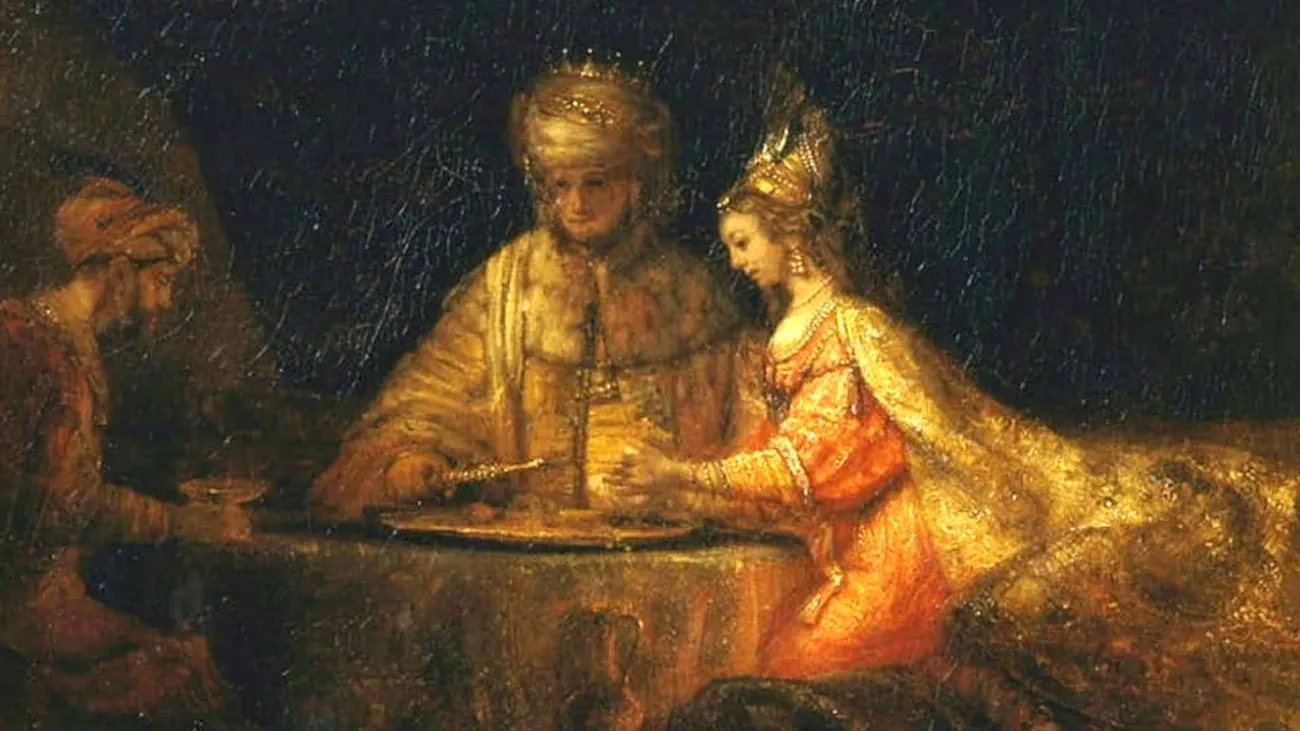
Throughout the Old Testament, few narratives present as dramatic a prefiguration of Mary’s intercessory role as the account of Queen Esther. This beautiful Jewish orphan, elevated to royal status in the Persian Empire, provides an extraordinary type of the Blessed Virgin’s queenship and maternal advocacy for humanity.
i) Esther 4-7
The Book of Esther recounts how a young Jewish maiden became Queen of the Persian Empire under King Ahasuerus (Xerxes I). Her true identity remained concealed until her people faced complete annihilation through the wicked decree orchestrated by Haman. When this crisis confronted the Jewish people, Esther embraced her destiny and prepared to intercede with the king.
Before approaching the throne, she called for spiritual preparation: “Go, gather all the Jews who are in Susa, and fast for me. Do not eat or drink for three days, night or day. I and my attendants will fast as you do” (Esther 4:16). This act of faith transformed her into a living image of prophetic intercession.
ii) Risking life for her people
Esther’s intervention demanded extraordinary courage. As she explained to Mordecai, “All the king’s provinces know that if any man or woman goes to the king inside the inner court without being called, there is but one law; all alike are to be put to death” (Esther 4:11). Her famous declaration of self-sacrifice followed: “If I perish, I perish” (4:16).
When she entered the throne room, the king extended his golden scepter, granting her life and accepting her petition. Through her mediation, the death decree was reversed and her people were delivered from destruction.
iii) Mary as Queen and Advocate
The Church Fathers recognized Esther as a typological figure of the Blessed Virgin Mary from the earliest centuries. Both queens intercede for their people before the throne of power. As King Ahasuerus granted Esther’s request because of his love for her, so too does the Almighty graciously hear Mary’s intercession on behalf of sinners who commend themselves to her care.
Mary’s queenship flows from her divine motherhood, and her advocacy for humanity forms part of the deposit of faith. As the New Ark of the Covenant, she carries the petitions of her spiritual children to Christ the King. Just as Solomon promised the Queen Mother Bathsheba, “I will never refuse you” (1 Kings 2:20), so too does Our Lord receive the intercession of His Mother with perfect love and acceptance.
This parallel shows how Mary’s role as advocate was prefigured in the Sacred Scriptures, demonstrating once again her unique position in the economy of salvation.
15) Revelation 12 – The Woman and the Dragon
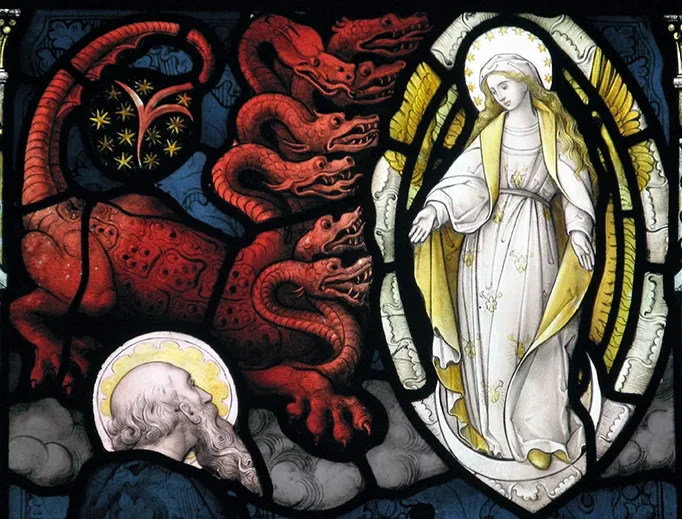
The final book of Sacred Scripture presents the most vivid biblical portrait connecting Mary to the Ark of the Covenant. This apocalyptic vision provides the culminating scriptural evidence for Mary as the vessel who carried God Himself.
i) Woman clothed with the sun
“A great portent appeared in heaven, a woman clothed with the sun, with the moon under her feet, and on her head a crown of twelve stars” (Revelation 12:1). The celestial imagery echoes Joseph’s prophetic dream recorded in Genesis 37:9, where sun, moon, and stars represented Jacob’s family [31]. The woman’s radiant appearance symbolizes divine glory surrounding her.
While some interpret this woman solely as representing Israel or the Church, the Catholic tradition recognizes multiple layers of meaning, including Mary herself [32]. Pope Benedict XVI affirmed this understanding: “The early Church had no difficulty recognizing in the Woman, on the other hand, Mary herself and, on the other hand, transcending time, the Church” [32].
ii) Child destined to rule all nations
This woman “brought forth a male child, one who is to rule all the nations with a rod of iron” (Revelation 12:5). The language directly references the Messianic prophecy from Psalm 2:8-9 [32]. The child being “caught up to God and to his throne” clearly points to Our Lord’s Ascension [33].
Even Protestant scholars like William Barclay acknowledge that identifying this woman as Mary is an “obvious” interpretation [34]. The timeline follows the historical reality: Christ’s birth, the dragon’s attempt to devour Him through Herod’s slaughter of the innocents, and His ascension to heaven [31].
iii) Mary as mother of the Church
The woman’s flight into the wilderness represents persecution against both Mary personally and the early Church collectively [35]. Mary embodies the people of God – first as Israel giving birth to the Messiah, then as the nascent Church. As Pope Francis affirmed, Mary stands as “mother of all believers” [31].
This cosmic battle where the woman triumphs connects directly to Genesis 3:15, completing the biblical arc from the first promise of salvation to its ultimate fulfillment in Christ through Mary. The Book of Revelation thus provides the final scriptural confirmation of Mary as the New Ark of the Covenant – the vessel chosen by God to carry divine presence into the world.
Scriptural Summary of Mary as the New Ark
Throughout our examination of Sacred Scripture, a consistent pattern emerges that establishes Mary’s identity as the New Ark of the Covenant. The following summary presents the scriptural evidence systematically arranged according to their primary references and theological significance:
Biblical Proof | Primary Reference | Key Symbolism/Connection | Theological Significance | Ark Connection |
Genesis 3:15 | Protoevangelium | Enmity between woman and serpent | Foreshadows Mary’s Immaculate Conception | Complete opposition to evil |
Isaiah 7:14 | Virgin birth prophecy | Virgin conceiving Emmanuel | Fulfillment in Luke’s Annunciation | Divine presence dwelling within |
Micah 5:2-3 | Birth in Bethlehem | Woman in travail without husband | Divine ruler’s birth through virgin | Vessel carrying divine presence |
Ark of Noah | Genesis 6-9 | Refuge from destruction | Protection from spiritual danger | Container of salvation |
Burning Bush | Exodus 3 | Divine fire without corruption | Virgin bearing God incarnate | Housing divine presence intact |
Tower of David | Canticles 4:4 | Impregnable fortress | Symbol of strength and protection | Safeguarding sacred contents |
Enclosed Garden | Canticles 4:12 | Hortus conclusus | Symbol of inviolability and purity | Protected, sacred space |
Temple of God | 1 Kings 8 | Cloud overshadowing | Dwelling place of divine presence | Housing God’s glory |
Seat of Wisdom | Wisdom Literature | Throne of divine wisdom | Bearer of Christ as Wisdom incarnate | Container of divine Word |
Sarah | Genesis 17:16 | Mother of nations | Miraculous motherhood | Vessel of covenant promise |
Rebecca | Genesis 27 | One who clothes the son | Enabler of divine blessing | Preparation for divine plan |
Rachel | Genesis 37 | Beautiful mother of savior | Mother of the beloved son | Bearer of salvation |
Deborah/Judith | Judges 4/Judith 8-15 | Victorious women | Crushing enemy’s head | Victory over evil |
Esther | Esther 4-7 | Interceding queen | Mediator for her people | Access to divine authority |
Revelation 12 | Apocalypse | Woman clothed with sun | Mother of Messiah and Church | Final biblical confirmation |
This systematic presentation reveals how the Old Testament consistently prefigures the Blessed Virgin Mary’s role as the vessel chosen to bear the Second Person of the Holy Trinity. From the earliest promise in Genesis to the apocalyptic vision in Revelation, Sacred Scripture presents Mary as the New Ark of the Covenant – the pure vessel who carried not symbols of God’s presence, but God Himself incarnate.
The Church Fathers recognized these connections as part of the deposit of faith, understanding that God’s providence arranged these typological relationships to illuminate the mystery of the Incarnation and Mary’s essential role in the economy of salvation.
As the Catholic Church teaches, Mary’s significance as the New Ark helps us understand why she holds such a special place in Christian tradition. She is venerated not as divine herself, but as the perfect created vessel chosen by God to bring divinity into humanity. Her “Fiat” at the Annunciation enabled the Incarnation, making her truly the New Ark who carried the Word made flesh.
These fifteen biblical proofs demonstrate that Mary’s identity as the New Ark of the Covenant rests firmly upon the foundation of Sacred Scripture, affirmed by the constant teaching of the Church from the earliest centuries to the present day.
God be with you.
References
[1] – https://aleteia.org/2018/12/22/why-we-call-mary-an-ark/
[2] – https://thepocketscroll.wordpress.com/2011/04/12/noahs-ark-the-annunciation-of-the-bvm/
[3] – https://themarianroom.com/the-blessed-virgin-mary-refuge-of-sinners/
[4] – https://stpaulcenter.com/posts/the-burning-bush-theotokos-in-the-old-testament?srsltid=AfmBOooS0UwC285ENx-BWexqLh2Yx2Tzfx3W2bC8v0MrtN40xVhfdM51
[5] – https://scapularap.com/blog/mary-in-the-old-testament-part-2
[6] – https://frted.wordpress.com/2023/08/15/the-burning-bush-and-the-theotokos/
[7] – https://catholiclife.diolc.org/2020/12/11/advent-and-the-tower-of-david/
[8] – https://www.facebook.com/StJohnGreenacre/videos/the-tower-of-david-the-tower-of-david-stands-as-a-symbol-of-strength-beauty-and-/892370926287454/
[9] – https://www.ncregister.com/blog/biblical-evidence-for-the-perpetual-virginity-of-mary
[10] – https://www.mdpi.com/2077-1444/15/2/143
[11] – http://www.artandobject.com/articles/seclusion-sin-and-sanctity-virgin-marys-enclosed-gardens
[12] – https://sspx.au/en/enclosed-garden-marys-perpetual-virginity-34139
[13] – https://www.shmoop.com/study-guides/decameron/hortus-conclusus-symbol.html
[14] – https://mlivermore.substack.com/p/the-moment-in-the-rose-garden
[15] – https://www.catholic.com/magazine/print-edition/mary-the-ark-of-the-new-covenant
[16] – https://www.bibleref.com/Genesis/17/Genesis-17-16.html
[17] – https://corechristianity.com/resources/articles/sarah-mother-of-the-promise
[18] – https://www.knowableword.com/2016/12/12/mary-and-sarah-a-study-in-contrasts/
[19] – https://therubyblossom.com/2020/09/15/lesson-on-motherhood-from-the-bible-series-sarah-a-mom-who-believed-the-impossible/
[20] – https://amazingcatechists.com/2010/12/miraculous-mothers/
[21] – https://influencemagazine.com/Practice/The-Story-of-Scripture-in-Four-Moms
[22] – https://bibleengagementproject.com/en/Blog/Studying-the-Bible/The-Story-of-Scripture-in-Four-Moms
[23] – https://www.christianity.com/wiki/people/who-was-rebecca-in-the-bible.html
[24] – https://reconquest.heralds.org/lesson/lesson-23-biblical-figure-of-this-devotion-rebecca-and-jacob-true-devotion-183-200/
[25] – https://jwa.org/encyclopedia/article/rebekah-midrash-and-aggadah
[26] – https://www.motherofallpeoples.com/mary-in-the-old-testament
[27] – https://media.ascensionpress.com/2020/05/11/what-many-people-miss-about-jacobs-stolen-blessing/
[28] – https://tomperna.org/2013/09/23/mondays-with-mary-mary-in-the-old-testament-part-1/
[29] – https://dtjsoft.com/joseph-a-type-of-christ/
[30] – https://www.divineuk.org/articles/transcribed-talks-on-mother-mary-mother-mary-the-new-rachel-fr-joseph-edattu-vc/
[31] – https://en.wikipedia.org/wiki/Woman_of_the_Apocalypse
[32] – https://www.ncregister.com/blog/revelation-12-who-is-the-woman-clothed-with-the-sun
[33] – https://www.bibleref.com/Revelation/12/Revelation-12-5.html
[34] – https://www.catholic.com/magazine/online-edition/is-mary-the-woman-in-revelation-12
[35] – https://www.godwhospeaks.uk/sun-moon-and-stars-the-role-of-mary-in-the-book-of-revelation/