The Real Story Behind the Two Thieves Crucified with Jesus – Beyond the Gospel
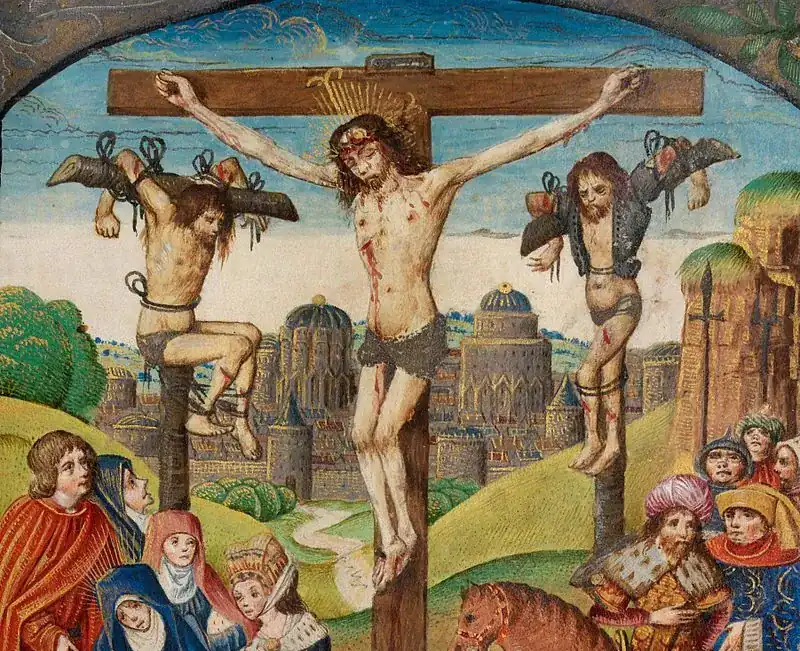
Who were the two men crucified alongside Our Lord Jesus Christ on that fateful day at Calvary? The Holy Scriptures provide us with their final moments, yet remain silent on their names. According to the apocryphal “Gospel of Nicodemus,” written in the 4th century, these men were called Dismas and Gestas.
As we read in the Scriptures, the Evangelists reveal a striking contrast between these two figures. The one we know as Dismas – recognized as a saint in the Roman Catholic Church with his feast day celebrated on March 25th – humbly asked Our Lord to remember him in paradise. Gestas, on the other hand, mocked Jesus and demanded a miracle for his salvation. This profound difference in their final moments provides us with powerful insights into repentance, mercy, and the nature of salvation itself.
These two men were part of a trio of criminals sentenced to death during that Passover week. Barabbas, as we know from the Gospel accounts, was pardoned and released to the crowds, while Dismas and Gestas were crucified alongside Our Savior on Golgotha.
The story of these two thieves offers us much more than their brief mention in the canonical Gospels might suggest. Through both biblical accounts and the rich tradition that has developed over centuries, we can explore how these unnamed figures in Scripture became important symbols in Catholic tradition. Much is to be learned from their contrasting responses to Christ, and I would highly recommend reflecting on their example as we consider our own response to Our Lord’s call to salvation.
The Final Hours: What Happened on the Cross?
The Holy Scriptures reveal to us a scene of profound significance at Calvary during Our Lord’s final hours. The biblical narrative presents Jesus crucified between two criminals, creating what must be considered one of the most theologically rich moments in Christian history. This seemingly simple detail carries profound meaning that continues to instruct the faithful today.
Who else was crucified with Jesus?
What does Scripture tell us about those who shared in Christ’s suffering that day? The Roman authorities crucified two criminals alongside Our Lord, and this was no mere coincidence. As we read in the prophecy of Isaiah 53:12, “He was numbered with the transgressors.” Our Lord Himself had foretold this fulfillment in Luke 22:37, declaring, “For I say to you that this which is written must still be accomplished in Me: ‘And He was numbered with the transgressors'” [3].
The Gospel accounts provide clear testimony that these two men were criminals deserving of their punishment. St. Luke describes them as “malefactors” or “evildoers,” indicating they were lawbreakers who had received their just sentence [11]. St. Matthew and St. Mark specifically refer to them as “thieves” or “robbers,” suggesting they had committed crimes against property or possibly violent robbery [11]. These were not innocent men caught in an unjust system—they were receiving, as one of them would later acknowledge, “the due reward of their deeds” [3].
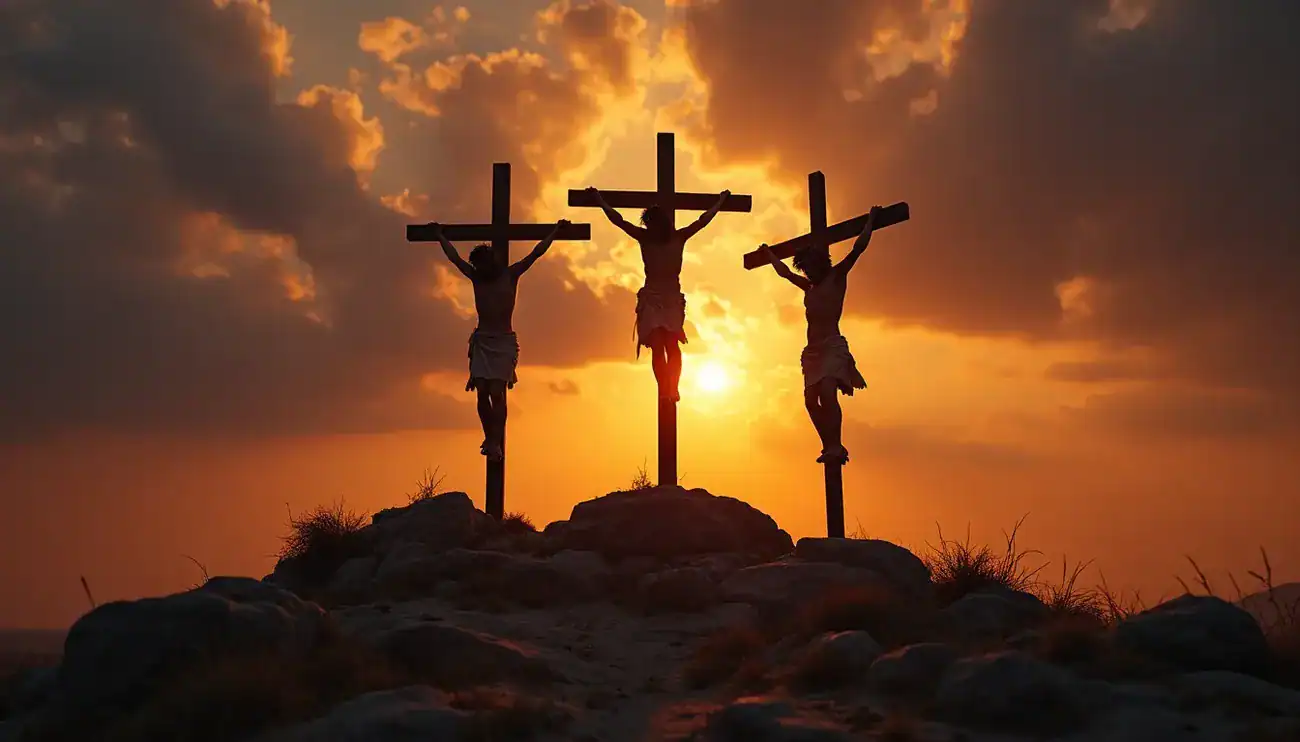
The physical arrangement of the three crosses holds particular symbolic importance. According to St. Luke 23:33, Jesus was positioned in the center, with “one on his right, the other on his left” [3]. This central placement manifested physically Our Lord’s role as mediator between God and humanity, even in His suffering. The positioning creates a powerful representation—Christ between two sinners, one who would embrace salvation and one who would reject it.
The apocryphal “Book of Nicodemus” provides names for these two men, though these names do not appear in the canonical Gospels. The criminal positioned on Jesus’ right was called Dismas (meaning “death” or “sunset” in Greek), and the one on His left was Gestas (meaning “to complain” or “to moan” in Greek) [3]. Despite their absence from Scripture, these names have been widely accepted in Christian tradition.
These two men represented far more than additional victims of Roman brutality. As one biblical scholar observes, they serve as “two types of all men” [3]. Since all have sinned and all must die, yet some are saved, these thieves illustrate the fundamental human choice regarding salvation—acceptance or rejection of Christ’s offer of redemption.
What conversation took place during those final hours on Calvary between Jesus and the thieves?
As Jesus hung on the cross, enduring unimaginable physical and spiritual torment, a remarkable exchange unfolded among the three crucified men. This dialogue reveals starkly different responses to suffering and to the Person of Christ.
Initially, both criminals joined the crowd in mocking Jesus. St. Matthew 27:44 and St. Mark 15:32 tell us that both “began their time on the cross by mocking and blaspheming Him,” participating in the widespread ridicule directed at Our Lord [3]. Yet something extraordinary occurred in the heart of one of these men, leading to a dramatic transformation in his attitude.
The first thief continued his verbal assault on Jesus. St. Luke’s Gospel records his taunting words: “Aren’t you the Messiah? Save yourself and us!” [3]. This challenge dripped with sarcasm and ridicule. The thief’s demand revealed his complete misunderstanding of Jesus’ mission. He wanted physical deliverance from suffering rather than spiritual salvation from sin [11]. His words echoed the same challenge that Satan had presented to Jesus in the wilderness: use your power for immediate relief rather than fulfilling your higher purpose.
The second thief, however, underwent a profound transformation. After initially joining in the mockery, he experienced a change of heart—perhaps after witnessing Jesus’ dignity in suffering or hearing Jesus pray for His executioners [3]. This man began to perceive something in Jesus that others missed. What Pope Francis described as “a wonderful example of repentance” followed, as the second thief rebuked his fellow criminal [11].
His rebuke contained several crucial elements:
- A call to fear God: “Don’t you fear God, since you are under the same sentence of condemnation?” [3]
- An acknowledgment of their guilt: “We are punished justly, for we are getting what our deeds deserve” [3]
- A recognition of Jesus’ innocence: “But this man has done nothing wrong” [3]
This exchange demonstrates a remarkable spiritual awakening. The good thief recognized both his own sinfulness and Jesus’ sinlessness—fundamental prerequisites for salvation. As one commentator puts it, “What a stunning transformation. The thief no longer mocked Jesus, now he defended Him” [3].
The contrasting responses of these two men perfectly illustrate humanity’s reaction to Christ. The first thief demanded that Jesus prove Himself by changing their circumstances. The second thief, despite facing identical suffering, saw beyond his immediate pain to recognize Jesus’ identity and authority.
What extraordinary request did the repentant thief make?
Following his defense of Jesus, he made a plea that revealed remarkable faith. Turning to Jesus, he said, “Jesus, remember me when you come into your kingdom” [3]. These simple words contain theological insights that surpass what even Jesus’ closest disciples understood at that moment.
Consider the profound elements of this request:
The thief addressed Jesus by name, indicating personal recognition of His identity. As Pope Francis observed, “He calls him by name, ‘Jesus,’ with confidence, and thus confesses what that name means: ‘the Lord saves'” [11].
His request demonstrated surprising spiritual perception. By asking to be remembered “when you come into your kingdom,” the thief showed that he believed:
- Jesus was truly a king with a genuine kingdom [3]
- Jesus would survive death and enter this kingdom [3]
- Jesus had the authority to determine who would join Him there [3]
This represents astounding faith considering the circumstances. As one biblical scholar notes, “The thief believed that Jesus was a king with a real kingdom” [3]. This faith is remarkable given that Jesus’ closest disciples had fled, and the evidence before the thief’s eyes suggested Jesus was merely another failed messiah dying an ignoble death.
The repentant thief’s plea came from utter humility. He didn’t ask for a place of honor or special treatment. He simply asked to be remembered. This reflects a fundamental understanding that salvation comes through grace rather than merit.
What makes this plea particularly powerful is the thief’s situation. He had no opportunity to be baptized, receive communion, perform good works, or join a religious community [11]. All he could offer was his confession of faith in his final hours.
How did Our Lord respond to this dying man’s plea?
Despite His own excruciating suffering, Jesus responded to the repentant thief with extraordinary compassion. His words—”Truly I tell you, today you will be with me in paradise” [3]—contain profound theological significance that has been studied by Christians for centuries.
Jesus prefaced His promise with “Truly I tell you”. This phrase appears 76 times in the New Testament, always on Jesus’ lips and never used by anyone else [3]. It serves as a solemn affirmation, signaling that what follows deserves special attention.
The promise itself contains several remarkable elements:
First, Jesus promised immediate fellowship: “today you will be with me” [26]. This contradicts notions of “soul sleep” or an extended waiting period after death [26]. Rather, it suggests an immediate transition to spiritual presence with Christ.
Second, Jesus spoke of “paradise,” a term rich with meaning. Throughout the Scriptures, paradise refers to a place of blessedness and rest, often associated with the Garden of Eden or the heavenly realm [26]. Jesus offered not just forgiveness but restoration to the ideal relationship with God that humans were created to enjoy.
Third, Jesus emphasized personal presence: “you will be with me” [26]. The greatest reward of paradise isn’t freedom from suffering—it’s intimate fellowship with Christ Himself.
Jesus’ promise to the thief reveals several important truths:
- Salvation can occur even at life’s end for those who genuinely repent and believe [22]
- Entry into paradise depends on Christ’s grace rather than human merit [11]
- Death for believers means immediate fellowship with Christ [26]
- Jesus’ authority extends beyond physical death into the spiritual realm [25]
What makes this exchange particularly moving is that it occurred during Jesus’ greatest suffering. As one commentator notes, “It is remarkable that, while in the excruciating and mind-numbing torment of the cross, the Son of Man had the heart, mind, and will to pray for others” [22].
The story of the repentant thief provides tremendous hope for all believers. If Jesus could save this criminal in his final moments, no one is beyond the reach of divine grace. As one biblical scholar observes, “What we learn from the saved thief on the cross is that we are all sinners in need of a Savior, and no matter the number of our sins… it is never too late to repent and accept the free gift of salvation” [22].
The contrast between the two thieves presents a powerful picture of human response to Christ. One man demanded proof and immediate relief, clinging to his pride even in death. The other acknowledged his guilt, recognized Jesus’ innocence and authority, and humbly requested mercy.
This narrative reminds us that no matter our past or present circumstances, Christ offers the same hope to us that He extended to a dying thief: “Today you will be with me in paradise.”
The Tradition Beyond Scripture: Stories of Dismas and Gestas
“The very cross was the tribunal of Christ; for the Judge was placed in the middle; one thief, who believed, was set free; the other, who reviled, was condemned; which signified what he was already about to do with the quick and dead; being about to set some on his right hand, but ethers on his left.” — Augustine, Early Christian theologian and philosopher
“The very cross was the tribunal of Christ; for the Judge was placed in the middle; one thief, who believed, was set free; the other, who reviled, was condemned; which signified what he was already about to do with the quick and dead; being about to set some on his right hand, but ethers on his left.” — Augustine, Early Christian theologian and philosopher
Much is unknown of these two men beyond their final moments recorded in the canonical Gospels. However, a rich tradition of legends, apocryphal texts, and religious accounts has developed around Dismas and Gestas throughout the centuries. These stories, while not part of biblical Scripture, have profoundly influenced Christian art, literature, and devotion. The Catholic Church, in her wisdom, has preserved these traditions as part of the deposit of faith, even as she distinguishes them from the inspired Word of God.
What do the names “Dismas” and “Gestas” mean?
The names “Dismas” and “Gestas” first appear in the apocryphal Gospel of Nicodemus, written in the 4th century [6]. The canonical Gospels, as we have seen, leave these men unnamed, focusing instead on their spiritual condition and response to Our Lord.
According to various Christian traditions, these men are known by different names across different regions:
- Dismas is alternatively called Titus, Rakh, or Demas [2]
- Gestas is sometimes known as Gesmas, Dumachus, or Dumach [2]
What does the etymology of these names reveal? “Dismas” derives from the Greek word meaning “sunset” or “death,” a fitting designation for a man who found redemption at the end of his life [4]. “Gestas,” meanwhile, appears to come from a Greek word meaning “to complain” or “to moan,” reflecting his unrepentant attitude on the cross [4].
Some traditions suggest that the criminality of these men extended beyond their own generation—their parents also led lives of banditry and “worked” side by side [2]. This hereditary pattern of sin creates an even more dramatic backdrop for Dismas’s conversion, showing that God’s grace can overcome not merely personal sin but a family legacy of wrongdoing.
The Holy Family’s Encounter with the Future Thieves
Among the most cherished traditions is an account of how the Holy Family encountered these future thieves years before the Crucifixion. According to this tradition, when Dismas was born, his mother could not nurse him due to illness [2]. Divine Providence would arrange that when Dismas was still an infant, the Holy Family was fleeing to Egypt to escape King Herod’s massacre of the Holy Innocents.
The tradition tells us that they came upon the robbers’ den where infant Dismas lived [2]. The Most Blessed Virgin Mary, in an act of extraordinary charity, nursed the infant Dismas for several days, thereby saving his life [2]. This account creates a beautiful connection between Our Lady’s nurturing of the infant thief and Our Lord’s later salvation of the adult criminal.
The “Arabic Infancy Gospel” provides a slightly different account. According to this text, the Holy Family was traveling through the desert toward Egypt when they encountered a band of robbers led by Gestas and a young Dismas [7]. Despite the Holy Family’s humble appearance, the robbers were astonished to discover the expensive gifts of gold, frankincense, and myrrh—the presents from the Magi—among their possessions [7].
What happened next reveals the workings of Divine Grace. Dismas was deeply moved by the infant Jesus and prevented the robbery by offering payment to Gestas [7]. As the Holy Family departed, young Dismas reportedly spoke words that would echo his future plea on the cross: “Remember me, wherever you are!” [27]
Another version of this tradition describes how the robber chief noticed something extraordinary about the infant Jesus. His heart was touched by the Divine Presence, and he ordered his men not to harm the travelers [27]. He then invited the Holy Family into his dwelling, where his wife provided food and comfort. The tradition further relates that the robber’s wife used the water from the Child Jesus’s bath to wash her leprous son—presumably the future good thief—and the child was miraculously healed [27].
These accounts, while apocryphal, demonstrate the Catholic understanding that God’s Providence works even through seemingly chance encounters. Just as Mary saved Dismas’s physical life in infancy, Jesus would later save his eternal soul at Calvary.
What was the Nature of Their Crimes?
The apocryphal “Infancy Gospel” offers yet another account of the thieves as adult bandits [2]. According to this text, while their companions rested after a robbery, Dismas and Gestas spotted Jesus and the Virgin Mary. Gestas wanted to alert the others, but Dismas persuaded him against it and even paid him to leave the travelers alone [2]. This text relates that Jesus then prophesied their future crucifixion at Golgotha and the forgiveness that awaited Dismas [2].
What manner of criminals were these men? Contemporary scholarship suggests they were likely not simple thieves as modern translations might indicate. They were probably bandits or highwaymen [8]. The Roman punishment of crucifixion was typically reserved for serious offenders, not merely petty thieves [4]. As one scholar notes: “Crucifixion was actually quite a rare punishment in Rome; thieves usually had to repay what they stole along with added fines” [4].
These men would be better understood as brigands or revolutionaries—potentially part of groups opposing Roman rule [8]. The Greek word used in the Gospel accounts is “λῃσταὶ” (léstés), meaning “brigand” or “robber” rather than simple thief [8]. Some translations of Matthew 27:44 even render the passage as: “Even the revolutionaries who were crucified with [Jesus] ridiculed him in the same way” [9].
Banditry was endemic throughout the Roman Empire, and the Roman state viewed highway robbery as sufficiently dangerous to warrant crucifixion [8]. As one historian observes, “the three most common causes of death were old age, sickness, and attacks by bandits” [8]. This context helps us understand why these men faced such severe punishment.
Some scholars have suggested that Dismas may have been something of a “Robin Hood” figure—a bandit with a noble cause, similar to the ancient Roman character Bulla Felix [4]. This interpretation adds depth to our understanding of Dismas, suggesting his crimes might have had some justification in the context of Roman oppression.
What became of Dismas after his death?
The apocryphal “Gospel of Nicodemus” provides an answer that aligns with Catholic teaching [2]. According to this text, Dismas indeed entered Paradise and was among the very first to do so [2]. The narrative describes how Christ descended into the Limbo of the Just after His death and subsequently led freed souls to Paradise [2]. There, the prophet Elijah and Enoch were already present, as was the repentant thief Dismas.
The word “Paradise” that Our Lord used when speaking to Dismas carries special significance. It comes from the Persian word “Paradeisos” and appears only three times in the New Testament [7]. The first instance is Jesus’s promise to Dismas in Luke 23:43. The second is in St. Paul’s description of his mystical experience in 2 Corinthians 12:3. The third is in the Book of Revelation (2:7), describing the heavenly paradise awaiting the righteous [7].
According to the Old Testament, this word appears primarily in descriptions of the Garden of Eden and in prophecies about a future restoration of Eden-like conditions [7]. Our Lord’s promise to Dismas was essentially offering him a return to the spiritual Eden—a restoration of the perfect communion with God that existed before the Fall [7].
This immediate entry into paradise aligns with Catholic teaching about “baptism of desire” and “baptism of blood” [10]. The Church teaches that while sacraments like baptism are normally necessary for salvation, God is not bound by these sacraments [11]. Baptism of desire applies to unbaptized people who die with faith in Christ but were unable to be baptized [10]. Baptism of blood refers to the application of baptismal grace through martyrdom [10].
Some theologians have suggested that Dismas, having been crucified on Jesus’s right side, would have been sprinkled with the blood and water that flowed from Christ’s pierced side [10]. Since the Church has traditionally viewed this blood and water as symbolizing the sacraments of baptism and Eucharist, this physical contact might have constituted a literal baptism of blood for Dismas [10].
Saint Dismas in Catholic Tradition
The Catholic Church formally recognizes Dismas as Saint Dismas [1]. He is considered a saint by virtue of Our Lord’s words promising him paradise [1]. His feast day is celebrated on March 25, which traditionally coincides with the Feast of the Annunciation [12]. This date was chosen because early Christians believed March 25 was the actual calendar date of the Crucifixion [13].
Saint Dismas holds several patronages in Catholic tradition:
- Condemned prisoners [28]
- Reformed thieves [28]
- Undertakers [28]
- Those seeking repentance [12]
His story has inspired concrete manifestations of faith. There are several towns named after him, including San Dimas, California [14]. Numerous churches bear his name as well, including St. Dismas Church in Waukegan, Illinois [1], the Church of the Good Thief in Kingston, Ontario (built by convicts at a nearby penitentiary), and the Church of St. Dismas at the Clinton Correctional Facility in Dannemora, New York [14].
According to the Eastern Orthodox tradition, Dismas is commemorated on Good Friday along with the Crucifixion [14]. The Synaxarion offers this poetic couplet in his honor: “Eden’s locked gates the Thief has opened wide, By putting in the key, ‘Remember me'” [14]. Orthodox Christians also honor him in a traditional prayer said before receiving the Eucharist: “I will not speak of Thy Mystery to Thine enemies, neither like Judas will I give Thee a kiss; but like the thief will I confess Thee: Remember me, O Lord in Thy Kingdom” [14].
One of the most beautiful Orthodox hymns of Good Friday is titled “The Good Thief” or “The Wise Thief” (in Church Slavonic: “Razboinika blagorazumnago”) [14]. This composition forms one of the highlights of the Russian Orthodox Church’s Good Friday services [14].
Gestas, the unrepentant thief, has received far less attention in Christian tradition. Nevertheless, his negative example serves as a powerful counterpoint to Dismas’s faith. Together, they represent the two possible responses to Christ—acceptance or rejection.
The Enduring Witness of the Two Thieves
Throughout our exploration of these two men crucified alongside Our Lord, we have uncovered a story far richer than their brief mention in the canonical Gospels might suggest. Dismas and Gestas, though unnamed in Scripture, have become powerful witnesses to humanity’s fundamental choice regarding salvation.
As the Church teaches, their contrasting responses reveal the essence of Christian faith. Dismas, despite his criminal past, found redemption through simple faith and humble acknowledgment of his sins. Gestas, conversely, rejected the very salvation hanging beside him. This stark contrast serves as a timeless representation of the two paths available to all humanity.
The theological implications of this encounter remain profound. Our Lord’s promise to Dismas—”Today you will be with me in paradise”—demonstrates God’s infinite mercy. This promise shows that salvation depends not on religious ceremonies, good works, or lengthy devotion, but on genuine faith and repentance. Dismas had no opportunity for baptism or church membership, yet Jesus declared his faith sufficient.
According to the prophet Isaiah, the Messiah would make “intercession for the transgressors,” and this was perfectly fulfilled at Calvary. Even while experiencing unimaginable suffering, Our Lord continued His ministry of reconciliation, bringing a condemned criminal into fellowship with God.
Much has developed in Christian tradition around these figures. The apocryphal accounts, legends about their childhood encounters with the Holy Family, and their place in sacred art demonstrate how deeply this story has penetrated Christian imagination. Saint Dismas achieved sainthood and patronage of prisoners and those seeking repentance. His feast day on March 25th and the churches bearing his name stand as testaments to his enduring legacy.
The lasting appeal of this narrative lies in its universal application. We all face the same fundamental choice presented to Dismas and Gestas—whether to recognize our need for salvation and turn to Christ in faith, or to remain prideful and reject divine mercy. Their contrasting responses at Calvary provide a powerful examination of our own spiritual journeys.
This seemingly simple Gospel account has become one of Christianity’s most meaningful narratives. The story reminds us that regardless of our past circumstances, Christ offers the same hope He extended to a dying thief. As the Church has always taught, no one is beyond the reach of divine grace.
For those seeking to deepen their understanding of this remarkable story, I highly recommend meditation on the Sorrowful Mysteries of the Rosary, particularly the Fifth Sorrowful Mystery – the Crucifixion. The writings of the Church Fathers, especially Saint Augustine’s reflections on the two thieves, provide great insight into the theological significance of their witness.
Praise God for His infinite Mercy and Justice, shown even in humanity’s darkest hour.
FAQs
Q1. Who were the two thieves crucified with Jesus? The two men crucified alongside Jesus are traditionally known as Dismas and Gestas. While not named in the Bible, these names come from later Christian tradition. Dismas is considered the “good thief” who asked Jesus to remember him, while Gestas is the unrepentant thief.
Q2. What happened to the thieves during the crucifixion? Initially, both thieves mocked Jesus. However, one of them (Dismas) had a change of heart. He rebuked the other thief, acknowledged his own guilt, recognized Jesus’ innocence, and asked Jesus to remember him. Jesus promised this repentant thief that he would be with Him in paradise that day.
Q3. How does the Catholic Church view Dismas? The Catholic Church recognizes Dismas as Saint Dismas. He is considered the patron saint of condemned prisoners, reformed thieves, and those seeking repentance. His feast day is celebrated on March 25th, coinciding with the traditional date of the crucifixion.
Q4. Are there any legends about Dismas and Gestas beyond the Bible? Yes, various apocryphal texts and legends have developed around these figures. One popular story suggests that the Holy Family encountered Dismas and Gestas as infants or young men during their flight to Egypt. These legends often create a meaningful connection between Mary’s compassion for the young Dismas and Jesus’ later salvation of him on the cross.
Q5. What is the significance of the two thieves in Christian teaching? The contrasting responses of Dismas and Gestas to Jesus represent the two possible human reactions to Christ – acceptance or rejection. Their story illustrates that salvation depends on genuine faith and repentance rather than past deeds or religious ceremonies. It also demonstrates that redemption is possible even in life’s final moments.
References
[1] – https://hermeneutics.stackexchange.com/questions/22029/in-matthew-2738-why-were-there-two-thieves-crucified-with-jesus
[2] – https://brownbible.com/index.php/en-us/newsletter/truth-versus-tradition/104-truth-versus-tradition-who-was-crucified-with-jesus
[3] – https://www.bible.com/bible/compare/LUK.23.39-43
[4] – https://www.pureflix.com/insider/thief-on-the-cross
[5] – https://www.artzabox.com/a/blog/bible-stories/who-was-crucified-next-to-jesus?srsltid=AfmBOooOToofMIGBU5qRT2f3fMGu-t77NPYWF2DJu7gVzTiHUVf76qxn
[6] – https://www.gotquestions.org/thief-on-the-cross.html
[7] – https://www.desiringgod.org/articles/jesus-between-the-criminals
[8] – https://www.vatican.va/content/francesco/en/audiences/2016/documents/papa-francesco_20160928_udienza-generale.html
[9] – https://openthebible.org/article/the-story-of-the-thief-on-the-cross-and-what-it-means-for-us/
[10] – https://www.catholic.com/magazine/online-edition/the-good-thief-and-salvation-by-faith-alone
[11] – https://biblehub.com/luke/23-43.htm
[12] – https://www.gotquestions.org/today-paradise.html
[13] – https://www.gotquestions.org/Dismas-and-Gestas.html
[14] – https://medium.com/@ancient.rome/dismas-and-gestas-who-were-the-thieves-crucified-with-christ-8aa66c94477d
[15] – https://www.artzabox.com/a/blog/bible-stories/who-was-crucified-next-to-jesus?srsltid=AfmBOop7Uda5whEf7Mji7HMTKAXpfQCdjOkEYizGzrMJN6lPqXe3EDUM
[16] – https://beyondthesestonewalls.com/posts/dismas-crucified-to-the-right-paradise-lost-and-found
[17] – https://www.ourcatholicprayers.com/A-tale-of-two-thieves.html
[18] – https://reynolds-news.com/2018/06/13/dimas-and-gestas-bandits-crucified-with-christ/
[19] – https://www.commonwealmagazine.org/revolution-passion
[20] – https://dwightlongenecker.com/the-salvation-of-st-dismas-the-good-thief/
[21] – https://connection.newmanministry.com/saint/saint-dismas/
[22] – https://faith.nd.edu/saint/st-dismas-the-good-thief/
[23] – https://www.catholicvoice.org.au/who-was-the-good-thief-and-why-is-he-a-saint/
[24] – https://www.smp.org/resourcecenter/resource/7524/?srsltid=AfmBOopP-ZAYG5d1t6yZzY82sT60bvrOHuEPkOT3alp0qCrQl5H2Ie3T
[25] – https://en.wikipedia.org/wiki/Penitent_thief
[26] – https://app.pureflix.com/videos/504496678700/the-two-thieves
[27] – https://www.imdb.com/title/tt3755762/
[28] – https://www.artzabox.com/a/blog/bible-stories/who-was-crucified-next-to-jesus?srsltid=AfmBOoorIjRnS4ALIrhAVinuPExe9HZSkbp6GcVq_IR5-We522ULZBbn