How Does Christ’s Promise to the Good Thief Illuminate the Mystery of Divine Mercy and Salvation?
“Today you will be with me in Paradise.” — Luke 23:43
Why Is the Second Word the Magna Carta of Divine Mercy?
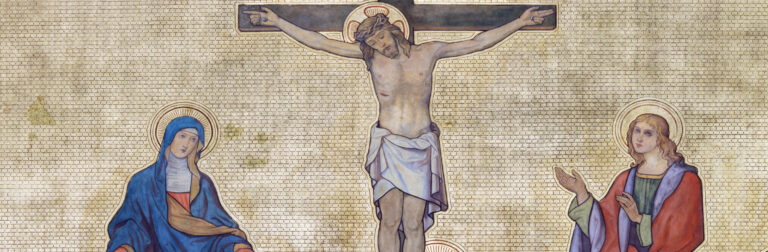
The second word of Christ from the Cross is directed not to the crowd, not to His enemies, but to a dying thief. In this brief exchange, the entire economy of salvation is compressed into a single dialogue. The penitent criminal — known in tradition as St. Dismas — makes his act of faith: ‘Jesus, remember me when you come into your kingdom’ (Luke 23:42). And Christ responds with a promise that has resounded through twenty centuries of Catholic theology: ‘Today you will be with me in Paradise’ (Luke 23:43). In these words, the mercy of God is revealed in its most breathtaking intimacy: not earned by a lifetime of virtue, but granted in the last moment of a life of sin, to a man dying on a cross beside the dying God.
The Greek word sēmeron — ‘today’ — is crucial. The adverb does not merely specify a time but underlines the immediacy and the absolute certainty of Christ’s promise. There is no condition attached, no purgatorial delay implied in this first utterance, no period of further probation required. The promise is immediate, personal, and definitive. This single word ‘today’ has generated sustained theological reflection on the nature of salvific grace and its relationship to merit, works, and the sacraments.
The contrast between the two thieves crucified alongside Christ is itself theologically significant. Both received the same suffering, the same proximity to Christ, the same opportunity to observe and hear Him. The difference between Dismas and Gestas is not a difference of circumstance but of interior disposition — one softened his heart before grace; the other hardened it. The Cross thus becomes a microcosm of the entire drama of human freedom before divine mercy: the offer is universal; the response is personal.
How Does Cornelius a Lapide Interpret the Promise of Paradise?
Cornelius a Lapide devotes extensive analysis to this passage in his Commentary on Luke. He begins by addressing the identity of the two thieves crucified alongside Christ, noting that ancient tradition (preserved in the Gospel of Nicodemus and cited by numerous Fathers) names the penitent thief Dismas and the impenitent thief Gestas. A Lapide argues that the contrasting responses of the two thieves represent the two fundamental responses to grace: Dismas receives the same suffering and the same proximity to Christ as Gestas, but responds with faith and repentance, while Gestas hardens his heart.
See here the greatest miracle of grace that the Cross wrought upon that day: not the darkening of the sun, nor the rending of the veil, but the conversion of a hardened criminal into a saint and martyr in the very hour of his death. The thief is the first fruit of the Cross, gathered before Christ Himself had breathed His last.
(a Lapide, 1876, Vol. IV, p. 349, Commentary on Luke 23:43)
A Lapide addresses the contested question of what Christ meant by ‘Paradise.’ Drawing on Patristic consensus, he distinguishes the Paradise of the thief’s entry from the beatific vision proper. Since Christ descended into hell before rising, and the gates of heaven were opened only by His Resurrection, A Lapide argues — following the majority of Scholastic opinion — that ‘Paradise’ here denotes the Limbo of the Fathers (sinus Abrahae), the place of rest where the just awaited redemption. The thief entered that blessed rest ‘today’ with Christ, and entered the fullness of heaven upon Christ’s glorious Ascension.
This interpretation maintains the integrity of the Church’s eschatological teaching: the beatific vision — the direct face-to-face encounter with God — was accessible to the human soul only after Christ’s redemptive work was ratified by the Resurrection. The promise to Dismas is therefore not less than the fullness of salvation; it is that fullness in its temporal unfolding. The ‘today’ of the promise is true: Dismas entered the state of the blessed immediately, even if the fullness of that blessedness awaited the opening of heaven’s gates.
What Do the Church Fathers Teach About the Conversion and Salvation of the Good Thief?
What Does St. Ambrose Reveal About the Radical Gratuity of Grace in This Passage?
St. Ambrose, in his Exposition of the Gospel of Luke, provides one of the most celebrated patristic meditations on this passage. He marvels at the reversal of human expectation: the thief who had spent his life in wickedness arrives in Paradise before the apostles who had followed Christ for three years. Ambrose sees in this the radical gratuity of divine grace — Paradise is not a reward for accumulated merit but a gift bestowed upon a contrite heart (Ambrose, c. 390/1956, Exposition of Luke, Book X, §§ 121–125). For Ambrose, this reversal is not an anomaly in the divine economy but its most transparent expression: grace operates according to divine logic, not human arithmetic, and a single moment of authentic contrition outweighs a lifetime of imperfect service.
How Does St. Augustine Deploy the Good Thief Against the Donatists and Pelagians?
St. Augustine, particularly in his anti-Donatist and anti-Pelagian writings, returns frequently to the conversion of the Good Thief as a proof-text for the absolute priority of grace. The thief had no opportunity for baptism with water; he received what Augustine calls ‘baptism of desire’ — or, more precisely, the direct remission of sins through his act of faith and contrition, united to the saving Blood of Christ flowing beside him. Augustine uses this example to argue against the Donatists that sacramental forms, while normative, are not absolute constraints upon God’s mercy (Augustine, c. 400/1887, On Baptism, Against the Donatists, Book IV, Ch. 22). The pastoral significance of this argument is enduring: the Church’s sacramental system is the ordinary and privileged means of salvation, but God is not bound by the ordinary means.
Why Does St. John Chrysostom Call Dismas ‘The Theologian of the Cross’?
St. John Chrysostom, in his Homilies on the Cross, identifies the faith of Dismas as remarkable precisely because it was exercised when all apparent evidence for Christ’s kingship had collapsed. The disciples had fled, the crowds were mocking, and Christ was dying in apparent defeat. Yet in this darkest moment, the thief perceived by faith what the learned had missed: that this crucified man was indeed a King, and that His kingdom was of a different order than any earthly power. Chrysostom calls Dismas ‘the theologian of the Cross’ — the first man to confess Christ’s royal dignity in the hour of His apparent humiliation (Chrysostom, c. 400/1843, Homilies on Matthew, Homily 88). This appellation elevates the Good Thief from a mere recipient of grace to a teacher of the faith: he models the theological virtue of faith precisely where that virtue costs the most.
How Does St. Cyril of Jerusalem Use the Good Thief in His Catechetical Instruction?
In his Catechetical Lectures, St. Cyril of Jerusalem uses the example of the Good Thief in his instruction of catechumens awaiting baptism, to illustrate the power of faith and the mercy of Christ. He emphasises the contrast between the thief’s past life and his final confession, teaching that the sacrament of repentance — whether sacramental or, in extremis, a direct act of contrition — is never too late. Cyril sees in Christ’s promise a charter of hope for every sinner approaching the end of life (Cyril of Jerusalem, c. 350/1955, Catechetical Lectures, Lecture XIII, § 30). For Cyril, the story of Dismas is not a marginal footnote but a centrepiece of pre-baptismal catechesis, establishing in the minds of the newly converted that their own conversion, however late in life it may have come, is welcomed with the same immediacy as the thief’s.
How Does St. Thomas Aquinas Situate the Good Thief Within His Theology of Baptism?
St. Thomas Aquinas, in the Summa Theologiae, discusses the Good Thief in the context of the necessity of baptism. He distinguishes baptism of water, baptism of blood, and baptism of desire, and situates the Good Thief’s salvation under the last category. Thomas argues that the sincere act of faith and contrition, when water baptism is impossible, suffices for justification because it implicitly contains the desire for all that God requires. The explicit promise of Christ (‘Today you will be with me in Paradise’) serves as the definitive confirmation of this theological principle (Aquinas, 1274/1948, Summa Theologiae, III, Q. 68, A. 2). Thomas’s tripartite theology of baptism has become the standard teaching of the Church, and the Good Thief remains its most vivid and scripturally grounded illustration.
What Pastoral Lessons Does St. Alphonsus Liguori Draw from Christ’s Response to Dismas?
St. Alphonsus Liguori, Doctor of the Church and patron of moral theologians, reflects on the Good Thief in his work on the Passion. He uses this word as the climactic proof of Christ’s inexhaustible mercy. Alphonsus observes that Christ, in the midst of His own agony, turns with complete attentiveness to the prayer of one repentant sinner. No pain, no mockery, no darkness of the hour diminishes His readiness to save (Liguori, 1761/1887, The Way of Salvation and of Perfection, Part II, Meditation 25). For Alphonsus, this attentiveness of Christ even in the extremity of His own suffering is the defining characteristic of divine mercy: it is a mercy that cannot be distracted or diminished by any circumstance. This is the model for the confessor and the pastoral priest: to be present with the same mercy to every soul, however broken, that turns to God.
What Is the Theological Significance of the Second Word for Salvation Theology?
The second word from the Cross is the Magna Carta of divine mercy. It teaches that salvation is available until the last breath, that faith and contrition are sufficient when sacramental channels are unavailable, and that the Cross of Christ is simultaneously the instrument of His own death and the font of life for those who turn to Him in their dying. A Lapide’s synthesis captures the tradition perfectly: the Good Thief is the firstfruit of the Redemption, a sign and a promise that the Cross of Christ is saving wood for all who cling to it in faith.
The second word also speaks directly to one of the perennial anxieties of the human soul: the fear that sin has placed one permanently beyond the reach of divine mercy. Against this despair, the word to Dismas stands as an absolute refutation. No record of sin, however long or grievous, can outrun the mercy of the Cross, provided the heart turns to Christ with genuine contrition. This is not an encouragement to presumption — the contrast with the impenitent Gestas makes clear that the gift of final repentance is itself a grace, not a guarantee — but it is the most powerful possible assurance that mercy awaits every soul that seeks it, even in the last hour.
References
a Lapide, C. (1876). The great commentary of Cornelius a Lapide: The holy Gospel according to Saint Luke (T. W. Mossman, Trans., Vol. IV). John Hodges. (Original work 1616)
Ambrose of Milan. (c. 390/1956). Exposition of the Holy Gospel According to Saint Luke (T. Tomkinson, Trans.). Center for Traditionalist Orthodox Studies. (Original work c. 390)
Aquinas, T. (1274/1948). Summa theologiae (Fathers of the English Dominican Province, Trans., 5 vols.). Benziger Bros. (Original work c. 1265–1274)
Augustine of Hippo. (c. 400/1887). On baptism, against the Donatists (J. R. King, Trans.). In P. Schaff (Ed.), Nicene and Post-Nicene Fathers, First Series (Vol. 4). Christian Literature Publishing. (Original work c. 400)
Chrysostom, J. (c. 400/1843). Homilies on the Gospel of Saint Matthew (G. Prevost, Trans.). In P. Schaff (Ed.), Nicene and Post-Nicene Fathers, First Series (Vol. 10). Christian Literature Publishing. (Original work c. 390–407)
Cyril of Jerusalem. (c. 350/1955). The works of Saint Cyril of Jerusalem (L. P. McCauley & A. A. Stephenson, Trans.). Fathers of the Church Series (Vol. 61). Catholic University of America Press. (Original work c. 347–350)
Liguori, A. (1761/1887). The way of salvation and of perfection (E. Grimm, Trans.). Redemptorist Fathers. (Original work 1761)