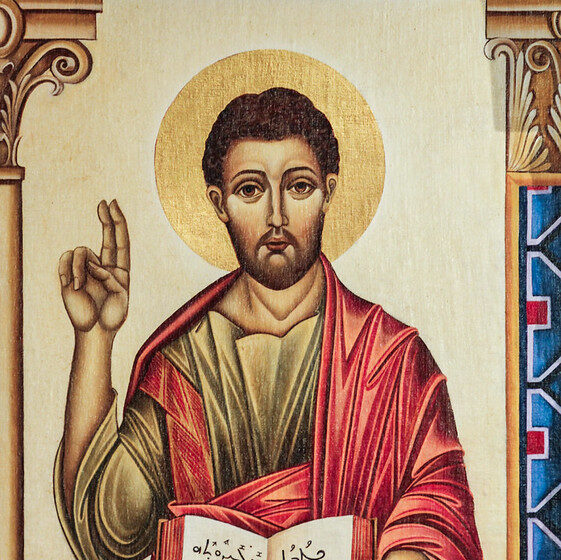
Why Does Jesus Have Two Different Genealogies?
Solving the 2,000-Year-Old “Bible Contradiction” with Traditional Catholic Wisdom
Have you ever noticed that Matthew and Luke give completely different genealogies for Jesus? Different names, different numbers of generations, even different fathers for Joseph! Skeptics love to point to this as proof that the Bible contradicts itself. But what if I told you that the Church Fathers solved this puzzle almost 2,000 years ago—and the answer is more beautiful than you might imagine?
The genealogies of Jesus Christ found in Matthew 1:1-17 and Luke 3:23-38 have puzzled readers for centuries. At first glance, they appear to contradict each other in nearly every detail. Modern biblical scholars, particularly since the rise of historical-critical methods in the 19th century, have often concluded these genealogies are irreconcilable. Some have dismissed them as theological inventions rather than historical records (Brown, 1993; Fitzmyer, 1981).
But such conclusions stand in direct contradiction to the Catholic Church’s consistent teaching on scriptural inerrancy—the doctrine that Sacred Scripture, being divinely inspired, contains no error in any of its assertions. This article will show you how the traditional Catholic harmonization not only resolves the apparent contradictions but also reveals profound truths about who Jesus is.
Does the Catholic Church Really Teach That the Bible Has No Errors?
What Did the Popes Say About Biblical Inerrancy?
Before we tackle the genealogies themselves, we need to understand the theological foundation. The Catholic Church has consistently and infallibly taught that Sacred Scripture is free from all error in everything it affirms. This isn’t just about “spiritual truths”—it extends to historical details, too.
Pope Leo XIII made this crystal clear in his 1893 encyclical Providentissimus Deus:
For all the books which the Church receives as sacred and canonical are written wholly and entirely, with all their parts, at the dictation of the Holy Ghost; and so far is it from being possible that any error can co-exist with inspiration, that inspiration not only is essentially incompatible with error but excludes and rejects it as absolutely and necessarily, as it is impossible that God Himself, the supreme Truth, can utter that which is not true. (Leo XIII, 1893, para. 20)
This wasn’t a new teaching. Pope Leo called it “the ancient and constant faith of the Church” (Leo XIII, 1893, para. 20). The early Church Fathers consistently affirmed this principle. St. Augustine declared that he believed “that the authors were completely free from error” (as cited in Leo XIII, 1893, para. 20). St. Justin Martyr wrote, “I am entirely convinced that no Scripture contradicts another” (as cited in Nicolau et al., 1955, p. 173).
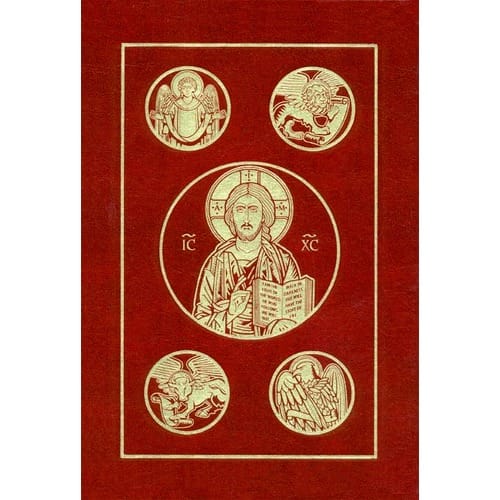
For two quality Bibles – Douay-Rheims and the Ignatius Bible – RSV 2nd Edition

Does This Mean Every Single Detail Is Protected from Error?
Yes! Pope St. Pius X, in his 1907 decree Lamentabili Sane, formally condemned the idea that only parts of Scripture are inerrant. He rejected the proposition that “Divine Inspiration does not extend to all of Sacred Scripture so that it renders its parts, each and every one, free from all error” (Pius X, 1907, prop. 11).
St. Thomas Aquinas taught that everything in Scripture must be held as a matter of faith, even historical assertions, because they are part of divine revelation (Summa Theologiae I, Q. 1, a. 7, ad. 2). He even declared it “heretical to claim that something false is found, not only in the Gospels but in any part of the canonical Scriptures” (as cited in Kolbe Center, n.d.).
The Catholic Approach: When we encounter something in Scripture that seems contrary to truth, we should conclude either that the text has been corrupted in transmission, that the translator made an error, or that we ourselves don’t yet understand the passage correctly. We should never simply conclude that Scripture itself contains error (as cited in Leo XIII, 1893).
What Exactly Are the Differences Between Matthew’s and Luke’s Genealogies?

How Does Matthew Present Jesus’ Family Tree?
The Gospel of Matthew begins with a carefully structured genealogy tracing Jesus’ lineage from Abraham through David to Joseph. Matthew divides his genealogy into three groups of fourteen generations each: from Abraham to David, from David to the Babylonian exile, and from the exile to Christ. This schematic arrangement demonstrates Jesus as the fulfillment of Jewish messianic prophecy.
Crucially, Matthew’s genealogy proceeds through David’s son Solomon, following the royal line of Judah’s kings. It culminates in Jacob, who is identified as the father of Joseph, the husband of Mary. The genealogy emphasizes Jesus’ legal right to the throne of David through his legal father Joseph.
How Is Luke’s Genealogy Different?
Luke takes a dramatically different approach. Presented at the beginning of Jesus’ public ministry following his baptism, Luke’s genealogy traces the lineage backward from Jesus through Joseph all the way to Adam, “the son of God.” This universal perspective reflects Luke’s emphasis on Jesus as the Savior of all humanity, not merely the Jewish people.
Here’s where it gets interesting: Luke’s genealogy diverges from Matthew’s after David, proceeding through David’s son Nathan rather than Solomon. The genealogy continues through a completely different set of names until reaching “Heli,” who is called Joseph’s father. Luke includes significantly more generations than Matthew for the same time period, and the names bear almost no correspondence to those in Matthew’s account.
What Are the Specific Problems We Need to Solve?
The differences are substantial. Eusebius of Caesarea, writing in the 4th century, devoted an entire chapter of his Church History to “The Alleged Discrepancy in the Gospels in Regard to the Genealogy of Christ” (Eusebius, c. 325/1890). Here are the main issues:
- • Different fathers for Joseph: Matthew says Joseph’s father was Jacob (Matthew 1:16), while Luke says it was Heli (Luke 3:23).
- • Divergent lines from David: Matthew traces through Solomon (the royal line), Luke through Nathan (a non-royal line).
- • Different number of generations: Matthew lists about 42 generations from Abraham to Jesus, while Luke lists 77 from Adam to Jesus (about 57 from Abraham to Jesus).
- • Almost no common names: Apart from Abraham through David, and possibly Shealtiel and Zerubbabel, the genealogies share virtually no names from David to Joseph.
No wonder skeptics have had a field day! Even some Catholic scholars like Raymond E. Brown argued these differences indicate historical inaccuracy, claiming the genealogies contain “errors and omissions” (Brown, 1993, p. 70). He concluded that “the New Testament has preserved for us two strikingly different genealogies of Jesus, which resist all harmonization” (Fitzmyer, 1981, p. 496).
How Did the Early Christians Solve This Problem?
What Did Julius Africanus Discover About the Genealogies?
The earliest recorded attempt to harmonize these genealogies comes from Sextus Julius Africanus (c. 160-240 AD), a Christian historian who lived in Palestine within 150 years of the Gospels being written. Here’s what makes his testimony so valuable: he actually spoke with relatives of Jesus who had preserved the family genealogical records!
In his letter to Aristides (preserved by Eusebius in Church History I.7), Africanus proposed a solution based on the Jewish law of levirate marriage. According to this law, if a man died without children, his brother was required to marry the widow and raise up children in the deceased brother’s name (Deuteronomy 25:5-10).
Africanus explained that Matthan (from Solomon’s line) married a woman named Estha and fathered Jacob. After Matthan died, Estha married Melchi (from Nathan’s line) and bore Heli. Thus, Jacob and Heli were uterine brothers—sharing the same mother but having different fathers. When Heli died childless, Jacob married Heli’s widow according to levirate law and fathered Joseph. Therefore, Joseph was the natural son of Jacob (as Matthew records) but the legal son of Heli (as Luke records).
Eusebius endorsed this explanation, noting it came from “relatives of the Savior” who had preserved these records (Eusebius, c. 325/1890, I.7.14). While this addresses Joseph having two fathers, it doesn’t fully explain why the two genealogical lines diverge so dramatically from David onward.
What Did Later Catholic Scholars Add to This Understanding?
A more comprehensive harmonization was developed by Catholic scholars in subsequent centuries, most notably by the great 16th-century Jesuit exegete Cornelius a Lapide (1567-1637). His solution is elegant and explains everything.
According to Lapide’s interpretation, which draws on earlier patristic traditions, the two genealogies actually trace two different lines converging in Mary, not just Joseph. Here’s the breakthrough insight:
The Complete Solution:
Matthew’s genealogy traces the line through St. Anne, the mother of the Blessed Virgin Mary. St. Anne was the daughter of Matthan (from Solomon’s royal line) and the sister of Jacob, who was Joseph’s father. Thus Matthew traces Jesus’ Davidic descent through Mary’s maternal lineage.
Luke’s genealogy traces the line through St. Joachim (also called Heli), the father of the Blessed Virgin Mary. Joachim descended from David through Nathan. Thus Luke traces Jesus’ Davidic descent through Mary’s paternal lineage.
Lapide explains it beautifully:
I say that it was quite likely that in the time of Christ it was very well known that Mathan was the common grandfather of Joseph and the Blessed Virgin; and that Jacob, the father of Joseph, and Heli, or Joachim (the father of the Blessed Virgin), were full brothers—or rather, that Jacob was the brother of St. Anne, the wife of Heli or Joachim, and mother of the Blessed Virgin; hence the genealogy of one is the genealogy of the other. For the Blessed Virgin was descended, through her mother, Anna, from Jacob, Mathan, and Solomon, and through her father, Joachim or Heli, from Mathat and Nathan. (a Lapide, 1908/original, p. 322)
How Exactly Are All These People Related?
Can You Break Down the Family Tree for Me?
Absolutely! Let me make this crystal clear:
Matthan (descended from Solomon’s royal line) had at least two children:
- Jacob – who became the father of St. Joseph
- Anne – who became the mother of the Blessed Virgin Mary
St. Joachim/Heli (descended from Nathan’s priestly line) married St. Anne, and together they had one daughter:
- Mary – the Mother of Jesus
Jacob (Matthan’s son and Anne’s brother) fathered:
- Joseph – who married his first cousin once removed, Mary
See the following download for a diagram representation.
Here’s the beautiful truth: Mary had Davidic descent through BOTH parents! Through her mother Anne, she descended from Solomon’s royal line. Through her father Joachim, she descended from Nathan’s priestly line. When Joseph (also from Solomon’s line through Jacob) married Mary, their combined lineages brought together both the royal and priestly lines in Jesus Christ.
Why Does Luke Call Joseph the “Son of Heli”?
This is actually quite simple once you understand ancient Jewish customs. Luke calls Joseph “the son of Heli” because he was Heli’s son-in-law—he married Heli’s daughter Mary. In ancient Jewish practice, sons-in-law were commonly referred to as “sons” of their fathers-in-law.
As Lapide notes, “Heli is, therefore, called the father of Joseph—father in the sense of father-in-law; for Heli is a short form of the name Eliakim, or Joachim, the husband of St. Anne and the father of the Blessed Virgin” (a Lapide, 1908/original, p. 324).
What’s the Deeper Meaning Behind All This?
Why Is Mary’s Double Davidic Heritage Important?
This traditional harmonization reveals a beautiful theological truth: the Blessed Virgin Mary possessed Davidic lineage through BOTH her father and mother. This means Jesus is doubly descended from David according to the flesh, fulfilling the messianic prophecies in their fullest sense.
As Lapide concludes: “It is clear…that the Blessed Virgin was descended through her mother, St. Anne, from Solomon, as was Joseph; but by her father, Heli, or Joachim, she was descended from Nathan, who was Solomon’s brother and a son of David” (a Lapide, 1908/original, p. 324).
Think about what this means: Jesus has undisputed claim to the throne of David through the royal line (Solomon) while also connecting to the priestly tradition (Nathan). He is both King and Priest!
Who Were Saints Anne and Joachim?
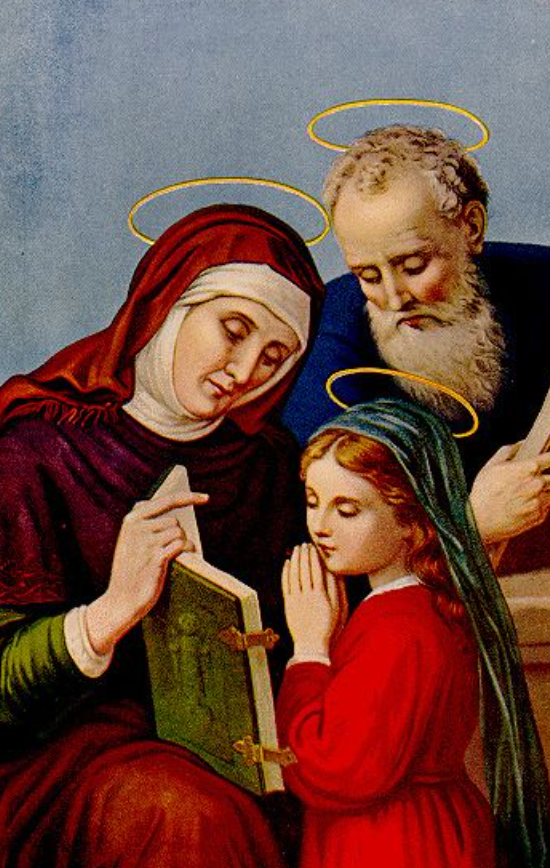
While the names of Mary’s parents don’t appear in the canonical Gospels, they’re attested in early Christian tradition, particularly in the Protoevangelium of James from the 2nd century. The Catholic Church has venerated Saints Joachim and Anne from ancient times, celebrating their feast day on July 26th.
According to tradition, Joachim and Anne were elderly and childless, suffering the reproach associated with barrenness in Jewish society. Through fervent prayer and divine intervention, they were blessed with the birth of Mary, whom they dedicated to God’s service (Catholic Encyclopedia, 1907).
Their role in salvation history is profound: they gave birth to the Mother of God and provided the genetic heritage through which Jesus would be connected to the House of David. As Franciscan Media notes, “The strong character of Mary in making decisions, her continuous practice of prayer, her devotion to the laws of her faith, her steadiness at moments of crisis, and her devotion to her relatives—all indicate a close-knit, loving family” (Franciscan Media, 2025).
Why Did Matthew and Luke Present Different Genealogies?
The evangelists had different audiences and different theological goals:
Matthew’s Purpose: Writing primarily for Jews, Matthew wanted to prove Jesus was the promised Messiah, the King of the Jews. His genealogy emphasizes Jesus’ legal right to David’s throne through Joseph. By tracing the royal line through Solomon and structuring it in three groups of fourteen generations (fourteen being the numerical value of David’s name in Hebrew), Matthew establishes Jesus’ royal credentials.
Luke’s Purpose: Writing for Gentiles, Luke emphasizes Jesus as the Savior of all humanity. His genealogy traces back to Adam, the father of the entire human race. By going through Nathan rather than the royal succession, Luke may also be highlighting Jesus’ priestly rather than purely political role.Key Insight: These different emphases don’t represent contradictions but complementary perspectives on Christ’s identity. Both genealogies are historically accurate—they simply present different lines of descent, both legitimately connecting Jesus to David and fulfilling messianic prophecy (Catholic Encyclopedia, 1910).
How Do We Respond to Modern Scholars Who Reject This Explanation?
What’s Wrong with the Modern Critical Approach?
Modern biblical scholars often claim the traditional harmonizations are “strained” or “artificial,” preferring to view the genealogies as theological constructions rather than historical records. But this approach has several serious problems:
1. They Assume Error from the Start: Modern critics begin by presuming that apparent difficulties must indicate historical error rather than gaps in our understanding. This violates the Catholic principle that Scripture must be interpreted consistently with its divine inspiration and inerrancy.
2. They Ignore Ancient Practices: As Catholic Answers notes, ancient genealogists commonly “skipped” generations when appropriate, focused on theological rather than merely biological descent, and used flexible terminology for family relationships (Catholic Answers, 2022). Modern critics judge ancient texts by modern standards.
3. They Dismiss Early Christian Testimony: Modern scholarship frequently dismisses the witness of early Christian tradition, including explanations from Julius Africanus and other Church Fathers who were much closer chronologically to the events and who had access to oral traditions and sources no longer available to us.
Why Should We Trust the Traditional Harmonization?
Several factors support the historical credibility of this solution:
Very Early Attestation: Julius Africanus’ explanation dates to within 150 years of the Gospels’ composition and claims to be based on information from “relatives of the Savior” (Eusebius, c. 325/1890, I.7.14). This is extremely early testimony.
Jewish Record-Keeping: The Jews were meticulous about genealogies, especially for families claiming Davidic descent. Completely fabricated genealogies would never have been accepted by first-century Jewish Christians, many of whom personally knew Jesus’ family members.
Complementary but Different: The fact that the evangelists provide different genealogies serving different purposes actually argues for their historical basis. If these were pure inventions, why not just copy the same list?
Consistent Patristic Interpretation: Church Fathers and Catholic theologians throughout the centuries accepted this harmonization. As the Kolbe Center notes, “none of the early Fathers even thought about giving these passages a figurative interpretation” (Kolbe Center, n.d.). This consistent literal interpretation across cultures and centuries argues for its validity.
Why Does This Matter for Catholics Today?
Is This Just an Academic Exercise?
Absolutely not! The question of how to interpret the Gospel genealogies touches fundamental issues of biblical authority and inspiration. If we accept that Scripture contains historical errors, even in small details, we undermine the basis for trusting Scripture about more essential matters of faith.
Pope Leo XIII warned that those who claim error is possible in any genuine Scripture passage “either pervert the Catholic notion of inspiration, or make God the author of such error” (Leo XIII, 1893, para. 21). The integrity of divine revelation requires complete confidence in Scripture’s trustworthiness.
The traditional harmonization demonstrates that apparent difficulties can be resolved through careful study, attention to historical context, and respect for Tradition. Rather than hastily concluding that Scripture errs, the Catholic approach seeks to understand how different passages complement one another.
What Can We Learn from the Genealogies About Reading Scripture?
The genealogies of Jesus teach us several vital lessons:
1. Tradition Is Essential: Understanding these passages requires information preserved in Tradition—Mary’s parents’ names, family relationships, and ancient genealogical practices. This proves that Scripture must be interpreted in light of Tradition, not by Scripture alone.
2. Be Patient with Difficulties: These apparent contradictions have troubled readers for nearly 2,000 years. Yet patient study yielded solutions maintaining both historical reliability and theological depth. This should encourage us to persevere with other difficult passages.
3. Scripture Has Multiple Layers: The genealogies function simultaneously as historical records, theological statements, and literary structures. Matthew’s three groups of fourteen and Luke’s universal emphasis show how inspired authors presented historical information serving theological purposes without sacrificing accuracy.
4. Scripture Is Both Divine and Human: The evangelists wrote for specific audiences with particular purposes, using their time’s literary conventions. Understanding these human dimensions enriches rather than diminishes our appreciation of Scripture’s divine origin.
What’s the Bottom Line?
The two genealogies of Jesus in Matthew and Luke, far from being irreconcilable contradictions, provide complementary testimony to Jesus’ identity as the Son of David and Savior of all humanity. Through the traditional Catholic harmonization developed by Church Fathers and scholars like Cornelius a Lapide, we understand how both genealogies are historically accurate while serving different theological purposes.
Matthew traces Jesus through St. Joseph and St. Anne (Mary’s mother), emphasizing the royal line through Solomon. Luke traces through St. Joachim (Mary’s father), emphasizing the priestly line through Nathan. Both lines converge in the Blessed Virgin Mary, who inherits Davidic descent through both parents, culminating in Jesus Christ—truly the Son of David in the flesh and the Son of God in divinity.
Remember This:
This harmonization vindicates Catholic teaching on scriptural inerrancy and demonstrates the value of interpreting Scripture in continuity with Church Tradition. As the Kolbe Center concludes, “The genealogies of Matthew and Luke provide another example of why faith in the Church, Sacred Tradition, and Sacred Scripture is so important. Instead of cowering before the unscrupulous claims leveled against Christ and His Church, we should be supremely confident in the revelation given us by Almighty God” (Kolbe Center, n.d.).
In an age when biblical authority faces constant challenges, the traditional Catholic understanding of the genealogies offers powerful testimony to Sacred Scripture’s reliability. Apparent difficulties, when approached with faith and reason, deepen rather than diminish our confidence in God’s word.
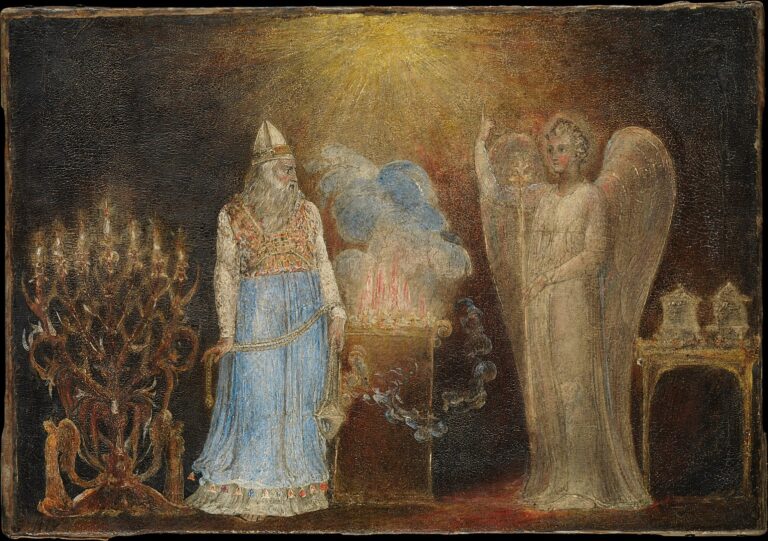
The genealogies, properly understood, proclaim the angel’s announcement: “The Holy Spirit will come upon you, and the power of the Most High will overshadow you; therefore the child to be born will be called holy—the Son of God” (Luke 1:35, ESV).
References
a Lapide, C. (1908). The great commentary of Cornelius a Lapide: S. Luke’s gospel (4th ed., T. W. Mossman, Trans.). J. Grant. (Original work published 16th century)
Brown, R. E. (1993). The birth of the Messiah: A commentary on the infancy narratives in the Gospels of Matthew and Luke (New updated ed.). Doubleday.
Catholic Answers. (2022, November 18). Why are the genealogies of Luke and Matthew different? https://www.catholic.com/qa/why-are-the-genealogies-of-luke-and-matthew-different
Catholic Encyclopedia. (1907). St. Anne. In The Catholic Encyclopedia. Robert Appleton Company. https://www.catholic.com/encyclopedia/anne-saint
Catholic Encyclopedia. (1910). Genealogy of Christ. In The Catholic Encyclopedia. Robert Appleton Company. https://www.newadvent.org/cathen/06410a.htm
Eusebius of Caesarea. (1890). Church history (A. C. McGiffert, Trans.). In P. Schaff & H. Wace (Eds.), Nicene and Post-Nicene Fathers, Second Series (Vol. 1). Christian Literature Publishing Co. (Original work composed c. 325)
Fitzmyer, J. A. (1981). The Gospel according to Luke (Vols. 1-2). Doubleday. (Anchor Yale Bible Commentaries)
Franciscan Media. (2025, August 26). Saints Joachim and Anne. https://www.franciscanmedia.org/saint-of-the-day/saints-joachim-and-anne/
Kolbe Center for the Study of Creation. (n.d.). Genealogies and scriptural inerrancy. https://kolbecenter.org/genealogies-and-scriptural-inerrancy/
Leo XIII. (1893, November 18). Providentissimus Deus [Encyclical letter on the study of Holy Scripture]. https://www.vatican.va/content/leo-xiii/en/encyclicals/documents/hf_l-xiii_enc_18111893_providentissimus-deus.html
Nicolau, M., Salaverri, J., Sagüés, J. F., Dalmau, J. M., Solano, J., Alonso, J. M., García Garcés, N., Sauras, E., Nicolau, M., & Cuervo, M. (1955). Sacrae theologiae summa IB: On Sacred Scripture, on the Triune God (K. Baker, Trans.). Keep the Faith, Inc. (Original work published 1955)
Pius X. (1907, July 3). Lamentabili Sane [Syllabus condemning the errors of the modernists]. https://www.vatican.va/content/pius-x/en/encyclicals/documents/hf_p-x_enc_19070703_lamentabili-sane.html
Pius XII. (1943, September 30). Divino Afflante Spiritu [Encyclical on promoting biblical studies]. https://www.vatican.va/content/pius-xii/en/encyclicals/documents/hf_p-xii_enc_30091943_divino-afflante-spiritu.html
Pius XII. (1950, August 12). Humani Generis [Encyclical concerning some false opinions threatening to undermine the foundations of Catholic doctrine]. https://www.vatican.va/content/pius-xii/en/encyclicals/documents/hf_p-xii_enc_12081950_humani-generis.html
Thomas Aquinas. (1265-1274). Summa theologiae. https://www.newadvent.org/summa/