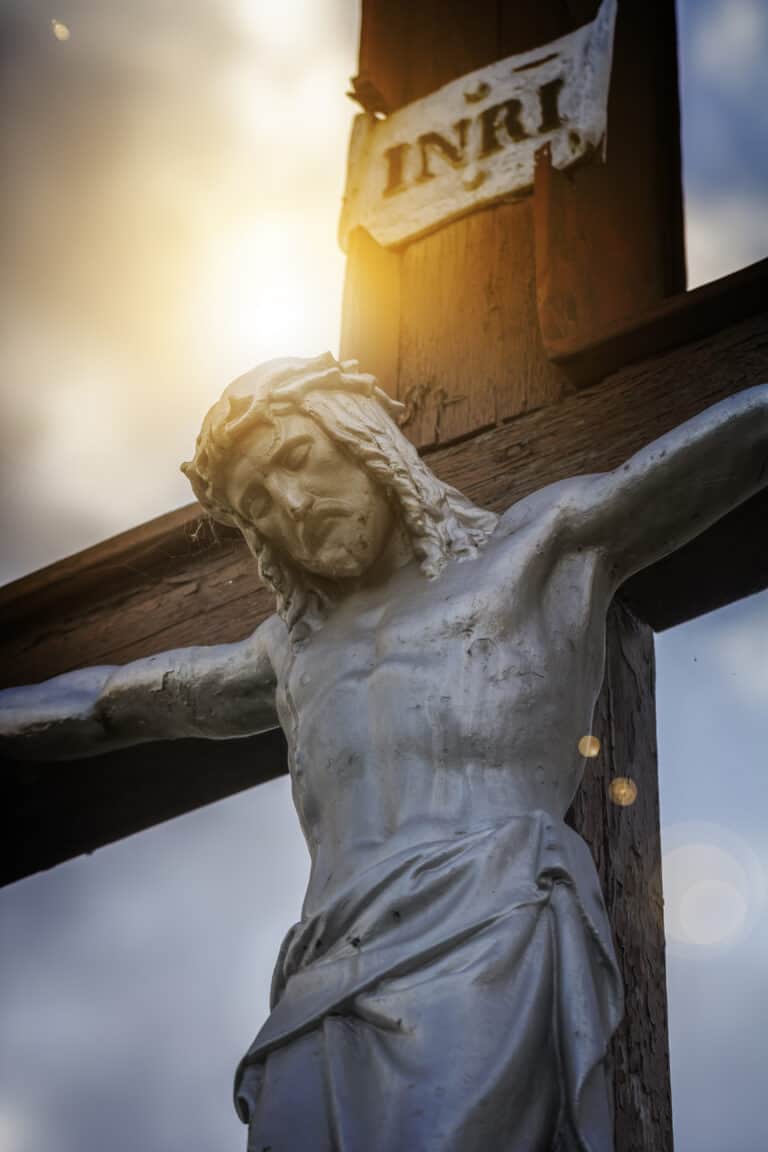
Daniel’s Prophecy of the Seventy Weeks: A Historical-Messianic Interpretation
Based on the research of Noel Woodbridge
Of all the prophetic passages in the Old Testament, none has inspired more debate — or more awe — than Daniel 9:24–27. Written six centuries before Christ, it describes with startling precision the timeline of the Messiah’s coming, His atoning death, and the catastrophic consequences of Israel’s rejection of her King. This article presents the Historic-Messianic interpretation of Daniel’s Seventy Weeks: the understanding held by the Church Fathers, the Protestant Reformers, and the great Catholic and Protestant commentators of every age.
Why Does a Talmudic Curse Forbid Reading Daniel 9?
It is a remarkable and rarely discussed fact that an ancient Rabbinic curse preserved in the Talmud forbids Jews from reading Daniel 9:24–27. Why would the Jewish religious authorities seek to place a curse upon a passage of their own sacred Scripture? The answer is uncomfortable but illuminating: Daniel 9 is one of the most powerful prophetic proofs that Jesus of Nazareth is the promised Messiah.
The prophecy not only predicts the Messiah’s coming — it pinpoints the precise year of His anointing, the year of His death, and the year in which God’s grace would finally shift from the Jewish nation to the Gentile world. To read it honestly and historically is to encounter a divine clockwork of such accuracy that it puts the identity of Jesus beyond rational dispute.

This is the prophecy. Let us read it carefully in the venerable Douay-Rheims Bible — the English translation of the Latin Vulgate, faithful to the ancient Catholic tradition:
“Seventy weeks are shortened upon thy people, and upon thy holy city, that transgression may be finished, and sin may have an end, and iniquity may be abolished; and everlasting justice may be brought; and vision and prophecy may be fulfilled; and the Saint of saints may be anointed.” — Daniel 9:24, Douay-Rheims
“Know thou therefore, and take notice: that from the going forth of the word, to build up Jerusalem again, unto Christ the prince, there shall be seven weeks, and sixty-two weeks: and the street shall be built again, and the walls in straitness of times. And after sixty-two weeks Christ shall be slain: and the people that shall deny him shall not be his. And a people with their leader that shall come, shall destroy the city and the sanctuary: and the end thereof shall be waste, and after the end of the war the appointed desolation. And he shall confirm the covenant with many, in one week: and in the half of the week the victim and the sacrifice shall fail: and there shall be in the temple the abomination of desolation: and the desolation shall continue even to the consummation, and to the end.” — Daniel 9:25–27, Douay-Rheims
What Is the Historical Background of This Prophecy?
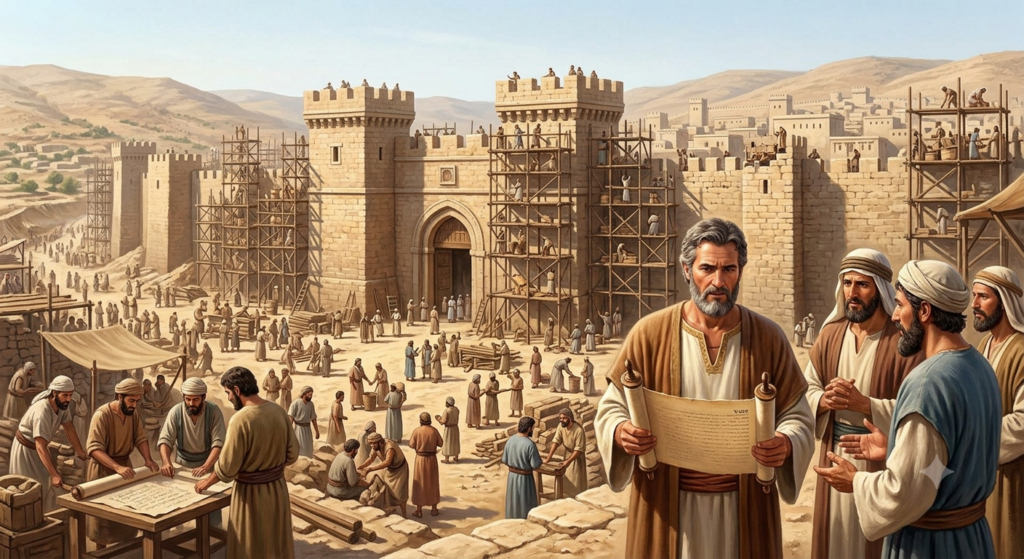
To understand the Seventy Weeks, we must first understand why Daniel was praying in the first place. The setting is the Babylonian Captivity, approximately 538–537 BC — the first year of the reign of Darius the Mede.
Daniel had been reading the prophecy of Jeremiah, which foretold that Jerusalem would lie desolate for seventy years (cf. Jeremias 25:11–12). That period of captivity was drawing to a close, and Daniel began to intercede on behalf of his people in one of the most moving prayers of confession in all of Scripture (Daniel 9:3–19). He acknowledged Israel’s long rebellion against God’s commandments and begged for mercy upon the holy city.
But why seventy years? Leviticus 25:1–7 records God’s command that the land of Israel receive a Sabbath rest every seventh year — a year when no crops would be sown and the land would lie fallow. For 490 consecutive years, Israel disobeyed this commandment. That amounts to seventy missed Sabbath Years. God’s response was precise and just: one year of captivity for each Sabbath Year the land had been denied its rest — seventy years in Babylon.
It is into this moment of humble prayer and national repentance that the Angel Gabriel appears, carrying God’s answer. But it is not merely the answer Daniel expected. God’s response reaches far beyond the immediate seventy-year captivity. He reveals a far greater prophetic calendar: Seventy Weeks — meaning 490 years — that would culminate in the atoning work of the Messiah Himself.
What Does “Seventy Weeks” Actually Mean?
The phrase “seventy weeks” is the translation of the Hebrew שָׁבֻעִים שִׁבְעִים (shiv’im shavuim), literally “seventy sevens.” The question is: seventy sevens of what?
The Bible itself provides the interpretive key through the Day-Year Principle — a method of prophetic calculation attested in two explicit Old Testament texts:
“According to the number of the days in which you viewed the land, forty days, for every day a year, you shall bear your iniquities forty years.” — Numbers 14:34, Douay-Rheims
“I have appointed thee each day for a year.” — Ezekiel 4:6, Douay-Rheims
Applying this principle to Daniel’s Seventy Weeks: seventy weeks of days = 490 prophetic days = 490 literal years of history. This transforms an abstract period into a precise prophetic calendar spanning from the decree to rebuild Jerusalem all the way to the death of the Messiah and the final rejection of Israel’s covenant privileges.
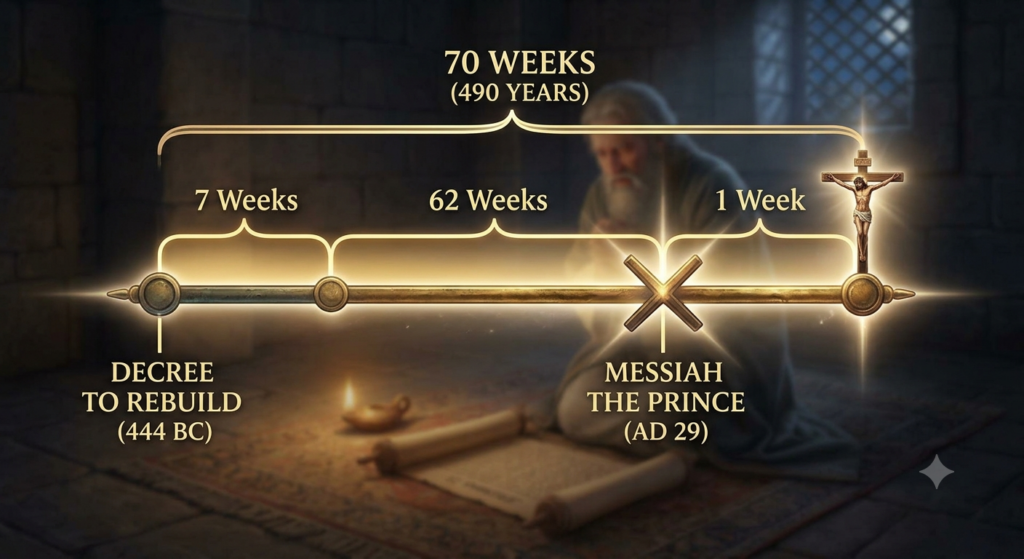
70 weeks × 7 days per week = 490 prophetic days = 490 literal years of redemptive history.
The prophecy also operates in the literary form of an apocalyptic chiasm — a Hebrew poetic structure in which themes are introduced and then repeated in reverse order, with the central element being the most important. In Daniel 9:25–27, the chiastic centre is the seven and sixty-two weeks, whose purpose is precisely to date the coming of the Messiah.
The prophecy also uses figurative language in a manner entirely consistent with the rest of Scripture. As the Bible uses “seven” as a figure of perfection and “ten” as a figure of completion, so Daniel’s “seventy sevens” represents a perfect and complete period — the decreed span in which the greatest work of God is brought to consummation.
What Are the Six Great Purposes of the Messiah’s Mission?
Before detailing the chronological structure of the Seventy Weeks, Daniel 9:24 lists six divine purposes to be accomplished over the entire 490-year period. Each of these purposes finds its fulfilment in Jesus Christ. Let us examine them in detail.
1. Is It About Finishing Transgression?
The first purpose is “that transgression may be finished” (Daniel 9:24, DR). The Hebrew word kâlâh carries the meaning of accomplishing, restraining, or bringing to an end. In the immediate context of Daniel 9, this refers to Israel’s long history of transgression — the very sin Daniel was confessing when Gabriel arrived.
In its broader Messianic application, it echoes the prophecy of Isaias 53, where the Suffering Servant bears the people’s “iniquity” (v. 6), is “wounded for our iniquities” (v. 5), and makes His soul an offering for sin (v. 10). The Christ who came to “finish transgression” is the Lamb of God who takes away the sin of the world.
2. Is It About Making an End of Sin?
The second purpose is “that sin may have an end” (Daniel 9:24, DR). The Hebrew tâmam conveys finality — a sealing up or conclusive termination. The phrase can also be rendered “to seal up sin-offerings”, pointing directly to the sacrificial system of the Temple, which Christ would render permanently obsolete by His one perfect offering on Calvary.
The Epistle to the Hebrews makes this point with characteristic forcefulness:
“But now once at the end of ages, he hath appeared for the destruction of sin, by the sacrifice of himself.” — Hebrews 9:26, Douay-Rheims
Christ did not eradicate sin from the earth in the sense of making men impeccable. Rather, He introduced the New Covenant under which the power of sin over the redeemed is definitively broken, and the need for repeated animal sacrifice is abolished forever.
“For this purpose the Son of God appeared, that he might destroy the works of the devil.” — 1 John 3:8, Douay-Rheims
3. Is It About Atoning for Iniquity?
The third purpose is “that iniquity may be abolished” — or more precisely translated, that atonement may be made for iniquity. The Hebrew kaphar shares its root with kippur, as in Yom Kippur, the Day of Atonement. Kipper means to cover over, to make propitiation, to pacify wrath through sacrifice.
The Christ is the true High Priest who enters the heavenly sanctuary — not with the blood of bulls and goats but with His own precious blood — to make eternal atonement for human sin:
“And he is the propitiation for our sins: and not for ours only, but also for those of the whole world.” — 1 John 2:2, Douay-Rheims
Taken together, these first three purposes of the Messiah’s mission reveal that the primary reason Christ came into the world was to deal definitively with the problem of human sin — its transgression, its dominion, and its guilt.
4. Is It About Bringing in Everlasting Justice?
The fourth purpose is “that everlasting justice may be brought” (Daniel 9:24, DR). The Hebrew phrase tsedek olamim refers to the righteousness of ages — the perfect, eternal righteousness that the Messiah would both possess and impart. This is the righteousness described by St. Paul when he writes:
“But now without the law the justice of God is made manifest, being witnessed by the law and the prophets. Even the justice of God, by faith of Jesus Christ, unto all and upon all them that believe in him.” — Romans 3:21–22, Douay-Rheims
The Messiah brought everlasting righteousness in two senses: first, by living a perfectly holy life — meeting the full demands of God’s law on our behalf; and second, by His atoning death, making it possible for sinners to be declared righteous before God by faith.
5. Is It About Sealing Up Vision and Prophecy?
The fifth purpose is “that vision and prophecy may be fulfilled” (Daniel 9:24, DR). The Hebrew velachtom means to seal up, to complete, to put a final end to. The implication is that the entire corpus of Old Testament prophecy — all the visions, all the oracles, all the messianic promises — would find their fulfilment and thus their completion in the Messiah’s coming.
St. Peter articulates this precisely when he declares that the ancient prophets were serving not themselves but those who would come after them, searching out “the sufferings of Christ, and the glories that should follow” (1 Peter 1:11, DR). With Christ’s coming, Old Testament prophetic revelation had accomplished its purpose.
This does not mean prophecy ceased to exist; the New Testament itself contains prophecy. Rather, it means that the Old Covenant prophetic office — whose function was to herald the Messiah — was brought to its glorious conclusion.
6. Is It About the Anointing of the Holy of Holies?
The sixth purpose is “that the Saint of saints may be anointed” (Daniel 9:24, DR). The Hebrew kodesh kodashim means “Holy of Holies” — the most sacred space in the Temple. But here it is applied not to a place but to a Person.
The anointing of Christ occurred at His Baptism in the Jordan, when the Holy Spirit descended upon Him in the form of a dove (Matthew 3:16). This was the moment of His public consecration — His anointing as Prophet, Priest, and King. The Book of Acts confirms this interpretation: “God anointed him with the Holy Ghost and with power” (Acts 10:38, DR).
Zechariah’s prophecy that the anointing oil was a symbol of the Spirit of God (Zacharias 4:1–6) gives further weight to this reading. The anointing of the ‘Holy of Holies’ at the commencement of the Seventy Weeks points therefore to the descent of the Holy Spirit upon Jesus at the beginning of His public ministry — in approximately AD 29, precisely 483 prophetic years after the Nehemiah decree of 444 BC.
How Are the Seventy Weeks Divided — and What Do They Mean?
Daniel 9:25 divides the Seventy Weeks into three distinct periods: seven weeks (49 years), sixty-two weeks (434 years), and one final week (7 years). The starting point of the entire period is “the going forth of the word, to build up Jerusalem again” (Daniel 9:25, DR).
When Did the Prophetic Clock Begin Ticking?
The starting point most consistently aligned with a 33 AD crucifixion is the decree of King Artaxerxes I of Persia to Nehemiah, issued in the twentieth year of his reign — 444 BC — recorded in 2 Esdras 2:1–8 (Douay-Rheims numbering). This decree authorised the rebuilding of the walls and gates of Jerusalem with full royal backing, precisely matching the language of Daniel 9:25: ‘the street shall be built again, and the walls in straitness of times’ (DR).
A commonly cited alternative starting point is the earlier decree of Artaxerxes to Ezra in 457 BC (1 Esdras 7:12–13, DR), which authorised the restoration of Jewish religious and civil life. Both decrees have their scholarly advocates, and both reflect the genuine Persian commitment to restoring Jerusalem under Artaxerxes. However, the decree of 444 BC to Nehemiah — with its specific focus on walls, gates, and the physical city — aligns with the chronological framework that places Christ’s ministry beginning around AD 29 and His Crucifixion in AD 33, the date supported by Roman historical sources, astronomical data for Passover full moons, and the Gospel chronology of John’s account.
What Happened During the First Seven Weeks (49 Years: 444 BC – 395 BC)?
The first seven weeks — 49 years — cover the period from the decree of Artaxerxes to Nehemiah to the completion of the rebuilding of Jerusalem under Nehemiah’s determined and courageous leadership. Daniel 9:25 specifically notes that ‘the street shall be built again, and the walls in straitness of times’ — and the book of 2 Esdras records exactly this: the reconstruction of the walls accomplished in just 52 days, against sustained opposition from Sanballat, Tobiah, and the enemies of Judah.
The enemies of the returned exiles harassed them, threatened violence, and sought by political intrigue to halt the work (cf. 2 Esdras 4, DR). These were indeed ‘times of straitness’ — troublous times — exactly as the prophecy foretold. The 49-year period encompasses the full consolidation of the restored community under Nehemiah and Ezra, the completion of the Hebrew canon of Scripture, and the establishment of Second Temple Judaism.
What Happened During the Sixty-Two Weeks (434 Years: 408 BC – AD 29)?
The seventy weeks of Daniel do not all trace to a single decree. A distinct chronological tradition — followed by commentators seeking to align Daniel’s prophecy with the beginning of Christ’s public ministry rather than His triumphal entry — locates the “word to restore and rebuild Jerusalem” (Daniel 9:25, DR) in the decree issued to Ezra in the seventh year of Artaxerxes I, generally dated to 457–458 BC (Finegan, 1998; Ezra 7:11–26, DR). Reckoning forward the first seven prophetic weeks, or 49 years, brings the timeline to roughly 408 BC — the completion of Jerusalem’s restoration “in troublous times” (Daniel 9:25, DR), consistent with the opposition Nehemiah records even a generation later.
From this point, a further sixty-two weeks — 434 years — were to elapse before the coming of “Christ the prince” (Daniel 9:25, DR). Counting forward 434 ordinary solar years from 408 BC arrives at approximately AD 27; allowing for the ordinary uncertainties in fixing an ancient regnal decree to the modern calendar, the terminus falls within a narrow window of AD 27–29 (Hoehner, 1977). This range converges closely with St. Luke’s own chronological marker for the opening of the Gospel era: John the Baptist began his ministry “in the fifteenth year of the reign of Tiberius Caesar” (Luke 3:1, DR), a date the best reconstructions place at AD 28–29 (Hoehner, 1977), shortly before Christ’s own Baptism in the Jordan.
AD 29 is therefore, on this reckoning, the year in which Jesus was baptised by John, anointed visibly by the Holy Spirit, and formally inaugurated His public ministry as the Messiah of Israel (cf. Luke 3:21–22, DR). This is a distinct chronological tradition from the better-known calculation of Sir Robert Anderson, which starts from the Nehemiah decree of 444 BC and, using a 360-day prophetic year, arrives at exactly 173,880 days — landing not at the Baptism but at Christ’s triumphal entry into Jerusalem in AD 32 or AD 33 (Anderson, 1894/1957; cf. Luke 19:37–44, DR). Both traditions read the sixty-two weeks as pointing to a real, dateable event in the life of Christ; they differ only in which decree, and which manifestation of “Christ the prince,” they take as the terminus.
What Happened During the Final Week (7 Years: AD 29 – AD 36)?
The seventieth and final week is the most theologically rich and historically contested period in the entire prophecy. According to the Historical-Messianic interpretation — the traditional view of the Church Fathers, the Protestant Reformers, and the great Catholic commentators — this final seven-year period was entirely fulfilled by Jesus Christ and His apostles, with no gap, no “parenthesis,” and no future fulfilment remaining.
The First Half of the Final Week (AD 29 – AD 33)
For the first three and a half years, Jesus conducted His public ministry — preaching the Kingdom of God, working miracles, and offering Himself as Messiah to the house of Israel. His focus was unambiguously the Jewish people:
“I was not sent but to the sheep that are lost of the house of Israel.” — Matthew 15:24, Douay-Rheims
Throughout this period, He was “confirming the covenant with many” (Daniel 9:27, DR) — fulfilling the ancient promises made to the fathers, establishing the New Covenant in His blood, and extending to Israel a final, gracious offer of salvation.
“Now I say that Jesus Christ was minister of the circumcision for the truth of God, to confirm the promises made unto the fathers.” — Romans 15:8, Douay-Rheims
St. Paul confirms the same:
“Now to Abraham were the promises made and to his seed. He saith not, And to his seeds, as of many: but as of one, And to thy seed, which is Christ. And this I say, that the covenant which was confirmed by God, the law which was made four hundred and thirty years after, doth not disannul, to make the promise of no effect.” — Galatians 3:16–17, Douay-Rheims
The Middle of the Final Week — The Crucifixion (AD 33)
Daniel’s prophecy is specific: “in the half of the week the victim and the sacrifice shall fail” (Daniel 9:27, DR). Three and a half years into the final seven-year period, at the very midpoint, the sacrificial system of the Temple would be rendered null and void.
Jesus Christ was crucified in AD 33 — precisely three and a half years after the commencement of His ministry in AD 29. Astronomical calculations confirm that in AD 33, the 14th of Nisan (Passover) fell on a Friday — uniquely consistent with the Gospel accounts of the Crucifixion. At the moment of His death, the veil of the Temple was torn from top to bottom (Matthew 27:51, DR), a divine act signalling that all animal sacrifice had ceased to be of value. The Great Sacrifice had been offered. The Lamb of God had been slain.

The Last Supper words of Jesus echo Daniel 9:27 directly:
“For this is my blood of the new testament, which shall be shed for many unto remission of sins.” — Matthew 26:28, Douay-Rheims
Note the phrase “for many” — the same expression used in Daniel 9:27 (“he shall confirm the covenant with many”). Jesus is not merely alluding to Daniel; He is consciously and deliberately fulfilling it.
The Second Half of the Final Week (AD 33 – AD 36)
For a further three and a half years after the Resurrection, the Apostles continued to preach the Gospel almost exclusively to the Jewish people (cf. Acts 1–6). God’s gracious offer of salvation remained directed to Israel as a nation, even after the crucifixion. The Seventy Weeks — “shortened upon thy people” (Daniel 9:24, DR) — were not yet complete.
The terminal event of the Seventy Weeks came in approximately AD 36, when the Jewish Sanhedrin stoned Stephen, the first martyr of the Church (Acts 7). This act of national rejection finalised Israel’s refusal of the Messiah and brought the seventy-week covenant period to its close. As St. Paul and Barnabas would later declare: “It behoved us first to speak the word of God to you: but because you reject it, and judge yourselves unworthy of eternal life, behold we turn to the Gentiles” (Acts 13:46, DR).
Was the Dispensationalist Interpretation Always the Christian View?
Many modern Christians have encountered the prophecy of Daniel’s Seventy Weeks primarily through the lens of Dispensationalism — a theological system that inserts a gap of more than 2,000 years between the sixty-ninth and seventieth weeks, applies the final week to a future period of Tribulation, and identifies the “he” who confirms the covenant as the Antichrist rather than Christ.
It is important to understand that this interpretation is historically recent. It was not known to the Church Fathers, the medieval theologians, or the Protestant Reformers. It emerged in the early nineteenth century through the influence of John Nelson Darby, building on ideas associated with a Scottish prophetess named Margaret McDonald. It began to be widely disseminated only in the late nineteenth and early twentieth centuries.
By contrast, the Historic-Messianic interpretation — which applies the entire Seventy Weeks to Christ — was the universal view of orthodox Christian scholarship for nearly eighteen hundred years. Matthew Henry’s commentary states plainly that by offering Himself as sacrifice, Christ “put an end to all the Levitical sacrifices.” Adam Clarke identifies the “one week” of Daniel 9:27 as the period in which Jesus “confirmed or ratified the new covenant with mankind.” The Jamieson, Fausset and Brown commentary concludes: “He shall confirm the covenant — Christ. The confirmation of the covenant is assigned to Him.”
John Wycliffe, Martin Luther, and Sir Isaac Newton all connected the Seventieth Week with the Messiah. This is the traditional interpretation, rooted in the text itself and confirmed by nineteen centuries of faithful Christian reading.
The Dispensationalist reading rests on a fundamental methodological assumption: that a 2,000-year gap can be silently inserted between the sixty-ninth and seventieth weeks with no textual warrant. As one scholar notes, there is no example anywhere in Scripture of a prophetic time-period that begins, stops for millennia, and then resumes. Biblical chronological prophecies are always consecutive: forty days and forty nights (Genesis 7:4), four hundred years in Egypt (Genesis 15:13), seventy years of captivity (Jeremias 25:11). The Seventy Weeks is no different.
What Were the Terrible Consequences of Israel’s Rejection of the Messiah?
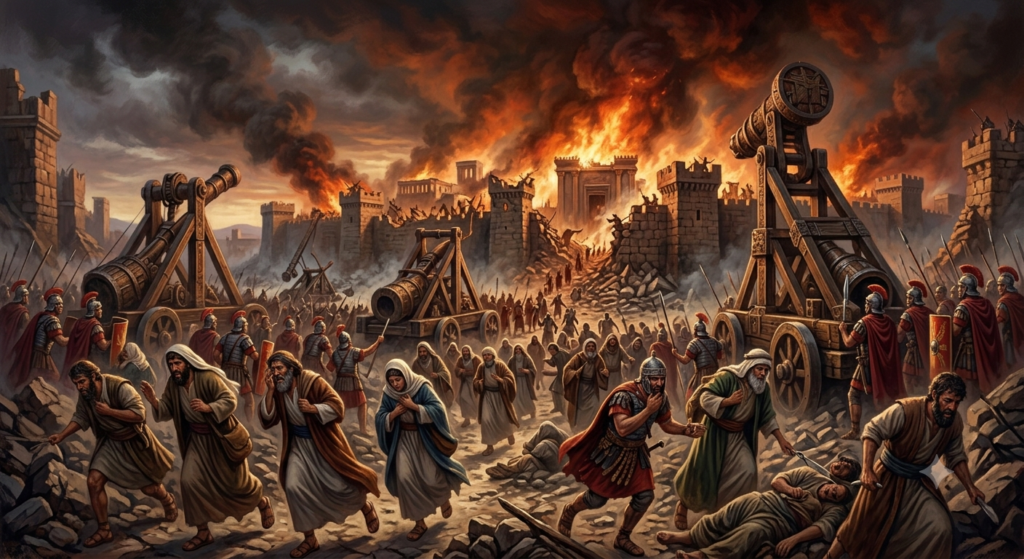
Daniel 9:26 contains a prophecy of devastating judgment: “a people with their leader that shall come, shall destroy the city and the sanctuary: and the end thereof shall be waste, and after the end of the war the appointed desolation” (DR). This was fulfilled with merciless precision in AD 70.
In AD 66, the Jewish nation revolted against Rome. Four years later, in AD 70, the Roman general Titus — the “prince” of Daniel 9:26 — besieged Jerusalem. After a five-month siege of unimaginable horror, the city fell. The Temple was demolished, stone by stone. Josephus records that over one million Jews perished in the siege and its aftermath; ninety-seven thousand were taken captive.
Our Lord had foretold this destruction in His Olivet Discourse, explicitly connecting it with Daniel’s prophecy:
“When therefore you shall see the abomination of desolation, which was spoken of by Daniel the prophet, standing in the holy place: he that readeth let him understand.” — Matthew 24:15, Douay-Rheims
And again, in mourning over Jerusalem:
“Behold, your house shall be left to you desolate.” — Matthew 23:38, Douay-Rheims
The destruction of Jerusalem was the solemn fulfilment of a prophecy written six centuries earlier, decreed by a just God who had offered His Son to His people and been refused. The desolation that swept over Judaea in AD 70 was the appointed consequence — “unto the consummation, and to the end” — of the national rejection of the Holy One of Israel.
Is There Still Hope for Israel?
The story of Daniel 9 does not end in judgment. The same tradition that interpreted the Seventy Weeks as fulfilled in Christ has always looked forward to a final great movement of God among the Jewish people — a large-scale turning of the house of Israel to their true Messiah in the last days.
St. Paul, writing to the Romans, draws on this hope in one of the most majestic passages in all of his letters:
“For I would not have you ignorant, brethren, of this mystery, (lest you should be wise in your own conceits), that blindness in part has happened in Israel, until the fulness of the Gentiles should come in. And so all Israel should be saved.” — Romans 11:25–26, Douay-Rheims
The “hardening in part” of Israel is not permanent. It has a purpose — the ingathering of the Gentiles — and it has a terminus. When God’s purposes among the nations are accomplished, a great conversion of the Jewish people to faith in their Messiah Jesus will occur. Many Catholic theologians and spiritual writers across the centuries have anticipated this as one of the great consolations of the end times.
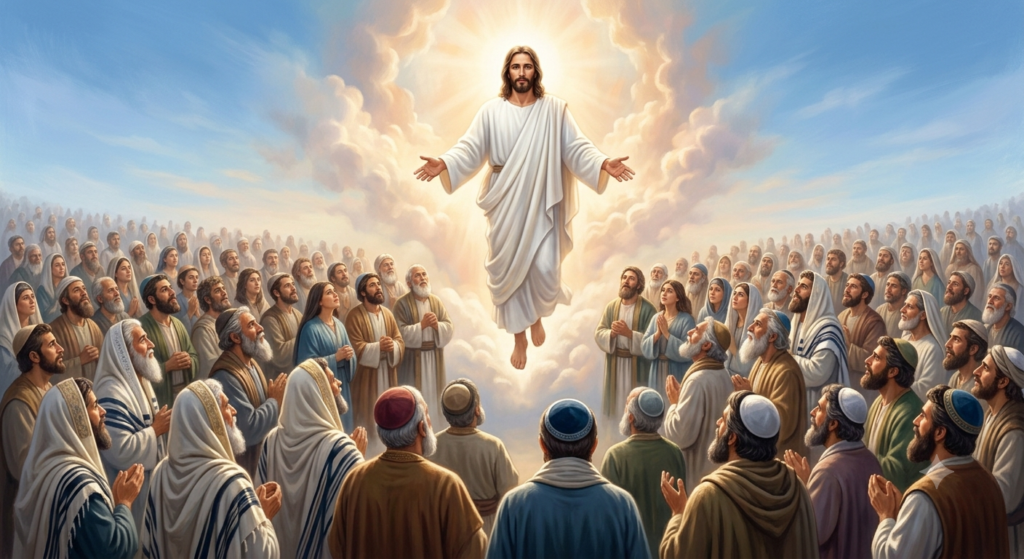
The Seventy Weeks prophecy is therefore not only a monument to God’s faithfulness in keeping His word but also a source of living hope: the same God who brought the Messiah into the world at the precise moment foretold by Daniel is working out His purposes still. The blindness that fell upon Israel at the stoning of Stephen will one day be lifted, and a great multitude of the sons of Abraham will see, with unveiled eyes, the One whom they pierced.
Conclusion: Why Does Daniel’s Prophecy Still Matter?
Daniel 9:24–27 is one of the most astonishing passages in all of Scripture. Written more than five centuries before the birth of Christ, it names Him by title (‘Christ the prince,’ DR), predicts the approximate year of His Baptism around AD 29, foretells His death at the midpoint of the final week in AD 33, and pronounces judgment on a nation that would reject Him. No other prophecy in any religious tradition demonstrates this level of historical precision.
The Historic-Messianic interpretation — the interpretation of the Church Fathers, the Reformers, the great Catholic and Protestant commentators — reads this prophecy as entirely fulfilled in the first century, with no artificial gaps and no future Antichrist. It sees in every line the sovereign hand of God, working out the redemption of humanity according to a timetable established before time began.
It also challenges us. If God kept His word so precisely in the first 69½ weeks of Daniel’s prophecy, we may have absolute confidence that He will keep it in everything that remains: the final conversion of Israel, the judgment of the world, and the glorious coming of Christ in His Kingdom.
The Talmudic curse that forbids reading Daniel 9 is, in its own way, a testimony. Truth does not need to be suppressed unless it is dangerous. And the truth of Daniel 9:24–27, faithfully read in the Douay-Rheims tradition, is the most dangerous truth in the Old Testament — dangerous to every false messiah, every competing religion, and every system of thought that denies the Lordship of Jesus Christ.
“Know thou therefore, and take notice: that from the going forth of the word, to build up Jerusalem again, unto Christ the prince, there shall be seven weeks, and sixty-two weeks.” — Daniel 9:25, Douay-Rheims
All Scripture quotations from the Douay-Rheims Bible unless otherwise noted.
References
Anderson, R. (1957). The coming prince: The marvelous prophecy of Daniel’s seventy weeks concerning the Antichrist (10th ed.). Kregel Publications. (Original work published 1894)
Finegan, J. (1998). Handbook of biblical chronology: Principles of time reckoning in the ancient world and problems of chronology in the Bible (Rev. ed.). Hendrickson Publishers.
Hoehner, H. W. (1977). Chronological aspects of the life of Christ. Zondervan Publishing House.
The Holy Bible: Douay-Rheims version. (1899 ed.). John Murphy Company.