Saints Who Wrote for Imperfect People: Holiness Despite Sin, Addiction, and Mental Illness
There is a particular loneliness that visits the believer who keeps falling. You go to confession, you mean it, and three weeks later you are kneeling in the same pew confessing the same sin. You pray for relief from the darkness in your head and the darkness does not lift. You wonder, quietly, whether holiness was ever really meant for someone like you.
The saints have an answer, and it is not the polished, stained-glass answer we often expect. The honest truth of the Church’s own canon is that a striking number of her greatest saints were addicts, depressives, public sinners, and spiritual wrecks before—and sometimes during—their journey to sanctity. The Church does not canonize the perfect. She canonizes the redeemed sinner.
This is not a sentimental claim. It is a doctrinal one. The Catechism of the Catholic Church teaches plainly that
“all Christians in any state or walk of life are called to the fullness of Christian life and to the perfection of charity” (CCC 2013)—and then immediately adds that
“the way of perfection passes by way of the Cross. There is no holiness without renunciation and spiritual battle” (CCC 2015). Holiness, in other words, is not the absence of struggle. It is fidelity inside the struggle.
This article looks at the imperfect saints: men and women who wrestled with severe temptation, mental illness, addiction, and catastrophic moral failure, and who became holy not in spite of being broken but as broken people leaning hard on grace. If you have ever felt too far gone, these are your patrons.
Who Was the Saint That Lost His Whole Life to Lust and Pride? (St. Augustine of Hippo)
No saint has written more candidly about his own disorder than Augustine of Hippo (354–430). His Confessions, composed around the year 397, is arguably the first true autobiography in Western literature, and it is essentially the diary of a man who could not stop sinning and could not stop wanting God.
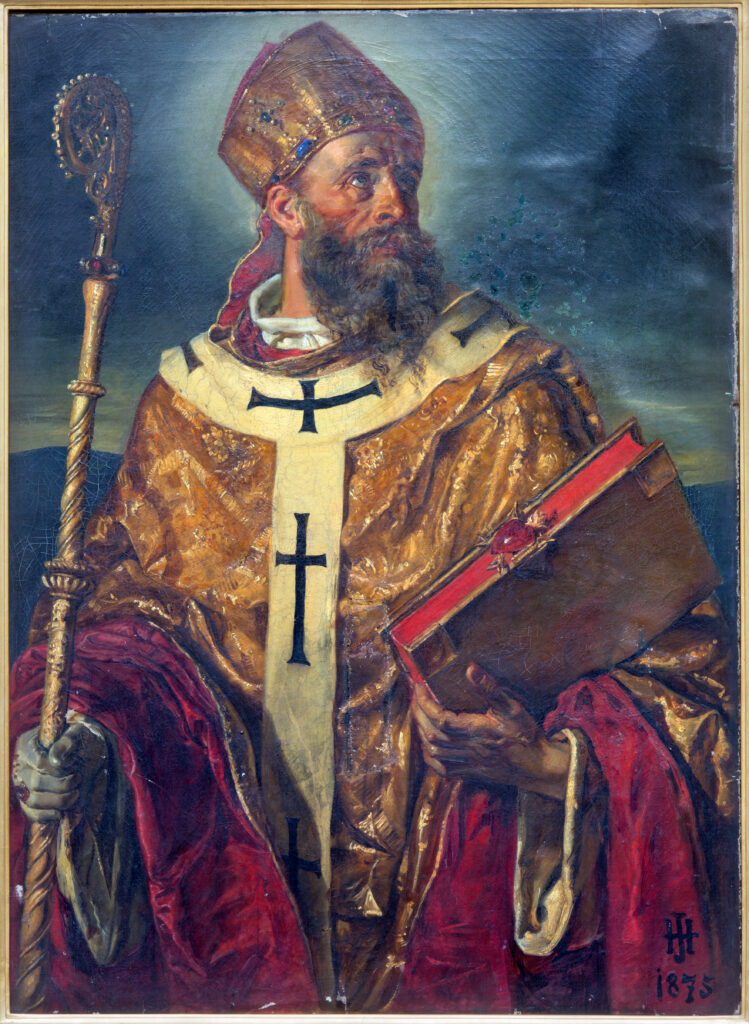
St Augustine’s struggles were threefold. There was sexual sin: he lived with a mistress for years, fathered a son out of wedlock, and famously prayed the most human prayer in the Christian canon—“Give me chastity and continence, but not yet” (Confessions 8.7). There was intellectual pride: he found the simplicity of the Scriptures beneath him and spent nine years entangled in Manichaeism, a dualist heresy that conveniently let him off the hook for his own choices. And there was the restless ambition that drove him from Carthage to Rome to Milan in pursuit of status.
His mother, St. Monica, wept and prayed for him for years. The turning point came in a Milan garden in 386 AD. In agony over his divided will, Augustine heard a child’s voice singing Tolle lege, tolle lege—”take up and read.” He opened St. Paul’s letters and his eyes fell on Romans 13:13–14. He later wrote: “I neither wished nor needed to read further… it was as though my heart was filled with a light of confidence and all the shadows of my doubt were swept away.”
St Augustine’s genius was to see that his decades of sin were not wasted but were the very raw material of his sanctity. His most famous line distils the entire theology of the imperfect saint: “Late have I loved you, O Beauty ever ancient, ever new, late have I loved you!… You called, you shouted, and you broke through my deafness” (Confessions 10.27). The man who took the longest to surrender became one of the greatest Doctors of the Church. His feast is August 28.
Recommended readings on the Life of St Augustine from TAN Books. Use CARMEL15 at checkout to receive a 15% Discount on NON-SALE ITEMS!
The Enchiridion of Faith, Hope, and Love
Who Was the Opium Addict the Church Made a Saint? (St. Mark Ji Tianxiang)
If St Augustine is the patron of the spectacular conversion, St. Mark Ji Tianxiang (1834–1900) is the patron of those who never get the conversion they pray for. His story is, frankly, scandalous to a certain kind of Catholic piety—which is precisely why it matters.
Mark Ji was a Chinese layman, a respected physician in Hebei province who treated the poor for free. In his mid-thirties he contracted a violent stomach ailment and treated himself with opium, the standard medicine of the day. He became addicted. His confessor—working without any understanding of addiction as a disease that alters brain chemistry—withheld absolution for thirty years, convinced Mark Ji lacked a firm purpose of amendment. For three decades, a devout man showed up to Mass he could not fully receive, shunned by his community, barred from the Eucharist, unable to beat the thing that had hold of him. And he kept showing up.
He prayed for the grace of martyrdom, convinced it was the only road to heaven left open to him. During the Boxer Rebellion of 1900 that prayer was answered. Mark Ji was rounded up with his son, two daughters-in-law, and six grandchildren. He begged his captors to execute him last, so that none of his family would die alone. He stood beside all nine of them as they were beheaded, singing the Litany of the Blessed Virgin Mary. Pope St. John Paul II canonized him on October 1, 2000, among the 120 Martyr Saints of China.
The Catechism teaches that “imputability and responsibility for an action can be diminished or even nullified by ignorance, inadvertence, duress, fear, habit, inordinate attachments, and other psychological or social factors” (CCC 1735). St Mark Ji’s confessor did not know this; the Church now canonizes the man he turned away. St. Mark Ji is the patron of addicts and all who feel the Church herself has shut the door on them.
Why Did the “Little Flower” Suffer a Crisis of Faith? (St. Thérèse of Lisieux)
The popular image of St. Thérèse of Lisieux (1873–1897) is all roses and sweetness. The reality is a young woman who battled what we would today recognise as serious mental and spiritual illness, and who died inside a crushing darkness of faith.
From childhood, Thérèse suffered from scrupulosity—a religious form of what psychologists now call obsessive-compulsive disorder, in which the sufferer is tormented by the fear that ordinary thoughts and acts are grave sins. The trial was so severe that it made her physically ill and forced her to leave school at thirteen. Then, in the last eighteen months of her life, as tuberculosis suffocated her, St Thérèse entered a “night of faith” so dark that she described it in Story of a Soul with shocking honesty: “One would have to travel through this dark tunnel to understand its darkness.” She heard, in the darkness, the mocking voice of unbelief itself.
What makes St Thérèse a Doctor of the Church is not that she escaped this darkness but what she did inside it. She reframed her suffering as solidarity, sitting—as she put it—”at the table of sinners,” offering her trial for atheists and unbelievers. A week before she died she said: “Yes! What a grace it is to have faith! If I had not any faith, I would have committed suicide without an instant’s hesitation.” This is not the testimony of a sheltered mystic. It is the testimony of someone who looked into the abyss and chose love anyway. Her “Little Way”—trusting God like a small child precisely because we cannot climb to him on our own merits—is the gospel for anyone whose feelings have stopped cooperating with their faith.
The following are a list of readings on the life of St Therese from a trusted Catholic Book supplier. Use CARMEL15 at checkout to receive a 15% Discount on NON-SALE ITEMS!
The Thoughts of St. Thérèse of the Child Jesus
The Story of a Soul: The Autobiography of Saint Therese of Lisieux (Deluxe Edition)
Can Someone With a Sexual Past Really Become a Saint? (St. Mary of Egypt and St. Margaret of Cortona)
The Church’s answer to this question is so emphatic that she gives us not one but several saints whose road to holiness began in sexual sin.
St. Mary of Egypt (c. 344–c. 421) ran away to Alexandria at twelve and lived seventeen years as a prostitute. She boarded a ship to Jerusalem seeking new conquests among pilgrims. But at the Church of the Holy Sepulchre, an invisible force barred her from entering. Convicted of her sin before an icon of the Virgin, she repented, crossed the Jordan, and spent forty-seven years alone in the desert. In her own words to the monk Zosimas: “For seventeen years I struggled with my deranged sexual desires as though with fierce beasts.” Her life maps perfectly onto the parable of the prodigal son.
St. Margaret of Cortona (1247–1297) ran off at seventeen with a nobleman and lived as his mistress for nine years. When he was murdered, the shock drove her to repentance. Rejected by her own father, she threw herself on the mercy of the Franciscans at Cortona. Her early penances were so violent that her confessor had to restrain her. Her Franciscan directors taught her the lesson at the heart of every imperfect saint’s story: no penance could earn Christ’s love, and no sin could make her unlovable in his eyes. She is the patron of single mothers, the falsely accused, and the mentally ill.
Which Saint Beat a Gambling Addiction to Found a Hospital Order? (St. Camillus de Lellis)
St. Camillus de Lellis (1550–1614) was a soldier of enormous stature—six foot six—with a violent temper and a ruinous addiction to gambling. In the winter of 1574, at age twenty-four, he gambled away everything he had: savings, weapons, and literally the shirt off his back, leaving him destitute on the streets of Rome. A festering leg wound that never fully healed compounded his misery.
His conversion came through a Capuchin sermon in 1575—but it was not instantaneous. Camillus relapsed into gambling more than once even after beginning studies for the priesthood. Grace worked on him gradually. Under the spiritual direction of St. Philip Neri, he became a nurse at a Roman hospital for incurables. Horrified by the neglect of the dying, he founded the Order of Clerks Regular, Ministers to the Sick—the Camillians—who wore a red cross and vowed to serve the sick at the risk of their lives, creating what amounted to the first military field ambulance. The compulsive gambler who threw away everything became the patron saint of the sick and nurses. His feast is July 14.
Did a Murderer and Gang Leader Really Become a Desert Father? (St. Moses the Black)
St. Moses the Black (c. 330–405) may be the most violent man ever canonized. A Nubian slave dismissed by his master for theft and suspected murder, he became the leader of a gang of robbers—some accounts list seventy-five men—who terrorised the Nile Valley. The early historian Palladius records that his crimes included murder.
After taking refuge among the desert monks of Scetis, Moses struggled for years with his violent temper and despair over his slow progress. His abbot, St. Isidore, took him to the roof before dawn and showed him the sunrise, saying: “Only slowly do the rays of the sun drive away the night… and thus, only slowly does one become a perfect contemplative.” Moses became a priest and spiritual father. His most famous saying, preserved in the Sayings of the Desert Fathers, came at a gathering called to condemn another monk: Moses arrived carrying a leaking basket of sand and said, “My sins run out behind me, and I do not see them, and today I am coming to judge the errors of another.” Around 405, warned of a bandit raid, he refused to take up arms and was martyred with seven companions. His feast is August 28.
How Did St. Ignatius Survive Suicidal Despair and Scrupulosity?
St. Ignatius of Loyola (1491–1556) was a vain and ambitious soldier until a cannonball shattered his leg at Pamplona in 1521. His convalescence conversion was followed not by peace but by a mental health crisis at Manresa that nearly killed him. He was assailed by ferocious scrupulosity—obsessively confessing past sins with no relief—fasted brutally, and grew so desperate that he was tempted to throw himself from a window. Modern Jesuit scholars identify the episode as a textbook case of major depression.
Only his fear of offending God restrained him: “Lord, I won’t do anything that would offend you.” His deliverance came when he learned to discern the source of his thoughts—to recognise that the spiral of despair was not from God but from “the enemy.” This hard-won insight became the backbone of his Spiritual Exercises and his famous “Notes Concerning Scruples,” in which he observes that the devil tempts the delicate conscience with scruples and the lax conscience with indifference. The man who wanted to jump out a window wrote one of the greatest manuals of spiritual healing in Christian history. His feast is July 31.
The following are a list of readings on the Spiritual Exercises of St Ignatius of Loyola from a Trusted Catholic Book supplier. Use CARMEL15 at checkout to receive a 15% Discount on NON-SALE ITEMS!
The Spiritual Exercises of Saint Ignatius
Saint Ignatius of Loyola: Founder of the Jesuits
What Does an Irish Alcoholic Teach Us About Sobriety? (Bl. Matt Talbot)
Venerable Matt Talbot (1856–1925) is the unofficial patron of everyone in recovery. Born into a poor Dublin family in which his father and most brothers were heavy drinkers, Matt was a confirmed alcoholic by sixteen. For sixteen years he drank away every wage, pawned his boots, and once stole a fiddle from a street musician to buy drink.
The turning point came in 1884. Penniless and out of credit, twenty-eight-year-old Matt stood outside a pub waiting for a friend to buy him a drink. None did. Humiliated, he walked home, announced to his mother he was “taking the pledge,” went to confession, and pledged to abstain from alcohol—first for three months, then for life. He maintained that sobriety for forty years.
The first seven years were brutal. He combated the cravings with daily Mass, the rosary, and intense prayer. He grasped a truth every recovering addict knows: “Never be too hard on the man who can’t give up drink. It’s as hard to give up the drink as it is to raise the dead to life again. But both are possible and even easy for Our Lord. We have only to depend on him.” Pope Paul VI declared him Venerable in 1975.
For these and more you may wish to take a course from TAN Books by clicking the link below.
Saints with a Past: A Study of Conversion in the Lives of Eight Notorious Sinners
What Do These Imperfect Saints Teach Us About God’s Mercy?
Step back from the individual stories and a pattern emerges that overturns much of our instinctive religion.
First, sanctity is not the erasure of weakness; it is fidelity within it. Pope Francis made this the heart of his 2018 apostolic exhortation Gaudete et Exsultate, insisting holiness is for ordinary, struggling people—what he calls “the middle class of holiness.” He is blunt that even canonized saints were not flawless: “Not everything a saint says is completely faithful to the Gospel… What we need to contemplate is the totality of their life” (Gaudete et Exsultate, 22). St Mark Ji never beat his addiction. St Moses never fully cooled his temper. Thérèse died in darkness. They are saints anyway.
Second, suffering itself can be redemptive. In Salvifici Doloris (1984), Pope St. John Paul II taught that human suffering united to the Cross of Christ acquires a salvific meaning—that “each man, in his suffering, can also become a sharer in the redemptive suffering of Christ.” Thérèse offering her night of faith for unbelievers, Mark Ji praying for martyrdom, Margaret embracing penance: these are not masochism but participation in the love that redeemed the world.
Third, mercy requires us to name the wound. The Catechism is striking: “to do its work grace must uncover sin so as to convert our hearts” (CCC 1848). The imperfect saints were all ruthless self-confessors— St Augustine in his Confessions, St Ignatius in his examen, Blessed Talbot in his pledge. And the Church reminds us that “God predestines no one to go to hell” (CCC 1037); the door is never shut from God’s side.
Conclusion: A Pastoral Word for the Still-Struggling
If you are reading this in the same pew, confessing the same sin, fighting the same darkness, the message of the imperfect saints is not “try harder.” It is “keep showing up.” St Mark Ji showed up to a Mass he could not receive for thirty years. St Camillus relapsed and came back. St Moses watched the slow sunrise. St Thérèse made more acts of faith in her darkness than in all her years of light.
Holiness is finally a gift, not an achievement—”the most excellent work of God’s mercy” (CCC 2020)—and it is given to people exactly like you. The saints who struggled are not the exception to sanctity; in a real sense they are its truest face, because they show that grace works on the unfinished, the addicted, the depressed, the failed, and the ashamed. Your weakness is not disqualifying. It may be, as it was for them, the very place where God breaks through.
St. Augustine, St. Mark Ji Tianxiang, St. Thérèse of Lisieux, St. Mary of Egypt, St. Margaret of Cortona, St. Camillus de Lellis, St. Moses the Black, St. Ignatius of Loyola, and Venerable Matt Talbot—all of you who were imperfect and became holy—pray for us.
References
Augustine of Hippo. (1992). Confessions (H. Chadwick, Trans.). Oxford University Press. (Original work composed ca. 397–400)
Bellm, C. (2021). No unlikely saints: A mental health pilgrimage with sacred company. Ave Maria Press.
Catholic News Agency. (n.d.). St. Camillus de Lellis, patron saint of hospitals, nurses, and the sick. https://www.catholicnewsagency.com
Denver Catholic. (n.d.). Venerable Matt Talbot: The saint of sobriety. https://www.denvercatholic.org
Franciscan Media. (n.d.). Saint Camillus de Lellis. https://www.franciscanmedia.org
Franciscan Media. (n.d.). Venerable Matt Talbot. https://www.franciscanmedia.org
John Paul II. (1984). Salvifici doloris: On the Christian meaning of human suffering. Libreria Editrice Vaticana.
Our Sunday Visitor. (n.d.). The life of St. Mark Ji Tianxiang: Persevering in faith despite addiction. https://www.oursundayvisitor.com
Pope Francis. (2018). Gaudete et exsultate: On the call to holiness in today’s world. Libreria Editrice Vaticana.
Simonson, Z. (2024, October 30). St. Mark Ji Tianxiang, the opium addict who became a saint. National Catholic Register. https://www.ncregister.com
Sophronius of Jerusalem. (n.d.). The life of St. Mary of Egypt (Patrologia Latina, Vol. 73).
St. Mary & St. Moses Abbey. (n.d.). Saint Moses the Strong (the Black). Coptic Orthodox Church.
Thérèse of Lisieux. (1976). Story of a soul: The autobiography of St. Thérèse of Lisieux (J. Clarke, Trans.). ICS Publications. (Original work published 1898)
United States Conference of Catholic Bishops. (2000). Catechism of the Catholic Church (2nd ed.). Libreria Editrice Vaticana.
Ward, B. (Trans.). (1984). The sayings of the desert fathers: The alphabetical collection. Cistercian Publications.