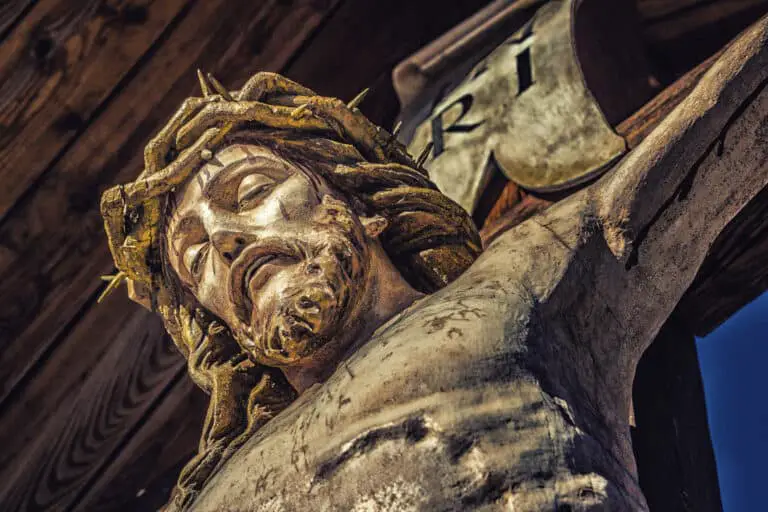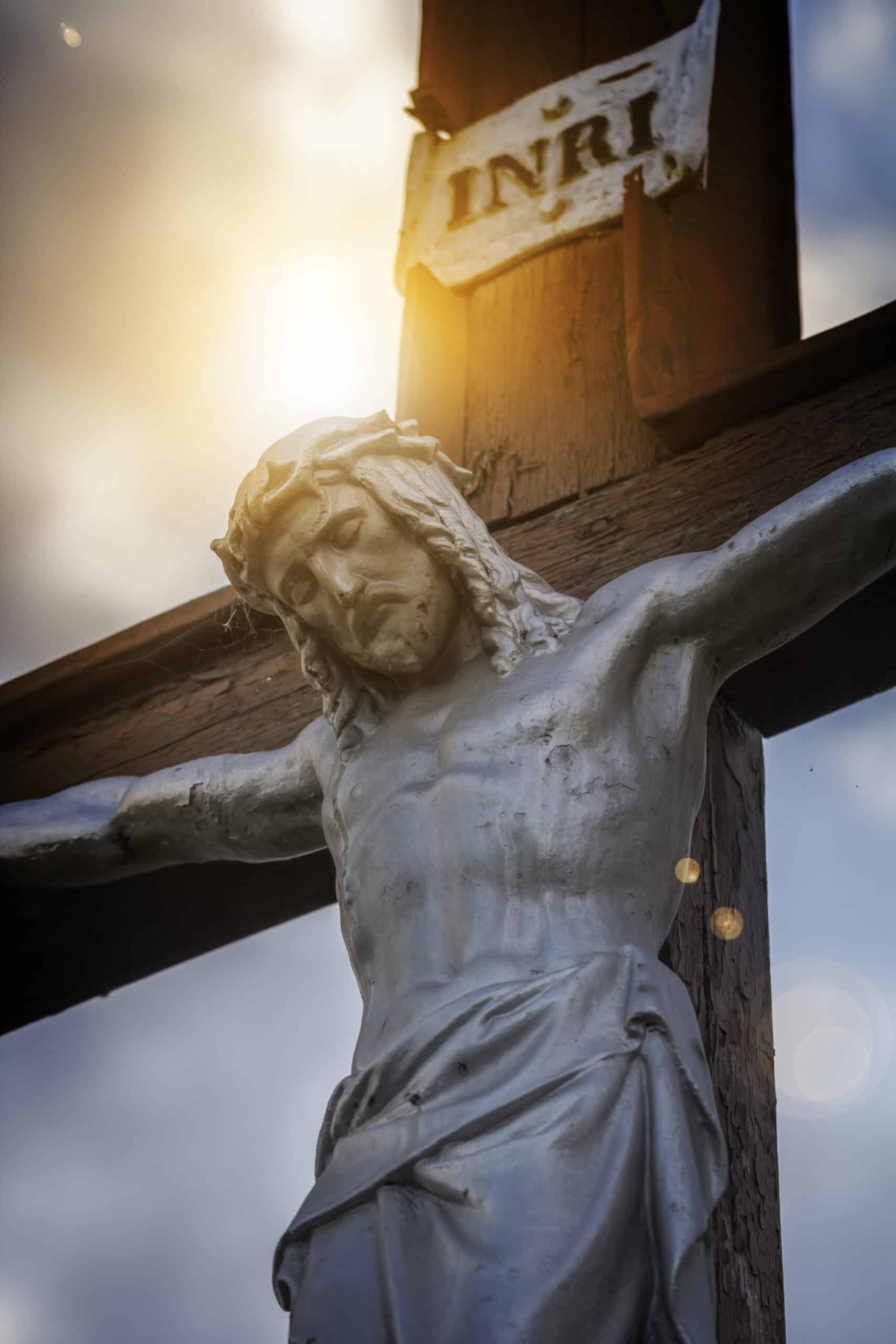
How Does Christ’s Declaration ‘It Is Finished’ Mark the Definitive Consummation of Salvation History?
“It is finished.” — John 19:30
What Is the Significance of Tetelestai as the Proclamation of Victory?
The sixth word from the Cross, again recorded only by St John the Evangelist, is simultaneously the simplest and the most theologically resonant declaration in the entire Passion narrative: ‘It is finished’ (John 19:30). The Greek word rendered ‘finished’ is tetelestai — a perfect passive verb meaning not merely ‘it is over’ but ‘it has been brought to its completion,’ ‘it stands accomplished,’ ‘it has been perfected.’ This is not the sigh of exhaustion of a dying man but the proclamation of a Victor who has completed the work for which He came. In these words, the entire Old Testament economy of sacrifice, prophecy, and preparation is declared fulfilled; the debt of sin is cancelled; the Redemption is accomplished.
The choice of the perfect passive form in Greek is theologically significant. The perfect tense in Greek denotes an action completed in the past with permanent and ongoing effects in the present: tetelestai means not merely ‘it was finished at some point’ but ‘it has been finished and remains finished.’ The work of Redemption is not a provisional arrangement subject to revision; it is a definitive and permanent achievement. The permanent, ongoing effect of Christ’s completed work is the foundation of the entire sacramental life of the Church: the Eucharist, Baptism, Reconciliation, and all the other sacraments draw their efficacy from this single, unrepeatable, permanently efficacious act.
In Greek commercial and legal usage, tetelestai was also the word stamped on paid receipts and satisfied contracts. A debt was declared tetelestai when it had been paid in full. This commercial resonance, noted by several commentators, enriches the theological understanding: in crying tetelestai, Christ declares that the debt of sin — the infinite debt that no finite creature could repay — has been satisfied in full by the infinite value of His sacrifice. There is no remaining balance; no further reparation is required from the side of God’s justice.
How Does Cornelius a Lapide Enumerate What Was Consummated on the Cross?
Cornelius a Lapide’s Commentary on John 19:30 opens with a philological reflection on tetelestai, which he renders in Latin as consummatum est — ‘it has been consummated’ or ‘brought to its perfection.’ He distinguishes this word carefully from a mere statement of termination (finitum est, ‘it is ended’) to establish its triumphal character. A Lapide then enumerates what has been ‘finished’ or brought to completion: the entirety of Mosaic Law and its prefigurative sacrificial system; all the Messianic prophecies contained in the Law and the Prophets; the mission entrusted to the Son by the Father; and the work of human redemption, the cancellation of the debt of original sin and all actual sin.
These words, Consummatum est, are the most triumphant ever spoken on this earth. The soldier hears the end of a campaign; the artist hears the completion of a masterpiece; the Son of God declares the consummation of the eternal plan of Redemption formed before the foundation of the world. In dying, He conquers; in finishing, He begins the new creation. (a Lapide, 1876, Vol. V, p. 531, Commentary on John 19:30)
A Lapide further reflects on the sixfold consummation achieved on the Cross:
(1) the consummation of all the Law’s ceremonies and prefigurations in the one eternal Sacrifice;
(2) the consummation of all Scriptural prophecy regarding the Messiah;
(3) the consummation of the obedience of the New Adam, perfectly reversing the disobedience of the first;
(4) the consummation of the divine justice satisfied by infinite reparation;
(5) the consummation of the divine mercy poured out without measure; and
(6) the consummation of Christ’s own human love, which had desired nothing more throughout His earthly life than to complete this work for the glory of the Father and the salvation of the world.
A Lapide’s sixfold schema is a synthesis of the entire tradition and reveals the multi-dimensional nature of the Atonement. The Cross is not merely a legal transaction (satisfying divine justice), nor merely a moral example (demonstrating divine love), nor merely a cosmic battle (defeating the devil) — though it is all of these. It is the comprehensive consummation of everything that the entire prior history of revelation had been preparing, and the definitive inauguration of everything that the subsequent history of the Church would be receiving and distributing.
What Do the Church Fathers Teach About the Meaning of ‘It Is Finished’?
How Does St. Irenaeus Understand This Word Through the Lens of Recapitulation?
St. Irenaeus, in his monumental Against Heresies, develops the concept of ‘recapitulation’ (anakephalaiōsis) — the idea that Christ in His person and in His work sums up and brings to completion the entire history of humanity. The sixth word, consummatum est, is the verbal expression of this recapitulation. All that Adam’s disobedience had undone is undone by Christ’s obedience; all that the Old Covenant had promised is now delivered (Irenaeus of Lyon, c. 185/1885, Against Heresies, Book V, Ch. 21). Irenaeus sees the Passion as the climactic moment of a history that began in Eden and finds its resolution at Calvary. The sixth word is therefore not merely the end of Jesus’s earthly life but the end — the telos, the goal — of the entire human story from Adam to the last day, which reaches its climax at the Cross and then unfolds into the eschatological fullness of the Kingdom.
How Does Tertullian Use This Word Against Marcionite Dualism?
Tertullian, in his Against Marcion, uses the sixth word as a refutation of Marcionite dualism. If the Old Testament God and the New Testament God were different, then the Mosaic Law and its prophecies would not be fulfilled by Christ — they would be irrelevant. But consummatum est declares precisely their fulfilment: the same God who gave the Law now consummates it in the Gospel. There is one God, one covenant of salvation, one history of Redemption brought to its completion on the Cross (Tertullian, c. 208/1972, Against Marcion, Book IV, Ch. 42). Tertullian’s polemical point has permanent apologetic value: the unity of the two Testaments is confirmed, not relativised, by the Cross. The Cross does not render the Old Testament obsolete; it renders it complete.
How Does St. Augustine Hear in This Word the Answer to the Psalms’ Longing?
St. Augustine, in his Tractates on the Gospel of John, hears in consummatum est the perfect answer to the Psalmist’s many expressions of longing. The whole of the Psalms is, for Augustine, a voice of desire — the desire of the Body for its Head, of humanity for its God. At the sixth word, that desire is satisfied: the work of Redemption stands accomplished (Augustine, c. 416/1988, Tractates on the Gospel of John, Tractate 119). St. Augustine also connects this word with the completion of the Scriptures themselves: with Christ’s dying declaration, there is nothing more to be added to the Word of God. Revelation is consummated in the Consummator of all things. This insight is echoed in the Church’s doctrine of the closure of Public Revelation with the death of the last Apostle: after the Cross and Resurrection, there is nothing new to be revealed, only the inexhaustible truth of what has already been accomplished to be understood more deeply.
How Does St. John Chrysostom Proclaim the Sixth Word as the Announcement of Paschal Victory?
St. John Chrysostom, with his characteristic emphasis on the triumphant Christ, reads the sixth word as a declaration of victory rather than of defeat. He contrasts the warrior who falls in battle with no achievement to show and the Christ who dies having accomplished the entire mission of the eternal Father. St. John Chrysostom writes that the Cross is the trophy of Christ’s victory over sin, death, and the devil, and that consummatum est is the proclamation of that victory (Chrysostom, c. 400/1843, Homilies on the Gospel of John, Homily 85). He uses this word extensively in his Easter preaching to establish the paschal joy that flows directly from the completed work of the Cross. For St. John Chrysostom, Good Friday and Easter Sunday are not opposed days but two aspects of a single divine triumph: the completion announced on Good Friday is vindicated and revealed on Easter morning.
How Does St. Thomas Aquinas Systematically Unpack the Meaning of ‘It Is Finished’?
St. Thomas Aquinas, in his Commentary on the Gospel of St. John, provides the most systematic treatment of the sixth word among the Scholastics. He identifies three primary referents of ‘It is finished’:
(1) the work of satisfying divine justice for the sins of humanity;
(2) the work of fulfilling every scriptural prophecy; and
(3) the work of demonstrating perfect obedience to the Father — ‘obedient to death, even death on a cross’ (Phil. 2:8).
St. Thomas’s Passion theology in the Summa Theologiae (III, Q. 48–49) is effectively a systematic unpacking of what ‘It is finished’ means theologically (Aquinas, c. 1270/2010, Commentary on the Gospel of John, Lecture on Chapter 19). The completeness of the satisfaction, the exhaustive fulfilment of prophecy, and the absolute perfection of obedience all converge in this single word: nothing more is needed, nothing has been omitted, and the Father’s will has been executed to its uttermost degree.
How Does St. Robert Bellarmine Connect the Sixth Word with the Art of Dying Well?
St. Robert Bellarmine, Jesuit theologian and Doctor of the Church, reflects on this sixth word in his spiritual writings. He connects consummatum est with the concept of ‘the art of dying well’ (ars moriendi): Christ’s dying word is the model for every Christian’s death. The Christian who has lived faithfully can approach death with the hope of saying, in a derivative sense, ‘It is finished’ — the course has been run, the faith kept, the work entrusted by God accomplished (Bellarmine, c. 1620/1989, The Art of Dying Well, Ch. 1). St. Robert Bellarmine uses this word as a call to perseverance: to live in such a way that death will indeed be a consummation and not a mere termination. This pastoral application transforms the sixth word from a theological datum into a lifelong vocation: each Christian is called to ‘finish’ their own mission as Christ finished His, so that at death they may echo, in their own limited and derivative way, the great tetelestai of Calvary.
What Is the Theological Synthesis Offered by the Sixth Word?
The sixth word is the hinge on which salvation history turns. Before the Cross, all was preparation, prophecy, and longing; after the Cross, all is reception, application, and thanksgiving. Consummatum est declares that the debt has been paid in full, that the sacrifice is complete, that the New Covenant has been sealed in the Blood of the Lamb. A Lapide’s synthesis, echoing every voice in the tradition, is triumphant: this is not the word of defeat but of absolute victory. The one who cries ‘It is finished’ is not finished; He is about to rise.
The permanent implications of the sixth word for the life of the Church are immense. Every Eucharist celebrated is a thanksgiving (eucharistia) for the completed work of Calvary. Every sacrament administered draws its efficacy from the tetelestai of the dying Christ. Every act of the Christian life — prayer, charity, suffering, obedience — participates in the consummation of the Cross, adding to it not by supplementing its infinite value but by sharing in its application to the ongoing history of the world. The completed work of Christ does not render human cooperation superfluous; it transforms human cooperation into a participation in divine consummation.
References
a Lapide, C. (1876). The great commentary of Cornelius a Lapide: The holy Gospel according to Saint John (T. W. Mossman, Trans., Vol. V). John Hodges. (Original work 1616)
Aquinas, T. (c. 1270/2010). Commentary on the Gospel of John (F. R. Larcher, Trans.). The Aquinas Institute for the Study of Sacred Doctrine. (Original work c. 1269–1272)
Augustine of Hippo. (c. 416/1988). Tractates on the Gospel of John (J. W. Rettig, Trans.). Fathers of the Church Series (Vols. 78–92). Catholic University of America Press. (Original work c. 416–420)
Bellarmine, R. (c. 1620/1989). The art of dying well (J. Dalton, Trans.). Burns and Oates. (Original work c. 1620)
Chrysostom, J. (c. 400/1843). Homilies on the Gospel of Saint John (P. Schaff, Trans.). In P. Schaff (Ed.), Nicene and Post-Nicene Fathers, First Series (Vol. 14). Christian Literature Publishing. (Original work c. 390–407)
Irenaeus of Lyon. (c. 185/1885). Against heresies (A. C. Coxe, Trans.). In A. Roberts & J. Donaldson (Eds.), Ante-Nicene Fathers (Vol. 1). Christian Literature Publishing. (Original work c. 180–185)
Tertullian. (c. 208/1972). Against Marcion (E. Evans, Trans.). Oxford Early Christian Texts. Clarendon Press. (Original work c. 207–208)