What Does Christ’s Cry of Dereliction Reveal About the Depths of Human Suffering and Redemptive Solidarity?
My God, my God, why have you forsaken me?” — Matthew 27:46; Mark 15:34
Why Is the Fourth Word the Most Theologically Challenging Utterance of the Passion?
The fourth word from the Cross is the most theologically challenging and, in many ways, the most profound. Spoken in Aramaic — ‘Eli, Eli, lama sabachthani?’ (Matt. 27:46) or ‘Eloi, Eloi, lama sabachthani?’ (Mark 15:34) — it is a verbatim quotation of the opening verse of Psalm 22 (21 in the Septuagint). The cry of apparent abandonment from the lips of the eternal Son of God has generated more theological reflection than almost any other verse in the New Testament. It touches the deepest mysteries of the hypostatic union, the Trinitarian life, the nature of the Atonement, and the spirituality of desolation and dark night.
Several interrelated questions press upon the interpreter of this word. First: Can the eternal Son truly be abandoned by the Father? Second: If not, in what sense does this cry express a genuine experience? Third: What is the relationship between this cry and the rest of Psalm 22, which ends in triumphant confidence? Fourth: How does this word illuminate the experience of spiritual desolation — the so-called ‘dark night’ — that forms part of the normal trajectory of mystical progress? Fifth: What does this word reveal about the nature of Christ’s saving work — is it principally vicarious identification, substitutionary satisfaction, or some more complex synthesis?
The tradition is unanimous on one point: this cry is not an expression of despair, nor does it indicate any fracture in the eternal Trinitarian communion. But beyond this point of consensus, the tradition deploys a rich variety of complementary explanations, each of which illuminates a different facet of the inexhaustible mystery.
How Does Cornelius a Lapide Resolve the Theological Difficulties of the Fourth Word?
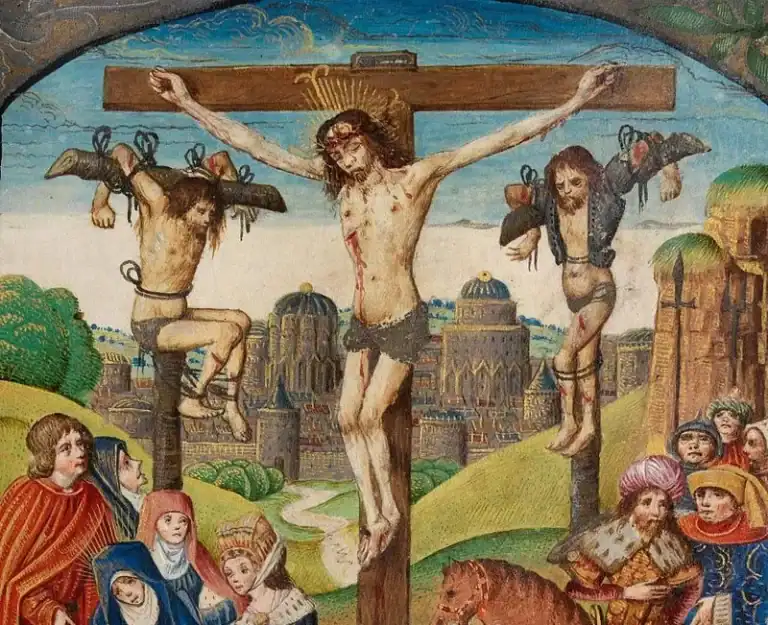
Cornelius a Lapide addresses this passage with characteristic thoroughness in his Commentary on Matthew. He begins by establishing the Psalm 22 context: Christ’s cry is not merely an expression of individual anguish but a deliberate citation of the great Messianic psalm, which begins in desolation and ends in triumphant confidence in God’s ultimate deliverance. A Lapide insists that Christ, in quoting this psalm, was drawing the attention of all who heard Him — especially those familiar with the Scriptures — to the entire psalm, whose later verses describe the very events unfolding around the Cross: the division of garments, the piercing of hands and feet, the mockery of bystanders.
Christ cries out not because the divinity of the Word has abandoned the humanity, for such separation is impossible — the hypostatic union cannot be dissolved. He cries out on behalf of us, His members, voicing the desolation of a humanity abandoned to suffering and death, and fulfilling the prophecy of the Psalmist who spoke in His person from the beginning.
(a Lapide, 1876, Vol. III, p. 621, Commentary on Matthew 27:46)
A Lapide examines and resolves several interpretative difficulties. He refutes the reading that would understand the cry as an expression of genuine ontological separation between the Father and the Son — a reading that would be theologically impossible and Nestorian in implication. Instead, following the Augustinian and Thomistic tradition, he understands the cry as spoken by Christ as Head of His mystical Body: He voices the dereliction of sinful humanity, abandoned by God through sin, and takes that cry of anguish upon His own lips as the representative of all the condemned.
This interpretation represents one of the most daring and profound moves in Catholic theology: the Son of God does not merely observe human dereliction from a divine distance; He assumes it so completely that He speaks it from within. In doing so, He transforms it: the dereliction that the sinner experiences as a consequence of sin, Christ experiences as the innocent representative of sinners. By speaking our cry of abandonment, He makes it His own — and in making it His own, He begins its redemption.
What Do the Church Fathers Teach About the Meaning of the Cry of Dereliction?
How Does St. Hilary of Poitiers Defend Divine Impassibility Against Misreadings of This Cry?
St. Hilary of Poitiers, in his magisterial De Trinitate, provides one of the earliest and most philosophically rigorous treatments of this cry. He argues that the Word of God, being impassible in His divine nature, cannot suffer abandonment in any ontological sense. Rather, Christ speaks these words in His assumed human nature, expressing the condition of the humanity He took upon Himself — a humanity that, by bearing the sins of the world, had entered the condition of those who stand under divine judgment (Hilary of Poitiers, c. 360/1954, De Trinitate, Book X, §§ 38–48). Hilary’s contribution is the rigorous defence of divine impassibility without any softening of the genuine human suffering involved: both poles must be maintained, and the doctrine of the hypostatic union is the hinge on which they are reconciled.
How Does St. Augustine’s ‘Voice of the Body’ Interpretation Shape the Western Tradition?
St. Augustine’s interpretation of the fourth word is the most influential in the Western tradition. In his lengthy Commentary on the Psalms (Enarrationes in Psalmos), Augustine explains that Christ speaks these words in persona nostra — ‘in our person.’ This is a form of speech that Augustine calls the ‘voice of the Body’ — the mystical Body of Christ, the Church and humanity, finding its voice in the Head. Christ has no sin of His own that could occasion real abandonment; He speaks in the person of sinful humanity, giving voice to its condition, and in doing so, takes that condition into Himself to transform it (Augustine, c. 415/1958, Enarrationes in Psalmos, Psalm 21). This Augustinian framework — the Head speaking with the voice of the Body — became the standard Catholic interpretation and was endorsed by Aquinas, A Lapide, and the entire subsequent tradition.
What Prophetic Significance Does St. Jerome Find in the Quotation of Psalm 22?
St. Jerome, in his Commentary on Matthew, emphasises the fulfilment of prophecy: Christ deliberately quotes Psalm 22 to signal to the learned among His hearers that this is the moment the Psalm prophesied. Jerome notes the detailed correspondence between the Psalm and the events of the Crucifixion — the casting of lots for garments (Ps. 22:18), the mockery (‘He trusted in the Lord; let him deliver him,’ Ps. 22:8), the piercing of hands and feet (Ps. 22:16) — and argues that the cry is therefore simultaneously a prayer of trust and a proclamation that prophecy is being fulfilled before their eyes (Jerome, c. 398/2008, Commentary on Matthew, Book IV, on Matthew 27:46). Jerome’s interpretive point is crucial for apologetics: far from being an expression of defeated faith, the fourth word is a confident, knowing citation of Scripture that invites informed hearers to see the entire psalm being enacted before them.
What Pastoral Lesson Does St. John Chrysostom Draw from the Cry of Dereliction?
Chrysostom, in his Homilies on Matthew, adds a pastoral dimension to the interpretation. He argues that Christ uttered this cry partly for the sake of those hearing — to demonstrate that He was truly suffering in His human nature and not undergoing a merely apparent passion (against the Docetists) — and partly to teach all believers the language of prayer in desolation (Chrysostom, c. 400/1843, Homilies on Matthew, Homily 88). Christ shows that even in the darkest moment — when God seems silent and absent — the proper response is still to cry out to God, to persist in address even when no answer seems to come. The soul in desolation should not turn away from God in despair or resentment; it should, with Christ, intensify its cry.
How Does St. Thomas Aquinas Resolve the Apparent Contradiction Between Beatific Vision and Desolation?
Aquinas, in the Summa Theologiae and the Tertia Pars, discusses whether Christ suffered true desolation. He argues with great precision that Christ’s soul, even on the Cross, enjoyed the beatific vision in its apex (the higher part of the soul, the apex mentis), while the lower sensory and emotional faculties suffered the full force of abandonment, sorrow, and pain (Aquinas, 1274/1948, Summa Theologiae, III, Q. 46, A. 7). This is the Thomistic synthesis that A Lapide largely follows: there is no contradiction between Christ’s enjoyment of union with the Father and His genuine human experience of desolation, because these operate on different levels of the same soul. The cry of dereliction is therefore the authentic expression of Christ’s human emotional experience — not a fiction, not a performance, but a genuine cry — while remaining entirely consistent with the unbroken union of the Son with the Father.
How Does St. John of the Cross Find in the Fourth Word the Foundation of Mystical Theology?
St. John of the Cross, Doctor of the Church and master of mystical theology, returns to the fourth word as the theological ground of the ‘dark night of the soul.’ In The Ascent of Mount Carmel and The Dark Night, he argues that the highest form of spiritual purification involves precisely this experience of apparent abandonment by God — an experience that Christ underwent in its absolute fullness on the Cross, making His cry the supreme model and charter for all souls who pass through the passive night of the spirit (John of the Cross, c. 1585/1991, The Dark Night, Book II, Ch. 7). The soul in the dark night is not truly abandoned by God; it participates in Christ’s cry of Psalm 22, trusting that the same psalm which begins in desolation ends in resurrection. John of the Cross’s contribution is to show that the fourth word is not merely a theological datum but a living spiritual reality that is recapitulated in every soul that is drawn into deep union with God.
What Is the Theological Synthesis Offered by the Fourth Word?
The fourth word from the Cross is the abyss of the Redemption. It descends into the depths of human dereliction — the condition of sin, death, and separation from God — and, by the presence of the divine Son in that abyss, transforms it. The tradition unanimously refuses to read this cry as a failure of faith or a moment of despair; rather, it is the most profound act of trust — the trust that persists in crying out to God even when God seems to have turned His face away.
As A Lapide and the entire patristic and scholastic tradition teach, the fourth word is spoken in our name, so that our desolation might find voice in the mouth of God’s own Son, and be redeemed thereby. The cry that sinners should utter in the darkness — ‘My God, my God, why have you forsaken me?’ — is taken up by the sinless God-Man and transformed, from within, into an act of perfect fidelity and trust. Every soul that has ever experienced the silence of God, the dryness of prayer, the darkness of faith, finds in this fourth word not a permission to despair but an invitation to unite its own desolation to that of Christ, confident that the psalm that begins in darkness ends in the triumphant proclamation: ‘They shall come, and shall declare his justice’ (Ps. 22:31).
References
a Lapide, C. (1876). The great commentary of Cornelius a Lapide: The holy Gospel according to Saint Matthew (T. W. Mossman, Trans., Vol. III). John Hodges. (Original work 1616)
Aquinas, T. (1274/1948). Summa theologiae (Fathers of the English Dominican Province, Trans., 5 vols.). Benziger Bros. (Original work c. 1265–1274)
Augustine of Hippo. (c. 415/1958). Expositions on the Book of Psalms (A. C. Coxe, Trans.). In P. Schaff (Ed.), Nicene and Post-Nicene Fathers, First Series (Vol. 8). Eerdmans. (Original work c. 415)
Chrysostom, J. (c. 400/1843). Homilies on the Gospel of Saint Matthew (G. Prevost, Trans.). In P. Schaff (Ed.), Nicene and Post-Nicene Fathers, First Series (Vol. 10). Christian Literature Publishing. (Original work c. 390–407)
Hilary of Poitiers. (c. 360/1954). The Trinity (S. McKenna, Trans.). Fathers of the Church Series (Vol. 25). Catholic University of America Press. (Original work c. 356–360)
Jerome. (c. 398/2008). Commentary on Matthew (T. P. Scheck, Trans.). Fathers of the Church Series (Vol. 117). Catholic University of America Press. (Original work c. 398) John of the Cross. (c. 1585/1991). The collected works of St. John of the Cross (K. Kavanaugh & O. Rodriguez, Trans.). ICS Publications. (Original work c. 1579–1585)