In What Sense Does Christ’s Third Word from the Cross Establish Mary as Universal Mother of the Faithful?
“Woman, behold your son… Behold your mother.” — John 19:26–27
What Is the Ecclesiological Significance of the Third Word?
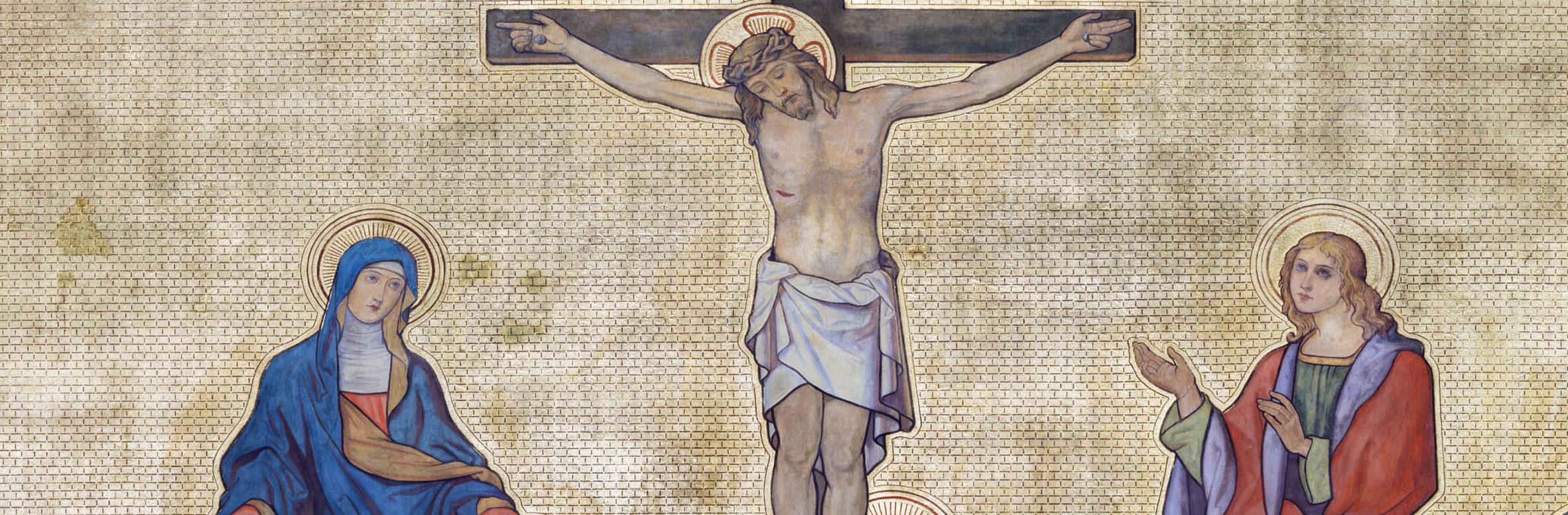
The third word spoken from the Cross is unique among the seven in that it is addressed not to God the Father, nor to a dying sinner, but to two persons standing at the foot of the Cross: the Blessed Virgin Mary and the beloved disciple St. John. ‘When Jesus therefore saw his mother, and the disciple standing by whom he loved, he said to his mother: Woman, behold your son. After that, he saith to the disciple: Behold your mother. And from that hour, the disciple took her to his own’ (John 19:26–27). This third word has been the foundation of the entire Catholic theology of Mary’s spiritual motherhood and of her unique role in the economy of salvation.
This utterance is remarkable on several levels. First, it is addressed by a dying man to his mother — an act of filial piety that even in ordinary circumstances would be deeply moving. But the circumstances are far from ordinary: the dying man is the eternal Son of God, and the act of provision He performs is not merely the arrangement of earthly care but the conferral of a new and universal relationship. Second, the address ‘Woman’ rather than ‘Mother’ is theologically deliberate, connecting this moment to a web of Scriptural typology that embraces the whole of salvation history. Third, the declaration is made to the Beloved Disciple in the second person — not ‘this is your mother’ but ‘behold your mother’ — emphasising the active and ongoing nature of the relationship that is being established.
The Church Fathers consistently understand this passage as founding not merely an individual arrangement between Mary and John but as establishing a universal spiritual maternity. The Beloved Disciple stands as the representative of all the faithful; Mary’s reception of him as her son is simultaneously her reception of the entire Church. This interpretation, explicit in Origen and Augustine, was formally restated by the Second Vatican Council in Lumen Gentium §§ 61–62.
How Does Cornelius a Lapide Develop the Theology of Mary’s Universal Spiritual Motherhood?
Cornelius a Lapide’s commentary on John 19:26–27 is one of the richest sections of his entire Great Commentary. He begins by observing that, in addressing Mary as ‘Woman’ rather than ‘Mother,’ Christ uses the same title He employed at Cana (John 2:4) and that which was applied to the Woman of Genesis 3:15. This is not a distancing but a theological elevation: Christ is presenting Mary in her universal dignity as the New Eve, the Woman of the proto-evangelium, whose ‘seed’ crushes the serpent’s head. The address ‘Woman’ is therefore a title of honour and theological significance, linking the Cross to the Garden of Eden and establishing Calvary as the definitive reversal of the Fall.
By entrusting John to Mary and Mary to John, Christ gave to His beloved disciple what is greater than any earthly inheritance: a Mother, and gave to His Mother what is most precious — a son in whom the whole Church is represented. For John stands here not merely as an individual, but as the type and figure of all the faithful whom Mary receives as her children in the order of grace.
(a Lapide, 1876, Vol. V, p. 512, Commentary on John 19:26–27)
A Lapide elaborates at length on the spiritual sense of this word, following the tradition of the Fathers and confirmed by subsequent Marian theology. He argues that Christ, as He fulfilled every detail of the Law in His life, also fulfilled His obligation as a dutiful Son — providing for the care of His mother. But this provision goes beyond mere filial duty: in giving Mary to John, Christ gives her to the whole Church, for John is the representative of all the faithful. The ‘new family’ created at the foot of the Cross — with Mary as Mother and John as the type of the Christian disciple — is the Church herself.
A Lapide also reflects on the profound silence of the text regarding Mary’s response. John records no words from Mary at this moment — only the action: ‘from that hour, the disciple took her to his own.’ A Lapide, following several Fathers, reads this silence as itself a theological statement: Mary receives the word of her Son with the same silent and total acceptance that characterised her ‘fiat’ at the Annunciation. Just as she had said ‘Behold the handmaid of the Lord’ at the beginning of the Incarnation, she now accepts her new and wider motherhood at the moment of its accomplishment in silence and total surrender.
What Do the Church Fathers Teach About Mary’s Spiritual Motherhood at the Cross?
How Does the Representation of John at the Cross Ground the Church’s Marian Devotion?
The foundational principle of Patristic interpretation of this passage is the representative character of John. The Fathers consistently understand John as standing in for the whole Church, and therefore Mary’s reception of him as her son is simultaneously her reception of all believers as her children. This interpretation is explicit in Origen, Epiphanius, and Augustine, and was restated by the Second Vatican Council in Lumen Gentium §§ 61–62. The significance of this exegetical principle cannot be overstated: it transforms the third word from a private act of filial provision into a public and ecclesiological declaration, one with permanent binding force for all who belong to Christ.
What Foundational Claim Does Origen Make About Mary’s Spiritual Motherhood?
Origen, in his Commentary on John, makes the foundational statement of Marian spiritual motherhood with respect to this passage. He writes that no one can truly understand the Gospel of John unless, like the Beloved Disciple, he has himself received Mary as his mother. Origen’s point is both spiritual and exegetical: Mary’s motherhood is not exhausted by her physical maternity of Jesus but extends to all who are configured to Christ through faith and love (Origen, c. 232/1993, Commentary on John, Book 1, §§ 4–6). This remarkable statement from one of the earliest and greatest of biblical commentators establishes a principle that would be developed through the entire subsequent tradition: Marian devotion is not an optional extra for the pious but a constitutive dimension of authentic discipleship.
How Does St. Epiphanius Address the Perpetual Virginity in Connection with This Word?
St. Epiphanius, while cautious against undue exaltation of Mary that might shade into worship, nonetheless affirms clearly that Christ’s gift of Mary to John established a pattern of filial piety toward the Mother of God that the Church was to maintain. He relates this passage to the ancient tradition that Mary remained a perpetual virgin and that the ‘brothers of the Lord’ mentioned in the Gospels were cousins or step-brothers, confirming that Jesus’s provision of John as her protector was necessary (Epiphanius, c. 377/1990, Panarion, Book 2, Haeresis 78). If Mary had had other biological sons, the provision of John would have been both unnecessary and peculiar; the fact that Christ makes this provision thus implicitly confirms the Church’s faith in Mary’s perpetual virginity.
How Does St. Augustine Connect Mary at the Cross with the Woman of Revelation 12?
St. Augustine’s treatment of this passage in his Tractates on the Gospel of John emphasises the divine foresight governing every detail of the Passion narrative. Christ, even dying, exercises the providential care of a Son, but also of a King disposing His household. Augustine reads in the word ‘Woman’ an echo of the glorious title from Revelation 12 — the Woman clothed with the sun — connecting Mary’s suffering at the foot of the Cross with her eschatological glory. The Cross is not the end of Mary’s story but its culmination and its launch into a new and universal maternity (Augustine, c. 416/1988, Tractates on the Gospel of John, Tractate 119). Augustine’s typological reading connects the Alpha (Genesis 3:15, the Woman whose seed will crush the serpent) with the Omega (Revelation 12, the Woman clothed with the sun) through the mesological moment of the Cross.
How Does St. Bonaventure Meditate on Mary’s Co-Suffering at the Foot of the Cross?
St. Bonaventure, in his Tree of Life (Lignum Vitae), meditates on this third word as the moment in which the sword prophesied by Simeon (Luke 2:35) pierces Mary’s soul with its fullest force. She stands at the Cross as Co-sufferer — not as a passive witness but as one whose maternal love makes her participation in the Passion interior and redemptively fruitful. Bonaventure’s meditation on this passage is among the most beautiful in medieval Marian spirituality, and his description of Mary at the Cross became a major source for St. Alphonsus Liguori’s Glories of Mary (Bonaventure, 1259/1978, Lignum Vitae, §§ 29–31). For Bonaventure, the giving of Mary to John — and through John to the whole Church — is the supreme gift that flows from the opened Heart of Christ, which is about to be pierced by the soldier’s lance.
How Does St. Alphonsus Liguori Ground Marian Intercession in the Third Word?
St. Alphonsus Liguori, in The Glories of Mary, devotes an extended reflection to Mary as Mother of Sorrows at the foot of the Cross. Drawing directly on Bonaventure and on the Fathers, Alphonsus argues that Mary’s spiritual maternity — formally established by Christ’s third word — is the foundation of the entire Catholic practice of Marian intercession (Liguori, 1750/1888, The Glories of Mary, Part I, Ch. 5). We go to Mary as a mother because Christ Himself gave her to us as a mother. Her intercession is not a deviation from Christ-centred prayer but is itself a gift of Christ: He who commands us to honour our father and mother has given us, as the supreme act of filial generosity, a mother who can intercede with the King because she is the Mother of the King.
What Is the Theological Synthesis Offered by the Third Word?
The third word from the Cross is the charter of Marian devotion and the theological foundation of Mary’s universal spiritual motherhood. The tradition, from Origen through the Fathers, through the great Scholastics, through Cornelius a Lapide and Alphonsus Liguori, converges on a single insight: that when Christ says ‘Behold your mother,’ He speaks to every disciple in every age. The Church is the family of Christ, and Mary is the Mother of that family. Every act of filial devotion to Mary is an obedience to the dying command of her Son.
The New Eve typology — Mary as the Woman of Genesis, of the Annunciation, of Cana, of Calvary, and of Revelation — provides the comprehensive theological framework for understanding why this word is not a merely private act but a salvific declaration of universal scope. Just as the first Eve’s act brought sin and death into the human family, the New Eve’s act of standing at the Cross, receiving the dying Christ’s gift of universal motherhood, becomes the instrument through which that death is transformed into the birth of the redeemed family of God.
References
a Lapide, C. (1876). The great commentary of Cornelius a Lapide: The holy Gospel according to Saint John (T. W. Mossman, Trans., Vol. V). John Hodges. (Original work 1616)
Augustine of Hippo. (c. 416/1988). Tractates on the Gospel of John (J. W. Rettig, Trans.). Fathers of the Church Series (Vols. 78–92). Catholic University of America Press. (Original work c. 416–420)
Bonaventure. (1259/1978). The tree of life (E. Cousins, Trans.). In Bonaventure: The Soul’s Journey into God, The Tree of Life, The Life of St. Francis. Classics of Western Spirituality. Paulist Press. (Original work 1259)
Epiphanius of Salamis. (c. 377/1990). The Panarion of Epiphanius of Salamis (F. Williams, Trans.). Nag Hammadi and Manichaean Studies (Vol. 35). E. J. Brill. (Original work c. 374–377)
Liguori, A. (1750/1888). The glories of Mary (R. A. Coffin, Trans.). Burns and Oates. (Original work 1750)
Origen of Alexandria. (c. 232/1993). Commentary on the Gospel according to John (R. E. Heine, Trans.). Fathers of the Church Series (Vol. 89). Catholic University of America Press. (Original work c. 230–232)