What Does Christ’s First Word from the Cross Reveal About Divine Forgiveness and the Nature of Redemption?
“Father, forgive them, for they know not what they do.” — Luke 23:34
What Is the Significance of the First Word as the Opening Act of Redemption?
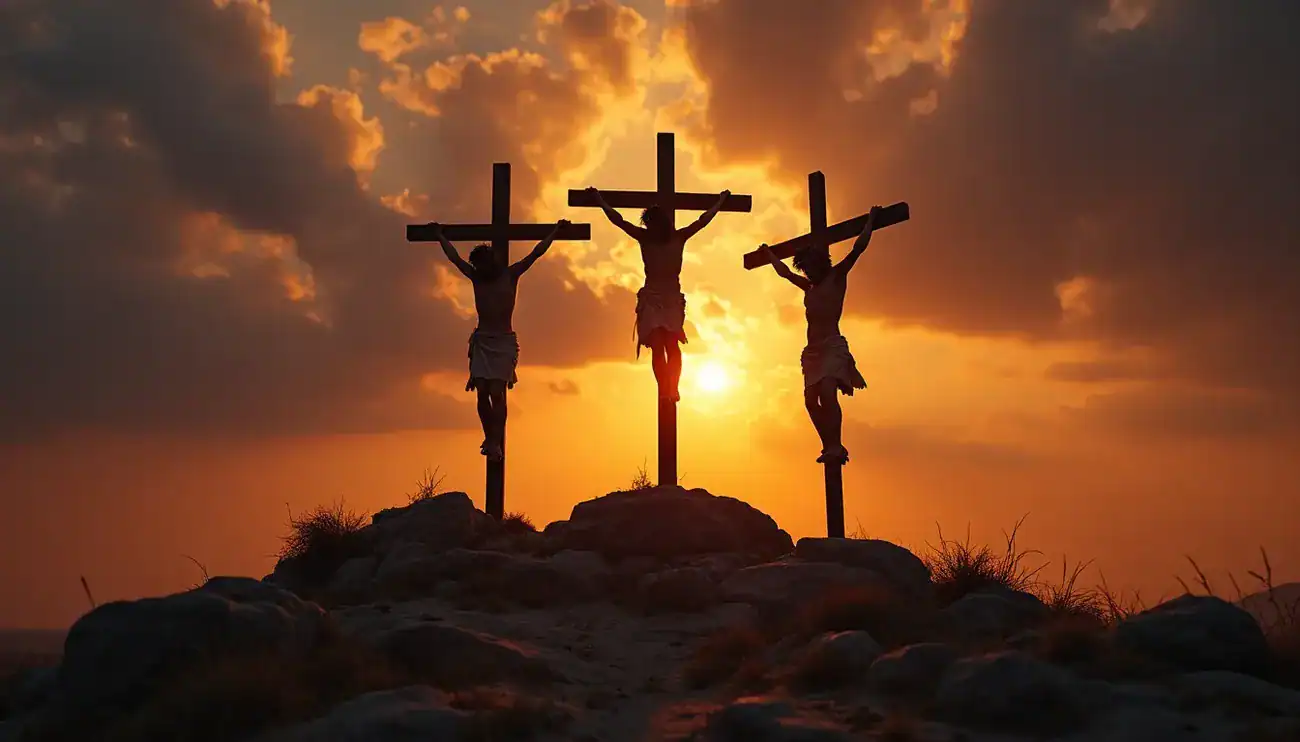
The first word spoken by Jesus from the Cross is perhaps the most stunning declaration in all of Sacred Scripture. Amid the agony of crucifixion — the tearing of flesh, the mocking of crowds, the abandonment of friends — the Son of God opens His lips not with a cry of pain or a word of condemnation, but with an intercession for His persecutors: ‘Father, forgive them, for they know not what they do’ (Luke 23:34). This utterance stands as the supreme model of Christian forgiveness and reveals the very heart of the Redemption.
To appreciate the full weight of this first word, it is essential to understand the context in which it was spoken. Roman crucifixion was a form of execution deliberately engineered to maximise suffering, humiliation, and prolonged dying. Historical sources confirm that those being crucified commonly cursed their executioners, their judges, and their tormentors. The silence of the accused or, still more extraordinary, a blessing directed toward those inflicting the torment would have been wholly unnatural. Yet Christ does not merely remain silent; He prays — and He prays not for Himself but for those who have condemned Him unjustly (Aquinas, 1274/1948, Summa Theologiae, III, Q. 47, A. 6).
The prayer is addressed in the most intimate of terms: ‘Father’ (Pater in the Vulgate, Πάτερ in the Greek). Christ does not merely petition God in general terms but addresses Him as a Son addresses a Father — invoking the eternal Trinitarian relationship even in the extremity of human suffering. This opening word is therefore simultaneously a prayer of intercession and a revelation of Christ’s inner life: the Passion does not sunder His union with the Father but is the supreme expression of that union.
The theological richness of this single sentence has occupied the minds of the Church Fathers, Scholastic theologians, and the great biblical commentators for two millennia. In this article, we draw upon the patristic tradition and the magisterial synthesis of the Flemish Jesuit exegete Cornelius a Lapide (1567–1637), whose Great Commentary on the Gospels remains one of the most comprehensive Catholic commentaries ever produced.
How Does Cornelius a Lapide Illuminate the Prayer for Forgiveness?
Cornelius a Lapide, in his commentary on Luke 23:34, observes that Christ’s prayer was directed first and foremost toward those who were most immediately responsible for His crucifixion: the Roman soldiers who drove the nails, the Jewish leaders who clamoured for His death, and the crowds who chose Barabbas over the Son of God. A Lapide notes that the phrase ‘they know not what they do’ does not constitute a complete exculpation but rather points to a vincible ignorance — the soldiers acted in the obedience of their office without full understanding of whom they were killing, while the Pharisees acted from malice tinged with theological blindness.
A Lapide’s use of the distinction between vincible and invincible ignorance here is theologically precise. Vincible ignorance — that which could have been overcome through due diligence — reduces culpability but does not eliminate it. This distinction, developed rigorously in Scholastic moral theology, allowed the Fathers to hold together two seemingly contradictory insights: that those who crucified Christ were genuinely guilty of a grave sin, and that their guilt was mitigated by a genuine, if culpable, failure to perceive the full nature of their act.
Christ prays for His enemies not once, not after the Passion is ended, but in the very midst of torment, teaching us that there is no moment so extreme that charity and intercession should cease. He sets before us the highest example of love for enemies, fulfilling the very precept He had taught on the Mount.
(a Lapide, 1876, Vol. IV, p. 342, Commentary on Luke 23:34)
A Lapide further connects this prayer with the prophecy of Isaiah 53:12 — ‘He bore the sin of many and made intercession for the transgressors’ — arguing that this first word from the Cross is the fulfilment of the suffering Servant’s role as priestly intercessor. In His passion, Christ is simultaneously Victim and Priest, and this prayer is the first act of His High Priestly office exercised upon the altar of the Cross. The connection to Isaiah 53 is not merely a proof-text; it establishes the entire framework of Penal Substitutionary satisfaction within which Catholic theology understands the Atonement. Christ, standing in the place of the condemned, intercedes for those He represents — and in doing so, reveals that the entire logic of the Redemption is one of substitutionary love rather than retributive justice.
What Do the Church Fathers Teach About Christ’s Prayer for His Persecutors?
What Does the Textual History of Luke 23:34 Tell Us About the Authenticity of This Word?
It should be noted that Luke 23:34a (‘Father, forgive them…’) is absent from some ancient manuscripts, a fact which has generated significant discussion among textual critics. However, the majority of Patristic witnesses cite the verse as authentic, and its omission in some manuscripts is best explained by scribal discomfort with the idea of forgiveness being sought for those responsible for the Crucifixion — particularly as Jewish-Christian tensions intensified in the late first and second centuries. The Church’s tradition overwhelmingly affirms its authenticity, and modern critical scholarship has increasingly returned to regarding the verse as original to Luke. The internal coherence of the verse with Lukan theology — especially Luke’s consistent portrayal of Jesus as the merciful Saviour who seeks out the lost — further supports its authenticity.
How Does St. Stephen’s Martyrdom Reflect Christ’s First Word?
The immediate echo of Christ’s first word is found in the martyrdom of St. Stephen, who prayed ‘Lord, do not hold this sin against them’ as he was stoned (Acts 7:60). St. Augustine draws out this parallelism explicitly, noting that Stephen imitated his Lord even in his dying prayer. This connection forged a tradition in the early Church of understanding Christ’s first word as the archetypal martyr’s prayer — the prayer of one who dies loving the very hands that kill him (Augustine, 415/1953, Sermon 315). The literary structure of Acts 7 is itself shaped by Luke to mirror the Passion narrative, suggesting that Luke intended his readers to understand Christian martyrdom as a participation in Christ’s own dying posture of forgiveness.
How Does Origen Understand This Word as an Act of Eternal Priestly Mediation?
Origen, writing in the third century, identifies the first word as an expression of Christ’s role as eternal intercessor. Drawing on the Epistle to the Hebrews, Origen argues that Christ ‘always lives to make intercession’ (Heb. 7:25), and that this intercession began not after the Resurrection but on the Cross itself. The prayer ‘Father, forgive them’ is therefore not a passing sentiment but an eternal act of priestly mediation that continues before the throne of God (Origen, c. 240/1998, Commentary on John, Book 28). For Origen, this eternal dimension of the prayer also implies a universal scope: Christ intercedes not merely for those present at Calvary but for all who have sinned throughout all of human history.
How Does St. Cyril of Alexandria Connect Ignorance with Culpability?
St. Cyril of Alexandria, in his Commentary on Luke, identifies the ‘ignorance’ pleaded by Christ as a theological category that distinguishes levels of culpability: those who acted without full knowledge of the divine identity of Jesus had their guilt mitigated, though not removed. Cyril emphasises that the prayer was answered — the subsequent conversion of three thousand souls at Pentecost being the visible fruit of Christ’s intercession from the Cross (Cyril of Alexandria, c. 430/1983, Commentary on Luke, Homily 153). This Pentecostal harvest is not a coincidence but a causal consequence: Christ’s prayer for forgiveness, offered at the moment of the Crucifixion, was heard by the Father and bore fruit in the outpouring of the Holy Spirit fifty days later.
How Does St. Thomas Aquinas Distinguish Between Degrees of Guilt Among the Crucifiers?
In the Summa Theologiae, St. Thomas Aquinas addresses whether Christ’s prayer on the Cross was fully efficacious. He argues that the prayer was heard and efficacious insofar as those among the crucifiers who were capable of salvation subsequently received the grace of conversion — most notably through St. Peter’s Pentecost sermon. Thomas distinguishes, however, between those who sinned through ignorance (the soldiers and some of the crowd) and those who sinned with greater malice (certain of the Sanhedrin leaders who had direct knowledge of Jesus’s miracles). The former received the primary benefit of the prayer; the latter were not excluded from grace but required greater repentance (Aquinas, 1274/1948, Summa Theologiae, III, Q. 47, A. 6). Aquinas’s analysis remains the most precise and definitive treatment in the tradition, and A Lapide draws on it extensively.
What Does St. Bernard Reveal About the Interior Disposition of Christ’s Forgiveness?
St. Bernard, in his Sermons on the Passion, meditates on the interiority of this first word. He argues that Christ’s forgiveness is not a display of magnanimity performed for an audience, but the authentic overflow of a Heart that is ‘meek and humble’ (Matt. 11:29). Bernard writes that the soul who meditates on this first word is drawn into the school of divine charity, learning that forgiveness is not the suppression of pain but its transcendence in love (Bernard of Clairvaux, c. 1140/1987, Sermons on the Passion, Sermon IV). Bernard’s insight is psychologically profound: the first word is not an act of stoic detachment but of passionate charity — Christ feels every nail, every insult, every wound, and yet His response to that felt anguish is intercession rather than condemnation.
What Is the Theological Synthesis Offered by the First Word?
The first word from the Cross establishes the theological keynote of the entire Passion: the Redemption is an act of love, not of coercion. Christ does not die as a reluctant victim but as a willing High Priest who intercedes in the very moment of sacrifice. A Lapide, following Aquinas and the entire patristic tradition, sees in this word the fulfilment of the entire moral teaching of the Sermon on the Mount. Jesus had commanded, ‘Love your enemies and pray for those who persecute you’ (Matt. 5:44); here He enacts that command with absolute perfection.
The ecclesiological implications of this first word are equally profound. If Christ’s prayer at Calvary was efficacious in converting thousands at Pentecost, then the Church’s continual offering of the Eucharistic sacrifice — which makes present the one sacrifice of the Cross — carries with it the same intercessory power. The Mass is, among its many dimensions, the perpetual renewal of this first word: the Church, united to her Head, continually offers the prayer ‘Father, forgive them’ for a world that ‘knows not what it does.’ Every Christian who forgives an enemy participates in this mystery; every act of genuine forgiveness is a sharing in the priestly intercession of the dying Christ.
For the Catholic faithful, this first word is both consolation and challenge. It is consolation because it reveals a God whose first instinct, even amid the most extreme injustice ever committed, is mercy. It is challenge because it calls every disciple to the same posture: to turn even the nails of betrayal and cruelty into occasions for intercession.
References
a Lapide, C. (1876). The great commentary of Cornelius a Lapide: The holy Gospel according to Saint Luke (T. W. Mossman, Trans., Vol. IV). John Hodges. (Original work 1616)
Aquinas, T. (1274/1948). Summa theologiae (Fathers of the English Dominican Province, Trans., 5 vols.). Benziger Bros. (Original work c. 1265–1274)
Augustine of Hippo. (415/1953). Sermons on selected lessons of the New Testament (R. G. MacMullen, Trans.). In P. Schaff (Ed.), Nicene and Post-Nicene Fathers, First Series (Vol. 6). Eerdmans. (Original work c. 415)
Bernard of Clairvaux. (c. 1140/1987). Sermons on the Passion and resurrection of the Lord. In M. Tobin (Trans.), Bernard of Clairvaux: Sermons on Conversion. Cistercian Publications. (Original work c. 1140)
Cyril of Alexandria. (c. 430/1983). Commentary on the Gospel of Saint Luke (R. P. Smith, Trans.). Studion Publishers. (Original work c. 428–444)
Origen of Alexandria. (c. 240/1998). Commentary on the Gospel of John, Books 28–32 (R. E. Heine, Trans.). Fathers of the Church Series (Vol. 89). Catholic University of America Press. (Original work c. 240)